Posted on 05/30/2026 5:10:31 AM PDT by Red Badger
In A Nutshell
Researchers found bacteria with probiotic potential in three British artisan cheeses.
The hay-aged cheese had the biggest increase in bacterial diversity as it matured.
Lactose was largely gone by maturity, which may matter for lactose-sensitive readers.
The study is promising, but it does not prove these cheeses improve gut health in people.
==========================================================================
For most people, cheese is a guilty pleasure: something delicious but probably not great for you. That assumption may be worth revisiting. A recent study took a close look at three traditional British artisan cheeses and tracked how their bacterial communities and chemical profiles shifted from production to the moment they hit the dinner table. What researchers found raises real questions about what’s happening inside aging cheese and what that means for the trillions of microbes living in your gut.
Cheese has long been dismissed as a health-food nonstarter because of its fat and salt content. But scientists have been building a case for years that certain cheeses may actually reduce the risk of heart disease, strengthen bones, and even lower the odds of early death. No one has fully explained why. This new study, led by researchers at the University of Reading in the UK, takes a step toward answering that question by mapping exactly which bacteria are present in these cheeses and which chemical compounds they produce as the cheeses ripen.
Researchers studied three artisan cheeses made at Nettlebed Creamery in Henley, UK: a soft, white-rind cheese called Bix, a semisoft orange-rind cheese called Highmoor, and a firmer cheese called Witheridge that ages wrapped in hay. Each style represents a distinct cheesemaking tradition, and by the time the study was done, the differences between them were significant. The resultes are published in ACS Food Science & Technology.
How Researchers Tracked Bacterial Life Inside Artisan Cheese To track changes in the cheeses, researchers collected samples at different stages of maturation and used two main tools. One was a DNA analysis technique that reads the genetic signatures of bacteria present in a sample, or essentially a census of microbial life inside each cheese. The other was a method that identifies and measures chemical compounds by exposing a sample to a powerful magnetic field. Together, these tools gave the team a detailed picture of both who was living in the cheese and what those microbes were producing.
Highmoor and Witheridge were sampled at a young stage, at a midpoint in maturation, and again when fully mature. Bix, which matures in just over a week, had only two sample points: young and mature. A fourth sample was also included: a version of Witheridge made with unpasteurized, or “raw,” milk, which allowed for a direct comparison with the standard pasteurized version.
What the Bacteria Revealed Each cheese told a different story. Bix, the soft white-rind variety, had the shortest aging period — just nine days before packaging — and its bacterial population was dominated throughout by a species called Lactococcus lactis, recognized for its potential probiotic properties. Because Bix is also ripened using yeasts and molds that weren’t captured by the analysis method used in this study, the researchers noted that the cheese may actually have more microbial complexity than the data shows.
Highmoor, the orange-rind variety, showed a sharp jump in bacterial diversity between its young and midpoint samples, likely driven by the growth of rind bacteria during the washing process. In this technique, the cheese’s surface is repeatedly treated with a saltwater solution to encourage specific microbes responsible for its characteristic pinkish-orange color, pungent smell, and sticky texture. One bacterium found in Highmoor, Propionibacterium freudenreichii, is deliberately added to give the cheese its nutty flavor. It also produces a compound called propionate, which has been shown to have anti-inflammatory and antimicrobial properties and may play a role in regulating appetite and cholesterol production.
Witheridge, the hay-aged cheese, was the most dramatic case. Between its youngest and most mature samples, the number of observed bacterial species increased 3.8-fold. That’s the highest diversity seen across all three cheeses. Researchers believe the hay itself plays a role in this, stimulating the growth of bacterial species that wouldn’t normally thrive in a cheese environment, particularly during the months-long period when the cheese is vacuum-sealed with hay and left to ferment without oxygen. “As hay is a source of protein and fiber, we hypothesize that it stimulates the growth of bacteria that do not otherwise thrive in the cheese environment, particularly during the period where the hay was fermenting on the surface of the cheese anaerobically,” the authors write.
When the pasteurized version of Witheridge was compared to the raw milk version, the raw version showed a large number of bacterial species that couldn’t be accounted for. These were likely populations that survived because pasteurization, the heat treatment that kills many microbes, was never applied.
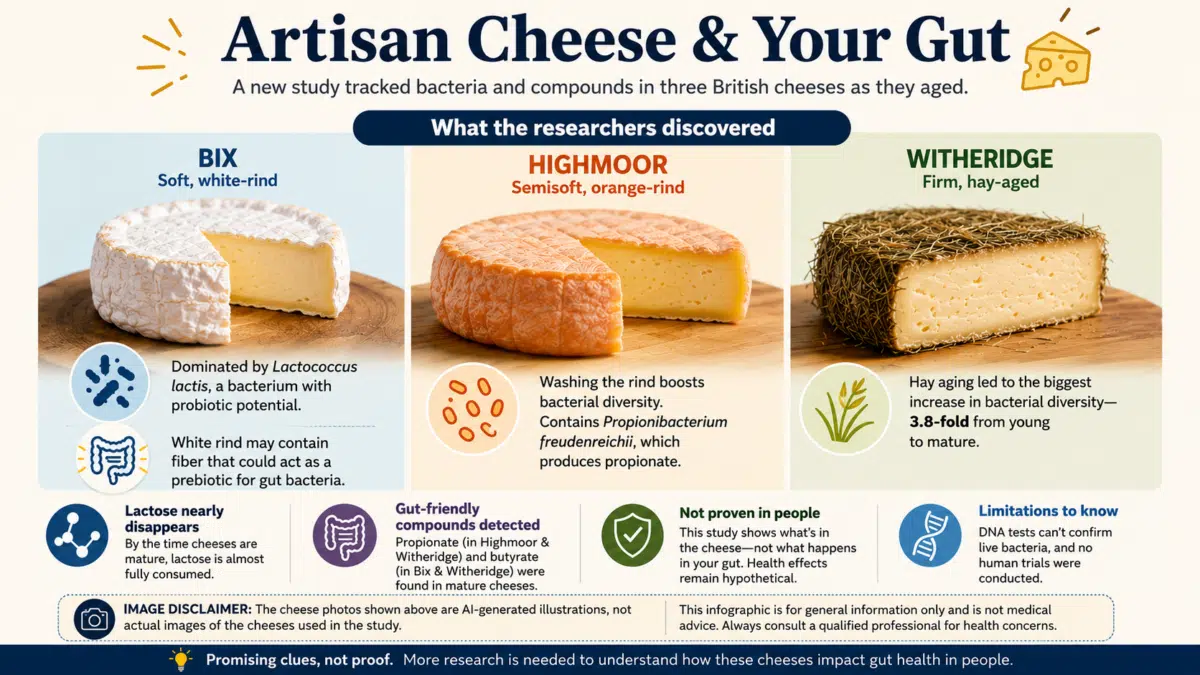
What the Chemistry Showed Inside Aging Cheese On the chemical side, one of the most consistent findings across all three cheeses was the near-complete disappearance of lactose, the natural sugar in milk, as each cheese matured. In the youngest samples of Bix and Highmoor, lactose was clearly present. By the midpoint and mature stages, it was gone entirely. Bacteria convert lactose into other compounds, including lactic acid, as part of their normal metabolism. For people who are lactose intolerant, this could matter: mature cheeses appear to have their lactose almost fully consumed before they ever reach the shelf.
Amino acids, the building blocks of proteins, were barely detectable in young samples of all three cheeses but increased noticeably as each cheese aged. Witheridge had the highest concentrations of these amino acids among the mature cheeses, which the researchers suggest may be partly due to that cheese having the lowest moisture content, making everything more concentrated.
Small molecules produced by bacterial fermentation — increasingly linked to gut health — were also detected in the mature cheeses. Propionate was found in both mature Highmoor and mature Witheridge. Butyrate, a compound associated with maintaining the lining of the gut, was found in mature Bix and Witheridge; the paper notes it may originate from clostridia, a common contaminant in cheese whose spores can survive pasteurization, so its source in these cheeses is uncertain. These are the same compounds that gut bacteria produce when they ferment dietary fiber, and their presence raises the possibility that these cheeses could contribute similar compounds to the gut; though how they behave after consumption still needs testing in people.
One unexpected finding involved the white rind on Bix. A mold used to create that rind produces a type of dietary fiber that research suggests can influence the immune system and alter bacterial communities in the gut, potentially acting as a prebiotic, a substance that feeds and supports beneficial gut bacteria. That soft, bloomy rind, the part many people cut off and discard, may actually be one of the most nutritionally interesting components of the cheese.
Not everything in the data is good news. Witheridge contained relatively high levels of a compound called succinate. While succinate plays a role in energy metabolism and immune regulation, high concentrations of it in the gut have been linked to inflammation and the growth of harmful bacteria. The authors note, however, that this only becomes a concern in excessive amounts, and that in moderate quantities it can actually support immune defense. They also pointed out that the DNA-based method used to identify bacteria cannot distinguish between living and dead cells, which means some of the potentially beneficial bacteria found in the mature cheeses may no longer be alive by the time the cheese is eaten.
Why This Research on Artisan Cheese and Gut Health Matters Cheese is one of the world’s most familiar fermented foods, and the science around fermented foods and gut health is one of the fastest-moving areas in nutrition research. This study doesn’t prove that eating Bix, Highmoor, or Witheridge will improve anyone’s health. Researchers are careful to say their findings allow them to hypothesize about potential effects rather than confirm them. But by building a detailed map of what’s actually inside these cheeses at the moment they’re consumed, the work lays a foundation for understanding why cheese — even the rich, salty, full-fat kind — might be doing something genuinely useful inside the human body. The next step, the authors suggest, is following those bacteria and compounds further down the digestive tract to see what actually happens when people eat them.
That cheese board long treated as an indulgence may be due for a second look.
Disclaimer: This article is for informational purposes only and is not medical or dietary advice. The findings described are based on laboratory analysis of cheese samples and have not been tested in human clinical trials. No conclusions about specific health benefits have been confirmed. Always consult a qualified healthcare professional before making changes to your diet.
just for the first time, i got some real parm ‘love bites’ and they were exceptional, i could taste crystal flavours in the cheese.
There are stores that have nothing but a big lineup of cheese. For those of us laymen what’s better than sharp?
And some stores are completely uncontaminated by cheese. Those are finest in the district.
Whole bunches of prejudices here including the one about animal fat being really bad for you. Because cheese has been the way of preserving the milk gathered from herds of domesticated animals since the dawn of human existence seems like evolution would have selected for the survival of those who can best consume animal fats. And there is a lot of evidence that the whole salt is bad thing was very overblown based upon feeding rats quantities of salt that would kill an elephant. Turns out the reason we crave salt when we don’t get enough is its importance in electrolyte balance. But we were taught that The Science knows better than what you can observe about the world with your own eyes. I saw a wave lapping against a Plymouth rock adjacent in a powerful storm, so maybe we are all doomed as The Science says we are.
Seriously Sharp. ;-p
Even though I'm joking around, we really do love Cabot's Seriously Sharp.
Plus, ya get to eat cheese. 🧀
🙂😊😁😀😃😆😅😂🤣
Coincidentally, Wensleydale (usually with fruit bits) is widely available even here in The Boonies.
Give me a shot of kimchee.
But my new love is GOUDA..
makes great toasted cheese...I add a slice of tomato and chopped scallions. (I cook them a tad first or not)...
If you ever make macaroni and cheese, use a bit of Gouda, gruyere, and sharp cheddar for the cheese sauce. You will fall in love with the combo. ;)
Wow! Turns out I’m gonna live forever!
A really good domestic cheese in the U.S. is Brick cheese. I prefer the younger version by Widmer’s.
The younger version is really good when used in a blend for pizza since it melts so well. It starts to sharpen as it ages.
Brie!
Oh, golly jeeshe, “diversity” in gut bacteria. How asinine can yah get?
Your gut needs specific buggies to work right, not a rainbow. ANy buggies not in that beneficial category are killing the good’uns.
But, like all wokie BSHitte, diversity in anything makes us stronger. right?
Good to know, thank you!
"Guilty"??? Only "guilty" for neurotic twats. The rest of us just eat.
Have you ever tried 17 year aged Wisconsin cheddar? OMG!
Murray’s Aged Irish cheddar has the crystals. It’s a little more expensive than their regular cheddar. It’s not super sharp, but it’s delicious.
Every time I see an article like this, I remember the Clintons in the 1990’s, particularly Hillary, telling the nation to avoid foods like this, as if it were poison.
Disclaimer: Opinions posted on Free Republic are those of the individual posters and do not necessarily represent the opinion of Free Republic or its management. All materials posted herein are protected by copyright law and the exemption for fair use of copyrighted works.