
Posted on 05/05/2026 8:05:11 AM PDT by Red Badger
(Photo credit: Exclusive Image for Unsplash+)
Research Shows That Avoiding Eggs Entirely Linked To 22% Higher Risk Of Memory-Stealing Disease
In A Nutshell
People who ate eggs regularly had lower Alzheimer’s diagnosis rates over 15 years.
The lowest risk appeared in those eating eggs five or more times per week.
Eggs provide nutrients linked to brain health, including choline and vitamin B12.
The study shows a connection, not proof that eggs prevent Alzheimer’s disease.
Eggs have spent decades bouncing between dietary hero and villain, praised for their protein one year and vilified for their cholesterol the next. A new study may tip the scales again. Researchers who tracked nearly 40,000 older adults for more than 15 years found that people who ate eggs regularly were far less likely to be diagnosed with Alzheimer’s disease than those who never or rarely touched them. The most frequent egg eaters, those having five or more servings a week, showed a 27% lower risk.
Alzheimer’s disease casts a long shadow over American life. It is the sixth leading cause of death in the United States, and the national costs of managing the disease are projected to exceed $600 billion annually by 2050. During the same period, the share of Americans aged 65 and older is expected to roughly double, from about 10% to 20%. With no cure available and current drug treatments offering limited help, researchers have turned increasing attention to prevention, and specifically to what people eat.
The study, published in The Journal of Nutrition, drew on data from the Adventist Health Study-2, a long-running research project that enrolled more than 96,000 members of the Seventh-day Adventist church across all 50 states between 2002 and 2007. That population is especially useful for studying diet because Adventists have a wide range of eating habits, from strict vegans who never touch an egg to omnivores who eat them daily. By linking participants’ dietary records with Medicare claims data, researchers could track who eventually received a clinical Alzheimer’s diagnosis through the medical system rather than relying on self-reported memory problems.

Sunny side up eggs - The debate over whether eggs are healthy or unhealthy continues, with the latest research offering good news when it comes to brain health. (Photo by Ismael Trevino on Unsplash)
How the Egg and Alzheimer’s Study Worked
Participants filled out a detailed food questionnaire at enrollment covering more than 200 food items, including how often they ate visible eggs: boiled, scrambled, fried, in omelets, and so on. Researchers sorted participants into five groups based on egg frequency: never or rarely, one to three times per month, once per week, two to four times per week, and five or more times per week. A separate calculation also estimated total daily egg intake in grams, capturing eggs hidden in baked goods, mixed dishes, and recipes.
After applying strict eligibility requirements, including being at least 65, enrolled in traditional Medicare, and free of an Alzheimer’s diagnosis at the start, the final sample included 39,498 people. Their average age at enrollment was 64, about 64% were female, roughly 74% were non-Hispanic White, and 19% were Black. The average follow-up period was 15.3 years, covering more than 603,000 person-years of observation. During that time, 2,858 participants received a clinical Alzheimer’s diagnosis through Medicare records.
Researchers built statistical models that progressively accounted for a long list of factors that could muddy the results: age, sex, race, education, marital status, body weight, physical activity, sleep, smoking history, alcohol use, intake of other major food groups, total calorie intake, and pre-existing health conditions including heart disease, high blood pressure, high cholesterol, respiratory conditions, anemia, kidney disease, thyroid problems, and cancers.
Eggs and Alzheimer’s Risk: What They Found Even after adjusting for all of those variables, the pattern was clear. Compared to people who never or rarely ate eggs, those who consumed them just one to three times per month had a 17% lower risk of Alzheimer’s. Eating eggs once a week was associated with a 17% reduction as well. Two to four times per week corresponded to a 20% lower risk, and five or more times per week was linked to a 27% lower risk. Statistical tests confirmed the trend was real.
A separate analysis modeled egg intake as a continuous daily measure rather than sorting people into groups. Using roughly one large egg per week as the reference point, the model found that people who ate zero eggs had a 22% higher risk of Alzheimer’s disease. Because this was an observational study and not a controlled experiment, that finding cannot prove cause and effect, but it does flip the usual framing: rather than eggs simply helping, skipping them altogether may carry its own penalty.
The results also held up under several checks designed to test their reliability. When the researchers removed all vegans from the analysis — since vegans made up a large chunk of the zero-egg group and tend to differ from others in many lifestyle ways — the findings barely budged. The team also ran substitution analyses, asking what would happen statistically if participants swapped their eggs for equivalent portions of nuts, seeds, or beans. The egg-eating groups still showed lower Alzheimer’s risk, a result that points to something specific about eggs rather than simply eating more protein-rich foods in general.
Why Eggs Might Matter for the Brain
The researchers pointed to several nutrients concentrated in eggs that are tied to brain function. Eggs are one of the richest dietary sources of choline, a building block for a chemical messenger in the brain that is critical for memory. They also contain pigments that accumulate in brain tissue and are linked to better thinking skills and lower levels of cellular damage.
Egg yolks are particularly rich in certain fats needed for brain cells to communicate with one another. Eggs supply a type of omega-3 fat called DHA that helps maintain the structure and flexibility of brain cell walls, and they provide about 25% of the recommended daily amount of vitamin B12, a nutrient connected to several biological processes involved in Alzheimer’s development. A shortage of B12 can raise blood levels of a substance that is a recognized risk factor for the disease.
Notably, deficiencies in both choline and DHA have been documented in the brains of people with Alzheimer’s, adding biological weight to the statistical association the researchers observed. Earlier concerns about egg cholesterol have also been largely eased by recent reviews showing that moderate egg consumption does not harm heart or metabolic health in most people when eaten as part of a balanced diet.
The vegan angle adds another layer. Previous work by these same researchers found that vegetarians had higher death rates specifically from dementia, raising questions about whether certain plant-based diets, if not carefully planned, may leave gaps in brain-protective nutrients like choline, DHA, and B12 — though more research is needed to understand how overall dietary patterns interact with Alzheimer’s risk.
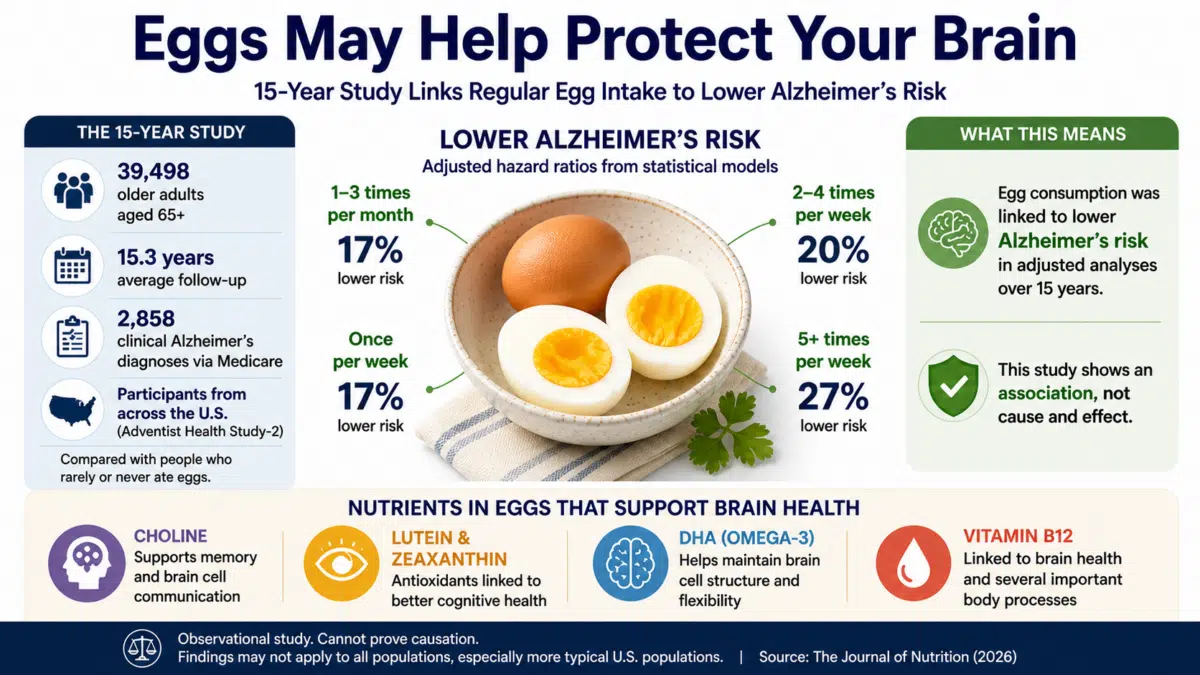
Eggs and Alzheimer's Disease Infographic - (Image generated by StudyFinds)
What This Means and What It Doesn’t
This was an observational study, meaning it tracked people’s habits and health outcomes over time but did not randomly assign anyone to eat more or fewer eggs. That design can reveal associations but cannot prove that eggs caused the lower Alzheimer’s risk. Unmeasured factors the researchers could not account for might partially explain the connection.
Dietary intake was measured only once, at enrollment, meaning changes in eating habits over the years were not captured. About 74% of participants showed consistent egg consumption patterns when a follow-up comparison was done roughly a decade later, which is reassuring but does not account for shifts among the remaining quarter.
One detail worth noting: the study was partially funded by the American Egg Board, an industry group. The authors stated that the funding source had no role in the study design, execution, data analysis, interpretation, manuscript preparation, or publication, and they reported no conflicts of interest. Industry funding does not automatically invalidate results, but it is a factor readers should weigh, particularly when findings align with the funder’s commercial interests.
A large sample, 15 years of follow-up, clinically confirmed Alzheimer’s diagnoses through Medicare records, and consistent results across multiple statistical approaches make this one of the larger and longer-running investigations into the egg-and-Alzheimer’s question to date. The study population offers both a strength and a limitation: Adventists tend to be healthier than the general public, with about 80% having never smoked and very few reporting alcohol use. That reduces interference from those well-known risk factors but also raises the question of whether the findings would look the same in a more typical American population.
For a country facing a projected wave of Alzheimer’s cases and the enormous costs that come with them, the possibility that eating eggs a few times a week might offer real protection is a finding that warrants serious attention — even as scientists continue working to understand exactly why.
Paper Notes
Disclaimer
This article is for informational purposes only and is not a substitute for professional medical or dietary advice. The findings described are based on observational research and do not establish that egg consumption causes a reduction in Alzheimer’s disease risk. Always consult a qualified healthcare professional before making changes to your diet or health regimen.
Limitations
Dietary intake was measured only once, at enrollment, meaning changes in eating habits over the years were not captured, though the researchers noted that about 74% of participants showed consistent egg consumption patterns when a follow-up comparison was done roughly a decade later. As with all studies relying on Medicare claims, Alzheimer’s diagnoses may have been undercounted, particularly among people with milder symptoms. The study could not determine whether participants aged 65 and older were actively using Medicare as their primary insurance, though an estimated 96% of Americans in that age group are enrolled. The highest egg intake category had relatively few participants, limiting the ability to draw conclusions about very high consumption. Because death can prevent an Alzheimer’s diagnosis from ever being recorded, the statistical estimates reflect the rate of diagnosis among people who were still alive and had not yet been diagnosed, rather than absolute risk in the broader population. Unmeasured factors cannot be entirely ruled out in an observational study.
Funding and Disclosures
Initial support for the Adventist Health Study-2 cohort was provided by the National Cancer Institute (grant 1U01CA152939). The analyses in this study were supported by an investigator-initiated grant from the American Egg Board. The authors stated that the funding sources had no role in the study design, execution, data analysis, interpretation, manuscript preparation, or publication. The authors reported no conflicts of interest.
Publication Details
Authors:
Jisoo Oh, Keiji Oda, Gabriela Chiriac, Gary E. Fraser, Rawiwan Sirirat, and Joan Sabaté, affiliated with the Center for Nutrition, Healthy Lifestyles, and Disease Prevention at the School of Public Health, Loma Linda University, and related departments at Loma Linda University in Loma Linda, California. Journal: The Journal of Nutrition.
Title: “Egg Intake and the Incidence of Alzheimer’s Disease in the Adventist Health Study-2 Cohort Linked with Medicare Data.” DOI: 10.1016/j.tjnut.2026.101541. The study protocol was approved by the Institutional Review Board at Loma Linda University, and written informed consent was obtained from all participants.
Ping!.................

That is exactly and all I thought of.
My main diet right now is plain eggs for breakfast, low sodium turkey sandwiches on egglife wraps and watermelon chunks for dessert. The eggs are low calorie and the watermelon reduces water weight. Down 17lbs in a couple months.
I prefer invisible eggs, though it's not easy to tell when they're cooked just right.
“Eating Eggs Regularly May Significantly Slash Alzheimer’s Risk”. Soft-boiled for three minutes please.
New!
My maternal Grampa ate eggs almost every day. He stayed amazingly sharp and lived to 99 (just a couple of weeks short of 100).
Connection? Quite possibly.
Other foods with a potential connection to dementia prevention are green leafy veggies (polyphenols), fish oil (omega 3s), olive oil, and pizza.
Yes, just kidding about the pizza)
I've been snacking on hard boileds for a good while now (Eggland's Best, store brand), and a couple years ago there was a topic I didn't find just now, but remember topic about a Canadian doctor who tried eating eggs daily (100 a month I think) and he improved his HDL/LDL. Since I was about to get my first Medicare physical and had 30 days to go, I did it, by far the best blood work in years.
My mother had eggs for breakfast most mornings. She never did go the Alzheimers route. On the other hand, she did fall into dementia.
She had bacon and eggs every morning, anyway, until the morning she did not wake up.
The only reason eggs are not touted as a miracle food universally is the medical establishment is hung up on cholesterol and statins.
I took statins for a bit and had terrible brain fog.
I now ignore cholesterol, eat plenty of eggs, and make sure I get a lot of anti-inflammatory foods and anti-oxidants.
You don’t get high cholesterol from eating cholesterol.
Just like you don’t get fat from eating fat.

I’m good on this one. I average 2-3 a day. Sometimes less when my supply is low. They make a good light lunch or a filling breakfast when combined with 1/2 a bagel. And I definitely fall into the over 65 age requirement, by 10 years.
Eating eggs doesn’t create cholesterol.
Eating bread does............
I was thinking of a can of pork brains fried with eggs.
Yummm. I guess.
YMMV but it was finally determined after years of checking and different eating habits and pills that I, due to genetics, internally create my own bad cholesterol. Oatmeal and low dose statins seem to effectively take care of that problem. Eggs do not contribute negatively. In fact, my good cholesterol appears to increase from them.
True. And “high cholesterol” is not the problem.
Nor is LDL cholesterol the problem. It’s the VLDL cholesterol (oxidized LDL bits) that is either the warning sign or cause of issues.
exercise, good fats, soluble fiber, and limit processed foods and sugar/alcohol, plus veggies and antioxidants
Had three eggs cooked in Irish butter and some veggies, a banana, and whole milk for breakfast, for example.
Aha!
Disclaimer: Opinions posted on Free Republic are those of the individual posters and do not necessarily represent the opinion of Free Republic or its management. All materials posted herein are protected by copyright law and the exemption for fair use of copyrighted works.