Skip to comments.
Iranian Regime tv Channel One hacked while it was airing Khamenie speech
various
| 10-8-22
Posted on 10/08/2022 1:05:38 PM PDT by nuconvert
Iranian Regime national tv Channel One hacked about an hour ago. During a broadcast of Khamenie speech, a red crosshair appeared over his face and chanting of Women. Life. Freedom. There was writing to the side saying "Rise up. Join us". Also 4 photos at the bottom of the screen of young people killed and additional writing: "The blood of our youth is dropping from your paws".
Also, there was a huge banner in the middle of Tehran highway today that read: We are no longer afraid of you. We will fight.
Also, attempted attack on IRI ambassador in Denmark. Her bodyguard was stabbed. Diplomatic Security intervened before the attacker could stab the ambassador.
TOPICS:
KEYWORDS: basij; deathtothemullahs; denmark; ebrahimrigi; erdogan; iran; iranprotests; iraq; irgc; iri; israel; khameini; khamenei; kurdistan; lebanon; mahsaamini; mullahloversonfr; mullahsmustbekilled; najisharifizindashti; protests; qudsforce; raisi; receptayyiperdogan; shahrammaroufmola; syria; turkey; yemen; zahedi
Navigation: use the links below to view more comments.
first previous 1-20 ... 2,241-2,260, 2,261-2,280, 2,281-2,300 ... 2,401-2,405 next last
Sal Mercogliano- What's Going on With Shipping? 13JUL2026:Strait of Hormuz Week 19 Update: Why “All is Well” is Far from the Truth
In this video, we dive deep into the current state of the Strait of Hormuz as we enter Week 19 of the ongoing maritime crisis. While some reports suggest a return to normalcy, a closer look at the data reveals a much more volatile situation for global shipping and energy security.
⚓The “All is Well” Myth: Analyzing why official statements regarding the safety of the strait may be premature or misleading.
⚓Shipping Traffic Trends: A breakdown of current vessel movements and how “dark fleet” activity continues to bypass traditional monitoring.
⚓Escalating Risks: Why the threat of sea mines and targeted attacks remains a primary concern for seafarers in the region.
⚓Global Economic Impact: How the sustained blockade is influencing fuel costs and port logistics heading into the next quarter.
⚓The Strategic Standoff: An update on the naval presence in the Persian Gulf and the shifting dynamics between regional powers.
0:00 – Intro: Week 19 of the Strait of Hormuz Crisis
0:30 – Latest News: Attack on GFS Galaxy & US Strikes
1:42 – Maritime Security Advisories & Threat Levels
2:56 – Iran's Closure Proclamation vs. Freedom of Navigation
4:26 – Analysis of Transit Data & Traffic Patterns
4:58 – Visual Replay: Monitoring Shipping Routes (July 6-12)
6:55 – Weekly Recap: IMO Council Meeting & Global Tensions
7:49 – Panama Canal Restrictions & El Niño Impact
8:36 – The Economics of Shipping Disruptions
9:34 – LNG Carrier Attacks & Safety Concerns
10:44 – Japan's Energy Crisis & Deals with Iran
11:27 – US Military Escalation & Retaliatory Strikes
12:55 – Mining Threats & Countermeasures in the Strait
13:36 – The End of the US-Iran Ceasefire & New Sanctions
15:37 – Global Impact: Russian Diesel Bans & Red Sea Updates
17:14 – War Risk Insurance & Rising Operational Costs
18:47 – UAE Oil Surge & Potential Conflict Triggers
19:12 – US Domestic Issues: Jones Act Waivers & Protests
20:46 – International Law & Right of Transit Passage
21:40 – Final Casualty Reports & Persistent Drone Threats
23:02 – Conclusion: What's Next for Global Shipping?
https://www.youtube.com/watch?v=goR2RoendmA
2,261
posted on
07/13/2026 9:03:34 AM PDT
by
AdmSmith
(GCTGATATGTCTATGATTACTCAT)
2,262
posted on
07/13/2026 12:11:54 PM PDT
by
AdmSmith
(GCTGATATGTCTATGATTACTCAT)
Iran Update Special Report, July 13, 2026
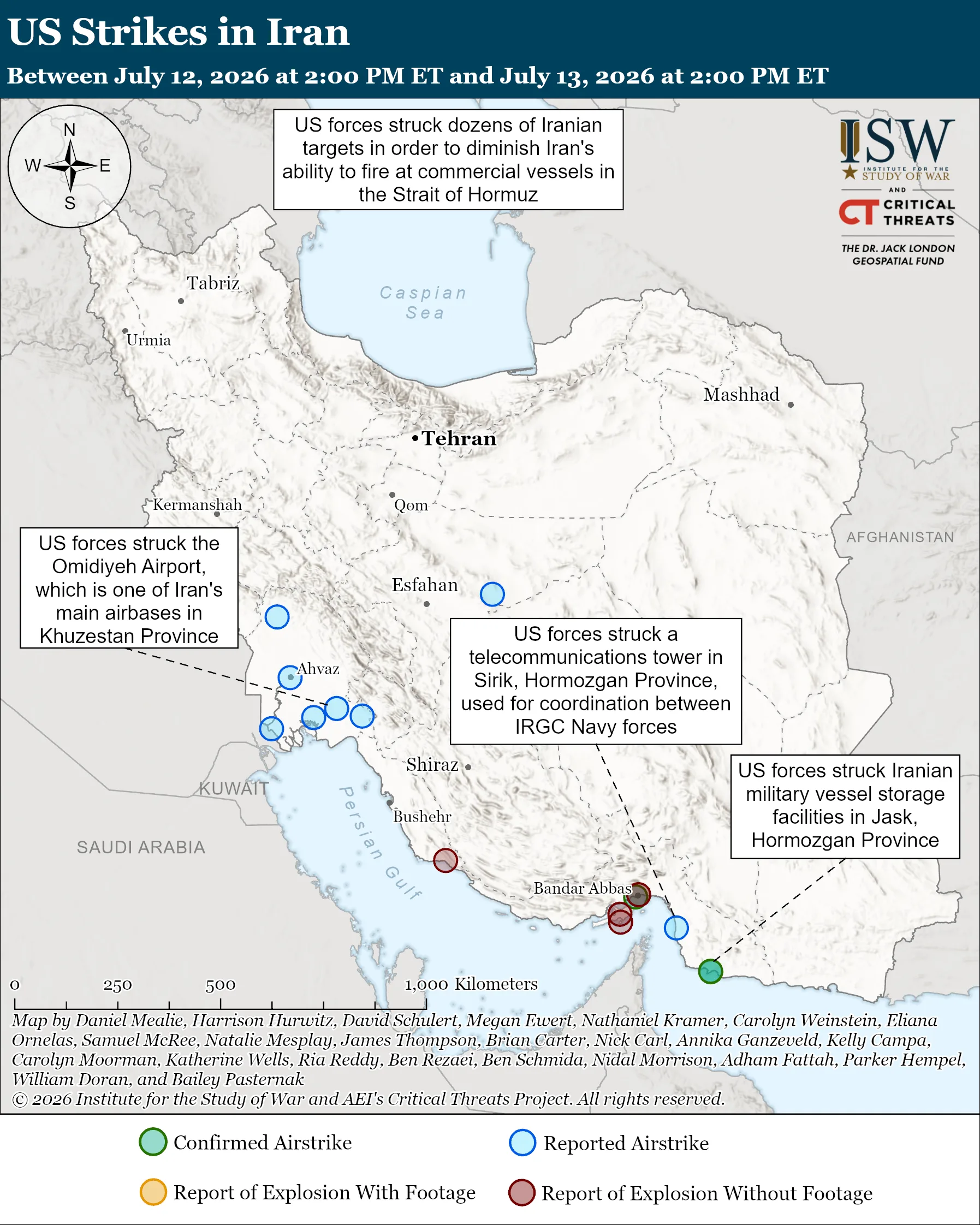
The US-Iran ceasefire has effectively ended with relatively more intense and consistent exchanges of fire in the Persian Gulf. The Islamic Revolutionary Guards Corps (IRGC) Navy announced on July 11 that it closed the strait, struck a Cyprus-flagged vessel, and then struck a second unspecified vessel on July 12.[1] The United States struck dozens of Iranian military targets on July 12 to degrade Iran's ability to threaten shipping.[2] The United States has conducted over 300 strikes in Iran since July 10.[3] Iran retaliated on July 12 with strikes against US military bases in Jordan, Bahrain, and Kuwait, likely in order to deter these countries from allowing US forces to use their territories to launch strikes against Iran.[4] Iran also claimed that it struck a US radar site in Oman on July 13, but neither the United States nor Oman commented on the strike.[5] The United States will resume its blockade of Iranian ports beginning on July 14 at 4:00 PM ET.[6]
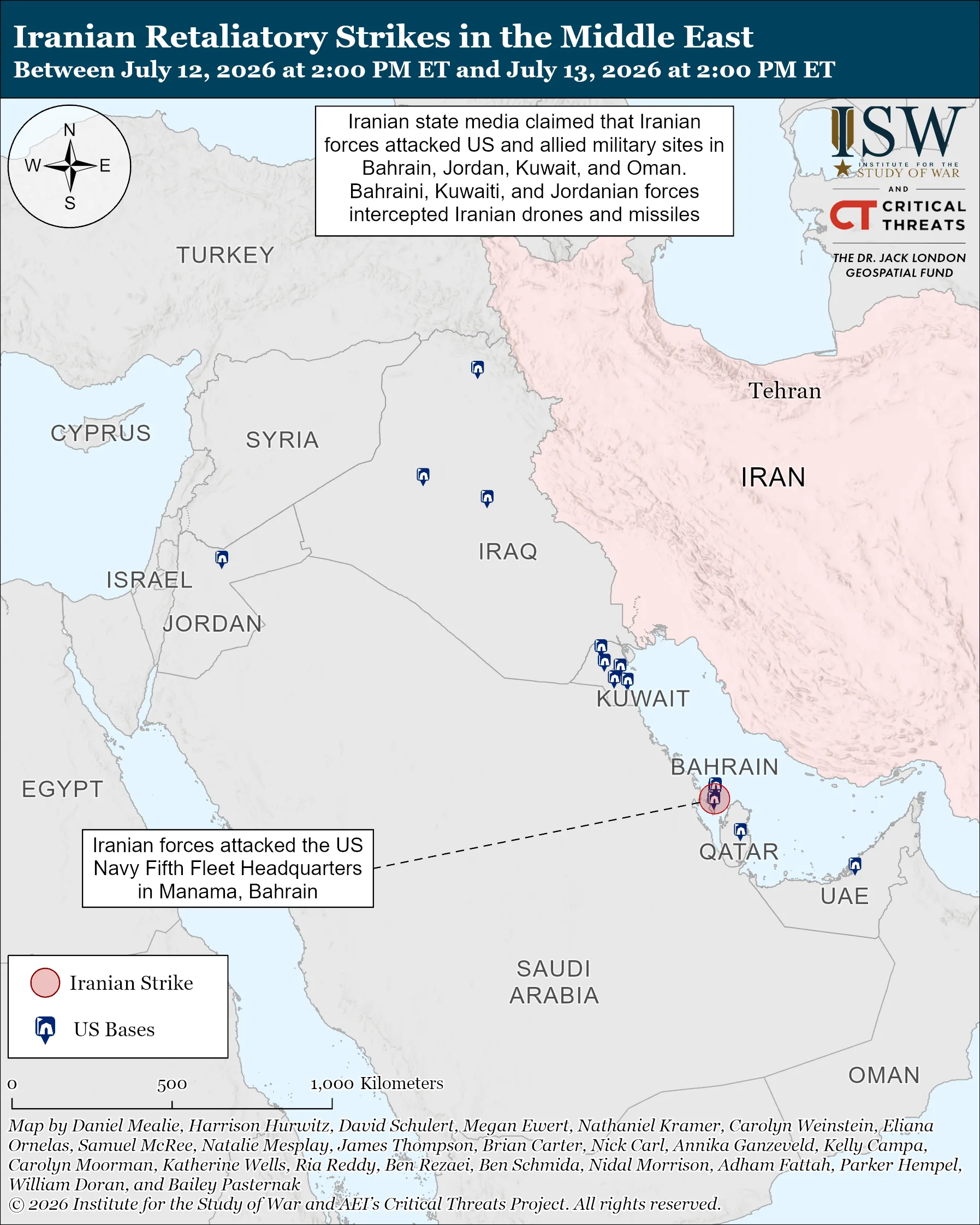
The present fighting is relatively less widespread in geographic scope and smaller in terms of total strikes compared to March and April 2026, but the increase in strikes and reimposition of the blockade nonetheless mark the end of the ceasefire. Most US strikes have targeted military sites in southern Iran, though the United States has conducted some strikes on infrastructure deeper into Iran.[7] Three hundred US strikes over three days is also roughly a third as many strikes as the United States alone conducted during the peak of the US-Israel campaign in March and April 2026.[8] Iran has continued to expand the geographic scope of its attacks, however, by targeting most of the Gulf states.[9] It has so far declined to target Israel or commit to large-scale targeting of civilian infrastructure in the Gulf states, as Iran chose to do in March and April 2026.
The US naval blockade had a limited but notable effect on Iranian willingness to continue fighting in Spring 2026 and was critical to securing the memorandum of understanding (MoU). The New York Times reported on July 4 that Iranian President Masoud Pezeshkian, reportedly fearful of the US blockade and the deteriorating economic situation in Iran, implored Supreme Leader Mojtaba Khamenei to accept the June 18 MoU despite the supreme leader's concerns and desire to retain control over the Strait of Hormuz.[10] Mojtaba reportedly agreed to the MoU only on the conditions that Iran's negotiating team would not cross his “red lines” and that Pezeshkian would accept responsibility if the MoU were to fail.[11] Pezeshkian‘s effort to pressure Mojtaba indicates that the US naval blockade played a major role in pressuring the Iranians to accept the MoU.
Pezeshkian’s efforts to secure the MoU do not imply that other elements of the Iranian regime were seriously affected by the blockade, however. Other elements from the IRGC — the leaders of which are close with Mojtaba — were far less willing to accept the MoU. Mojtaba’s concerns about the control of the Strait of Hormuz under the MoU are likely emblematic of the position of the anti-negotiations camp. It is notable in the context of Mojtaba’s concerns about controlling the strait that as soon as the United States, Oman, and others made efforts to undermine Iranian control through the southern transit route in the strait, the IRGC began attacking shipping again. It remains far from clear when and if economic damage caused by the blockade will affect the willingness of the IRGC to continue the fight.
The recent MoU breakdown and the reimposition of the US naval blockade can cause negative political effects within Iran that are not immediately related to a breakdown in the regime's willingness to continue the fight. Many Iranians, including, presumably, many regime supporters, are suffering under an extremely devastating economic situation.[12] The present MoU had promised an end to the conflict on a relatively acceptable basis for the Iranian regime. The regime's decision to continue firing into the Strait of Hormuz ultimately reignited the war, and the regime will need to argue the case to its own people and among itself as to why continued conflict is necessary. This situation will likely revive the intra-regime debate over how to handle the strait, economy, and negotiations with the United States. The anti-negotiations camp will likely use the reimposition of the US blockade as evidence that negotiating with the United States was a mistake and that Iran should pursue its strategic objectives, including the preservation of its nuclear program, control of the strait, and survival of Hezbollah, even at the risk of a longer conflict with the United States and its ensuing economic costs. The effect of the new US blockade will likely manifest differently if the anti-negotiations camp can successfully argue that negotiations and the MoU were a failure.
This is a new phase in the war, and both sides have had time to internalize lessons and reconstitute after the initial round of conflict. Iran has continuously made efforts to reconstitute its ballistic missile and drone programs since the ceasefire on April 8.[13] The United States has presumably also had time to undertake reconstitution tasks and apply lessons learned. Both sides have also had significant economic and political reprieves. The Iranians were able to execute some oil exports, while the global economy reacted to the ceasefire and MoU. The price of oil dropped from $92 USD per barrel on June 1 (down from a high of $104 USD on May 18) to as low as $68 USD on July 2.[14] These military and political effects will probably change some features of the conflict relative to its previous iteration in March and April 2026.
An unspecified Lebanese official told international media on July 13 that the next round of US-brokered Israel-Lebanon negotiations will begin in Rome, Italy, on July 14.[15] The negotiations will likely focus on plans to implement the first two “pilot zones” in southern Lebanon. Lebanese media reported on July 13 that the Lebanese delegation's primary objective for the talks is to secure a timeframe to implement the pilot zones that are stipulated in the June 26 Trilateral Framework Agreement.[16] Lebanese President Joseph Aoun instructed the Lebanese negotiating delegation to demand that the Israel Defense Forces (IDF) withdraw from the pilot zones as a precondition to further technical discussions.[17] The Lebanese government previously conditioned its participation in the Rome meetings on the IDF’s withdrawal from the pilot zones, according to Saudi media on July 11.[18] Hezbollah-aligned media reported on July 11 that Israeli officials proposed to the Lebanese government that the Lebanese Armed Forces (LAF) deploy in pilot zones and begin disarming Hezbollah with Israeli and US oversight before authorizing any IDF withdrawals, which the Lebanese government rejected.[19]
US military representatives have continued to meet with LAF commanders in Lebanon to discuss plans to implement the pilot zones since July 11.[20] An unspecified US official told international media on July 11 that the LAF would begin backfilling IDF positions in the pilot zones “in a matter of days” and stated that Israel, Lebanon, and the United States are planning to establish future pilot zones.[21] Lebanese media reported on July 12 that the IDF will “attempt” to withdraw from one of the two initial pilot zones before negotiations begin in Rome to demonstrate Lebanese government progress in direct talks with Israel and combat Hezbollah's argument to Lebanese citizens that the negotiations are fruitless.[22] ISW-CTP has not observed any indicators that Israeli forces are currently withdrawing from the pilot zones, however.
The Lebanese government is attempting to balance the need to disarm Hezbollah with the significant latent threat Hezbollah poses to Lebanese stability amid unprecedented Hezbollah weakness. Hezbollah remains unprecedentedly weak despite its relative military success against Israel. The group still lacks experienced commanders and a charismatic leader, and increasing reliance upon Iranian guidance has made it appear significantly less Lebanese.[23] This weakness, however, disguises the serious latent threat that Hezbollah poses to Lebanon's stability. Unspecified sources close to Lebanese President Joseph Aoun told Lebanese media on July 13 that Aoun seeks to “contain” Hezbollah's influence in Lebanon, not forcibly disarm the group.[24] Aoun previously stated on July 10 that the Lebanese government must “cooperate with Hezbollah” in order to disarm the group.[25] Aoun’s hesitancy and caution reflect the latent threat Hezbollah poses. The risk of a clash with Hezbollah is relatively greater because the group feels threatened and its military wing is full of Iranian and other foreign cadres.[26] These cadres may be less restrained in their dealings with the Lebanese government given Lebanon is not their country.
Any disarmament plan that relies on cooperating with Hezbollah — and therefore its Islamic Revolutionary Guards Corps and Iraqi, Syrian, and other militia cadres — will almost certainly fail, because none of these actors will acquiesce to disarming Hezbollah.[27] Hezbollah leaders and Hezbollah-allied politicians have continued to assert that Hezbollah will remain armed in southern Lebanon and have threatened that attempts by the LAF to disarm the group would cause civil war.[28] Lebanese Parliament Speaker Nabih Berri and unspecified Hezbollah officials told Hezbollah-aligned media on July 13 that LAF commanders are aware that it would be “extremely difficult” to disarm Hezbollah.[29]
The Islamic Resistance in Iraq, which is a coalition of Iranian-backed Iraqi militias, released a statement on July 12 outlining its views on several topics, including the Iraqi federal government's ongoing anti-corruption campaign and US-Iraq relations.[30] The coalition noted its support for the anti-corruption campaign, which has included over 50 arrests in recent weeks as part of the government's efforts to recover public funds.[31] The Islamic Resistance in Iraq may support the campaign because anti-corruption has broad public support in Iraq, and the campaign has not affected Iranian-backed Iraqi politicians and officials. Iraqi authorities have instead mainly arrested Sunnis and political allies of former Iraqi Prime Minister Mohammad Shia al Sudani.[32] The Islamic Resistance in Iraq argued that the Iraqi federal government should prioritize an end to the US “occupation” and condemned Iraqi Prime Minister Ali al Zaydi’s visit to Washington, DC, which begins on July 13.[33] US-led international coalition forces are expected to leave Iraqi Kurdistan in September 2026.[34] Coalition forces previously withdrew from federal Iraq in January 2026.[35]
The Islamic Resistance in Iraq also argued in the July 12 statement that the Iraqi federal government should “liberate” the Iraqi economy from “American hegemony,” amid continued reports that Zaydi will focus on expanding US-Iraq economic relations during his visit to Washington.[36] The coalition's statement said that the United States imposes control over Iraqi resources and funds, almost certainly in reference to the US Treasury Department temporarily pausing shipments of Iraq's oil earnings to Iraq during the war due to Iranian-backed Iraqi militia activity.[37] The Iraqi Central Bank has managed an account at the New York Federal Reserve that has held the Iraqi federal government's oil export revenue in US dollars since 2003.[38] Zaydi wrote in a Washington Post op-ed on July 13 that he hopes US companies will invest in Iraq and that his visit to DC, during which he will meet with US President Donald Trump, will transform US-Iraq relations from “crisis management to opportunity creation.”[39] Iraqi federal government spokesperson Haider al Aboudi said on July 13 that the agenda for Zaydi’s visit includes developing economic relations in the US oil, gas, energy, technology, and infrastructure sectors.[40] Aboudi added that the United States and Iraq will sign an MoU related to the oil and gas sectors.[41] It is unclear if this MoU is related to the agreement Zaydi is reportedly expected to sign with the United States, in which the US government will support investment in Iraq in exchange for the Iraqi federal government taking steps to limit Iranian influence in Iraq, including by disarming the Iraqi militias.[42]
The Islamic Resistance in Iraq reaffirmed its commitment to armed resistance against the United States and Israel on July 10, which further exemplifies the problems the Iraqi federal government faces in attempting to comply with US demands to disarm the militias.[43] The coalition includes Kataib Hezbollah, Harakat Hezbollah al Nujaba, Kataib Sayyid al Shuhada, and Harakat Ansar Allah al Awfiya. The first three of these militias conducted the most attacks during the war and are the closest Iraqi militias groups to Iran.[44] Zaydi noted in his Washington Post op-ed that the Iraqi federal government is committed to restricting arms to the state and has made “significant progress” in disarming several unspecified armed groups.[45] The federal government has not yet clarified how it plans to disarm militias that refuse to disarm, however. Zaydi’s op-ed follows an Iraqi media report on July 9 that unidentified militias are handing “scrap” missiles and inoperable drones to the government but holding onto functional heavy weapons.[46] The Iraqi federal government also has historically lacked accurate information on the number and types of militia weapons to the covert nature of the militias, including those within the Popular Mobilization Forces (PMF).[47]
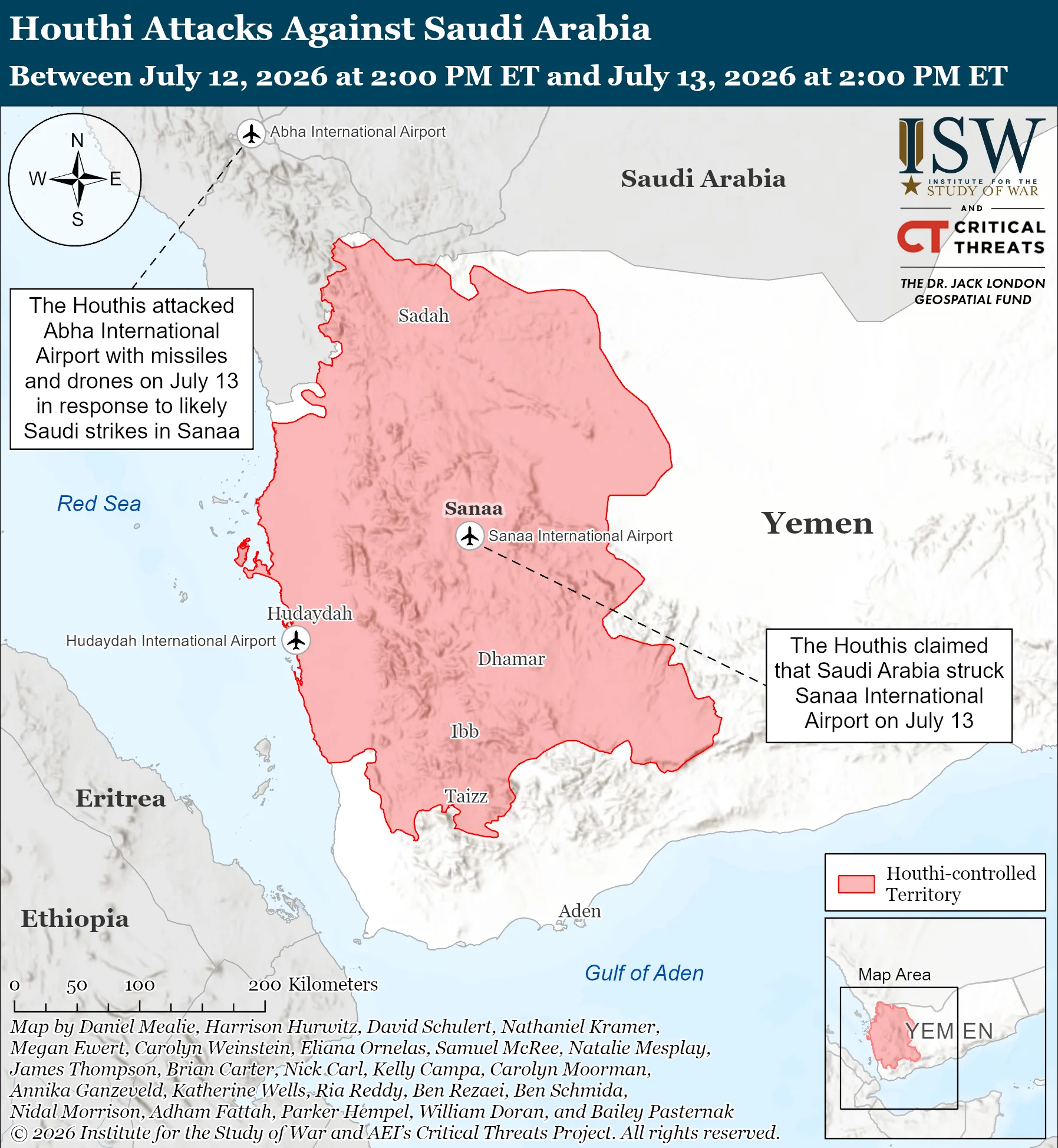
The Houthis launched an unspecified number of ballistic missiles and drones on July 13 targeting Abha International Airport, Saudi Arabia, in response to likely Saudi strikes on Houthi-controlled Sanaa International Airport, Yemen.[48] The Saudi Defense Ministry spokesperson confirmed on July 13 that it intercepted Houthi ballistic missiles targeting Saudi Arabia's southern region.[49] The Houthi Political Bureau previously claimed on July 13 that Saudi Arabia struck Sanaa International Airport to prevent an IRGC-affiliated Mahan Air passenger jet from landing at the airport.[50] The aircraft was reportedly carrying a Houthi delegation returning from former Iranian Supreme Leader Ali Khamenei’s funeral in Tehran.[51] Some missile remnants found at the airport appeared to come from a Storm Shadow cruise missile, according to a munitions researcher.[52] Saudi Arabia uses the Storm Shadow.[53] This escalation comes after Mahan Air resumed direct flights between Tehran and Sanaa on July 3.[54] Houthi military spokesperson Yahya Sarea claimed on July 3 that Saudi aircraft attempted to prevent the Mahan Air flight from landing in Sanaa, but that Houthi air defenses forced the Saudi aircraft to withdraw.[55] Sarea also warned Saudi Arabia that the Houthis would retaliate against any future Saudi “airspace violations” with strikes on Saudi airports and other “vital interests on land and sea.”[56]
https://understandingwar.org/research/middle-east/iran-update-special-report-july-13-2026/
2,263
posted on
07/13/2026 11:01:39 PM PDT
by
AdmSmith
(GCTGATATGTCTATGATTACTCAT)
🚨 Heavy IRGC losses are mounting under continued U.S. strikes, with one military source claiming that American forces have turned IRGC training facilities into “killing fields.” As fighting intensifies across the Persian Gulf and Strait of Hormuz, unofficial reports indicate that roughly 10 IRGC personnel have been killed since the latest wave of U.S. airstrikes began in mid-July. The IRGC has officially confirmed five deaths:
🔴 IRGC commander Mohammadreza Khazimi was killed in Mahshahr on July 8.
🔴 Second Brigadier General Saeed Tavakolzadeh and Basij member Mohsen Nejati were killed in Khuzestan on July 9.
🔴 Second Lieutenant Mohammad Nasser Delirvar was killed on Farur Island.
A source familiar with the matter claims the actual death toll is higher because some personnel deployed aboard IRGC fast-attack boats are not formally registered as IRGC or Basij members. Instead, they are sent on missions under the title of “grassroots forces,” allowing authorities to record them as ordinary civilians if they are killed.
The source added:
“Through the delusional and corrupt leadership of commanders, field forces eager for martyrdom have been turned into easy targets for American pilots.”

https://x.com/TheIranWatcher/status/2076889654033367073
2,264
posted on
07/13/2026 11:10:10 PM PDT
by
AdmSmith
(GCTGATATGTCTATGATTACTCAT)
Iran Update Special Report, July 14, 2026
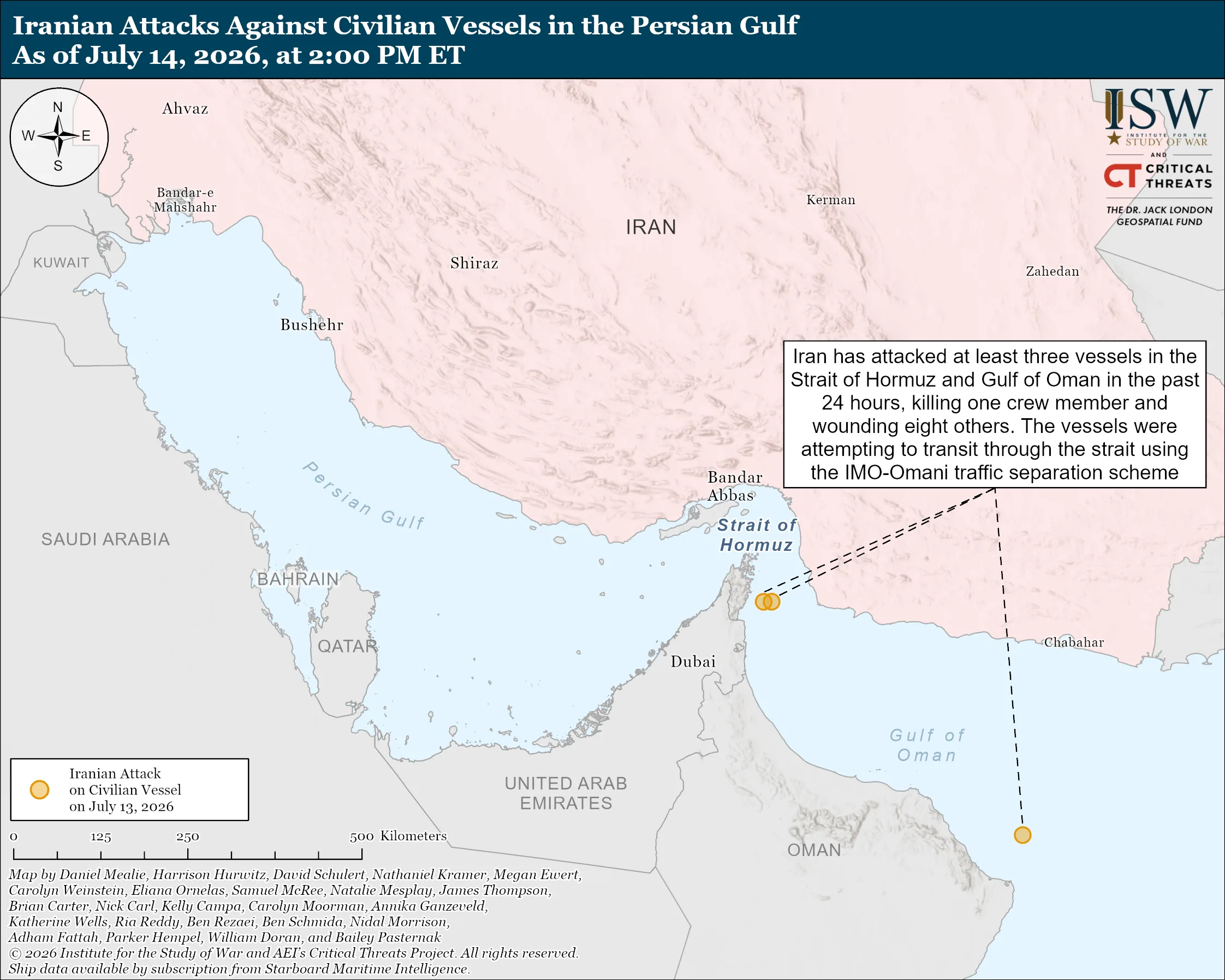
Iran has attacked at least three commercial vessels in the Strait of Hormuz in the past 24 hours, which indicates that Iran retains the ability and willingness to attack commercial shipping despite recent US strikes on Iran. Iran struck at least three vessels, including two Emirati tankers, on July 13 that were attempting to transit through the strait via the southern route along Oman's coast.[1] The Iranian attacks killed one crew member and wounded eight others.[2] Iran has repeatedly used force to try to deter vessels from using the alternative traffic separation scheme along Oman's coast because traffic through this route undermines Iranian efforts to assert full control over traffic in the strait. US Central Command (CENTCOM) announced on July 13 that it conducted another wave of strikes against Iranian military targets that Iran used to threaten shipping in the strait.[3] US officials, including US President Donald Trump, have stated that the current US campaign to degrade Iran's ability to threaten shipping could last several weeks. It is therefore premature to assess the effects of this campaign. The threshold for Iran to be able to disrupt shipping in the strait remains low, however, given that even individual drone and missile attacks can deter vessels from passing through the strait. Maritime traffic through the strait is dependent on the risk calculations of ship captains and shipping companies, which are generally risk averse.
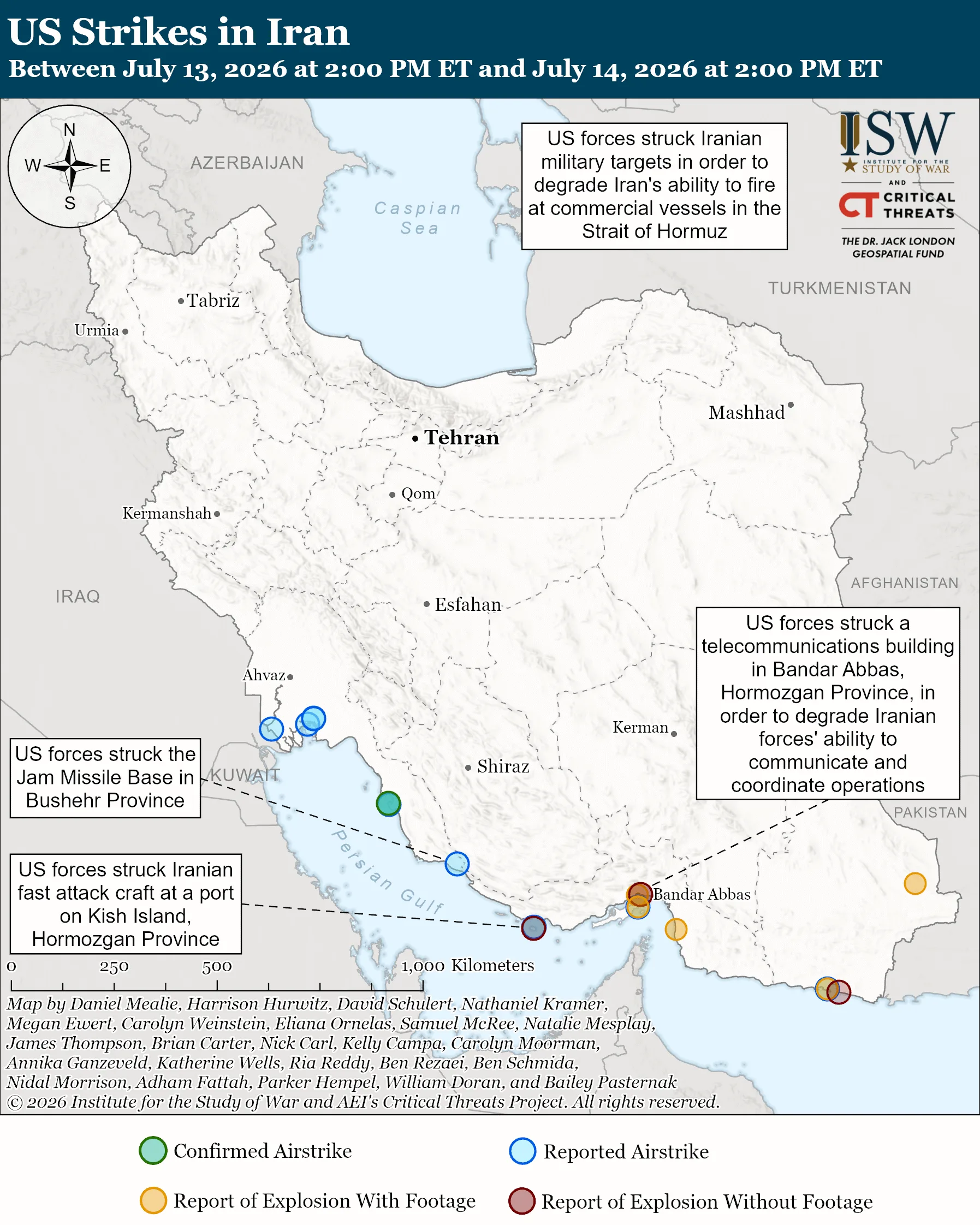
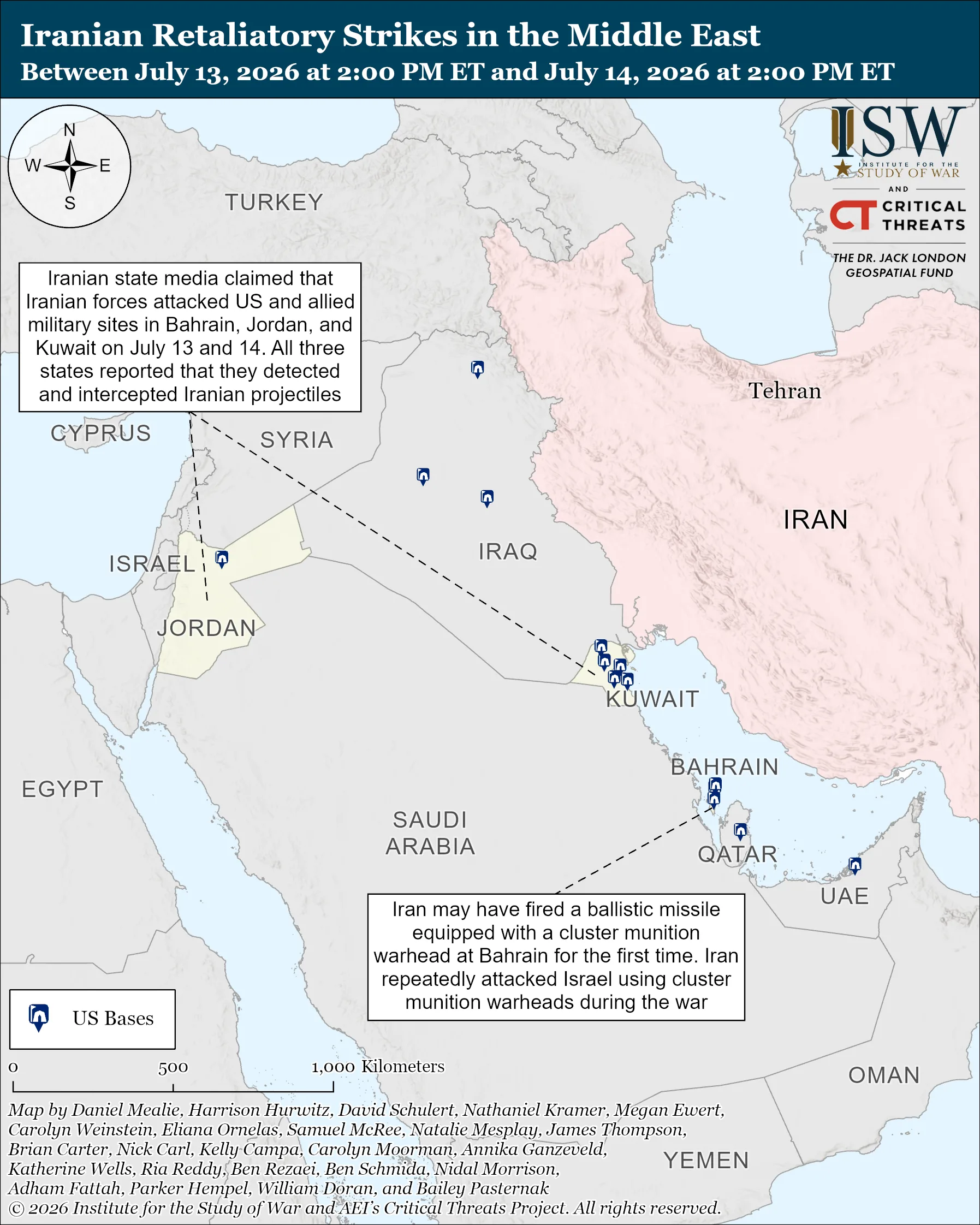
Iran responded to the US strikes by attacking US military bases across Kuwait, Bahrain, and Jordan on July 14.[4] Iran reportedly used a cluster munition warhead in an attack on Bahrain for the first time. ISW-CTP cannot verify this report, but if the report is accurate, Iran's use of a cluster munition warhead to attack Bahrain would represent a notable inflection in Iranian tactics given that Iran has previously only used cluster munition warheads in attacks against Israel.[5] Cluster munition warheads contain submunitions that disperse over a wide area and are intended to maximize damage.
The Iranian Parliament held its first open session since the start of the US-Israel-Iran War and discussed proposed legislation on Iranian management of the Strait of Hormuz.[6] Parliamentarians reviewed the “Strategic Action Plan for Ensuring the Security and Sustainable Development of the Strait of Hormuz and the Persian Gulf,” which Parliament first proposed in April, among other matters, at the July 13 session.[7] Parliament did not approve the bill or publish its text. The bill is likely intended to formalize Iran's control over the Strait of Hormuz and likely will not fundamentally alter the steps Iran is currently taking to secure its control over the strait. One hundred and eighty parliamentarians also signed a letter on July 14 calling for an oversight committee to ensure the government implements the bill.[8]
Iranian Parliament Speaker Mohammad Bagher Ghalibaf notably did not preside over the session, and Deputy Parliament Speaker Hamidreza Haji Babaei led the session in his absence.[9] It is unclear why Ghalibaf did not lead the session, but his absence comes after several parliamentarians have criticized Ghalibaf in recent weeks for failing to convene Parliament.[10]
Iran may be deploying forces to the Iran-Iraq border due to concerns about Kurdish opposition groups conducting anti-regime activity amid heightened tensions between the United States and Iran. Anti-regime Kurdish groups based in Iraqi Kurdistan told Iraqi media on July 14 that the Islamic Revolutionary Guards Corps (IRGC) deployed 3,000 “special forces” from the IRGC Aerospace Force and IRGC Ground Forces, as well as drones, artillery, and tanks, to the Iran-Iraq border in recent weeks.[11] The groups’ leaders claimed that the IRGC is deploying these forces to prepare for a possible confrontation against them.[12] No other sources have reported this large troop deployment at the time of this writing, however. Iran has periodically launched drone and missile attacks at these groups’ bases during the US-Israel-Iran War, including during the US-Iran ceasefire.[13] ISW-CTP has observed an uptick in these groups’ attacks on Iranian security forces and Iranian security operations in Kurdish-populated areas in recent weeks.[14] Iranian Armed Forces General Staff-run outlet Defa Press also reported in June that the regime is closely monitoring fighters in Kurdish-populated provinces and has replaced “purely defensive reactions” with an “active deterrence” doctrine against these fighters.[15] The Iranian regime has historically accused Kurdish opposition groups of cooperating with Israel and the United States to conduct operations against the regime and destabilize Iran.
Hezbollah appears to be conducting an information campaign to delay the Lebanese government's disarmament efforts by attempting to convince the Lebanese government that the group will cooperate with the Lebanese Armed Forces (LAF) and that the Lebanese government must prioritize securing a complete Israeli withdrawal from Lebanon before disarmament efforts can begin. Hezbollah is attempting to portray itself as a willing partner to the Lebanese government that also seeks to preserve internal Lebanese stability, which is a key Lebanese government objective.[16] Senior Hezbollah officials, including Hezbollah Secretary General Naim Qassem, have repeatedly stated in recent weeks that Hezbollah seeks to maintain Lebanese national unity and supports the LAF’s deployment to southern Lebanon.[17] Unspecified sources told Lebanese media on July 13 that Hezbollah agreed to withdraw from southern Lebanon and “cooperate” with the LAF.[18] Hezbollah previously agreed to withdraw its forces north of the Litani River during the Lebanese government's previous disarmament efforts following the November 2024 ceasefire agreement.[19] Hezbollah has consistently stated that it will remain armed, even if the group withdraws from southern Lebanon, however.[20] Hezbollah-affiliated media also claimed on July 14 that Hezbollah has informed all “relevant parties” that the LAF is permitted to deploy “wherever it wishes,” so long as the LAF does not “approach” Hezbollah positions and the Lebanese government prioritizes securing an Israeli withdrawal before any Hezbollah-Lebanese government discussions about disarmament take place.[21]
Hezbollah and Hezbollah allies are simultaneously claiming that the pilot zone plan in the Trilateral Framework Agreement is intended to cause “internal conflict” between the LAF and Hezbollah.[22] Lebanese Parliament Speaker and Hezbollah ally Nabih Berri has continued to criticize the framework agreement and claimed that the initiative may be an Israeli “trap” to force the LAF into an internal conflict with Hezbollah.[23] Hezbollah parliamentarians have similarly claimed in recent weeks that the United States and Israel seek to provoke conflict between the LAF and Hezbollah by pressuring the LAF to disarm Hezbollah under the framework agreement.[24] Hezbollah officials have consistently threatened that any Lebanese disarmament efforts could result in “civil war.”[25]
Hezbollah's information campaign is likely capitalizing on the Lebanese government's cautious approach toward Hezbollah's disarmament.[26] The Lebanese government has sought to balance Hezbollah's disarmament with the group's continued threat to Lebanese stability despite the group's unprecedented weakness.[27] Lebanese President Joseph Aoun stated on July 10 that the Lebanese government must “cooperate with Hezbollah” in order to disarm the group, for example.[28] Any disarmament plan that relies on cooperating with Hezbollah and its supporting foreign cadres, including the IRGC, will almost certainly fail, because none of these actors will acquiesce to disarming Hezbollah.[29]
Hezbollah's information campaign also coincides with US-mediated Israel-Lebanon talks in Rome, which began on July 14 and have reportedly focused on the pilot zone plan.[30] Israeli Foreign Minister Gideon Saar told international media on July 14 that the IDF is ready to move forward with implementing the two recently announced pilot zones.[31] The Israeli and Lebanese delegations reportedly continue to disagree over the timeframe for the IDF’s withdrawal and the LAF’s backfill of the pilot zones, the geographic scope of the LAF’s deployment, and how the United States and Israel will monitor the LAF’s efforts to disarm Hezbollah within the pilot zones, however.[32]
Unspecified Iranian-backed Iraqi militias are reportedly demanding guarantees before they disarm, including Iraqi federal government protection from future US or Israeli strikes and an end to the US military presence in Iraq.[33] Unspecified sources told Iraqi media on July 14 that the militias are concerned that surrendering their weapons to the government would leave them “vulnerable” given current regional tensions.[34] Three Shia Coordination Framework sources told Iraqi media on July 14 that the militias that refuse to disarm do not seek confrontation with the Iraqi federal government, but view existing, unspecified “guarantees” as insufficient.[35] One of the framework sources specifically noted the lack of guarantees regarding the safety of militia leaders and said that the militias seek guarantees that they will not face “political and security prosecution” in the future.[36] The US-Israeli combined force conducted numerous strikes targeting Iranian-backed Iraqi militia positions during the war to degrade the ability of the militias to attack the United States, Israel, and the Gulf states.[37] Multiple militias, including those within the Islamic Resistance in Iraq, have repeatedly refused to disarm and often cite the continued presence of US-led international coalition forces in Iraq as a reason to remain armed.[38] The Islamic Resistance in Iraq is a coalition of Iranian-backed Iraqi militias.[39]
Iranian-backed Iraqi militia Kataib Hezbollah threatened on July 14 that Iranian-backed Iraqi militias would participate in a renewed war between Iran and the United States and Israel.[40] It is not clear how Kataib Hezbollah is defining “war,” however. Iran and the United States have exchanged more frequent and intense fire in the Persian Gulf in recent days, though below pre-ceasefire levels.[41] Iraqi militias, especially Kataib Hezbollah, frequently attacked US and foreign targets in Iraq and the region during the war in March and April.[42] Iranian-backed Iraqi militias also likely conducted several attacks targeting the Gulf states between the start of the ceasefire and mid-May.[43]
Recent Iranian-backed Iraqi militia statements reflect ongoing divisions among the militias over the Iraqi federal government's ongoing anti-corruption campaign. Kataib Sayyid al Shuhada Spokesperson Kazem al Fartousi rejected the anti-corruption campaign in an interview with Iraqi media on July 13 and said that the militia opposes the government “selectively” fighting corruption.[44] Fartousi added that the worst forms of corruption, which he implied the government should prioritize, are the quota system and nepotism in state institutions.[45] Kataib Hezbollah separately said on July 14 that it supports the anti-corruption campaign but warned the government against using the campaign to “settle scores and eliminate opponents.”[46] Iraqi authorities have primarily arrested Sunnis and allies of former Prime Minister Mohammad Shia al Sudani.[47] Kataib Hezbollah added that the campaign must focus on all governing institutions. Kataib Sayyid al Shuhada and Kataib Hezbollah are both members of the Islamic Resistance in Iraq, which released a statement on July 12 expressing support for the anti-corruption campaign.[48] Fartousi’s opposition to the campaign may reflect disagreements in the Islamic Resistance in Iraq about the campaign. Fartousi’s comments may also indicate internal divisions within Kataib Sayyid al Shuhada regarding the campaign.
Asaib Ahl al Haq Spokesperson Ahmed Adnan expressed support on July 14 for US investment in Iraq in contrast to the Islamic Resistance in Iraq's July 12 statement that implored the Iraqi federal government to “liberate” the Iraqi economy from “American hegemony.”[49] Iraqi Prime Minister Ali al Zaydi’s visit to Washington, DC, began on July 13 and is expected to focus on expanding US-Iraq economic relations.[50] Asaib Ahl al Haq is not a member of the Islamic Resistance in Iraq and Adnan’s comments reflect the group's differing strategic priorities compared to those of the militias in the Islamic Resistance in Iraq.[51] Asaib Ahl al Haq’s leadership, including its leader Qais al Khazali, has focused more on politics than kinetic activity in recent years, including during the October 7 War.[52] The US-Israeli combined force struck multiple Asaib Ahl al Haq positions during the recent war and the US Treasury Department noted in April 2026 that the group conducted drone attacks targeting US and coalition forces in northern Iraq in March 2026, however.[53]
Iraqi Armed Forces Spokesperson Major General Sabah al Numan announced on July 14 that Iraq will establish a new security cooperation framework with the United States after the US-led coalition withdraws from Iraq in September 2026.[54] Numan stated that the framework will include enhanced military and intelligence cooperation with the United States.[55] Numan also stated that Iraqi Prime Minister Ali al Zaydi will sign agreements with the United States to support training and capacity building for the Iraqi Security Forces (ISF) during his visit to Washington, DC, on July 14.[56] The US Treasury Department has not resumed its funding for the ISF since it halted US dollar shipments to Iraq in April 2026 due to concerns about Iranian-backed Iraqi militia attacks during the war.[57] US-led international coalition forces are currently based in Iraqi Kurdistan following their withdrawal from federal Iraq in January 2026.[58]
Two US officials stated on July 14 that the United States backed Saudi Arabia's July 13 airstrikes on Houthi-controlled Sanaa International Airport in Yemen.[59] Axios reported on July 14 that Saudi officials expressed concern to the United States last week about the resumption of IRGC-affiliated Mahan Air flights between Sanaa and Tehran. The flights resumed on July 3, marking the first direct flights between the two cities in over 10 years.[60] Axios reported that Saudi Arabia is concerned that Iran will use the direct air route to transfer weapons and military advisers to the Houthis.[61] Saudi Crown Prince Mohammad bin Salman spoke with US President Donald Trump on July 10, during which Salman reportedly requested and received Trump's approval for “military action” against the Houthis, according to a US official.[62] Saudi forces struck Sanaa International Airport on July 13, which the Houthis responded to by launching an unspecified number of ballistic missiles and drones targeting Abha International Airport in Saudi Arabia.[63] The Houthi Political Bureau claimed on July 13 that Saudi Arabia struck Sanaa International Airport to prevent a Mahan Air passenger jet from landing at the airport.[64] The Mahan Air flight was reportedly carrying a Houthi delegation returning from former Iranian Supreme Leader Ali Khamenei’s funeral in Tehran but returned to Iran following the strikes.[65] The Houthis also warned commercial airlines on July 14 against using Saudi airspace.[66]
https://understandingwar.org/research/middle-east/iran-update-special-report-july-14-2026/
2,265
posted on
07/15/2026 1:08:25 AM PDT
by
AdmSmith
(GCTGATATGTCTATGATTACTCAT)
To: nuconvert; BeauBo; blitz128; gleeaikin
Iran Update Special Report, July 15, 2026
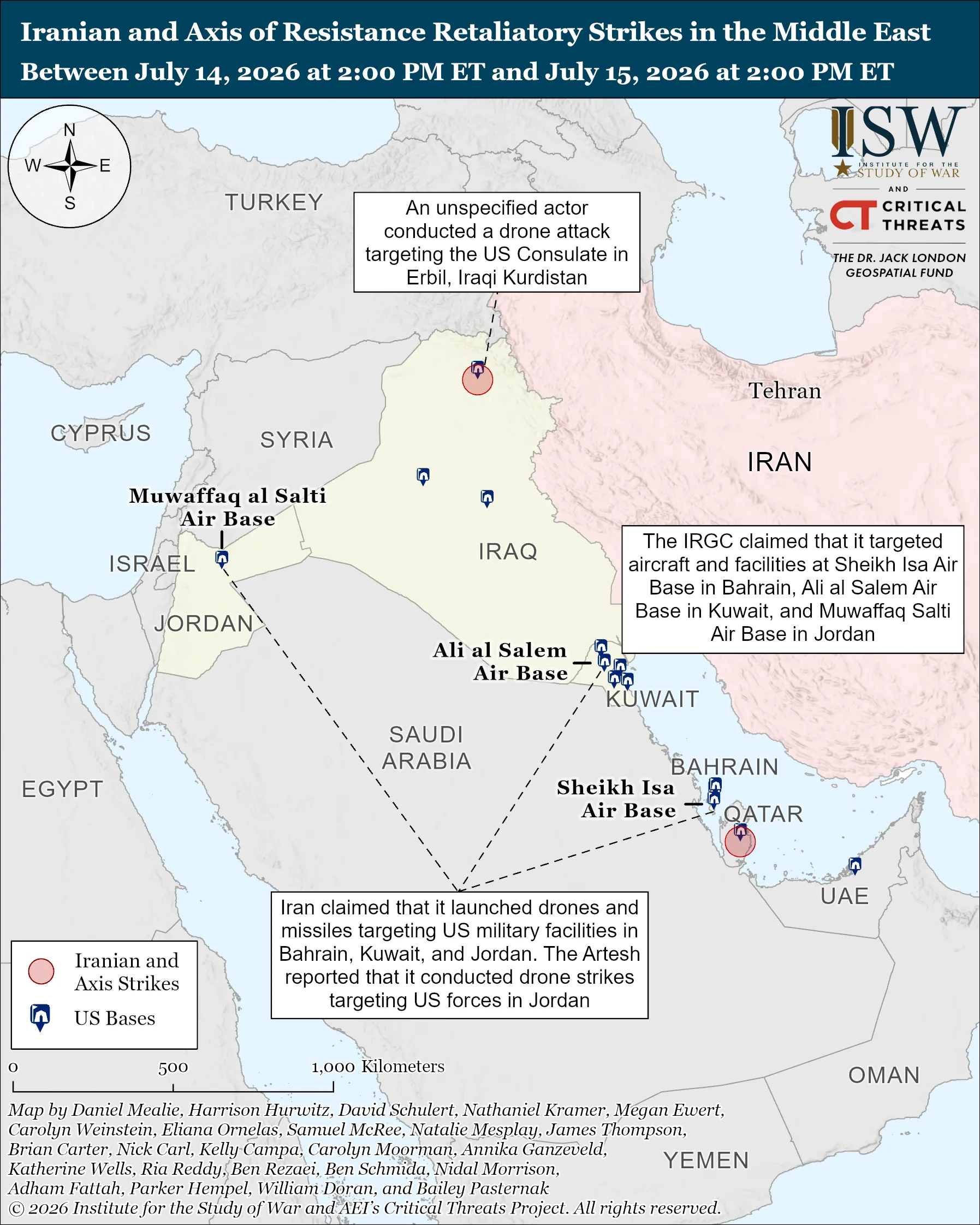
The United States has continued to strike Iranian military targets, including some targets further inland. Iranian regime media reported on July 15 that US forces struck the Artesh Ground Forces 388th Mechanized Assault Brigade barracks in Iranshahr, Sistan and Baluchistan Province.[1] The strikes reportedly killed seven Artesh soldiers, injured 13 others, and destroyed several buildings.[2] This strike is notable given that the 388th Brigade is located around 200 kilometers from the Iranian coast, while most US airstrikes in July have been concentrated around Iran's southern coast. The 388th Brigade operates under the 88th Armored Division, which is based in Zahedan, Sistan and Baluchistan Province.[3] US forces reportedly struck a second inland site — an unspecified IRGC base — in Saravan, Sistan and Baluchistan Province on July 15.[4] The Artesh has conducted operations throughout the war and most recently claimed on July 15 that it conducted drone strikes targeting US forces at Muwaffaq Salti Airbase in Azraq, Jordan.[5] The Artesh claimed that it has recently conducted eight waves of drone attacks against US bases in the region.[6]
Iran also conducted attacks against US forces in Bahrain and Kuwait on July 15. Iraqi media separately reported on July 15 that an unknown actor launched six drones targeting Erbil International Airport and the US Consulate in Erbil, Erbil Province.[7] It is unclear whether Iran or Iranian-backed Iraqi militias conducted this attack. Air defenses intercepted all of the drones.[8]
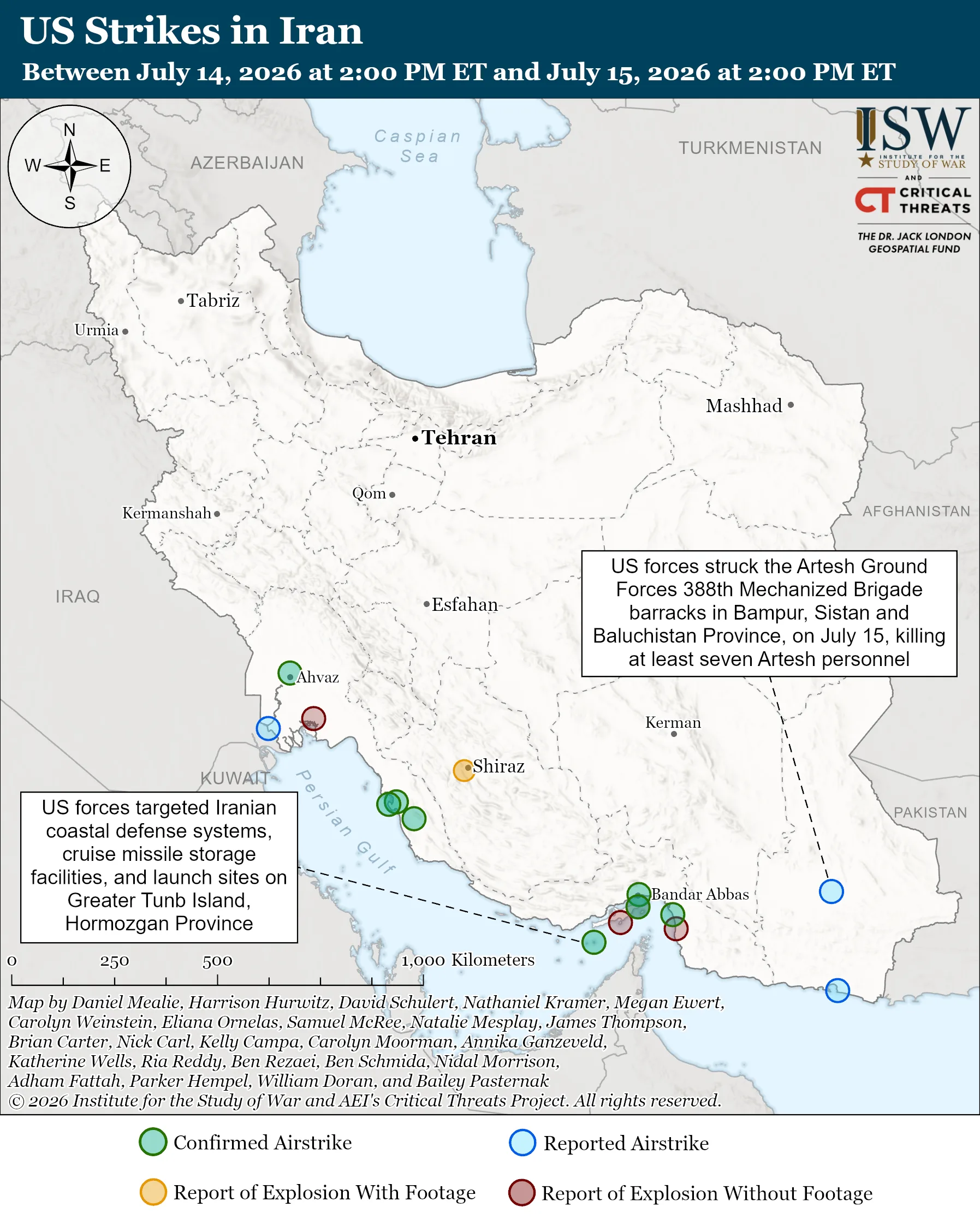
Iran is attacking vessels that have adopted alternative mechanisms to bypass Iranian control of the Strait of Hormuz. Iran attacked three vessels in the strait on July 13, two of which were conducting “shuttle runs,” or repeated short trips to ports outside the strait in order to transport oil through the strait while avoiding Iranian territorial waters.[9] The Wall Street Journal reported on July 14 that the two tankers were conducting “shuttle runs” using the US-backed southern route off the coast of Oman.[10] The two vessels — Mombasa B and Al Bahyah — operate under the Abu Dhabi National Oil Company (ADNOC).[11] ADNOC has previously adopted new methods — such as turning off its ships’ automatic identification systems (AIS) and using ship-to-ship transfers — to evade Iranian detection.[12] The United Arab Emirates has also insisted that Iran must not be allowed to control traffic in the strait. Iran has repeatedly attacked vessels attempting to transit through the strait using the southern route along Oman's coast because maritime traffic through this alternative route undermines Iran's efforts to achieve recognized control of the strait.[13]
Iran's attacks on shipping are having some success in deterring shipping companies from using routes outside Iran's illegal traffic separation scheme, which advances Iran's objective of securing control over the strait. Seven maritime security and shipping industry sources told Reuters on July 15 that shipping companies are avoiding using the southern route despite US military escorts, highlighting how shipping companies’ willingness to use alternative routes in the strait is dependent on their risk calculations.[14] People familiar with the matter separately told the Wall Street Journal on July 14 that some tanker captains have refused to transit through the strait in recent days.[15] The threshold for Iran to disrupt shipping in the strait remains low, given that even individual attacks can deter ships from transiting through the strait.
The United States is increasing economic pressure on Iran's weapons procurement, oil export, and sanctions evasion networks through further sanctions as part of its campaign to degrade Iran's willingness to attack commercial shipping in the Strait of Hormuz.[16] The US Treasury Department sanctioned more than 50 individuals, entities, and vessels on July 14 for supporting Mohammad Hossein Shamkhani’s oil export, shipping, and sanctions evasion network.[17] Shamkhani is the son of former senior official Ali Shamkhani. The sanctions targeted Shamkhani’s financiers, logistics facilitators, container shipping companies, vessel operators, and Caspian Sea shipping network, which move Iranian and Russian petroleum products, sanctioned goods, and cargo to Iranian-backed actors, including the Houthis.[18] The United States previously sanctioned Mohammad Hossein Shamkhani and his multinational shipping network in July 2025 and April 2026 for generating tens of billions of dollars for the Shamkhani family and the Iranian regime.[19] The US Treasury Department separately sanctioned three individuals and four entities on July 15 for supporting the procurement of weapons for the IRGC.[20] The new sanctions follow the United States’ recent decision to revoke the sanctions waiver that it had implemented under the US-Iran memorandum of understanding (MoU) and reimpose the naval blockade on Iranian ports.[21] These economic measures are intended to reduce Iran's willingness to attack commercial vessels by imposing an economic cost on Iran for conducting such attacks.
Israeli and Lebanese officials reportedly agreed on aspects of a plan to implement “pilot zones” in southern Lebanon during US-brokered negotiations in Rome, Italy, on July 14 and 15.[22] A US State Department official told an Israeli correspondent on July 15 that the Israeli and Lebanese delegations reached an agreement on the “structure and guidelines” of a plan for the Lebanese Armed Forces (LAF) to deploy to pilot zones in accordance with the June 26 Trilateral Framework Agreement.[23] Lebanese government officials told Lebanese media on July 15 that the LAF will deploy to two zones that include towns both currently under Israel Defense Forces (IDF) control, from which the IDF will withdraw, and without an IDF ground presence.[24] Saudi media previously reported on July 14 that Israeli and Lebanese officials disagreed on whether the LAF would backfill IDF positions or deploy to territory nominally under Lebanese government control instead.[25]
Many details surrounding the pilot zones plan remain unclear, including the plan's timeline and scope, however. US and Lebanese officials said on July 15 that the IDF and LAF will implement the first pilot zones “within days,” whereas other unspecified US officials told Lebanese media on July 15 that implementation will not begin until the end of July.[26] Lebanese and international media also reported different details on the pilot zones’ territorial extents, with some media outlets claiming that the zones will include up to six towns while other reports have denied that the delegations made any changes to the zones that Israeli and Lebanese officials agreed on in June.[27] It is also unclear whether the Lebanese government will order the LAF to search private property to disarm Hezbollah in the pilot zones. Lebanese media reported on July 15 that neither the Israeli nor the Lebanese government has requested that the LAF search private property.[28] Other Lebanese media reported that the Lebanese government has authorized the LAF to conduct all “inspection operations” necessary to disarm Hezbollah, however.[29] The LAF only conducted limited private property searches at the IDF’s request during previous efforts to disarm Hezbollah after the November 2024 ceasefire.[30] Any Hezbollah disarmament plan that restricts the LAF from searching private property will likely fail because Hezbollah frequently conceals materiel in civilian homes.[31]
Unspecified Iranian-backed Iraqi militias have expressed concern that the United States is pressuring the Iraqi federal government to disarm the militias before the United States launches a “grand plan” to overthrow the Iranian regime, according to unspecified sources close to the militias speaking to Iraqi media on July 15.[32] The militias’ reported concerns come amid increased exchanges of fire between Iran and the United States in recent days.[33] Most of the militias that refuse to disarm, such as Kataib Hezbollah, Harakat Hezbollah al Nujaba, and Kataib Sayyid al Shuhada, maintain the closest ties to Iran.[34] These militias frequently attacked US military bases in Iraq and the Gulf countries during the US-Israel-Iran War.[35]
US Secretary of Defense Pete Hegseth reiterated after his meeting with Iraqi Prime Minister Ali al Zaydi on July 14 that Iraq must disarm Iranian-backed Iraqi militias.[36] Hegseth said that the militias conducted over 600 attacks targeting US personnel during the war.[37] Hegseth and Zaydi discussed expanding US technical, technological, and digital cooperation with the Iraqi military and security establishment.[38] The United States has not resumed its funding for some counterterrorism and training programs for the Iraqi Security Forces since suspending funding for these programs in April 2026 due to concerns about Iranian-backed Iraqi militia attacks during the war.[39] Iraqi Armed Forces Spokesperson Major General Sabah al Numan announced on July 14 that Zaydi had directed the formation of an Iraqi committee to negotiate the details of a new US-Iraq security cooperation framework ahead of the scheduled withdrawal of US-led coalition forces from Iraqi Kurdistan in September 2026.[40] US-led coalition forces are currently based in Iraqi Kurdistan following their withdrawal from federal Iraq in January 2026.[41]
US and Iraqi officials have continued to describe Zaydi’s recent visit to Washington, DC, as the start of a new US-Iraqi relationship. US Special Envoy to Iraq and Syria Tom Barrack called US President Donald Trump's meeting with Zaydi on July 14 a “turning point” in US-Iraqi relations.[42] Barrack added that the future US-Iraqi relationship will focus on investment, trade, and economic opportunities in addition to security.[43] An informed source similarly told Iraqi media on July 14 that the Iraqi delegation is expected to sign more than 18 agreements with the United States covering energy, oil, education, and health during Zaydi’s visit.[44] One of these agreements could be what Iraqi and regional media have described as the “June agreement,” in which the United States will support investment in Iraq in exchange for the Iraqi federal government reducing Iranian influence in Iraq, including disarming Iranian-backed Iraqi militias.[45]
The Iraqi federal government is developing alternative routes to the Strait of Hormuz for Iraqi oil exports amid Iranian efforts to control traffic in the strait. A US State Department official told Reuters on July 24 that the United States is supporting Iraqi and Syrian efforts to revive the Kirkuk-Baniyas pipeline that extends from Kirkuk to the eastern Mediterranean Sea.[46] The pipeline has been largely inoperable for years, but Syrian and Iraqi officials have repeatedly discussed re-opening it since 2025.[47] The US State Department official's comments are consistent with long-standing US efforts to reduce Iraqi dependence on Iran.[48] An unspecified Western source told Saudi media on July 7 that US Special Envoy to Iraq and Syria Tom Barrack seeks to create “a new alliance of interests” between Iraq, Syria, and other regional states.[49] This effort is intended, in part, to reduce regional reliance on the Strait of Hormuz by linking Iraq, Syria, and other regional countries to the Mediterranean Sea.[50] Iraqi Oil Minister Bassem Mohammad Khudair al Abadi also said on July 13 that a consortium of US and Qatari companies is working to develop another oil pipeline from Basra in federal Iraq to Peshkabour in Iraqi Kurdistan in order to connect this pipeline to pipelines in Ceyhan in western Turkey and Baniyas in western Syria.[51]
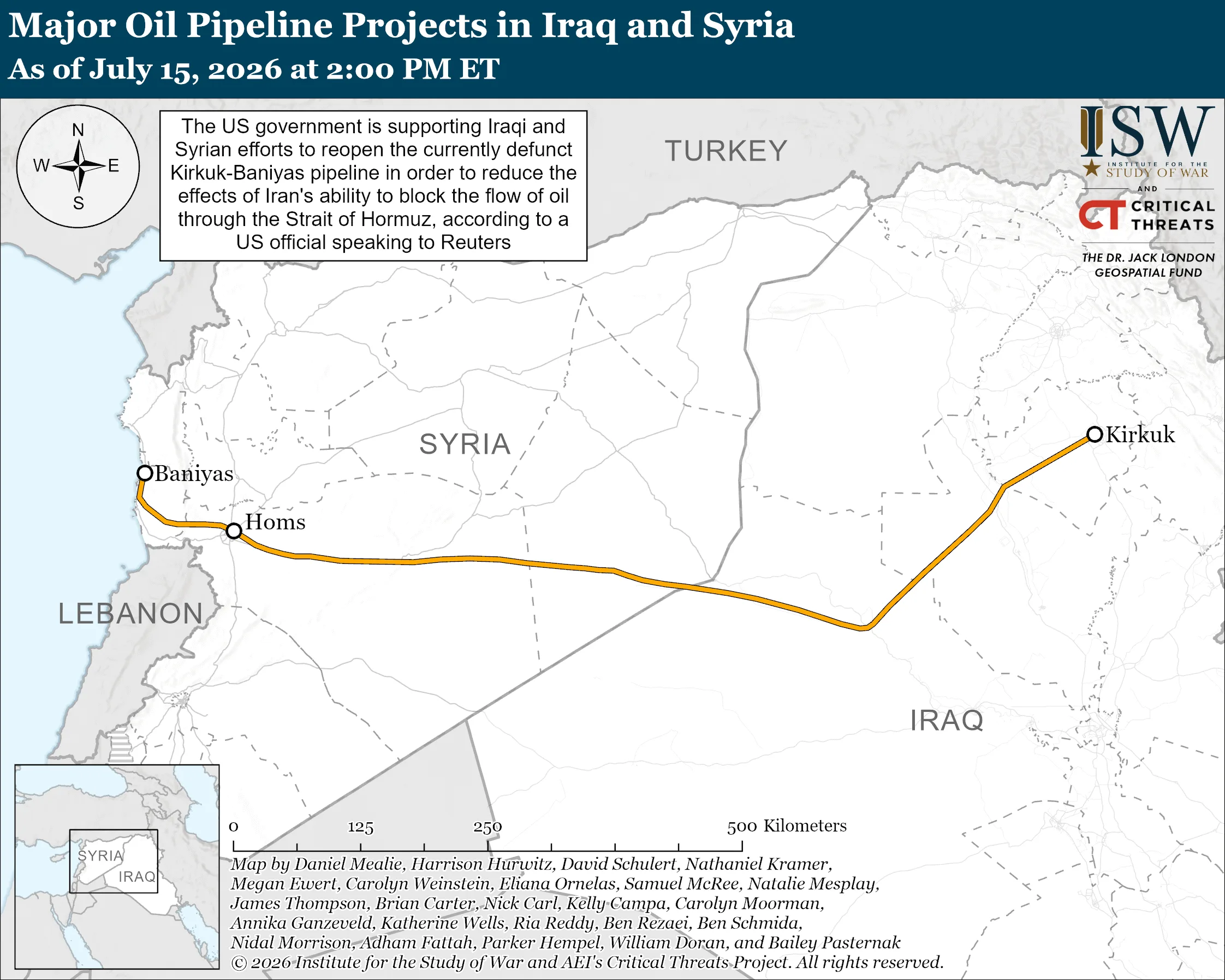
The Iraqi federal government reportedly designated Lebanese Hezbollah as a terrorist organization in early July and issued a directive to freeze the assets of individuals and corporations affiliated with Hezbollah and the Islamic State in Iraq and al Sham (ISIS), according to Iraqi and regional media.[52] Iraqi and regional outlets reported on July 15 that the Iraqi Foreign and Finance Ministries facilitated the designation in early July.[53] These reports follow increased US pressure on the Iraqi federal government to reduce Iranian influence in Iraq, including by dismantling Iranian-backed Iraqi militia financial networks.[54] Iranian-backed Iraqi actors exploit their access to the Iraqi economy to fund the Iranian regime and its Axis of Resistance, including Hezbollah.[55] The Iraqi federal government has previously retracted similar financial actions targeting Axis of Resistance members, however. The Iraqi Gazette, which publishes binding Iraqi federal decisions, published in December 2025 that the Iraqi government had designated Hezbollah and the Houthis as terrorist organizations.[56] Multiple Iranian-backed Iraqi actors publicly opposed the decision, however.[57] The Iraqi Committee for the Freezing of Terrorist Actions subsequently accused the Gazette of releasing the designation of the Houthis and Hezbollah as terrorist organizations “without revisions” and said that the committee would revise the decision.[58]
https://understandingwar.org/research/middle-east/iran-update-special-report-july-15-2026/
2,266
posted on
07/16/2026 3:45:20 AM PDT
by
AdmSmith
(GCTGATATGTCTATGATTACTCAT)
Southern Giants Forces Reveal Details of a Specialized Weapons Manufacturing Shipment Seized in Bab al-Mandab, En Route to the Houthis The Southern Giants Forces revealed today the details of a specialized shipment of materials and equipment designated for military manufacturing, which had been seized by one of their naval patrols stationed in the Bab al-Mandab sector, yesterday Tuesday, July 14, 2026 AD, aboard a smuggling boat on its way to the terrorist Houthi militia in Al-Hudaydah Governorate.
The naval patrol affiliated with the Southern Giants Forces succeeded in this specialized operation in intercepting the smuggling boat, seizing the shipment, and arresting its crew consisting of seven sailors from the smugglers affiliated with the Houthi militia; they were detained and referred along with the seized items to the competent authorities to complete the legal procedures.
The seized shipment contains advanced military manufacturing tools and equipment, and precision parts used in equipping weapons factories affiliated with the militia; it included computer numerical control (CNC) machines designated for shaping aluminum structures, which are used in manufacturing winged unmanned aerial vehicles (drones) and rocket structures, as well as engines specific to jet aircraft, in addition to spare parts and supplies for mortar weapons and sniper rifles, and precise optical inspection and measurement devices specific to quality control (QC), along with tools and equipment for tunnel drilling and rock fragmentation, and lifting machines and hydraulic presses designated for military industrial works.
Member of the Presidential Leadership Council and Commander-in-Chief of the Southern Armed Forces, Abdul Rahman Al-Muharami Abu Zara, praised this major security achievement by the members of the naval patrols of the Southern Giants Forces, emphasizing the necessity of doubling efforts and raising the level of vigilance in combating smuggling and drying up its sources, in order to ensure the severance of the maritime supply artery to the Iranian-backed terrorist Houthi militia.
https://x.com/alamalikah/status/2077446670997131319
1 min video
🔹 The Giants Forces revealed on Wednesday details of the shipment seized in the Bab al-Mandab area during an attempt to smuggle it to the terrorist Houthi group.
🔹 It clarified that the shipment includes advanced military manufacturing equipment, among them rocket structures and equipment used in the production of drones and jet aircraft.
🔹 It stated that the seized items included CNC (Computer Numerical Control) machines dedicated to shaping aluminum structures used in the manufacture of drones and rocket structures.
🔹 The shipment also contained engines for jet aircraft, spare parts, and supplies specific to mortar weapons and sniper rifles.
🔹 It added that the shipment included precise optical inspection and measurement devices for quality control, along with tunnel drilling equipment, rock fragmentation tools, and hydraulic lifting and pressing machines.
🔹 The Giants Forces had announced on Tuesday the interception of a smuggling boat and the seizure of the shipment in Bab al-Mandab, in the second operation of its kind within half a month.
🔹 It confirmed that the naval patrol arrested the boat's crew, consisting of seven sailors, whom it said were affiliated with the terrorist Houthi group.
🔹 The accused, along with the seized items, were referred to the competent authorities to complete legal procedures, according to a statement from the Media Center of the Giants Forces.

https://x.com/majhar_net/status/2077505636753879207
Southern Giants Brigades
The Southern Giants Brigades (Arabic: الوية العمالقة الجنوبية, romanized: Alwiyat al-Amaliqa al-Janubia), better known as the Giants Brigades, is a pro-government militia in Yemen. Its fighters are predominantly tribesmen from southern Yemen, particularly from the Lahej, Abyan and Dhale governorates. They include Salafi students of Muqbil bin Hadi al-Wadi’i’s Dar al-hadith religious institute in Dammaj, Saada that were expelled by the Houthis in early 2014. The militia is part of the Yemeni Joint Forces and is the largest faction in the formation. The Giants Brigades also received extensive support from the United Arab Emirates militarily and financially.
https://en.wikipedia.org/wiki/Southern_Giants_Brigades
Nice catch!
2,267
posted on
07/16/2026 3:57:34 AM PDT
by
AdmSmith
(GCTGATATGTCTATGATTACTCAT)
Damascus, July 16 (SANA) Syria's Interior Ministry said on Thursday it had intercepted a large shipment of advanced weapons destined for the Hezbollah terrorist militia, preventing it from entering the country through the Syrian-Iraqi border. The ministry said specialized security units carried out the operation after detecting a suspicious vehicle parked near the border. A search uncovered a cache of weapons that included long-range missiles, guided anti-tank missiles and drones. According to the ministry, preliminary investigations based on evidence collected at the scene indicated that the shipment was intended to transit Syrian territory before being delivered to the Hezbollah terrorist militia in Lebanon.

https://sana.sy/en/syria/2329911/
2,268
posted on
07/16/2026 4:02:56 AM PDT
by
AdmSmith
(GCTGATATGTCTATGATTACTCAT)
2,269
posted on
07/16/2026 3:40:56 PM PDT
by
AdmSmith
(GCTGATATGTCTATGATTACTCAT)
To: nuconvert
14JUL2026 The Telegraph: Trump blocks Bibi? Ex-Mossad chief on why Israel is out of Iran war
Why hasn’t Israel rejoined the US war with Iran? Sima Shine, former head of research and evaluation at Mossad and Iran expert at Israel’s Institute for National Security Studies, explains why she thinks Donald Trump has put a break on Israeli leader Benjamin Netanyahu participating in the latest round of fighting.
On part one of today’s episode of Iran: the Latest, Roland Oliphant asks her about the explosive news about Israel’s Operation Puss in Boots, a yearslong, multi-pronged effort to overthrow the Iranian regime and install the most unlikely of candidates, arch Israeli enemy former President Mahmoud Ahmadinejad. She reveals what led military intelligence to rebel against the plan spearheaded by Netanyahu and Mossad, how it went ahead anyway, and why the Kurdish invasion plan would never have worked.
https://www.youtube.com/watch?v=NSzGyi5lYK0
2,270
posted on
07/16/2026 10:17:40 PM PDT
by
AdmSmith
(GCTGATATGTCTATGATTACTCAT)
Iran Update Special Report, July 16, 2026
Iran is trying to deter the United States from striking Iranian energy infrastructure by threatening Houthi attacks on shipping in the Bab al Mandeb. Two senior Iranian sources and a regional source familiar with the matter told Reuters on July 16 that Iran requested that the Houthis prepare to attack Red Sea shipping if the United States expands its airstrikes to Iranian energy infrastructure.[1] An unspecified source close to the Houthis said that the Houthis have deployed missile and drone assets near the Bab al Mandeb and are awaiting orders.[2] Iranian officials, including IRGC Quds Force Commander Brigadier General Esmail Ghaani, have previously threatened that the Houthis could launch another campaign against shipping in the Bab el Mandeb Strait.[3] The comments to Reuters are part of an Iranian effort to signal that the Axis of Resistance could create another crisis for international shipping — this time around the Bab al Mandeb. This report comes as Western media has reported on the possibility that the United States could intensify operations against Iran.[4] US President Donald Trump recently threatened to expand US strikes to include ”power plants and bridges.”[5]
It is unclear whether the Houthis would follow through on Iran's threats. The Houthis have not yet closed the Bab al Mandeb to shipping despite numerous threats throughout the war to do so. Houthis Supreme Leader Abdul Malik al Houthi noted on July 16 that the Houthis are continuing to prevent Israeli vessels from transiting the Bab el Mandeb Strait and Gulf of Aden but made no reference to expanding this campaign to close the strait to all commercial shipping.[6] The risk that the Houthis escalate against maritime traffic around the Bab al Mandeb remains high, however.
Iranian efforts to stoke global concerns about Houthi attacks in the Red Sea coincide with rising tensions between the Houthis and Saudi Arabia. Abdul Malik asserted in his speech that Saudi Arabia had “embroiled itself” in conflict against the Houthis, referring to recent exchange in fire with Saudi Arabia over Iran's attempt to land a flight at Sanaa Airport earlier on July 14.[7] Abdul Malik threatened to launch drone and missile attacks targeting “all Saudi oil installations and highly vital facilities“ if it attacks the Houthis again.[8] The Houthis previously attacked Saudi energy infrastructure in 2022.[9] Abdul Malik’s statement follows the Houthis’ warning commercial airlines against using Saudi airspace.[10] Two regional sources close to Saudi leadership told Reuters on July 16 that Saudi Arabia is seriously concerned about Iran and the Houthis’ threat and is aware of Iran-Houthi coordination regarding the Red Sea.[11] Saudi Arabia has diverted 70 percent of its energy exports to its Red Sea port of Yanbu to circumvent Iranian attacks through the Strait of Hormuz.[12]
The United States is striking Iranian targets further inland in southeastern and southwestern Iran. The purpose of these strikes is not immediately clear. US forces struck a hangar at Semnan Airport in Semnan Province, according to a local official.[13] Semnan Province hosts several missile test and space launch sites.[14] Iranian media reported that US forces struck more targets in Sistan and Baluchistan Province, including an IRGC base near Rask, which is approximately 130 kilometers from Iran's southern coastline.[15] The United States has struck at least three inland targets in Sistan and Baluchistan Province since July 14.[16] Iranian media also reported that the United States struck unspecified sites near Kabudarahang in Hamedan Province, Khorramabad in Lorestan Province, Khondab City in Markazi Province, and Ahvaz in Khuzestan Province.[17] A US official told Reuters on July 15 that recent US airstrikes could be seen as “shaping operations” to degrade Iranian defenses in case the US military was ordered to conduct more intensive operations.[18]
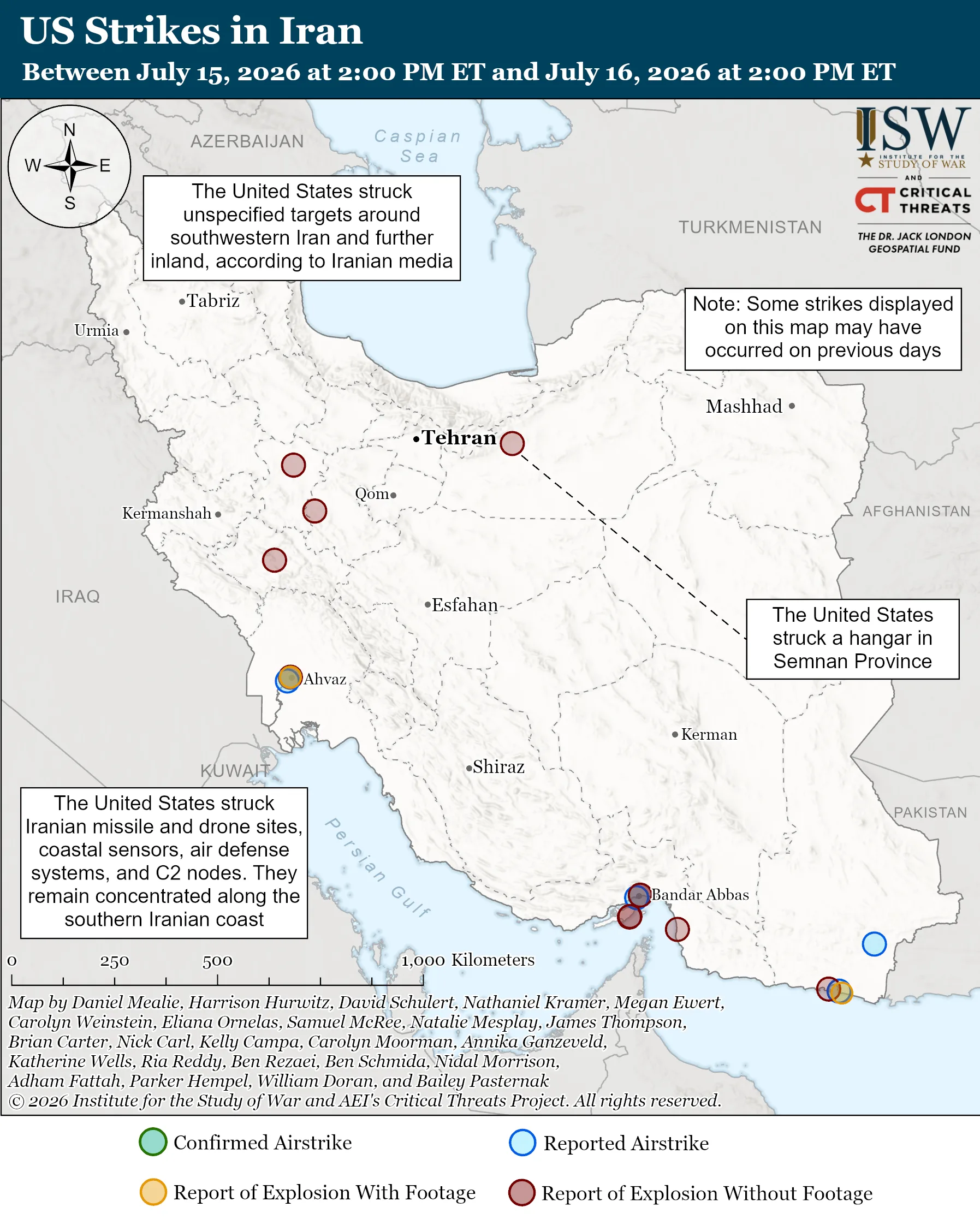
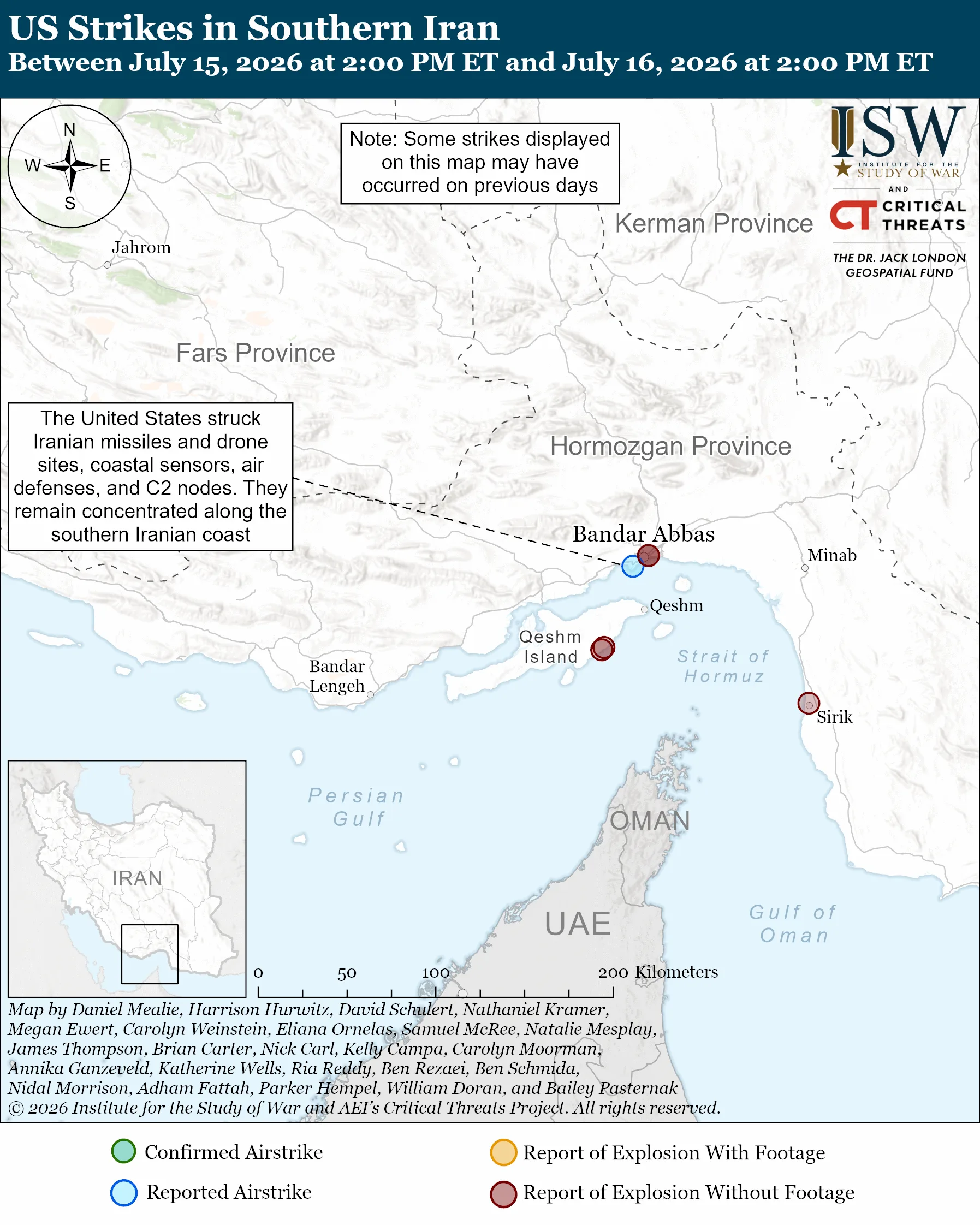
The United States continued to strike Iranian naval and coastal installations that Iran uses to threaten maritime traffic in the Strait of Hormuz on July 15 and 16. US Central Command (CENTCOM) announced on July 15 that US forces struck Iranian command centers, air defense sites, missile and drone capabilities, and coastal surveillance facilities, including near Bandar Abbas and Greater Tunb Island.[19] Iranian media and open-source intelligence accounts on X recorded US airstrikes targeting Islamic Revolutionary Guards Corps (IRGC) Navy and Aerospace Force sites in Hormozgan, Bushehr, Khuzestan, Sistan and Baluchistan provinces near its southern coastline.[20]
 >
>
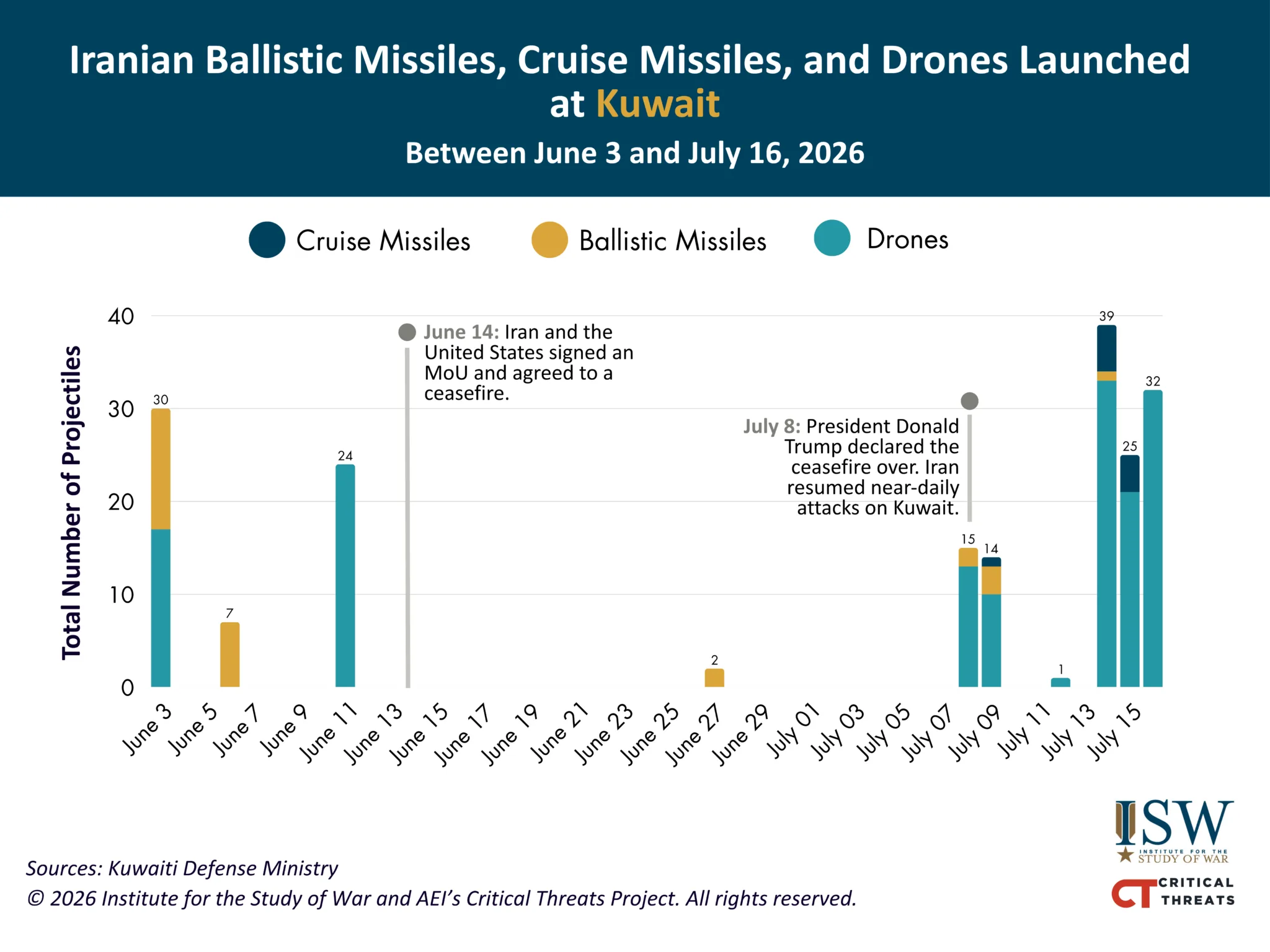
Iran is continuing to retaliate against the United States by firing at US bases in the region. The IRGC and Artesh launched several drone and missile attacks at US bases in Bahrain, Kuwait, and Jordan on July 15 and 16.[21] All three countries appeared to have intercepted the Iranian attacks. Kuwait reported that it intercepted 21 drones and four cruise missiles.[22]
ISW-CTP has not observed Iranian attacks on vessels in the vicinity of the Strait of Hormuz since July 13.[23] Western media reported on July 15 that crews in the strait remain concerned about transiting the strait through the ”southern route” in Omani waters due to the ongoing threat of Iranian attacks.[24]
The IRGC is trying to supply Lebanese Hezbollah with first-person view (FPV), fiber-optic drones and other weapons that the group has used to attack Israeli forces in Lebanon and Israeli towns since March 2026. Syrian Interior Ministry forces thwarted an IRGC attempt to smuggle advanced weapons, including FPV drones, from Iraq through Syria to Hezbollah in Lebanon on July 7.[25] Syrian forces seized the shipment in a vehicle near al Tanf around the Iraq-Syria border.[26] The shipment included hundreds of 13-inch FPV drones and FPV drone components, including Chinese-made fiber-optic spools, Iranian-made PG-7V anti-tank warheads converted for FPV use, and FPV drone batteries.[27] Syrian forces also seized dozens of Iranian Almas anti-tank guided missiles (ATGM) manufactured in 2026 and Iranian Paveh-351 cruise missile components.[28] Hezbollah deployed FPV fiber-optic drones to attack Israeli forces in southern Lebanon and northern Israel for the first time in March 2026 and has deployed them at an increasing scale in the subsequent months.[29] Hezbollah has used fiber-optics systems, including drones equipped with thermal cameras, to impose physical and psychological costs on Israeli ground forces and attempt to compel the IDF to withdraw from Lebanese territory.[30] Unspecified Israeli officials told Western media in May 2026 that the IRGC had sent fiber-optic drones to Hezbollah.[31] A Syrian source reported that the IRGC smuggled the weapons on Iraqi oil tanker trucks traveling in daily convoys to export Iraqi oil through Syrian ports after Iran closed the Strait of Hormuz.[32]
Russia may have supplied Iran with some of the seized fiber-optic drones or drone components. Russia reportedly offered to provide Iran with 5,000 short-range, fiber-optic drones in May 2026, though it is unclear if this transfer ever occurred.[33] Russia would be the most likely actor to have provided Iran with fiber-optic drone capabilities.[34] Some of the equipment seized by Syrian forces contains commercially available Russian- or Chinese-manufactured components. The FPV drones that Syrian forces seized appear to have originated from a Russian company that sells standard and thermal camera-equipped FPV drones for 1,000 to 2,000 US dollars.[35] The seized Chinese fiber-optic spools were reportedly produced in Guangdong and are advertised on Alibaba.[36] These spools range from three to 30 kilometers, though it is unclear which variant and length Syrian authorities seized.[37]
Iran has also likely provided Hezbollah with technical support and knowledge on drone development. Syria- and Iraq-focused analysts have reported that Hezbollah has praised “Dr. Zain” for his role in developing Hezbollah's FPV drone program. Zain reportedly “regularly” visited Iran and worked with the IRGC Quds Force.[38] Israeli media reported that Iran supplies Hezbollah with the technical expertise and funding to develop its drones.[39]
Iran's Judiciary-run outlet, Mizan News Agency, denied reports that Iran released or exchanged a US prisoner.[40] US President Donald Trump stated on July 15 that Iran allowed an American citizen ”wrongfully detained” in December 2024 to leave Iran.[41] Iranian authorities detained an Iranian-American dual national who worked for a US technology company and operated a children's charity in December 2024, according to Western media.[42] Iranian authorities later released the woman from prison but confiscated her passports, prevented her from leaving Iran, and charged her with espionage.[43] Mizan News Agency reported that Iranian prisons had not released or exchanged any convicted US prisoner or “American spy” matching Trump's description or any other description.[44]
Iran is seeking to maintain its oil exports through the Persian Gulf despite the reinstated US naval blockade on Iranian ports. US naval forces disabled a Curacao-flagged oil tanker, M/T Belma, on July 15 as the vessel sailed for Kharg Island.[45] US aircraft struck the smokestack after the ship ignored multiple warnings to stop its course.[46] Tanker Trackers reported on July 16 that M/T Belma has transported at least 38 million barrels of Iranian crude oil over an unspecified number of years in service.[47]
Elements of the Iranian regime continue to debate how much effort Iran should commit to controlling the Strait of Hormuz. An Iranian outlet, Asr Iran, published an op-ed on July 15 that argued that Iran successfully diverted US attention to the Strait of Hormuz and away from the US war aims, such as collapsing the regime and ending Iran's nuclear program. Asr Iran previously had ties to Parliament Speaker and chief negotiator Mohammad Bagher Ghalibaf, who is currently leading the regime's pro-negotiations camp.[48] It is unclear if the outlet is still affiliated with Ghalibaf. The op-ed implied that it is unnecessary for Iran to allocate excessive resources to controlling the strait, particularly if doing so requires Iran to sacrifice other objectives, such as preserving its nuclear program or ensuring regime stability.[49] It remains unclear how widely the author's proposal to shift Iran's priorities away from the strait resonates within mainstream circles in the Iranian regime. Iranian hardliners continue to extol the value of maintaining control over the strait at all costs. Khatam ol Anbia Central Headquarters spokesperson Ebrahim Zolfghari described the strait as Iran's “unbreakable red line” on June 16 and noted that Iran will not allow the United States to interfere in the strait's affairs, for example.[50]
The Lebanese Armed Forces (LAF) began to deploy forces to and near one of the “pilot zones” defined by the June 26 Trilateral Framework Agreement.[51] The LAF announced that its forces began to conduct patrols and establish checkpoints and observation posts in the towns of Ghandouriyeh, Froun, Qalaouiyeh, and Kfar Dounine in Bint Jbeil District, Qaaqaaiyet al Jisr in Nabatieh District, and Srifa in Tyre District on July 16.[52] The Agreement stipulates that Israeli forces will eventually withdraw from areas in southern Lebanon, after which the LAF would secure the pilot zones and disarm and dismantle local armed groups.[53] One of these pilot zones is expected to be centered around Ghandouriyeh and Froun, according to an Israeli government press conference on June 27.[54] An unspecified security source told Lebanese media on July 16 that the Israel Defense Forces (IDF) is not currently deployed in Ghandouriyeh and Froun.[55] ISW-CTP has not observed any LAF deployments to Zawtar el Gharbiyeh yet, which is expected to be the second pilot zone.[56] The LAF deployments follow recent US-mediated talks between Israel and Lebanon in Rome on July 14 and 15, in which the parties discussed the implementation of the pilot zone plan.[57] US, Israeli, and Lebanese military delegations will reportedly meet virtually on July 17 to discuss further implementation of the pilot zones.[58]
Iran likely launched two drones that struck Iraqi energy infrastructure in Basra Province, Iraq, on July 15 and 16 and briefly halted Iraqi oil exports.[59] Iraqi sources told Reuters that a likely Iranian drone struck an oil tanker vessel at Basra's oil terminal on July 16, forcing the terminal to briefly suspend oil loading.[60] There were no casualties. The sources said that the origin of the drone was unclear.[61] The director general of Iraq's state oil company SOMO asserted that the drone did mistakenly strike the Basra Oil Terminal and had a different target.[62] Iraqi media separately reported on July 15 that an “unidentified” drone struck al Faw Port, Basra Province, and ed caused damage but no casualties.[63] Iraqi media published an image of drone wreckage at the port, with Persian writing on the drone commemorating Iranian officials killed in the war, which indicates the drone may have originated from Iran.[64] An Iraqi source claimed that Iran was targeting Kuwait but accidentally struck al Faw port instead.[65] These likely Iranian strikes on Iraqi energy infrastructure coincide with Iraqi efforts to develop oil export routes that bypass the Strait of Hormuz.[66]
An Iranian-backed Iraqi militia denied responsibility for a July 15 drone attack that targeted the US consulate in Erbil and Erbil Airport.[67] Multiple Iraqi sources reported that an unknown actor launched at least eight drones at the US Consulate in Erbil and a US base at Erbil International Airport on July 15.[68] Iraqi air defenses intercepted the drones.[69] Kataib Sayyid al Shuhada spokesperson Kazem al Fartousi told Iraqi media on July 16 that neither the group nor any other militia launched any operations ”toward Erbil.” The spokesperson added that the attacks on US bases and interests in Iraq are part of the ongoing confrontation between Iran and the United States.[70] Kataib Sayyid al Shuhada has conducted numerous attacks on US bases in Iraq during this conflict through its front group, Saraya Awliya al Dam.[71] Iranian-backed Iraqi militias use front groups to conduct attacks and obfuscate responsibility.[72]
https://understandingwar.org/research/middle-east/iran-update-special-report-july-16-2026/
2,271
posted on
07/16/2026 10:35:51 PM PDT
by
AdmSmith
(GCTGATATGTCTATGATTACTCAT)
Tensions in Yemen appear to be rising rapidly: -Houthi leader Abdul-Malik al-Houthi has stepped up his rhetoric against Saudi Arabia, warning of possible military confrontation.
-Senior Houthi officials are in a state of heightened concern.
-Houth-held areas, mainly Sana’a, have been under an unusually high security alert for roughly the past week.
-Several Houthi leaders have moved to undisclosed locations as a precaution.
-Many relatives of senior Houthi officials have departed Sana’a for Amran and Saada governorates.
-The Houthis are reaching out to local figures, offering significant financial incentives to recruit thousands of new fighters.
-Yemen’s internationally recognized govt has placed its armed forces on maximum operational readiness.
https://x.com/Alsakaniali/status/2077881907866378553
2,272
posted on
07/16/2026 10:53:06 PM PDT
by
AdmSmith
(GCTGATATGTCTATGATTACTCAT)
President of Yemen Rashad al-Alimi:
Messages to our people in the militia areas:
1-You are the soul of this republic, and we will not abandon your aspirations, no matter the sacrifices. We have offered every possible initiative to alleviate your suffering, protect your lives, and open horizons for peace, but this renegade group has chosen, every time, to flee into escalation and destruction.
2-The state was never the reason for the closure of Sana’a Airport; rather, it presented one initiative after another to operate flights through the national carrier and ensure the legal continuation of travel for all Yemenis. However, the militias went so far as to seize the aircraft of Yemenia Airways, confiscate its funds, and destroy it, with utter disregard for the suffering of the citizens.
3-To the tribes of Yemen, and to every father and mother:
Do not make your children fuel for futile wars that do not serve your country or its future, for the Republic was established to uphold the dignity of all Yemenis, without discrimination, and true change begins with everyone’s commitment to the project of the state, justice, and equal citizenship.
4-Experiments have proven that the policy of blackmail and escalation will bring Yemen nothing but more suffering. Therefore, the state, with all its institutions and armed forces, will continue to fulfill its constitutional duty in protecting its sovereignty and safeguarding the interests of its citizens, while keeping its hand extended to every sincere endeavor that achieves a just peace that ends the coup and upholds the dignity of Yemenis.
https://x.com/PresidentRashad/status/2077840592512651333
There are many clans and armed groups in Yemen, so it seems the situation is about to escalate.
2,273
posted on
07/16/2026 11:07:56 PM PDT
by
AdmSmith
(GCTGATATGTCTATGATTACTCAT)
Iran Update Special Report, July 17, 2026
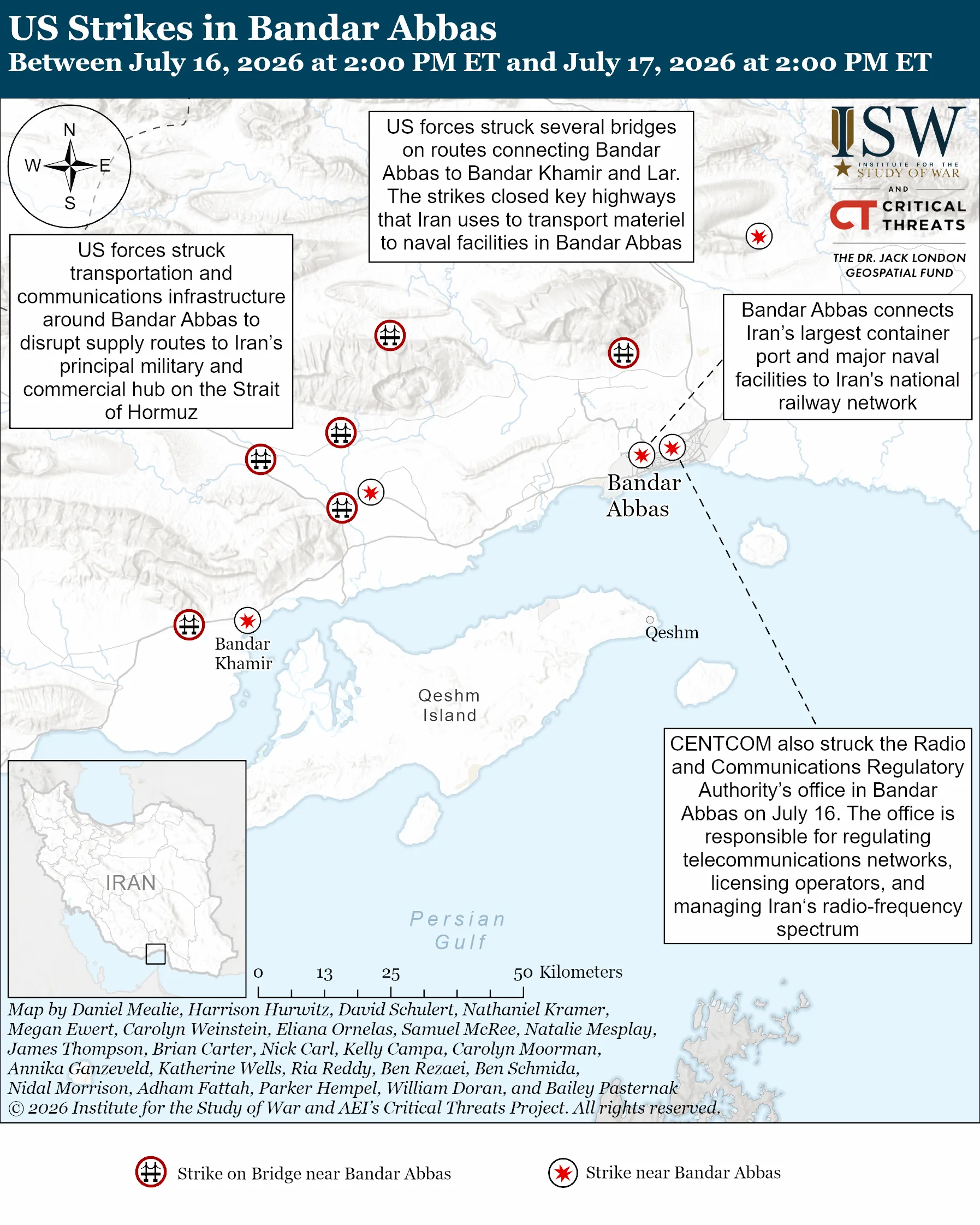
The United States has struck several bridges and railroads in southern Iran since ISW-CTP’s last data cutoff in order to disrupt supply routes to Bandar Abbas, Hormozgan Province, according to a senior US official speaking to the Wall Street Journal.[1] Bandar Abbas is a port city that hosts the IRGC Navy First Naval District and numerous other naval facilities.[2] Iranian state media reported strikes on bridges in and around the city and the closure of highways connecting Bandar Abbas to nearby provinces.[3] The United States also struck the Radio and Communications Regulatory Authority's office in Bandar Abbas on July 16.[4] The office is responsible for regulating telecommunications networks, licensing operators, and managing Iran's radio-frequency spectrum.[5] Iranian media also reported on July 17 that US forces struck Bandar Abbas's railway junction station, which is located approximately 10 kilometers west of Bandar Abbas.[6] Bandar Abbas is Iran's principal military and commercial hub on the strait, as the city hosts key facilities belonging to both the IRGC Navy and the Artesh Navy. The Shahid Rajaei Port in Bandar Abbas handles roughly 85 percent of Iran's container traffic and connects directly to Iran's national rail and highway networks, making Bandar Abbas a critical hub for moving military supplies, fuel, personnel, and commercial cargo between Iran's interior and its southern coast.[7] US Central Command (CENTCOM) acknowledged on July 17 that US forces struck “military logistics infrastructure.”[8]
The Kuwaiti Electricity, Water, and Renewable Energy Ministry announced that an attack, which it attributed to “Iranian aggression,” damaged several power generation units at an unspecified power and water desalination plant on July 17.[9] Kuwait intercepted 32 Iranian drones on July 16.[10] Interceptor shrapnel from an Iranian drone previously struck and damaged a Kuwaiti desalination plant in April 2026.[11] About 90 percent of Kuwait's drinking water comes from desalination.[12]
Iran may have struck the Kuwaiti plant in response to recent US strikes on bridges in Iran and to deter the United States from attacking Iranian energy infrastructure. US forces struck several bridges in Iran on July 17 (see above).[13] Regime officials have repeatedly warned that Iran would attack “regional infrastructure” in response to any US attacks on Iranian critical infrastructure.[14] The Iranian regime has also attributed recent power outages in southern Iran to US strikes, although there is no available evidence at this time that the United States has targeted Iranian energy infrastructure.[15] US President Donald Trump recently threatened on July 14 to expand US strikes to include power plants, and the Iranian strike on the Kuwaiti plant may have been intended to deter the United States from intentionally targeting Iranian energy infrastructure by signaling that Iran could retaliate by attacking critical infrastructure in the region.[16]
Iran attacked US targets in Bahrain, Jordan, Qatar, and Oman on July 16 and 17 as part of Iran's ongoing effort to impose costs on US allies and partners in the region and discourage them from supporting US efforts to undermine Iranian control of the strait.[17] Iran targeted US assets in Oman that support US operations in the Strait of Hormuz, likely to try to degrade the United States’ capability to operate in the strait. The IRGC Navy claimed on July 17 that it destroyed a naval surveillance radar on the Salamah Archipelago and a US air surveillance radar near Ghanem Island in the Persian Gulf.[18] Iran also likely aims to deter Oman from supporting international efforts to undermine Iranian control over the strait. Iran has recently adopted a more hostile tone toward Oman and accused Oman of giving in to “US pressure” to oppose Iranian management of the strait.[19] Iranian officials have explicitly stated that Oman and other Gulf states cannot prevent Iran from asserting control over the strait in recent weeks.[20] Iran also likely seeks to punish US regional allies and make their continued cooperation with the United States increasingly costly. IRGC Aerospace Force Commander Brigadier General Majid Mousavi warned on July 17 that the IRGC will continue to launch “effective and targeted” strikes until the United States ceases its attacks in southern Iran.[21]
The IRGC said that it targeted a US special operations command center at al Tanf Garrison in the Syrian Badia in retaliation for the killing of Iranian soldiers in Iranshahr, Sistan and Baluchistan Province.[22] US forces struck the Artesh Ground Forces 388th Brigade in Iranshahr on July 15, reportedly killing seven Artesh soldiers. US forces withdrew from al Tanf in February 2026, and Syrian government forces assumed control of the position.[23] An unspecified Syrian military source told Reuters that Iran conducted an attack near al Tanf but did not hit the base itself.[24] CENTCOM denied Iranian claims that the attack killed US troops at al Tanf.[25] The Iranian attack on al Tanf comes amid repeated Iranian threats to Syria and was likely intended to deter the Syrian government from taking action against Hezbollah by demonstrating Iran's ability and willingness to attack Syrian territory. An expert close to the Iranian regime warned on July 16 that the Iranian regime would respond to any Syrian action against Hezbollah with Iranian missile and drone attacks on Syria.[26] US President Donald Trump has repeatedly suggested in recent weeks that the Syrian transitional government could play a role in operations against Hezbollah in Lebanon.[27] The location of the al Tanf Garrison attack on July 17 is also notable given that Syrian forces announced that they interdicted an IRGC shipment of drones, missiles, and weapons components intended for Hezbollah near al Tanf on July 16.[28]
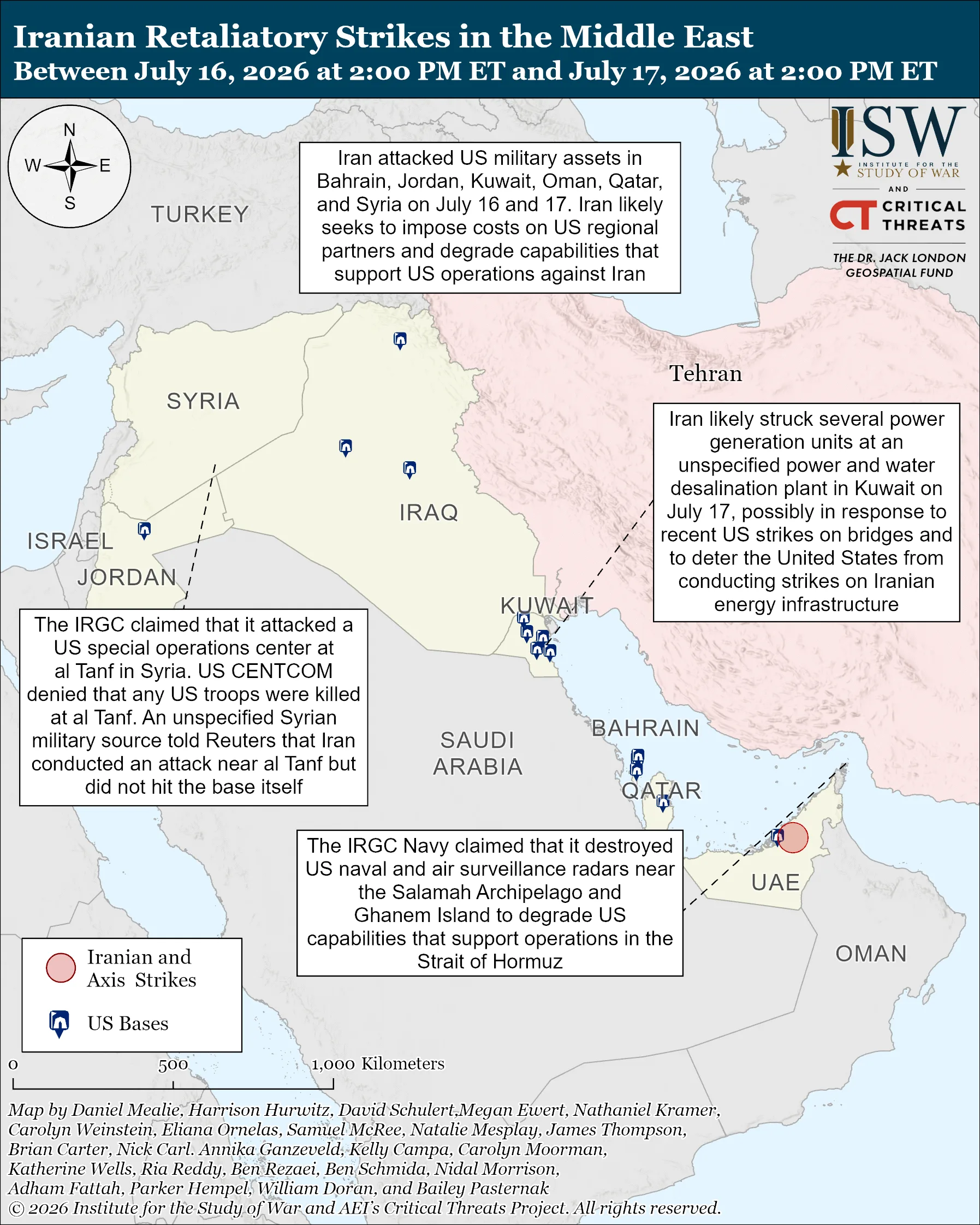
Iran is continuing to use force and the threat of further attacks to impose its control over the Strait of Hormuz. Iran targeted a Thai-flagged vessel in the strait on July 17.[29] Islamic Revolutionary Guards Corps (IRGC)-affiliated Tasnim News Agency, citing an informed source, claimed that the IRGC Navy struck the vessel after it ignored warnings from the IRGC Navy and attempted to transit through the strait without Iranian authorization.[30] United Kingdom Maritime Trade Operations (UKMTO) reported on July 17 that an unidentified projectile struck a vessel 19 nautical miles east of Khasab, Oman.[31] The location of the vessel suggests that it was attempting to pass through the southern transit route along Oman's coast. Iran has repeatedly attacked vessels using this route because the route is an alternative to Iran's illegal traffic separation scheme and therefore undermines Iranian efforts to assert authority over the strait. Kpler data on July 17 shows that only eight vessels transited through the strait on July 16.[32] The low traffic volume on July 16 demonstrates how Iranian attacks on shipping are deterring shipping companies and ship captains from transiting the strait. Seven maritime security and shipping industry sources recently told Reuters on July 15 that shipping companies are avoiding using the southern route despite US military escorts.[33] Iran does not need to routinely attack vessels to disrupt shipping in the strait; a single successful attack, or even the persistent threat of one, can deter vessels from using routes outside Iran's control.

US naval forces are redirecting and disabling vessels around the Persian Gulf and the Gulf of Oman to enforce the naval blockade. The US Navy has redirected three vessels and disabled one vessel since the United States reimposed the US blockade on Iranian ports on July 14.[34] The 11th Marine Expeditionary Unit boarded the Curacao-flagged M/T Wen Yao about 100 nautical miles east of Duqm, Oman, on July 16 to ensure the vessel's compliance with the blockade.[35] Maritime intelligence company Tanker Trackers reported that M/T Wen Yaowas carrying Iranian oil.[36]
The United States conducted a sixth consecutive night of strikes on Iran on July 16 in order to degrade Iran's ability to attack commercial shipping. CENTCOM stated on July 17 that the United States struck dozens of Iranian coastal surveillance and air defense sites, military logistics infrastructure, and maritime capabilities.[37] The United States destroyed the Chahbahar Shahid Kalantari Port surveillance tower on July 17, which CENTCOM said Iran used to track and target commercial vessels in the strait.[38] The United States previously struck the tower on July 8.[39] Iranian media reported that US aircraft also struck the IRGC Navy Imam Ali Naval Base in Chabahar, Sistan and Baluchistan Province, on July 16.[40] The US-Israeli combined force repeatedly struck the Imam Ali base in February and March 2026.[41] Commercially available satellite imagery captured between July 8 and 13 also showed damage to a boathouse and pier in Jask, Hormozgan Province.[42]
An Israeli geospatial analyst reported that commercially available satellite imagery shows that the United States struck the Oghab 44 underground aviation base in northern Hormozgan Province between July 14 and 16.[43] Israeli media reported that this facility probably houses Iranian aircraft and drones in underground facilities.[44] Iranian media separately reported that the United States struck unspecified targets at Iranshahr Airport in Sistan and Baluchistan Province on July 16.[45] The United States previously struck Iranshahr Airport on July 8.[46]
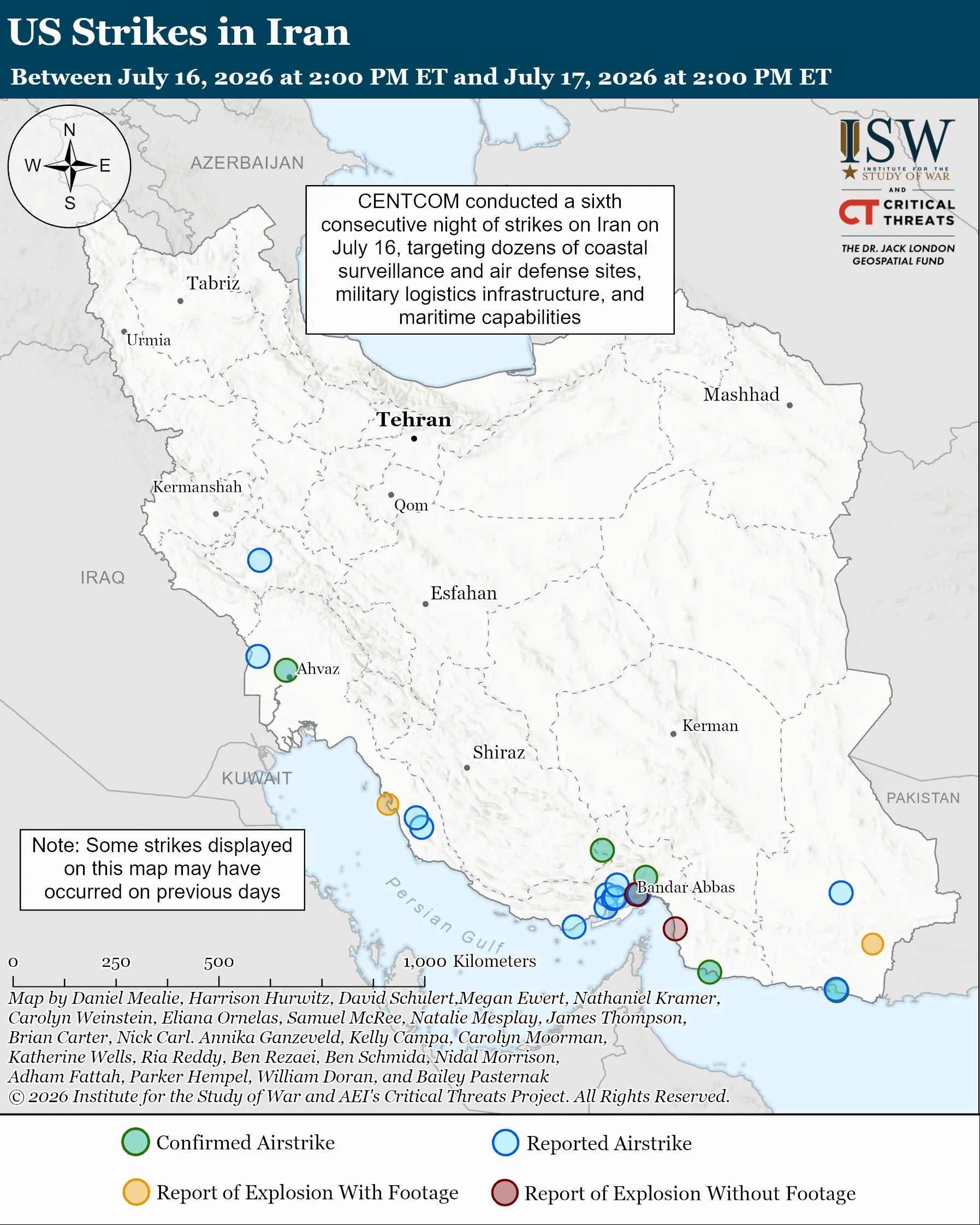
The United States also struck facilities that Iran may be using to strike Gulf states. Commercially available satellite imagery captured between July 15 and 17 showed damage to several buildings at the IRGC Aerospace Force Shahid Assi Zadeh Base in Ahvaz, Khuzestan Province.[47] This base's location in western Iran and distance from the Persian Gulf suggests that this base may be involved in Iranian retaliatory attacks against Gulf countries as opposed to Iranian attacks on commercial shipping. An Israeli geospatial analyst assessed that the United States struck Khorgu Missile Base in Hormozgan Province between July 8 and 16.[48] The United States repeatedly struck the Khorgu Missile Base in March 2026.[49] The geospatial analyst also assessed on July 17 that the United States struck Khormoj Missile Base in Bushehr Province on an unspecified recent date.[50] The analyst said that Iran has launched ballistic missiles from the Khormoj base at Gulf states.[51]
The Lebanese Armed Forces (LAF) continued to deploy forces to one of the “pilot zones” in southern Lebanon on July 17.[52] Lebanese and Israeli media reported that the LAF deployed additional forces to Froun and Kfar Dounine in the Bint Jbeil District on July 17.[53] French media reported that the LAF also deployed additional forces to Qalaouiyeh in Bint Jbeil District on July 17.[54] The LAF began deploying forces to Froun, Kfar Dounine, Qalaouiyeh, and additional areas in and around the “pilot zones” as part of the June 26 Trilateral Framework Agreement on July 16.[55] An Israeli military correspondent close to the Israeli government reported on July 17 that Kfar Dounine is within one of the pilot zones.[56] Israeli Prime Minister Benjamin Netanyahu did not include Kfar Dounine in the two pilot zones that he announced on June 27, however.[57] Netanyahu originally stated that one pilot zone would include territory surrounding Zawtar el Gharbiyeh in Nabatieh District, and the other pilot zone would include territory surrounding Ghandouriyeh and Froun in Bint Jbeil District.[58] Israeli media reported on July 17 that Zawtar al Charqiyeh in Nabatieh District is expected to be the next pilot zone.[59]
Unidentified actors conducted multiple drone attacks targeting several sites in Iraqi Kurdistan, including the US Consulate in Erbil, on July 17.[60] Kurdish counter-terrorism authorities stated on July 17 that US-led international coalition forces intercepted eight booby-trapped drones but provided no further details.[61] Iraqi media separately reported on July 17 that air defenses at Erbil International Airport shot down four drones attempting to target the US Consulate in Erbil.[62] Iranian-backed Iraqi militias launched numerous attacks against US positions in Iraqi Kurdistan during the war.[63] Unidentified actors also launched at least eight drones at the US Consulate in Erbil and a US base at Erbil International Airport on July 15.[64] No actor claimed the attack, and Iranian-backed Iraqi militia Kataib Sayyid al Shuhada denied responsibility for it.[65]
Iraqi Shia Coordination Framework sources revealed to regional media on July 17 additional information about how Iranian-backed Iraqi militias are attempting to circumvent the Iraqi federal government's disarmament initiative.[66] The sources reported that some militias are surrendering “older and lower-quality” weapons, such as heavy mortars, Katyusha rockets, armored vehicles, and mines, to the Iraqi state.[67] The framework sources added that the militias have not handed over drones or missiles with a range longer than 50 kilometers.[68] Iraqi media similarly reported on July 10 that unidentified militias are surrendering “scrap” missiles or inoperable drones but keeping functional heavy weapons.[69] Militia attacks during the war demonstrated that the militias have access to a large number of missiles and drones, including first-person view (FPV) drones.[70] The militias have acquired many of these weapons from Iran and via smuggling routes in Syria. The Iraqi federal government lacks accurate information about the number and types of militia weapons due to the covert nature of the militias, including those within the Iranian-backed Popular Mobilization Forces (PMF).[71]
Kuwait is reportedly negotiating an expanded defense pact with Pakistan that would build upon a limited 2023 bilateral defense agreement between the two countries.[72] Unspecified Pakistani officials told Reuters on July 17 that Kuwait wants Islamabad to deploy aircraft, drones, an air defense system, and thousands of troops to Kuwait as part of the agreement.[73] Kuwait and Pakistan's limited 2023 agreement includes joint training and capacity-building programs.[74] Kuwait would help boost Pakistan's oil and fuel reserves under the new agreement.[75] A source familiar with Kuwaiti security planning told Reuters that Kuwait views Pakistan as a safe alternative for defense cooperation given Pakistan's long history of defense procurement and its positive relationships with Saudi Arabia and the United States.[76] Saudi Arabia signed a mutual defense pact with Pakistan in September 2025.[77] Unspecified sources with knowledge of Kuwait-Pakistan talks told Reuters that the negotiations are in an “early stage.”[78]
https://understandingwar.org/research/middle-east/iran-update-special-report-july-17-2026/
2,274
posted on
07/18/2026 4:29:18 AM PDT
by
AdmSmith
(GCTGATATGTCTATGATTACTCAT)
2,275
posted on
07/18/2026 4:39:06 AM PDT
by
AdmSmith
(GCTGATATGTCTATGATTACTCAT)
To: nuconvert; BeauBo; blitz128; gleeaikin
Iran Update Special Report, July 18, 2026
Iran is adapting to US defenses by firing high-speed, maneuverable missiles at US bases in the region, which highlights the threat that the advancement of Iran's ballistic missile program poses to US national security interests.[1] US officials told the Wall Street Journal on July 18 that Iran is using missiles that “travel at extremely high speeds and can maneuver as they streak toward the earth.”[2] Iranian leaders have expressed interest since at least the Iranian strikes on Israel in April and October 2024 in employing maneuverable reentry vehicles in order to improve the relatively low accuracy of Iranian missiles.[3] All ballistic missiles have a circular error probable (CEP), which is the “radius of a circle, centered at the intended target, within which 50 percent of the missiles would be expected to impact.”[4] The stated and publicly known CEPs of Iranian medium-range ballistic missiles are between 20 and 500 meters.[5] A maneuverable reentry vehicle can be used to evade anti-ballistic missile systems or improve the accuracy of ballistic missiles by altering their trajectory during the terminal stage of flight.[6] Iranian leaders examined using maneuverable reentry vehicles and other technical improvements to missile accuracy after the 12-Day June 2025 War.[7] Such improvements could make individual projectiles harder to intercept and more destructive.[8] Iran still struggled with relatively poor missile accuracy in its strikes against Israeli military targets in March and April 2026, however, which likely pushed Iran to deploy cluster munitions at a greater scale in order to maximize damage.[9]
Iran previously claimed in May 2025 that it had developed a maneuverable reentry vehicle capability, and it is possible that Iran has deployed missiles with that capability in the current conflict. Iran introduced an upgraded version of the Haj Qassem missile with a maneuverable reentry vehicle in May 2025 known as “Qassem Basir.”[10] IRGC-affiliated media posted footage of Iranian forces launching Haj Qassem missiles at Jordan and other Gulf states on July 18.[11] It is unclear if Iranian forces fired the Qassem Basir variant, however.[12]
An Iranian missile attack on a base in Jordan killed two US service members on July 17.[13] A third service member is missing in action.[14] Unspecified US officials told Western media that the attack took place at Muwaffaq Salti Airbase in Azraq, Jordan.[15] It is not clear which missiles Iran used in the attack. Two US officials said that Iran struck the base earlier this week and the US service members suffered minor injuries.[16]
The People's Republic of China (PRC) and Russia are likely supporting Iranian efforts to target US bases in the region. US officials told the Wall Street Journal on July 18 that they are concerned that the PRC and Russia are supporting recent Iranian targeting of US assets.[17] Both countries have supported Iranian targeting during the conflict thus far. Iran used an advanced reconnaissance satellite purchased from the PRC in 2024 to target US military assets and bases across the Middle East in spring 2026, according to the Financial Times in April 2026.[18] The Washington Post separately reported in March 2026 that Russia was providing Iran with the locations of US military assets, including warships and aircraft, to support Iranian attacks against US forces.[19] Russia is also reportedly sharing advanced drone tactics with Iran to support Iranian attacks against US forces and assets. [20] Iran likely continues to rely on its key partners to improve the accuracy and effectiveness of its attacks.

Iranian Supreme Leader Mojtaba Khamenei and other senior Iranian officials, including members of the negotiating delegation, have publicly declared that the US–Iran memorandum of understanding (MoU) is no longer in effect. Mojtaba published a statement on July 18 condemning alleged US “violations” of the US-Iran MoU and claiming that US “violations,” including airstrikes on Iran, prove that US President Donald Trump's signature of the MoU was “invalid.”[21] Iranian Deputy Foreign Affairs Minister for International and Legal Affairs Kazem Gharibabadi told Iranian state media earlier on July 18 that Iran is “suspending” its commitments and implementation of the MoU.[22] It remains unclear if the Iranian regime has given up on diplomacy entirely, however. The Supreme Leader's military adviser, Major General Mohsen Rezaei, stated on X on July 17 that “both diplomacy and negotiations…are over,” but some regime elements continue to advocate for diplomacy to achieve Iranian objectives.[23] Iranian negotiating team head and Parliament Speaker Mohammad Bagher Ghalibaf argued on July 15 that Iran needs diplomacy with the United States to secure its national interests.[24] Regime outlet Nour News separately published an op-ed on July 18 in which it argued that diplomacy would secure Iran's interests through long-term commitments.[25]
Iran and the United States interpreted the MoU’s fifth clause about the Strait of Hormuz in fundamentally different ways, which contributed to the MoU’s collapse. The MoU stipulated that Iran had to make “its best efforts” to ensure the safe passage of traffic through the strait.[26] US President Donald Trump indicated that the MoU would enable traffic in the strait to return to pre-war conditions, inferring that the MoU would remove the Iranian threat to shipping and dispel Iranian control over the strait.[27] Iran interpreted the clause as affirming Iranian authority over the strait, however, and only allowed safe passage for vessels through Iran's traffic separation scheme. [28] Iran has repeatedly attacked vessels attempting to transit through the strait via the southern corridor along Oman's coast. Iran's Ambassador to Pakistan, Reza Amiri Moghadam, claimed on X on July 18 that the United States interpreted the MoU in a manner inconsistent with its original intent and used it to ”gain control” over parts of the Strait of Hormuz, almost certainly referring to the US-sponsored southern corridor.[29] Iranian Judiciary Chief Gholam Hossein Mohseni Ejei separately described US plans for a southern corridor in the Strait of Hormuz as a “strategic failure.”[30]
The fifth clause also required Iran to engage in talks with Oman and other Persian Gulf littoral states regarding the future management of the strait.[31] Iran consulted the Gulf states, but these states rejected Iran's management of the strait, including Iran's proposal to impose transit fees and other restrictions on vessels transiting the waterway.[32] ISW-CTP previously noted that the fifth clause assumed that the Gulf states would moderate Iran's stance on the strait and that Iran would reach an agreement with these states. The clause did not take into account that Iran could resort to using force to advance its objective of securing permanent control over the strait. Iran has adopted an increasingly hostile tone toward the Gulf states in recent weeks, and its current attacks on the Gulf states are likely, in part, meant to deter these states from continuing to oppose Iranian control of the strait (read more about Iran's attacks on the Gulf states below).[33]
Iran struck a Kuwaiti power and desalination plant on July 18, likely in response to an alleged US strike on an Iranian desalination plant near Jask, Hormozgan Province, on July 17. Iranian officials alleged that the United States struck “power facilities and desalination pumps” on a pier in Bonji village, north of Jask, on July 17.[34] Several Iranian media outlets circulated photos of a destroyed structure along the pier.[35] ISW-CTP cannot independently confirm the structure's purpose. A local official claimed that US strikes on the facility cut off water to several villages west of Jask.[36] Iranian regime officials have repeatedly warned in recent days that Iran would attack “regional infrastructure” in response to any US attacks on Iranian critical infrastructure.[37] The Iranian attack on the Kuwaiti power and desalination plant on July 18 marks the second attack that Iran has conducted on such a plant in Kuwait in the past 48 hours. Commercially available satellite imagery captured on July 18 showed smoke rising over the Shuaiba Power Plant.[38] Iran also struck an unspecified Kuwaiti oil facility on July 18.[39] The Kuwait Petroleum Corporation said that the facility suffered material damage.[40] Iran has not acknowledged the attacks on Kuwaiti critical infrastructure at the time of this writing and claimed that it targeted a radar and support center at two US bases in Kuwait.[41]
The United States has struck additional bridges and roads around Bandar Abbas, Hormozgan Province, since ISW-CTP’s last data cutoff at 2:00 PM ET on July 17.[42] A senior US official speaking to the Wall Street Journal on July 17 said that the United States has targeted transportation infrastructure around Bandar Abbas in order to disrupt supply routes to the city.[43] Bandar Abbas is a port city that hosts the IRGC Navy First Naval District and numerous other naval facilities, and the city is also vital for moving military supplies, fuel, personnel, and commercial cargo between Iran's interior and its southern coast.[44] US strikes have targeted several bridges linking Bandar Abbas to nearby towns and Iranian provinces.[45] Geolocated footage posted by an OSINT account on July 18 shows damage from US strikes on July 16 to a tunnel that connects Bandar Abbas to a nearby county.[46] IRGC-affiliated media reported on July 18 that recent US strikes caused 116 telecom towers to go offline in Bandar Abbas and Hajjiabad, which is about 100 kilometers north of Bandar Abbas.[47] Israeli media claimed on July 18 that the telecom towers “support SIM cards used to control” Shahed drones and that the damage to the towers could limit the range of the drones that Iran uses to attack shipping in the Strait of Hormuz.[48] The United States previously struck on July 16 the Radio and Communications Regulatory Authority's office in Bandar Abbas, which is responsible for regulating telecommunications networks, licensing operators, and managing Iran's radio-frequency spectrum.[49] Iran has taken several steps to re-open its supply routes in Bandar Abbas and clear damage from US strikes. Iranian authorities announced on July 18 that they opened an alternative route to avoid a bridge that the United States attacked on July 17, for example.[50]
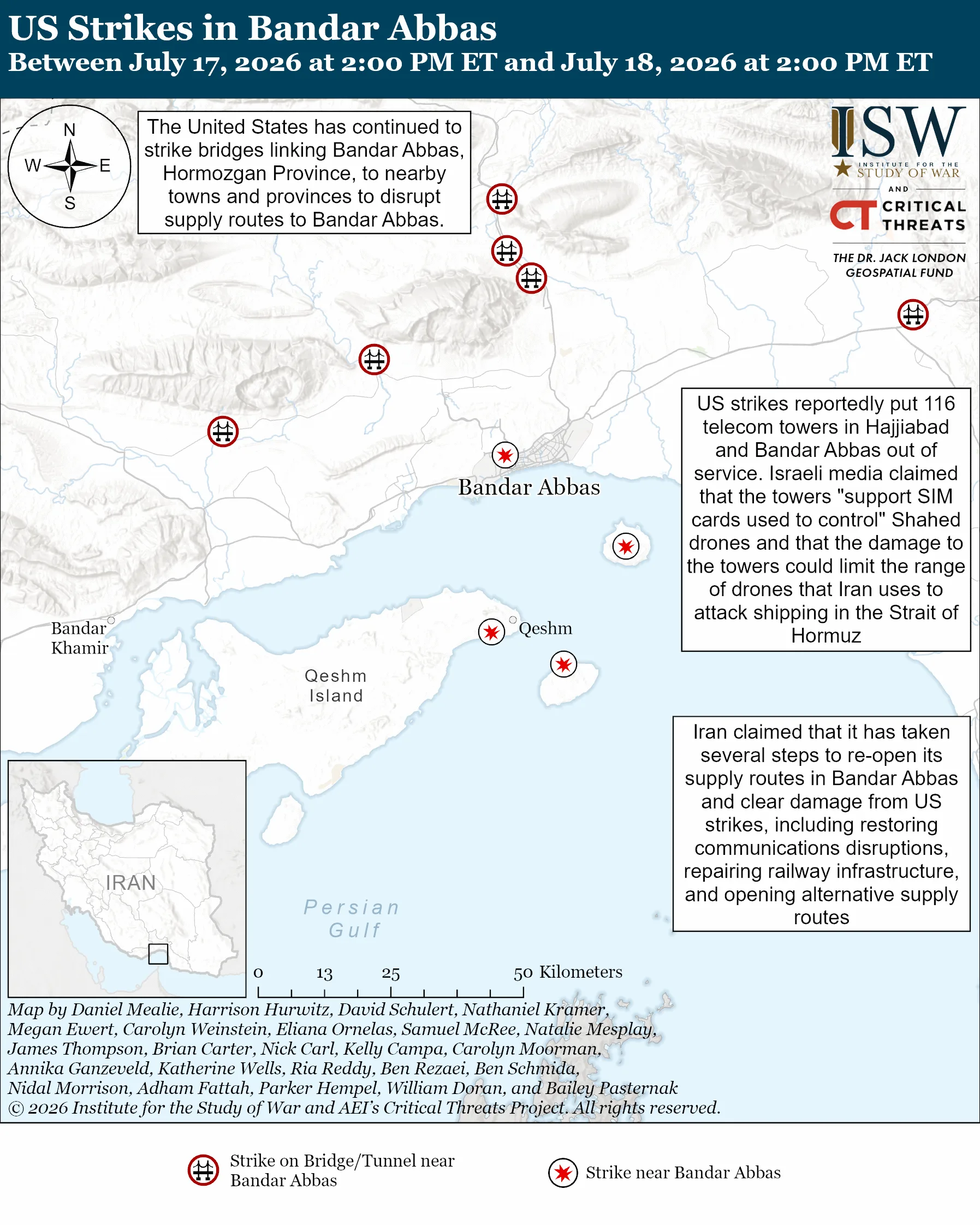
Iran launched a ballistic missile at a US base in Saudi Arabia, marking the first Iranian attack on Saudi territory in nearly three months.[51] Iran launched one ballistic missile at an unspecified base in al Kharj, near Riyadh.[52] Prince Sultan Airbase is located in al Kharj. Early warning sirens also went off in Yanbu on Saudi Arabia's Red Sea coast, although it is unclear whether an attempted attack took place there.[53] Saudi Arabia relies on Yanbu as a key oil export terminal to mitigate disruptions from the closure of the Strait of Hormuz.[54] The Iranian attack on Saudi Arabia comes amid heightened tensions between Saudi Arabia and the Houthis. Saudi Arabia recently struck Houthi-controlled Sanaa International Airport to prevent an Iranian Mahan Air flight from landing there, after which the Houthis responded by attacking an airport in southern Saudi Arabia.[55] It is possible that Iran conducted the attack on al Kharj on July 18 to deter Saudi Arabia from taking further action against the Houthis.
Iran appears to be less willing to target Saudi Arabia with the intensity that it is currently targeting other regional US allies, given that Iran only fired a single missile at al Kharj. Iran previously reduced its rate of attacks on Saudi Arabia in March following reports that Saudi Arabia was considering responding to the attacks.[56] Saudi Arabia, which has conducted covert strikes on Iran during the war, has favored reaching a diplomatic agreement with Iran and reportedly even briefly explored pursuing a mutual non-aggression pact with Iran.[57]
Iran also targeted US facilities in Bahrain and Jordan on July 17 and 18. The IRGC claimed that it targeted several US bases and a data center in Bahrain.[58] Bahrain said that it intercepted multiple Iranian attacks on July 18.[59] The Jordanian Defense Ministry intercepted four Iranian drones and 10 missiles on July 18.[60]
Iran continues to attempt to coerce vessels to transit through Iranian territorial waters in order to secure recognized control over the strait and impose transit fees on these vessels. An Iranian Environmental Protection Agency official announced on July 18 that the agency asked the government to charge fees for “environmental services” from ships transiting the strait, citing the UN Convention on the Law of the Sea (UNCLOS).[61] UNCLOS stipulates that coastal countries may not impose fees or hamper maritime traffic in international waterways but may charge fees within territorial waters.[62] Iran is forcing vessels to transit Iranian territorial waters by conducting drone and missile attacks on vessels using routes outside of Iranian territorial waters, including the southern route along the Omani coast.[63] The Islamic Revolutionary Guards Corps (IRGC) Navy announced on July 17 that it conducted combined drone and missile attacks on “four violating ships.”[64] ISW-CTP has not recorded any new Iranian attacks on civilian vessels since its last data cutoff at 2:00 PM ET on July 17, however. The IRGC Navy may have been referring to vessels it attacked prior to the data cutoff.[65] These vessels may have also not reported the incidents. Iranian officials continue to threaten attacks against vessels. Iranian Armed Forces General Staff Commander's senior adviser Brigadier General Hossein Ashtari threatened “a crushing response to any move” from the United States and “any interference in the Strait of Hormuz” on July 17.[66]
The United States conducted a seventh consecutive night of strikes on Iran on July 17 in order to degrade Iranian military capabilities.[67] CENTCOM said that the United States targeted Iranian surveillance sites, military logistics infrastructure, underground weapons storage sites, and maritime capabilities.[68] Anti-regime media posted footage on July 18 of smoke rising from the 10th Artesh Air Force Tactical Airbase in Konarak, Sistan and Baluchistan Province.[69] The United States repeatedly struck this base during the war in March and April.[70] Two OSINT accounts reported that the United States struck a missile launch site in Lar, Fars Province, on July 17.[71] The United States may have also struck the Yazd Missile Base, given that Iranian media and multiple OSINT accounts reported explosions in the area.[72] Iran frequently launches missiles from this base, and the US-Israeli combined force struck the site at least five times during the war.[73] OSINT accounts and anti-regime media also reported strikes in Sanandaj, Kurdistan Province, and posted footage of the aftermath of an explosion in Sepahan Shahr, Esfahan Province.[74] Three US officials told Reuters on July 16 that recent US strikes in Iran can be viewed as “shaping operations” but did not provide further details.[75] Supreme Leader Military Adviser Major General Mohsen Rezaei threatened on July 17 that Iran will begin “full-scale destruction” if the United States continues to attack Iran in the next two to three days.[76]
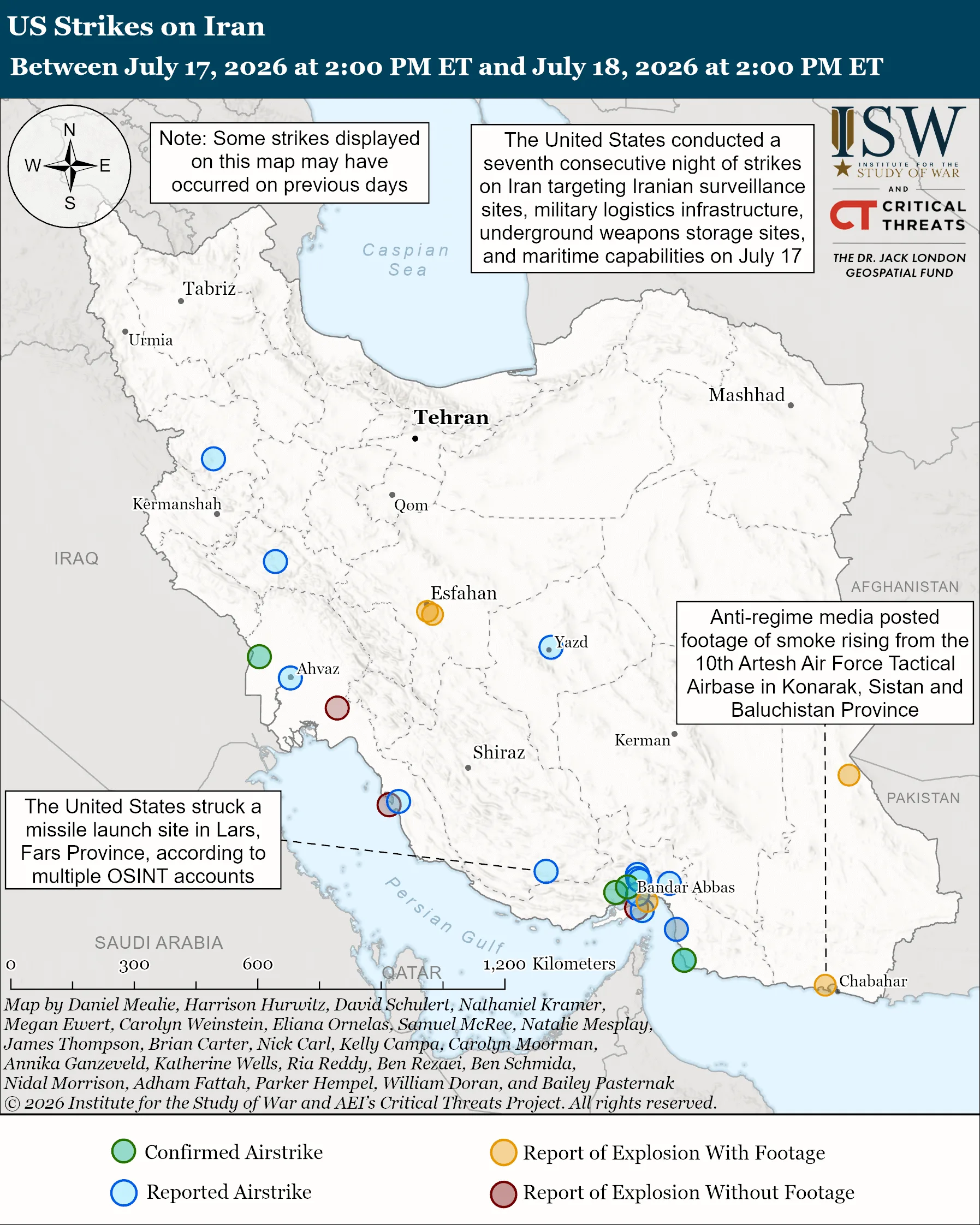
Unidentified actors launched drones at unspecified targets in Erbil, Iraqi Kurdistan, on July 17. The US-led international coalition intercepted five drones over Erbil on July 17, according to Kurdish media.[77] Unidentified actors launched eight booby-trapped drones in Erbil earlier on July 17, some of which may have been targeting the US Consulate in Erbil.[78] Unidentified actors also launched at least eight drones at the US Consulate in Erbil and a US base at Erbil International Airport on July 15.[79] Iranian-backed Iraqi militias launched numerous attacks against US positions in Iraqi Kurdistan during the war in March and April, but no group has claimed responsibility for these recent attacks at the time of this writing.[80]
https://understandingwar.org/research/middle-east/iran-update-special-report-july-18-2026/
2,276
posted on
07/19/2026 7:06:01 AM PDT
by
AdmSmith
(GCTGATATGTCTATGATTACTCAT)
Iran Update Special Report, July 19, 2026
Iranian Foreign Affairs Minister Abbas Araghchi implied on July 19 that a special committee within the Supreme National Security Council (SNSC) made important decisions on negotiations with the United States without the direct input of Supreme Leader Mojtaba Khamenei, which highlights the seemingly limited role that Mojtaba has played in regime decision-making over the past several months.[1] Araghchi told regime media on July 19 that a six-person committee in the SNSC, which he said was formed between the June 2025 and Spring 2026 wars, was responsible for making decisions “on the spot” regarding negotiations with the United States when Iranian leaders were unable to contact Mojtaba.[2] The SNSC is Iran's highest national security and foreign policy decision-making body. The SNSC includes 11 senior leaders, including the president, parliament speaker, judiciary chief, foreign affairs minister, and IRGC commander, among others.[3] Araghchi stated that he, President Masoud Pezeshkian, Parliament Speaker Mohammad Bagher Ghalibaf, and SNSC Secretary Mohammad Bagher Zolghadr are part of the committee.[4] Araghchi’s comment that the committee made key decisions “on the spot” is notable given the historic role that the supreme leader has traditionally played as the ultimate decision-making authority. Araghchi’s acknowledgement of the committee comes amid numerous reports in recent months that Mojtaba is incapacitated or seriously wounded following combined force strikes during the war.[5] Many Iranian officials reportedly continue to have difficulties contacting Mojtaba.[6] Israeli media reported on April 19 that Vahidi, whom ISW-CTP assesses is driving regime decision-making, is the only Iranian official with direct access to Mojtaba.[7] Araghchi’s comments about the six-person committee are consistent with a Reuters report from April that Mojtaba has been “legitimizing” decisions made through “institutional consensus.”[8]
Vahidi is very likely one of the six members of the SNSC’s special committee due to the outsized role he has played in regime decision-making over the past several months. The Wall Street Journal reported on June 13 that Vahidi has frequently overruled Araghchi and Iranian President Masoud Pezeshkian, who sought a deal with the United States in order to secure economic relief.[9] Anti-regime media similarly reported on April 14 that regime officials, which ISW-CTP assessed almost certainly included Vahidi, summoned the Iranian negotiating team to return to Tehran from negotiations with the United States in Pakistan after Araghchi reportedly expressed flexibility regarding the regime's red lines.[10] Araghchi and others in the pro-negotiations camp have continued to defend the need to engage in talks with the United States in order to secure the regime's objectives. Araghchi stated in the interview that negotiations with the United States did not cause the current war and that the decision to negotiate was a collective regime decision.[11] Araghchi’s emphasis on the decision to negotiate being a collective choice, rather than an individual one, is notable because it may be an attempt to counter recent reports that Vahidi is dominating regime decision-making and sidelining pragmatist actors in the regime.
Iran continues to use force to coerce vessels to transit through Iranian territorial waters in order to secure recognized control over the strait. The Islamic Revolutionary Guards Corps (IRGC) Navy announced on July 19 that it attacked four vessels with “malicious intent.”[12] ISW-CTP has not recorded any Iranian attacks on civilian vessels since its last data cutoff at 2:00 PM ET on July 18, however. The IRGC Navy similarly claimed attacks on four “violating vessels” on July 17, which ISW-CTP also could not confirm.[13]
The United States conducted an eighth consecutive night of strikes on Iran on July 18 to degrade Iran's ability to target international shipping and respond to an Iranian attack on US forces in Jordan on July 17 that killed two US service members.[14] US Central Command (CENTCOM) announced on July 18 that it struck various Iranian military targets, including coastal surveillance sites, air defense systems, maritime assets, and missile and drone storage facilities.[15] CENTCOM also said that it struck Islamic Revolutionary Guards Corps (IRGC) forces responsible for the missile attack that killed two US service members at Muwaffaq Salti Airbase in Jordan on July 17.[16] The Atomic Energy Organization of Iran announced on July 19 that the United States struck the Darkhovin Nuclear Power Plant in Khuzestan Province.[17] The International Atomic Energy Agency (IAEA) said on July 19 that the facility was in the “very early stages of construction” and that the IAEA did not find nuclear material there during its last inspection, although an Israeli analyst claimed that the site's nuclear reactor was at an ”advanced” stage in development.[18]
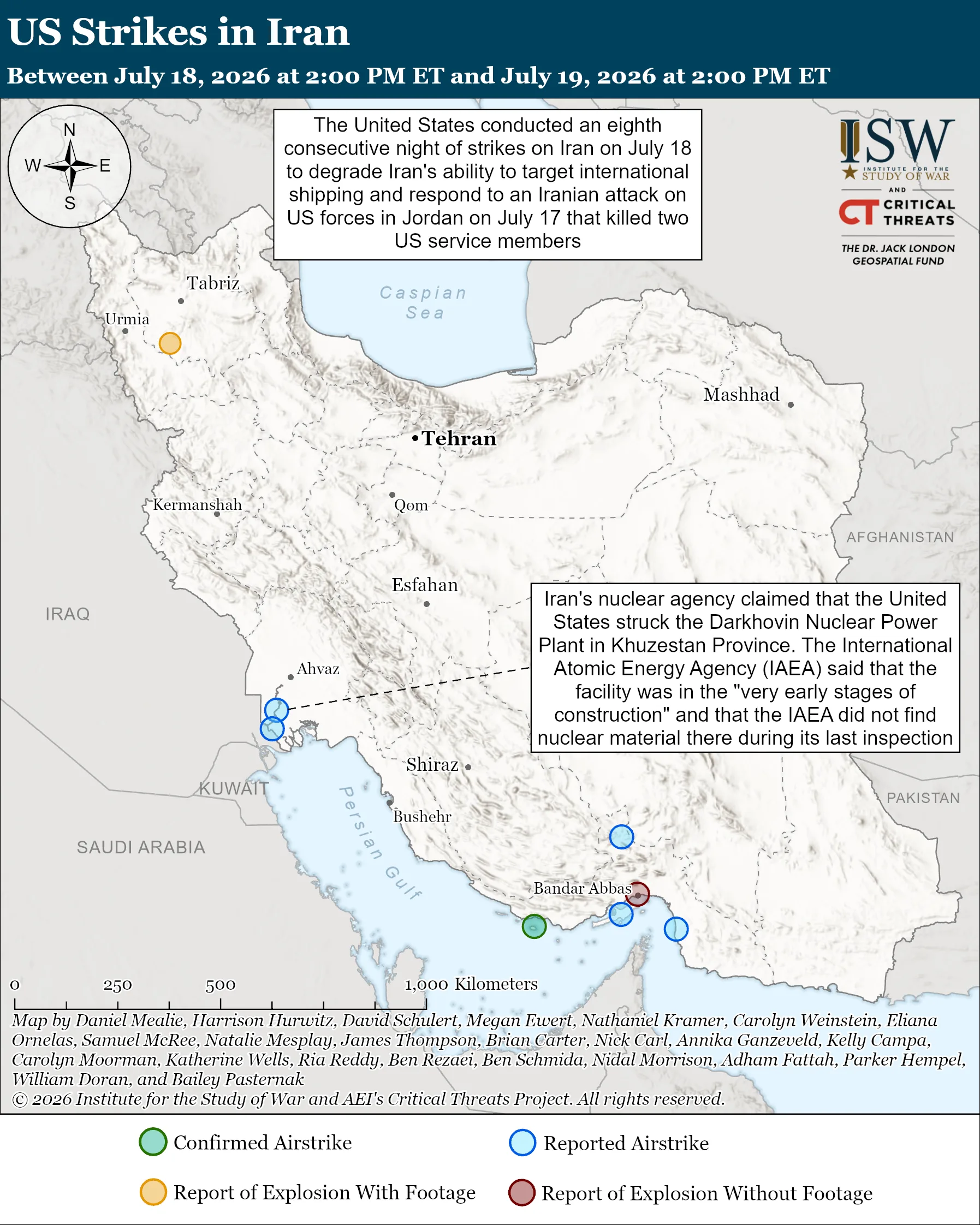
Various Iranian regime officials claimed on July 19 that Iranian authorities have quickly repaired and reopened damaged roadways and other infrastructure following US strikes in recent days.[19] Iranian Law Enforcement Command Traffic Police Chief Timour Hosseini announced on July 19 that the Shahed Mirzaei Tunnel, north of Bandar Abbas in Hormozgan Province, reopened less than 48 hours after US forces struck and damaged the tunnel.[20] Iranian Energy Minister Abbas Aliabadi also announced on July 19 that Hormozgan provincial authorities repaired five power transmission lines within hours of sustaining damage in US strikes.[21] ISW-CTP cannot verify these claims, however.
Iran continues to conduct drone and missile attacks on Gulf energy and telecommunications infrastructure, as well as US regional bases, in response to US airstrikes on Iran. Kuwait's Electricity, Water, and Renewable Energy Ministry announced on July 19 that Iran had conducted an attack on one of its power generation and water desalination plants for the second time in two days.[22] The attack caused a fire and damage to parts of the facility.[23] An Iranian attack on the same facility on July 18 had also caused a fire, forcing some production units to be shut down.[24] The July 19 attack was the third Iranian attack on Kuwaiti power and water desalination facilities in three days.[25] The IRGC Navy separately claimed on July 18 that it targeted a data center belonging to Bahraini state-run telecommunications company Batelco that the IRGC claimed the US military uses.[26] An IRGC-affiliated outlet published satellite imagery of alleged damage to the Bahraini data center on July 19.[27] An open-source intelligence (OSINT) account and publicly available satellite imagery confirmed on July 19, however, that Iran struck the data center's electrical substation, but not the data center itself.[28] The Kuwaiti Armed Forces and Bahrain Defense Force General Command also confirmed that they intercepted Iranian drone and missile attacks on July 19.[29] The Iranian Artesh announced that it has conducted two waves of drone strikes since ISW-CTP’s last data cutoff at 2:00 PM ET on July 18, including an attack on a US ammunition depot at Camp Buehring in Kuwait, as well as US radars and barracks at Ali al Salem Airbase in Kuwait.[30]
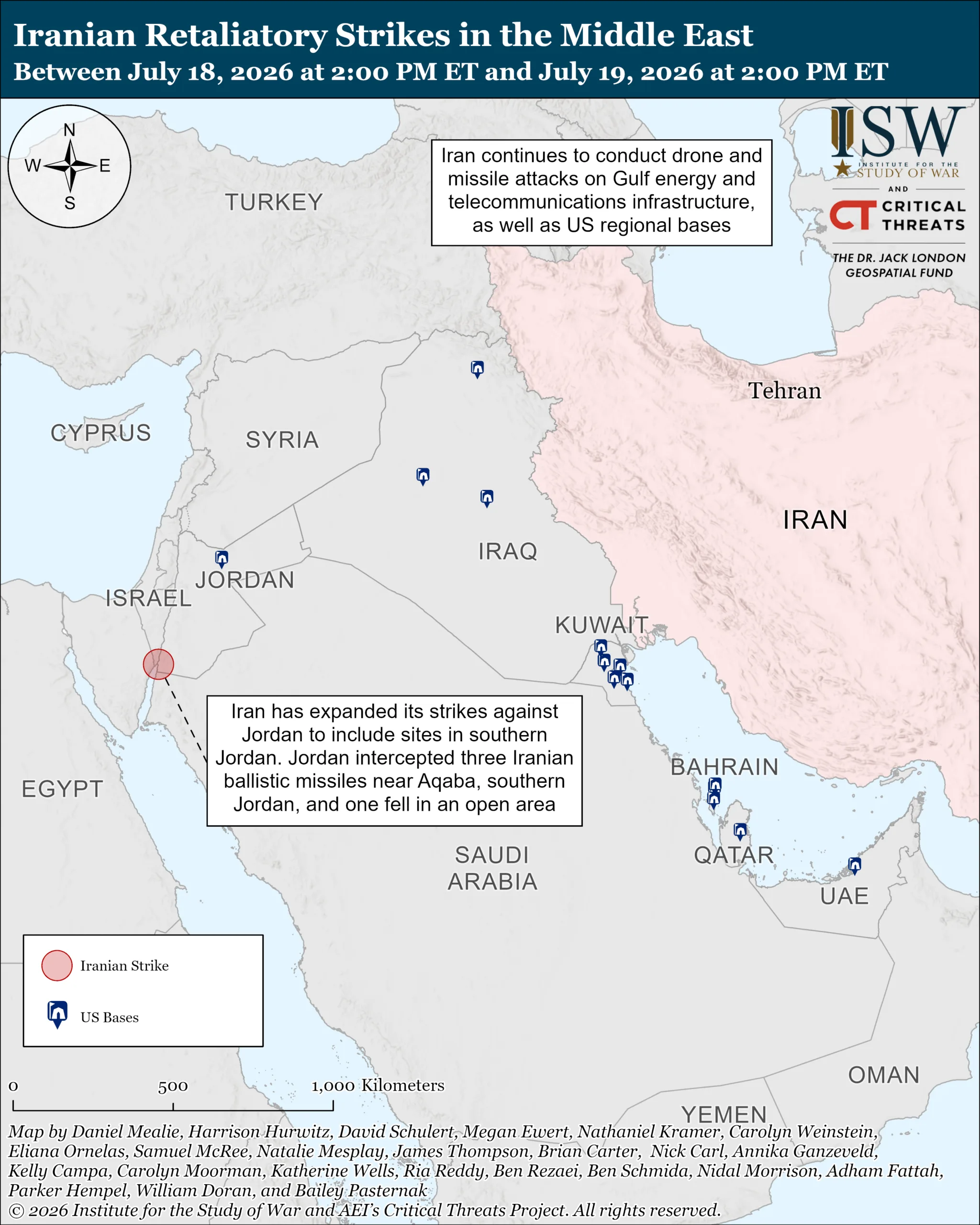
Unidentified actors attacked the US Consulate in Erbil, Iraqi Kurdistan, on July 18.[34] Iranian media reported explosions at the consulate, citing unspecified Iraqi sources.[35] An open-source intelligence (OSINT) account posted footage of US air defenses intercepting unidentified projectiles in Erbil.[36] Iranian-backed Iraqi militias frequently attacked US sites in Iraqi Kurdistan in March and April, but no actor has claimed responsibility for recent attacks on US positions in Iraqi Kurdistan at the time of this writing.[37] CENTCOM separately announced on July 19 that the controlled detonation of unexploded ordnance from a downed Iranian one-way attack drone killed a US service member in Iraqi Kurdistan.[38]
https://understandingwar.org/research/middle-east/iran-update-special-report-july-19-2026/
2,277
posted on
07/20/2026 3:25:39 AM PDT
by
AdmSmith
(GCTGATATGTCTATGATTACTCAT)
Iran Update Special Report, July 20, 2026
The Houthis’ announced naval blockade against Saudi Arabia could result in an expansion of the shipping crisis in the Middle East.[1] ISW-CTP has not recorded any Houthi attacks on shipping since July 7, 2025, at the time of this writing, but the Houthis ordered Saudi-bound vessels to turn back from Saudi Arabia over radio on July 20.[2] The announcement of the blockade combined with the Houthi orders will almost certainly increase the cost of shipping through the Red Sea by discouraging ships from transiting through the Red Sea. Insurance industry sources told Western media July 20 that insurance costs to ship goods through the Red Sea rose following the Houthis’ announcement.[3]
Iran is trying to expand the geographical scope of its conflict with the United States to the Red Sea to cause further disruption to international markets and impose additional costs on the United States. Iran asked the Houthis to prepare to attack Red Sea shipping if the United States expands its airstrikes to Iranian energy infrastructure, according to two senior Iranian sources and an informed regional source speaking to Western media on July 16.[4] Iranian officials, including Islamic Revolutionary Guards Corps (IRGC) Quds Force Commander Brigadier General Esmail Ghaani, have threatened that the Houthis could launch another campaign targeting shipping in the Bab al Mandeb Strait.[5] Saudi Arabia has increasingly relied on the Bab al Mandeb Strait to export its oil to Asian markets in recent months, according to Kpler data cited by the New York Times on July 20.[6]
The Houthis may have announced the blockade to deter Saudi Arabia from striking Houthi targets in Yemen to discourage further Saudi attacks, separate from but partially satisfying Iranian efforts to impose costs on the United States. It remains unclear what triggered the Houthi blockade announcement. Houthi Military Spokesperson Yahya Sarea stated on July 20 that they imposed the blockade in response to Saudi Arabia's imposing an “unjust siege” on Yemen for 12 years, but this is likely a false reason.[7] Saudi forces struck Sanaa International Airport on July 13 due to concerns that Iran would use the direct air route to transfer weapons and military advisers to the Houthis, but the Houthis responded by attacking Abha International Airport in Saudi Arabia on July 13.[8] There have been no further attacks since July 13. The UN negotiated a separate and relatively stable ceasefire between the Houthis, the recognized Yemeni government, and Saudi Arabia that has been in effect since 2022.[9] The Houthi blockade announcement, regardless of the proximate cause and how it affects Houthi objectives in Yemen, supports Iranian efforts to impose costs on the United States.
Some senior Iranian officials appear concerned that the renewed conflict will deepen Iran's economic problems and threaten Iran's internal security. Senior Iranian officials have previously appeared concerned that the conflict will deepen Iran's economic problems, but these concerns do not appear to have meaningfully impacted the calculus of the IRGC. Iranian President Masoud Pezeshkian warned in a Supreme Judicial Council meeting on July 20 that economic pressure could generate social discontent and damage the public support that the regime has gained during the US-Israel-Iran war.[10] Pezeshkian emphasized that the economy and people's livelihoods are Iran's “main battlefield” now.[11] Pezeshkian previously voiced his concerns about the economic costs of war in March, and he convinced the supreme leader to accept the MoU in June using arguments about the MoU’s economic benefits.[12] Pezeshkian’s concern follows the disintegration of the US-Iran memorandum of understanding (MoU) and the highly anticipated economic relief for Iran, economic relief that Iran expected from, including the lifting of the US naval blockade, sanctions relief, and access to frozen assets.[13] The United States did not unfreeze any Iranian assets and has since restored the blockade and revoked the sanctions waiver.[14] Judiciary Chief Gholam Hossein Mohseni Ejei similarly acknowledged that sustaining the war imposes costs on the population and urged officials to address high prices, protect public resilience, and prevent economic hardship from undermining national unity at the same meeting.[15] Both Pezeshkian and Ejei previously aligned with a faction that favored moderation and diplomacy amid concerns for Iran's economy and internal security after the June 2025 Israel-Iran war, according to four senior Iranian officials cited by the New York Times.[16]
Iran continues to coerce vessels by force to transit through Iranian territorial waters to prevent them from using routes through the strait that Tehran does not approve. Iran has attacked at least two vessels in the strait since ISW-CTP’s last data cutoff.[17] Unidentified projectiles struck a Malta-flagged tanker and a Liberian-flagged tanker that were attempting to use the US-facilitated route through the strait on July 19, according to the United Kingdom Maritime Trade Operations (UKMTO) center and western media.[18] The projectiles struck the Malta-flagged vessel 8 nautical miles north of Kumzar, Oman, and forced the crew to abandon ship.[19] Iran also almost certainly conducted another attack on a vessel 17 nautical miles east of Dibba, United Arab Emirates, on July 20.[20] The IRGC described the attacks on the Malta- and Liberian-flagged tankers as “explosions,” thus obfuscating its responsibility, and added that the two vessels were attempting to transit through a “dangerous” route.[21] Iran continues to be the only “danger” in the strait for merchant shipping.
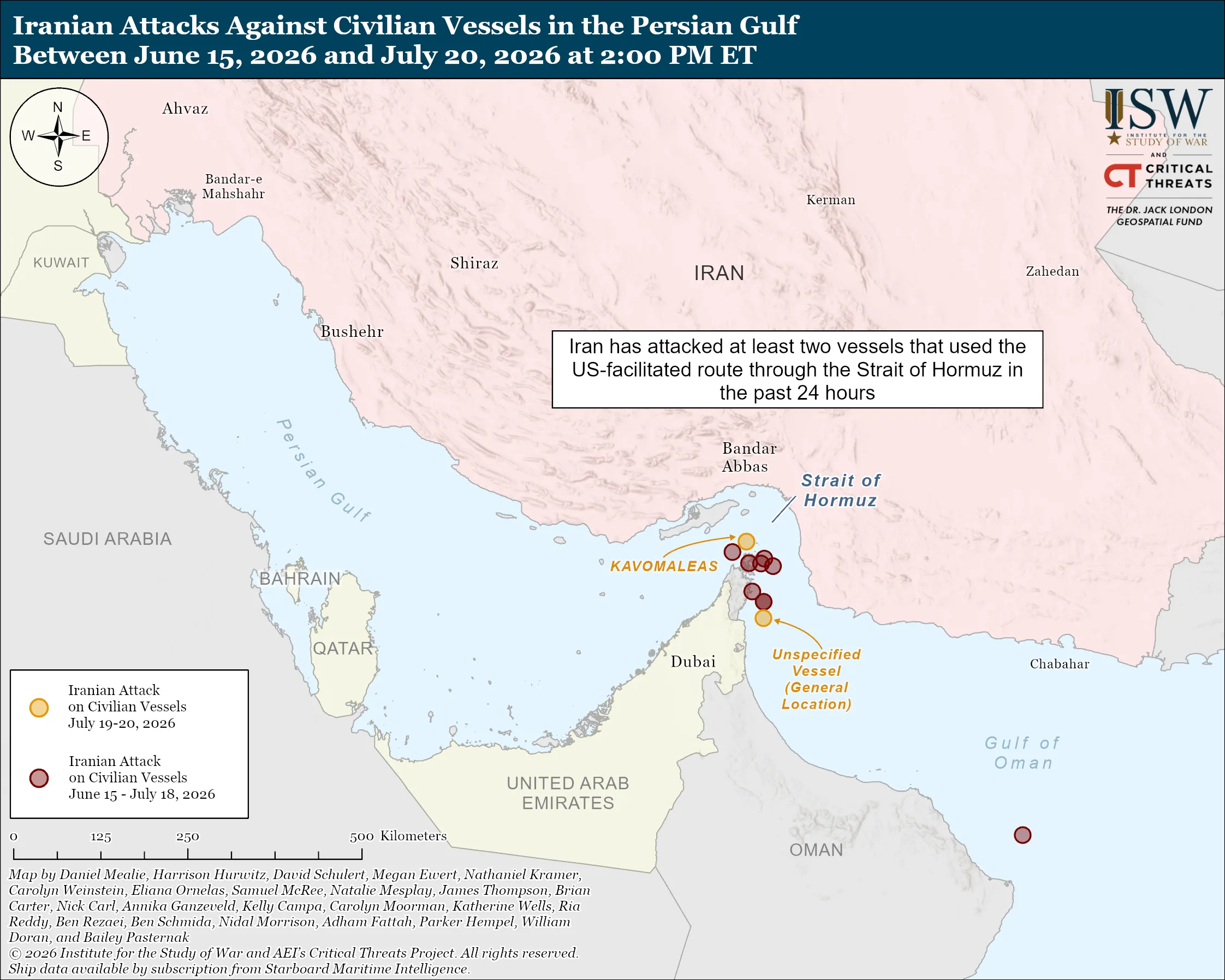
US forces expanded strikes to possible missile launch sites in northwestern and central Iran. Iranian regime media reported on July 19 that US forces struck an unspecified site in Urmia, West Azerbaijan Province.[22] Anti-regime media, citing unspecified local reports, claimed on July 20 that Iran had been using the site to launch missiles in recent days.[23] US forces also struck an unspecified military area in Tabriz, East Azerbaijan Province, on July 19, which marks the first US strikes on Tabriz in the latest phase of the war.[24] The US struck multiple missile bases in Tabriz in March and April 2026, including the IRGC Amand Missile Base and Southwest Tabriz Missile Base.[25] An open-source intelligence account on X reported on July 19 that US forces struck the IRGC Ghazi Tabatabaei Training Base in Khosrow Shah, East Azerbaijan Province, and that Iran used the military school to launch missiles.[26] US forces struck the Khojir Military Complex in Khojir, Tehran Province, on July 19, which marks the first time US strikes have targeted Tehran Province in the latest phase of the war.[27] The Khojir complex is one of Iran's key research, development, and manufacturing facilities for solid- and liquid-fuel missiles.[28]
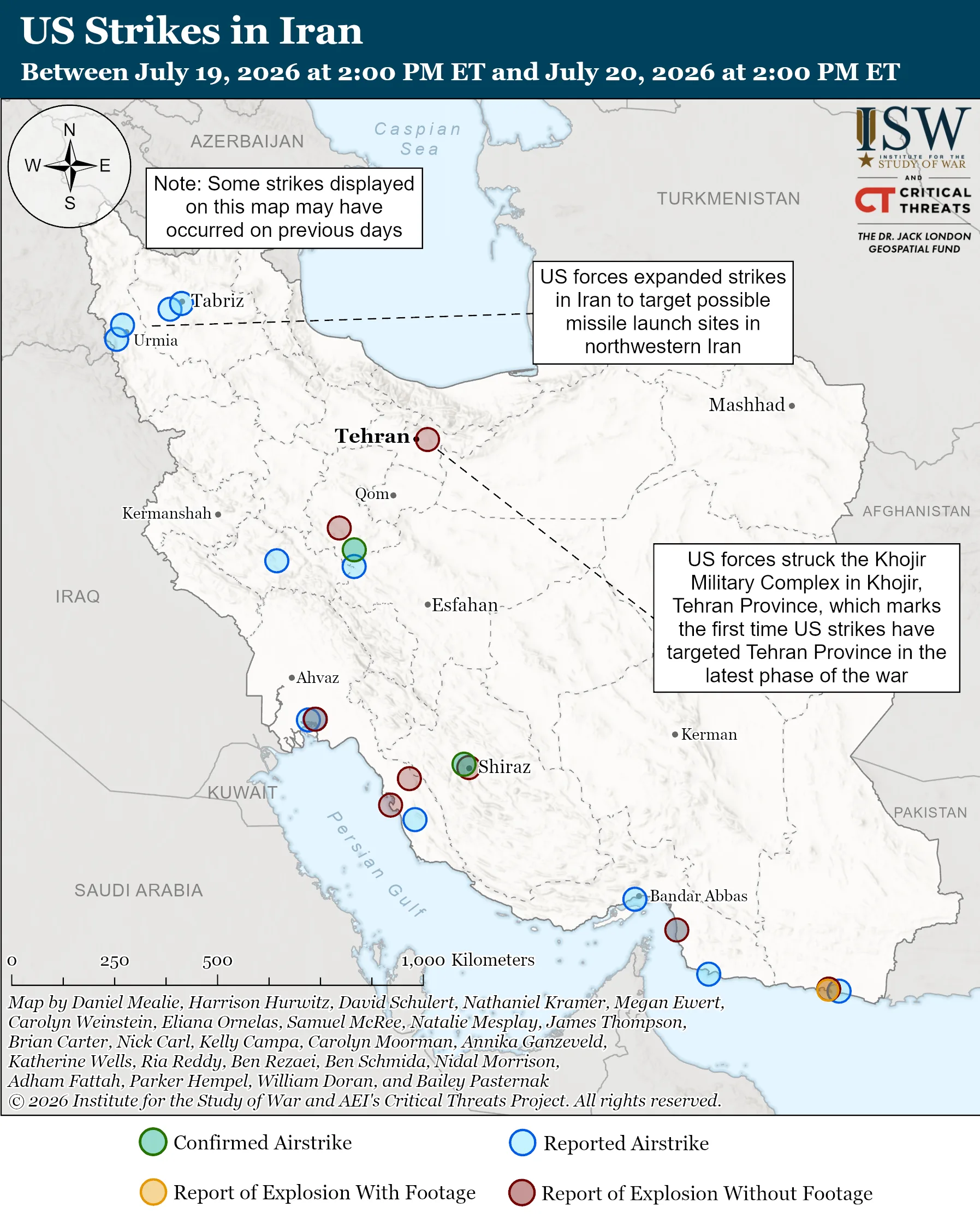
Iran continues to conduct drone and missile strikes on US regional bases in response to US airstrikes on Iran. The Kuwaiti Armed Forces and Bahrain Defense Force General Command both announced that they intercepted Iranian drone and missile attacks since ISW-CTP’s last data cutoff at 2:00 PM on July 19.[29] Bahrain's Civil Defense reported on July 20 that Iran conducted a drone attack targeting Bahrain's civil navigation systems but that the attacks did not impact flight operations in Bahrain.[30]
The IRGC released a statement on July 19 thanking the Jordanian people for providing Iran with information that has aided Iran's recent attacks on Jordan.[31] The IRGC said that the Jordanian people provided information on US military equipment at Aqaba airport. Iran launched four missiles at the airport on July 19, but Jordanian air defense systems intercepted three and let the fourth strike an open area.[32] An Israeli analyst posted footage on July 20 of Jordanian air defenses engaging an additional Iranian attack on Aqaba.[33] The IRGC also claimed that information provided by Jordanian people led to the “precise” targeting of 20 US shelters in Jordan's al Azraq region, which likely refers to personnel shelters at Muwaffaq al Salti Air Base in the al Azraq region.[34] Iran struck a group of buildings at Muwaffaq al Salti Air Base and killed at least two US service members and seriously injured four others.[35]
The IRGC may have released this statement to counter continuing reports that Russia and the People's Republic of China have helped Iran target US assets in the region during the US-Israel-Iran War.[36] The statement could also be part of recent broader Iranian efforts to mobilize the local populations in Arab countries against US forces. Iranian officials have increasingly called on individuals in the region in recent weeks to stand up to their leadership and counter the US presence in their countries.[37]
Unspecified armed individuals killed a Sunni cleric and Friday Prayer Leader Molavi Mohammad Anvar Rigi in Mirjaveh, in Sistan and Baluchistan Province on July 20.[38] No actor has claimed responsibility for the attack at the time of this writing. Anti-regime media citing local Baloch media reported on July 20 that the Supreme Leader representative to Sistan and Baluchistan Province previously intervened to appoint Anvar Rigi as Mirjaveh Friday prayer leader in 2024 after authorities removed and arrested the city's previous Friday Prayer Leader.[39] Anvar Rigi previously escaped an assassination attempt in December 2024.[40] Sistan and Baluchistan Province is a hotspot for anti-regime activity, including by anti-regime Baloch separatist groups that frequently attack Iranian security forces in southeastern Iran.[41]
The Israel Defense Forces (IDF) and the Lebanese Armed Forces (LAF) are preparing for Israeli forces to begin withdrawing from the “pilot zones.” An unspecified Israeli official told Axios on July 20 that Israeli forces will begin withdrawing from one of the “pilot zones” on July 21.[42] This would mark the first Israeli withdrawal in southern Lebanon in accordance with the June 26 Trilateral Framework Agreement. The Agreement stipulates that Israeli forces will eventually withdraw from ”pilot zones” in southern Lebanon, after which the LAF would secure the areas and disarm and dismantle local armed groups.[43] Israeli and Lebanese media clarified that Israeli forces are expected to withdraw from Zawtar el Gharbiyeh in Nabatieh District on July 21.[44] The LAF instructed civilians to not enter Zawtar el Gharbiyeh on July 20, likely in preparation for an IDF withdrawal.[45] The State Department announced on July 20 that Israel and Lebanon are cooperating to implement the ”pilot zones“ plan in Zawtar el Gharbiyeh as well as Froun in Bint Jbeil District and Srifa in Tyre District.[46] The LAF began deploying forces to and around the “pilot zones” in Froun, Srifa, and additional areas without an IDF presence on July 16 and 17.[47]
Israeli and Lebanese efforts to implement the “pilot zones” come during Lebanese President Joseph Aoun’s visit to Washington, DC between July 18 and 21.[48] Aoun met with US Secretary of State Marco Rubio to discuss further implementation of the Agreement and an Israeli withdrawal from the “pilot zones” on July 19.[49] Aoun is expected to meet with US President Donald Trump on July 21, according to Reuters.[50]
Informed sources told Iraqi media on July 20 that Iraqi Prime Minister Ali al Zaydi will ask the Iranian government to pressure Iranian-backed Iraqi militias to surrender Iranian-provided missiles to the Iraqi federal government during his upcoming visit to Tehran on July 23.[51] The Iranian government is unlikely to agree to Zaydi’s request, however. Zaydi’s trip comes as Iran has warned its Iraqi militia partners to resist disarmament.[52] The IRGC reportedly told Iraqi militia leaders that their weapons belong to Iran, and that the militias do not have the right to surrender these weapons to the Iraqi federal government, according to unspecified sources speaking to US-funded, Arabic-language media on June 10.[53] Iran supplied its Iraqi militia partners with weapons, including missiles and drones, before and during the Iran war.[54] Zaydi’s trip to Iran also follows his visit to Washington, DC, on July 14, during which he signed several investment agreements with the United States.[55] One of these agreements could be what Iraqi and regional media have described as the “June agreement,” in which the United States will support investment in Iraq in exchange for the Iraqi federal government reducing Iranian influence in Iraq, including disarming Iranian-backed Iraqi militias.[56]
The Iranian-backed Islamic Resistance in Iraq on July 19 threatened to target US bases and interests in the region if the United States expands its strike campaign against Iran.[57] The Islamic Resistance in Iraq is a coalition of Iranian-backed Iraqi militias, including Kataib Hezbollah, Harakat Hezbollah al Nujaba, Kataib Sayyid al Shuhada, and Harakat Ansar Allah al Awfiya.[58] The statement denied that the Islamic Resistance in Iraq recently attacked US bases in the region, however.[59] The Islamic Resistance in Iraq frequently claimed attacks against US bases in Iraq and the region during the war in March and April.[60]
https://understandingwar.org/research/middle-east/iran-update-special-report-july-20-2026/
2,278
posted on
07/20/2026 10:58:08 PM PDT
by
AdmSmith
(GCTGATATGTCTATGATTACTCAT)
Iran is not the Islamic Republic, and Iranians are not “the regime.”
Iran is an ancient nation, a civilization, a homeland, and a people with thousands of years of history. The Islamic Republic is the authoritarian political system imposed on Iran since 1979. When discussing terrorism, repression, nuclear threats, or regional aggression, name the Islamic Republic, the IRGC, or the regime—not “Iran” or “Iranians.” A clear majority of Iranians oppose the regime, and many have paid for that resistance with their freedom and their lives. This is not merely a semantic distinction. It is the difference between a nation and the regime occupying it.

https://x.com/CyrusTheGreat/status/2078177748233879619
2,279
posted on
07/20/2026 11:12:29 PM PDT
by
AdmSmith
(GCTGATATGTCTATGATTACTCAT)
“We'll bomb our own territory and people if it's occupied.”
That's the message from Iranian Army spokesperson Brig. Gen. Mohammad Akrami-Nia, who laid out a fanatical doctrine under which the regime would rather destroy parts of Iran than allow them to fall into American hands. The Islamic Republic's massacre of 45,000 Iranians in January showed exactly how little it values Iranian lives. To this regime, the people are expendable and its survival is all that matters.
https://x.com/TheIranWatcher/status/2079372531274825846
video in Persian
2,280
posted on
07/20/2026 11:16:08 PM PDT
by
AdmSmith
(GCTGATATGTCTATGATTACTCAT)
Navigation: use the links below to view more comments.
first previous 1-20 ... 2,241-2,260, 2,261-2,280, 2,281-2,300 ... 2,401-2,405 next last
Disclaimer:
Opinions posted on Free Republic are those of the individual
posters and do not necessarily represent the opinion of Free Republic or its
management. All materials posted herein are protected by copyright law and the
exemption for fair use of copyrighted works.
FreeRepublic.com is powered by software copyright 2000-2008 John Robinson