Iran Update Special Report, July 19, 2026
Iranian Foreign Affairs Minister Abbas Araghchi implied on July 19 that a special committee within the Supreme National Security Council (SNSC) made important decisions on negotiations with the United States without the direct input of Supreme Leader Mojtaba Khamenei, which highlights the seemingly limited role that Mojtaba has played in regime decision-making over the past several months.[1] Araghchi told regime media on July 19 that a six-person committee in the SNSC, which he said was formed between the June 2025 and Spring 2026 wars, was responsible for making decisions “on the spot” regarding negotiations with the United States when Iranian leaders were unable to contact Mojtaba.[2] The SNSC is Iran's highest national security and foreign policy decision-making body. The SNSC includes 11 senior leaders, including the president, parliament speaker, judiciary chief, foreign affairs minister, and IRGC commander, among others.[3] Araghchi stated that he, President Masoud Pezeshkian, Parliament Speaker Mohammad Bagher Ghalibaf, and SNSC Secretary Mohammad Bagher Zolghadr are part of the committee.[4] Araghchi’s comment that the committee made key decisions “on the spot” is notable given the historic role that the supreme leader has traditionally played as the ultimate decision-making authority. Araghchi’s acknowledgement of the committee comes amid numerous reports in recent months that Mojtaba is incapacitated or seriously wounded following combined force strikes during the war.[5] Many Iranian officials reportedly continue to have difficulties contacting Mojtaba.[6] Israeli media reported on April 19 that Vahidi, whom ISW-CTP assesses is driving regime decision-making, is the only Iranian official with direct access to Mojtaba.[7] Araghchi’s comments about the six-person committee are consistent with a Reuters report from April that Mojtaba has been “legitimizing” decisions made through “institutional consensus.”[8]
Vahidi is very likely one of the six members of the SNSC’s special committee due to the outsized role he has played in regime decision-making over the past several months. The Wall Street Journal reported on June 13 that Vahidi has frequently overruled Araghchi and Iranian President Masoud Pezeshkian, who sought a deal with the United States in order to secure economic relief.[9] Anti-regime media similarly reported on April 14 that regime officials, which ISW-CTP assessed almost certainly included Vahidi, summoned the Iranian negotiating team to return to Tehran from negotiations with the United States in Pakistan after Araghchi reportedly expressed flexibility regarding the regime's red lines.[10] Araghchi and others in the pro-negotiations camp have continued to defend the need to engage in talks with the United States in order to secure the regime's objectives. Araghchi stated in the interview that negotiations with the United States did not cause the current war and that the decision to negotiate was a collective regime decision.[11] Araghchi’s emphasis on the decision to negotiate being a collective choice, rather than an individual one, is notable because it may be an attempt to counter recent reports that Vahidi is dominating regime decision-making and sidelining pragmatist actors in the regime.
Iran continues to use force to coerce vessels to transit through Iranian territorial waters in order to secure recognized control over the strait. The Islamic Revolutionary Guards Corps (IRGC) Navy announced on July 19 that it attacked four vessels with “malicious intent.”[12] ISW-CTP has not recorded any Iranian attacks on civilian vessels since its last data cutoff at 2:00 PM ET on July 18, however. The IRGC Navy similarly claimed attacks on four “violating vessels” on July 17, which ISW-CTP also could not confirm.[13]
The United States conducted an eighth consecutive night of strikes on Iran on July 18 to degrade Iran's ability to target international shipping and respond to an Iranian attack on US forces in Jordan on July 17 that killed two US service members.[14] US Central Command (CENTCOM) announced on July 18 that it struck various Iranian military targets, including coastal surveillance sites, air defense systems, maritime assets, and missile and drone storage facilities.[15] CENTCOM also said that it struck Islamic Revolutionary Guards Corps (IRGC) forces responsible for the missile attack that killed two US service members at Muwaffaq Salti Airbase in Jordan on July 17.[16] The Atomic Energy Organization of Iran announced on July 19 that the United States struck the Darkhovin Nuclear Power Plant in Khuzestan Province.[17] The International Atomic Energy Agency (IAEA) said on July 19 that the facility was in the “very early stages of construction” and that the IAEA did not find nuclear material there during its last inspection, although an Israeli analyst claimed that the site's nuclear reactor was at an ”advanced” stage in development.[18]
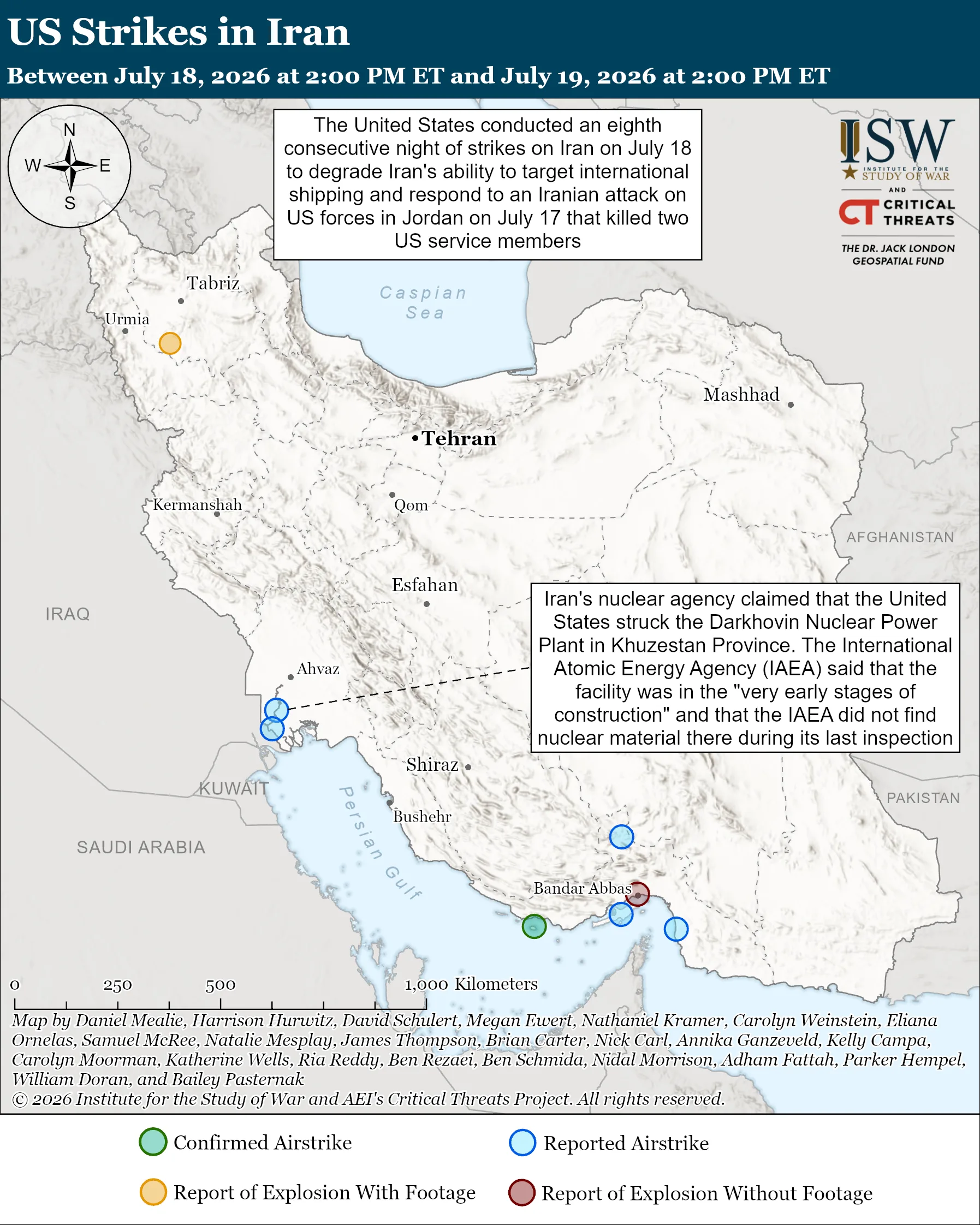
Various Iranian regime officials claimed on July 19 that Iranian authorities have quickly repaired and reopened damaged roadways and other infrastructure following US strikes in recent days.[19] Iranian Law Enforcement Command Traffic Police Chief Timour Hosseini announced on July 19 that the Shahed Mirzaei Tunnel, north of Bandar Abbas in Hormozgan Province, reopened less than 48 hours after US forces struck and damaged the tunnel.[20] Iranian Energy Minister Abbas Aliabadi also announced on July 19 that Hormozgan provincial authorities repaired five power transmission lines within hours of sustaining damage in US strikes.[21] ISW-CTP cannot verify these claims, however.
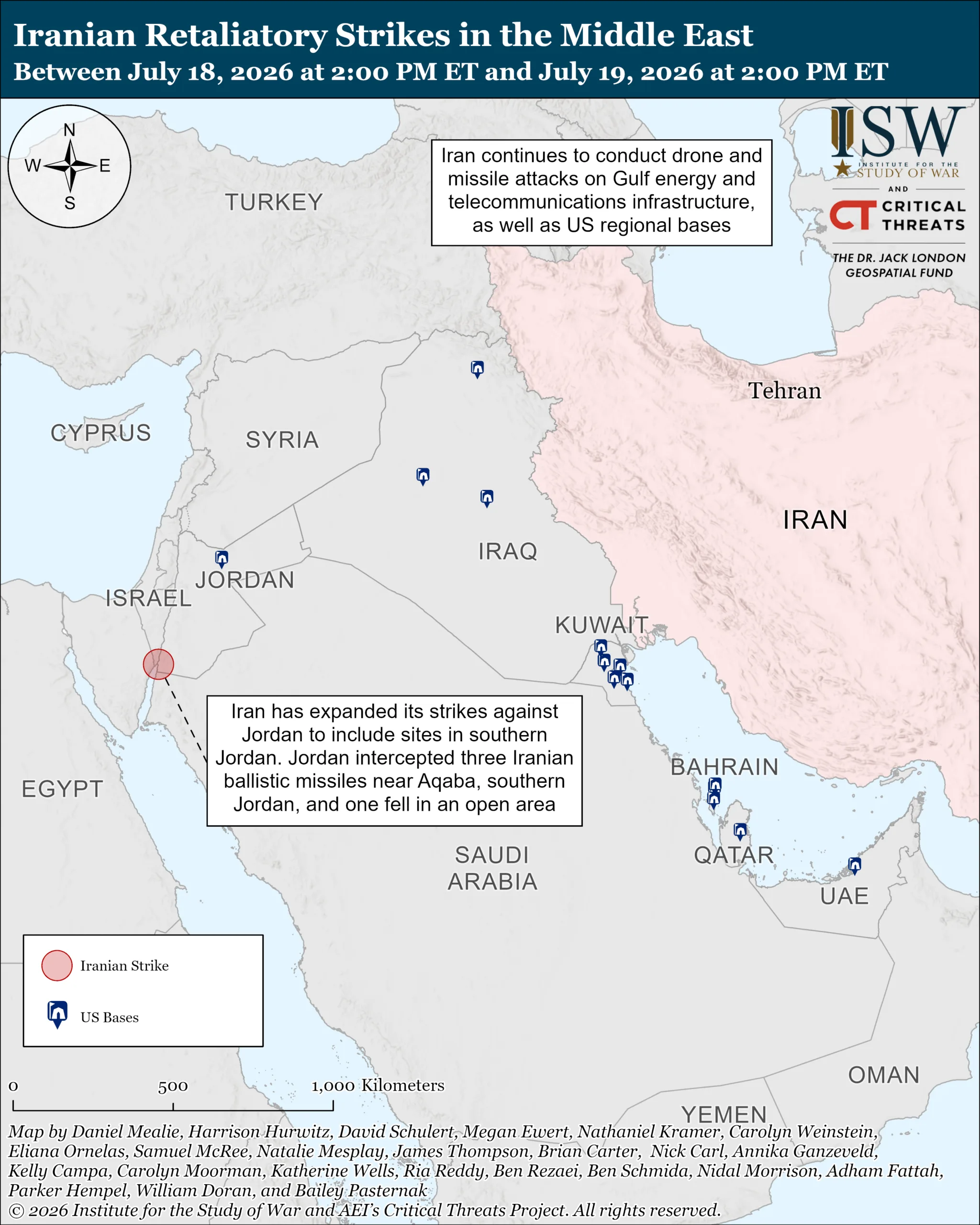
Iran continues to conduct drone and missile attacks on Gulf energy and telecommunications infrastructure, as well as US regional bases, in response to US airstrikes on Iran. Kuwait's Electricity, Water, and Renewable Energy Ministry announced on July 19 that Iran had conducted an attack on one of its power generation and water desalination plants for the second time in two days.[22] The attack caused a fire and damage to parts of the facility.[23] An Iranian attack on the same facility on July 18 had also caused a fire, forcing some production units to be shut down.[24] The July 19 attack was the third Iranian attack on Kuwaiti power and water desalination facilities in three days.[25] The IRGC Navy separately claimed on July 18 that it targeted a data center belonging to Bahraini state-run telecommunications company Batelco that the IRGC claimed the US military uses.[26] An IRGC-affiliated outlet published satellite imagery of alleged damage to the Bahraini data center on July 19.[27] An open-source intelligence (OSINT) account and publicly available satellite imagery confirmed on July 19, however, that Iran struck the data center's electrical substation, but not the data center itself.[28] The Kuwaiti Armed Forces and Bahrain Defense Force General Command also confirmed that they intercepted Iranian drone and missile attacks on July 19.[29] The Iranian Artesh announced that it has conducted two waves of drone strikes since ISW-CTP’s last data cutoff at 2:00 PM ET on July 18, including an attack on a US ammunition depot at Camp Buehring in Kuwait, as well as US radars and barracks at Ali al Salem Airbase in Kuwait.[30]
Unidentified actors attacked the US Consulate in Erbil, Iraqi Kurdistan, on July 18.[34] Iranian media reported explosions at the consulate, citing unspecified Iraqi sources.[35] An open-source intelligence (OSINT) account posted footage of US air defenses intercepting unidentified projectiles in Erbil.[36] Iranian-backed Iraqi militias frequently attacked US sites in Iraqi Kurdistan in March and April, but no actor has claimed responsibility for recent attacks on US positions in Iraqi Kurdistan at the time of this writing.[37] CENTCOM separately announced on July 19 that the controlled detonation of unexploded ordnance from a downed Iranian one-way attack drone killed a US service member in Iraqi Kurdistan.[38]
https://understandingwar.org/research/middle-east/iran-update-special-report-july-19-2026/
Iran Update Special Report, July 20, 2026
The Houthis’ announced naval blockade against Saudi Arabia could result in an expansion of the shipping crisis in the Middle East.[1] ISW-CTP has not recorded any Houthi attacks on shipping since July 7, 2025, at the time of this writing, but the Houthis ordered Saudi-bound vessels to turn back from Saudi Arabia over radio on July 20.[2] The announcement of the blockade combined with the Houthi orders will almost certainly increase the cost of shipping through the Red Sea by discouraging ships from transiting through the Red Sea. Insurance industry sources told Western media July 20 that insurance costs to ship goods through the Red Sea rose following the Houthis’ announcement.[3]
Iran is trying to expand the geographical scope of its conflict with the United States to the Red Sea to cause further disruption to international markets and impose additional costs on the United States. Iran asked the Houthis to prepare to attack Red Sea shipping if the United States expands its airstrikes to Iranian energy infrastructure, according to two senior Iranian sources and an informed regional source speaking to Western media on July 16.[4] Iranian officials, including Islamic Revolutionary Guards Corps (IRGC) Quds Force Commander Brigadier General Esmail Ghaani, have threatened that the Houthis could launch another campaign targeting shipping in the Bab al Mandeb Strait.[5] Saudi Arabia has increasingly relied on the Bab al Mandeb Strait to export its oil to Asian markets in recent months, according to Kpler data cited by the New York Times on July 20.[6]
The Houthis may have announced the blockade to deter Saudi Arabia from striking Houthi targets in Yemen to discourage further Saudi attacks, separate from but partially satisfying Iranian efforts to impose costs on the United States. It remains unclear what triggered the Houthi blockade announcement. Houthi Military Spokesperson Yahya Sarea stated on July 20 that they imposed the blockade in response to Saudi Arabia's imposing an “unjust siege” on Yemen for 12 years, but this is likely a false reason.[7] Saudi forces struck Sanaa International Airport on July 13 due to concerns that Iran would use the direct air route to transfer weapons and military advisers to the Houthis, but the Houthis responded by attacking Abha International Airport in Saudi Arabia on July 13.[8] There have been no further attacks since July 13. The UN negotiated a separate and relatively stable ceasefire between the Houthis, the recognized Yemeni government, and Saudi Arabia that has been in effect since 2022.[9] The Houthi blockade announcement, regardless of the proximate cause and how it affects Houthi objectives in Yemen, supports Iranian efforts to impose costs on the United States.
Some senior Iranian officials appear concerned that the renewed conflict will deepen Iran's economic problems and threaten Iran's internal security. Senior Iranian officials have previously appeared concerned that the conflict will deepen Iran's economic problems, but these concerns do not appear to have meaningfully impacted the calculus of the IRGC. Iranian President Masoud Pezeshkian warned in a Supreme Judicial Council meeting on July 20 that economic pressure could generate social discontent and damage the public support that the regime has gained during the US-Israel-Iran war.[10] Pezeshkian emphasized that the economy and people's livelihoods are Iran's “main battlefield” now.[11] Pezeshkian previously voiced his concerns about the economic costs of war in March, and he convinced the supreme leader to accept the MoU in June using arguments about the MoU’s economic benefits.[12] Pezeshkian’s concern follows the disintegration of the US-Iran memorandum of understanding (MoU) and the highly anticipated economic relief for Iran, economic relief that Iran expected from, including the lifting of the US naval blockade, sanctions relief, and access to frozen assets.[13] The United States did not unfreeze any Iranian assets and has since restored the blockade and revoked the sanctions waiver.[14] Judiciary Chief Gholam Hossein Mohseni Ejei similarly acknowledged that sustaining the war imposes costs on the population and urged officials to address high prices, protect public resilience, and prevent economic hardship from undermining national unity at the same meeting.[15] Both Pezeshkian and Ejei previously aligned with a faction that favored moderation and diplomacy amid concerns for Iran's economy and internal security after the June 2025 Israel-Iran war, according to four senior Iranian officials cited by the New York Times.[16]
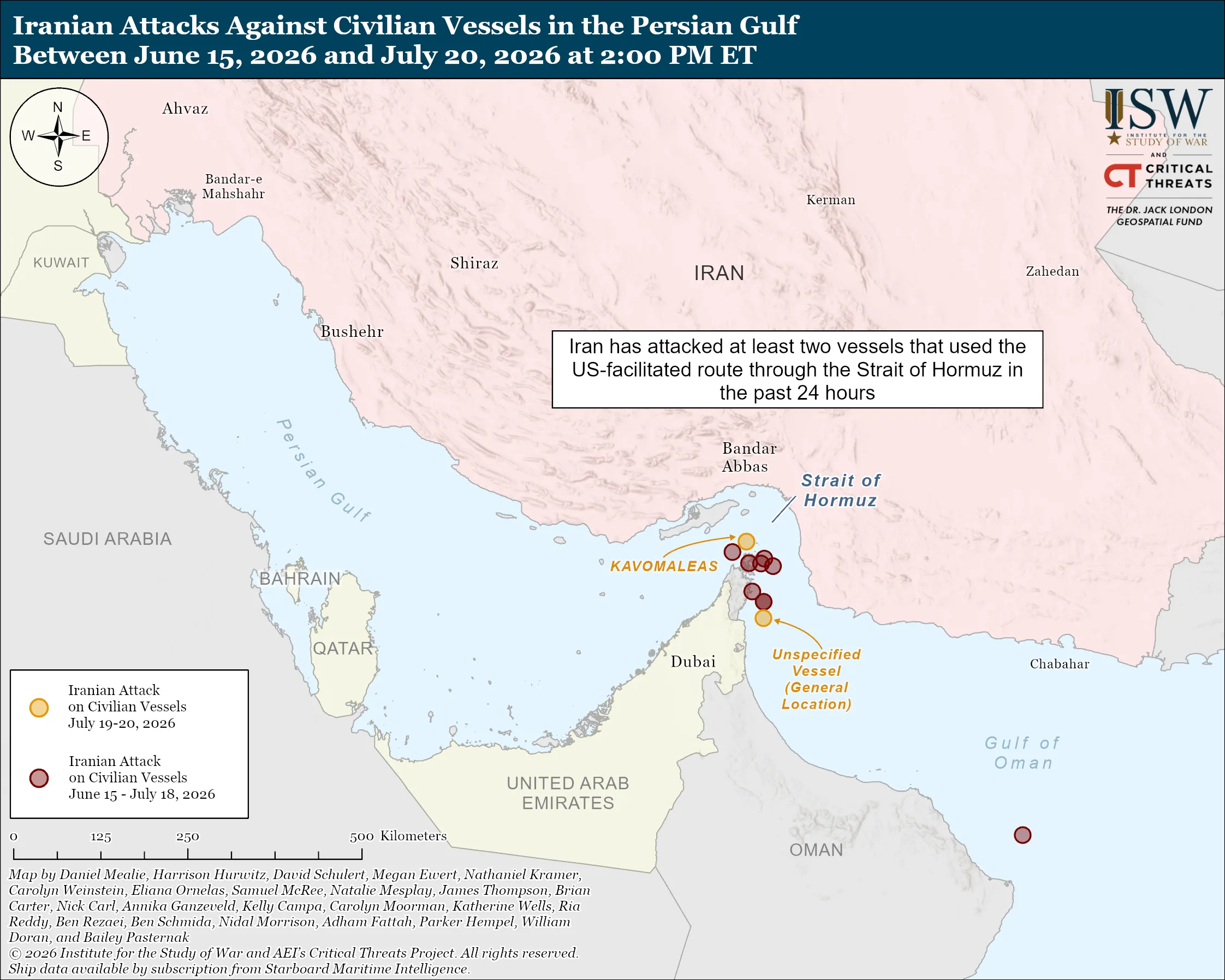
Iran continues to coerce vessels by force to transit through Iranian territorial waters to prevent them from using routes through the strait that Tehran does not approve. Iran has attacked at least two vessels in the strait since ISW-CTP’s last data cutoff.[17] Unidentified projectiles struck a Malta-flagged tanker and a Liberian-flagged tanker that were attempting to use the US-facilitated route through the strait on July 19, according to the United Kingdom Maritime Trade Operations (UKMTO) center and western media.[18] The projectiles struck the Malta-flagged vessel 8 nautical miles north of Kumzar, Oman, and forced the crew to abandon ship.[19] Iran also almost certainly conducted another attack on a vessel 17 nautical miles east of Dibba, United Arab Emirates, on July 20.[20] The IRGC described the attacks on the Malta- and Liberian-flagged tankers as “explosions,” thus obfuscating its responsibility, and added that the two vessels were attempting to transit through a “dangerous” route.[21] Iran continues to be the only “danger” in the strait for merchant shipping.
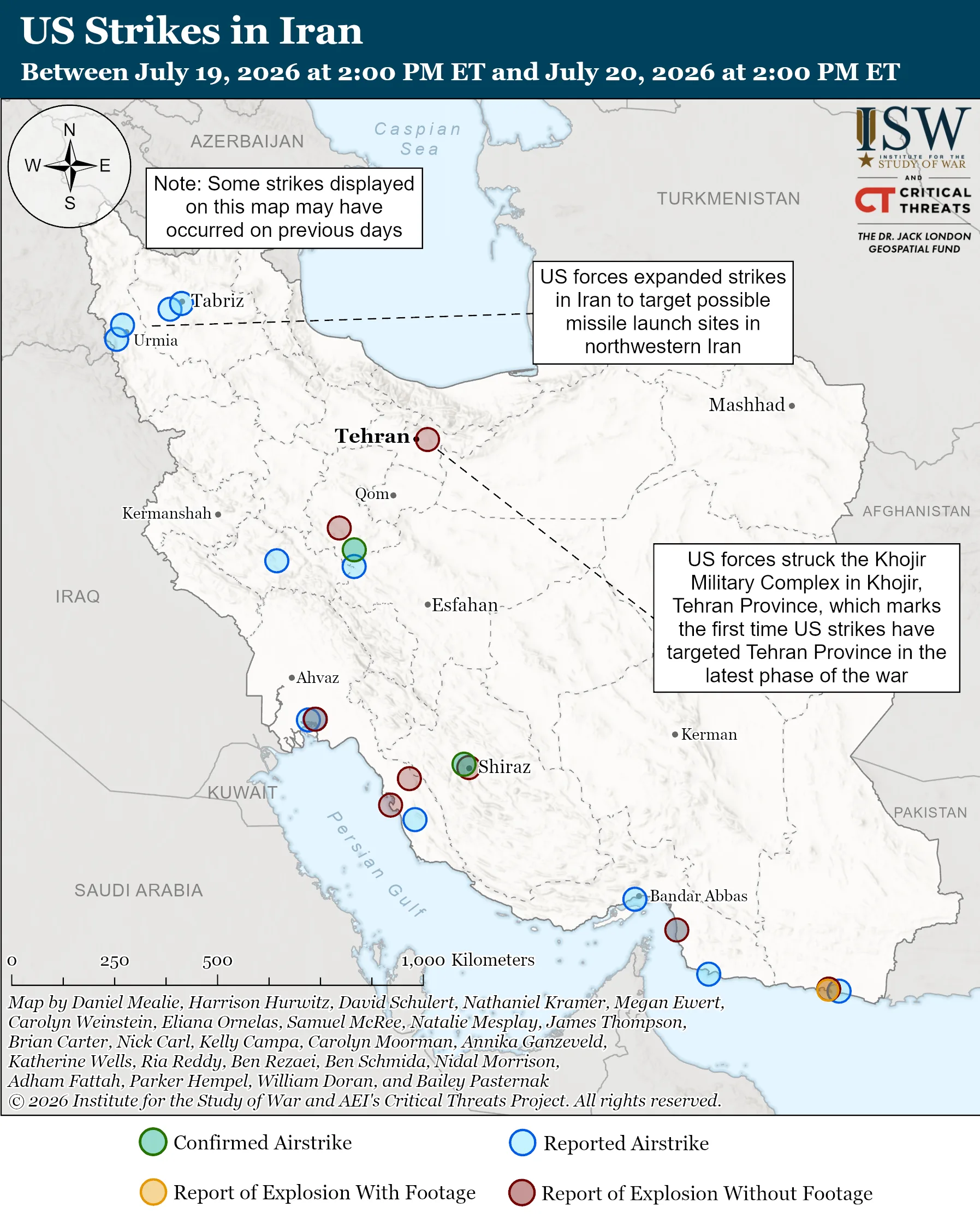
US forces expanded strikes to possible missile launch sites in northwestern and central Iran. Iranian regime media reported on July 19 that US forces struck an unspecified site in Urmia, West Azerbaijan Province.[22] Anti-regime media, citing unspecified local reports, claimed on July 20 that Iran had been using the site to launch missiles in recent days.[23] US forces also struck an unspecified military area in Tabriz, East Azerbaijan Province, on July 19, which marks the first US strikes on Tabriz in the latest phase of the war.[24] The US struck multiple missile bases in Tabriz in March and April 2026, including the IRGC Amand Missile Base and Southwest Tabriz Missile Base.[25] An open-source intelligence account on X reported on July 19 that US forces struck the IRGC Ghazi Tabatabaei Training Base in Khosrow Shah, East Azerbaijan Province, and that Iran used the military school to launch missiles.[26] US forces struck the Khojir Military Complex in Khojir, Tehran Province, on July 19, which marks the first time US strikes have targeted Tehran Province in the latest phase of the war.[27] The Khojir complex is one of Iran's key research, development, and manufacturing facilities for solid- and liquid-fuel missiles.[28]
Iran continues to conduct drone and missile strikes on US regional bases in response to US airstrikes on Iran. The Kuwaiti Armed Forces and Bahrain Defense Force General Command both announced that they intercepted Iranian drone and missile attacks since ISW-CTP’s last data cutoff at 2:00 PM on July 19.[29] Bahrain's Civil Defense reported on July 20 that Iran conducted a drone attack targeting Bahrain's civil navigation systems but that the attacks did not impact flight operations in Bahrain.[30]
The IRGC released a statement on July 19 thanking the Jordanian people for providing Iran with information that has aided Iran's recent attacks on Jordan.[31] The IRGC said that the Jordanian people provided information on US military equipment at Aqaba airport. Iran launched four missiles at the airport on July 19, but Jordanian air defense systems intercepted three and let the fourth strike an open area.[32] An Israeli analyst posted footage on July 20 of Jordanian air defenses engaging an additional Iranian attack on Aqaba.[33] The IRGC also claimed that information provided by Jordanian people led to the “precise” targeting of 20 US shelters in Jordan's al Azraq region, which likely refers to personnel shelters at Muwaffaq al Salti Air Base in the al Azraq region.[34] Iran struck a group of buildings at Muwaffaq al Salti Air Base and killed at least two US service members and seriously injured four others.[35]
The IRGC may have released this statement to counter continuing reports that Russia and the People's Republic of China have helped Iran target US assets in the region during the US-Israel-Iran War.[36] The statement could also be part of recent broader Iranian efforts to mobilize the local populations in Arab countries against US forces. Iranian officials have increasingly called on individuals in the region in recent weeks to stand up to their leadership and counter the US presence in their countries.[37]
Unspecified armed individuals killed a Sunni cleric and Friday Prayer Leader Molavi Mohammad Anvar Rigi in Mirjaveh, in Sistan and Baluchistan Province on July 20.[38] No actor has claimed responsibility for the attack at the time of this writing. Anti-regime media citing local Baloch media reported on July 20 that the Supreme Leader representative to Sistan and Baluchistan Province previously intervened to appoint Anvar Rigi as Mirjaveh Friday prayer leader in 2024 after authorities removed and arrested the city's previous Friday Prayer Leader.[39] Anvar Rigi previously escaped an assassination attempt in December 2024.[40] Sistan and Baluchistan Province is a hotspot for anti-regime activity, including by anti-regime Baloch separatist groups that frequently attack Iranian security forces in southeastern Iran.[41]
The Israel Defense Forces (IDF) and the Lebanese Armed Forces (LAF) are preparing for Israeli forces to begin withdrawing from the “pilot zones.” An unspecified Israeli official told Axios on July 20 that Israeli forces will begin withdrawing from one of the “pilot zones” on July 21.[42] This would mark the first Israeli withdrawal in southern Lebanon in accordance with the June 26 Trilateral Framework Agreement. The Agreement stipulates that Israeli forces will eventually withdraw from ”pilot zones” in southern Lebanon, after which the LAF would secure the areas and disarm and dismantle local armed groups.[43] Israeli and Lebanese media clarified that Israeli forces are expected to withdraw from Zawtar el Gharbiyeh in Nabatieh District on July 21.[44] The LAF instructed civilians to not enter Zawtar el Gharbiyeh on July 20, likely in preparation for an IDF withdrawal.[45] The State Department announced on July 20 that Israel and Lebanon are cooperating to implement the ”pilot zones“ plan in Zawtar el Gharbiyeh as well as Froun in Bint Jbeil District and Srifa in Tyre District.[46] The LAF began deploying forces to and around the “pilot zones” in Froun, Srifa, and additional areas without an IDF presence on July 16 and 17.[47]
Israeli and Lebanese efforts to implement the “pilot zones” come during Lebanese President Joseph Aoun’s visit to Washington, DC between July 18 and 21.[48] Aoun met with US Secretary of State Marco Rubio to discuss further implementation of the Agreement and an Israeli withdrawal from the “pilot zones” on July 19.[49] Aoun is expected to meet with US President Donald Trump on July 21, according to Reuters.[50]
Informed sources told Iraqi media on July 20 that Iraqi Prime Minister Ali al Zaydi will ask the Iranian government to pressure Iranian-backed Iraqi militias to surrender Iranian-provided missiles to the Iraqi federal government during his upcoming visit to Tehran on July 23.[51] The Iranian government is unlikely to agree to Zaydi’s request, however. Zaydi’s trip comes as Iran has warned its Iraqi militia partners to resist disarmament.[52] The IRGC reportedly told Iraqi militia leaders that their weapons belong to Iran, and that the militias do not have the right to surrender these weapons to the Iraqi federal government, according to unspecified sources speaking to US-funded, Arabic-language media on June 10.[53] Iran supplied its Iraqi militia partners with weapons, including missiles and drones, before and during the Iran war.[54] Zaydi’s trip to Iran also follows his visit to Washington, DC, on July 14, during which he signed several investment agreements with the United States.[55] One of these agreements could be what Iraqi and regional media have described as the “June agreement,” in which the United States will support investment in Iraq in exchange for the Iraqi federal government reducing Iranian influence in Iraq, including disarming Iranian-backed Iraqi militias.[56]
The Iranian-backed Islamic Resistance in Iraq on July 19 threatened to target US bases and interests in the region if the United States expands its strike campaign against Iran.[57] The Islamic Resistance in Iraq is a coalition of Iranian-backed Iraqi militias, including Kataib Hezbollah, Harakat Hezbollah al Nujaba, Kataib Sayyid al Shuhada, and Harakat Ansar Allah al Awfiya.[58] The statement denied that the Islamic Resistance in Iraq recently attacked US bases in the region, however.[59] The Islamic Resistance in Iraq frequently claimed attacks against US bases in Iraq and the region during the war in March and April.[60]
https://understandingwar.org/research/middle-east/iran-update-special-report-july-20-2026/