Iran Update Special Report, July 17, 2026
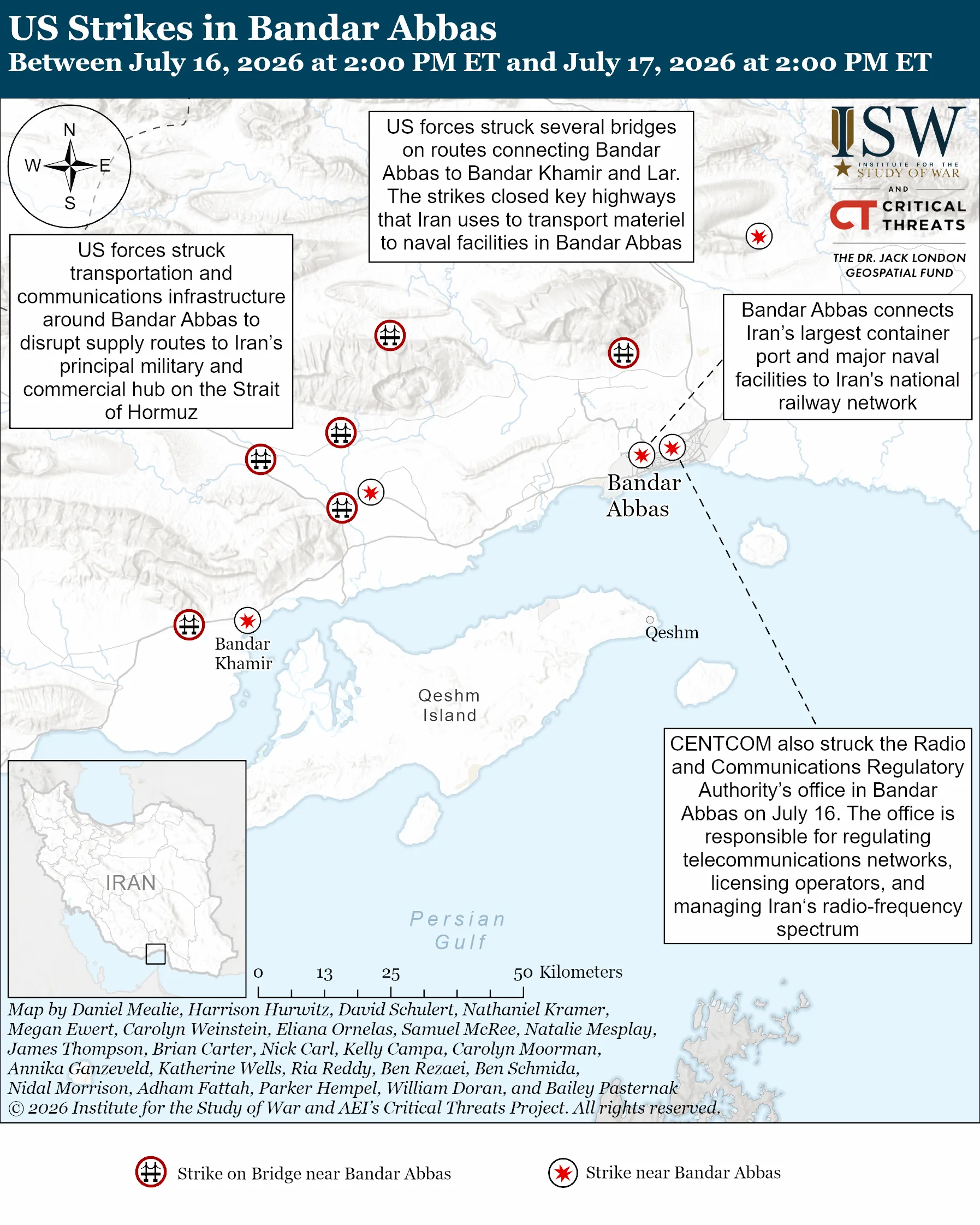
The United States has struck several bridges and railroads in southern Iran since ISW-CTP’s last data cutoff in order to disrupt supply routes to Bandar Abbas, Hormozgan Province, according to a senior US official speaking to the Wall Street Journal.[1] Bandar Abbas is a port city that hosts the IRGC Navy First Naval District and numerous other naval facilities.[2] Iranian state media reported strikes on bridges in and around the city and the closure of highways connecting Bandar Abbas to nearby provinces.[3] The United States also struck the Radio and Communications Regulatory Authority's office in Bandar Abbas on July 16.[4] The office is responsible for regulating telecommunications networks, licensing operators, and managing Iran's radio-frequency spectrum.[5] Iranian media also reported on July 17 that US forces struck Bandar Abbas's railway junction station, which is located approximately 10 kilometers west of Bandar Abbas.[6] Bandar Abbas is Iran's principal military and commercial hub on the strait, as the city hosts key facilities belonging to both the IRGC Navy and the Artesh Navy. The Shahid Rajaei Port in Bandar Abbas handles roughly 85 percent of Iran's container traffic and connects directly to Iran's national rail and highway networks, making Bandar Abbas a critical hub for moving military supplies, fuel, personnel, and commercial cargo between Iran's interior and its southern coast.[7] US Central Command (CENTCOM) acknowledged on July 17 that US forces struck “military logistics infrastructure.”[8]
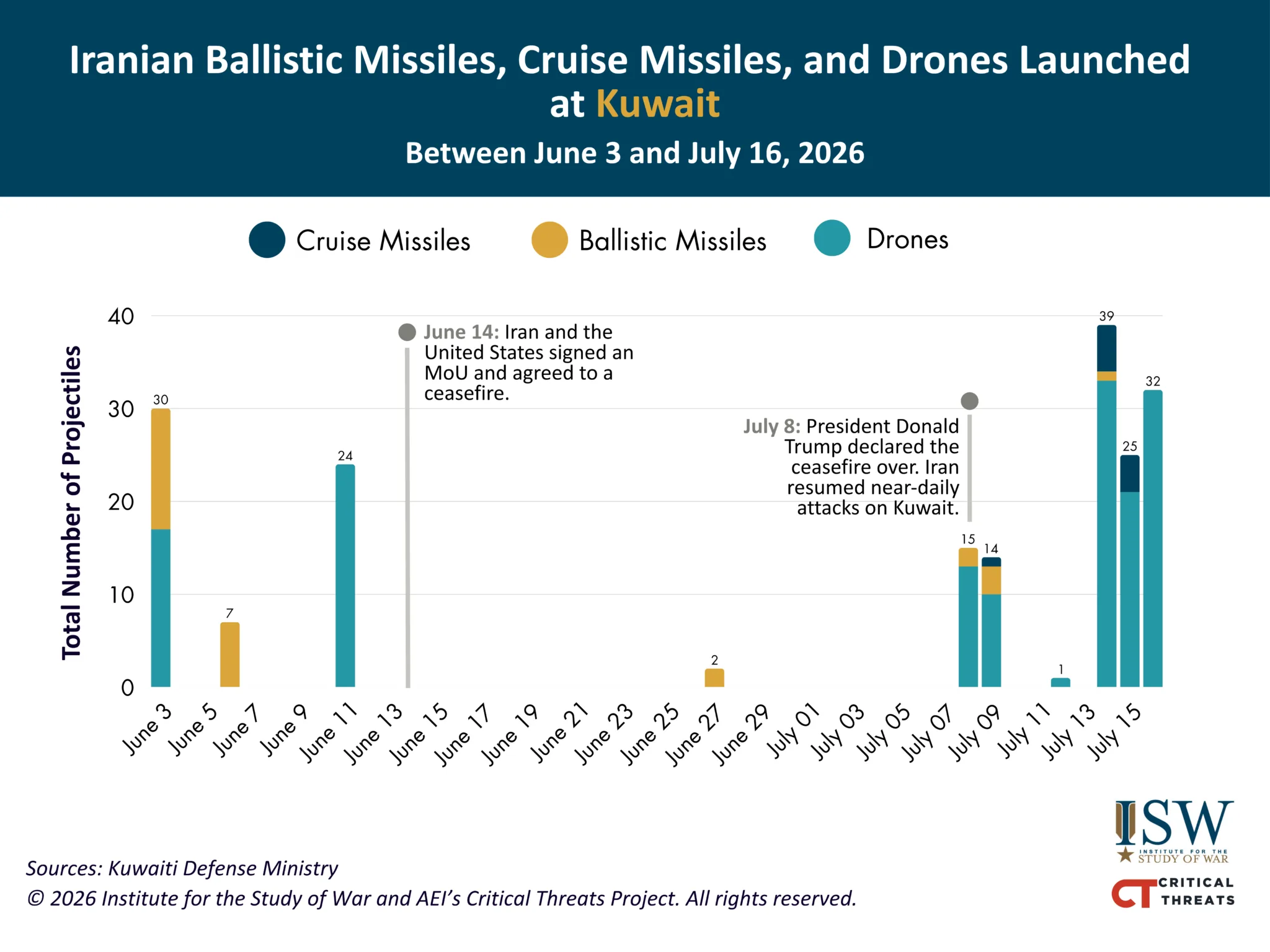
The Kuwaiti Electricity, Water, and Renewable Energy Ministry announced that an attack, which it attributed to “Iranian aggression,” damaged several power generation units at an unspecified power and water desalination plant on July 17.[9] Kuwait intercepted 32 Iranian drones on July 16.[10] Interceptor shrapnel from an Iranian drone previously struck and damaged a Kuwaiti desalination plant in April 2026.[11] About 90 percent of Kuwait's drinking water comes from desalination.[12]
Iran may have struck the Kuwaiti plant in response to recent US strikes on bridges in Iran and to deter the United States from attacking Iranian energy infrastructure. US forces struck several bridges in Iran on July 17 (see above).[13] Regime officials have repeatedly warned that Iran would attack “regional infrastructure” in response to any US attacks on Iranian critical infrastructure.[14] The Iranian regime has also attributed recent power outages in southern Iran to US strikes, although there is no available evidence at this time that the United States has targeted Iranian energy infrastructure.[15] US President Donald Trump recently threatened on July 14 to expand US strikes to include power plants, and the Iranian strike on the Kuwaiti plant may have been intended to deter the United States from intentionally targeting Iranian energy infrastructure by signaling that Iran could retaliate by attacking critical infrastructure in the region.[16]
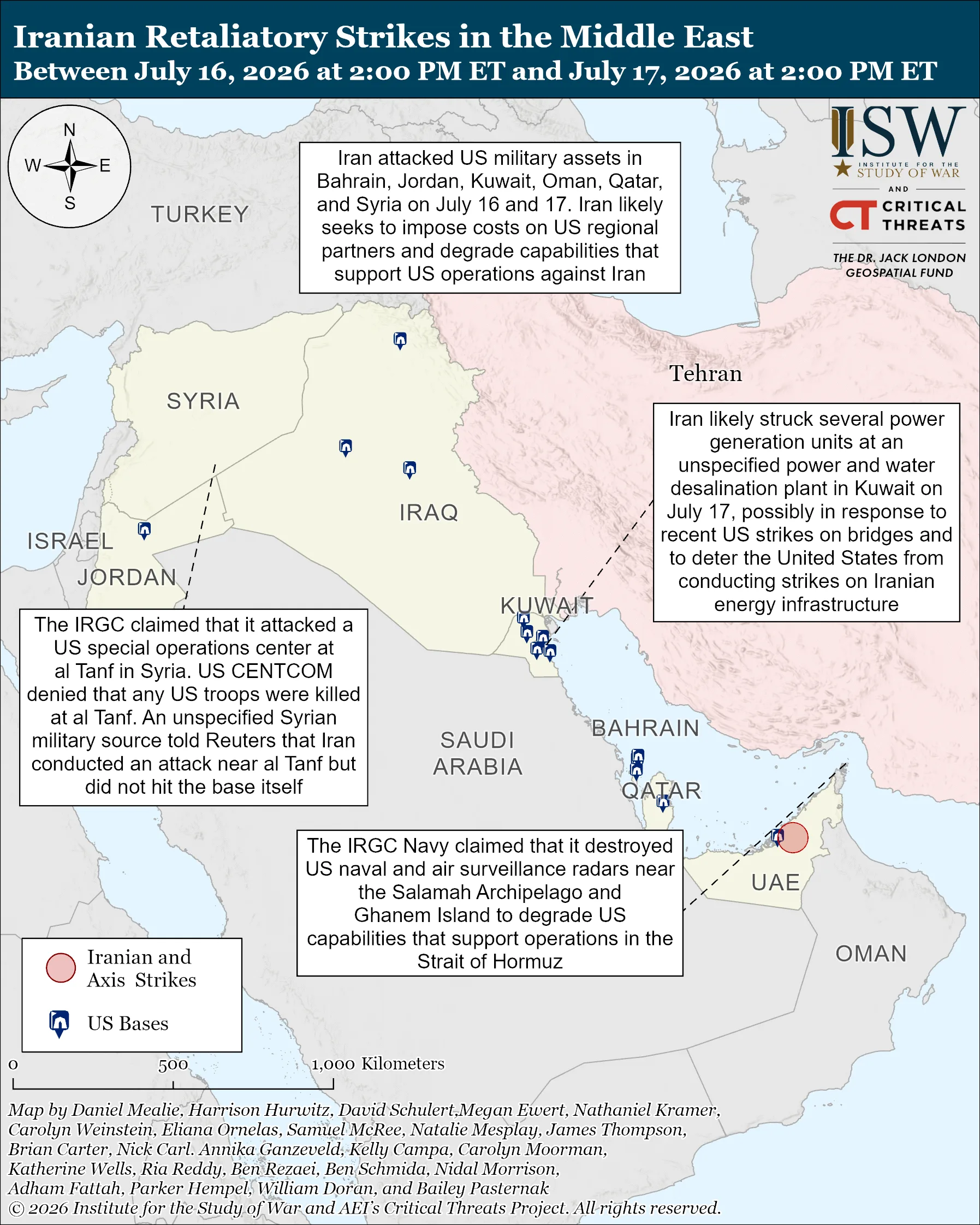
Iran attacked US targets in Bahrain, Jordan, Qatar, and Oman on July 16 and 17 as part of Iran's ongoing effort to impose costs on US allies and partners in the region and discourage them from supporting US efforts to undermine Iranian control of the strait.[17] Iran targeted US assets in Oman that support US operations in the Strait of Hormuz, likely to try to degrade the United States’ capability to operate in the strait. The IRGC Navy claimed on July 17 that it destroyed a naval surveillance radar on the Salamah Archipelago and a US air surveillance radar near Ghanem Island in the Persian Gulf.[18] Iran also likely aims to deter Oman from supporting international efforts to undermine Iranian control over the strait. Iran has recently adopted a more hostile tone toward Oman and accused Oman of giving in to “US pressure” to oppose Iranian management of the strait.[19] Iranian officials have explicitly stated that Oman and other Gulf states cannot prevent Iran from asserting control over the strait in recent weeks.[20] Iran also likely seeks to punish US regional allies and make their continued cooperation with the United States increasingly costly. IRGC Aerospace Force Commander Brigadier General Majid Mousavi warned on July 17 that the IRGC will continue to launch “effective and targeted” strikes until the United States ceases its attacks in southern Iran.[21]
The IRGC said that it targeted a US special operations command center at al Tanf Garrison in the Syrian Badia in retaliation for the killing of Iranian soldiers in Iranshahr, Sistan and Baluchistan Province.[22] US forces struck the Artesh Ground Forces 388th Brigade in Iranshahr on July 15, reportedly killing seven Artesh soldiers. US forces withdrew from al Tanf in February 2026, and Syrian government forces assumed control of the position.[23] An unspecified Syrian military source told Reuters that Iran conducted an attack near al Tanf but did not hit the base itself.[24] CENTCOM denied Iranian claims that the attack killed US troops at al Tanf.[25] The Iranian attack on al Tanf comes amid repeated Iranian threats to Syria and was likely intended to deter the Syrian government from taking action against Hezbollah by demonstrating Iran's ability and willingness to attack Syrian territory. An expert close to the Iranian regime warned on July 16 that the Iranian regime would respond to any Syrian action against Hezbollah with Iranian missile and drone attacks on Syria.[26] US President Donald Trump has repeatedly suggested in recent weeks that the Syrian transitional government could play a role in operations against Hezbollah in Lebanon.[27] The location of the al Tanf Garrison attack on July 17 is also notable given that Syrian forces announced that they interdicted an IRGC shipment of drones, missiles, and weapons components intended for Hezbollah near al Tanf on July 16.[28]
Iran is continuing to use force and the threat of further attacks to impose its control over the Strait of Hormuz. Iran targeted a Thai-flagged vessel in the strait on July 17.[29] Islamic Revolutionary Guards Corps (IRGC)-affiliated Tasnim News Agency, citing an informed source, claimed that the IRGC Navy struck the vessel after it ignored warnings from the IRGC Navy and attempted to transit through the strait without Iranian authorization.[30] United Kingdom Maritime Trade Operations (UKMTO) reported on July 17 that an unidentified projectile struck a vessel 19 nautical miles east of Khasab, Oman.[31] The location of the vessel suggests that it was attempting to pass through the southern transit route along Oman's coast. Iran has repeatedly attacked vessels using this route because the route is an alternative to Iran's illegal traffic separation scheme and therefore undermines Iranian efforts to assert authority over the strait. Kpler data on July 17 shows that only eight vessels transited through the strait on July 16.[32] The low traffic volume on July 16 demonstrates how Iranian attacks on shipping are deterring shipping companies and ship captains from transiting the strait. Seven maritime security and shipping industry sources recently told Reuters on July 15 that shipping companies are avoiding using the southern route despite US military escorts.[33] Iran does not need to routinely attack vessels to disrupt shipping in the strait; a single successful attack, or even the persistent threat of one, can deter vessels from using routes outside Iran's control.

US naval forces are redirecting and disabling vessels around the Persian Gulf and the Gulf of Oman to enforce the naval blockade. The US Navy has redirected three vessels and disabled one vessel since the United States reimposed the US blockade on Iranian ports on July 14.[34] The 11th Marine Expeditionary Unit boarded the Curacao-flagged M/T Wen Yao about 100 nautical miles east of Duqm, Oman, on July 16 to ensure the vessel's compliance with the blockade.[35] Maritime intelligence company Tanker Trackers reported that M/T Wen Yaowas carrying Iranian oil.[36]
The United States conducted a sixth consecutive night of strikes on Iran on July 16 in order to degrade Iran's ability to attack commercial shipping. CENTCOM stated on July 17 that the United States struck dozens of Iranian coastal surveillance and air defense sites, military logistics infrastructure, and maritime capabilities.[37] The United States destroyed the Chahbahar Shahid Kalantari Port surveillance tower on July 17, which CENTCOM said Iran used to track and target commercial vessels in the strait.[38] The United States previously struck the tower on July 8.[39] Iranian media reported that US aircraft also struck the IRGC Navy Imam Ali Naval Base in Chabahar, Sistan and Baluchistan Province, on July 16.[40] The US-Israeli combined force repeatedly struck the Imam Ali base in February and March 2026.[41] Commercially available satellite imagery captured between July 8 and 13 also showed damage to a boathouse and pier in Jask, Hormozgan Province.[42]
An Israeli geospatial analyst reported that commercially available satellite imagery shows that the United States struck the Oghab 44 underground aviation base in northern Hormozgan Province between July 14 and 16.[43] Israeli media reported that this facility probably houses Iranian aircraft and drones in underground facilities.[44] Iranian media separately reported that the United States struck unspecified targets at Iranshahr Airport in Sistan and Baluchistan Province on July 16.[45] The United States previously struck Iranshahr Airport on July 8.[46]
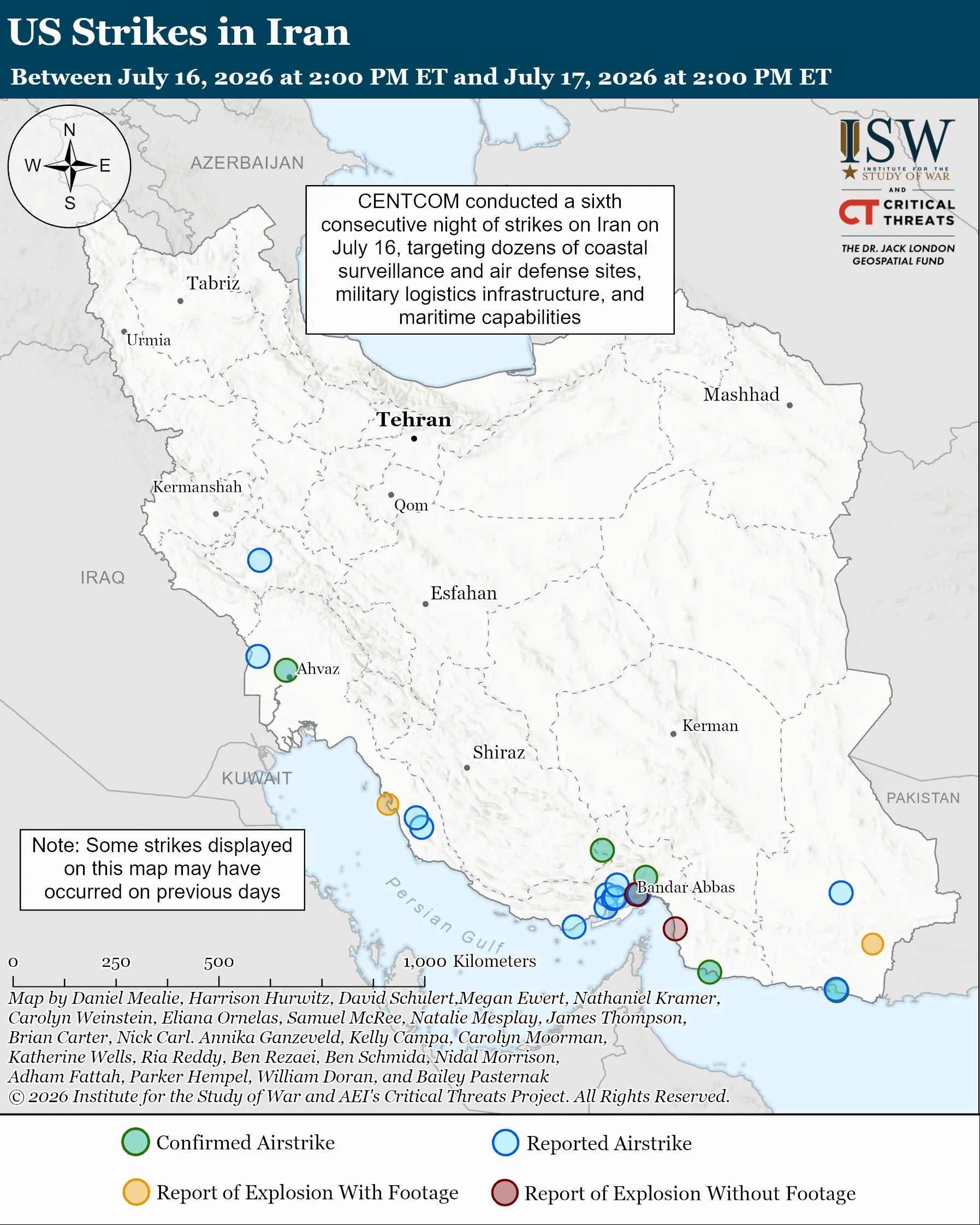
The United States also struck facilities that Iran may be using to strike Gulf states. Commercially available satellite imagery captured between July 15 and 17 showed damage to several buildings at the IRGC Aerospace Force Shahid Assi Zadeh Base in Ahvaz, Khuzestan Province.[47] This base's location in western Iran and distance from the Persian Gulf suggests that this base may be involved in Iranian retaliatory attacks against Gulf countries as opposed to Iranian attacks on commercial shipping. An Israeli geospatial analyst assessed that the United States struck Khorgu Missile Base in Hormozgan Province between July 8 and 16.[48] The United States repeatedly struck the Khorgu Missile Base in March 2026.[49] The geospatial analyst also assessed on July 17 that the United States struck Khormoj Missile Base in Bushehr Province on an unspecified recent date.[50] The analyst said that Iran has launched ballistic missiles from the Khormoj base at Gulf states.[51]
The Lebanese Armed Forces (LAF) continued to deploy forces to one of the “pilot zones” in southern Lebanon on July 17.[52] Lebanese and Israeli media reported that the LAF deployed additional forces to Froun and Kfar Dounine in the Bint Jbeil District on July 17.[53] French media reported that the LAF also deployed additional forces to Qalaouiyeh in Bint Jbeil District on July 17.[54] The LAF began deploying forces to Froun, Kfar Dounine, Qalaouiyeh, and additional areas in and around the “pilot zones” as part of the June 26 Trilateral Framework Agreement on July 16.[55] An Israeli military correspondent close to the Israeli government reported on July 17 that Kfar Dounine is within one of the pilot zones.[56] Israeli Prime Minister Benjamin Netanyahu did not include Kfar Dounine in the two pilot zones that he announced on June 27, however.[57] Netanyahu originally stated that one pilot zone would include territory surrounding Zawtar el Gharbiyeh in Nabatieh District, and the other pilot zone would include territory surrounding Ghandouriyeh and Froun in Bint Jbeil District.[58] Israeli media reported on July 17 that Zawtar al Charqiyeh in Nabatieh District is expected to be the next pilot zone.[59]
Unidentified actors conducted multiple drone attacks targeting several sites in Iraqi Kurdistan, including the US Consulate in Erbil, on July 17.[60] Kurdish counter-terrorism authorities stated on July 17 that US-led international coalition forces intercepted eight booby-trapped drones but provided no further details.[61] Iraqi media separately reported on July 17 that air defenses at Erbil International Airport shot down four drones attempting to target the US Consulate in Erbil.[62] Iranian-backed Iraqi militias launched numerous attacks against US positions in Iraqi Kurdistan during the war.[63] Unidentified actors also launched at least eight drones at the US Consulate in Erbil and a US base at Erbil International Airport on July 15.[64] No actor claimed the attack, and Iranian-backed Iraqi militia Kataib Sayyid al Shuhada denied responsibility for it.[65]
Iraqi Shia Coordination Framework sources revealed to regional media on July 17 additional information about how Iranian-backed Iraqi militias are attempting to circumvent the Iraqi federal government's disarmament initiative.[66] The sources reported that some militias are surrendering “older and lower-quality” weapons, such as heavy mortars, Katyusha rockets, armored vehicles, and mines, to the Iraqi state.[67] The framework sources added that the militias have not handed over drones or missiles with a range longer than 50 kilometers.[68] Iraqi media similarly reported on July 10 that unidentified militias are surrendering “scrap” missiles or inoperable drones but keeping functional heavy weapons.[69] Militia attacks during the war demonstrated that the militias have access to a large number of missiles and drones, including first-person view (FPV) drones.[70] The militias have acquired many of these weapons from Iran and via smuggling routes in Syria. The Iraqi federal government lacks accurate information about the number and types of militia weapons due to the covert nature of the militias, including those within the Iranian-backed Popular Mobilization Forces (PMF).[71]
Kuwait is reportedly negotiating an expanded defense pact with Pakistan that would build upon a limited 2023 bilateral defense agreement between the two countries.[72] Unspecified Pakistani officials told Reuters on July 17 that Kuwait wants Islamabad to deploy aircraft, drones, an air defense system, and thousands of troops to Kuwait as part of the agreement.[73] Kuwait and Pakistan's limited 2023 agreement includes joint training and capacity-building programs.[74] Kuwait would help boost Pakistan's oil and fuel reserves under the new agreement.[75] A source familiar with Kuwaiti security planning told Reuters that Kuwait views Pakistan as a safe alternative for defense cooperation given Pakistan's long history of defense procurement and its positive relationships with Saudi Arabia and the United States.[76] Saudi Arabia signed a mutual defense pact with Pakistan in September 2025.[77] Unspecified sources with knowledge of Kuwait-Pakistan talks told Reuters that the negotiations are in an “early stage.”[78]
https://understandingwar.org/research/middle-east/iran-update-special-report-july-17-2026/
Iran Update Special Report, July 18, 2026
Iran is adapting to US defenses by firing high-speed, maneuverable missiles at US bases in the region, which highlights the threat that the advancement of Iran's ballistic missile program poses to US national security interests.[1] US officials told the Wall Street Journal on July 18 that Iran is using missiles that “travel at extremely high speeds and can maneuver as they streak toward the earth.”[2] Iranian leaders have expressed interest since at least the Iranian strikes on Israel in April and October 2024 in employing maneuverable reentry vehicles in order to improve the relatively low accuracy of Iranian missiles.[3] All ballistic missiles have a circular error probable (CEP), which is the “radius of a circle, centered at the intended target, within which 50 percent of the missiles would be expected to impact.”[4] The stated and publicly known CEPs of Iranian medium-range ballistic missiles are between 20 and 500 meters.[5] A maneuverable reentry vehicle can be used to evade anti-ballistic missile systems or improve the accuracy of ballistic missiles by altering their trajectory during the terminal stage of flight.[6] Iranian leaders examined using maneuverable reentry vehicles and other technical improvements to missile accuracy after the 12-Day June 2025 War.[7] Such improvements could make individual projectiles harder to intercept and more destructive.[8] Iran still struggled with relatively poor missile accuracy in its strikes against Israeli military targets in March and April 2026, however, which likely pushed Iran to deploy cluster munitions at a greater scale in order to maximize damage.[9]
Iran previously claimed in May 2025 that it had developed a maneuverable reentry vehicle capability, and it is possible that Iran has deployed missiles with that capability in the current conflict. Iran introduced an upgraded version of the Haj Qassem missile with a maneuverable reentry vehicle in May 2025 known as “Qassem Basir.”[10] IRGC-affiliated media posted footage of Iranian forces launching Haj Qassem missiles at Jordan and other Gulf states on July 18.[11] It is unclear if Iranian forces fired the Qassem Basir variant, however.[12]
An Iranian missile attack on a base in Jordan killed two US service members on July 17.[13] A third service member is missing in action.[14] Unspecified US officials told Western media that the attack took place at Muwaffaq Salti Airbase in Azraq, Jordan.[15] It is not clear which missiles Iran used in the attack. Two US officials said that Iran struck the base earlier this week and the US service members suffered minor injuries.[16]
The People's Republic of China (PRC) and Russia are likely supporting Iranian efforts to target US bases in the region. US officials told the Wall Street Journal on July 18 that they are concerned that the PRC and Russia are supporting recent Iranian targeting of US assets.[17] Both countries have supported Iranian targeting during the conflict thus far. Iran used an advanced reconnaissance satellite purchased from the PRC in 2024 to target US military assets and bases across the Middle East in spring 2026, according to the Financial Times in April 2026.[18] The Washington Post separately reported in March 2026 that Russia was providing Iran with the locations of US military assets, including warships and aircraft, to support Iranian attacks against US forces.[19] Russia is also reportedly sharing advanced drone tactics with Iran to support Iranian attacks against US forces and assets. [20] Iran likely continues to rely on its key partners to improve the accuracy and effectiveness of its attacks.

Iranian Supreme Leader Mojtaba Khamenei and other senior Iranian officials, including members of the negotiating delegation, have publicly declared that the US–Iran memorandum of understanding (MoU) is no longer in effect. Mojtaba published a statement on July 18 condemning alleged US “violations” of the US-Iran MoU and claiming that US “violations,” including airstrikes on Iran, prove that US President Donald Trump's signature of the MoU was “invalid.”[21] Iranian Deputy Foreign Affairs Minister for International and Legal Affairs Kazem Gharibabadi told Iranian state media earlier on July 18 that Iran is “suspending” its commitments and implementation of the MoU.[22] It remains unclear if the Iranian regime has given up on diplomacy entirely, however. The Supreme Leader's military adviser, Major General Mohsen Rezaei, stated on X on July 17 that “both diplomacy and negotiations…are over,” but some regime elements continue to advocate for diplomacy to achieve Iranian objectives.[23] Iranian negotiating team head and Parliament Speaker Mohammad Bagher Ghalibaf argued on July 15 that Iran needs diplomacy with the United States to secure its national interests.[24] Regime outlet Nour News separately published an op-ed on July 18 in which it argued that diplomacy would secure Iran's interests through long-term commitments.[25]
Iran and the United States interpreted the MoU’s fifth clause about the Strait of Hormuz in fundamentally different ways, which contributed to the MoU’s collapse. The MoU stipulated that Iran had to make “its best efforts” to ensure the safe passage of traffic through the strait.[26] US President Donald Trump indicated that the MoU would enable traffic in the strait to return to pre-war conditions, inferring that the MoU would remove the Iranian threat to shipping and dispel Iranian control over the strait.[27] Iran interpreted the clause as affirming Iranian authority over the strait, however, and only allowed safe passage for vessels through Iran's traffic separation scheme. [28] Iran has repeatedly attacked vessels attempting to transit through the strait via the southern corridor along Oman's coast. Iran's Ambassador to Pakistan, Reza Amiri Moghadam, claimed on X on July 18 that the United States interpreted the MoU in a manner inconsistent with its original intent and used it to ”gain control” over parts of the Strait of Hormuz, almost certainly referring to the US-sponsored southern corridor.[29] Iranian Judiciary Chief Gholam Hossein Mohseni Ejei separately described US plans for a southern corridor in the Strait of Hormuz as a “strategic failure.”[30]
The fifth clause also required Iran to engage in talks with Oman and other Persian Gulf littoral states regarding the future management of the strait.[31] Iran consulted the Gulf states, but these states rejected Iran's management of the strait, including Iran's proposal to impose transit fees and other restrictions on vessels transiting the waterway.[32] ISW-CTP previously noted that the fifth clause assumed that the Gulf states would moderate Iran's stance on the strait and that Iran would reach an agreement with these states. The clause did not take into account that Iran could resort to using force to advance its objective of securing permanent control over the strait. Iran has adopted an increasingly hostile tone toward the Gulf states in recent weeks, and its current attacks on the Gulf states are likely, in part, meant to deter these states from continuing to oppose Iranian control of the strait (read more about Iran's attacks on the Gulf states below).[33]
Iran struck a Kuwaiti power and desalination plant on July 18, likely in response to an alleged US strike on an Iranian desalination plant near Jask, Hormozgan Province, on July 17. Iranian officials alleged that the United States struck “power facilities and desalination pumps” on a pier in Bonji village, north of Jask, on July 17.[34] Several Iranian media outlets circulated photos of a destroyed structure along the pier.[35] ISW-CTP cannot independently confirm the structure's purpose. A local official claimed that US strikes on the facility cut off water to several villages west of Jask.[36] Iranian regime officials have repeatedly warned in recent days that Iran would attack “regional infrastructure” in response to any US attacks on Iranian critical infrastructure.[37] The Iranian attack on the Kuwaiti power and desalination plant on July 18 marks the second attack that Iran has conducted on such a plant in Kuwait in the past 48 hours. Commercially available satellite imagery captured on July 18 showed smoke rising over the Shuaiba Power Plant.[38] Iran also struck an unspecified Kuwaiti oil facility on July 18.[39] The Kuwait Petroleum Corporation said that the facility suffered material damage.[40] Iran has not acknowledged the attacks on Kuwaiti critical infrastructure at the time of this writing and claimed that it targeted a radar and support center at two US bases in Kuwait.[41]
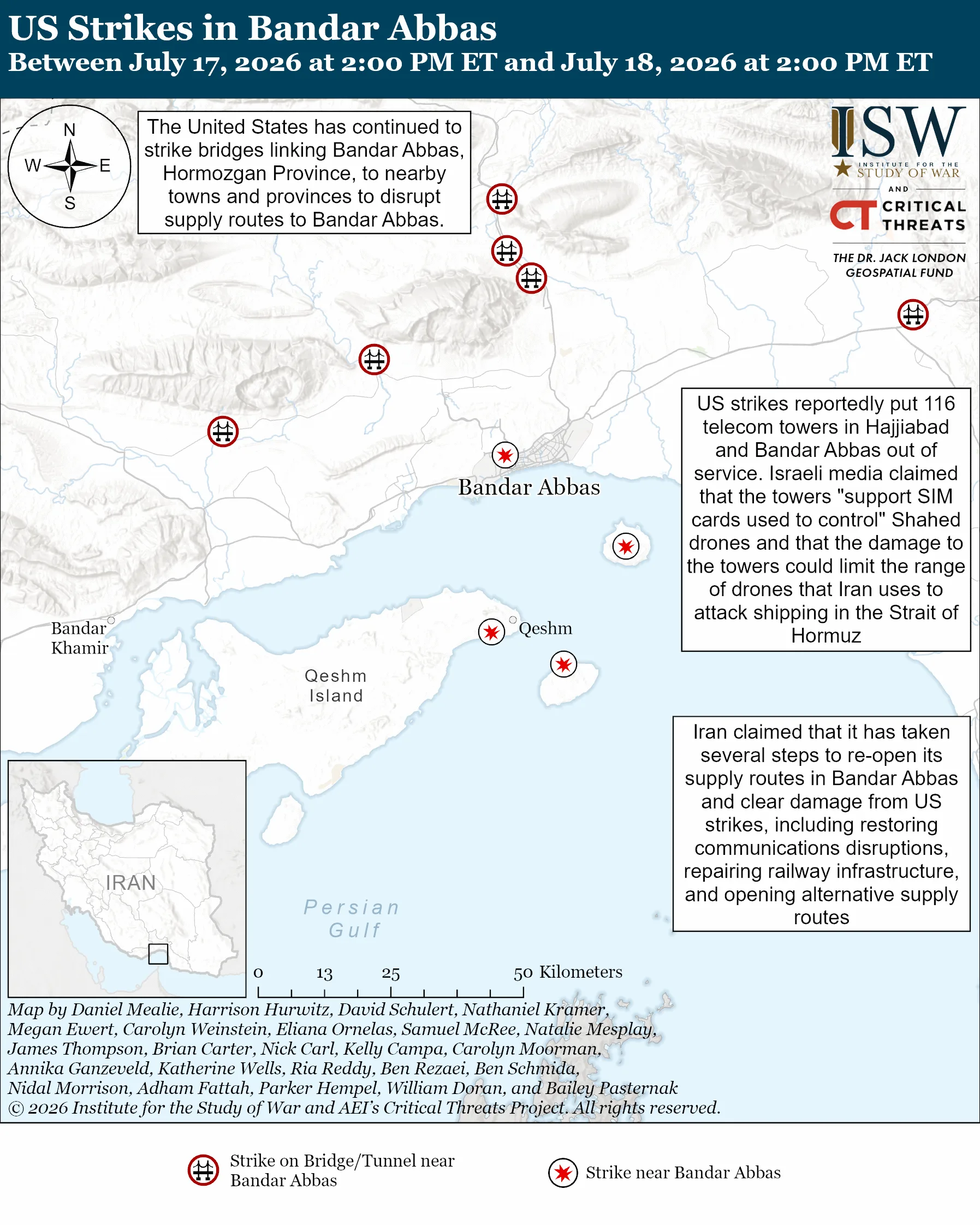
The United States has struck additional bridges and roads around Bandar Abbas, Hormozgan Province, since ISW-CTP’s last data cutoff at 2:00 PM ET on July 17.[42] A senior US official speaking to the Wall Street Journal on July 17 said that the United States has targeted transportation infrastructure around Bandar Abbas in order to disrupt supply routes to the city.[43] Bandar Abbas is a port city that hosts the IRGC Navy First Naval District and numerous other naval facilities, and the city is also vital for moving military supplies, fuel, personnel, and commercial cargo between Iran's interior and its southern coast.[44] US strikes have targeted several bridges linking Bandar Abbas to nearby towns and Iranian provinces.[45] Geolocated footage posted by an OSINT account on July 18 shows damage from US strikes on July 16 to a tunnel that connects Bandar Abbas to a nearby county.[46] IRGC-affiliated media reported on July 18 that recent US strikes caused 116 telecom towers to go offline in Bandar Abbas and Hajjiabad, which is about 100 kilometers north of Bandar Abbas.[47] Israeli media claimed on July 18 that the telecom towers “support SIM cards used to control” Shahed drones and that the damage to the towers could limit the range of the drones that Iran uses to attack shipping in the Strait of Hormuz.[48] The United States previously struck on July 16 the Radio and Communications Regulatory Authority's office in Bandar Abbas, which is responsible for regulating telecommunications networks, licensing operators, and managing Iran's radio-frequency spectrum.[49] Iran has taken several steps to re-open its supply routes in Bandar Abbas and clear damage from US strikes. Iranian authorities announced on July 18 that they opened an alternative route to avoid a bridge that the United States attacked on July 17, for example.[50]
Iran launched a ballistic missile at a US base in Saudi Arabia, marking the first Iranian attack on Saudi territory in nearly three months.[51] Iran launched one ballistic missile at an unspecified base in al Kharj, near Riyadh.[52] Prince Sultan Airbase is located in al Kharj. Early warning sirens also went off in Yanbu on Saudi Arabia's Red Sea coast, although it is unclear whether an attempted attack took place there.[53] Saudi Arabia relies on Yanbu as a key oil export terminal to mitigate disruptions from the closure of the Strait of Hormuz.[54] The Iranian attack on Saudi Arabia comes amid heightened tensions between Saudi Arabia and the Houthis. Saudi Arabia recently struck Houthi-controlled Sanaa International Airport to prevent an Iranian Mahan Air flight from landing there, after which the Houthis responded by attacking an airport in southern Saudi Arabia.[55] It is possible that Iran conducted the attack on al Kharj on July 18 to deter Saudi Arabia from taking further action against the Houthis.
Iran appears to be less willing to target Saudi Arabia with the intensity that it is currently targeting other regional US allies, given that Iran only fired a single missile at al Kharj. Iran previously reduced its rate of attacks on Saudi Arabia in March following reports that Saudi Arabia was considering responding to the attacks.[56] Saudi Arabia, which has conducted covert strikes on Iran during the war, has favored reaching a diplomatic agreement with Iran and reportedly even briefly explored pursuing a mutual non-aggression pact with Iran.[57]
Iran also targeted US facilities in Bahrain and Jordan on July 17 and 18. The IRGC claimed that it targeted several US bases and a data center in Bahrain.[58] Bahrain said that it intercepted multiple Iranian attacks on July 18.[59] The Jordanian Defense Ministry intercepted four Iranian drones and 10 missiles on July 18.[60]
Iran continues to attempt to coerce vessels to transit through Iranian territorial waters in order to secure recognized control over the strait and impose transit fees on these vessels. An Iranian Environmental Protection Agency official announced on July 18 that the agency asked the government to charge fees for “environmental services” from ships transiting the strait, citing the UN Convention on the Law of the Sea (UNCLOS).[61] UNCLOS stipulates that coastal countries may not impose fees or hamper maritime traffic in international waterways but may charge fees within territorial waters.[62] Iran is forcing vessels to transit Iranian territorial waters by conducting drone and missile attacks on vessels using routes outside of Iranian territorial waters, including the southern route along the Omani coast.[63] The Islamic Revolutionary Guards Corps (IRGC) Navy announced on July 17 that it conducted combined drone and missile attacks on “four violating ships.”[64] ISW-CTP has not recorded any new Iranian attacks on civilian vessels since its last data cutoff at 2:00 PM ET on July 17, however. The IRGC Navy may have been referring to vessels it attacked prior to the data cutoff.[65] These vessels may have also not reported the incidents. Iranian officials continue to threaten attacks against vessels. Iranian Armed Forces General Staff Commander's senior adviser Brigadier General Hossein Ashtari threatened “a crushing response to any move” from the United States and “any interference in the Strait of Hormuz” on July 17.[66]
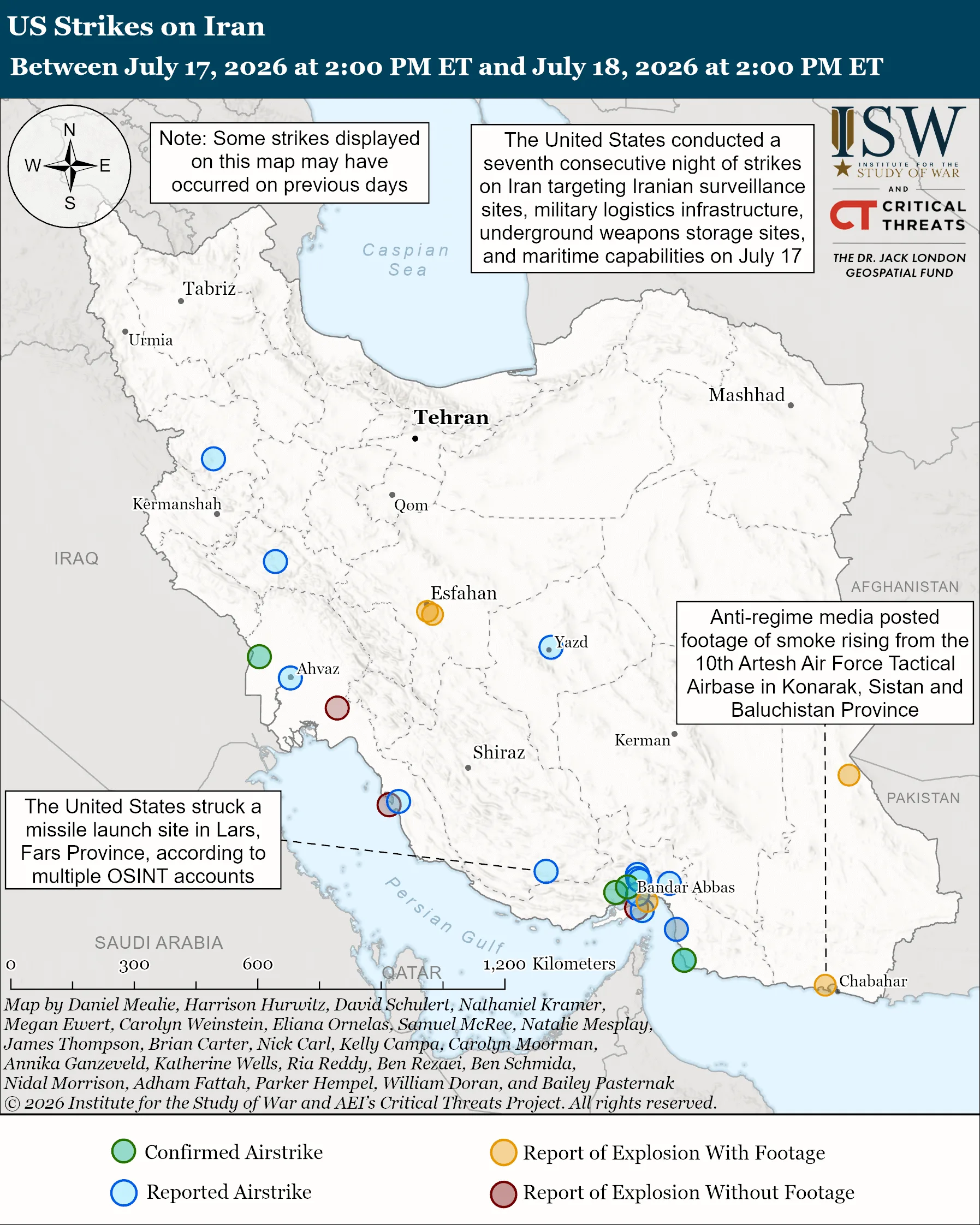
The United States conducted a seventh consecutive night of strikes on Iran on July 17 in order to degrade Iranian military capabilities.[67] CENTCOM said that the United States targeted Iranian surveillance sites, military logistics infrastructure, underground weapons storage sites, and maritime capabilities.[68] Anti-regime media posted footage on July 18 of smoke rising from the 10th Artesh Air Force Tactical Airbase in Konarak, Sistan and Baluchistan Province.[69] The United States repeatedly struck this base during the war in March and April.[70] Two OSINT accounts reported that the United States struck a missile launch site in Lar, Fars Province, on July 17.[71] The United States may have also struck the Yazd Missile Base, given that Iranian media and multiple OSINT accounts reported explosions in the area.[72] Iran frequently launches missiles from this base, and the US-Israeli combined force struck the site at least five times during the war.[73] OSINT accounts and anti-regime media also reported strikes in Sanandaj, Kurdistan Province, and posted footage of the aftermath of an explosion in Sepahan Shahr, Esfahan Province.[74] Three US officials told Reuters on July 16 that recent US strikes in Iran can be viewed as “shaping operations” but did not provide further details.[75] Supreme Leader Military Adviser Major General Mohsen Rezaei threatened on July 17 that Iran will begin “full-scale destruction” if the United States continues to attack Iran in the next two to three days.[76]
Unidentified actors launched drones at unspecified targets in Erbil, Iraqi Kurdistan, on July 17. The US-led international coalition intercepted five drones over Erbil on July 17, according to Kurdish media.[77] Unidentified actors launched eight booby-trapped drones in Erbil earlier on July 17, some of which may have been targeting the US Consulate in Erbil.[78] Unidentified actors also launched at least eight drones at the US Consulate in Erbil and a US base at Erbil International Airport on July 15.[79] Iranian-backed Iraqi militias launched numerous attacks against US positions in Iraqi Kurdistan during the war in March and April, but no group has claimed responsibility for these recent attacks at the time of this writing.[80]
https://understandingwar.org/research/middle-east/iran-update-special-report-july-18-2026/