Posted on 06/24/2026 8:04:59 PM PDT by Red Badger
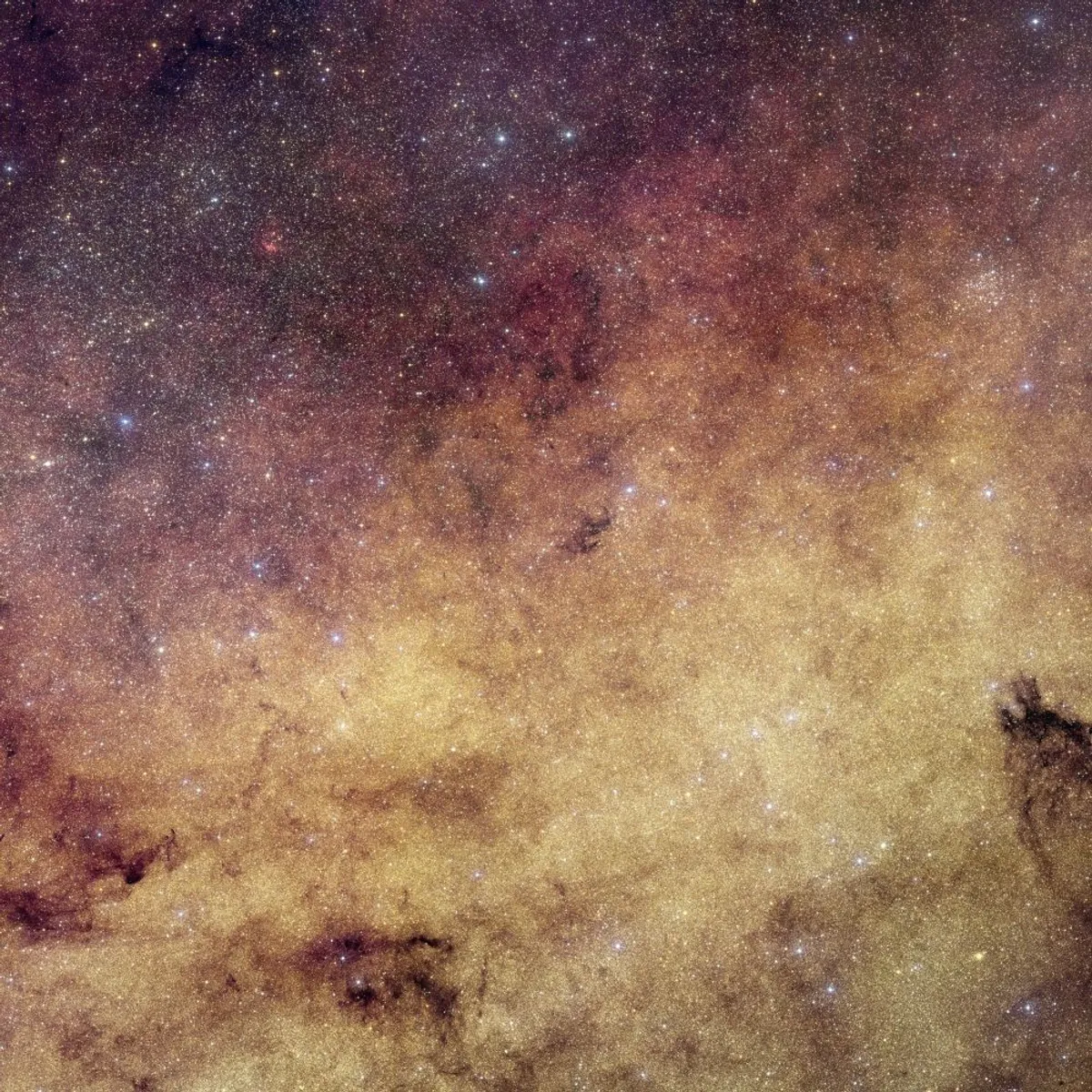
This image will help us discover countless new exoplanets.
The full Euclid image. Image credit: ESA/Euclid/Euclid Consortium/NASA, CFHT, image processing by J.-C. Cuillandre and E. Bertin (CEA Paris-Saclay)
Pointing the telescope to look at the central region of the galaxy wasn't just because it’s pretty or because Euclid can. The research team will use this incredible image and the data behind it to discover and characterize planets. This is possible thanks to a technique known as microlensing.
Any object with mass warps spacetime. Galaxies, clusters, and black holes can create a strong gravitational lensing effect: space-time warps so much that it acts as a lens, magnifying the background.
Microlensing is a lot more modest. It occurs when small changes to the luminosity of a distant star are caused by a foreground star passing in front of it. What’s exciting is if there is a planet orbiting the foreground star.
In that case, the microlensing is slightly asymmetric, hinting at the presence of the planet as it moves around its host star. In other cases, it's even possible to have a free-floating planet without a star doing the microlensing.
“To catch microlensing, you need to observe parts of the sky that are crowded with stars, such as close to the centre of our galaxy,” Euclid member Jean-Philippe Beaulieu, from the Institut d’Astrophysique de Paris in France and the University of Tasmania in Australia, said in a statement.
“During the last twenty years, almost 300 exoplanets have been discovered using this technique, all with ground-based telescopes and all towards the centre of our galaxy. This image from Euclid includes 51 known planetary systems – and it will assist in studying many more that will be found.”
So, how many planets has Euclid discovered with this image? The answer is zero. The set of observations has not been used to discover planets just yet, they are simply a crucial reference for future work.
It takes about 20 days of continuous observations to catch foreground and background stars overlapping. Space telescopes, like the upcoming Nancy Grace Roman, and ground observatories will instead be looking at the center of the Milky Way to spot microlensing events using the Euclid data as a reference.
“In 24 hours, Euclid has already captured the stars involved in all the future microlensing events that the Roman space telescope will detect, but before the stars and planets involved have aligned,” explained Natalia Rektsini of the Institut d’Astrophysique de Paris in France, who led the release of Euclid’s galactic bulge survey data for the scientific community.
“This means that anyone who detects a microlensing event in the same region, for example with Roman, will be able from now on to use Euclid data as a time reference in the past and see how the stars looked before they overlapped,” Rektsini explains.
“Since Euclid can clearly separate individual stars, one can then measure how fast they move over time and use that information to confirm the existence of a planet and determine its mass. This would not be possible with data from one point in time.”
Euclid continues to be a game-changing instrument, a jewel in ESA’s crown of space missions. And we are yet to see its first data release, which is coming soon.
Ping!............
More Stars here than ever found in Old Hollywood.
Dust off your telescopes and take a good look!
How can anyone believe that there isn’t intelligent life orbiting some of those stars?
God filled every possible space on Earth with *Life*. I doubt He would have wasted all of that other space.
Not much here. 😂👍🇺🇸
How good to sing praises to our God...How delightful and how fitting...He counts the stars...and calls them all by name. ✨✨✨ Psalm 147:1,5
Maybe He created it all just for US to explore!..................
One by one, the stars were going out.
I think God is more creative than that. He made so many species for Earth; why wouldn’t he have made many species for His Universe?
Thanks for the ping!
· join · view topics · view or post blog · bookmark ·
· post new topic · subscribe ·Google news searches: exoplanet · exosolar · extrasolar ·
And of course Psalm 19
1 The heavens declare the glory of God;
the skies proclaim the work of his hands.
2 Day after day they pour forth speech;
night after night they reveal knowledge.
3 They have no speech, they use no words;
no sound is heard from them.
4 Yet their voice[b] goes out into all the earth,
their words to the ends of the world.
60,000,000 stars out of 200 billion trillion stars in the universe.
Not even a blip.
Incredible.
bkmk
Wow that’s a lot of stars
Are we viewing the “beating heart of the Milky Way” from the Milky Way’s brain or gonads?
Because we don't have any proof of it (yet). We have found lots of planets in and outside our solar system, but so far no has been found any suitable to support life. Also, the odds of life (let alone intelligent life) existing here on earth is so unlikely as to be impossible. The conditions that had to be met just to set the process in motion are, literally, miraculous.
I'd like to believe there's intelligent life out there, but until there is actual evidence, I can't say there is. Even though God created the Universe, he doesn't have to populate any given planet. Until then, my belief is that we indeed live on a privileged planet--that, similar to Israel in the Old Testament, God chose the earth to be the object of his special love, making it green and good and placing creatures on it that he could love and would love him.
Arthur C. Clark, The Nine Billion Names of God?
I can. We've been scanning the skys for decades for radio waves. Nothing. For someone scanning us our radio signals are now out as far as 120 light years away.
Some people are obsessed with finding intelligent life out in the stars. Some of us are dedicated to trying to find it here.😁
“Apart from hydrogen, the most common thing in the universe is stupidity.”
-Harlan Ellison
Nice 👍👍
The thing that is beyond comprehension is that those stars are hundreds of millions of miles apart from each other and some of those things that look like stars are actually galaxies that contain billions of stars which are also hundreds of millions of miles apart from each other.
Disclaimer: Opinions posted on Free Republic are those of the individual posters and do not necessarily represent the opinion of Free Republic or its management. All materials posted herein are protected by copyright law and the exemption for fair use of copyrighted works.
