
Posted on 05/08/2026 8:27:01 PM PDT by Red Badger
The beams are an in-kind contribution from CERN. Matthew Kapust / SURF The US has begun lowering 10 million pounds of steel nearly a mile underground to build the Deep Underground Neutrino Experiment (DUNE), widely regarded as one of the world’s most ambitious particle physics experiments.
The Fermi National Accelerator Laboratory (Fermilab), the premier US national lab for high-energy particle physics announced the start of the underground detector assembly for the massive neutrino project in South Dakota on May 7. It is carried out along with the Sanford Underground Research Facility and CERN.
Transported deep underground, the steel beams will be used for the construction of massive detector modules that will help Fermilab engineers to study neutrinos, some of the most common and least understood particles in the universe.
Norbert Holtkamp, Fermilab director, highlighted the importance of the advance. “Today represents the start of a pivotal phase for DUNE, the development of the far detector structures in South Dakota,” he elaborated.
A new construction phase DUNE brings together scientists and engineers from over 35 countries around the globe. Once fully operational, it will send the world’s most intense neutrino beam roughly 800 miles from Fermilab in Illinois to detectors buried deep beneath the ground at SURF in South Dakota.
For the project, the European Organization for Nuclear Research (CERN) provided personnel, expertise, and 10 million lbs of steel for the underground detectors. It is the organization’s first infrastructure investment outside Europe.
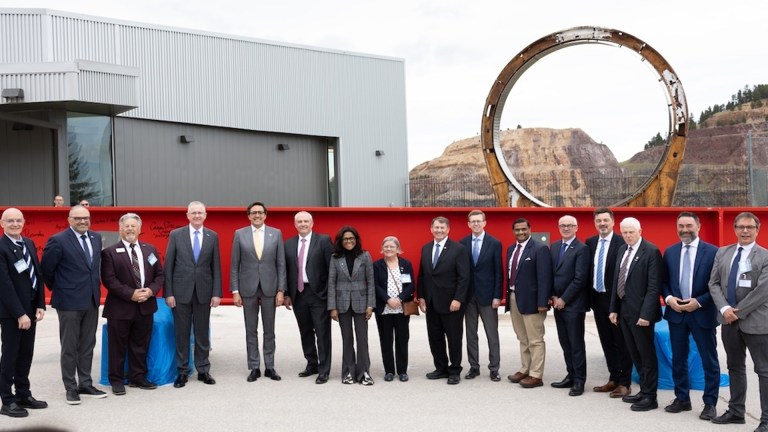
The event marked the start of 10 million pounds of steel beams being lowered underground to form the DUNE detectors. Credit: Landin Burke / Fermilab
The steel beams will be used to build the cryostats. These are massive insulated containers made to hold liquid argon cooled to -300 degrees Fahrenheit. These detectors will capture neutrino interactions with unprecedented precision.
Each of the first two detector modules will be massive. In practice, this translates to roughly 216 feet long, 62 feet wide, and 60 feet high, which is equal to the size of a five-story building. Once completed, each cryostat will contain approximately 17,000 tons of liquid argon, nearly a mile underground.
Going underground
Mark Thomson, CERN director general, revealed that CERN is supplying prototype detectors and giant cryostats for DUNE, while in parallel, US labs are providing superconducting magnets for the High-Luminosity Large Hadron Collider. “This important milestone for DUNE is a testament to the strong scientific partnership between CERN and the US,” Thomson concluded in a press release.
The DUNE experiment is the largest scientific project currently backed by the US Department of Energy (DOE) Office of Science. It is, additionally, one of the most important neutrino experiments ever attempted.
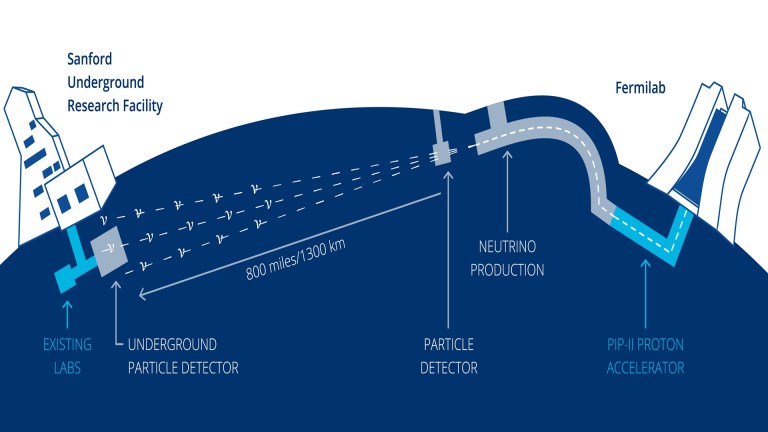
DUNE will send the world’s most intense neutrino beam 800 miles from Fermilab in Illinois to detectors deep underground at SURF in South Dakota. Credit: Fermilab
Neutrinos are highly difficult to study because they rarely interact with matter. Billions pass through the human body every second unnoticed. According to Fermilab, the project could help answer some of the biggest physics mysteries, including why matter dominates over antimatter in the universe and how the universe evolved after the Big Bang.
The team also believes that the research could influence fields, including national security, communications, and medical imaging. The project brings together more than 1,500 scientists from institutions worldwide. With underground installation now underway, Fermilab’s next major target is delivering the first neutrino beam to DUNE by 2031.
Shift happens!
The spice must flow.😏
The cat might be dead ... or not.
-Schrödinger
Bkmk
I may just be dense, but why all the expenditures on a particle that seems to have about a net-zero effect on anything?
If they can learn how to control neutrinos, then you have a practically unbreakable communication system..........
DUNE has been troubled by major cost overruns, schedule delays, and Department of Energy‑mandated descoping. Most of the technology has been done elsewhere before: underground neutrino labs, large liquid argon detectors, neutrino beams from colliders. Just not at this scale. I think the most likely outcome of the experiments will be the measurement of the leptonic CP-violating phase and better measurements of the already-measured neutrino parameters. Of course, there is always the possibility of a revolutionary discovery.
Shai-Hulud Rules!
No. It doesn’t seem. It is.
The article itself already posted a Stargate SG1 photo in the second pic.
If it leads to the development of cheese powder that adheres to the Cheetos but not to your fingers, hell yeah it's worth it!
I wonder what Dr. John J. Smallberries had to say about it.

Do neutrinos really matter?
Thanks Sheldon! JK!
And all this time I thought they were floaters in my eyes….
That sounds as useful as finding out how a parking meter works but $$$$$$$$$$$$$$$$$$$$$$$$$$$$$$$$$$$$$$$$$$$$$$ ensues.
I’m no physicist. Maybe it’s a stupid idea…
Any large concentration of iron can be detected by magnetometers!.........
That’s what I thought. Haven’t there been magnetic anomalies detected on the Moon? Hmmmm…..
Disclaimer: Opinions posted on Free Republic are those of the individual posters and do not necessarily represent the opinion of Free Republic or its management. All materials posted herein are protected by copyright law and the exemption for fair use of copyrighted works.