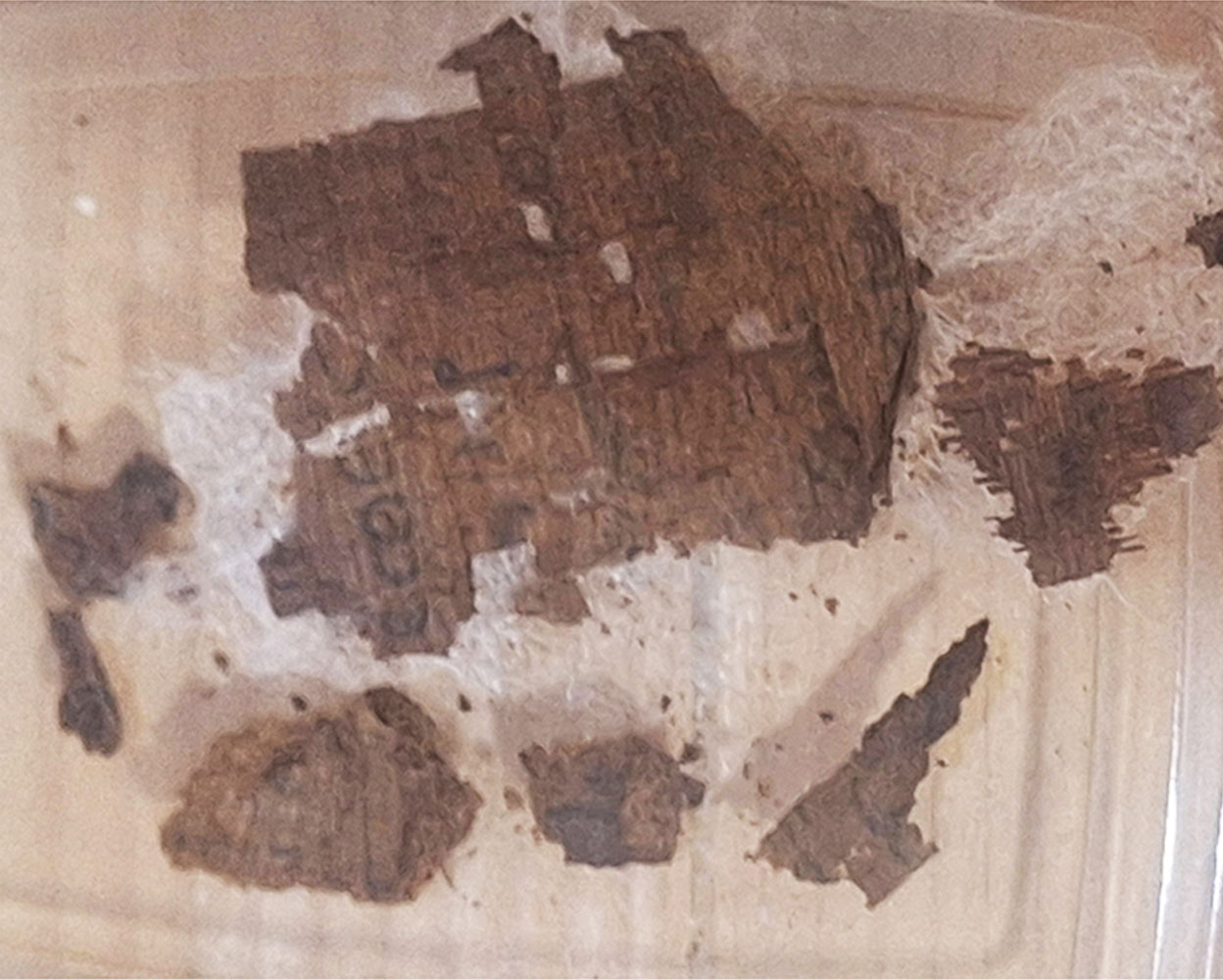
The papyrus fragment with a passage from Homer's IliadIgnasi-Xavier Adiego
Posted on 05/05/2026 6:43:21 AM PDT by SunkenCiv
In the ancient Egyptian city of Oxyrhynchus, archaeologists recently discovered a 1,600-year-old tomb with several mummies inside. Some of them were decorated with gold leaf or geometric patterns—features commonly found in burials of this kind.
But one of the mummies was unearthed alongside a particularly unusual artifact: a papyrus fragment from Homer's Iliad, the epic poem set during the Trojan War. The ancient Greek text had been tucked beneath the wrappings on the mummy's abdomen during the embalming process.
"The fact that in this case the text, in Greek, refers to a literary text is truly novel," say Maite Mascort and Esther Pons, who lead the Oxyrhynchus Archaeological Mission, in a statement to Smithsonian magazine. "We are currently studying and proposing various hypotheses."
The passage in question comes from a famous section of the Iliad that's known as the catalog of ships. In Book II of the more than 2,700-year-old text, the narrator calls on the muses, asking them to name the leaders of the Greek forces that sailed to the city of Troy: "For you are goddesses and are in all places so that you see all things." The remainder of the passage provides a lengthy list of these warriors. A man named Guneus arrived with "two and twenty ships from Cyphus." Tlepolemus, "son of Hercules, a man both brave and of great stature," brought nine ships from Rhodes. And so on.
(Excerpt) Read more at smithsonianmag.com ...
The papyrus fragment with a passage from Homer's IliadIgnasi-Xavier Adiego
Thanks for the link!
Even back then there were Fan Bois..........
Even back then there were Fan Bois..........
Sing, Goddess, of Achilles’ rage,
Dark and murderous, which cost the Greeks
Unmeasurable pain, and pitched the souls
Of countless heroes into dark Hades ,
Leaving their bodies to rot as a feast
For dogs and birds, as was Zeus’ will to be done.
Reminds me of the Somerset Man, and the scrap that had been torn from the final page of a copy of Rubáiyát of Omar Khayyám.
None of the ship captains listed in that part of the Iliad were known to have ever come from or gone to Egypt. I’m wondering if maybe one of the sailors on one of the ships ended up there though and that’s why the scrap was included in their wrappings.
Maybe, or the dead guy (?) had grown up in one of those towns, or somewhere else in Greece. Regardless, sounds like a big fan of the Iliad. It would be nice if strotium in his or her teeth were checked to narrow down where he or she grew up.
Wow! What a great discovery.
Sounds like this scroll was snatched out of his hollow coffin.
Now, you Muses living on Olympus, tell me— for you are goddesses and know everything, while we hear only stories, knowing nothing certain— tell me the leaders of Danaans, the rulers. It would be impossible for me to tell the story of or name those in the common mass, not even with ten tongues, ten mouths, an untiring voice, a heart of bronze, unless the Olympian Muses, daughters of aegis-bearing Zeus, could sing of the men, all those who came to Troy. But I shall list the leaders, commanders of the ships, and all the ships in full...
https://johnstoniatexts.x10host.com/homer/iliad2html.html
There are probably lots of such frags repurposed as mummy wrappings. Given the advancements in non-invasive methods of coaxing out texts (like the Villa of the Papyri scrolls) CAT scans and whatnot of the mummies might prove quite fruitful, particularly in the so-called Valley of the Golden Mummies, where the Roman-era hoi polloi got the old school treatment but probably on the cheap.
The longest Etruscan text in existence, the Zagreb mummy wrapping, was written on a linen cloth later used in the mummification of a person in Egypt. Someone brought the mummy to Croatia in the 19th century and the text was later discovered.
Liber Linteus, oddly enough, I’ve got something on deck about the Etruscans, there’s a big ‘do’ going on at the Fine Arts in SF.
“One of the most exciting things in the exhibition is the Liber linteus.”
https://www.youtube.com/watch?v=uJ59rR9pwDE
The Liber Linteus is in the Archaeological Museum in Zagreb in a special climate-controlled room (or at least it was some years ago when I visited the museum).
What is paper mache' usually made of? Repurposed newspapers - so the concept didn't start in comparatively recent France.
Maybe his loved ones just wanted to make sure he had something to read while taking care of after-dinner business in the afterlife.

"Roll empty. What to do?"
( Brave search comments: "The full opening line is typically translated as "Sing, goddess, the wrath of Achilles..." However, the Greek word order places "μῆνιν" (wrath/anger) at the very beginning to immediately establish the poem's central theme.)
If you want to see the first 16 lines in Greek click on the link. There is also a link to a soundcloud clip with someone reading it in Greek.
Publication information: “Homer, Iliad 1.1–16 , Read in Greek by Gregory Nagy”. 1997. Cambridge, MA: Department of the Classics, Harvard University.
μῆνιν ἄειδε θεὰ Πηληϊάδεω Ἀχιλῆος
οὐλομένην, ἣ μυρί’ Ἀχαιοῖς ἄλγε’ ἔθηκε,
πολλὰς δ’ ἰφθίμους ψυχὰς Ἄϊδι προΐαψεν
ἡρώων, αὐτοὺς δὲ ἑλώρια τεῦχε κύνεσσιν
οἰωνοῖσί τε πᾶσι, Διὸς δ’ ἐτελείετο βουλή
(couldn't resist)
Thx!
Disclaimer: Opinions posted on Free Republic are those of the individual posters and do not necessarily represent the opinion of Free Republic or its management. All materials posted herein are protected by copyright law and the exemption for fair use of copyrighted works.