You are correct, but at least it is not a 'planet killer' for Earth!

Wonder if it will even be eyesight visible?
Posted on 06/23/2021 6:26:07 AM PDT by BenLurkin
The mystery object is called 2014 UN271, and it’s currently 22 AU from the Sun (in which 1 AU is the average distance of Earth to the Sun), which means it has already passed the orbit of Neptune.
The International Astronomical Union Minor Planet Center announced the detection on June 19. This object will travel another 11.1 AU before reaching its perihelion point (closest approach to the Sun) in 2031, after which 2014 UN271 will begin its long journey back to the Oort cloud.
Measuring somewhere between 62 and 230 miles (100-370 kilometers) in diameter, 2014 UN271 is one of the largest known objects to come in from the outer solar system....UN271 is probably between 60 and 93 miles (100-150 km) in length, not even close to a dwarf planet in terms of size—nor is it likely to be spherical...
That said, should the object develop a coma and tail during its perihelion in 2031, it will rank as among the largest comets ever recorded. Other examples of big comets include Comet Sarabat (observed in 1729), with an estimated nucleus around 62 miles (100 km) in diameter, and Comet Hale-Bopp, which had a nucleus from 25 to 50 miles (40 to 80 km). The newly detected object could very well be a record breaker, but we’ll have to wait for more precise size estimates to be sure.
Interestingly, this object, should it turn into a comet, could be a pristine comet, meaning a comet that’s experiencing its first flare-up during a close approach to the Sun. Observations of pristine comets are quite rare.
Should 2014 UN271 flare up into a comet, it likely won’t be visible to the unaided eye or binoculars. But at an estimated magnitude between 16 and 17, it will most certainly be visible to telescopes.
(Excerpt) Read more at gizmodo.com ...
It was reported as such back in the day.
Kohoutek 2: Electric Boogaloo
It is only going to get as close as the orbit of Saturn. That means this comet is not going to warm up much.
That is a good one. I also liked Kraftwerk’s instrumental arrangement by the same name.
You are correct, but at least it is not a 'planet killer' for Earth!
Wonder if it will even be eyesight visible?
Not even close to eyesight visible. The more interesting question is what could have perturbed the orbit of something this big?
I thought the Cloud was controlled by Google.
Oort Cloud ....I’ve always wanted to visit....being a sweater I hear. Chilly at night
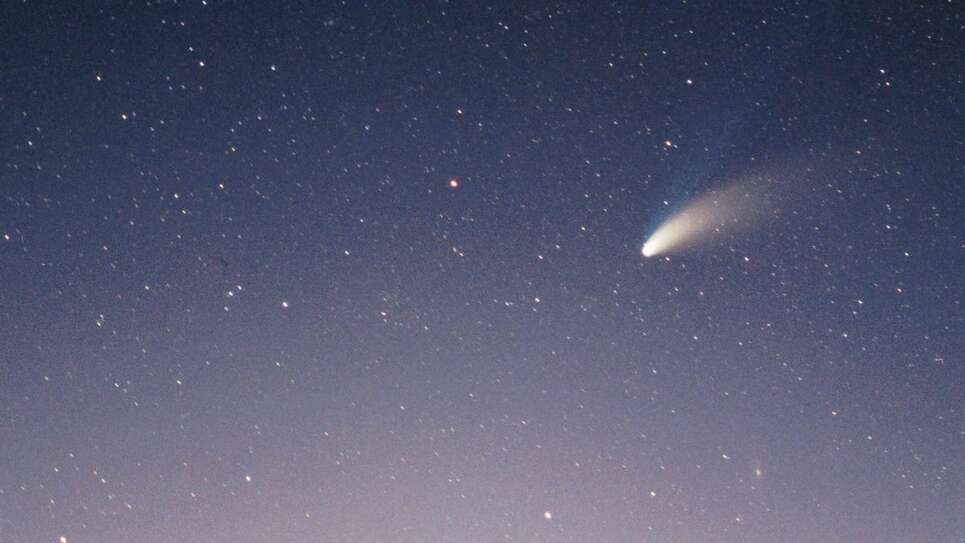

OMG! IT’S A FLYING URANUS!.....................
Thanks BenLurkin.
|
Measuring somewhere between 62 and 230 miles (100-370 kilometers) in diameter, 2014 UN271 is one of the largest known objects to come in from the outer solar system... should the object develop a coma and tail during its perihelion in 2031, it will rank as among the largest comets ever recorded... could very well be a record breaker, but we’ll have to wait for more precise size estimates to be sure.
Well, it escaped Ord Cloud.
The object is an escapist accretion anomaly
[snip] Comet Kohoutek confirmed for astronomers a very sorry lesson: The brightness of comets can be wildly unpredictable. Like ISON, Kohoutek was a comet on its initial visit to the inner solar system from the Oort cloud, the comet reservoir beyond Neptune. As Kohoutek warmed in its first exposure to solar heating, frozen methane and ammonia began to vaporize and form a cloud around the frozen comet nucleus while it was still at a huge distance from the Sun, giving the false impression that the activity would continue unabated closer to our star. Once the easily vaporized materials had dissipated, though, the rate of brightening declined sharply. [/snip]
https://skynews.ca/kohoutek-fiasco/
[snip] This early discovery of a large comet in an orbit that would carry it close to the Sun prompted the National Aeronautics and Space Administration to initiate “Operation Kohoutek,” a program to coordinate widespread observations of the comet from ground observatories, aircraft, balloons, rockets, unmanned satellites, and Skylab. This program was headed by Stephen P. Maran of the Goddard Space Flight Center. The third Skylab mission was rescheduled so as to make the best use of this opportunity-specifically to permit observations from Skylab during a period centered on perihelion. It is during this period that the most interesting and dramatic changes happen to comets, and it is also during this period that observations from the Earth’s surface are hardest to make or even impossible because light from the nearby Sun is scattered by the Earth’s atmosphere into instruments aimed at the comet. Another factor making Comet Kohoutek an attractive subject for study was the fact that orbital calculations suggested it was a new comet-one that had never before passed close to the Sun and would therefore be expected to differ from comets that had periodically returned. This effort was indeed successful to the degree that Comet Kohoutek became the best observed and studied comet in history. Directly, through unique measurements made on board, and indirectly, through stimulus to others, Skylab can be credited with this success. [/snip]
https://history.nasa.gov/SP-404/ch4.htm
I question the existence of an Oort cloud. From what I hear, about 70+ years ago, a Dutch astronomer named Jan Oort suggested it to explain where comets come from. But observations have never verified whether there is an Oort cloud. The space probes we have sent that far have observed Kuiper Belt objects, but no frozen comet nuclei. Myself, I prefer to think they just drift in from interstellar space, like the asteroid (Ouamuamua?) that passed through our solar system a few years ago.
“Lucifer’s Hammer”
We think alike. Van Oort postulated the Oort Cloud to 'solve' a discrepancy in the math involved in the standard model for Solar System formation. The search for exoplanets has shown that that model is clearly not universally applicable by a long shot, although obviously the technology continues to improve and proliferate.
Currently about 4,000 exoplanets have been confirmed (about half of that number had been found by the Kepler orbiting observatory by 2016) with thousands of others waiting to be. In five years the number will likely be somewhere north of 20,000.
[snip] The Oort cloud is estimated to be approximately 0.6 pc in diameter [/snip]
https://en.wikipedia.org/wiki/Parsec
https://en.wikipedia.org/wiki/Oort_cloud
[snip] The Voyager 1 probe, launched in 1977, is the most distant manmade object from Earth. It is a mere six ten-thousandths of a parsec away. The nearest star to the sun, a small red dwarf named Proxima Centauri, is just over one parsec from us. That is actually fairly typical in our neck of the galaxy – one star for every cubic parsec – but it’s not typical everywhere. In the cores of globular clusters, the density can reach well over a hundred stars per cubic parsec! [/snip]
https://earthsky.org/space/what-is-a-parsec/
The discovery of Comet C/2014 UN271 Bernardinelli-Bernstein was announced just over a week ago, however the first images of the object were taken by the Dark Energy Survey back in 2014. It's unusually far from the sun and won't pass closer than 10.9 AU to the sun. Based on the brightness it could be 200km across, but we have a hard time knowing for sure due to the extreme distance.Comet Bernardinelli-Bernstein Discovered 6 Years After It Was First Imaged | June 28, 2021 | Scott Manley
Disclaimer: Opinions posted on Free Republic are those of the individual posters and do not necessarily represent the opinion of Free Republic or its management. All materials posted herein are protected by copyright law and the exemption for fair use of copyrighted works.

