Skip to comments.
The Day the Stars Fell: November 13, 1833 [20:50]
YouTube ^
| November 13, 2026
| The History Guy: History Deserves to Be Remembered
Posted on 11/16/2026 4:27:30 PM PST by SunkenCiv
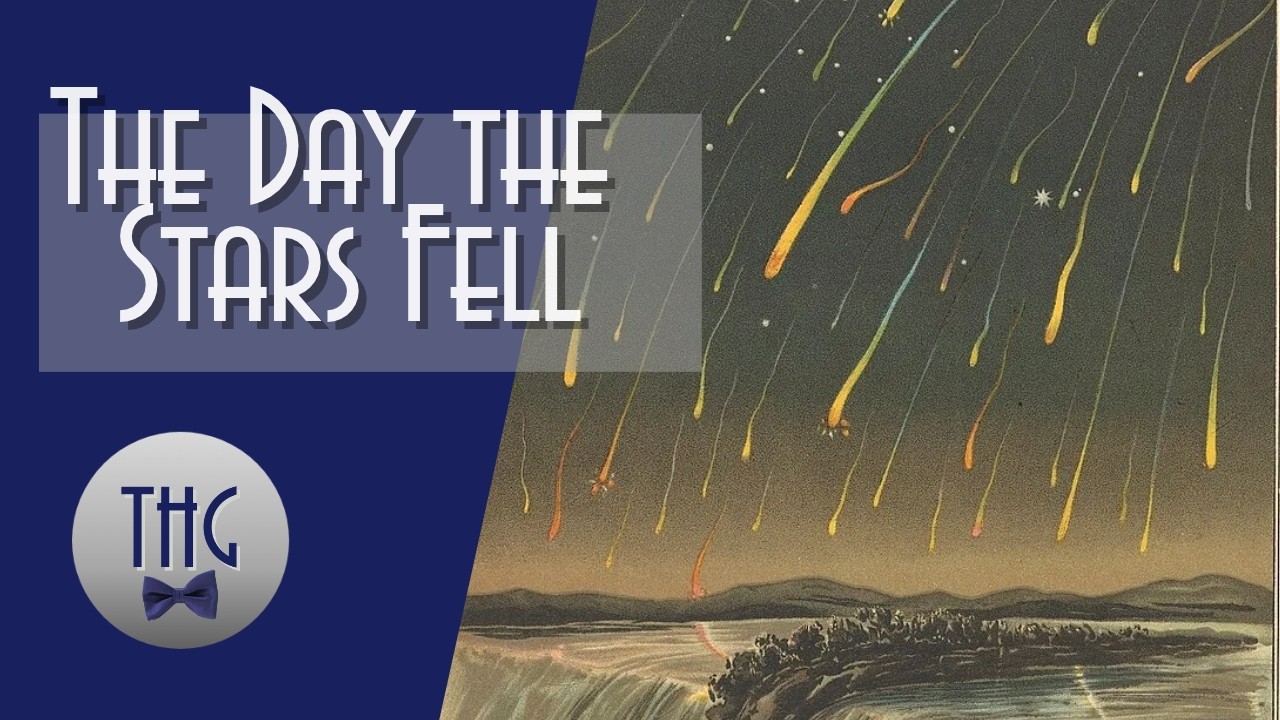
On November 13, 1833 the night became as bright as daylight, the heavens fell, and people feared that it was the end of times. The event was so dramatic that it sparked both a new religion and a new science.
Note: Just because you can think up a reason to criticize doesn't mean that you are obligated to do so. Pedantic is not a compliment folks. The Day the Stars Fell: November 13, 1833 | 20:50
The History Guy: History Deserves to Be Remembered | 1.65M subscribers | 123,819 views | November 13, 2026
(Excerpt) Read more at youtube.com ...
TOPICS: Astronomy; History; Science
KEYWORDS: 1833; 183311; 18331113; abrahamlincoln; adventists; astronomy; beauty; catastrophism; denisonolmsted; fear; giovannischiaparelli; godsgravesglyphs; greatawakening; illinois; josephsmith; lancegeiger; leonids; meteors; meteorshower; meteorstorm; missouri; mormonism; mormons; prophecy; prophetsofdoom; religion; science; shootingstars; sunkenciv; thegreatawakening
Message from Jim Robinson:
Dear FRiends,
We need your continuing support to keep FR funded. Your donations are our sole source of funding. No sugar daddies, no advertisers, no paid memberships, no commercial sales, no gimmicks, no tax subsidies. No spam, no pop-ups, no ad trackers.
If you enjoy using FR and agree it's a worthwhile endeavor, please consider making a contribution today:
Click here: to donate by Credit Card
Or here: to donate by PayPal
Or by mail to: Free Republic, LLC - PO Box 9771 - Fresno, CA 93794
Thank you very much and God bless you,
Jim
The YouTube transcript was processed with my fine country craftsmanship, and *may* follow.
1
posted on
11/16/2026 4:27:30 PM PST
by
SunkenCiv
To: 75thOVI; Abathar; agrace; aimhigh; Alice in Wonderland; AnalogReigns; AndrewC; aragorn; ...
A nice twofer.

2
posted on
11/16/2026 4:29:00 PM PST
by
SunkenCiv
(TDS -- it's not just for DNC shills and jihadists anymore -- oh, wait, yeah it is.)
Transcript
Chapter 1: The night the stars fell
[ad text redacted]
On November 13th, 1833, the night sky became almost as bright as day. The stars fell from the sky and people worried that it might be the end of times. It was an event so dramatic that it sparked both a new religion and a new science. It inspired poets and artists and at least one president. And we can never understand today the way that people saw such an event in 1833. But what is even worse is that what they saw in 1833 we will never see again. It’s history that deserves to be remembered.
Chapter 2: Sponsor message
[ad text redacted]
Chapter 3: Eyewitness accounts
The descriptions of the event reported across North America were vivid. For example, the Rochester Times Union reported, “A neighbor disturbed our slumber this morning at daylight to tell us that something was going on a loft that we as editors ought to behold.” On going to the window, what should we see but a shower of meteors dropping from the skies like the big scattering drops before a thunder?
A report in the Charleston Daily Courier likewise used a weather analogy. The whole heavens were lighted by falling meteors as thick and constant as the large flakes which utter in a snowstorm. We might say it snowed meteors. The scale was certainly spectacular. The Chambersburg, Pennsylvania Franklin repository wrote, “Objects resembling shooting stars were seen descending by thousands and thousands and 10 times thousands from every point towards the Earth, literally filling the air with long fiery traces that marked their downward course.”
One of the most thorough descriptions, however, came from the Alexandria, Virginia Gazette.
The heavenly vision that was beheld here last Wednesday commenced immediately after midnight. Then the starshoots were few and far between. By 1:00 the fluid discharge had become almost incessant. And by 2:00 the whole heavens were stre with liquid fire and strung with golden beads which bursting upon us in brightness of various colors and various diameters now hid the soft glory of the stars and an on would have caused the moon if present to have hung her head and acknowledged herself out shown.
At 4:00, it appears the explosion of one of the falling balls was since we heard. And about a quarter pass 5, we saw a star shoot from near the zenith, about three or two points to the westward north, which in descent showed a fine line of fire the color of fish blood about 2 or 3 in wide, which after traversing far down the vault, described a ball the size of a man’s hat, and then rushed on the road, and it had come, actually become a serpent. It laid upon the firmament, we say 10 minutes. Others say 12. And then it struck off to seem to the west.
It scrolled up. While the serpent hung in the heavens, a star shot from the circle near the zenith, about southsoutheast, which left an immense trail behind, 2 in perhaps wide, as measured by the eye 24 ft long. Its first color was tinged beautifully blue, emerged into silver, became an orange ball near the size of a man’s hat, and then rapidly vanished. is impossible to describe the beauties of the scene with tongue or pen. We could write hours on the subject, but must conclude that’s um a lot with a snake or something. I don’t know. The first thing that we can conclude is that they really don’t write newspapers the way that they used to. But the second thing that we can conclude is that what they witnessed at night had to be something truly extraordinary.
3
posted on
11/16/2026 4:34:46 PM PST
by
SunkenCiv
(TDS -- it's not just for DNC shills and jihadists anymore -- oh, wait, yeah it is.)
Chapter 4: A celestial mystery
What they were seeing, of course, was a meteor shower, or rather its more intense cousin, a meteor storm. In fact, they were seeing an annual meteor shower that is today called the Leonit and occurs every year in November between the 6th and the 30th. But why would people in 1833 be surprised by an annual atmospheric event? will understand that this was no average meteor storm, but assumably one of the brightest in history with rates estimated at over 50,000 to more than 240,000 meteors per hour across North America. The thing is, in 1833, very little was understood about meteor showers, and no one had made the connections to explain why, which led to some odd, if not entirely unpredictable, interpretations.
The Chambersburg, Pennsylvania Franklin repository, for example, noted that all of our citizens who witnessed this extraordinary manifestation were filled with wonder and amazement, and not a few with fear and trembling. The Charleston, South Carolina Daily Courier, explained that we never saw anything like it. We were waked by a neighbor who had also been roused in a similar manner, but one who supposeded that the world was coming to an end and the stars were falling. The sign was taken differently by different groups. The Midfield, Georgia Journal reported that one farmer was so scared that he yelled, “The world is now actually coming to an end, for the stars are falling,” and ran naked outside and hid under his house.
4
posted on
11/16/2026 4:35:13 PM PST
by
SunkenCiv
(TDS -- it's not just for DNC shills and jihadists anymore -- oh, wait, yeah it is.)
Chapter 5: Spiritual and social impact
It’s not surprising that people would find the event to have spiritual significance. 1833 was the height of the religious revival called the Second Great Awakening. Thousands of new converts were being drawn to the church, although often new denominations leading to schisms. Thousands gathered in streets, fields, and churches to weep, confess their sins, and pray for salvation. Often tying the event to the book of Revelation 6:13, which describes the stars of heaven falling to the earth like unripe figs. The meteor spurred a surge in church memberships among Baptists, Methodists, and Presbyterians who were leading the revival movement. In fact, the event sparked a new religion. The impact was particularly strong for William Miller, a Baptist lay preacher who had used calculations based on biblical prophecy to predict the Earth’s destruction by fire sometime between 1843 and 1844.
The 1833 meteor shower served as the defining catalyst that transformed William Miller from a relatively obscure rural lecturer into the leader of a massive national revival movement. The shower was seen as a literal fulfillment of biblical prophecy and a major sign that the second coming of Christ was near, giving people a sense of spiritual urgency and giving momentum to a movement that would eventually claim up to half a million converts, who would be understandably upset when the world didn’t end in 1844, something that was called the Great Disappointment. The movement evolved, however, into the Adventist movement, which still see the 1833 meteor shower as part of a prophetic timeline.
But it wasn’t just the movements of the Great Awakening that saw significance. Joseph Smith, founder of the Mormon Church, saw special meaning as the church had recently been expelled from Jackson County, Missouri, writing, “I arose into my great joy beheld the stars fall from heaven like a shower of hail, a literal fulfillment of the word of God as recorded in the Holy Scriptures as a sure sign that the coming of Christ is close at hand.” The event was seen as a sign that reinforced the people’s faith as they faced a difficult relocation to Illinois, especially as an affirmation of Smith, whom church history claimed had predicted that the stars would fall from the sky. The meteor event might have saved the Mormon church from destruction. Native Americans were likewise impressed. The Lakota, Blackfoot, Kya, and Ponyie recorded significant yearly events on height paintings called winter counts.
The 1833 storm was so universally remembered that almost every surviving plains winter count from that period records the night the stars fell as its anchor year to synchronize oral histories. For some, the impact was more direct, leading to spontaneous confession. The Huntsville, Alabama Democrat reported that last week presented quite a bustle in our town caused by the collection of strangers who were attending the races. There seemed to be a larger proportion of sporting characters than we had recollected to have witnessed on any previous occasion. The gaming tables were well attended and the betters were not idle until the appearance of the meteors which caused much alarm. It is said that some called for their horses and put off under whip and spur whilst others were content with simply confessing their sins and asking for forgiveness. One man is reported to have acknowledged that he had stolen many horses and was then engaged in a conspiracy to rob the Decatur bank.
In retrospect on the 1833 event, the Washington Post noted in 2023 that the great great granddaughter of an enslaved girl related a family story that white people on her plantation were so sure that it was judgment day that they quote started calling all the slaves together. And for no reason, they started telling some of the slaves who their mothers and fathers was. and who they’ve been sold to and where to look for them. For his part, Frederick Douglas, 15 years old at the time, described in his autobiography being aruck by the sublime scene and the falling stars, wondering if it signaled the coming of the son of man to deliver him as a friend. That is, while others saw the end of times, he wondered if it preaged the end of slavery.
Whereas many saw the falling stars as a sign of the end of the world, a young Abraham Lincoln took the opposite meaning. Walt Whitman related a story where Lincoln explained that he had been boarding with a Presbyterian deacon in New Salem, Illinois at the time. Lincoln was suddenly woken up in the middle of the night by the deacon, shouting that the day of judgment had come. The 24year-old future president, however, noticed that the familiar old constellations behind the falling stars remain fixed and true in their places. The president used that memory to reassure a group of bankers during the Civil War. Gentlemen, the world did not come to an end then, nor will the Union now.
5
posted on
11/16/2026 4:35:38 PM PST
by
SunkenCiv
(TDS -- it's not just for DNC shills and jihadists anymore -- oh, wait, yeah it is.)
Chapter 6: Scientific confusion
While many were seeking religious meaning, others were seeking scientific understanding. But in 1833, people really didn’t know much about meteor showers. Individually, meteor showers have been recorded as early as the 7th century BC with MJ Martinez Uso of the Department of Applied Mathematics at the University of Valencia, Spain, noting in a 2023 edition of the Journal of Planetary and Space Science, that the oldest known account linked to a modern meteor shower was that of the Ly, a meteor shower that occurs in April, documented in China in 687 BC, with imperial court astronomers of the Zhao dynasty recording that stars fell like rain.
But who uso notes that the astronomers did not connect the observation to other showers or recognize these particularly bright showers as being a phase of an annual event. In fact, several ancient astronomers recorded meteor showers but viewed them as isolated portants, weather oddities or atmospheric disturbances rather than repeating annual streams. In 1833, people still did not understand that meteor showers were connected events, more or less understand why. In fact, at the time, meteor showers were thought to be an atmospheric event, and most of the papers that were reporting on them at the time gave observations about the weather. The many explanations offered sound downright bizarre today.
The Charleston Observer gave this in-depth explanation. The history of the weather will probably enable the philosophical reader to account for a phenomenon that is equally strange and beautiful. The heavy frost have given a tendency to decay to the vegetable kingdom. The hot sun acting on so extensive a surface must have exhaled an unusual quantity of gases of various kinds, particularly hydrogen, which becoming ignited by electricity or phosphoric particles in the air, may have presented the appearance described. Meteors have long been considered an electrical phenomenon. But this species is probably owing to a gelatinous matter floating in the atmosphere inflated and rendered buoyant by phosphoreted hydrogen gas which descending into a dense portion of the air becomes ignited by the greater quantity of oxygen which it then comes in contact. The ignis fatoule or willow the wisps which float over moist places and burial grounds are of the same character. Their descent may be accounted for by accidental coallescence till the gravity of the united particles become too great to continue above. This tendency too would be favored by a diminuition of the temperature which originally elevated them to the upper regions of the atmosphere. For this morning we had another frost. Uh what not to say that scientists were wholly in the dark. The Richmond, Indiana Weekly Palladium made some observations based on their reading of the encyclopedia Americana which began publishing in 1829.
The analysis makes some reasonable conclusions. For example, that falling stars, the first verified written reference of the term was in act two, scene four of Shakespeare’s Richard II, written around 1595, are higher than the region of the clouds because they are never seen on a cloudy day. The various answers provided though by some they are ascribed to terrestrial and by others to lunar volcanoes were the author admitted very far from affording a satisfactory explanation of the shower of meteors. The variety of hypothesis shows the little progress has been made in acquiring any certain or correct knowledge of the origin of meteors. But it was in that recognition of exactly how much knowledge we lacked that this particularly bright meteor storm would find its real significance.
6
posted on
11/16/2026 4:36:41 PM PST
by
SunkenCiv
(TDS -- it's not just for DNC shills and jihadists anymore -- oh, wait, yeah it is.)
Chapter 7: The birth of meteor science
Jenny Horton, a librarian in residence at the Library of Congress, explained on the library’s website in 2022 that professor of mathematics at Yale University named Denison Olmsted, impressed by the shower, decided to seek more information on the event. Realizing that he didn’t even know the extent of the event, he decided to seek more information by reaching out to newspapers across the United States. Olmstead drafted a letter, Horton writes, and sent it off to the New Haven Daily Herald, appealing to the public to send any information about the storm. It read, “As the cause of falling stars is not understood by meteorologists, it is desirable to collect all the facts attending this phenomena stated with as much precision as possible. The subscriber therefore requests to be informed of any particulars which were observed by others, respecting the time when it was first discovered, the position of the radiant point above mentioned, whether progressive or stationary, and any of the other facts relative to the meteors. The request was republished throughout the nation, and Olmstead received thousands of responses. The observations helped him understand the size and nature of the phenomenon. That is he gathered the observations by soliciting contributions from a large distributed group of people.
He had crowdsourced what is generally recognized as the birth of modern meteor science. He established meteor study as a legitimate branch of astronomy. He noticed that many observers had seen that the meteors seem to shoot outward in all directions from a single point in the constellation Leo. In fact, the annual shower today is called the Leonids for that reason. But he realized that this was an optical illusion and that the meteors were actually traveling in parallel paths relative to one another. The appearance of them diverging from a single point was an optical effect of perspective. The same visual phenomenon where parallel railroad tracks appear to converge in the distance. But the fact that they seem to radiate from that point was also important because Olmstead noticed that as the Earth rotated and the stars shifted across the night sky, this radiant point moved along with the background stars rather than remaining fixed relative to the Earth’s surface or atmosphere. Because the radiant moved with the celestial sphere, the source of the meteors had to lie outside the Earth’s atmosphere. Moreover, he was able to conclude that the shower was visible in North America, but had not been seen hours before in Europe.
In fact, the observations demonstrated that the display was visible simultaneously over a vast geographical area. Thus, he realized the meteors belong to a massive cloud of particles orbiting the sun independently. Earth encountered this cloud as its own orbit intersected the path of the meteor stream. Finally, Olmstead determined that despite the thousands of bright fireballs and streaks, virtually no fragments or debris were found on the ground immediately following the storm. Homestead concluded that these particles were composed of small, lightweight material entering the atmosphere at extreme speeds. The intense heat generated by atmospheric friction caused the particles to burn up and disintegrate high above the Earth before reaching the surface. Olmstead’s scientific treatment of the 1833 storm transformed the study of meteors from folklore and atmospheric meteorology to a legitimate field of astronomy. If it hadn’t been such a spectacular meteor storm, he might never have bothered, nor would people have collected the data that he used to make his conclusions. He was, however, missing just one bit.
7
posted on
11/16/2026 4:37:05 PM PST
by
SunkenCiv
(TDS -- it's not just for DNC shills and jihadists anymore -- oh, wait, yeah it is.)
Chapter 8: Comets and modern context
His work inspired another scientist, Italian astronomer Giovanni Schiaparelli, to track the orbits that matched meteor showers and concluded that meteor showers match the exact orbital paths of known comets. Who’s able to conclude that meteor showers come as the result of the earth passing through the tail of a comet. And so you see the thing is that the Leonids are caused by a comet that is called Tempel–Tuttle. And Tempel–Tuttle orbits around the sun about every 33 years. But the trick is sometimes the Earth passes through its debris field when the comet has passed more recently and thus there is much more debris and a much more spectacular meteor shower like in 1833 which was only rivaled by the shower in 1966. But here’s the bad news for us today. It appears that Jupiter has perturbed the debris stream of Tempel–Tuttle and that the Earth no longer passes directly through. Now, we’ll continue to pass through older debris streams. We’ll still have the Leonids, but astronomers think that we will never see a meteor storm like the one they saw in 1833 ever again. It is literally history. History that it’s up to us to remember.
[Plug for the channel]
I hope you enjoyed watching this episode of The History Guy. And if you did, please feel free to like and subscribe and share the history guy with your friends. And if you also believe that history deserves to be remembered, then you can support the history guy as a member on YouTube, a supporter on our community at Locals, or as a patron on Patreon. You can also check out our great merchandise shop or book a special message from the history guy on Cameo.
8
posted on
11/16/2026 4:37:44 PM PST
by
SunkenCiv
(TDS -- it's not just for DNC shills and jihadists anymore -- oh, wait, yeah it is.)
To: SunkenCiv
I can imagine many people were absolutely terrified by that event
9
posted on
11/16/2026 4:50:31 PM PST
by
NFHale
(The Second Amendment - By Any Means Necessary )
To: SunkenCiv
Used to be “Stars fell on Alabama” on our license plates...I live very near the Wetumpka meteor crater which is not related to the 1833 event by a quite a few million years so they say.
10
posted on
11/16/2026 4:51:14 PM PST
by
BamaBelle
(Psa 143:8 - ...cause me to know the way wherein I should walk; for I lift up my soul unto thee.)
To: SunkenCiv
Dumb question: What caused the Lenoids to be so numerous that particular year — can it happen again?
11
posted on
11/16/2026 5:02:12 PM PST
by
BenLurkin
(The above is not a statement of fact. It is opinion or satire. Or both.)
To: SunkenCiv
The heavens will surely shake again, my FRiend!
Good to see you still posting wonders and mysteries…this is an amazing time and place
12
posted on
11/16/2026 5:15:53 PM PST
by
One Name
(Ultimately, the TRUTH is a razor's edge and no man can sit astride it.)
To: BamaBelle
13
posted on
11/16/2026 5:17:06 PM PST
by
frank ballenger
(There's a battle outside and it's raging. It'll soon shake your windows and rattle your walls. )
Disclaimer:
Opinions posted on Free Republic are those of the individual
posters and do not necessarily represent the opinion of Free Republic or its
management. All materials posted herein are protected by copyright law and the
exemption for fair use of copyrighted works.
FreeRepublic.com is powered by software copyright 2000-2008 John Robinson
