Posted on 08/16/2026 10:43:43 AM PDT by Red Badger
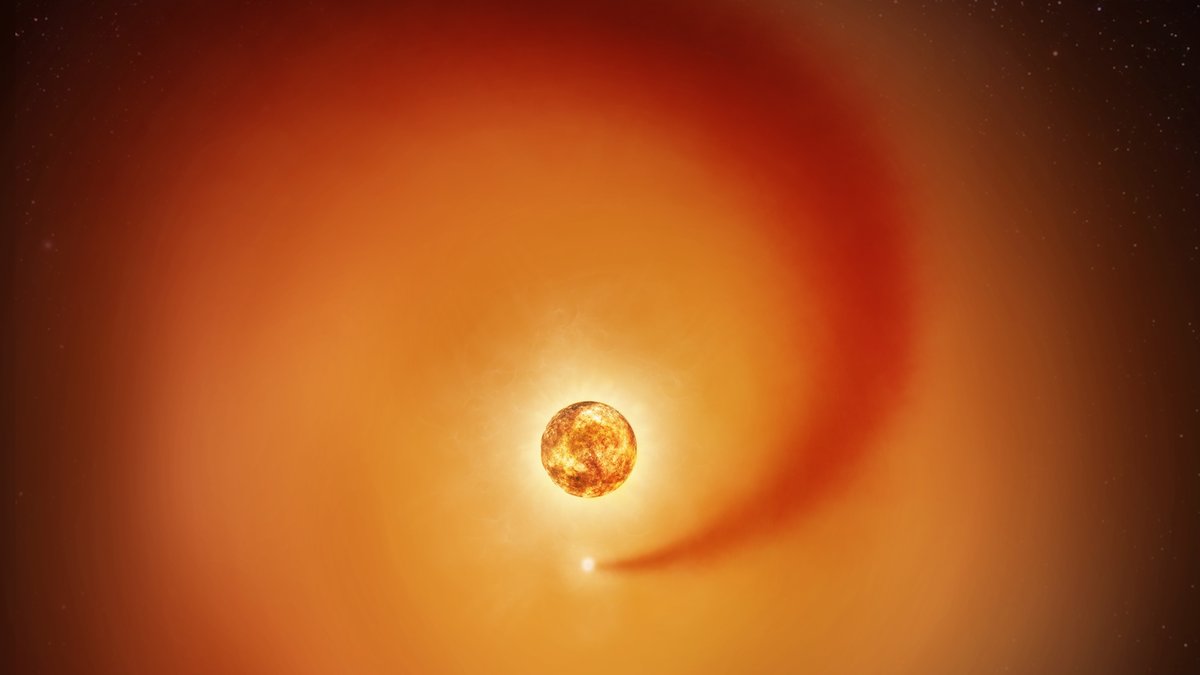
This artist’s concept shows the red supergiant star Betelgeuse and a companion star orbiting within the supergiant’s tenuous outer atmosphere. Artwork: NASA, ESA, Elizabeth Wheatley (STScI); Science: Andrea Dupree (CfA)
Betelgeuse has always been something of a mystery.
And by “mystery,” I mean a source of endless fun, fascination and frustration for astronomers.
Betelgeuse is one of the brightest stars in the sky, marking the right shoulder of the constellation Orion. It’s a red supergiant, a massive star with more than a dozen times the sun’s heft, that’s blasting out many tens of thousands as much light as our own star. It’s also dying, already well on its way to becoming a supernova.
It’s one of the most studied stars in the sky yet still puzzlingly difficult to understand.
Some two millennia ago Chinese astronomers reported Betelgeuse as being yellow. Has it changed color over the centuries? What does that mean for what its internal structure is and how it emits light? The star dimmed tremendously in late 2019, not returning to its typical brightness until early 2020, which caused much consternation among stargazers. It took years to show that the star had eructated out a huge cloud of opaque dust that blocked its light until the cloud dissipated enough to let Betelgeuse shine through once more. Could that happen again?
Astronomers have long known that Betelgeuse has an unexplained six-year-long periodic fluctuation in its brightness in addition to its less dramatic 400-day cycle. They suspected the cause was a second star—a “Betel buddy,” if you will—orbiting the supergiant; the system dims when the companion star is behind the supergiant and hidden from our view. Astronomers observing Betelgeuse in 2024 found hints of a second star, and now a paper published in the journal Astronomy and Astrophysics strongly supports its existence. This stellar companion is apparently a luminous star that has three times the mass of the sun but is so close to the far brighter supergiant that its light had been hidden in the glare all this time. Confirming this mystery object’s identity is pretty straightforward: observe Betelgeuse in 2027, half an orbit after than its first detection. If the object appears on the other side of the star from where it was in 2024, it’s a binary companion.
If so, it orbits the red supergiant (now called Betelgeuse A) at a minimum distance of about 1.3 billion kilometers, roughly the distance Saturn is from the sun. Even so, from the perspective of this companion star—Betelgeuse B—the supergiant is so swollen that it occupies half the sky. Red supergiants are awesome beasts.
Despite its mysteries, there is one thing we know for sure about Betelgeuse A: someday it will go supernova in one of the most titanic explosions this universe can generate. We don’t know when, precisely—that’s another mystery. It could be tonight, but most signs point toward it happening more like 100,000 years from now.
This cataclysmic end for the star is inevitable. In the core of Betelgeuse A, thermonuclear processes are at work: There almost unthinkable heat and pressure cause helium nuclei to be merrily fused into carbon nuclei. Eventually that carbon will begin to fuse into neon, then the neon will fuse into magnesium, and so on up the periodic table until iron builds up in the core. Iron doesn’t release energy when it fuses; it actually steals energy that’s otherwise needed to support the colossal mass of the star around it. This theft rug-pulls the entire star, causing the core to collapse. Fantastic temperatures—upward of 100 billion degrees Celsius— will be achieved, triggering a detonation that destroys the star: a supernova.
The onslaught of energy is almost beyond comprehension. In a few moments, the nascent supernova will release as much energy as the sun will over its entire lifetime. The event will be so luminous that it could be detected halfway across the observable universe.
Astronomers still debate the effects this will have on Earth—likely minimal, given its distance. But for a star literally right next to the explosion, it’s easy to think the event would be catastrophic.
Stars are sturdily constructed, however, and even being right next to a supernova doesn’t guarantee destruction. It won’t be fun, but it won’t be a death sentence, either.
Interestingly, there has been very little research on the effects inflicted on a wide-binary companion during such an event. What follows are the results from my personal back-of-the-envelope calculations—enough to give us an idea of what lies ahead for Betelgeuse B.
Right away, we do know companion stars can survive: there is a class of objects called runaway stars, which are screaming through space at hundreds of kilometers per second, far faster than a typical star. There are a few ways these stars can get kicked up to these speeds, but one is to orbit a star that goes supernova. The sudden loss of mass means the strength of the primary star’s gravity drops suddenly, causing the secondary companion to get flung out into space at dizzying speeds. We know these stars exist, and they were likely in tighter orbits around their supernova progenitor star than Betelgeuse B is. They survived the explosion, so that gives us confidence Betelgeuse B will make it out, too.
But it won’t do so unscathed. The sudden influx of heat will be huge, though temporary and unlikely to have lingering effects. There will also be a lot of matter thrown out by the exploding star, but it will thin rapidly as the material expands, and the amount that physically impacts Betelgeuse B will be a tiny fraction compared with the star’s own mass. Of course, that material will be moving at several thousand kilometers per second. So the physical blow will still be enormous—not enough to disrupt the star (again, stars are sturdy), but it will certainly cause tremendous heating and likely strip some mass off the star itself. A stellar body slam will do that.
Amazingly, all this energy from the supernova is only a small fraction (about 1 percent) of the total that’s emitted! Most is in the form of subatomic particles called neutrinos, which carry little energy individually but are generated in vast numbers when a star explodes. Neutrinos are notoriously unaffected by normal matter—most pass right through it. Still, so many are made in a stellar explosion (something like 1058, a number so huge that it made the hair on the back of my neck stand up just to type it out) that, at the distance of Betelgeuse B from the now former Betelgeuse A, a human would get a near-fatal dose of radiation in just neutrinos (aside from the other extremely fatal effects). The amount of neutrino energy absorbed by the companion star, however, would be only a tiny fraction of the amount of energy the star emits on its own, so again, this is likely to have little effect.
After the explosion, Betelgeuse A will probably leave behind a superdense neutron star with an incredibly strong magnetic field. This will certainly affect Betelgeuse B, but it will depend on the exact circumstances of the explosion and the characteristics of the neutron star, which, at this time, are difficult, if not impossible, to predict.
So in the end, a star like Betelgeuse B will survive, even as close as it is to the hellish fury of a supernova, but the exact outcomes are still not clear.
Our uncertainty about this star and its potential fate are a reminder of just how much about this star system we don’t know—despite its obvious relative proximity to us; even its distance isn’t nailed down. One of the most attention-grabbing stars in the sky still keeps its secrets close—and that is one of the main reasons astronomers have so much fun studying it.

|
Click here: to donate by Credit Card Or here: to donate by PayPal Or by mail to: Free Republic, LLC - PO Box 9771 - Fresno, CA 93794 Thank you very much and God bless you. |
Beetlejuice for senate....(when Howard Stern was funny)
Or....in the year 2525.....
It will be blamed on Trump.
It’ll be less of a Starry Starry Night. That’s for sure.
ZZ Top had some pretty suggestive lyrics back in the day

One day it will blow up real good!
100,000 years?
No one will ever know...
There will be nothing here to “know”...
“You mean when he still had Jackie The Joke Man writing his material.”
And before he became an insane bootlicking lib. I remember in college sitting in the car listening and laughing my arse off and seeing half the lot doing the same thing. Especially when Gilbert Godfried did the news with Robin. Hilarious. I have only got clips when he went for satellite radio. I didn’t laugh a second. The tension on his terrestrial radio having to hold back the profanity and crude made the show that much more fun. Geesh. That was what, 25 30 years ago. Now? He is an angry unfunny old man yelling at clouds as he worships clowns like Fauci .
Before Satellite radio, there was an envelope to push. That was part of the show. Once there was no longer an envelope to push, it just got stale and boring.
That was the best thing about REAL rock and soul. So many ways to sing about sex without mentioning sex. “Pearl Necklace” Really? How about Aretha’s “Pink Cadillac” “Givin the Dog a Bone” AC/DC....
Good music.
ZZ Top had some pretty suggestive lyrics back in the day
“I’ve got the six.....”
Named after the movie Beetlejuice, I guess?
“it just got stale and boring.”
BINGO. Perfect way to explain it. Thanks
—— Nixon filling in “——” a doodle do.
“Well, it takes a Dick to know a cock.”
Crude but funny.
“Neutrinos - so many are made in a stellar explosion (something like 1058, a number so huge that it made the hair on the back of my neck stand up just to type it out)”
I assume the author means 10 to the 58th power.
When it blows, you’ll need to change your handle to:
Red ‘Supergiant’ Badger...
Light year is a measure of distance, not time. It’s like saying, “We’ll find out in 5.88 trillion miles.”
Orion will need a shoulder replacement.
And, when Betelgeuse goes supernova, so much mass is ejected that the gravitational tug between Betelgeuse A and its companion "B" disappears and "B" is flung out instantaneously at incredible speeds. Kind of like flying an object around your head on a string and cutting the string.
But the research on this companion "Betelbuddy" suggests it's a young, low-mass star that's gradually spiraling inward due to tidal interaction with Betelgeuse's bloated envelope, and the leading prediction is that it will be tidally consumed and merge with Betelgeuse within roughly the next 10,000 years — likely well before Betelgeuse actually explodes, since supernova timing itself remains highly uncertain (estimates range from soon to 100,000+ years out). So the more probable fate described in recent research isn't a dramatic ejection at the moment of explosion, but the companion getting swallowed long before that moment ever arrives. The "flung out during the supernova" scenario is physically sound as a general mechanism, but it may not be the actual fate awaiting this particular companion.
If a star is a million light years away, it takes a million years for its light to arrive here. If it were to explode tomorrow, we would not see the change for a million years.
Disclaimer: Opinions posted on Free Republic are those of the individual posters and do not necessarily represent the opinion of Free Republic or its management. All materials posted herein are protected by copyright law and the exemption for fair use of copyrighted works.