Posted on 06/26/2026 9:23:14 PM PDT by Red Badger
The orbits of long-period comets suggest a star passed by our Sun and caused some havoc we're still seeing.
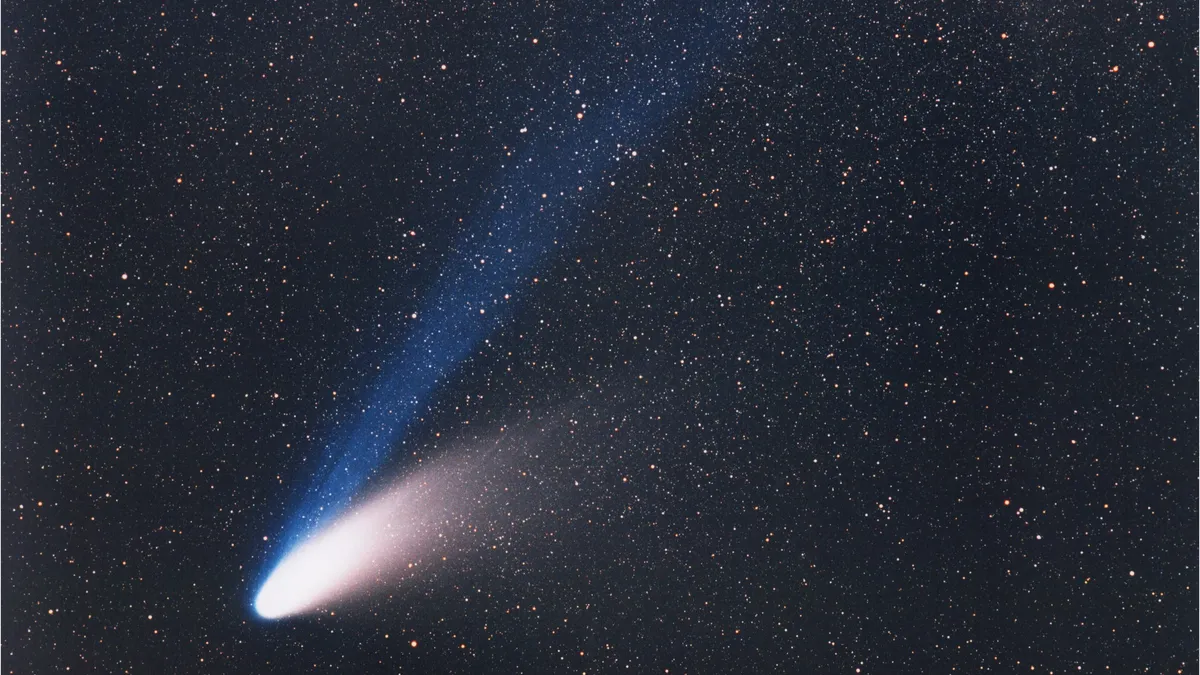
Hale-Bopp, the Great Comet of 1997, is a very famous long-period comet. Image Credit: ESO/E. Slawik
=================================================================
The closest star to the Sun is Proxima Centauri, about 4.2 light-years away. This has not always been the case, as all stars in the galaxies move about. Observations suggest that just 2.5 million years ago, there was a star that passed very close to the Solar System, and this passage might still have consequences we can see today.
Data from the ESA Gaia observatory, which produced the most accurate map of the Milky Way, indicates the close passage of the star in question, HD 7977, at around 4,000-25,000 astronomical units (1 AU is the Earth-Sun distance) from the Sun. Now, a team proposes that by studying the orbits of new comets, HD 7977 passed by at 6,000-10,000 AU. That’s just 35 to 58 light-days away, which is very close in cosmic terms. It may have set off a new comet shower.
Long-period comets are those with orbits that stretch for millions of years, usually pristine and coming from somewhere in the Oort cloud. They are influenced by the Milky Way’s disk as a whole, but can get nudged into the inner Solar System by something passing by so close that its gravity alters their trajectory. These comets are known as new comets because they are entering the Solar System for the first time. Comets that have gone through the inner Solar System have shorter periods due to the interactions with the planets.
“The distribution of comet orbits suggests we are living through an unusual time where HD 7977 has dominated the generation of new comets and not the larger gravitational field of the Milky Way, as it usually would," Planetary Science Institute senior scientist Nathan Kaib said in a statement.
"This would also mean we’re living through the late stages of a pretty rare and powerful comet shower.”
There is a twist, though. The Kaib and collaborator Sean Raymond from the Université de Bordeaux decided to run simulations to see how the passage of this star would affect the comet population and what kind of distribution we should be seeing. While the observations match the idea of a stellar disturbance, the simulated comet orbits do not really look like the observed ones.
“Like many other works that simulate long-period comet production, we find that our comets’ orbit sizes aren’t a great match to the observed distribution. It’s possible we’re missing some important physics from our simulations, and it’s conceivable that this has caused us to misinterpret comet orbit data,” added Raymond.
The Solar System might be more complex than thought; the effect of comet jets could also play a more prominent role, accounting for the discrepancy here. Maybe it's multiple factors. While the puzzle remains to be solved, researchers know it will only take a little patience to get to an answer.
“The nice thing about our prediction is that it will be testable pretty soon," said Kaib.
"Gaia is still publishing new data on the motions of stars, and in 6-12 months, it should be able to improve our understanding of HD 7977’s motion and tell us if we are right or wrong."
The work was presented at the American Astronomical Society Division on Dynamical Astronomy.
Nibiru Ping!..................
It's only a matter of time until a big one hits.
Thank you, Mr. Einstein,
I’d think another star passing by 4,000-25,000 astronomical units from our sun would have obliterated the solar system.
Europe: we’ll calculate the trajectories of comets and stars while we tear out your HVACs.
An actual ClimAte Change occurred ……
Wow, using new data to put your hypothesis up against a failure test. This is what scientists do. I have never once seen a "climate scientist" suggest a pet theory could possibly be "right or wrong".
That might explain the 4 cans of Comet we have in the pantry...
Hopefully not in our lifetime….
Hopefully not in our lifetime….we have enough to think about, with earthquakes and volcanoes, hurricanes and tornadoes.
And if that’s not enough there’s always the democrats…
LOL, love it!
First known (or unknown) example of Affirmative Action?
An alternate theory proposed by astronomer Tom Van Flanderen is 1 or two planets exploded several hundred million years ago.
Thanks! But no, not Nibiru, which is a modern fiction.
· join · view topics · view or post blog · bookmark ·
· post new topic · subscribe ·Google news searches: exoplanet · exosolar · extrasolar ·
Accretion.....
Space dust accretes into particles that accrete into asteroids that have gathered into a belt where there is adequate attraction by the sun.
Some of the above is subject to planetary accretion in the form of tings and growth into moons.
The dust is ever-present. A star passing by is an unnecessary theoretical intrusion
Disclaimer: Opinions posted on Free Republic are those of the individual posters and do not necessarily represent the opinion of Free Republic or its management. All materials posted herein are protected by copyright law and the exemption for fair use of copyrighted works.

