Posted on 04/22/2026 4:02:20 PM PDT by Diana in Wisconsin
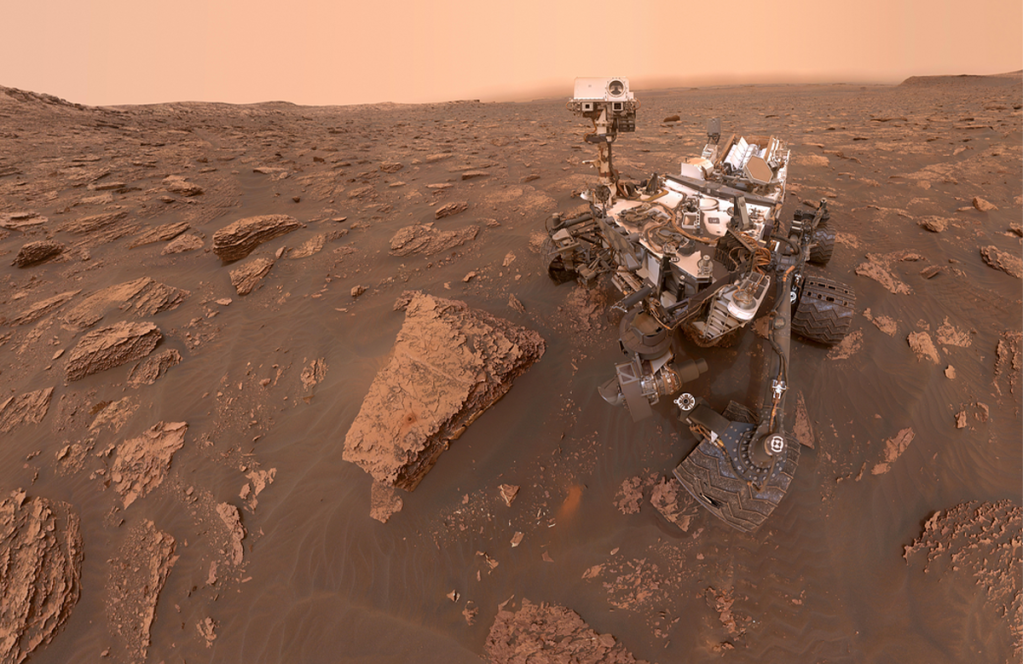
With all the excitement over sending scientists back to the moon, it’s easy to forget we’ve already got a pair of talented chemists on Mars: the Curiosity and Perseverance rovers. Although they beam back plenty of breathtaking images, these two robots are more than just cameras on wheels. Their primary mission is to search for signs of ancient life, and they’re equipped with a suite of onboard scientific instruments and chemical reagents to carry that mission out.
Now, new research published in Nature Communications details Curiosity’s latest find—never-before-seen organic compounds, including one with a structure similar to DNA precursors.
“We think we’re looking at organic matter that’s been preserved on Mars for 3.5 billion years,” study author and NASA geologist Amy Williams of the University of Florida said in a statement. “It’s really useful to have evidence that ancient organic matter is preserved, because that is a way to assess the habitability of an environment. And if we want to search for evidence of life in the form of preserved organic carbon, this demonstrates it’s possible.”
Curiosity extracted samples from clay deposits from Gale crater, broke them down with on-board chemicals, and analyzed them with gas chromatography–mass spectrometry. Together with its earthbound team, the rover found more than 20 organic molecules, including some surprising large compounds. One was a nitrogen-bearing molecule with a structure similar to DNA precursors and another was a benzothiophene, a double-ringed organic molecule containing sulfur, likely brought to the planet via meteorite.
“The same stuff that rained down on Mars from meteorites is what rained down on Earth, and it probably provided the building blocks for life as we know it on our planet,” Williams said.
To help interpret Curiosity’s data, scientists back on Earth performed similar experiments on a 7-billion-year-old meteorite retrieved from Australia in 1969. They even simulated the effects of a leak that occurred shortly after the rover landed (the mishap hasn’t interfered with Curiosity’s analyses, and may have even helped out).
“We now know that there are big complex organics preserved in the shallow subsurface of Mars, and that holds a lot of promise for preserving large complex organics that might be diagnostic of life,” Williams said.
These encouraging findings come as the European Space Agency plans to launch its own Mars rover in 2028. Named for Rosalind Franklin, the chemist who helped determine the double helix structure of DNA, this planned rover will bring even more scientific instrumentation to the red planet and join her colleagues Curiosity and Perseverance in their quest for signs of ancient life.
Yes a lot of planets in the universe get hit with the same kind of stuff. Groundbreaking.
Thanks!
· join · view topics · view or post blog · bookmark ·
· post new topic · subscribe ·Google news searches: exoplanet · exosolar · extrasolar ·
“’The same stuff that rained down on Mars from meteorites is what rained down on Earth, and it probably provided the building blocks for life as we know it on our planet,’” Williams said.”
Ten to one that in future EONS, others will be studying findings on Earth where there was once, ‘Life.’
Or, you know, it could all be Devinely Designed for our pleasure. Maybe planet Mars was just an experiment for future human habitation? ;)
Come on, Man! Believe in magic just a little bit! ;)
The earth has been bombarding the solar system planets from Mars on out it for a billion years. If Mars had a temperate climate and water back then, there is every reason to believe that Earth organisms may have survived there until Mars’ core slowed down and Mars’ magnetic field collapsed. Thus allowing the solar wind to destroy everything.
They have been chewing their fingers off hoping to find life there, its not gonna happen. Wishing and hyping things up don’t make it real.
If they want “magic”, let them go to Disneyworld.
Which planet was formed first or were they all made at the same time?
I DO believe in magic, I do! I do! I do!
Back before woketopia, before political correctness and the bastardization of language and science, and for most of human history, organic simply meant “contains carbon.”
Carbon is the fourth most abundant element in the universe by mass, trailing only hydrogen, helium, and oxygen.
It will be “news” when we do not find organic materials.
Aside from having no air to breathe, water to drink or food to eat, Mars is terribly exciting!
Let’s send Hillary, Joe, Rashida, Ilhan, George, and so on. They’ll have a grand time!
I don’t know. That’s on my, ‘Things to ask God’ list. I also want to know why he invented raisins. Ick. And snakes. Double-ick!
p
“I also want to know why he invented raisins. Ick. And snakes. Double-ick!”
*********************************
He didn’t invent raisins. We did.
LOL Martians will send rover to earth and ooo and awwww over some desert scenes of rocks lol
“ Named for Rosalind Franklin, the chemist who helped determine the double helix structure of DNA…”
Move over, Watson and Crick! Time for girl power!

Pretty sure that when humans land on Mars they will find the same thing these rovers have found... Absolutely nothing of any consequence.
Rocks, dust, sand... Call it what you want, we have plenty of that stuff here on earth... And if hear one more time about finding water on some planet, I’m going to puke... And when I do it will be watery puke... Because we are literally swimming in water... We have more than enough water on earth to last for the rest of human existence.
In the meantime, these rovers appear to be doing a fine job without any humans and if one of these probes actually does find something other than rocks, dust and sand... Awesome! Then we should go there... Until then... Why bother?
Complex organic molecules are easy to make. Just take carbon, hydrogen, oxygen and a few other elements and mix them under pressure with a heat source for a few million years. Gas giants work well for this. The trick is making the jump from the most complex organic compounds to the simplest living organism.
Unless and until we either discover life somewhere else or figure out how to make a living organism from scratch in a laboratory we have no idea how common or rare life may be in the rest of the universe.
Most likely, Earth was pretty well formed and then got whacked so hard it created the Earth-Moon system, and some of the other matter went we don’t know where. However, that is presumed to have happened before life arose on Earth.
Disclaimer: Opinions posted on Free Republic are those of the individual posters and do not necessarily represent the opinion of Free Republic or its management. All materials posted herein are protected by copyright law and the exemption for fair use of copyrighted works.
