Posted on 07/26/2023 10:33:46 AM PDT by MtnClimber
Dismantling the belief in a static universe, Edwin Hubble's revolutionary observations in the 1920s laid the groundwork for our understanding of a continually expanding cosmos. However, we must seek to reconcile this theory with observations that are consistent with a non-expanding universe, writes Tim Anderson.
You have been taught that the universe began with a Big Bang, a hot, dense period about 13.8 billion years ago. And the reason we believe this to be true is because the universe is expanding and, therefore, was smaller in the past. The Cosmic Microwave Background is the smoking gun for the Big Bang, the result of a reionization of matter that made the universe transparent about 300–400,000 years after the Big Bang.
How did we go from Einstein modifying his equations to keep the universe static and eternal, which he called the biggest blunder of his life, to every scientist believing that the universe had a beginning in 10 years? It all started with astronomer Edwin Hubble using the most powerful telescope at the time on Mount Wilson in California. At the time, in the 1920s, scientists believed that the Milky Way galaxy was the totality of the universe. Objects in the night sky like Andromeda that we now know are galaxies were called “nebulae”.
Looking at these objects, however, Hubble knew how bright particular stars called Cepheid variables were supposed to be. Knowing how bright they were supposed to be meant that he could tell how far away they were. He found to his surprise that Andromeda and Triangulum had Cepheid variables that were too far away to be inside the Milky Way. They weren’t nebulae. They were galaxies.
Hubble’s discoveries, made in 1924, merited a short column on page 6 of the New York Times. In that article, “Dr. Hubbell” was said to have shown that nebulae are in fact “island universes”. The concept was so new that they weren’t even recognized as galaxies. Hubble was able to estimate distances for his newly discovered galaxies. His estimates were off by about a factor of 7 but proportionally correct. Other scientists such as Vesto M. Slipher, had been busy, since 1912, measuring how fast the galaxies he identified were moving towards or away from us by measuring their redshift.
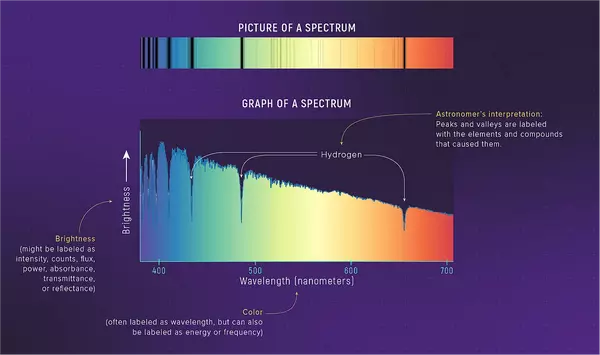
The way you measure redshift uses a concept from atomic theory called spectroscopy. Basically, stars contain elements that absorb light at specific wavelengths. These are patterns of missing wavelengths in the spectrum of the light called absorption spectra. These patterns show up because the atoms contain electrons that absorb photons with particular frequencies. When the photon strikes the atom, the electron absorbs it and moves to a higher orbital, but only if it has the exact frequency needed for that electron. Otherwise, no absorption happens. This property can be used to determine what things are made of by exposing them to light and measuring their emissions. It can also be used to make lasers.
Spectrum of the star Altair from NASA, ESA, Leah Hustak (STScI).
In astronomy, it is how we determine how fast objects are moving towards or away from us because of something called the Doppler effect. If something is moving away from us, the wavelengths of light coming from that object will be stretched out which makes them longer and lower frequency. This shifts the absorption spectrum to the right in the above picture and so is called redshift since the right side is red. If the object is moving towards us, then it will be shifted to the blue side and so is called blueshift. The same thing happens with sound which is why a siren has a higher pitch as an ambulance moves towards you and a lower pitch when it moves away from you.
Since we know what the frequencies in the absorption spectrum are supposed to be for particular elements and we can, by the pattern and what we know about stars, identify what those elements should be. We can determine how redshifted stars and galaxies are. When Hubble looked at all these new galaxies he had identified, he made a correlation between their velocity based on redshift and their distance based on the Cepheid variables. It turns out that these were linearly correlated. In other words, the further away a galaxy was, the faster it moved away from us. You can make a graph with speed on the vertical axis in km/s and distance on the horizontal axis in Megaparsecs (about 3.26 million lightyears) and you will find that it makes a line.
Hubble identified the slope of this line as a universal constant which we now know as the Hubble constant. His value was about 500 km/s/Megaparsec. If you correct for his factor of 7 error in distance, this falls within the currently accepted value of 68–74 km/s/Megaparsec. Alexander Friedmann in 1922 and Fr. George Lemaître independently in 1927 had used Einstein’s field equation to predict that the universe should be expanding (or shrinking). Combining their results with Hubble’s observations and the successful demonstration of the correctness of Einstein’s equations within the Solar System, scientists concluded that the universe was expanding.
Not everyone was happy about this conclusion. That included Hubble himself. Hubble disagreed with the interpretation of his data believing that redshifts might not be related to velocity at all and he criticised the popularity of the expanding universe theory, saying in the Journal of the Royal Astronomical Society in 1937:
The interpretation of red shifts by the theory of the expanding universes is so plausible and so widely current that, in making a delicate test of the theory, it is desirable to push uncertainties in the favourable direction before admitting a discordance.
He had good reason to believe in a discordance because, based on his data, the universe would have been younger than the Earth, too small and dense by far, with a “closed” geometry implying it should fall back in on itself. This turned out to be wrong because Hubble had vastly underestimated the distances to the galaxies he had observed. The universe was actually far older and less dense than he believed.
Live in the future, today!
“One of the craziest things over these last few crazy years has been watching physics at both ends (subatomic and cosmological) completely fall apart.”
Actually, not.
“Any group that relies on “matter” that cannot be detected except by it’s gravitational effect to make it’s theories work is not a group that can be taken seriously.”
Once we could not detect anything with a frequency above visible light.
We couldn’t detect elementary particles.
” frequency loss with distance”
There is no frequency loss with distance.
Actually yes.
At the subatomic level String Theory is a dead end, we are now in the same place we were 30+ years ago.
On the other end, it looks like we have been wrong about the age of the universe by a factor of 2. Dark Matter theory is falling apart and it looks like there may be something fundamentally wrong with our understanding of gravity.
I agree with you that there is too much politics in science, but it wasn’t politics that made string theory implode.
The universe is expanding rapidly and Dr. Hubble proved in at Mt. Wilson in Los Angeles in 1924 by using the red shift. A static universe is impossible, since expanding is natural. Einstein failed miserably compared to Hubble and the 30 years of letters between Hubble and Einstein reveal Hubble’s kindness and Einstein’s regret. God the Father planned the universe from start to finish one day about fifteen billion years ago, and yes, God the Father is micromanaging and not stuck in coffee shop watching events unfold at a distance. Pray and be virtuous.
The universe is expanding rapidly and Dr. Hubble proved in at Mt. Wilson in Los Angeles in 1924 by using the red shift. A static universe is impossible, since expanding is natural. Einstein failed miserably compared to Hubble and the 30 years of letters between Hubble and Einstein reveal Hubble’s kindness and Einstein’s regret. God the Father planned the universe from start to finish one day about fifteen billion years ago, and yes, God the Father is micromanaging and not stuck in coffee shop watching events unfold at a distance. Pray and be virtuous.
How can the universe “expand”? There must be something beyond the expansion line. Is there a man standing at that line with a sign saying, “Stop you can go no further”?
It’s swirling just like everything else
Prevailing theory until quantum gravity matures or an actual “graviton” is discovered...
“At the subatomic level String Theory is a dead end, “
? ST is based on subatomic modeling. Theory is a misnomer. It is a mathematical model still unproven.
“On the other end, it looks like we have been wrong about the age of the universe by a factor of 2.”
Never seen that. Source, please.
“Dark Matter theory is falling apart and it looks like there may be something fundamentally wrong with our understanding of gravity.”
DMT is not falling apart.
I think gravitons and quantum gravity are both dead ends.
“If it’s expanding, what is it expanding into?”
Nothing, apparently.
Imagine you have a spreadsheet. That spreadsheet has 10 rows and 10 columns. From your perspective, working in Excel or whatever, there is nothing (no data) outside of the spreadsheet. If you add more rows and columns (or just increase the width of the existing ones) now you have a bigger spreadsheet. But what did it expand into? From the perspective of the user, it expanded into nothing.
Now from the programmer’s perspective, he may know that the spreadsheet is now using more resources that exist on a storage device. But the user can’t see that. Science is like the user that can never peek outside of the program and see what is happening outside of it. There may be something there, but we can’t detect it.
No man can serve two theories
30 years of searching is more than enough. Another solution is one they cannot even consider. The gravitational constant isn’t really constant. Nor is the speed of light. They change.
“Is the universe flat?”
The prevailing conception is that spacetime is a curved 4 dimensional surface. So imagine a curved 2 dimensional surface, like the outside of a globe, where the 2 dimensional plane wraps around a 3 dimensional shape. Now imagine the 3 dimensional world we know (ignoring time) and then try to imagine that world is similarly curved around some hypothetical 4 dimensional object.
There’s plenty of debate still about exactly what kind of 4-d shape the universe would be wrapped around though. Maybe it’s a hypersphere. Or maybe we’re on the INSIDE of a hypersphere, or maybe it’s a hyperdonut, etc.
Dark energy was proposed to replace Einstein’s “fudge factor”, the cosmological constant, to account for the universe expanding more quickly than it should according to the known forces of the universe. I guess “energy we can’t detect” is more palatable to scientists than just introducing another force.
Dark matter is what is needed to correct for nature (not just the speed) of galactic rotation. It’s an even worse “fudge factor”, since it is basically able to magically appear wherever scientists need it and never where they don’t.
“30 years of searching is more than enough. Another solution is one they cannot even consider. The gravitational constant isn’t really constant. Nor is the speed of light. They change.”
So far, nothing has disproved DMT. The gravitational constant may be incorrect but no explanation has been satisfactory in explaining known observations.
The theory is “The speed of light in a vacuum is constant”.
Ok...
Disclaimer: Opinions posted on Free Republic are those of the individual posters and do not necessarily represent the opinion of Free Republic or its management. All materials posted herein are protected by copyright law and the exemption for fair use of copyrighted works.