Posted on 07/18/2023 12:42:47 PM PDT by Red Badger
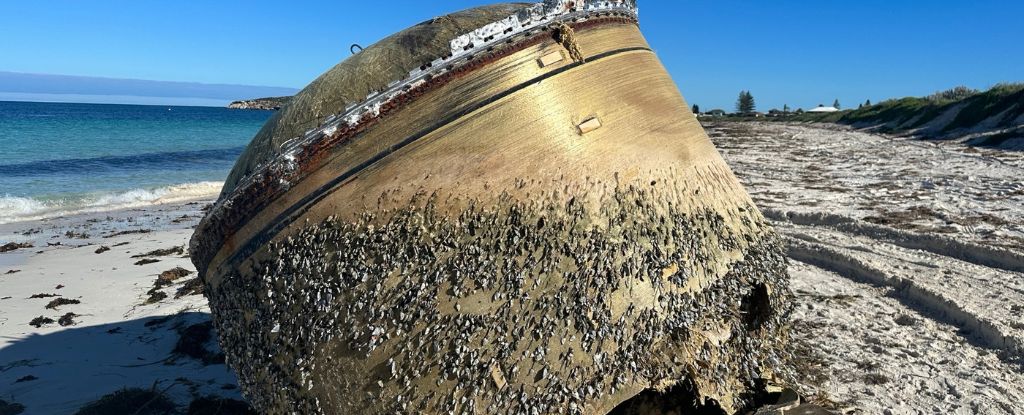
(Australian Space Agency) A massive metal object found drifting off the shore of a remote beach in Western Australia is awash in mystery as officials try to figure out where it came from.
Police have been guarding the mysterious thingamajig since it was discovered by baffled locals this last weekend about 250 kilometers (155 miles) north of Perth.
The object appears to be human-made, although it has clearly fallen into disrepair. About 2.5 meters (8.2 feet) wide and nearly 3 meters long, the cylinder's sides are covered in barnacles, its base a mess of fragmented metal.
On the white sandy beaches of Green Head, it stands out like a sore thumb.
Police say chemistry analysis of the unidentified object has deemed it safe, though they are yet to confirm where it came from.
In spite of a futile attempt by Australian police to "urge everyone to refrain from drawing conclusions", internet users began to speculate as to the object's origins shortly after the news made headlines.
The leading online theory at this point is that the metal structure did not rise from the deep ocean but fell from space.
On Reddit, a user pointed out that the cylinder is a "perfect match" for the third stage motor case of India's Polar Satellite Launch Vehicle (PSLV) rocket.
In fact, the Indian Defense Research Wing has already claimed the object as its own. In a recent statement, officials at the research wing said the PSLV rocket is an "essential workhorse in India's space program". When this rocket is launched, it is designed to lose its parts and fall back to Earth over remote ocean regions.
The third stage often plummets into the ocean near Australia.
The Australian Space Agency has not yet confirmed or denied this theory, although in a recent tweet they admitted the object "could be from a foreign space launch vehicle.".
The parallels are pretty easy to see, even for the average layperson.
A photo of India's PSLVs (seen below), which launched several satellites for Singapore in 2015, shows the copper-colored rocket motor, which "provides the upper stages high thrust after the atmospheric phase of the launch."

Rocket India Launch
India's PSLV. The third stage is the copper-colored cylinder. (Indian Space Research Organization)
The agency had another launch earlier this year, but judging by the barnacles on this newly beached metal object, it has probably been in the ocean for more than a few months.
The issue of space junk from rocket launches is one that is gaining greater attention in recent years, as more satellites are deployed into Earth's orbit. The rocket parts are often purposefully sunk in remote regions of the ocean, without any plans for retrieval.
The Australian Space Agency said in a statement that they "are committed to the long-term sustainability of outer space activities, including debris mitigation, and continue to highlight this on the international stage."
Sorry, that is a UFO.
It needs to go to Washington, D.C., right away.

I first wondered how, if it was metal, it would not have sunk to the bottom of the ocean immediately.
But a look at the side shows barnacles only covering half of it, which means there was trapped air, and it was buoyant - so it would move with ocean currents.
Thanks for the update. I was wondering what that was.
Space junk
It’s a container of crack cocaine to be delivered to The White Crack House attention Hunter Biden.
Space junk. Heads Up! ;)
Makes sense you can see how it was sitting in the water and if it is space junk they would have made it as light as possible.
For half a second I thought it might be Chris Christie
So why the mystery?
“Don’t speculate”? Why not?
The space debris angle seems very plausible given the pics...the condition seems mysterious, is all: burned out? Blown out?
Could have been Lizzo.
It is not space junk, just earth junk.
Ocean Junk...................
I always tell my wife you’d be surprised what you’ll eat when your hungry enough.....that can definitely makes the list.......
“A fiber wrapped fuel tank. The time of landing could be determined by the barnacles.
15 posted on 7/17/2023, 12:54:07 PM by Organic Panic”
There ought to be an international agreement that all future objects launched into space to be required to have de-orbiting ability to reduce space junk accumulation. At some point in the future, there’s going to have to be some way of gathering up some of the space junk and de-orbiting it or bringing it back down for disposal.
Nah, the barnacles would be up to his neck.
Why is it that a lot of things fall into the ocean and not on land, on skyscrapers, etc. Lucky?
Skylab crashed around Perth
Disclaimer: Opinions posted on Free Republic are those of the individual posters and do not necessarily represent the opinion of Free Republic or its management. All materials posted herein are protected by copyright law and the exemption for fair use of copyrighted works.
