Posted on 09/08/2021 10:50:32 AM PDT by Red Badger
In metals, electrons are normally expected to be diffusive in their movement, operating as individual particles – in other words, they don't gain momentum as a group.
In a new study, scientists have now discovered a type of metal where electrons actually do flow in a fluid-like way – like water in a pipe – by interacting with quasiparticles called phonons, which emerge from vibrations in a crystal structure.
This causes the electrons to shift from diffusive (particle-like) to hydrodynamic (fluid-like) behavior in their movement.
The metal superconductor that causes this behavior is a synthesis of niobium and germanium called ditetrelide (NbGe2), the research team reports. Potentially, it could give rise to a new type of electronic device.
"We wanted to test a recent prediction of the 'electron-phonon fluid'," says experimental physicist Fazel Tafti from Boston College.
"Typically, electrons are scattered by phonons which leads to the usual diffusive motion of electrons in metals. A new theory shows that when electrons strongly interact with phonons, they will form a united electron-phonon liquid. This novel liquid will flow inside the metal exactly in the same way as water flows in a pipe."
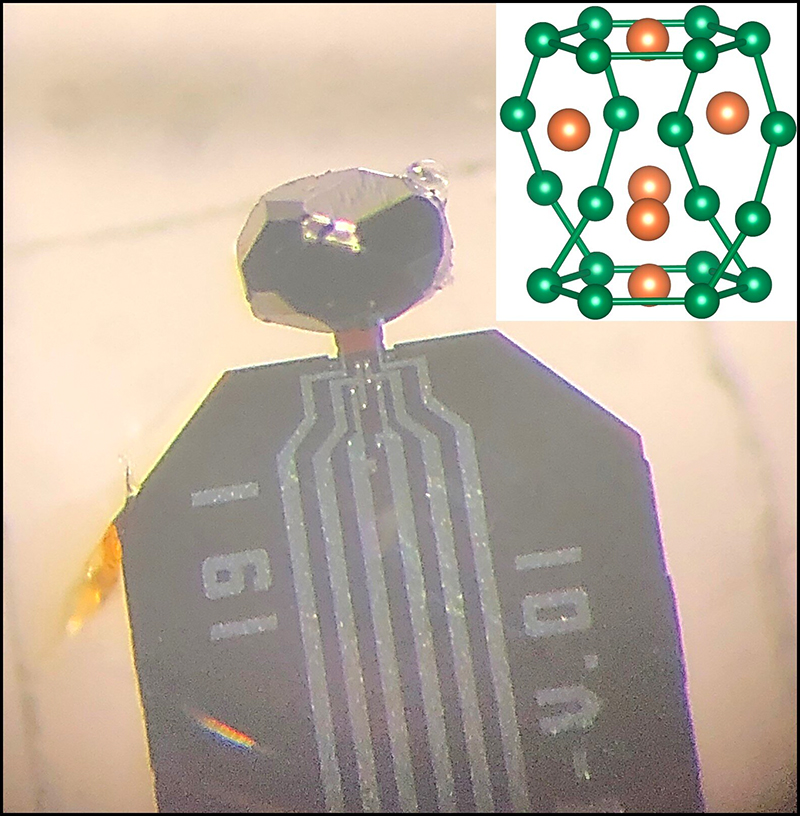
Above: A small crystal of the new material on a device, with the inset showing the atomic arrangement.
Three experimental methods confirmed the electron-photon fluid hypothesis put together by Tafti and his colleagues. The first was the measurement of electrical resistivity in the metal, which showed its electrons had a higher mass than would normally be expected.
Second, Raman scattering laser analysis showed that the vibration of NbGe2 changed because of the unusual flow of electrons, and finally X-ray diffraction techniques revealed the crystal structure of the metal.
The mass of electrons was three times larger than it should be, a material mapping approach known as quantum oscillations showed: another sign that the electrons and phonons were causing unusual behavior.
"This was truly surprising because we did not expect such 'heavy electrons' in a seemingly simple metal," says Tafti.
"Eventually, we understood that the strong electron-phonon interaction was responsible for the heavy electron behavior. Because electrons interact with lattice vibrations, or phonons, strongly, they are 'dragged' by the lattice and it appears as if they have gained mass and become heavy."
There's currently a lot of research interest in the idea of electron-phonon liquids, even if it's not fully clear yet what the implications might be for the electronic gadgets and communication systems of the future.
This new work opens up plenty of interesting options for future research. Next, the researchers want to find other materials that behave in the same way as NbGe2, and to work on controlling the fluid flow of electrons for future applications.
"Whereas electron-phonon scattering relaxes the electron's momentum in metals, a perpetual exchange of momentum between phonons and electrons may conserve total momentum and lead to a coupled electron-phonon liquid," the researchers explain in their study.
"Such a phase of matter could be a platform for observing electron hydrodynamics."
The research has been published in Nature Communications.

Imagine a motor made of this material for windings.......................
If I read this correctly, it could help solve the electromigration problem we see in semiconductors.
First pass however is the parent metal is probably too resistive to be useful.
we don’t know the strength of the metal or how well it would last compared to copper
they don’t give enough info
thx
Is this at ambient temperatures?
Phonon.....Hmmm
Well As I live, I must learn. Phonon is a new one on me
I must learn something different. My understanding of electrics was that a source produces an electromotive force that causes electrons to flow in a conductor like water in a pipe.
Reduce the pipe size and the resistance produces heat. A switch acts like a valve and stops the flow. A diode acts like a check valve. and Etc
Or Inoson.
Good place to start
https://en.wikipedia.org/wiki/Phonon
In physics, a phonon is a collective excitation in a periodic, elastic arrangement of atoms or molecules in condensed matter, specifically in solids and some liquids. Often referred to as a quasiparticle,[1] it is an excited state in the quantum mechanical quantization of the modes of vibrations for elastic structures of interacting particles. Phonons can be thought of as quantized sound waves, similar to photons as quantized light waves.[2]
The study of phonons is an important part of condensed matter physics. They play a major role in many of the physical properties of condensed matter systems, such as thermal conductivity and electrical conductivity, as well as play a fundamental role in models of neutron scattering and related effects.
The concept of phonons was introduced in 1932 by Soviet physicist Igor Tamm. The name phonon comes from the Greek word φωνή (phonē), which translates to sound or voice, because long-wavelength phonons give rise to sound. The name is analogous to the word photon.[citation needed]
Thanks for that!
wonder if it’s heavy...
We’re discussing the benefits to LENR right here on this thread. And Phonons have been the focus of a lot of Condensed Matter Nuclear Science for a couple of decades.
https://www.lenr-forum.com/search-result/64185/?highlight=phonons
Perhaps a suitable thread for the LENR ping list?
ISWYDT!......................
I believe so...................
😁...
+1

My version of Heavy Metal.
I had a Phonon once.
It was stereo......................
Instead of phonons, I’ve started to think in terms of Electron Pressure Waves.
1964 — Wave propagation in a fully ionized plasma with
uniform velocity
Leverne Kenneth Seversike
Iowa State University
https://lib.dr.iastate.edu/cgi/viewcontent.cgi?article=4884&context=rtd
Piddington’s (l8) account, in which the motions of both the ions
and electrons are considered, states that only four basic types of waves
can propagate through an electrically conducting medium in the presence
of an externally applied magnetic field. Two of the wave modes are
longitudinal or pressure waves. One of these corresponds to the usual
sound wave occuring in fluids and the other longitudinal waves appears
as an electron pressure wave. The remaining two waves are transverse in
character and are essentially independent of pressure. At low frequencies,
they are the hydromagnetic waves-first described by Alfvén (l) and at
high frequencies they correspond to electromagnetic or radio waves.
Disclaimer: Opinions posted on Free Republic are those of the individual posters and do not necessarily represent the opinion of Free Republic or its management. All materials posted herein are protected by copyright law and the exemption for fair use of copyrighted works.