
Posted on 11/15/2024 6:02:08 AM PST by Red Badger
credit: NASA/CSA/ESA, M. Xiao & P. A. Oesch (University of Geneva), G. Brammer (Niels Bohr Institute), Dawn JWST Archive
Researchers using the James Webb Space Telescope have discovered three massive galaxies from the early universe, revealing them to be as massive as the Milky Way and forming stars with surprising efficiency.
This finding, which contradicts earlier models of slow stellar formation, suggests that star formation in the early universe was much more productive than previously believed.
Three Galactic “Red Monsters” Discovered in the Early Universe
An international research team, led by the University of Geneva (UNIGE), has discovered three ultra-massive galaxies, each nearly as large as the Milky Way, that existed within the first billion years after the Big Bang. This unexpected finding was made using the James Webb Space Telescope’s FRESCO program, which leverages the NIRCam/grism spectrograph to precisely measure the distances and stellar masses of galaxies.
The results suggest that star formation in the early Universe was significantly more efficient than previously believed, challenging established models of galaxy formation. These findings were published in Nature on November 13.
Challenge to Conventional Galaxy Formation Theories
According to the prevailing scientific model, galaxies gradually form within vast halos of dark matter, which draw in gas (atoms and molecules) to form gravitationally bound structures. Typically, only about 20% of this gas converts into stars within galaxies. However, the new observations from UNIGE’s team, utilizing NASA’s James Webb Space Telescope (JWST), question this view. The data indicate that massive galaxies in the early Universe may have formed stars at a much higher rate than later galaxies, growing far more rapidly than once thought.
“Our findings are reshaping our understanding of galaxy formation in the early Universe.” Dr. Mengyuan Xiao
Unveiling the “Red Monsters”
JWST’s unparalleled capabilities have allowed astronomers to systematically study galaxies in the very distant and early Universe, providing insights into massive and dust-obscured galaxies. By analyzing galaxies in the FRESCO survey, scientists found that most sources fit existing models.
However, they also found three surprisingly massive galaxies, with stellar masses comparable to today’s Milky Way. These are forming stars nearly twice as efficiently as their lower-mass counterparts and galaxies at later times. Due to their high dust content, which gives them a distinct red appearance in JWST images, they have been named the three “Red Monsters.”
“Our findings are reshaping our understanding of galaxy formation in the early Universe,” says Dr. Mengyuan Xiao, lead author of the new study and postdoctoral researcher in the Department of Astronomy at UNIGE Faculty of Science. “The massive properties of these ‘Red Monsters’ were hardly determined before JWST, as they are optically invisible due to dust attenuation,” says Dr. David Elbaz, director of research at CEA Paris-Saclay.
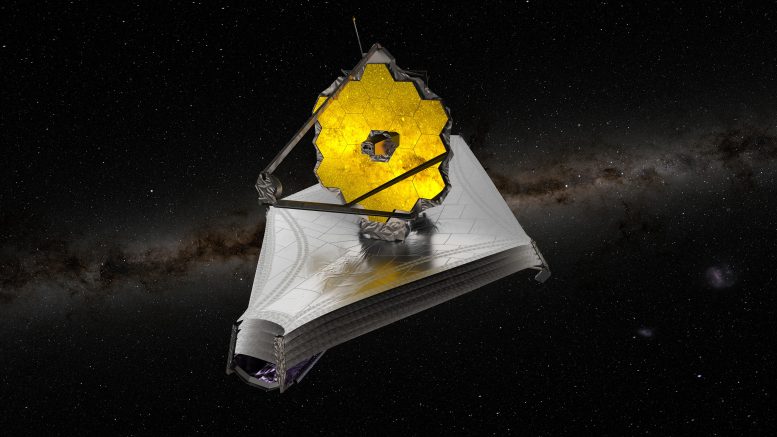
Webb Wallpaper The James Webb Space Telescope is a revolutionary tool in space exploration, capable of peering into the early Universe and uncovering distant galaxies, stars, and planets. Using infrared technology, it reveals details hidden from previous telescopes. Credit: ESA/ATG medialab
New Frontiers in Galactic Exploration
The international team has developed a new program with the JWST to systematically analyze a complete sample of emission-line galaxies within the first billion years of cosmic history. This approach enabled the team to achieve precise distance estimates and reliable stellar mass measurements for the full galaxy sample.
“Our findings highlight the remarkable power of NIRCam/grism spectroscopy,” explains Pascal Oesch, associate professor in the Department of Astronomy at the UNIGE Faculty of Science, principal investigator of this observation program. “The instrument on board the space telescope allows us to identify and study the growth of galaxies over time, and to obtain a clearer picture of how stellar mass accumulates over the course of cosmic history.”
“Too Many, Too Massive” Galaxies in the Early Universe
While these findings do not conflict with the standard cosmological model, they raise new questions for galaxy formation theories, specifically the issue of “too many, too massive” galaxies in the early Universe. Current models may need to consider unique processes that allowed certain early massive galaxies to achieve such efficient star formation and thus form very rapidly, very early in the Universe. Future observations with JWST and the Atacama Large Millimeter Array (ALMA) will provide further insights into these ultra-massive “Red Monsters” and reveal larger samples of such sources.
“These results indicate that galaxies in the early Universe could form stars with unexpected efficiency,” Dr. Mengyuan Xiao concludes. “As we study these galaxies in more depth, they will offer new insights into the conditions that shaped the Universe’s earliest epochs. The ‘Red Monsters’ are just the beginning of a new era in our exploration of the early Universe.”
Reference:
“Accelerated formation of ultra-massive galaxies in the first billion years”
by Mengyuan Xiao, Pascal A. Oesch, David Elbaz, Longji Bing, Erica J. Nelson, Andrea Weibel, Garth D. Illingworth, Pieter van Dokkum, Rohan P. Naidu, Emanuele Daddi, Rychard J. Bouwens, Jorryt Matthee, Stijn Wuyts, John Chisholm, Gabriel Brammer, Mark Dickinson, Benjamin Magnelli, Lucas Leroy, Daniel Schaerer, Thomas Herard-Demanche, Seunghwan Lim, Laia Barrufet, Ryan Endsley, Yoshinobu Fudamoto, Carlos Gómez-Guijarro, Rashmi Gottumukkala, Ivo Labbé, Dan Magee, Danilo Marchesini, Michael Maseda, Yuxiang Qin, Naveen A. Reddy, Alice Shapley, Irene Shivaei, Marko Shuntov, Mauro Stefanon, Katherine E. Whitaker and J. Stuart B. Wyithe, 13 November 2024, Nature.
DOI: 10.1038/s41586-024-08094-5
Conventional wisdom is neither.............
13.85B...
But... they’ve found “Methuselah stars” that are approaching 15B years old...
And now super-massive galaxies that are far too complex and far too old to fit the current “big bang” BS...
Not to mention SOA’s, Star Owners Association fees and rules.................
Probably my favorite line in The Creator with Peter O’Toole (Dr Wolper) - paraphrasing mind you: “When science finally reaches the top of the peak of understanding, we will find God looking us in the face. We know nothing.”
More like a bad marriage, time drags on...
A long time ago....
In a galaxy far, far away..................
I have though the same thing and my head hurt.
Yeah, from billions of earth years ago.
The nearest star is 4.5 light years away, so a 10-year mission at the speed of light is feasible. But the nearest galaxy is millions of light years away (2.5 million I think).
So, travelling at "just" the speed of light isn't nearly fast enough to explore much of anywhere. We're gonna need a faster spaceship.
Anything older than 15 billion and we will need new technology to be able to see that far back in time. The Red Shift would be so massive as to put the light frequencies to below ‘near infrared’ levels we are using now.................
We need “The SPICE”.............................
Seems like Christmas comes every three months...................
The Science told us the universe was 4 billion years old
‘Then it told us it was 7 billion years old.
Now I believe it is 11 billion years old.
—
Now its 13.5 billion years old.
From BRAVE AI:
HD 140283
metal-poor subgiant star
The Methuselah star, officially designated as HD 140283, is a metal-poor subgiant star located approximately 200.5 light-years away from Earth in the constellation Libra. Here are some key facts about this ancient star:
Age:
Initially estimated to be around 14.46 billion years old, making it older than the universe’s estimated age of 13.77 billion years. However, more recent models of its stellar evolution have revised its age to around 12 billion years, which is still remarkably old.
Metallicity:
The star has very low metallicity, indicating it likely formed from the remnants of the first generation of stars, which would have formed early in the universe’s history.
Spectral Type:
sdF3, classified as a chemically peculiar star.
Apparent Magnitude:
7.205, making it visible with binoculars.
Distance:
200.5 light-years from Earth.
Constellation:
Libra, near the boundary with Ophiuchus.
Proper Motion:
-1114.93000 ± 0.68000 milliarcseconds/year (right ascension) and -304.36000 ± 0.46000 milliarcseconds/year (declination).
The Methuselah star is one of the oldest known stars in the Milky Way galaxy, providing valuable insights into the early formation and evolution of our galaxy. Its age and metallicity make it a unique object of study for astronomers, offering a glimpse into the distant past of our cosmic neighborhood.
I’m aware of the controversy...
I bought a star timeshare. Turns out I was only able to go there at night.
Here's a site that does a good job of exploring that question: https://bigthink.com/starts-with-a-bang/what-universe-expanding-into/
In short, they say the Universe is expanding into itself:
"The key realization is to stop thinking of the Universe as a thing that evolves in some larger, greater context; it’s perfectly reasonable to think of it as all there is, and to simply recognize that expansion and contraction are properties inherent to space itself."
.
The Great Somethingness is/are expanding into the Great Nothingness, thereby
creating new something(s) where there has always been nothing but great,
infinitely enormous nothing(s) - except of course for the infinitely old
“NO PARKING - Watch This Space” signs placed there by God.
There’s not enough lithium to fit the BB theory. Oh, and there should be identical amounts of matter and antimatter. A deep dive will turn up a lot more anomalies the torpedo the theory.
The one thing they never address is where the laws came from to allow all this to occur? In other words, why is there anything at all? Hint: thought is senior to matter.
Re: mentions of AlGore
El Rush-Bo had the best name for AlGore’s book: Earth In The Lurch
A British judge ruled that if British schools were actually going to use/teach using AlGore’s book, the schools had to point out out the many lies in the book.
Disclaimer: Opinions posted on Free Republic are those of the individual posters and do not necessarily represent the opinion of Free Republic or its management. All materials posted herein are protected by copyright law and the exemption for fair use of copyrighted works.