
Posted on 09/09/2024 8:57:19 AM PDT by Red Badger
On a few acres in central Wyoming, a car restoration enthusiast has a large collection of wrecks and rusted vintage autos. He hopes to turn the space into a ‘Disneyland’ for car enthusiasts who want to get their hands dirty.
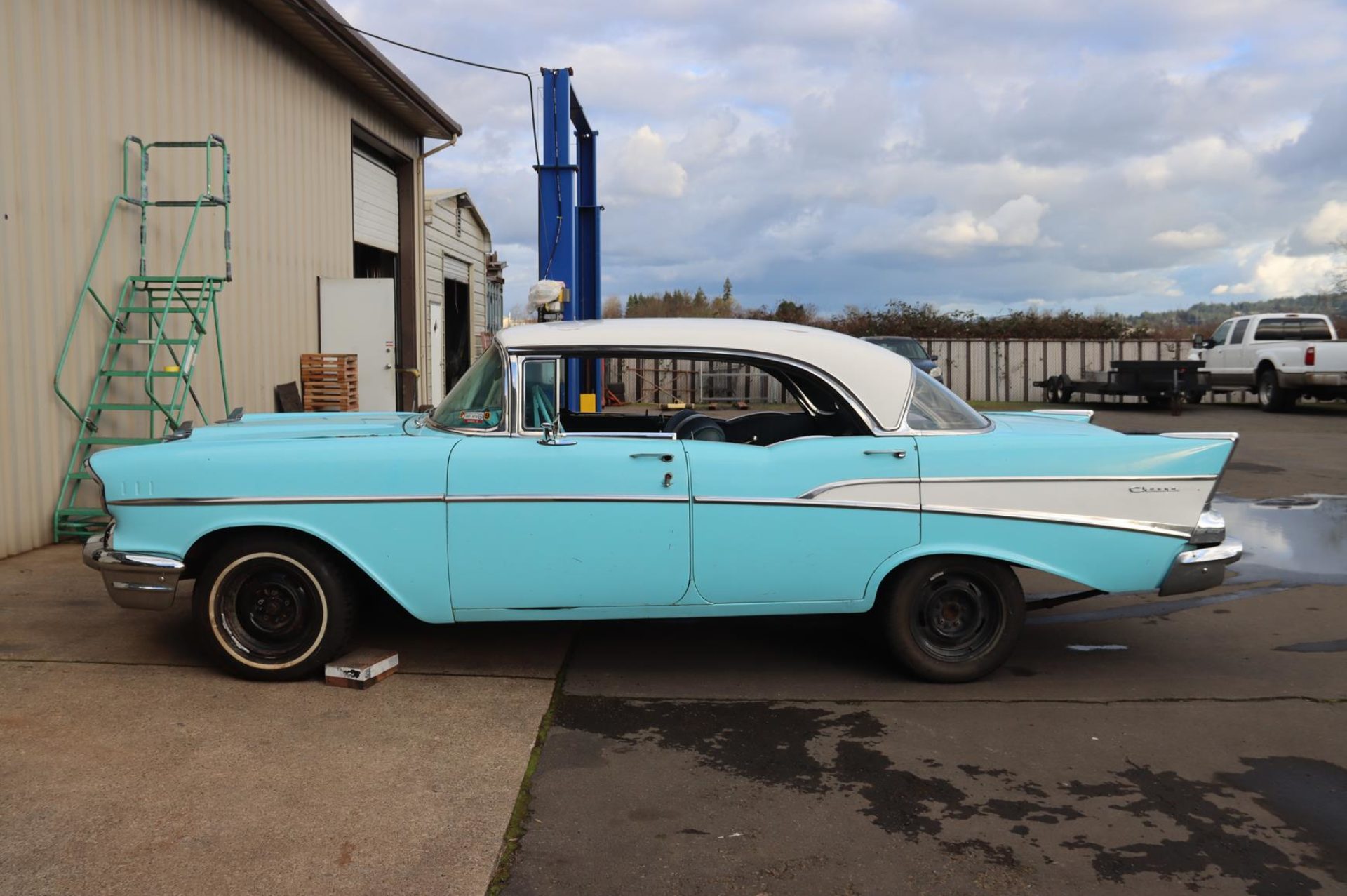
A 1960 Chevy Impala without door posts between windows is one of the treasures owned by Steven Murphy. (Dale Killingbeck, Cowboy State Daily)
==========================================================================
On a couple of acres in the middle of Wyoming, it does not take a lot of imagination to envision a popular kids movie about vintage cars come to life before your eyes.
Inside a fence next to a building sits a tow truck that resembles Mater from the hit animated movie “Cars.” In real life, this rusted-out hulk once towed a lot of wrecks around Hulett, Wyoming.
There’s also a 1954 Ford Skyliner with a jet-like hood ornament and rare glass top, and a 1956 DeSoto that had power windows — one of 5,600 made that year.
There are vehicles that once drove the roadways of South Dakota, Montana, Utah, Chicago and Maine.
“I went all the way to New Mexico for this car,” said Steven Murphy, standing next to the DeSoto. He intends to create a type of “Disneyland” for car restorers on his property. He does not yet want to advertise his exact location until his vision becomes more reality.
What is real on the acreage is an eclectic collection of vintage autos, some crashed, some with motors gone. There are convertibles without the tops, bumpers missing and bent and upholstery that is torn and tattered.
There are Plymouth Barricudas and Dodge Darts “that once terrorized the streets” and generated high insurance bills, as well as a couple of 1960s Plymouth Belvederes, similar to ones used by legendary racer Richard Petty on NASCAR tracks.
But to the 41-year-old who has spent nearly 30 years restoring cars, they all look like jewels in the rough or a “blank canvas” waiting for an artist.
Murphy, moved to central Wyoming after spending several years in Star Valley. His dream is a facility where car gurus and restorers can gather and in an almost assembly-line way take a wreck into one side of a building and bring it out the other side a jewel.
Life Of Restoring Cars “This is a snowball effect of restoring cars for the past nearly 30 years and just wanting to do more, faster and better, and it just turned into ‘we need a place to do this,’” Murphy said. “We have a future restoration shop, it’s not quite there yet but we are working on it. Right now, it is a bunch of old cars, old buildings and projects.”
Murphy said he has always worked on cars, his first was a 1971 Dodge Demon that was passed down through the family. He kept up his passion through high school and it “progressively got worse.”
“I call it my addiction,” he said.
He estimates he has worked on 30 car restoration projects with others, 10 of them “completes” where he has taken the project from beginning to end. Most of his learning has come from hands-on experiences and talking with experts, though he has taken college courses for body work.
His main interests are in 1950s and ‘60s era Chrysler cars, but there are Fords and others on the property.
Most of the collection can be traced to his trip to see a man about two cars and then deciding to purchase his entire collection. Murphy agrees that the collection has some resemblance to the 2006 movie “Cars” about old automobiles in a high-desert town.
“Sometimes I worry about crossing my vision with the Disney movie,” he said. “Although, I’ve been doing this before ‘Cars’ came out, and I love ‘Cars.’”
Murphy emphasized the vehicles on his property are future restoration projects. He does not sell car parts and is not interested in selling what is there.
He just traveled to Maine to bring back two Chevy Blazers as part of a project for an individual. One Blazer will be parts for the other. Once finished, he will transport them back to Maine.
Restored Blazers are selling anywhere from $45,000 to $100,000.
“The Blazers are really popular,” he said. Murphy said he also has helped a partner in Nevada restore Broncos, but the Blazers are now more in demand.

Dream Destination
Murphy’s dream destination for car restoration enthusiasts includes having a sand-blasting space, acid dipping tank, paint booth and all the other components of car restoration to make it a one-stop shop.
He said he would work on his own projects while others would bring in their own restorations. Murphy said he views it as a “collective” or “school of restoration.”
He has spoken with friends and acquaintances who are mechanics, upholstery and auto body experts who would be willing to work and teach at the facility once the buildings are ready. He has no firm timeline.
“I have talked to them about coming out and spending a few weeks or a month or two, most of them are of retirement age,” he said. “They’ve told me when you get up and running, I will be over. They will do trainings or whatever. Essentially, this will be the car restorers Disneyland.”
For Murphy, the wrecks waiting behind his fences will keep him busy for years ahead.
His vision for the tow truck that resembles Mater is to restore mechanical parts but leave the “patina” that includes a Triple-A logo on the back of the cab and iconic Phillips 66 logo on its doors.
Murphy’s 1966 Plymouth Belvedere convertible boasts head rests and head rests weren’t standard until 1969 or mandated. He said the Belvederes when restored make “a beautiful cruiser” because of their body lines.
Convertible Restoration
Restoring a convertible is a lot harder because of the convertible top.
“It’s not something that every restorer can do because you have to finagle and finess and know how to trip the top so when the top closes it seals across your top and when it opens it is not ripping or tearing or getting stuck,” Murphy said. “It takes a lot of time and a lot of patience and a lot of adjustments to do a convertible top.”
He estimates the restored value of a Belvedere at $25,000 to $75,000 depending on the engine and transmission.
But he warns that putting $35,000 into the restoration effort is not out of the question. That’s why he wants to have his own facility with all the equipment at one location to bring costs down.
Murphy estimates the high-end of restored cars now averages around $250,000 versus $100,000 not that many years ago. But value depends on demand and what a person is willing to pay.
Murphy said some of the cars he has only cost him $100, and others thousands — even in their wrecked condition.
Among his rarer cars is a 1966 Dodge Coronet 500 big block convertible that had a 383 motor, four-barrel carberators, power windows, and power top. It is one of just 666 made that year.
Another rare find is the 1954 Ford Skyliner with the glass top and the hood ornament that looks like a jet aircraft. He has found a glass top replacement that is in good shape to replace the cracked on in the vehicle.
On oddity sitting among his collection is a 1962 Plymouth Savoy that Chrysler tried to design with a European influence. The model did not sell well and was only made that year.
“They are just really weird looking,” Murphy said. “It’s loved by collectors because it is an oddball.”


‘Ridiculous’ Trunk
He also has a unique four-door 1960 Chevy Impala that has no door posts between the front and rear passenger windows. Its trunk looks more like a huge table.
“I would like to speak with the engineer that did these … these back ends look live ‘50s carnival rides. I love them, but they are a bit ridiculous,” he said.
Just across the field is the two-door 1956 DeSoto with a Hemi engine. Murphy said he saw it for sale on the Internet and “had to have it” because not many of them were made. DeSoto began as its own brand, was purchased by Chrysler the late 1920s, and phased out by Chrysler in the early 1960s.
In his garage, Murphy shows off his own restored 1960 Chevy Impala convertible.
“This car is a blast to drive, it is gorgeous, we used it at my wedding,” he said. “I’ve taken it to car shows and its won awards.”
Next to it is his forever “learning car,” a 1969 Dodge Dart.
“Every time I put it together, I tear it apart and redo it. I started that project back in 2001 or 2002 and it’s never been finished,” he said. “It comes together and then I take it apart and redo it. … We’ve redone the interior twice and every time it gets a little bit cooler and a little bit better. It’s been more a learning thing for me. I’ve perfected my craft on it.”
In his car restoration world, Murphy said the bottom line always comes down to time. He believes everything is fixable, but cost will depend on the time it takes to fix it — so choosing the right project and having logistics in place to condense time is important.
For Murphy, the love of cars ultimately will become a collaboration and fellowship with others of like minds. He plans to keep driving himself toward that dream.
“The best part about cars, honestly, is that the cars are fun but it’s relationships with the people that you meet and the stories that you can tell,” he said. “A car is worthless without a good story.”
Dale Killingbeck can be reached at dale@cowboystatedaily.com.
And the floor vents. Organic a/c !!
shoudl send em out to ‘counting cars’ restoration- keep em busy for a few years
Love the idea. Gonna’ take lots of work. Might want to build all the restoration infrastructure for those so inclined to bring their own cars in and do their own work under the guidance of a few experts.
To author of report... It’s BarrAcuda...BarrIcuda is near sacrilege.
Also, a car with no pillar between front and rear windows is called a “hardtop”...
AI can’t save ignorance...
I miss a lot of things about old cars, especially the lack of so many electronic gizmos that can break. I didn’t have AC in a car until I was about 40; and I really never missed it, or missed automatic windows, door locks, etc.
(The one thing I didn’t miss and was glad to give up was the lack of power steering in that big old car.)
Me too. Even today, I still think about putting one in myself. WTF. Nobody asked anybody if that high beam switch needed to be moved, they just did it. Dumb asses.
I loved the hard, audible click, and the convenience.
When I used to work on my car, it was back when you could go to a junkyard, bring your tools, and walk out to find a junker that had your part. Friggin wasp nests and stuff like that.
And of course, on occasion, there was the ghostly echo of a tragedy. I remember one where you could see the impact point where the people’s heads had impacted the windshield, and from one of them, you could see human hairs still stuck in there.
Kind of eerie.
I guess they don’t let you do that anymore, walk around and pull stuff off. They run junkyards like a real recycling business now, apparently. All the parts get harvested and put on shelving.
I liked it the old way.
“He has no firm timeline.”
It’s very easy to restore an old car by putting 1,000 hours and $75,000 into it.
And still have it be worth maybe $30,000.
Never buy and restore an old car. Buy one from someone who did the restoration and is losing $20,000 for his efforts.
This ain’t the 50’s..........
Sadly only a memory of when America was still America.
Also advertised as the “No draft” vent window.
Technically, sold by Chevrolet as the “Sport Sedan”.
The 4 door cars without a ‘b’ pillar were called ‘sport sedans’.
MOPAR = Mostly Old Parts And Rust
Wyoming is not Arizona. Those cars are likely to be made of rust held together by paying
There’s one just like that in a back yard about 2 blocks from my home.
If VGG finds out, he’ll move closer!
My dad had gold 57 Super 88 4 door hardtop! I want one!
“Triangular wind vents,” or just “wing vents,” is all we called ‘em! I liked them because you could direct the air where you wanted it.
I don’t blame you, that was a beautiful car, Loved that roofline!
Disclaimer: Opinions posted on Free Republic are those of the individual posters and do not necessarily represent the opinion of Free Republic or its management. All materials posted herein are protected by copyright law and the exemption for fair use of copyrighted works.