Skip to comments.
Iranian Regime tv Channel One hacked while it was airing Khamenie speech
various
| 10-8-22
Posted on 10/08/2022 1:05:38 PM PDT by nuconvert
Iranian Regime national tv Channel One hacked about an hour ago. During a broadcast of Khamenie speech, a red crosshair appeared over his face and chanting of Women. Life. Freedom. There was writing to the side saying "Rise up. Join us". Also 4 photos at the bottom of the screen of young people killed and additional writing: "The blood of our youth is dropping from your paws".
Also, there was a huge banner in the middle of Tehran highway today that read: We are no longer afraid of you. We will fight.
Also, attempted attack on IRI ambassador in Denmark. Her bodyguard was stabbed. Diplomatic Security intervened before the attacker could stab the ambassador.
TOPICS:
KEYWORDS: basij; deathtothemullahs; denmark; ebrahimrigi; erdogan; iran; iranprotests; iraq; irgc; iri; israel; khameini; khamenei; kurdistan; lebanon; mahsaamini; mullahloversonfr; mullahsmustbekilled; najisharifizindashti; protests; qudsforce; raisi; receptayyiperdogan; shahrammaroufmola; syria; turkey; yemen; zahedi
Navigation: use the links below to view more comments.
first previous 1-20 ... 2,161-2,180, 2,181-2,200, 2,201-2,220 ... 2,401-2,405 next last
2,181
posted on
06/19/2026 10:19:07 AM PDT
by
AdmSmith
(GCTGATATGTCTATGATTACTCAT)
Iran Update Special Report, June 19, 2026
Iran is attempting to condition US-Iran nuclear negotiations on the United States compelling Israel to halt operations against Hezbollah in Lebanon. Tying the US-Iran nuclear negotiations to the Lebanon issue not only helps Iran advance its strategic objective of preserving Hezbollah but also enables the regime to delay nuclear negotiations while reaping the economic benefits of the US-Iran memorandum of understanding (MoU). US and Iranian officials had planned to hold technical nuclear talks in Switzerland on June 19 in accordance with the US-Iran MoU. Iranian officials pulled out of the talks, citing Israel's recent strikes in Lebanon, which they claimed violated the MoU that the United States and Iran signed on June 17.[1] The Israel Defense Forces (IDF) struck over 80 Hezbollah targets in Lebanon between June 18 and 19 in response to a Hezbollah attack that killed four IDF soldiers near Kfar Tebnit in southern Lebanon.[2] The first clause of the US-Iran MoU calls for a ceasefire on all fronts, including Lebanon.[3] The Iranian regime has interpreted this clause as both requiring Israel to cease operations against Hezbollah and withdraw its forces from Lebanese territory. A later clause stipulates that negotiations on a final deal can only begin after the earlier clauses are implemented. Iran's insistence on a complete ceasefire in Lebanon is part of its effort to force an Israeli capitulation in Lebanon and thereby preserve Hezbollah, which Iran views as a key pillar of its deterrence strategy.
Iran is attempting to compel the United States to pressure Israel to end operations against Hezbollah, given that Israel is not a party to the MoU. Iranian Deputy Foreign Affairs Minister Saeed Khatib Zadeh told Al Jazeera on June 19 that the United States must ensure that Israel “abides” by the MoU and added that Iran is prepared to implement the MoU “step by step” if the United States implements its commitments in the agreement.[4] Khatib Zadeh’s statement indicates that Iran won't proceed to the next step of the agreement, which stipulates that Iran and the United States will negotiate nuclear issues over a 60-day period, until the United States pushes Israel to cease its operations in Lebanon. Iranian Foreign Affairs Ministry Spokesperson Esmail Baghaei separately condemned Israeli operations in Lebanon and said that the United States bears direct responsibility for the situation.[5] Iranian Foreign Affairs Minister Abbas Araghchi similarly told Pakistani Foreign Minister Ishaq Dar on June 19 that the United States has a “commitment and responsibility” to end the war on all fronts, including Lebanon, and warned that the United States would be responsible for any violation of the MoU.[6]
Iran likely seeks to postpone nuclear negotiations in order to avoid having to make concessions on its nuclear program while benefiting from the economic relief that is included in the MoU. Iranian officials have not indicated any willingness to concede on key nuclear issues, such as Iran's highly enriched uranium stockpile and ability to enrich uranium on Iranian territory. Iranian officials likely seek to postpone discussions about these issues while simultaneously benefiting from the United States lifting its blockade on Iranian ports and issuing sanctions waivers for Iranian oil exports. A senior US official told Axios on June 17 that the negotiations process could stop in the next two to three weeks if Iran is not “serious about nuclear concessions.”[7]
Israel and Hezbollah agreed to a new ceasefire on June 19.[8] This ceasefire probably does not meet Iran's demand for a “complete ceasefire” in Lebanon because Iranian officials and media have repeatedly argued that a “complete ceasefire” in Lebanon requires the withdrawal of Israeli forces from Lebanese territory. The United States “relayed” to Iran on June 19 that Israel will not “further escalate” its attacks against Hezbollah in Lebanon.[9] The Israeli ambassador to the United States confirmed on June 19 that Israel will abide by the ceasefire and end “offensive operations.”[10] A senior Israeli official indicated that the IDF would respond to future Hezbollah attacks, however.[11] The ambassador and several other Israeli officials also confirmed that Israeli forces will remain positioned in southern Lebanon and continue to operate there.[12] Hezbollah sources confirmed the ceasefire agreement.[13] Iran may use its interpretation of the MoU, which does not explicitly call for an Israeli withdrawal from Lebanon, to insist that the withdrawal of Israeli forces from Lebanon is a precondition for US-Iran nuclear talks. Iranian officials and media have continued to insist that an Israeli withdrawal from Lebanon is part of the MoU.[14] Iran repeatedly used the issue of Israeli operations against Hezbollah in Lebanon to try to delay negotiations over its nuclear program and the Strait of Hormuz prior to the signing of the MoU.[15]
Iran is reopening the Strait of Hormuz in a way that retains Iranian control over the strait rather than restoring the pre-war status quo. The Supreme National Security Council (SNSC) stated on June 18 that commercial vessels seeking to transit through the strait must submit requests to the Persian Gulf Strait Authority (PGSA), transit only along assigned routes and times, and comply with Iranian safety requirements.[16] The PGSA said that Iran will waive tariffs for “security, safety, and environmental services” and “related Iranian insurance” during the 60-day negotiations period.[17] IRGC-affiliated media previously reported that Iran intends to resume charging vessels fees after the 60-day period, but ISW-CTP has not previously observed reports of the regime requiring vessels to obtain “Iranian insurance.” The PGSA separately published a new map of Iran's traffic separation scheme.[18] Iran's new traffic separation scheme is different from the one it imposed in April 2026 but still passes through Iranian territorial waters. United Kingdom Maritime Trade Operations and the US Navy-led Joint Maritime Information Center warned vessels to avoid the international traffic separation scheme due to the presence of naval mines, but stated that the southern transit route along Omani territorial waters is clear of mines and is the recommended route.[19] British maritime security firm Ambrey and the Wall Street Journal separately reported that Iranian forces turned back some vessels and told them to apply for exit permits.[20] These developments indicate that Iran has allowed renewed transit through the strait but preserved a system that enables the regime to regulate and restrict access, which gives Iran significant leverage over global commerce.
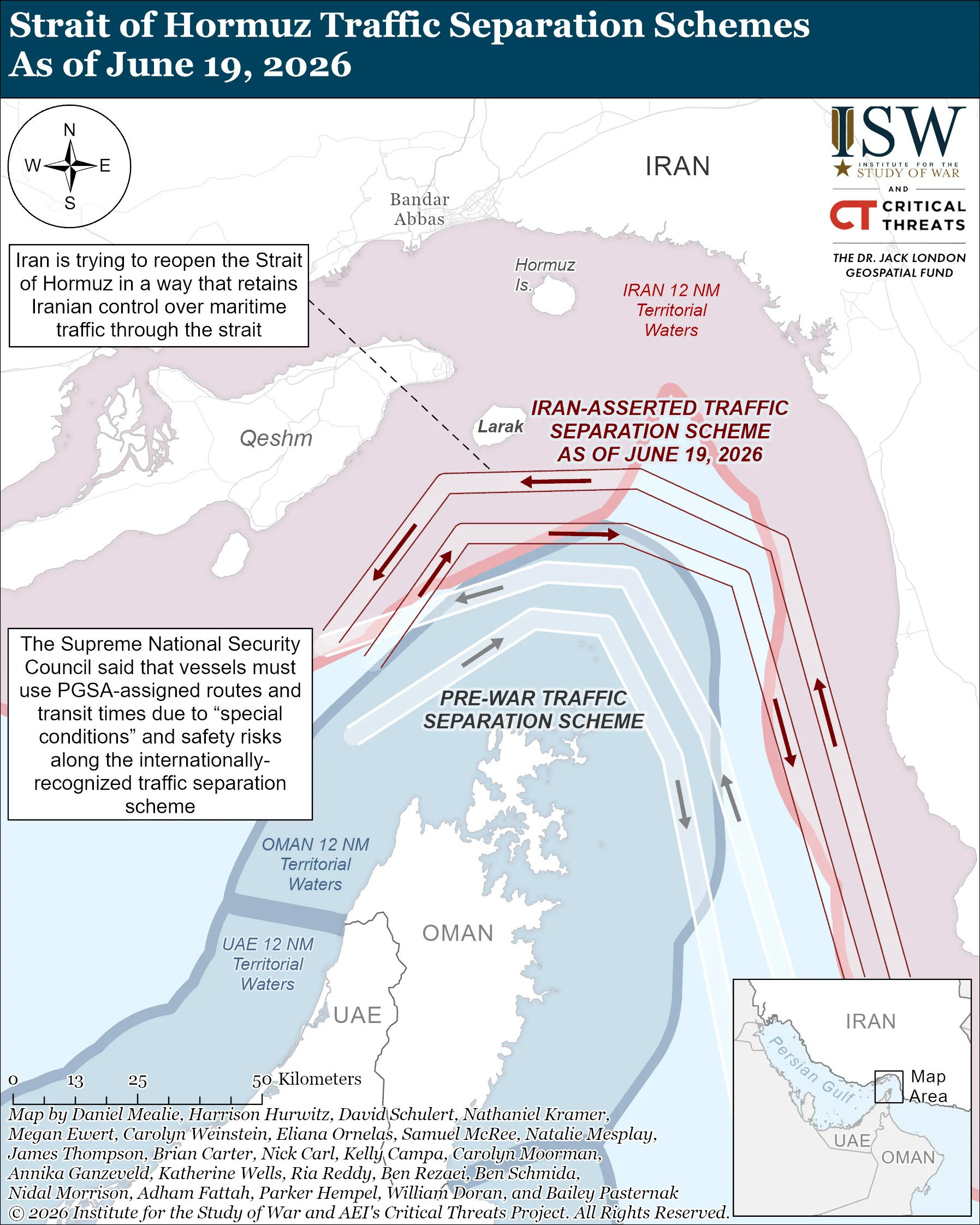
Some elements of the Iranian regime have argued that Iran should close the Strait of Hormuz to extract further concessions from the US, such as securing an end to Israeli operations in Lebanon and an Israeli withdrawal. Iran retains the ability to use the Strait of Hormuz as a tool to secure concessions and advance its strategic objectives under the current MoU. Islamic Revolutionary Guards Corps (IRGC)-affiliated Tasnim News Agency argued on June 19 that the Strait of Hormuz must remain closed and future negotiations must be canceled until Israel stops operations in Lebanon and withdraws from Lebanese territory.[21] IRGC-affiliated Fars News similarly argued on June 19 that Iran should cancel negotiations with the United States as a first step and then close the Strait of Hormuz as a second step to force the United States to “contain” Israel.[22] The Iranian regime's English-language media outlet, Press TV, described Iranian control over the Strait of Hormuz as Iran's “permanent strategic leverage” and argued that Iran can use nuclear negotiations to secure Israel's withdrawal from Lebanon, the release of Iranian frozen assets, and other US commitments.[23]
The IRGC has formed multiple Iraqi militia cells that directly report to the IRGC, instead of pre-existing Iranian-backed Iraqi militias, in order to conduct attacks on Gulf countries hosting US forces, according to eight Iraqi sources speaking to Reuters on June 19.[24] The sources included two Iraqi military officials, a security official, and five local militia commanders.[25] Three of the sources said that three or four of these new cells, each containing around 10 “elite” Iraqi Shia fighters, launched at least seven drone attacks targeting the Gulf countries between April 20 and May 17 from desert areas in southern Iraq.[26] The sources said that these attacks included three attacks targeting Kuwait, two targeting the United Arab Emirates (UAE), and two targeting Saudi Arabia.[27] The IRGC-directed militia cells targeted Kuwait's Ali al Salem Airbase and a military terminal at Kuwait's international airport.[28] The UAE and Saudi Arabia reportedly intercepted all of the attacks launched by IRGC-directed militia cells at their territory. ISW-CTP assessed in mid-April that Iranian-backed Iraqi militias were likely responsible for some of the drone strikes against the Gulf states.[29] The IRGC-directed militia attacks against the Gulf states were probably intended, in part, to further Iran's efforts to drive a wedge between the Gulf states and the United States. Iranian-backed Iraqi militias conducted up to half of the roughly 1,000 drone attacks targeting Saudi Arabia during the war, according to an unnamed source speaking to the Wall Street Journal on April 21.[30]
The new militia cells reportedly contain multiple Islamic Resistance in Iraq members who operate outside of this coalition's command structure and directly report to the IRGC.[31] This engagement represents a deviation from the IRGC’s historical pattern of engagement with Iraqi militias. The five local militia commanders told Reuters that Iran's establishment of these cells reflects a shift in the IRGC’s tactics and is aimed at projecting Iranian force across the region.[32] The IRGC Quds Force has typically directly worked with Iraqi militia leaders and commanders, not cells of fighters who don't report to an Iraqi militia.[33] Iran's established Iraqi partners conducted numerous attacks on US and foreign targets in Iraq and the region, including the Gulf countries, during the war.[34] Unspecified Iraqi sources told Saudi media in April that IRGC Quds Force officers “constantly” supervised militia attacks, helped militias develop ammunition for drones, and provided militias with technical expertise regarding missiles.[35] One source added that IRGC officers provided daily target lists to Iraqi militias that recommended the timing and amount of ammunition to use for attacks.[36]
Iran reportedly formed these new militia cells to deflect responsibility for attacks from established militias amid increased US pressure on the Iraqi federal government to disarm Iraqi militias. The Iraqi sources told Reuters that the IRGC created the cells to maintain plausible deniability, deflect blame from established Iranian-backed Iraqi militias, and reduce US pressure on the Iraqi federal government to disarm the militias.[37] The United States has increased pressure on the Iraqi federal government in recent months to disarm the militias. The US Treasury Department halted shipments of Iraq's oil revenue held in the US Federal Reserve during the war due to militia attacks against US forces.[38] The United States has also seemingly conditioned economic support for Prime Minister Ali al Zaydi’s government on its ability to disarm the militias and dismantle their financial networks.[39] The Iraqi federal government has taken initial steps towards restricting arms to the state in recent weeks, including by forming a joint disarmament committee.[40] The PMF is an Iraqi state security service that includes many Iranian-backed Iraqi militias, such as Asaib Ahl al Haq and Kataib al Imam Ali, that answer to Iran instead of the Iraqi prime minister.[41] Asaib Ahl al Haq and Kataib al Imam Ali have both recently indicated their willingness to disarm.[42]
It is also possible that Iran formed these new militia cells as part of an initial effort to build a new, loyal cadre of ideological militias over which Iran has strong control and would supplement the political activity of existing Iranian-backed Iraqi actors. A retired Iraqi army general told Reuters that the new cells appear “smaller, more ideologically hardened, and more tightly controlled.”[43] Iraq analysts Michael Knights and Crispen Smith also noted in a May 2026 report that there is a growing trend of the IRGC Quds Force directly running Iraqi militia cells composed of militia members from different groups.[44] Iran has previously established splinter groups from previous organizations to ensure loyalty to Iran.[45] Iran helped split Kataib Hezbollah and Asaib Ahl al Haq from Iraqi Shia nationalist cleric Muqtada al Sadr's Jaysh al Mahdi after 2006, as Jaysh al Mahdi became less responsive to Iranian control, for example.[46] UK-based Amwaj media reported in November 2025 that Iran has encouraged unspecified Iranian-backed Iraqi militias to shift their focus from armed resistance to political engagement.[47] An Iranian-backed Iraqi militia source told Amwaj media that Iran would consider supporting and had provided funding to smaller Iraqi militias that are not affiliated with the PMF, and thus fully outside of state structures and control.[48] Unspecified informed sources told Iraqi media on May 5 that IRGC Quds Force Commander Brigadier General Esmail Ghaani has similarly suggested that multiple Iraqi militias, including Kataib Hezbollah, Harakat Hezbollah al Nujaba, and Kataib Sayyid al Shuhada, end their kinetic activity in exchange for maintaining the PMF’s role within the Iraqi state.[49] These specific militias have repeatedly refused to disarm, however.[50]
An unspecified senior Iranian military official highlighted the effectiveness of Iranian ballistic missiles equipped with cluster munition warheads during the recent war in an interview with Iranian media, which highlights how Iran will use this and other lessons it learned during the war to inform its future military planning.[51] The official stated in an interview with regime outlet Nour News that Iran employed several types of drone and missile systems during the conflict, and specifically highlighted the use of ballistic missiles equipped with cluster munitions.[52] The official argued that military success depends on Iran's ability to sustain pressure on US and Israeli air defense systems and that ballistic missiles equipped with cluster munitions can “saturate [air] defense systems.” Iran launched numerous missiles equipped with cluster munitions at Israel during the conflict.[53] A single Iranian cluster-munition warhead created more than 30 separate impact sites in one instance.[54] ISW-CTP previously assessed that Iran likely opted to use cluster munitions because they are harder to intercept and cause extensive damage in a general area.[55] Iranian leaders also likely recognized that they could not reliably generate the mass needed to defeat Israeli air defenses and destroy discrete military targets with regular missiles.[56]
An Iraqi Ministry of Defense (MoD) official appeared to confirm that some weapons that the Iraqi federal government will receive as part of its efforts to restrict arms to the state could be supplied to the Iranian-backed Popular Mobilization Forces (PMF).[57] The PMF is an Iraqi state security service that includes many Iranian-backed Iraqi militias. MoD Director of Media and Moral Guidance Major General Tahsin al Khafaji told the Iraqi News Agency on June 18 that the federal government's process for restricting arms to the state includes administrative and armament components.[58] The administrative components include determining positions within the Iraqi security establishment to grant to, presumably, militia members who disarm.[59] The Shia Coordination Framework reportedly approved Iraqi Prime Minister Ali al Zaydi’s recent plan to offer 35,000 jobs within Iraq's security establishment to militia members willing to disarm.[60] Khafaji said the armament component involves receiving and distributing light, medium, and heavy weapons to the MoD, the Ministry of Interior, and potentially other “addresses operating within the framework” of the prime minister, which presumably refers to the PMF.[61] Iranian-backed Iraqi militias within the PMF answer, on paper, to the prime minister but, in reality, follow Iranian direction.[62]
https://understandingwar.org/research/middle-east/iran-update-special-report-june-19-2026/
2,182
posted on
06/20/2026 3:33:39 AM PDT
by
AdmSmith
(GCTGATATGTCTATGATTACTCAT)
2,183
posted on
06/20/2026 5:21:18 AM PDT
by
AdmSmith
(GCTGATATGTCTATGATTACTCAT)
To: nuconvert
19JUN2026 The Cipher Brief The Endless Negotiation - Iran’s Playbook for Buying Time and Preserving Power
According to former CIA officer and former National Intelligence Manager for Iran, Norm Roule, the answer may be that the negotiations themselves serve Tehran’s interests.
As Washington and Tehran continue discussions over a potential agreement, many observers are focused on whether a deal will emerge. Roule argues that a more important question may be whether Iran needs a deal at all. By prolonging negotiations, preserving leverage, maintaining its asymmetric capabilities, and exploiting tensions between the United States, Israel, and regional partners, Tehran may be pursuing a strategy designed to buy time while advancing its broader objectives.
In this in-depth conversation with Cipher Brief CEO Suzanne Kelly, Roule examines the current state of U.S.-Iran negotiations, the role of Hezbollah and other Iranian proxies, the future of the Strait of Hormuz, threats to global energy and data infrastructure, and the risks that could quickly derail diplomatic efforts.
Whether negotiations ultimately succeed or fail, Roule explains why the current stalemate may become the new normal.
CHAPTERS
00:00 Introduction
01:12 Why U.S.-Iran negotiations are so difficult
04:10 Hezbollah, Lebanon, and Israel’s role in the talks
10:04 The Strait of Hormuz and global energy markets
14:58 The hidden risks of Iraqi militias
18:58 Undersea cables, data infrastructure, and gray-zone threats
20:27 What Iran is doing while negotiations continue
23:32 Can diplomacy deliver measurable results?
25:34 Is the current stalemate the new status quo?
28:50 Final thoughts
https://www.youtube.com/watch?v=UNrFGVjM41I
2,184
posted on
06/20/2026 8:16:53 AM PDT
by
AdmSmith
(GCTGATATGTCTATGATTACTCAT)
To: AdmSmith
SSSSSShush - 47 will have to have another round of negotiations if this gets out. Very Embarrassing.
2,185
posted on
06/20/2026 2:40:05 PM PDT
by
PIF
(They came for me and mine ... now its your turn)
Iran Update Special Report, June 20, 2026
An Iranian negotiating delegation arrived in Switzerland on June 20 to discuss the implementation of the US-Iran memorandum of understanding (MoU) with US negotiators.[1] Iran will likely use these talks to try to pressure the United States to compel Israel to cease military operations against Hezbollah in Lebanon. Iranian Foreign Affairs Ministry Spokesperson Esmail Baghaei told Iranian state media on June 20 that the purpose of the US-Iran talks in Switzerland is to “demand the fulfillment of the [United States’] obligations,” likely referring to the regime's position that the United States is obligated under the MoU to make Israel cease its operations against Hezbollah.[2] Baghaei claimed that the United States has failed to implement the first clause of the MoU, which requires a ceasefire on all fronts, including Lebanon.[3] Baghaei argued that nuclear negotiations can only take place after the United States implements this clause.[4] Iran's negotiating delegation includes Parliament Speaker Mohammad Bagher Ghalibaf, Foreign Affairs Minister Abbas Araghchi, Supreme National Security Council (SNSC) Deputy Secretary for International Affairs Ali Bagheri Kani, Central Bank Governor Abdolnaser Hemmati, Deputy Oil Minister and National Iranian Oil Company Chairman Hamid Bord, Deputy Foreign Affairs Minister for Legal and International Affairs Kazem Gharibabadi, and Baghaei.[5]
It is unclear if Iran's negotiating delegation will discuss the Iranian nuclear program in Switzerland. International Atomic Energy Agency (IAEA) Director General Rafael Grossi is attending the talks in Switzerland.[6] CTP-ISW has not observed any Iranian officials confirm that US and Iranian officials will discuss Iran's nuclear program in Switzerland, however. Even if nuclear discussions take place in Switzerland, CTP-ISW has not observed any indications from Iranian officials that the regime is willing to make concessions on key nuclear issues.
The Iranian delegation will likely use Iran's renewed closure of the Strait of Hormuz as leverage in the talks to try to pressure the United States to compel Israel to halt operations against Hezbollah in Lebanon. Iran's top operational headquarters, the Khatam ol Anbia Central Headquarters, and the Islamic Revolutionary Guards Corps (IRGC) Navy announced on June 20 that Iran has closed the strait until Israel stops operations in Lebanon.[7] Iran likely calculates that it can use the strait as a tool to put greater economic pressure on the United States to meet Iranian demands. Iran has consistently sought to keep oil prices high during the conflict to put economic pressure on the United States, and Iranian officials likely recognize that announcing the closure of the strait will raise the perceived risks of shipping companies that seek to transit through the strait, which in turn drives up oil prices. US Central Command Spokesperson Captain Tim Hawkins told Axios after Iran announced the closure of the strait on June 20 that “Iran does not control the Strait of Hormuz” and that “traffic continues to flow” through the strait, however.[8]
Israel and Hezbollah continued to launch attacks targeting each other despite agreeing to a ceasefire on June 19. Israeli Prime Minister Benjamin Netanyahu stated on June 20 that Israel will remain in the IDF security zone in southern Lebanon “as long as necessary to defend [Israel's] northern border.”[9] Hezbollah continues to launch rocket, drone, anti-tank guided missile, and artillery attacks targeting IDF positions in southern Lebanon.[10] Israeli Ambassador to the United States Michael Leiter reported that Hezbollah has launched 147 rockets, 20 drones, and nine anti-tank guided missiles at Israeli forces in southern Lebanon and into Israel in the past 24 hours.[11] The IDF announced that a Hezbollah rocket attack killed an IDF soldier and injured 13 others near Kfar Tebnit in southeastern Lebanon.[12] IDF forces also engaged Hezbollah fighters near Ali al Taher on June 20.[13] Netanyahu's office reported that the IDF has struck over 300 Hezbollah targets and killed over 100 fighters in the past two days in response to Hezbollah attacks on Israeli soldiers.[14] CTP-ISW observed a significant increase in Israeli airstrikes between June 19 and 20 compared to recent days.[15] Netanyahu's office and the IDF warned that it is committed to the ceasefire but will continue to “forcefully” strike Hezbollah if the group launches further attacks against Israeli forces.[16]
There are some indications of disagreements within the Iranian regime regarding Iran's participation in the talks. IRGC-affiliated outlet Tasnim News Agency stated that Araghchi has “no justification” for going to Switzerland because the United States has not fulfilled its commitment to secure a ceasefire on all fronts.[17] This report suggests that some elements within the Iranian regime oppose talks with the United States until the United States pressures Israel to cease operations against Hezbollah and withdraws from Lebanon. The Iranian negotiating delegation presumably received approval from key decision-makers within the regime, specifically Iranian Supreme Leader Mojtaba Khamenei and/or IRGC Commander Major General Ahmad Vahidi, to attend the talks in Switzerland. There are several reasons why these leaders may have approved the talks. The Iranian regime has a vested interest in maintaining the negotiations process under the MoU because Iran is receiving economic relief, such as sanctions waivers, as part of the agreement. Iran may also seek to avoid appearing as the party obstructing negotiations.
The composition of the Iranian negotiating delegation indicates that Iran intends to discuss economic relief components of the MoU at the talks. The inclusion of Central Bank Governor Abdolnaser Hemmati and Deputy Oil Minister and National Iranian Oil Company Chairman Hamid Bord in Iran's delegation highlights how the Iranian regime intends to focus part of the talks in Switzerland on economic issues, such as the lifting of sanctions and release of Iran's frozen assets.[18] Iranian officials and media have emphasized the need to secure economic relief in the early stages of the implementation of the MoU.[19] Iran would almost certainly use any economic relief to try to reconstitute its defense and military capabilities and the Axis of Resistance.[20] Iran may also calculate that the United States would have less leverage to extract concessions from Iran on its nuclear program during the 60-day negotiations period if Iran can frontload economic relief.
https://understandingwar.org/research/middle-east/iran-update-special-report-june-20-2026/
2,186
posted on
06/21/2026 3:32:02 AM PDT
by
AdmSmith
(GCTGATATGTCTATGATTACTCAT)
Iran Update Special Report, June 21, 2026
Iran is attempting to use the sequencing of the US-Iran memorandum of understanding's (MoU) clauses to make the United States meet Iranian demands regarding Lebanon and economic relief before Iran agrees to discuss nuclear issues. Iran and the United States held quadrilateral talks with Qatari and Pakistani mediators in Burgenstock, Switzerland, on June 21.[1] Qatari officials stated that the parties established “specialized technical and expert working groups” to negotiate a final agreement covering “all aspects” of the MoU.[2] Iranian officials and media emphasized that the June 21 talks only focused on pushing the United States to implement MoU clauses that the MoU states must be implemented before nuclear negotiations can begin, however.[3] Islamic Revolutionary Guards Corps (IRGC)-affiliated Fars News reported on June 21 that no members of Iran's “nuclear committee” were part of the Iranian delegation.[4] Iranian negotiating team member Hossein Ghorban Zadeh said that the talks focused on implementing clause 13 of the MoU, which states that Iran and the United States will only start negotiations for a final agreement once clauses 1, 4, 5, 10, and 11 are implemented.[5] These clauses concern the ceasefire on all fronts, including Lebanon, the lifting of the US naval blockade, the reopening of the Strait of Hormuz, temporary oil sanctions waivers, and the release of frozen Iranian assets.[6] Ghorban Zadeh emphasized that a ceasefire in Lebanon is Iran's “top priority” and that progress on other aspects of the MoU depends on this ceasefire.[7] Iran's conditions in these talks demonstrate how Iran is using the MoU’s sequencing to demand that the United States fulfil its commitments in the MoU before Iran agrees to discuss its nuclear program. Iranian officials and media have repeatedly emphasized that Iran must solidify its military gains in the war in negotiations by using negotiations to secure Iran's strategic objectives, which include preserving Hezbollah and the Axis of Resistance writ large as well as securing Iranian control over the Strait of Hormuz.[8] The talks reportedly paused after US President Donald Trump threatened Iran that the United States would strike Iran “harder” if Iran does not stop Hezbollah, which prompted the Iranian team to temporarily withdraw to its hotel “in protest,” according to Iranian media.[9] An unspecified diplomat told Axios on June 21 that the Iranian delegation had not left the venue and that US-Iran negotiations were ongoing, however.[10]
Iran is using the first clause of the MoU, which calls for a ceasefire on all fronts, to try to pressure the United States to compel Israel to cease operations against Hezbollah in Lebanon and withdraw its forces from Lebanese territory. Iran's interpretation of this clause is part of its broader effort to preserve Hezbollah as a central element of Iran's deterrence strategy against Israel. Iranian officials have interpreted the first clause of the MoU as requiring both a halt to Israeli operations against Hezbollah and an Israeli withdrawal from southern Lebanon.[11] This interpretation creates a win-win situation for the regime: if the United States agrees to Iran's interpretation and compels Israel to withdraw its forces from Lebanon, this would represent a strategic victory for Iran and Hezbollah. If, on the other hand, the United States does not accept Iran's interpretation of this clause, Iran can continue to postpone nuclear negotiations by claiming that the United States is violating the MoU. Hezbollah-affiliated parliamentarians have stated that the US-Iran MoU provides a path to a complete ceasefire in Lebanon and Israeli withdrawal from Lebanon.[12] Israeli and Hezbollah attacks have paused since June 20, but Israeli forces continue clearing operations within the Israel Defense Forces’ (IDF) “security zone” in southern Lebanon.[13] The current ceasefire in Lebanon will likely not satisfy Iran's maximalist demands because Israeli officials continue to emphasize that the IDF will remain in southern Lebanon, however.[14] Israeli media reported on June 21 that the United States is pushing the IDF to withdraw to positions at and behind the Yellow Line, which denotes the extent of the IDF’s military buffer zone in Lebanon.[15] Israeli media added that Israeli political officials instructed the IDF to halt operations around Ali al Taher in order to avoid disrupting US-Iran negotiations.[16]
Iran is also attempting to frontload economic benefits from the MoU before addressing its nuclear program in negotiations. Iran likely seeks to acquire funds up front in case negotiations collapse and also likely seeks to reduce US leverage in later nuclear talks in order to make it more difficult for the United States to extract concessions from Iran. Iran could use early access to oil revenue and frozen assets to reduce US leverage during the 60-day nuclear negotiations period and try to reconstitute its military capabilities and the Axis of Resistance.[17] Fars News reported that Iran is still expecting the United States to release $12 billion USD in Iranian assets, which Fars News claimed includes a planned $500 million USD “test purchase” from Iranian assets in Qatar.[18] The Iranian Central Bank also confirmed that Central Bank Governor Abdolnaser Hemmati joined the Iranian delegation in Switzerland to work on the release of the $6 billion USD that is blocked in Qatar.[19] ISW-CTP previously assessed on June 20 that Hemmati’s inclusion in the Iranian delegation indicated that Iran intended to focus part of the talks in Switzerland on economic relief.[20]
Iran is using its announced closure of the Strait of Hormuz to increase economic pressure on the United States as part of its effort to push the United States to compel Israel to halt operations against Hezbollah and withdraw from Lebanon. The IRGC Navy announced on June 20 that it had “closed” the strait, but some vessels continue to transit through the Omani coastal route and Iran's newly asserted traffic separation scheme.[21] Commercially available maritime data indicates that 16 vessels passed through the strait between 1400 ET on June 20 and 1400 ET on June 21 despite Iranian claims that the strait remains closed.[22] The fact that shipping through the strait has continued after Iran announced the closure of the strait suggests that this announcement was likely intended to primarily have an informational effect. Iran's announcement increased global oil prices, and the Iranian regime likely calculated that an increase in oil prices would increase pressure on the United States to meet Iranian demands.[23] Iranian Supreme Leader Adviser Mohammad Mokhber highlighted on June 21 how Iranian control over the Strait of Hormuz enables Iran to “significantly influence the global economy.”[24] Mokhber added that Iran seeks to alter “the rules governing the strait.”
Iran's involvement in negotiations in Switzerland has exposed fissures among some Iranian factions over how Iran should advance its objectives. IRGC-affiliated outlet Fars News published an op-ed on June 20 that criticized IRGC-affiliated outlet Tasnim News Agency for allegedly supporting Iranian negotiating delegation head Parliament Speaker Mohammad Bagher Ghalibaf and advancing Ghalibaf’s pro-negotiations agenda.[25] Fars News also accused Tasnim of misinterpreting a recent statement from Supreme Leader Mojtaba Khamenei in which Khamenei suggested that he did not fully support the MoU.[26] Fars News’ claim that Tasnim is affiliated with Ghalibaf is inconsistent with recent Tasnim reports that have argued that Iran shouldn't conduct negotiations with the United States until the United States achieves a ceasefire in Lebanon. Tasnim argued on June 20 that Foreign Affairs Minister Abbas Araghchi had “no justification” to go to Switzerland, for example.[27]
Iranian media continues to reflect on aspects of the recent war that it assesses contributed to Iran's “success” against the United States and Israel. Iranian Armed Forces General Staff-run media Defa Press published an op-ed on June 21 in which it described the effectiveness of Iran's “mosaic defense” strategy in countering US and Israeli airstrikes during the war.[28] Iran's “mosaic defense” strategy dates back to 2005 under former IRGC Commander Mohammad Ali Jafari and involves the decentralization of military decision-making to lower echelons.[29] Defa noted that, unlike traditional, centralized defense models that depend on heavy equipment and rigid command structures, Iran's “mosaic defense“ relies on numerous small, low-cost, and flexible units—such as drones, radars, and missile platforms—that can operate independently yet cohesively with other units.[30] Defa emphasized that, in this structure, losses of individual components do not compromise the overall network.[31] Defa also highlighted how systems, such as Shahed drones, that are relatively cheap to produce, can pose financial strain on Iran's adversaries by making them invest in costly countermeasures.[32]
https://understandingwar.org/research/middle-east/iran-update-special-report-june-21-2026/
2,187
posted on
06/22/2026 12:02:52 AM PDT
by
AdmSmith
(GCTGATATGTCTATGATTACTCAT)
Sal Mercogliano- What’s Going on With Shipping?
21JUN2026 The Strait of Hormuz Ship Show: Week 16 Update
The situation in the Strait of Hormuz has escalated into what can only be described as a “ship show.” Following a brief moment of hope for a ceasefire and the reopening of the waterway, the emergence of the Persian Gulf Strait Authority (PGSA) has thrown maritime operations into chaos.
In this Week 16 recap, we break down the conflicting signals: while the U.S. declares the “Southern Highway” open and free for transit, Iran is asserting authority over the entire strait, demanding new “insurance” clearances that many in the industry view as a protection racket. We look at the data from Marine Traffic to see who is actually sailing, which ships are turning their AIS off, and why major carriers like Maersk remain cautious despite the diplomatic “14 points.”
In this episode:
⚓The impact of the PGSA’s new requirements on global shipping.
⚓Analysis of tanker movements: Who is using the Iranian vs. Omani channels?
⚓The reality of demining efforts and why the “Southern Highway” remains high-risk.
⚓US Blockade Officially Lifted & Toll Uncertainties
⚓How China and Russia are positioning themselves as oil and commodity markets shift.
https://www.youtube.com/watch?v=CuVb_Jjyh58
2,188
posted on
06/22/2026 8:24:59 AM PDT
by
AdmSmith
(GCTGATATGTCTATGATTACTCAT)
Iran Update Special Report, June 22, 2026
The structure of the newly established “deconfliction cell” to oversee the ceasefire in Lebanon appears to constrain Israeli action against Hezbollah by eliminating the post-2024 ceasefire monitoring mechanism, which allowed Israel to act against Hezbollah ceasefire violations in certain circumstances. Iran secured a number of gains from the quadrilateral talks with the United States, Qatar, and Pakistan in Switzerland on June 21. One of these gains includes the establishment of a “deconfliction cell” to oversee the ceasefire in Lebanon that excludes Israel and appears to replace a previous monitoring mechanism that enabled Israeli operations in Lebanon under the November 2024 ceasefire.[1] The new mechanism includes the United States, Iran, Qatar, the Lebanese government, and Pakistan. The previous mechanism, often referred to as the “ceasefire monitoring committee,” enabled Israel to conduct operations against Hezbollah and degrade the threat Hezbollah posed to Israel following Israel's defeat of Hezbollah in 2024.[2] This mechanism included Israel, Lebanon, the United States, France, and the United Nations Interim Force in Lebanon (UNIFIL).[3] Israel, under this mechanism, reported Hezbollah ceasefire violations to the mechanism in order for the Lebanese Armed Forces (LAF) to address the violations.[4] Israel took action to neutralize the Hezbollah threats with force when the LAF failed to address or insufficiently addressed the Hezbollah violations, which frequently occurred.[5] Israeli media reported that the newly agreed-upon mechanism between the United States, Iran, Qatar, and Pakistan is designed to replace the former ceasefire monitoring committee. It is unclear how the newly established deconfliction cell will function. The disempowerment of the former mechanism in favor of a new “deconfliction cell” that excludes Israel nonetheless benefits Iran because it removes a recognized forum in which Israel raised Hezbollah violations and acted against them if necessary. Both Iran and Hezbollah could materially benefit from a constrained Israeli ability to confront Hezbollah.
The inclusion of Iran and exclusion of Israel in the “deconfliction cell” will seriously challenge the cell's ability to achieve its stated objective of ensuring the “termination of military operations” in Lebanon.[6] Both actors are actively involved in combat operations in southern Lebanon. Iran reportedly deployed Islamic Revolutionary Guards Corps (IRGC) officers to Maroun al Ras to help coordinate Hezbollah's defense against Israel Defense Forces (IDF) advances in southern Lebanon, according to a senior Israeli source speaking to regional media on June 22.[7] These IRGC deployments are consistent with recent reports that IRGC officers have embedded themselves in Hezbollah's command structure in order to rebuild the group following Hezbollah's defeat in Fall 2024.[8] The IDF continues to operate against Hezbollah on the ground in southeastern Lebanon.[9] Iran's involvement in the conflict will enable it to directly relay intelligence and information from southern Lebanon to the “deconfliction cell.” Israel will only be able to indirectly relay information to the “deconfliction cell” via the United States, however. Israel was previously able to directly raise issues to the November 2024 monitoring mechanism.[10]
The conflicting positions of the deconfliction cell's member states will also challenge the mechanism's ability to secure an end to military operations in Lebanon. The United States is reportedly allowing Israel to maintain a military presence in southern Lebanon, according to Israeli media citing Israeli sources. Right-wing Israeli media reported on June 22 that Israeli and US officials have agreed that the IDF will remain in southern Lebanon for an unspecified period of time to continue clearing Hezbollah infrastructure in areas within the IDF’s military buffer zone.[11] Left-leaning Israeli media reports indicated on June 21 that the IDF is considering “a symbolic withdrawal” from areas of southern Lebanon beyond the Yellow Line — which refers to the extent of the IDF’s “security zone” in Lebanon—as a gesture to the Lebanese government.[12] Israeli Prime Minister Benjamin Netanyahu and Defense Minister Israel Katz continue to insist that Israel has the right to protect itself and that this includes maintaining a presence in southern Lebanon to combat Hezbollah and conduct clearing operations.[13] Iran continues to demand a full ceasefire that includes a complete IDF withdrawal from southern Lebanon, however.[14] Israeli, US, and Lebanese delegations will probablydiscuss the scope of Israeli military operations in Lebanon and the new “deconfliction cell” in Israel-Lebanon ceasefire talks in Washington, DC, between June 23 and 25.[15]
Iran has also secured economic relief through a US Treasury Department sanctions waiver for Iranian oil and petrochemical exports and a reported Iran-Qatar memorandum of understanding (MoU) that facilitates the unfreezing of Iranian assets. The US Treasury Department issued a waiver on June 22 for Iranian crude oil and petrochemical exports through August 21. The waiver includes associated services such as banking transactions, insurance, and transportation. The waiver does not apply to Iranian exports to North Korea, Cuba, and Russian-occupied parts of Ukraine.[16] The United States had already committed to the sanctions waiver as part of the US-Iran MoU that the United States and Iran signed on June 17.[17] Iranian media separately reported that Iran and Qatar signed a separate MoU for Qatar to unfreeze Iranian assets.[18] Qatar has not acknowledged this claim as of this writing. US Vice President JD Vance told reporters on June 22 that Iran would use unfrozen funds to purchase US agricultural products if the United States unfroze the funds.[19] Iranian media subsequently denied Vance's comments, however.[20]
Iran does not appear to have made any nuclear concessions in the June 21 talks in Switzerland. Iranian Foreign Affairs Ministry Spokesperson Esmail Baghaei told reporters on June 22 that both the US and Iranian delegations expressed their countries’ views on Iran's nuclear program but did not negotiate on their positions during the June 21 talks.[21] Baghaei reiterated that the United States must fulfill other MoU clauses, such as the ceasefire on all fronts and economic relief clauses, in order to “pave the way for the implementation of mutual obligations.” Baghaei was likely referencing negotiations about Iran's nuclear program, which is consistent with how Iran is attempting to condition nuclear talks on economic relief and the United States compelling Israel to end operations and withdraw from Lebanon.[22] US President Donald Trump suggested on June 22 that Iran will have to agree to International Atomic Energy Agency (IAEA) inspections of nuclear sites.[23] Baghaei denied that Iran has made any “new commitments” over IAEA inspections and said that Iran's interactions with the IAEA would remain under Iran's existing legal frameworks, however.[24]
The US and Iranian delegations agreed on June 21 to establish a line of communication to prevent military incidents in the Strait of Hormuz as commercial vessels transit through the strait.[25] Islamic Revolutionary Guards Corps (IRGC)-affiliated media claimed on June 21 that this line of communication — which appears to be designed mainly to avoid maritime incidents or miscommunication — establishes Iran's sovereignty over the strait.[26] The regime may assess that this line of communication will require vessels to coordinate with Iran in order to safely pass through the strait and thereby implicitly recognize Iran's sovereignty over the strait. Commercially available maritime data indicates that 25 vessels passed through the strait between 1400 ET on June 21 and 1400 ET on June 22, despite Iranian claims on June 20 that it had closed the strait due to Israeli “violations” of the ceasefire in Lebanon.[27]
https://understandingwar.org/research/middle-east/iran-update-special-report-june-22-2026/
2,189
posted on
06/22/2026 10:56:37 PM PDT
by
AdmSmith
(GCTGATATGTCTATGATTACTCAT)
Iran Update Special Report, June 23, 2026
Iran is taking steps to establish a joint mechanism with Oman to try to exercise long-term authority over the Strait of Hormuz. Such a mechanism would enable Iran to regulate transit through the strait and decide to restrict passage at its discretion. Iranian Parliament Speaker Mohammad Bagher Ghalibaf met with Omani officials in Muscat on June 23 to discuss joint Iranian-Omani management of the strait.[1] Iranian and Omani officials released a joint statement following the talks that emphasized their commitment to clause 5 of the US-Iran memorandum of understanding (MoU). This clause states that Iran will work with Oman to “define the future administration and maritime services in the Strait of Hormuz” in consultation with other Persian Gulf littoral states.[2] Islamic Revolutionary Guards Corps (IRGC)-affiliated Fars News Agency reported that both delegations agreed to continue discussions on the management of the strait, including maritime services and associated costs.[3] These discussions will almost certainly involve Iranian efforts to establish a toll system in which vessels must pay “service fees” to Iran and Oman to transit through the strait. Omani Foreign Affairs Minister Badr Albusaidi stated after the meeting that Oman supports “toll-free safe passage” through the strait.[4] Iran, however, has consistently differentiated between “tolls” and other charges, such as “service fees” and “insurance” to protect vessels against attacks. Iran continues to be the only threat against commercial shipping in the strait. Any imposition of fees would violate international law. The Strait of Hormuz is an international waterway, not territorial waters, and Article 26 of the UN Convention on the Law of the Sea — which permits fees in territorial waters — therefore does not apply to the strait.[5] A reality in which Iran is able to manage traffic through the strait and collect related fees would constitute a significant strategic victory for Iran and give Iran substantial leverage over global commerce.
Recent increased vessel traffic through the strait does not eliminate the threats that Iranian control over the strait poses to US interests and global commerce. Western media reporting and commercially available maritime data indicate that vessel traffic through the strait has increased in recent days.[6] Iran continues to claim that the IRGC Navy is “allowing” vessels to pass through the strait, however.[7] This framing implies that Iran has the authority to deny vessels passage whenever it chooses, which significantly undermines US interests and global commerce. Iran has already used its claimed control over traffic in the strait as a lever to try to extract concessions during negotiations with the United States. ISW-CTP previously assessed that Iran's recent announcement of the “closure” of the strait likely aimed to increase economic pressure on the United States to compel Israel to halt operations against Hezbollah and withdraw from Lebanon, for example.[8] Iran's continued efforts to establish joint control over the strait would enable Iran to retain its ability to use the strait as a tool of coercion.
Iranian regime officials have continued to deny that the United States could control how the regime spends any funds it obtains from the US-Iran memorandum of understanding (MoU). Any economic relief that the regime obtains could support Iranian efforts to reconstitute its military capabilities and the Axis of Resistance. Iranian Ambassador to the United Nations Ali Bahreini rejected on June 23 any US involvement in deciding how Iran could use unfrozen assets it gains access to from the MoU.[9] Iran's Central Bank Governor, Abdolnaser Hemmati, told regime media on June 23 that Iran has “no obligation” to buy US agricultural products under the terms of the MoU.[10] US Vice President JD Vance told reporters on June 22 that, if the United States unfroze Iranian assets, Iran would have to use the assets to purchase US agricultural products.[11] Regime officials have previously indicated that the regime could use any economic relief from the MoU to reconstitute Iran's military capabilities. Arab mediators told the Wall Street Journal on June 13 that IRGC Commander Major General Ahmad Vahidi, whom ISW-CTP continues to assess is leading regime decision-making, has insisted that Iran's frozen assets should not be “barred from military spending,” for example.[12] Iranian Foreign Affairs Ministry Spokesperson Esmail Baghaei similarly stated in May that Iran would use assets released under an agreement with the United States to advance its defense and military sectors, including Iran's missile and drone programs.[13]
Iranian Supreme Leader Mojtaba Khamenei’s Telegram channel reiterated the primary objectives that Iran seeks to achieve in the current conflict.[14] The objectives include:
Ending US military operations against Iran;
Making the United States lift its naval blockade on Iranian ports;
Consolidating Iranian sovereignty over the Strait of Hormuz;
US compensation for Iranian reconstruction;
The lifting of all sanctions;
“The resolution of nuclear issues,” likely referring to maintaining the Iranian nuclear program; and
Iranian access to frozen assets.
Recent Iranian reporting suggests that Major General Ali Abadi Abdollahi may now serve as the Armed Forces General Staff (AFGS) deputy chief and Khatam ol Anbia Central Headquarters commander simultaneously. The Iranian media has not publicly announced a replacement for the AFGS deputy chief position since the current IRGC Commander Major General Ahmad Vahidi, who previously served as the AFGS deputy chief, was appointed as the IRGC deputy commander in December 2025.[15] Vahidi was appointed as IRGC Commander in March 2026.[16] Iranian media, including an AFGS-affiliated outlet, identified Abdollahi as the AFGS deputy chief in May and June 2026 while reporting that he had appointed new officials to positions within the Passive Defense Organization (PDO).[17] The PDO operates under the AFGS and develops and coordinates policies to protect Iranian civilian, military, and nuclear infrastructure from attacks.[18] Abdollahi’s reported role as AFGS deputy chief in making these appointments is notable because the AFGS chief, rather than the deputy chief, has historically appointed senior PDO officials.[19] The Iranian media has not announced a new AFGS chief since Israeli strikes killed former AFGS Chief Major General Abdol Rahim Mousavi in February 2026.[20] Iranian media have simultaneously continued to identify Abdollahi as the commander of the Khatam ol Anbia Central Headquarters, a position to which he was appointed in September 2025, which suggests that Abdollahi may hold both positions concurrently.[21] Iranian media reports identifying Abdollahi as the AFGS deputy chief follow unconfirmed reports from December 2025 that Iranian leaders were considering merging the AFGS and Khatam ol Anbia Central Headquarters.[22] A single commander previously served as both the Khatam ol Anbia commander and AFGS chief before the regime separated the two organizations in 2016.[23] The regime may have decided to merge the AFGS and Khatam ol Anbia Central Headquarters as part of a broader effort to restructure the military establishment after the 12-day Israel-Iran War, which highlighted Iran's command-and-control issues.[24] Such a move would likely aim to increase coordination and reduce redundancies at the highest level of Iran's military establishment.
United States Central Command's (CENTCOM) proposed deconfliction initiative in Lebanon would operate at a disadvantage compared to Iran because the IRGC’s on-the-ground presence in Lebanon likely enables Iran to identify and report alleged ceasefire violations to the newly established “deconfliction cell” faster than the United States.[25] CENTCOM Spokesperson Captain Tim Hawkins told US media on June 23 that CENTCOM is monitoring kinetic activity in Lebanon for tactical deconfliction.[26] US media reported that CENTCOM’s monitoring mechanism is part of the newly established “deconfliction cell” to oversee the ceasefire in Lebanon.[27] The “deconfliction cell” includes both US and Iranian representatives, but no Israeli representation.[28] The United States does not have an on-the-ground presence in southern Lebanon, and its tactical monitoring efforts will thus presumably rely on the Israel Defense Forces (IDF). This reliance on the IDF for information would likely delay US awareness about ceasefire violations because IDF soldiers would need to report Hezbollah ceasefire violations to their superiors, who would in turn also need to notify their superiors until the report reaches a senior command echelon. The senior command echelon would presumably notify CENTCOM, which in turn would inform US officials in the “deconfliction cell.” Iran, however, has deployed IRGC Quds Force officers to southern Lebanon in the current conflict, which would likely reduce the time and complexity needed for IRGC officers to report incidents to Iranian officials involved in the “deconfliction cell.”[29] Iran may face some challenges with reporting incidents despite its overall advantage, however, because Hezbollah's combat units are decentralized and maintain limited communication with other units and higher command echelons.[30] Being able to notify the “deconfliction cell” about incidents faster would enable Iran to provide its interpretation of incidents and thereby influence the narrative over incidents in the “deconfliction cell.”
Israeli political leaders have expressed concern over the “deconfliction cell” due to Iran's role in the cell and Israel's exclusion from the mechanism.[31] Israeli Ambassador to the United States Yechiel Leiter warned Lebanese and US officials at the start of US-brokered negotiations in Washington, DC, on June 23 that negotiations are failing to expel Iranian influence from Lebanon and risk offering Hezbollah a “new lease on life.”[32]
Israeli and Lebanese officials met in Washington, DC, for the latest round of US-brokered negotiations on June 23.[33] International media reported that the talks will likely continue through June 25 and that Israeli, Lebanese, and US officials will discuss ceasefire measures, including plans to replace the IDF with the Lebanese Armed Forces (LAF) in “pilot zones” in southern Lebanon.[34] Israeli media reported on June 23 that the IDF will likely withdraw from limited specific areas in southern Lebanon and transfer control of these areas to the LAF.[35] The IDF first transferred control of Dibbine, Marjaayoun District, to the LAF and the United Nations Interim Force in Lebanon (UNIFIL) after withdrawing from the town on June 4.[36] Hezbollah Secretary General Naim Qassem said in a speech on June 23 that Hezbollah is cooperating “to the fullest extent” with the LAF and urged the Lebanese government to “take advantage” of Hezbollah as a partner force in Lebanon.[37] Qassem has previously claimed that Hezbollah would work with Lebanese authorities and urged the Lebanese government to align with the group, although Qassem has also frequently criticized the Lebanese government for pursuing Hezbollah's disarmament.[38]
The Israel Defense Forces (IDF) reported that it engaged two groups of Hezbollah fighters near Ali al Taher, Nabatieh District, on June 23. The IDF reported that its forces killed a group of Hezbollah fighters that advanced toward IDF positions near Ali al Taher.[39] The IDF also reported that it conducted a drone strike targeting four Hezbollah fighters in vehicles near IDF positions in Ali al Taher.[40] The IDF reported that this group of Hezbollah fighters “operated under civilian cover.”[41] Hezbollah claimed that Israeli forces targeted civilians as they cleared roads and recovered bodies.[42] Hezbollah accused the IDF of violating the June 19 Israel-Lebanon ceasefire.[43] Israeli forces and Hezbollah last engaged each other on June 20.[44] Israeli Prime Minister Benjamin Netanyahu and the IDF warned on June 20 that Israel is committed to the ceasefire but will continue to “forcefully” strike Hezbollah if the group launches further attacks against Israeli forces.[45]
Iranian Ambassador to Iraq Mohammad Kazem Sadegh downplayed Iran's opposition to Iranian-backed Iraqi militia disarmament in an interview with Iraqi state media on June 22.[46] Sadegh claimed that Iran would respect any Iraqi government decision regarding militia disarmament and called the issue an “internal Iraqi matter,” which contradicts previous reporting about Iran's position on the issue.[47] Unspecified political and informed security sources previously told US-funded, Arabic-language media on June 10 that Iran views Iraqi militias’ possible disarmament as an issue related to the Axis of Resistance rather than merely an internal Iraqi matter.[48] The IRGC also reportedly told Iraqi militia leaders not to surrender their weapons and vowed that Iran would do “everything in its power” to keep the militias armed.[49] Sadegh’s interview comes as the Iraqi federal government has recently taken initial steps to disarm Iranian-backed Iraqi militias, including forming a disarmament committee, amid increased US pressure on the Iraqi government to dismantle the militias.[50] ISW-CTP continues to assess that any Iraqi federal government attempt to disarm the militias and integrate them into the Iraqi security establishment that does not address the militias’ networks and allegiance to Iran would likely further embed Iranian influence within the Iraqi state.[51]
Sadegh also attempted to deflect Iranian responsibility for Iranian-backed Iraqi militia attacks during the recent conflict.[52] He falsely claimed during the interview that Iran “did not ask any party to intervene” on its behalf during the war.[53] Eight Iraqi sources told Western media on June 19, however, that the IRGC formed multiple Iraqi militia cells that directly report to the IRGC, instead of pre-existing Iranian-backed Iraqi militias, to conduct attacks on US forces in Gulf countries.[54] Unspecified Iraqi sources also told Saudi media in April that IRGC Quds Force officers “constantly” supervised militia attacks, helped militias develop ammunition for drones, and provided militias with technical expertise regarding missiles.[55]
https://understandingwar.org/research/middle-east/iran-update-special-report-june-23-2026/
2,190
posted on
06/23/2026 11:35:23 PM PDT
by
AdmSmith
(GCTGATATGTCTATGATTACTCAT)
In this Conflicted Conversation, Yeganeh Torbati, the Iran correspondent for the New York Times, discusses her excellent new book Stolen Revolution: Betrayal and Hope in Modern Iran.
Yeganeh explains how:
The 1979 revolution promised justice but created clerical authoritarianism.
Islamic law was subordinated to preservation of the supreme leader.
Institutions created to help the poor became engines of economic corruption.
The IRGC became a military-economic oligarchy.
Khatami-era reformism failed by refusing to challenge the constitutional source of authoritarian power.
Ahmadinejad promised to overthrow corrupt elites but merely installed new ones.
Rouhani promised economic normalization but enabled even greater corruption.
The destruction of all sources of organized opposition left protesters exposed to overwhelming violence.
Foreign powers encouraged expectations they did not possess the strategy or commitment to fulfil.
Iranian society continues to resist socially and culturally, making the future unstable rather than settled.
Find Yeganeh on X: https://x.com/yjtorbati
https://podcasts.apple.com/gb/podcast/the-betrayal-of-the-iranian-people/id1443491069
2,191
posted on
06/23/2026 11:38:37 PM PDT
by
AdmSmith
(GCTGATATGTCTATGATTACTCAT)
Iran Update Special Report, June 24, 2026
Iran is likely using discussions required by the US-Iran memorandum of understanding (MoU) to reach arrangements with the Gulf states that would allow for sustained Iranian influence around the Strait of Hormuz during the post-war period. The fifth clause of the US-Iran MoU charges Iran with discussing the future management of the Strait of Hormuz with Oman and other littoral Persian Gulf states.[1] Iranian officials, including Iranian Parliament Speaker and chief negotiator Mohammad Bagher Ghalibaf, met with Omani officials in Muscat on June 23.[2] Iranian Foreign Affairs Minister Abbas Araghchi also discussed strengthening regional cooperation with his Saudi counterpart, Faisal bin Farhan, on June 24.[3] Iran is likely attempting to use these talks to segue discussions over the immediate management of the Strait of Hormuz and resumption of traffic into broader discussions about a new regional architecture in the Gulf region. Ghalibaf explicitly stated on June 24 that Iran is ready for security agreements with Gulf states “that are made sustainable through economic cooperation.”[4] Brigadier General Esmail Ahmadi Moghaddam, who is the Supreme National Defense University President and a longtime regime insider who plays an influential role in Iranian security discourse, also highlighted Iran's objectives to strengthen its strategic relations with its neighbors in this post-war period in a speech on June 24.[5]
Recent remarks from Qatari Foreign Minister and Prime Minister Mohammed bin Abdulrahman al Thani suggested that some Gulf countries may be amenable to cooperating with the Iranians on a “broader economic framework.” Thani told the Financial Times on June 24 that Qatar was open to discussing Iran's plans to administer the strait alongside Oman with other Gulf countries.[6] Qatari officials met with Omani officials on June 24, likely to discuss Oman's recent discussions about the strait with Iranian officials.[7] A diplomat briefed on Thani’s visit to Muscat told Reuters that Qatari and Omani officials discussed initiating negotiations involving Iran, Iraq, and Gulf Arab states on the Strait of Hormuz.[8] The diplomat stated that the Gulf states are planning to push for no “transit fees,” and added that Iran “could” push for environmental, navigation, and security fees in these discussions.[9] The diplomat's framing, in which Gulf states oppose transit fees explicitly but do not oppose other fees explicitly, implies that some Gulf states are willing to entertain fees in return for certain Iranian concessions or guarantees. Iran could weave these fees into any regional agreement over the strait's management, for example. Thani denied that Qatar would approve any plan in which the Persian Gulf — which Thani called Qatar's “gateway to the world” — was “controlled” or subject to a toll system. Thani did not explicitly rule out other arrangements that could still be favorable to Iran and give Iran a say in the future of the strait.[10] A diplomat familiar with the matter told Agence France-Presse later on June 24 that Saudi Arabia is preparing to hold a “reconciliation summit” between Iran and Arab Gulf states separate from the US-Iran negotiations, but no date has been set at the time of this writing.[11] The Strait of Hormuz is an international waterway under the UN Convention on the Law of the Sea (UNCLOS).[12] Any effort to place the Strait under the control of a state or several states would erode long-standing international norms and maritime law.
The Iranian regime may also be attempting to segue discussions with the Gulf states on the status of the Strait of Hormuz into broader conversations about limiting US or Israeli influence and partnerships in the Gulf. This effort would be consistent with a persistent Iranian narrative in which the regime describes its intent to use the post-war period to establish a regional architecture favorable to Iran. Iranian officials have asserted during and after the war in Iranian and regional media that US partnerships with the Gulf fuels instability for Gulf States, which is designed to exploit Gulf state fears of renewed Iranian drone and missile attacks on the Gulf and surrounding the current uncertainty over US-Iran negotiations.[13] ISW-CTP has previously assessed that Iran seeks to persuade Gulf countries that accommodation with Iran — rather than reliance on US and Israeli security partnerships — offers them greater stability.[14] This is ultimately part of a longstanding Iranian effort to reduce US presence and influence in the region. Iranian Foreign Affairs Ministry spokesperson Esmail Baghaei stated on June 24 that as long as the US military interferes in the region, the Middle East will never achieve lasting peace.[15] Iran may be using recent engagements with Gulf countries to attempt to strengthen its relationships with regional countries as a result. Senior Iranian officials recently met with senior Emirati security officials, following multiple Iranian requests to meet for a rapprochement.[16]
Israeli, Lebanese, and US officials discussed proposals for the Lebanese Armed Forces (LAF) to backfill the IDF in “pilot zones” in southern Lebanon during talks in Washington, DC, on June 23 and 24. Israeli officials told Reuters and Israeli media on June 24 that Israeli and Lebanese negotiators discussed a US-backed plan to deploy US-trained and vetted LAF personnel to backfill Israeli positions.[17] US Secretary of State Marco Rubio announced on June 24 that the United States would help strengthen the LAF’s capacity to clear and hold territory in southern Lebanon, but did not confirm any specific plans to vet Lebanese soldiers.[18] Unspecified US sources told Lebanese media on June 24 that the Lebanese government has proposed that the IDF transfer control of territory in the vicinity of Beaufort Castle, Nabatieh District, to the LAF as part of an initial pilot zone trial.[19] Israel reportedly seeks to complete an assessment of Hezbollah's capabilities before authorizing any “broader” withdrawal from Lebanese territory, however.[20] An unnamed Lebanese official told Reuters on June 24 that the Israeli and Lebanese delegations will not announce any plans involving Israeli withdrawal from Lebanon until the conclusion of talks in Washington on June 25.[21] The IDF first transferred control of Dibbine, Marjaayoun District, to the LAF and the United Nations Interim Force in Lebanon (UNIFIL) after withdrawing from the town on June 4.[22]
The Israel Defense Forces (IDF) has continued to respond to threats in southern Lebanon as the United States, Iran, Lebanon, and mediators develop plans for the “deconfliction cell” to monitor the conflict. Qatari Foreign Minister and Prime Minister Mohammed bin Abdulrahman al Thani stated on June 24 that a “core element” of the deconfliction cell will be to monitor ceasefire violations.[23] Qatar is a member of the deconfliction cell alongside the United States, Iran, Lebanon, and Pakistan.[24] The deconfliction cell appears to constrain Israeli action against Hezbollah by eliminating the post-2024 Israel-Lebanon ceasefire monitoring mechanism, which allowed Israel to act against Hezbollah ceasefire violations in certain circumstances.[25] Both Iran and Hezbollah could materially benefit from a constrained Israeli ability to confront Hezbollah.[26]
The IDF has continued to respond to perceived threats in southern Lebanon, however. The IDF reported that its forces killed two Hezbollah fighters who advanced toward IDF positions near Ali al Taher and posed an “immediate threat.”[27] The IDF also reported that it later struck a second group of Hezbollah fighters in a vehicle that approached IDF positions in Ali al Taher.[28] It is not yet clear how the newly-proposed “deconfliction cell” in Lebanon will handle incidents in which the IDF identifies a direct threat to troops in the future. An Israeli intelligence official told Haaretz that IDF soldiers have not received any official updates about the role that the deconfliction mechanism may play in Lebanon.[29]
The Iranian regime continues to emphasize that a full Israeli withdrawal from southern Lebanon is a condition for any final US-Iran deal. Iranian Parliament Speaker and lead negotiator Mohammad Bagher Ghalibaf reiterated on June 24 that a complete Israeli withdrawal is a “central condition” for reaching any final agreement with the United States.[30] ISW-CTP has assessed that the Iranian regime is using the war in Lebanon to delay any substantive negotiations over Iran's nuclear program and Iranian efforts to control the Strait of Hormuz.[31] Israeli Prime Minister Benjamin Netanyahu affirmed on June 24 that the IDF will remain deployed within the security zone in southern Lebanon while he remains in office.[32]
https://understandingwar.org/research/middle-east/iran-update-special-report-june-24-2026/
2,192
posted on
06/24/2026 10:42:57 PM PDT
by
AdmSmith
(GCTGATATGTCTATGATTACTCAT)
Sal Mercogliano- What’s Going on With Shipping?
24 Jun 2026: The Strait of Hormuz is the world’s most critical maritime choke point, but the question of who actually “owns” it is far from simple. In this video, we dive into the complex web of international law, territorial claims, and historical precedents that define control over these narrow waters. From the UN Convention on the Law of the Sea (UNCLOS) to the specific claims of Iran and Oman, we break down why this 21-mile-wide passage remains the center of global shipping tension and what “right of transit passage” really means for the world’s fleet.
Key Highlights:
⚓The Geography of Control: A look at the Traffic Separation Schemes and how the territorial waters of Iran and Oman overlap in this 21-nautical-mile-wide strait.
⚓The Portuguese “Cartage” System: A historical look at how 16th-century Portugal used a passport and toll system to control trade in the region—and why today’s actions might feel like history repeating itself.
⚓UNCLOS Explained: An analysis of the UN Convention on the Law of the Sea (UNCLOS). ⚓We discuss the rights of “Transit Passage” under Articles 37, 38, and 44, which prevent coastal states from hampering international shipping.
⚓The “Outlaw Sea”: Why maritime law is often described as the “Wild West” and how nations like the U.S. and Iran navigate a system they haven’t fully ratified.
⚓Global Comparisons: How the Strait of Hormuz compares to other major waterways like the Suez Canal, Panama Canal, the Turkish Straits, and the English Channel.
⚓Does Iran have the legal right to close the strait? Can Oman charge for passage? Watch to find out why the freedom of the seas remains the backbone of the global economy.
https://www.youtube.com/watch?v=IPaCT6nRm88
2,193
posted on
06/25/2026 5:28:52 AM PDT
by
AdmSmith
(GCTGATATGTCTATGATTACTCAT)
Iran Update Special Report, June 25, 2026
Iran is attacking and threatening vessels in the Strait of Hormuz to advance its objective of establishing control over the waterway. The Islamic Revolutionary Guards Corps (IRGC) Navy attacked a vessel approximately eight nautical miles southeast of Dahit, Oman, on June 25.[1] The attack came after the IRGC Navy issued a warning demanding that vessels coordinate with Iranian authorities and use the Iranian-approved traffic separation scheme.[2] The IRGC Navy warned that traffic outside these routes is “very dangerous” and implicitly threatened vessels that do not comply.[3] Iran likely seeks to use force and coercion to compel vessels to use its illegitimate traffic separation scheme and implicitly acknowledge Iranian control over the strait, which is a key objective for the regime.
The recent attack and ongoing threats also likely seek to undermine international efforts to guarantee safe passage through the Strait of Hormuz. The International Maritime Organization (IMO) and Oman announced a joint initiative on June 23 to help hundreds of stranded vessels transit the strait through a designated safe route.[4] The IRGC Navy criticized the initiative as “unacceptable and completely dangerous,” likely because Iran assesses that a viable transit route outside Iranian territorial waters would weaken its ability to control maritime traffic and use the strait as leverage.[5] Commercially available maritime data indicates that at least 67 vessels transited the strait since ISW-CTP’s last data cutoff.[6] Forty-seven vessels used the IMO-Omani route along the Omani coast, while only ten used the Iranian-approved route, which illustrates how alternative transit routes may threaten Iran's efforts to manage traffic through the strait unless Iran continues to fire on shipping or otherwise compel shipping to use its transit scheme.[7] The IMO paused its evacuation plan following the IRGC attack on the vessel.[8] One of the IMO’s key responsibilities is to designate safe maritime routes.[9] Iran may calculate that attacks on vessels could discourage countries and international organizations from facilitating such alternative transit routes.
Iran is using military threats and economic incentives to try to convince Gulf states to support its efforts to control the strait, but the Gulf states appear to be resisting Iranian pressure at present. The recent Iranian threats and attacks likely serve as an implicit warning to Gulf countries—particularly Oman, given the Omani-IMO efforts described above—that Iran will continue to attack international shipping if they do not cooperate with Iran. Iran used a similar strategy during the recent US-Iran War. Iran launched hundreds of drones and missiles at Gulf states during the war in order to try to influence their decision-making to achieve Iranian objectives, which included halting US operations against Iran and driving a wedge between the United States and its Gulf allies. Iran is currently trying to diplomatically induce and militarily compel these states into cooperation. Iranian Foreign Affairs Minister Abbas Araghchi held a phone call with Omani Foreign Minister Badr al Busaidi on June 25, likely as part of this broader diplomatic effort.[10] The US-Iran memorandum of understanding (MoU) requires Iran to coordinate with Oman and the other Gulf countries on the future management of the strait, which likely explains Iran's efforts to do so in recent days.[11] Iran has also offered economic incentives to attract regional support for its plans for the strait. Iranian officials told the Wall Street Journal that Iran wants Gulf states to participate in a future system that would charge vessels for services in the strait and share the revenue.[12] Officials familiar with the proposal estimated that such fees could generate roughly 40 billion USD annually “for [the] states involved.”[13] It is not immediately clear whether this means 40 billion USD annually split between the states involved, or 40 billion USD annually per state.
The Gulf states appear to be resisting Iran's efforts to control the strait and impose fees on maritime traffic, however. Delegations from the Gulf Cooperation Council (GCC), which includes Oman, Kuwait, Qatar, Saudi Arabia, Bahrain, and the United Arab Emirates, met with a US delegation led by Secretary of State Marco Rubio in Manama, Bahrain, on June 25 to discuss the US-Iran MoU and maritime security in the strait, among other issues.[14] The United States and GCC foreign ministers issued a joint statement following the meeting that emphasized the importance of “free, unconditional, and unrestricted navigation” and rejected “any tolls, fees, or attempts to assert control over the strait.”[15] Iran has attempted to reframe tolls as “service fees” and has signaled its intention to impose such charges over the long term.[16] The joint statement addresses this distinction and opposes any payment requirement for transit through the strait. The statement also rejects efforts to control the strait more broadly, not merely the imposition of tolls.[17] This language implicitly opposes Iranian attempts to manage maritime traffic through measures such as its traffic separation scheme or requirements that vessels coordinate with the IRGC Navy. A senior UAE adviser similarly criticized Iranian efforts to impose a new reality in the strait and region.[18]
US Vice President JD Vance told a UK-based outlet on June 25 that the United States and Iran established a direct deconfliction channel in Doha, Qatar, to reduce the threat of conflict resuming.[19] Vance added that Iran agreed to establish a direct deconfliction channel between an IRGC representative and a US Central Command official in Doha to resolve disputes.[20] Iranian Parliament Speaker and chief negotiator Mohammad Bagher Ghalibaf previously stated on June 22 that Iran and the United States agreed to establish a mechanism to quickly resolve potential problems or incidents in the Strait of Hormuz, which may be referring to the channel that Vance announced.[21]
US, Israeli, and Lebanese officials continue to discuss proposals for the Lebanese Armed Forces (LAF) to backfill Israel Defense Forces (IDF) positions in “pilot zones” in southern Lebanon as trilateral talks continue in Washington, DC, on June 25. Lebanese media reported on June 25 that the Israeli and Lebanese delegations have exchanged and rejected over ten proposals to establish “pilot zones” in southern Lebanon due to disagreements over the location and timeframe for the proposed “pilot zones.”[22] A Lebanese official told Reuters on June 25 that the Lebanese government wants the “pilot zones” to be established in Israel's “security zone” and facilitate a complete Israeli withdrawal from southern Lebanon.[23] Israeli and Lebanese officials stated that the Israeli delegation, however, has insisted that the ”pilot zones“ should be established in areas north of the Israeli “security zone” on an incremental, case-by-case basis without any timeline.[24] Israeli government spokesperson David Mencer said on June 25 that any “redeployment” would only come once southern Lebanon was demilitarized and Hezbollah disarmed.[25] The IDF remains deployed both within the IDF “security zone” in southern Lebanon and at points beyond the Yellow Line.[26] Israeli officials and the IDF on June 25 rejected reports that the IDF had begun to withdraw from parts of southern Lebanon.[27] The IDF announced that Israeli forces have not changed positions in southern Lebanon.[28] The IDF has also continued to respond to threats it perceived in southern Lebanon on June 25.[29] The IDF reported that its forces killed five Hezbollah fighters in a vehicle between Zawtar al Charqiyeh and Maifadoun in Nabatieh District.[30] The IDF reported that it also conducted an airstrike targeting Hezbollah fighters in the vicinity of Kfar Tebnit, Nabatieh District, on June 25.[31] Israeli officials continue to reiterate that the IDF will remain in Lebanon until Hezbollah no longer poses a threat to the IDF and Israel.[32]
https://understandingwar.org/research/middle-east/iran-update-special-report-june-25-2026/
2,194
posted on
06/26/2026 3:32:39 AM PDT
by
AdmSmith
(GCTGATATGTCTATGATTACTCAT)
Maryam Sinaiee: Rival visions of Iran take to the streets during Ashura Every year during the Islamic month of Muharram, millions of Shi'ite Muslims across Iran commemorate the martyrdom of Imam Hussein, the grandson of the Prophet Muhammad who was killed in 680 AD. Hardliners often invoke his example to argue Iran should continue confronting the United States, while government critics use the same symbolism to condemn injustice at home. Political messaging also comes through speeches by eulogists (maddahs), who preside over ceremonies recounting Hussein's sacrifice and heroism.
At one ceremony, well-known maddah Reza Narimani criticized President Masoud Pezeshkian for disclosing in a recent speech that funds equivalent to the value of 20 million barrels of oil had been allocated to the Revolutionary Guards’ Aerospace Force during the war.
Another popular mourning chant, which has gained prominence among religious opponents of the government in recent years, criticizes what it portrays as state-sponsored religion. “In your religion, there is God's name, but God is absent,” the lyrics say. The poem's author, Shahabeddin Mousavi, was detained for a period after it became widely known.
According to social media posts, some Ashura gatherings this year included performances of the patriotic song Az Khoon-e Javanan-e Vatan (”From the Blood of the Nation's Youth”) in memory of thousands of young people killed during the January unrest. Originally composed during Iran's Constitutional Revolution more than a century ago, the song likens the blood of fallen youth to red tulips blooming from the earth. At some ceremonies, eulogists reportedly read aloud the names of those killed.
In the central city of Arak, the mother of Mohammad Radmannia, a 29-year-old who was fatally shot in the back of the head with live ammunition in Tehran, urged mourners to continue her son's path. “The massacre of protesters in January was carried out on the direct orders of the leader of Shi’ites (Ali Khamenei), while other senior clerics remained silent,” one user wrote on X. “A couple of Yazdi or Bushehri mourning chants cannot erase that crime from our society's memory.”
Another user wrote: “The blood that was unjustly spilled will never be washed away. No lament or elegy can diminish the scale of this tragedy in our collective memory.”
Another wrote that participating in Ashura ceremonies was “part of the struggle to reclaim religious symbols” from the government. A further comment added: “When will people understand that many ordinary religious Iranians have nothing to do with the government or its hardline supporters?”
https://www.iranintl.com/en/202606256312
2,195
posted on
06/26/2026 3:44:30 AM PDT
by
AdmSmith
(GCTGATATGTCTATGATTACTCAT)
Iran Update Special Report, June 26, 2026
Iran is using force in an attempt to maintain its control over the Strait of Hormuz in the immediate future. Iran fired four drones into the strait over the past 24 hours, according to US President Donald Trump.[1] Trump subsequently called this attack a ceasefire violation.[2] An Iranian drone targeted a Singapore-flagged cargo ship approximately eight nautical miles southeast of Dahit, Oman, in the Strait of Hormuz on June 25.[3] The IRGC Navy issued a public warning that demanded vessels coordinate with Iranian authorities and use the Iranian-approved traffic separation scheme some time before it attacked the ship.[4]
Iran is likely attempting to prevent vessels from using non-Iranian shipping channels with force in the immediate term as it continues negotiations with the Gulf Arab states to secure long-term recognition of its control. Oman and the International Maritime Organization (IMO) announced on June 23 that they have established a joint mechanism to help hundreds of vessels move through a designated safe route along the Omani coast. US Central Command (CENTCOM) said on June 26 that it is providing “safe passage coordination” in the strait as well, though it did not specify whether “safe passage coordination” by CENTCOM is related to the IMO-Omani scheme. Iran responded with the attacks outlined above and claimed that the safe route was “completely dangerous.” This claim is an implicit threat that Iran will attack shipping using the safe route because Iran is the only threat to shipping in the strait. Iranian Deputy Foreign Affairs Minister for Legal and International Affairs Kazem Gharibabadi explicitly stated on June 26 that safe passage through the strait cannot rely on “parallel routes” or decision-making outside Iran's considerations as a coastal state.[5] Iran is standing firm on its requirement to approve vessels’ passage through the strait, as it provides Iran with significant leverage that it could exploit at will.
CENTCOM struck an unspecified number of Iranian missile and drone storage sites and coastal radar sites on June 26 in response to Iran's June 25 drone attack on a commercial vessel.[6] CENTCOM added that US forces will continue to provide “safe passage coordination” and support to commercial vessels transiting the strait.[7]
Iran is also using diplomacy and threats to secure long-term diplomatic recognition of its control of the Strait of Hormuz because continued Iranian strikes in the Strait of Hormuz would be difficult to maintain. Iran needs Gulf states’ recognition of its control over Iran's route to maintain control over the strait because it cannot conduct attacks in perpetuity without risking instability and additional attacks. Iran has met with various Gulf states in recent days as part of this effort. An Iranian negotiating team member claimed on Iranian TV that Oman and Iran had formed a committee to address the strait issue. But Iran's diplomatic efforts nonetheless appear to be faltering. Oman and the IMO are also collaborating to undermine Iran's unrecognized transit scheme, as described above. The Gulf states and international organizations appear united against Iranian efforts to control the strait, however. The United States and the Gulf Cooperation Council ministers emphasized in a joint statement on June 25 that free, unconditional, and unrestricted navigation through the strait remains essential to regional and global security, and explicitly rejected any tolls, fees, or attempts to assert control over the strait.[8]
Iranian officials and state media are reacting to their faltering diplomatic efforts with a significantly more hostile tone towards the Gulf states. Iranian officials attempted on June 24 to frame Iran's post-war approach to the strait's management as part of a new regional security framework that would remove non-littoral Persian Gulf states from decision making over the strait, which would ultimately be in the Gulf states’ interests.[9] Iranian officials and entities have since become much more aggressive in response to increased opposition from the Gulf states to Iranian efforts to control the strait. The Iranian Foreign Affairs Ministry called the US-Gulf Cooperation Council (GCC) statement “interventionist, irresponsible, and provocative” and warned against continued US-backed “belligerent and interventionist” behavior in the region.[10] The ministry asserted that Iran and Oman have rights and responsibilities over safe passage through the waterway.[11] Other officials, including two advisers to the supreme leader, also harshly condemned the US-GCC statement.[12] One of the advisers called the Gulf states “peripheral minor players” who have “no seat at the table” and can only survive thanks to Iranian tolerance.[13] The Gulf states have a seat at the table in the memorandum of understanding to discuss control of the strait with Iran, notably. Iranian Parliament National Security and Foreign Policy Committee Chairman Ebrahim Azizi warned the GCC on June 26 that “outsourcing your security has made you less secure” and claimed that US military bases in the region have become a source of threats rather than security.[14]
Israel and Lebanon signed a US-brokered “framework agreement” on June 26 that describes a path towards eventual full Israeli withdrawal.[15] The Lebanese Armed Forces (LAF) will backfill the Israel Defense Forces (IDF) at two positions in southern Lebanon.[16] The IDF will eventually withdraw under the agreement if it is fully actualized. The full details of the plan remain unclear. Israeli Prime Minister Benjamin Netanyahu said that the IDF will remain in its security zone in southern Lebanon.[17] An Israeli source also told Axios that the IDF would remain in southern Lebanon until Hezbollah is disarmed.[18] Israeli Prime Minister Benjamin Netanyahu stated that the IDF and the LAF will start their first “pilot zone” in two unnamed “connected villages” in southern Lebanon.[19] Israeli and US officials also told Axios that US military officers will help oversee LAF forces backfilling these positions to provide training and to confirm that Hezbollah has been removed from the area.[20] Lebanese Ambassador to the United States Nada Maawad Hamad stated that the ”framework agreement” with Israel is the “first step toward restoring Lebanon's sovereignty.“[21]
Iranian and Hezbollah officials’ response to the signing of the agreement has remained limited at the time of this writing. Both the Iranian and Hezbollah leadership have emphasized the need for Israel's withdrawal to be unconditional, however.[22] Hezbollah Parliamentarian Hassan Fadlallah condemned the signing of the “framework agreement” and warned that the Lebanese government cannot implement the agreement ”unless they resort to a civil war.”[23] Fadlallah also noted that the ”framework agreement” represents an intentional obstruction of the US-Iran MoU.[24]
The Israel Defense Forces (IDF) and Hezbollah continued to engage each other on June 25 and June 26 in southern Lebanon. Israeli media reported that Hezbollah fighters threw a hand grenade at IDF forces operating near Beit Yahoun, South Governorate, injuring four soldiers on June 25.[25] The IDF struck Hezbollah positions in the area with artillery fire in response.[26] The IDF reported that it later conducted two airstrikes targeting Hezbollah fighters in Nabatieh al Fawqa on June 26.[27] The IDF reported that it killed seven Hezbollah fighters who were transporting weapons from a vehicle to a combat and observation post in the second strike on Nabatieh al Fawqa.[28]
The IDF separately reported on June 26 that its forces took “complete control” of Ali al Taher, Nabatieh Governate, which reportedly hosts one of Hezbollah's largest underground command and control facilities.[29] IDF Arabic-language Media Spokesperson Lieutenant Colonel Ella Waweya stated that Ali al Taher “no longer serves as a base [for Hezbollah] to threaten Israel's security.”[30] Hezbollah disputed the IDF’s control of Ali al Taher and stated that the area ”is free of any presence of [Israeli] forces.”[31] The IDF previously struck Hezbollah positions near Ali al Taher once on June 23, and twice on June 24.[32]
https://understandingwar.org/research/middle-east/iran-update-special-report-june-26-2026/
2,196
posted on
06/27/2026 12:58:05 AM PDT
by
AdmSmith
(GCTGATATGTCTATGATTACTCAT)
2,197
posted on
06/27/2026 1:00:11 AM PDT
by
AdmSmith
(GCTGATATGTCTATGATTACTCAT)
To: nuconvert
25JUN2026 Conflicted As the Middle East wakes up to an unnerving new normal following the signing of the M.O.U., Aimen and Thomas turn their attention to something truly cutting edge: the AI Arms Race that is rapidly transforming the Gulf into the front lines of a truly global U.S.-China confrontation.
Aimen and Thomas discuss:
Iran's drone attacks on Gulf data centres.
AI in missile defence and military targeting.
The physical infrastructure behind cloud computing.
Cheap Gulf energy and rapid data-centre construction.
The UAE–Saudi competition for AI leadership.
Sheikh Tahnoon, G42 and MGX.
Saudi Arabia's HUMAIN strategy.
The US–China global AI rivalry.
Israel's cybersecurity and military-AI role.
Whether AI-generated art can be genuinely creative.
https://podcasts.apple.com/ae/podcast/the-middle-easts-ai-arms-race/id1443491069
2,198
posted on
06/27/2026 1:12:10 AM PDT
by
AdmSmith
(GCTGATATGTCTATGATTACTCAT)
🚨 Mohammad Ghalibaf and Abbas Araghchi were compared on Iranian state TV to commanders from Yazid’s army - among the most reviled figures in Shi’a Islam. A cleric appearing on state television likened their conduct to that of Umar ibn Sa’d, the commander who led Yazid’s forces at the Battle of Karbala. For Shi’a Muslims, Karbala is the defining event of their faith, and figures associated with Yazid’s camp symbolize treachery, betrayal, and oppression. Drawing such a comparison is an extraordinary public condemnation.
It also underscores the growing infighting within the Islamic Republic. The IRGC says one thing, state TV another, the government something else - all while claiming loyalty to the same absent Supreme Leader.
https://x.com/TheIranWatcher/status/2070593337032339548
47 s video /Persian
🚨 “Do you want to make a deal with the murderer of the Imam of the Martyrs?”
That's how Ayatollah Ahmad Alamolhoda, [https://en.wikipedia.org/wiki/Ahmad_Alamolhoda ] one of the Islamic Republic's most powerful clerics and the Supreme Leader's representative in Mashhad, referred to Ali Khamenei while attacking negotiations with the United States. The remarks are another extraordinary public rebuke of the Qalibaf-Araghchi faction.
For a regime heavyweight of Alamolhoda’s stature to openly challenge the negotiations in such inflammatory terms exposes just how deep the divisions have become at the top of the Islamic Republic.
https://x.com/TheIranWatcher/status/2070618210551140391
2,199
posted on
06/27/2026 1:26:28 AM PDT
by
AdmSmith
(GCTGATATGTCTATGATTACTCAT)
Iran Update Special Report, June 27, 2026
Iran has continued to use force to try to deter the United States from undermining Iranian efforts to control the Strait of Hormuz. Iran conducted a drone attack targeting a Singapore-flagged cargo ship approximately eight nautical miles southeast of Dahit, Oman, on June 25.[1] A US official told the New York Times on June 26 that US forces struck four Iranian missile and drone storage facilities along the strait and on Qeshm Island in response.[2] Iranian forces then conducted a drone attack against US positions in Bahrain on June 27.[3] Bahraini air defenses intercepted one drone, while a second drone landed in a remote area.[4] United Kingdom Maritime Trade Operations (UKMTO) subsequently reported on June 27 that an unspecified projectile struck a tanker off the coast of Oman.[5] Iran likely attacked the vessel because it was presumably using the southern route along Oman's coast to transit through the strait instead of Iran's illegitimate traffic separation scheme (TSS).[6] The international community has recently attempted to circumvent Iran's TSS, undermining Iranian efforts to establish control over the strait. The International Maritime Organization (IMO) and Oman announced a joint effort on June 23 to move hundreds of stranded vessels through the strait through a designated safe route along the Omani coast.[7] The IMO paused this effort on June 26 after Iran attacked the Singapore-flagged cargo ship on June 25, however.[8] The Joint Maritime Information Center (JMIC), which operates under the US-led Combined Maritime Forces, told UKMTO on June 27 that the southern route in the Strait of Hormuz has been expanded to accommodate simultaneous inbound and outbound traffic.[9] It is unclear whether the southern route described by the JMIC is distinct from the IMO-Omani route.
Iran's strikes against Bahrain may also be part of an ongoing Iranian effort to coerce the Gulf states to accept Iran's control of the strait and deter them from supporting US efforts to undermine Iran's control. The Iranian Foreign Affairs Ministry responded to the US retaliatory strikes against Iran on June 26 by warning Gulf states not to allow the United States to attack Iran from bases within their territory.[10] Iran's attack against Bahrain comes after the Gulf Cooperation Council (GCC) and the United States explicitly rejected on June 25 any Iranian attempts to assert control over the strait, including by charging tolls.[11] The Iranian Foreign Affairs Ministry called the US-GCC statement “interventionist, irresponsible, and provocative.”[12] Iran's attack on Bahrain may have been, in part, intended to signal to the Gulf states that Iran could take military action against them if they support US efforts to undermine Iranian attempts to control the strait. Multiple Gulf states condemned Iran's drone attack against Bahrain.[13]
The Israel-Lebanon-United States Trilateral Framework challenges Iranian and Hezbollah efforts to facilitate an Israeli capitulation in Lebanon and threatens Hezbollah's existence as an armed group. The US State Department released the full text of the framework agreement on June 26.[14] The agreement seeks the disarmament of all non-state armed groups in Lebanon, particularly Hezbollah.[15] The second and third clauses of the agreement confirm that the Lebanese Armed Forces (LAF) will “gradually” reassert control over all of southern Lebanon and that the Israel Defense Forces (IDF) will “progressively redeploy” out of mutually determined “pilot zones.”[16] These clauses assert that the LAF will assume full security responsibility for areas where armed groups have been successfully disarmed and dismantled, suggesting that the IDF’s withdrawal from Lebanon is contingent upon Hezbollah's disarmament.[17] The fourth clause of the agreement emphasizes that the LAF will completely disarm all non-state groups and ensure that they possess “no armed capabilities anywhere in Lebanon,” which would include Hezbollah's weapons north of the Litani River.[18] Hezbollah has long resisted disarmament north of the Litani River because the group has stockpiled much of its weapons in the Bekaa Valley.[19] The seventh clause of the agreement clarifies that Israel and Lebanon retain the right to self-defense, which similarly challenges Iran's demand that the IDF cease all military activity in Lebanon.[20] The eleventh clause of the agreement stipulates that the United States and Lebanon will restrict the flow of unspecified funds to any entity affiliated with Lebanese non-state armed groups.[21] Such funds presumably include Iranian funding for Hezbollah. International media reported on June 17 that Iran would use potential economic relief gained from the memorandum of understanding (MoU) with the United States to fund and reconstitute Hezbollah.[22]
Israeli Defense Minister Israel Katz reiterated on June 27 that the IDF will maintain its “security zone” in southern Lebanon amid continued Israeli strikes on Hezbollah targets.[23] An Israeli military correspondent reported on June 27 that Katz lauded the “historic” deal between Israel and Lebanon but said that the IDF will not “entirely withdraw” from Lebanon and that Israeli forces will maintain their “security zone,” including the Beaufort Castle ridge area.[24] He also directed the IDF to prepare for a prolonged deployment in the “security zone” and to continue to protect northern Israel from Hezbollah attacks.[25] The IDF continued strikes on Hezbollah targets on June 27. Lebanese media reported multiple IDF airstrikes on Nabatieh el Fawqa, Nabatieh District, on June 27.[26] The IDF told Reuters that one of the strikes targeted an individual who posed a threat to IDF forces but did not provide further details.[27] Lebanese media separately reported an Israeli strike near Tallouseh, Marjaayoun District, on June 27.[28] A Hezbollah-aligned journalist also claimed on June 27 that the IDF had advanced toward the outskirts of Kfarchouba, Hasbaya District, but the IDF has not confirmed this report at the time of this writing.[29]
Hezbollah is conducting an information operation to weaken the Lebanese government's resolve to disarm Hezbollah by threatening renewed civil war in Lebanon if the government attempts to implement the framework agreement. Hezbollah Parliamentarian Hassan Fadlallah denounced the tripartite agreement on June 26 and warned that attempts by the Lebanese government to implement the agreement could reignite civil war in Lebanon.[30] Fadlallah said that Hezbollah will retain its weapons and confront any Lebanese government action to disarm the group. Fadlallah also claimed that the LAF is militarily incapable of disarming Hezbollah.[31] Hezbollah supporters protested against the framework agreement in the Beirut area on June 26 and 27 in line with Fadlallah’s threat that the group would mobilize the Lebanese “street” to stop the government from implementing the agreement.[32] Hezbollah has long leveraged the threat of renewed civil war to deter the Lebanese government from attempting to disarm the group. Hezbollah Secretary General Naim Qassem threatened in August 2025 to organize mass anti-government protests and said that there would be “no life” in Lebanon if the LAF attempted to disarm Hezbollah, for example.[33] Other Hezbollah figures have attempted to delegitimize the framework agreement by deeming it unlawful and spreading disinformation about the agreement's provisions. Hezbollah parliamentary bloc leader Mohammad Raad alleged that the tripartite agreement is a “cover up” for a permanent Israeli military presence in Lebanon, despite Israel's affirmation in the agreement that it has no territorial ambitions in Lebanon.[34] Various Hezbollah officials, including Qassem, called the framework agreement unconstitutional and a violation of the sensitive, sectarian National Pact, which suggests that Hezbollah is trying to depict the agreement as both illegal and liable to inflame sectarian tensions.[35]
The Iranian regime likely views the framework agreement as contravening the Lebanon-related clause of the US-Iran MoU and may attempt to use the agreement as a pretext to further delay nuclear negotiations with the United States. Iranian state media claimed that the framework agreement is illegitimate because it exists separately from the MoU and US-Iran negotiations and preserves the IDF’s freedom of movement in Lebanon.[36] The Iranian Foreign Affairs Ministry issued a statement on June 27 that characterized continued Israeli military action in Lebanon as a violation of the first clause of the MoU, which stipulates the “immediate and permanent termination of military operations on all fronts, including in Lebanon.”[37] The Iranian regime likely views the framework agreement, which permits Israel's continued ground presence until Hezbollah is completely disarmed and enables Israel to act against Hezbollah in self-defense, as contravening the first clause of the MoU.[38] Fadlallah claimed on June 26 that Iran would not sign any agreement with the United States until Israel withdraws from Lebanese territory entirely.[39] ISW-CTP has repeatedly assessed that Iran has attempted to condition US-Iran nuclear negotiations on the United States compelling Israel to halt operations against Hezbollah in Lebanon and withdraw from Lebanese territory as part of its efforts to preserve Hezbollah and delay nuclear negotiations.[40]
The Iranian-backed Popular Mobilization Forces (PMF) appointed Haqqi Ismail al Khalidi as the PMF Anbar Operations Command commander on June 24.[41] The PMF is an Iraqi state security service that includes multiple Iranian-backed Iraqi militias that answer to Iran instead of the prime minister.[42] Khalidi replaced Haider al Hammouri, who temporarily held the position after US-Israeli combined force strikes killed former PMF Anbar Operations Command Commander Dawai al Baiji in March 2026.[43] The PMF has also characterized Kataib Hezbollah-affiliated Qasim Musleh al Khafaji as the PMF Anbar Operations Command commander.[44] It is unclear how Khafaji and Khalidi’s responsibilities differ.
https://understandingwar.org/research/middle-east/iran-update-special-report-june-27-2026/
2,200
posted on
06/28/2026 12:56:46 AM PDT
by
AdmSmith
(GCTGATATGTCTATGATTACTCAT)
Navigation: use the links below to view more comments.
first previous 1-20 ... 2,161-2,180, 2,181-2,200, 2,201-2,220 ... 2,401-2,405 next last
Disclaimer:
Opinions posted on Free Republic are those of the individual
posters and do not necessarily represent the opinion of Free Republic or its
management. All materials posted herein are protected by copyright law and the
exemption for fair use of copyrighted works.
FreeRepublic.com is powered by software copyright 2000-2008 John Robinson