Iran is attempting to condition US-Iran nuclear negotiations on the United States compelling Israel to halt operations against Hezbollah in Lebanon. Tying the US-Iran nuclear negotiations to the Lebanon issue not only helps Iran advance its strategic objective of preserving Hezbollah but also enables the regime to delay nuclear negotiations while reaping the economic benefits of the US-Iran memorandum of understanding (MoU). US and Iranian officials had planned to hold technical nuclear talks in Switzerland on June 19 in accordance with the US-Iran MoU. Iranian officials pulled out of the talks, citing Israel's recent strikes in Lebanon, which they claimed violated the MoU that the United States and Iran signed on June 17.[1] The Israel Defense Forces (IDF) struck over 80 Hezbollah targets in Lebanon between June 18 and 19 in response to a Hezbollah attack that killed four IDF soldiers near Kfar Tebnit in southern Lebanon.[2] The first clause of the US-Iran MoU calls for a ceasefire on all fronts, including Lebanon.[3] The Iranian regime has interpreted this clause as both requiring Israel to cease operations against Hezbollah and withdraw its forces from Lebanese territory. A later clause stipulates that negotiations on a final deal can only begin after the earlier clauses are implemented. Iran's insistence on a complete ceasefire in Lebanon is part of its effort to force an Israeli capitulation in Lebanon and thereby preserve Hezbollah, which Iran views as a key pillar of its deterrence strategy.
Iran is attempting to compel the United States to pressure Israel to end operations against Hezbollah, given that Israel is not a party to the MoU. Iranian Deputy Foreign Affairs Minister Saeed Khatib Zadeh told Al Jazeera on June 19 that the United States must ensure that Israel “abides” by the MoU and added that Iran is prepared to implement the MoU “step by step” if the United States implements its commitments in the agreement.[4] Khatib Zadeh’s statement indicates that Iran won't proceed to the next step of the agreement, which stipulates that Iran and the United States will negotiate nuclear issues over a 60-day period, until the United States pushes Israel to cease its operations in Lebanon. Iranian Foreign Affairs Ministry Spokesperson Esmail Baghaei separately condemned Israeli operations in Lebanon and said that the United States bears direct responsibility for the situation.[5] Iranian Foreign Affairs Minister Abbas Araghchi similarly told Pakistani Foreign Minister Ishaq Dar on June 19 that the United States has a “commitment and responsibility” to end the war on all fronts, including Lebanon, and warned that the United States would be responsible for any violation of the MoU.[6]
Iran likely seeks to postpone nuclear negotiations in order to avoid having to make concessions on its nuclear program while benefiting from the economic relief that is included in the MoU. Iranian officials have not indicated any willingness to concede on key nuclear issues, such as Iran's highly enriched uranium stockpile and ability to enrich uranium on Iranian territory. Iranian officials likely seek to postpone discussions about these issues while simultaneously benefiting from the United States lifting its blockade on Iranian ports and issuing sanctions waivers for Iranian oil exports. A senior US official told Axios on June 17 that the negotiations process could stop in the next two to three weeks if Iran is not “serious about nuclear concessions.”[7]
Israel and Hezbollah agreed to a new ceasefire on June 19.[8] This ceasefire probably does not meet Iran's demand for a “complete ceasefire” in Lebanon because Iranian officials and media have repeatedly argued that a “complete ceasefire” in Lebanon requires the withdrawal of Israeli forces from Lebanese territory. The United States “relayed” to Iran on June 19 that Israel will not “further escalate” its attacks against Hezbollah in Lebanon.[9] The Israeli ambassador to the United States confirmed on June 19 that Israel will abide by the ceasefire and end “offensive operations.”[10] A senior Israeli official indicated that the IDF would respond to future Hezbollah attacks, however.[11] The ambassador and several other Israeli officials also confirmed that Israeli forces will remain positioned in southern Lebanon and continue to operate there.[12] Hezbollah sources confirmed the ceasefire agreement.[13] Iran may use its interpretation of the MoU, which does not explicitly call for an Israeli withdrawal from Lebanon, to insist that the withdrawal of Israeli forces from Lebanon is a precondition for US-Iran nuclear talks. Iranian officials and media have continued to insist that an Israeli withdrawal from Lebanon is part of the MoU.[14] Iran repeatedly used the issue of Israeli operations against Hezbollah in Lebanon to try to delay negotiations over its nuclear program and the Strait of Hormuz prior to the signing of the MoU.[15]
Iran is reopening the Strait of Hormuz in a way that retains Iranian control over the strait rather than restoring the pre-war status quo. The Supreme National Security Council (SNSC) stated on June 18 that commercial vessels seeking to transit through the strait must submit requests to the Persian Gulf Strait Authority (PGSA), transit only along assigned routes and times, and comply with Iranian safety requirements.[16] The PGSA said that Iran will waive tariffs for “security, safety, and environmental services” and “related Iranian insurance” during the 60-day negotiations period.[17] IRGC-affiliated media previously reported that Iran intends to resume charging vessels fees after the 60-day period, but ISW-CTP has not previously observed reports of the regime requiring vessels to obtain “Iranian insurance.” The PGSA separately published a new map of Iran's traffic separation scheme.[18] Iran's new traffic separation scheme is different from the one it imposed in April 2026 but still passes through Iranian territorial waters. United Kingdom Maritime Trade Operations and the US Navy-led Joint Maritime Information Center warned vessels to avoid the international traffic separation scheme due to the presence of naval mines, but stated that the southern transit route along Omani territorial waters is clear of mines and is the recommended route.[19] British maritime security firm Ambrey and the Wall Street Journal separately reported that Iranian forces turned back some vessels and told them to apply for exit permits.[20] These developments indicate that Iran has allowed renewed transit through the strait but preserved a system that enables the regime to regulate and restrict access, which gives Iran significant leverage over global commerce.
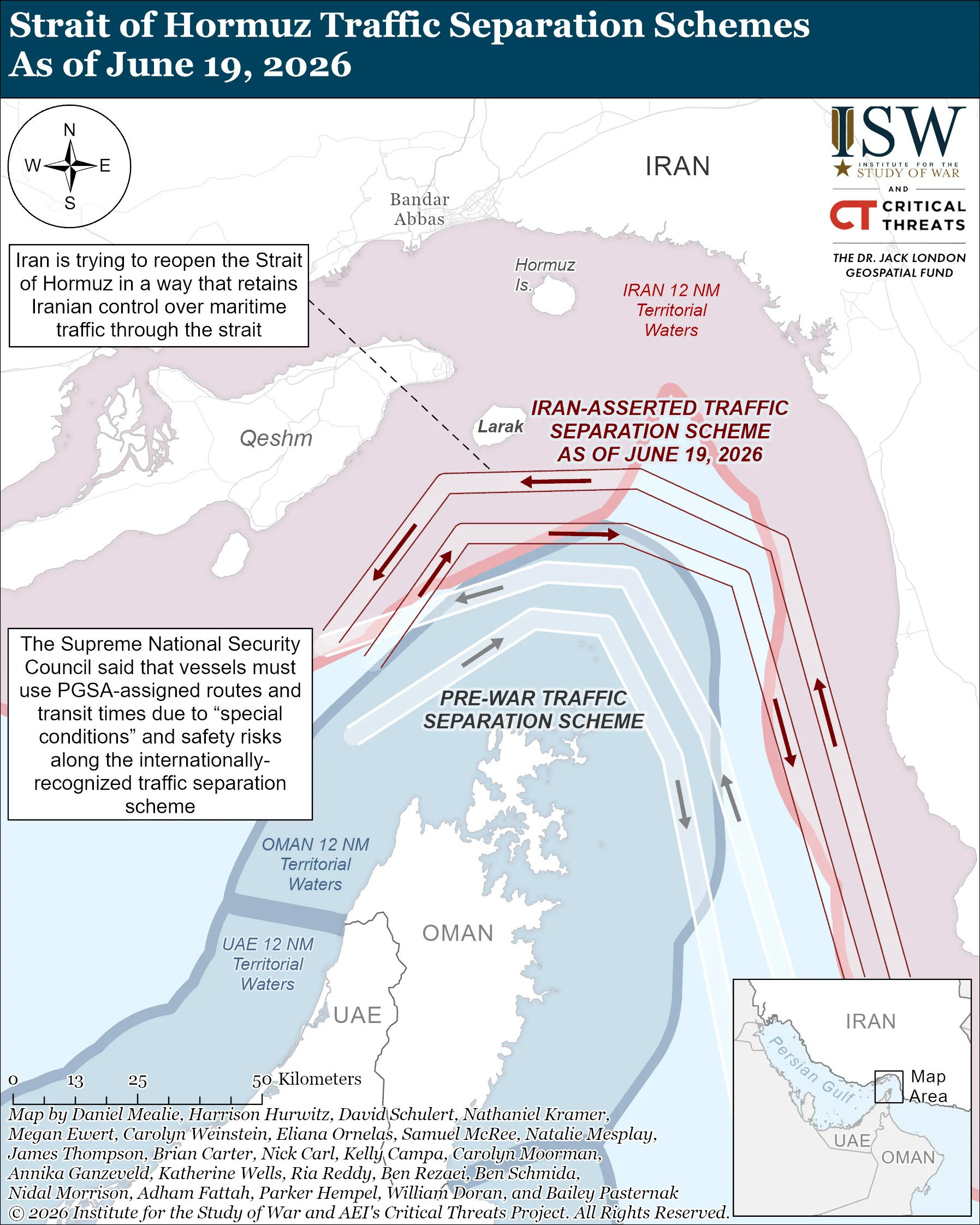
Some elements of the Iranian regime have argued that Iran should close the Strait of Hormuz to extract further concessions from the US, such as securing an end to Israeli operations in Lebanon and an Israeli withdrawal. Iran retains the ability to use the Strait of Hormuz as a tool to secure concessions and advance its strategic objectives under the current MoU. Islamic Revolutionary Guards Corps (IRGC)-affiliated Tasnim News Agency argued on June 19 that the Strait of Hormuz must remain closed and future negotiations must be canceled until Israel stops operations in Lebanon and withdraws from Lebanese territory.[21] IRGC-affiliated Fars News similarly argued on June 19 that Iran should cancel negotiations with the United States as a first step and then close the Strait of Hormuz as a second step to force the United States to “contain” Israel.[22] The Iranian regime's English-language media outlet, Press TV, described Iranian control over the Strait of Hormuz as Iran's “permanent strategic leverage” and argued that Iran can use nuclear negotiations to secure Israel's withdrawal from Lebanon, the release of Iranian frozen assets, and other US commitments.[23]
The IRGC has formed multiple Iraqi militia cells that directly report to the IRGC, instead of pre-existing Iranian-backed Iraqi militias, in order to conduct attacks on Gulf countries hosting US forces, according to eight Iraqi sources speaking to Reuters on June 19.[24] The sources included two Iraqi military officials, a security official, and five local militia commanders.[25] Three of the sources said that three or four of these new cells, each containing around 10 “elite” Iraqi Shia fighters, launched at least seven drone attacks targeting the Gulf countries between April 20 and May 17 from desert areas in southern Iraq.[26] The sources said that these attacks included three attacks targeting Kuwait, two targeting the United Arab Emirates (UAE), and two targeting Saudi Arabia.[27] The IRGC-directed militia cells targeted Kuwait's Ali al Salem Airbase and a military terminal at Kuwait's international airport.[28] The UAE and Saudi Arabia reportedly intercepted all of the attacks launched by IRGC-directed militia cells at their territory. ISW-CTP assessed in mid-April that Iranian-backed Iraqi militias were likely responsible for some of the drone strikes against the Gulf states.[29] The IRGC-directed militia attacks against the Gulf states were probably intended, in part, to further Iran's efforts to drive a wedge between the Gulf states and the United States. Iranian-backed Iraqi militias conducted up to half of the roughly 1,000 drone attacks targeting Saudi Arabia during the war, according to an unnamed source speaking to the Wall Street Journal on April 21.[30]
The new militia cells reportedly contain multiple Islamic Resistance in Iraq members who operate outside of this coalition's command structure and directly report to the IRGC.[31] This engagement represents a deviation from the IRGC’s historical pattern of engagement with Iraqi militias. The five local militia commanders told Reuters that Iran's establishment of these cells reflects a shift in the IRGC’s tactics and is aimed at projecting Iranian force across the region.[32] The IRGC Quds Force has typically directly worked with Iraqi militia leaders and commanders, not cells of fighters who don't report to an Iraqi militia.[33] Iran's established Iraqi partners conducted numerous attacks on US and foreign targets in Iraq and the region, including the Gulf countries, during the war.[34] Unspecified Iraqi sources told Saudi media in April that IRGC Quds Force officers “constantly” supervised militia attacks, helped militias develop ammunition for drones, and provided militias with technical expertise regarding missiles.[35] One source added that IRGC officers provided daily target lists to Iraqi militias that recommended the timing and amount of ammunition to use for attacks.[36]
Iran reportedly formed these new militia cells to deflect responsibility for attacks from established militias amid increased US pressure on the Iraqi federal government to disarm Iraqi militias. The Iraqi sources told Reuters that the IRGC created the cells to maintain plausible deniability, deflect blame from established Iranian-backed Iraqi militias, and reduce US pressure on the Iraqi federal government to disarm the militias.[37] The United States has increased pressure on the Iraqi federal government in recent months to disarm the militias. The US Treasury Department halted shipments of Iraq's oil revenue held in the US Federal Reserve during the war due to militia attacks against US forces.[38] The United States has also seemingly conditioned economic support for Prime Minister Ali al Zaydi’s government on its ability to disarm the militias and dismantle their financial networks.[39] The Iraqi federal government has taken initial steps towards restricting arms to the state in recent weeks, including by forming a joint disarmament committee.[40] The PMF is an Iraqi state security service that includes many Iranian-backed Iraqi militias, such as Asaib Ahl al Haq and Kataib al Imam Ali, that answer to Iran instead of the Iraqi prime minister.[41] Asaib Ahl al Haq and Kataib al Imam Ali have both recently indicated their willingness to disarm.[42]
It is also possible that Iran formed these new militia cells as part of an initial effort to build a new, loyal cadre of ideological militias over which Iran has strong control and would supplement the political activity of existing Iranian-backed Iraqi actors. A retired Iraqi army general told Reuters that the new cells appear “smaller, more ideologically hardened, and more tightly controlled.”[43] Iraq analysts Michael Knights and Crispen Smith also noted in a May 2026 report that there is a growing trend of the IRGC Quds Force directly running Iraqi militia cells composed of militia members from different groups.[44] Iran has previously established splinter groups from previous organizations to ensure loyalty to Iran.[45] Iran helped split Kataib Hezbollah and Asaib Ahl al Haq from Iraqi Shia nationalist cleric Muqtada al Sadr's Jaysh al Mahdi after 2006, as Jaysh al Mahdi became less responsive to Iranian control, for example.[46] UK-based Amwaj media reported in November 2025 that Iran has encouraged unspecified Iranian-backed Iraqi militias to shift their focus from armed resistance to political engagement.[47] An Iranian-backed Iraqi militia source told Amwaj media that Iran would consider supporting and had provided funding to smaller Iraqi militias that are not affiliated with the PMF, and thus fully outside of state structures and control.[48] Unspecified informed sources told Iraqi media on May 5 that IRGC Quds Force Commander Brigadier General Esmail Ghaani has similarly suggested that multiple Iraqi militias, including Kataib Hezbollah, Harakat Hezbollah al Nujaba, and Kataib Sayyid al Shuhada, end their kinetic activity in exchange for maintaining the PMF’s role within the Iraqi state.[49] These specific militias have repeatedly refused to disarm, however.[50]
An unspecified senior Iranian military official highlighted the effectiveness of Iranian ballistic missiles equipped with cluster munition warheads during the recent war in an interview with Iranian media, which highlights how Iran will use this and other lessons it learned during the war to inform its future military planning.[51] The official stated in an interview with regime outlet Nour News that Iran employed several types of drone and missile systems during the conflict, and specifically highlighted the use of ballistic missiles equipped with cluster munitions.[52] The official argued that military success depends on Iran's ability to sustain pressure on US and Israeli air defense systems and that ballistic missiles equipped with cluster munitions can “saturate [air] defense systems.” Iran launched numerous missiles equipped with cluster munitions at Israel during the conflict.[53] A single Iranian cluster-munition warhead created more than 30 separate impact sites in one instance.[54] ISW-CTP previously assessed that Iran likely opted to use cluster munitions because they are harder to intercept and cause extensive damage in a general area.[55] Iranian leaders also likely recognized that they could not reliably generate the mass needed to defeat Israeli air defenses and destroy discrete military targets with regular missiles.[56]
An Iraqi Ministry of Defense (MoD) official appeared to confirm that some weapons that the Iraqi federal government will receive as part of its efforts to restrict arms to the state could be supplied to the Iranian-backed Popular Mobilization Forces (PMF).[57] The PMF is an Iraqi state security service that includes many Iranian-backed Iraqi militias. MoD Director of Media and Moral Guidance Major General Tahsin al Khafaji told the Iraqi News Agency on June 18 that the federal government's process for restricting arms to the state includes administrative and armament components.[58] The administrative components include determining positions within the Iraqi security establishment to grant to, presumably, militia members who disarm.[59] The Shia Coordination Framework reportedly approved Iraqi Prime Minister Ali al Zaydi’s recent plan to offer 35,000 jobs within Iraq's security establishment to militia members willing to disarm.[60] Khafaji said the armament component involves receiving and distributing light, medium, and heavy weapons to the MoD, the Ministry of Interior, and potentially other “addresses operating within the framework” of the prime minister, which presumably refers to the PMF.[61] Iranian-backed Iraqi militias within the PMF answer, on paper, to the prime minister but, in reality, follow Iranian direction.[62]
https://understandingwar.org/research/middle-east/iran-update-special-report-june-19-2026/