Skip to comments.
Iranian Regime tv Channel One hacked while it was airing Khamenie speech
various
| 10-8-22
Posted on 10/08/2022 1:05:38 PM PDT by nuconvert
Iranian Regime national tv Channel One hacked about an hour ago. During a broadcast of Khamenie speech, a red crosshair appeared over his face and chanting of Women. Life. Freedom. There was writing to the side saying "Rise up. Join us". Also 4 photos at the bottom of the screen of young people killed and additional writing: "The blood of our youth is dropping from your paws".
Also, there was a huge banner in the middle of Tehran highway today that read: We are no longer afraid of you. We will fight.
Also, attempted attack on IRI ambassador in Denmark. Her bodyguard was stabbed. Diplomatic Security intervened before the attacker could stab the ambassador.
TOPICS:
KEYWORDS: basij; deathtothemullahs; denmark; ebrahimrigi; erdogan; iran; iranprotests; iraq; irgc; iri; israel; khameini; khamenei; kurdistan; lebanon; mahsaamini; mullahloversonfr; mullahsmustbekilled; najisharifizindashti; protests; qudsforce; raisi; receptayyiperdogan; shahrammaroufmola; syria; turkey; yemen; zahedi
Navigation: use the links below to view more comments.
first previous 1-20 ... 2,101-2,120, 2,121-2,140, 2,141-2,160 ... 2,401-2,406 next last
Iran Update Special Report, June 3, 2026
Iran and Hezbollah are continuing to try to transform negotiations about ending the war over the Strait of Hormuz into negotiations about ending the war in Lebanon, which Iran and Hezbollah seek to end in Israel's capitulation. US President Donald Trump announced on June 1 a partial ceasefire between Israel and Hezbollah in which Israel would not attack Hezbollah targets in Beirut and Hezbollah would halt attacks against Israel.[1] Israeli Prime Minister Benjamin Netanyahu subsequently announced that Israel would attack Hezbollah targets in Beirut if Hezbollah continued to attack Israel, suggesting that he agreed not to strike Beirut if Hezbollah ceased attacks on Israel.[2] The Lebanese Embassy in Washington claimed on June 1 that Hezbollah had agreed to cease attacks on northern Israel.[3] Hezbollah officials claimed after Trump's announcement that the group would not adhere to a partial ceasefire, however.[4] Hezbollah conducted rocket attacks targeting the Israel Defense Forces (IDF) in northern Israel on June 3 for the first time since June 1.[5] Hezbollah claimed that it fired rockets targeting IDF soldiers near the Israel-Lebanon border on June 3, several hours after the IDF conducted an airstrike targeting a vehicle in Khalde, eight miles south of Beirut.[6] Israeli Ambassador to the United States Yechiel Leiter called Hezbollah's June 3 attack a violation of the partial ceasefire and suggested that Israel could respond by attacking Hezbollah targets in Beirut.[7] An Israeli military correspondent reported on June 3 that Netanyahu is set to meet with senior Israeli officials to determine Israel's response to Hezbollah's attack.[8]
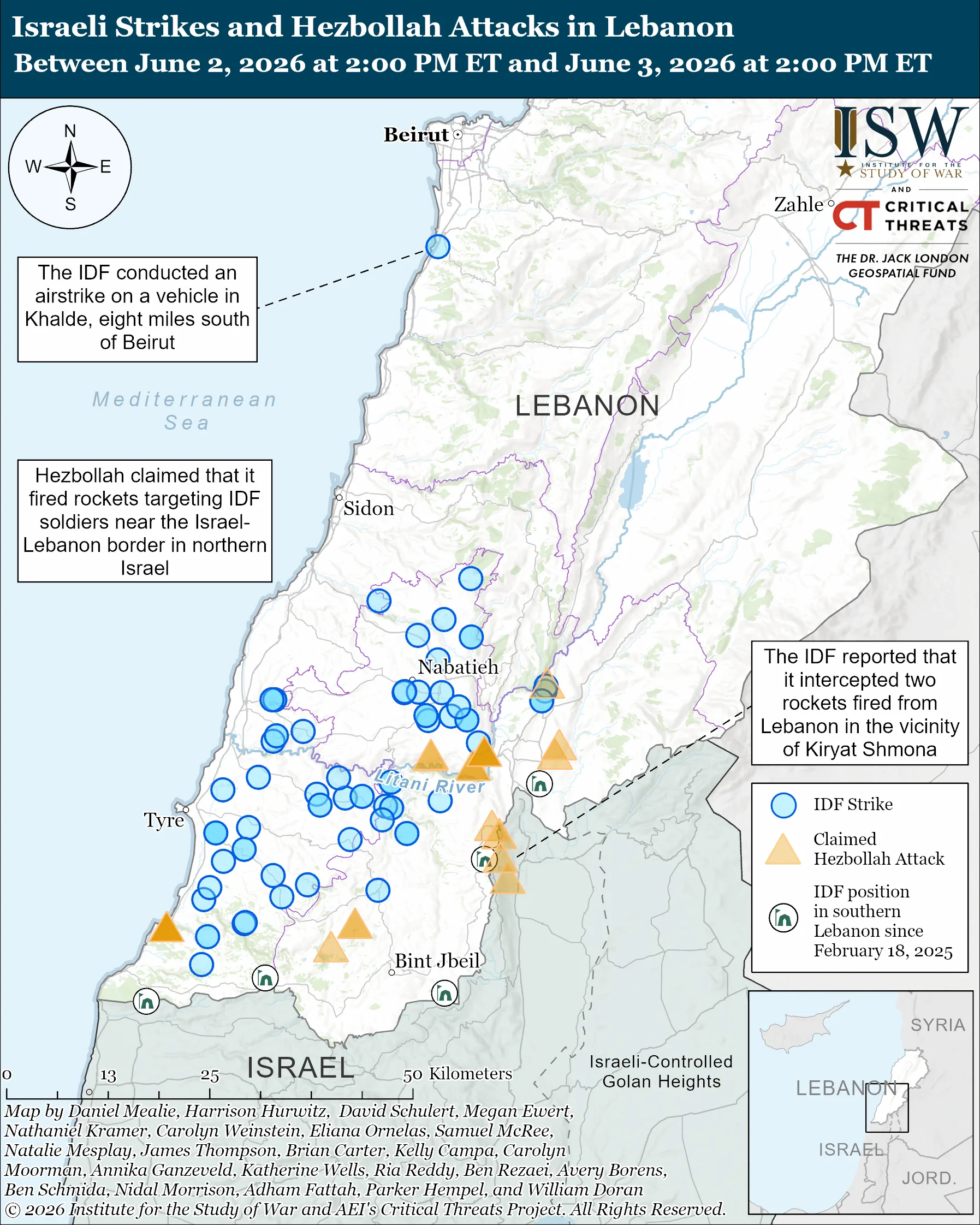
Senior Hezbollah officials have continued to demand a complete ceasefire and the withdrawal of Israeli forces from Lebanon. Hezbollah Political Council member Mahmoud Qamati told Western media that Hezbollah will not accept a partial ceasefire and later said that “there was no ceasefire agreement.”[9] Hezbollah officials have demanded that the IDF cease all military operations in Lebanon and fully withdraw from southern Lebanon and claimed that the group will make “whatever sacrifices are required” to expel Israeli forces from southern Lebanon.[10] A Hezbollah parliamentarian said on June 2 that one of Hezbollah's primary objectives is to obtain a timeframe for a full Israeli withdrawal from Lebanon.[11] These positions are consistent with Hezbollah Secretary General Naim Qassem’s demands that the IDF halt all operations against Hezbollah and withdraw from Lebanon.[12]
Iranian officials have echoed Hezbollah's maximalist demands for a complete ceasefire in Lebanon and withdrawal of Israeli forces from Lebanon as part of Iran's effort to create a protracted discussion about the Lebanon issue and thereby deflect attention from negotiations about the Strait of Hormuz and other key points of disagreement. Iranian Foreign Affairs Minister Abbas Araghchi told Hezbollah-affiliated media on June 3 that Iran and Lebanon are “linked” and that conflict with the United States and Israel will not end unless Israeli forces withdraw from southern Lebanon.[13] Iranian Parliamentary National Security and Foreign Policy Commission Chairman Ebrahim Azizi told Hezbollah officials on June 3 that ending the war with the United States and Israel on all fronts, “especially in Lebanon,” is at the “forefront” of Iran's ceasefire agreement with the United States.[14] Islamic Revolutionary Guards Corps (IRGC)-affiliated media outlet Tasnim News Agency argued on June 3 that there must be a complete ceasefire between Hezbollah and Israel and a complete withdrawal of Israeli forces from Lebanon. The outlet also highlighted how Iran can use Hezbollah to deter and preserve its leverage against Israel and the United States.[15] A political analyst close to the regime also noted on June 3 that the preservation of Hezbollah is “a geopolitical, strategic, and national security imperative for Iran.”[16]
The Iranian regime also likely calculates that it can preserve its leverage on other issues in negotiations with the United States, such as its nuclear program and control of the Strait of Hormuz, by deflecting talks to the war in Lebanon. The US-sanctioned Persian Gulf Strait Authority (PGSA) continued to post data on June 3 about ships requesting Iranian permission to pass through the strait.[17] Tasnim News Agency argued on June 3 that the PGSA’s reports “show the stabilization of Iranian sovereignty over the strait.” This comment is consistent with ISW-CTP’s assessment that Iran is using the ceasefire period to try to normalize Iranian control over the Strait of Hormuz.[18] Tasnim also stated that the Iranian regime is prioritizing achieving sovereignty over the strait over collecting tolls from vessels that transit through Iran's illegal traffic separation scheme. ISW-CTP assessed on May 14 that Iran may be prioritizing upholding the “legitimacy” of its claims to the Strait of Hormuz over toll collection.[19] These comments reflect how Iranian decision-makers are using the current situation to try to solidify de facto Iranian control over the Strait of Hormuz. A protracted discussion about Lebanon also deflects from negotiations over Iran's highly enriched uranium stockpile and ability to enrich uranium on Iranian territory, which Iranian decision-makers have refused to make concessions on.
The Iranian regime is trying to impose costs on the United States for continuing to enforce its blockade while also trying to strain Gulf states’ relations with the United States. US Central Command (CENTCOM) stated on June 2 that US naval forces disabled an Iranian-affiliated tanker, the Botswana-flagged M/T Lexie, that was transiting toward Iran's Kharg Island in violation of the US blockade.[20] Iranian forces then launched attack drones at civilian ships trying to transit the Persian Gulf. US forces intercepted three of the drones.[21] The IRGC also claimed that it launched anti-ship missiles at the Liberia-flagged MSC Panaya, which it claimed belongs to the United States and Israel.[22] US forces subsequently conducted self-defense strikes against drone ground control stations on Qeshm Island in the Strait of Hormuz.[23] Iranian forces then retaliated by firing ballistic missiles and drones at US bases in Kuwait and Bahrain.[24] The Kuwaiti Defense Ministry stated on June 3 that Kuwaiti forces intercepted 13 ballistic missiles and 17 drones.[25] Two Iranian missiles hit Kuwait International Airport, however, killing one person, injuring at least 63 others, and causing significant damage.[26] US and Bahraini air defenses also intercepted three ballistic missiles, one of which targeted the US Fifth Fleet Headquarters in Manama.[27] The Iranian regime's English-language media outlet, Press TV, claimed that Iran's attacks sent a message to Gulf countries that their “territory is not safe” if they continue to host US forces.[28] This comment reflects Iran's efforts to drive a wedge between the Gulf states and the United States by threatening to attack the Gulf states if they cooperate with the United States. Iran's efforts to sow divisions between the Gulf states and the United States are part of Iran's broader strategic objective to expel the United States from the Middle East.
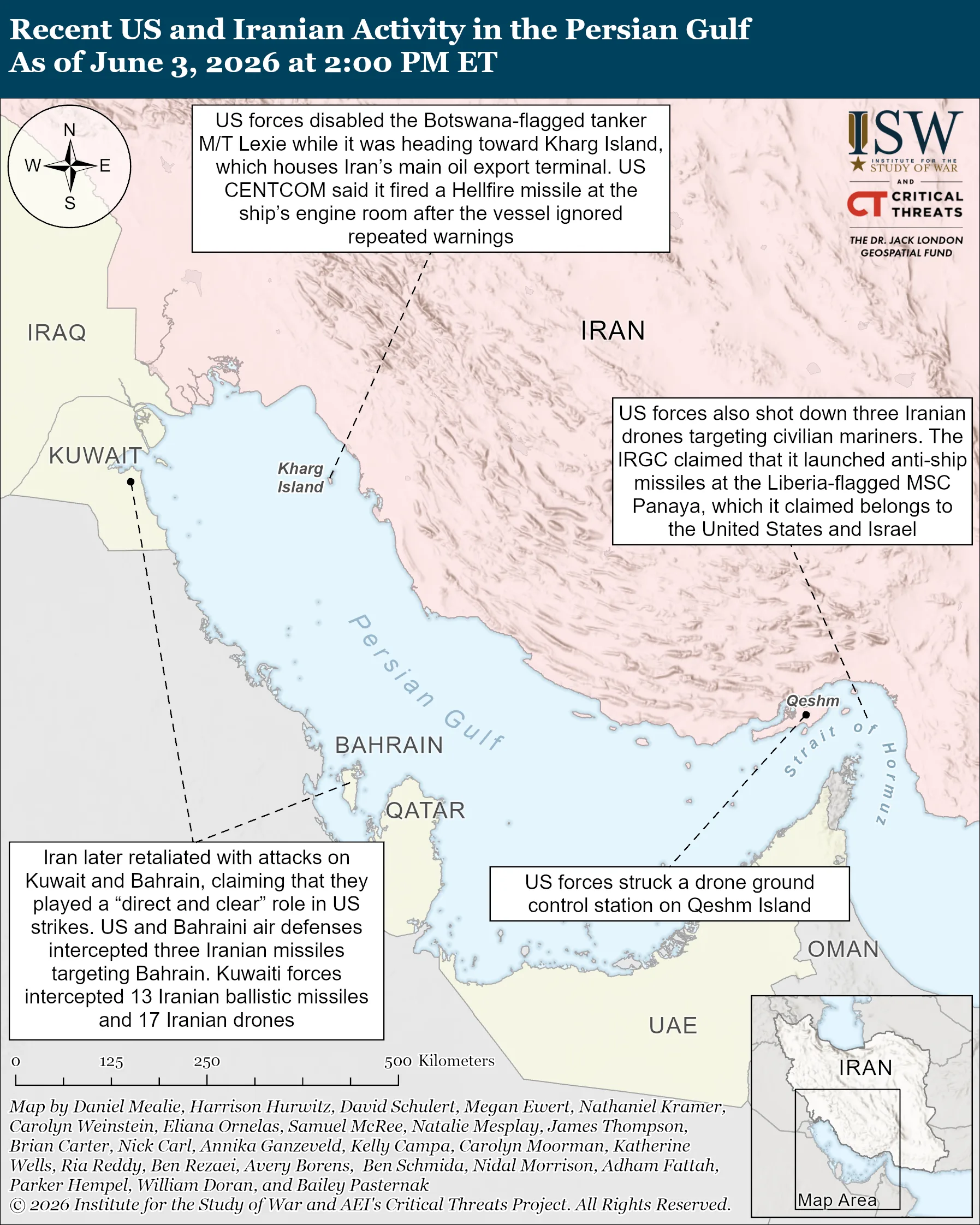
Iranian officials and media responded to these attacks with further threats, probably to try to deter the United States from enforcing its blockade on Iranian ports. Iranian Supreme Leader Mojtaba Khamenei’s military adviser, Mohsen Rezaei, stated on X on June 3 that Iran will not allow the United States to make “excessive demands” in negotiations and will respond to any US military action with a “barrage of missiles and drones.”[29] Press TV also argued that Iran will intensify its responses to US military action to deter the United States from taking such action.[30]
Iranian Parliament Speaker and Iran's Special Representative for the People's Republic of China (PRC) Affairs, Mohammad Bagher Ghalibaf, appears to be performing an executive-level role in Iran's economic and foreign policy. Ghalibaf convened the Iranian Central Bank governor, Planning and Budget Organization head, and oil, economy, and industry ministers on June 3 to coordinate Iran's economic policy toward the PRC.[31] This meeting marks the first meeting that Ghalibaf has convened as Iran's special representative for PRC affairs since Supreme Leader Mojtaba Khamenei appointed him to this position on May 17.[32] The meeting was unusual because parliament speakers in Iran do not normally convene government officials to coordinate and implement foreign economic policy. IRGC-affiliated Tasnim News Agency previously emphasized on May 17 that Ghalibaf’s new role carries a different “level of authority” than previous PRC-related representative roles.[33] The meeting to discuss Iran's economic policy toward the PRC also highlights how Ghalibaf seeks to deepen cooperation with US adversaries such as the PRC.
Ghalibaf’s meeting notably comes as President Masoud Pezeshkian appears to have been sidelined in the regime. Anti-regime media reported on May 31 that Pezeshkian recently submitted his resignation letter to Supreme Leader Mojtaba Khamenei due to IRGC officials’ growing dominance in the regime.[34] ISW-CTP continues to assess that IRGC Commander Major General Ahmad Vahidi and his inner circle are dominating regime decision-making and have gained the upper hand over Ghalibaf.[35] The fact that Ghalibaf appears to be playing an executive-level role does not mean that Ghalibaf holds the same influence over regime decision-making that Vahidi does.
Eighty-five Iranian parliamentarians implicitly called for the development of intercontinental ballistic missile (ICBM) capabilities in a letter to Supreme Leader Mojtaba Khamenei on May 31.[36] The parliamentarians stated that Parliament will support Iran's military forces and defense industry until Iranian missiles can reach the United States.[37] Iran's known longest-range missiles are the Emad, Sejjil, and Shahab-3, which have a reported range of 2,000 kilometers.[38] Iran attempted to launch two ballistic missiles targeting Diego Garcia in March 2026, which is approximately 3,700 kilometers from Iran's southern border, marking the furthest ever attempted Iranian missile strike.[39] One of the missiles failed in flight, while US forces intercepted the other.[40]
The United States continues to apply economic pressure on the Iranian regime by isolating the regime from international markets. The US Treasury Department sanctioned four major Iranian cryptocurrency exchanges and their leadership on June 2 for facilitating Iranian sanctions evasion.[41] The US Justice Department separately announced on June 3 that US law enforcement arrested a dual US-Iranian national and CEO of an Iran-based tech firm for evading US sanctions for more than a decade by covertly purchasing and exporting US-origin networking and encryption equipment to Iranian nuclear and military entities.[42] The CEO reportedly laundered over $15 million USD through international intermediaries.[43]
Hezbollah has continued to use first-person view (FPV) drones equipped with thermal cameras to conduct nighttime attacks targeting Israeli forces in southern Lebanon, likely in response to the IDF ground forces’ own tactical adjustments to operate at night to avoid Hezbollah FPV drone reconnaissance and attacks. Hezbollah posted footage from several FPV drones using thermal cameras to identify and strike Israeli positions at night on June 1 and 2.[44] Hezbollah has likely begun equipping FPV drones with thermal cameras for nighttime attacks on Israeli forces since at least May 23.[45] Hezbollah has primarily conducted nighttime FPV drone attacks on Israeli forces advancing north of the Litani River in recent days.[46] Hezbollah is also likely using FPV drones at night to degrade Israeli forces’ morale and maximize psychological distress, as these capabilities increase the risk of more frequent and unpredictable attacks.[47] Hezbollah may have posted footage of its nighttime FPV attacks to increase fear among the Israeli public and generate popular domestic pressure on Israeli political leaders to end the IDF’s campaign in Lebanon as well.[48]
https://understandingwar.org/research/middle-east/iran-update-special-report-june-3-2026/
2,121
posted on
06/03/2026 10:11:46 PM PDT
by
AdmSmith
(GCTGATATGTCTATGATTACTCAT)
🚨🇰🇼 🇮🇷 CCTV footage now shows the moment a terminal at Kuwait International Airport was hit, with an Iranian Shahed-136 kamikaze drone slamming into Terminal 1.
The IRGC denied responsibility for the airport damage and tried to pin it on a malfunctioning Patriot interceptor. Cameras catching a Shahed flying into the building makes that excuse very hard to sustain. Source: Tabz on TG
https://x.com/MarioNawfal/status/2062295248391250203
🚨🇰🇼 A Shahed-136 piston engine has reportedly been recovered from the wreckage at Kuwait International Airport, physical proof that an Iranian drone hit the terminal.
The IRGC claimed the airport damage came from a malfunctioning American Patriot, but you do not find a Shahed engine in the debris of a Patriot failure. Between the CCTV footage of the drone flying into Terminal 1 and now the hardware pulled from the scene, the evidence runs one direction. Source: Middle East Spectator on TG

https://x.com/MarioNawfal/status/2062345473185231185
2,122
posted on
06/03/2026 10:35:29 PM PDT
by
AdmSmith
(GCTGATATGTCTATGATTACTCAT)
2,123
posted on
06/04/2026 6:05:48 AM PDT
by
AdmSmith
(GCTGATATGTCTATGATTACTCAT)
To: nuconvert
Citizens in Karaj, west of Tehran, have put up “missing person” notices for Iran’s new supreme leader, Mojtaba Khamenei, as he remains out of public view more than three months after being injured in an airstrike that killed his father, according to a video sent to Iran International.
https://x.com/IranIntl_En/status/2062596412865483208
1 min video
2,124
posted on
06/04/2026 11:59:52 AM PDT
by
AdmSmith
(GCTGATATGTCTATGATTACTCAT)
To: AdmSmith
2,125
posted on
06/04/2026 3:58:34 PM PDT
by
nuconvert
( Warning: Accused of being a radical militarist. Approach with caution.)
Iran Update Special Report, June 4, 2026
Hezbollah and Iranian leaders continue to reject any ceasefire framework in Lebanon that does not meet their maximalist demand for total Israeli capitulation in Lebanon. Hezbollah and Iran's insistence on this demand is part of an effort to defer negotiations about key points of disagreement between Iran and the United States, particularly Iranian efforts to control the Strait of Hormuz, and strengthen Iran's negotiating position vis-à-vis the United States. The United States, Israel, and Lebanon issued a joint statement on June 3 agreeing to implement a ceasefire contingent upon Hezbollah's agreement to halt all attacks and evacuate its fighters south of the Litani River.[1] The joint statement indicates that Israel, Lebanon, and the United States seek to develop a framework to achieve their respective long-term objectives in Lebanon.[2] The statement announced that Israel and Lebanon would coordinate to establish “pilot zones” in southern Lebanon. The Lebanese Armed Forces (LAF) would deploy to these zones “to the exclusion of all non-state actors.”[3] The Lebanese government confirmed that the LAF has begun deploying to southern Lebanese territory that the Israel Defense Forces (IDF) seized during ground operations against Hezbollah.[4] Lebanese President Joseph Aoun called the joint statement the “last opportunity” to obtain “a final and comprehensive ceasefire” in Lebanon on June 4.[5] Israeli Ambassador to the United States Yechiel Leiter separately said on June 4 that a ceasefire in Lebanon would be contingent upon Hezbollah's “complete dismantling.”[6] Hezbollah rejected the joint statement's condition that the group cease attacks and withdraw to north of the Litani River.[7] Hezbollah Secretary General Naim Qassem said on June 4 that Hezbollah's accession to the joint statement would constitute surrender and instead reiterated the group's long-standing demands for a “comprehensive ceasefire” that would require Israel to cease all military operations and withdraw from Lebanon.[8] Qassem indicated that Hezbollah will continue its attacks until Israel accedes to the group's demands.[9] These demands constitute total Israeli capitulation in Lebanon because agreeing to them would force Israel to abandon its core political objective for operations in Lebanon, which is to dismantle Hezbollah as a militant group.[10]
Hezbollah and Iranian leaders are unified in viewing Israeli capitulation in Lebanon as inextricable from Iranian negotiations with the United States. Qassem acknowledged Iran's role in pushing for a complete ceasefire in Lebanon and noted that Iran's push for a complete ceasefire is an “integral part” of Iran's own efforts against the United States.[11] Islamic Revolutionary Guards Corps (IRGC) Quds Force Commander Brigadier General Esmail Ghaani also called for a full ceasefire in Lebanon and complete withdrawal of Israeli forces from Lebanon on June 4.[12] The IRGC similarly stated on June 4 that a ceasefire on “all fronts” was Iran's “initial condition” for the US-Iran ceasefire, which went into effect in early April.[13] Senior Iranian officials, including former IRGC Commander and current IRGC Baghiyatollah Sociocultural Headquarters Commander Major General Mohammad Ali Jafari, previously described a ceasefire in Lebanon as a precondition for negotiations with the United States.[14] Iranian officials have re-emphasized this issue in recent days amid the deadlock in US-Iran negotiations over Iran's nuclear program and the status of the Strait of Hormuz, however.[15]
Iranian officials have continued to emphasize the Lebanon issue in order to try to deflect focus away from key points of disagreement in the US-Iran negotiations, particularly the Strait of Hormuz and Iran's nuclear program, which the regime seeks to avoid making concessions on. The United States and Iran do not currently appear to be discussing Iran's nuclear program, given that Iran suspended negotiations until a complete ceasefire in Lebanon is reached.[16] ISW-CTP previously noted that a protracted discussion about Lebanon deflects from negotiations over Iran's highly enriched uranium stockpile and ability to enrich uranium. Iranian officials and media have also not commented on US demands regarding Iran's nuclear program in recent days. Iranian officials and media continue to insist that Iran will not cede control of the Strait of Hormuz, however. A newspaper published on the Supreme Leader's website, Voice of Iran, published an op-ed on June 2 claiming that Iran has the “winning cards” in negotiations over the strait and that the status of the strait will not return to pre-war conditions.[17] This comment reflects how the Iranian regime does not solely seek to survive this war and return to the pre-war status quo; the regime has positive objectives that it seeks to achieve, including securing Iranian sovereignty over the strait.[18]
Iran has continued to try to justify its control over the Strait of Hormuz by attempting to give its illegal actions in the strait a veneer of legality. Iranian Deputy Foreign Affairs Minister for Legal and International Affairs Kazem Gharibabadi claimed that Iran is complying with the UN Convention on the Law of the Sea (UNCLOS) because Iran is offering “services” and “protection” to vessels in Iranian waters in an interview with Iranian media on June 4.[19] The “protection” that Iran is “offering” vessels is protection from Iranian attacks, which means that Iran has effectively established a protection racket in the strait. Iran has repeatedly used force, including attacks on commercial vessels and naval mines, to make vessels sail through Iranian territorial waters. Iranian officials then claim that Iran has the right to extract a fee from these vessels.[20]
Iran also continues to demand other preconditions for negotiations, such as immediate economic relief upon the signing of any US-Iran memorandum of understanding (MOU). ISW-CTP previously assessed that, even if Iran's maximalist demands in Lebanon are met, Iran could condition further negotiations with the United States on additional US concessions.[21] Gharibabadi told Iranian media on June 4 that Iran still seeks the immediate release of at least half of its frozen assets upon the signing of an MoU and the second half in the subsequent negotiating period in his interview with Iranian media on June 4.[22]
Iran additionally continues to seek to erode US regional influence by trying to strain relations between the United States and the Gulf countries. Supreme Leader Mojtaba Khamenei claimed on June 4 that the war has caused a “tangible divergence of countries from” the United States, possibly in reference to the Gulf states.[23] Mojtaba previously claimed in late April that US bases in the region cannot defend the United States’ Gulf partners, also likely as part of an effort to sow divisions between the United States and its Gulf partners and push Gulf countries to expel US forces from their territory.[24] Iran has continued to launch missile and drone attacks targeting the Gulf states following the ceasefire in April, most recently Kuwait and Bahrain on June 2.[25]
The Iraqi federal government has begun to try to restrict arms to the state through the disarmament and integration of Iranian-backed Iraqi militias into the Iraqi security establishment, including the Iranian-backed Popular Mobilization Forces (PMF). The PMF is an Iraqi state security service that includes many Iranian-backed Iraqi militias that answer to Iran instead of the Iraqi prime minister.[26] Iraqi Shia nationalist cleric Muqtada al Sadr's “deputy for jihad affairs” formally handed over the flag of Sadr's militia, Saraya al Salam, to representatives of the federal government's committee in charge of restricting arms to the state on June 4.[27] Sadr announced on May 27 the dissolution of Saraya al Salam and the “full integration” of the militia's members into the Iraqi state.[28] The Iraqi Joint Operations Command deputy commander, who heads the federal government's disarmament committee, said that the “mechanism” linking Saraya al Salam to the PMF will be abolished and that the militia will be “directly linked” to the prime minister, presumably after it is integrated into the PMF.[29] Saraya al Salam controls the 313th, 314th, and 315th PMF brigades.[30] The federal government committee also includes representatives from the defense and interior ministries and the PMF and is responsible for developing “mechanisms, technical contexts, and arrangements related to weapons and restructuring, leading to [the] full integration” of militia members into the Iraqi security establishment.[31] Iraqi Prime Minister Ali al Zaydi’s spokesperson said on June 3 that the government's efforts to restrict arms to the state apply to all armed groups operating outside of the PMF.[32] A Shia Coordination Framework member also said on June 3 that the federal government has formed joint committees with militias to develop inventories of militia weapons and supervise the handover of operations to the PMF.[33] Zaydi held separate meetings with delegations from Asaib Ahl al Haq and Kataib al Imam Ali on June 3 to discuss disarmament.[34] Both militias announced their readiness to restrict arms to the state on June 2.[35]
Zaydi is also reportedly pursuing a plan, approved by unidentified framework leaders, in which disarmed militia members would integrate into other Iraqi security institutions, such as the Counter Terrorism Service (CTS).[36] Informed sources told Iraqi media on June 4 that Zaydi presented US officials with a proposal to gradually disarm Iranian-backed Iraqi militias in exchange for US investment in Iraq.[37] Zaydi’s plan reportedly includes granting jobs in formal security institutions, including CTS, to 35,000 militia members who disarm.[38] Saraya al Salam members would fill 15,000 of these positions, according to the informed sources.[39] Unidentified framework leaders reportedly approved this plan and agreed that officials from the defense and interior ministries would be “involved” in overseeing the federal government's disarmament efforts.[40] The framework is a loose coalition of Iraqi Shia political parties, some of which Iran backs, and it is unclear which specific elements of the framework supported this plan. Asaib Ahl al Haq head Qais al Khazali and Kataib al Imam Ali head Shibl al Zaidi, who are both framework members, almost certainly supported the plan, however. The informed sources added to Iraqi media that the political wings of multiple Iraqi militias have threatened to leave the framework and boycott the Iraqi political process if the framework proceeds with US pressure to disarm the militias and dissolve or integrate the PMF.[41]
Multiple Iranian-backed Iraqi militias, including Kataib Hezbollah–whose political wing is part of the framework, continue to reject disarmament. A Harakat Hezbollah al Nujaba official said on June 3 that the Islamic Resistance in Iraq refuses to disarm.[42] The Islamic Resistance in Iraq, which is a coalition of Iranian-backed Iraqi militias, includes Harakat Hezbollah al Nujaba, Kataib Hezbollah, Kataib Sayyid al Shuhada, and Ansar Allah al Awfiya.[43] These militias have, both historically and during the war, been the most kinetically active and are more subordinate to Iran than other Iraqi militias.[44] Kataib Hezbollah said on June 4 that it would not disarm until foreign troops in Iraq, almost certainly in reference to US and Turkish forces, withdraw and foreign interference in Yemen ends.[45] Kataib Hezbollah added that it would only surrender its weapons to the “Imam Mahdi.”[46] The Imam Mahdi is the twelfth and final Imam in Shia Islam, who, according to Twelver Shia, is hiding and will reveal himself in the future.[47] Kataib Hezbollah also said that militias that have agreed to disarm have already severed their ties to Iran, stopped obeying Iran's orders, and stopped conducting attacks against the “adversary,” in reference to Asaib Ahl al Haq and Kataib al Imam Ali.[48] Iraq analysts have long noted that Asaib Ahl al Haq’s leadership, particularly its head Qais al Khazali, has focused more on politics than kinetic activity in recent years, including during the October 7 War.[49] Kataib Hezbollah and Harakat Hezbollah al Nujaba criticized Asaib Ahl al Haq in November 2023 for failing to conduct attacks against US forces in Iraq and Syria.[50] The US Treasury Department noted in April 2026, however, that Asaib Ahl al Haq fighters had conducted drone attacks targeting US and coalition forces in northern Iraq in March 2026.[51] Kataib Sayyid al Shuhada separately said on June 3 that it would not disarm until US forces leave Iraq.[52] Likely Kataib Sayyid al Shuhada front group Saraya Awliya al Dam conditioned its disarmament on the Iraqi federal government fulfilling a large list of demands that include ending all financial and economic dependence that “restricts Iraqi sovereignty” and securing modern air defense and radar systems.[53]
Any Iraqi federal government attempt to disarm the militias and integrate them into the Iraqi security establishment that does not address the militias’ networks and allegiance to Iran will likely further embed Iranian influence within the Iraqi state. Some Iraqi officials have discussed reorganizing militia forces within Iraqi security institutions but have not specified how they plan to do so.[54] Zaydi’s spokesperson said on June 3 that the government's effort to “disengage” militias from the PMF refers to “reorganizing these forces within the security institutions” in a way that preserves militia members’ rights and legal protections, for example.[55] It is unclear if the Iraqi federal government plans to integrate the militias into Iraqi security institutions as units or individuals. Militia-controlled PMF brigades could be reflagged as new units, which would largely retain the units’ composition, networks, and structure. Integrating the militias into the PMF or other Iraqi security institutions as reflagged units would further entrench the militias into the Iraqi state's security sector, which would enable deeper Iranian infiltration. Zaydi’s spokesperson also said that the first step toward restricting arms to the state is “realigning” the forces, likely in reference to Iranian-backed Iraqi militia members who operate outside of militia-controlled PMF brigades, and ensuring that the “forces” only respond to the prime minister.[56]
Failing to properly address the militias’ networks and loyalty to Iran during their disarmament and integration into the Iraqi security establishment would also likely pose a threat to the institutions that the militia members would reportedly join, assuming the details of Zaydi’s proposal are accurate. The replacement of most of CTS’s top leadership during former Prime Minister Mohammad Shia al Sudani’s administration has led to worsening corruption and militia infiltration of what most analysts consider to be Iraq's most effective security service.[57] The risk posed by militia infiltration of Iraq's security services is especially great, given the extent to which the United States funds the Iraqi security establishment.[58] CTS gave a Kataib Hezbollah-owned company $12 million USD in its 2023 budget, for example.[59]
The Badr Organization denied on June 3 that the framework and Badr Organization head Hadi al Ameri had formed a committee to restrict arms to the Iraqi state.[60] Iraqi and regional reporting noted in early May that the committee, which included Ameri, Zaydi, and Sudani, had been preparing a plan to disarm the militias.[61] Iraqi media previously reported that the framework chose Ameri for the committee because his ties to Iran were meant to “help build trust with the militias and persuade them to engage with the state.”[62] Badr has integrated itself into Iraqi state institutions to a greater extent than other Iranian-backed Iraqi militias since 2003.[63] Badr would likely face economic blowback to a greater extent than other militias if the United States imposed sanctions or other financial pressure on the Iraqi federal government over failing to address the militias, given the extent of Badr’s dealings with the Iraqi state. Ameri may have denied the committee's existence in response to backlash from more ideologically hardline elements of the Badr Organization.
https://understandingwar.org/research/middle-east/iran-update-special-report-june-4-2026/
2,126
posted on
06/04/2026 11:56:07 PM PDT
by
AdmSmith
(GCTGATATGTCTATGATTACTCAT)
The Many Revolutions That Almost Freed Iran
In a quietly devastating new book, two journalists chart the protest movements fighting for change inside the country.
STOLEN REVOLUTION: Betrayal and Hope in Modern Iran, by Yeganeh Torbati and Bozorgmehr Sharafedin
Before the bombs began falling on Iran earlier this year, the war was sold by its advocates as a possible catalyst for regime change — a final blow against a government already weakened by years of economic crisis and political unrest. To many outside observers, the Islamic Republic appeared vulnerable to collapse. Yet the coordinated bombing campaign by the United States and Israel has only strengthened the most hard-line elements of the Iranian state.
Those of us who have spent years studying modern Iran understood that this was always the more likely outcome. Again and again, moments that seemed poised to break the system instead became the conditions through which it adapted and endured. It is a recurring pattern that the New York Times journalist Yeganeh Torbati and the veteran Iran correspondent Bozorgmehr Sharafedin trace in “Stolen Revolution,” their deeply reported and quietly devastating account of half a century of upheaval in the country. The result is one of the most perceptive books on modern Iran in years, capturing not only the machinery of repression but the fragile forms of hope that survive beneath it.
https://www.nytimes.com/2026/06/02/books/review/stolen-revolutions-yeganeh-torbati-bozorgmehr-sharafedin.html
Stolen revolution: Betrayal and hope in modern Iran Brookings Institution
The Center for Middle East Policy at Brookings will host authors Torbati and Sharafedin to discuss the personal narratives spotlighted in “Stolen Revolution” and reflect on how the events of modern Iranian history have led to the current moment. The discussion will be moderated by Suzanne Maloney, Iran scholar and vice president and director of the Foreign Policy program at Brookings.
https://www.youtube.com/watch?v=F__yDj2auWs
2,127
posted on
06/05/2026 12:09:46 AM PDT
by
AdmSmith
(GCTGATATGTCTATGATTACTCAT)
Iran Update Special Report, June 5, 2026
Hezbollah and Iranian leaders continue to reject any ceasefire framework in Lebanon that does not meet their maximalist demand for total Israeli capitulation in Lebanon. Hezbollah officials and allies have continued to reiterate their maximalist demand for a complete ceasefire in Lebanon that would require Israel to cease all military operations and withdraw from Lebanon.[1] Lebanese Parliament Speaker and Hezbollah ally Nabih Berri stated on June 5 that he would agree to Hezbollah's withdrawal from southern Lebanon if Israeli troops withdrew from the territory they hold in Lebanon and Israel agreed to a “complete and comprehensive ceasefire without conditions.”[2] Berri stated that the June 3 US-Israel-Lebanon agreement is “unjust” and “unworthy of discussion,” which echoes Hezbollah's rejection of the agreement.[3] The United States, Israel, and Lebanon agreed on June 3 to implement a ceasefire in Lebanon contingent upon Hezbollah's agreement to halt all attacks and evacuate its fighters south of the Litani River. The Israel Defense Forces (IDF) would halt strikes targeting the group after Hezbollah ceased attacks against Israel and withdrew its forces from south of the Litani.[4] The US and Lebanese governments previously proposed on June 2 that a ceasefire between the IDF and Hezbollah would be geographically limited, with the IDF halting strikes against Beirut in exchange for Hezbollah halting all attacks on Israeli territory.[5] The June 3 agreement did not specify the geographic scope of the proposed ceasefire.[6] Hezbollah and Iranian officials have repeatedly insisted that an acceptable ceasefire must require Israel to halt attacks across Lebanon and withdraw from Lebanese territory.[7] Iranian Foreign Affairs Minister Abbas Araghchi told Hezbollah-affiliated media on June 3 that the IDF must withdraw from territories it has “occupied” in Lebanon as part of an end to the war.[8]
Hezbollah and Iran's maximalist demands seek to undermine US and Lebanese government efforts to end the conflict with Israel and restrict weapons to the Lebanese state. Hezbollah and Iran have repeatedly rejected ceasefire proposals mediated and supported by the United States and the Lebanese government, which has complicated ongoing US-mediated Israel-Lebanon negotiations.[9] Lebanese President Joseph Aoun and Prime Minister Nawaf Salam stated on June 5 that Iran is using Lebanon as a bargaining chip in US-Iran negotiations.[10] Salam emphasized that the conflict in Lebanon is “not being fought for us, but on our land and at the expense of our people.”[11] The June 3 US-Israel-Lebanon joint statement suggests that these parties seek to develop a framework to achieve their respective long-term objectives in Lebanon, including ending the conflict in Lebanon and disarming Hezbollah so that weapons are restricted to the Lebanese state.[12] Aoun stated that current Israel-Lebanon negotiations are “tough,” but that the most recent US-Israel-Lebanon joint statement could be a path forward for “lasting peace.”[13]
Iran and Hezbollah continue to link Israeli capitulation in Lebanon to US-Iran negotiations to try to delay discussions about key points of disagreement between the United States and Iran, particularly Iran's nuclear program and its efforts to control the Strait of Hormuz. Araghchi told Hezbollah-affiliated media on June 3 that the US-Iran war will not end until the war in Lebanon ends.[14] Supreme Leader Military Adviser Mohsen Rezaei similarly stated on June 5 that Lebanon is an “inseparable part” of any US-Iran agreement or ceasefire.[15] ISW-CTP previously assessed that Iran is likely trying to use prolonged discussions about a ceasefire in Lebanon to divert attention from negotiations over its nuclear program and activities in the Strait of Hormuz.[16] Iranian officials have repeatedly insisted that Iran will not negotiate on its nuclear program until the United States accepts an initial agreement that includes a complete ceasefire in Lebanon, among other Iranian preconditions.[17] These preconditions likely seek to reduce US leverage ahead of any future nuclear negotiations, which would make it more difficult for the United States to extract nuclear concessions from Iran. Iranian officials have shown no willingness to meet US demands regarding Iran's highly enriched uranium stockpile or enrichment activities.[18] Iran is similarly using the Lebanon issue to shift attention away from its efforts to expand and legitimize its control over the Strait of Hormuz. Iran continues to try to legitimize its illegal actions in the strait and pursue long-term control over this critical waterway, which is detrimental to US and Gulf interests.[19]
Iranian officials and media are highlighting the growing ties between the UAE and Israel, likely to try to exploit anti-Israel sentiment among Gulf states to drive a wedge between the UAE and its Gulf neighbors. Islamic Revolutionary Guards Corps (IRGC)-affiliated outlet Tasnim News Agency, citing a senior source in the Axis of Resistance, claimed that senior UAE official Anwar Gargash has secretly cooperated with Israeli intelligence services, including Mossad.[20] Tasnim claimed that Mossad shaped Gargash’s positions and agenda through a series of meetings, likely referring to Gargash’s recent statements advocating for a more aggressive stance toward Iran.[21] Gargash stated in March 2026 that the UAE’s “main concentration is…the Iranian threat on [the UAE’s] security” and has repeatedly argued that Gulf states cannot accept a future defined by persistent Iranian missile and nuclear threats.[22] Gargash’s statements followed repeated Iranian attacks on Gulf countries during the war and Iranian efforts to control the strait. Iranian Foreign Affairs Minister Abbas Araghchi similarly emphasized the UAE’s relationship with Israel on June 5 and stated that the UAE has established close ties with Israel.[23] Araghchi stated that the UAE would have had a better relationship with Iran if it had pursued a policy more similar to that of other Gulf states.[24] Araghchi may have been implicitly warning other Gulf states against adopting the UAE’s approach toward Israel and Iran. Iran targeted the UAE more than any other country during the recent war, and Araghchi’s comments may have sought to warn other Gulf states that they can avoid similar Iranian retaliation by distancing themselves from Israel and refraining from adopting a more aggressive stance toward Iran.[25] The UAE and Israel have deepened bilateral ties since the UAE signed the Abraham Accords in 2020.[26] Israel's recognition of Somaliland—the first country to formally do so—in 2025 and its reported deployment of forces there further illustrate the growing alignment of Emirati and Israeli interests, given that the UAE and Somaliland share deep economic and defense ties.[27]
A drone strike recently caused an explosion near the Mina al Fahal Port in Oman, according to people familiar with the matter speaking to Reuters.[28] Three unspecified sources said that oil loading was suspended at the port following the explosion.[29] Petroleum Development Oman stated on June 5 that operations at the port have resumed.[30]
Israel reportedly deployed military and intelligence units to Azerbaijan during the recent war with Iran, according to unspecified sources speaking to CNN. This report could intensify long-standing Iranian concerns that Azerbaijan is facilitating Israeli operations against Iran. CNN reported on June 5 that Israel secretly deployed elite military and intelligence units to Azerbaijan as part of a network of covert sites across the Middle East to facilitate operations against Iran, according to four sources familiar with the matter.[31] The Azerbaijani Embassy in Washington denied CNN's report.[32] Israeli forces reportedly operated from several locations in southern Azerbaijan, which is adjacent to Iran's northern border and roughly 60 miles from Tabriz, East Azerbaijan Province.[33] CNN reported that the Israeli strike on March 4 that killed IRGC Intelligence Division head Rahman Moghaddam was launched from Azerbaijan.[34] Iran notably launched a drone attack targeting Nakhchivan International Airport in Azerbaijan a day after Moghaddam was killed.[35] Iran denied its involvement in the attack.[36] CNN added that Azerbaijan's State Security Service reported that it had disrupted an IRGC plot to attack critical infrastructure and Israeli and Jewish targets in Azerbaijan on March 6.[37] Iranian officials and regime-linked media have repeatedly accused Azerbaijan of allowing Israel to use Azerbaijani territory and airspace to conduct operations against Iran.[38] An Iranian hardline newspaper close to the supreme leader claimed in July 2025 that Israeli strikes on Tehran and Alborz provinces during the June 2025 Israel-Iran War came from the direction of the Caspian Sea and passed through Azerbaijani airspace, for example.[39]
The IDF and Hezbollah have continued to engage one another in southern Lebanon. The IDF has continued to strike Hezbollah infrastructure and personnel throughout southern Lebanon amid ongoing Hezbollah attacks on IDF soldiers and vehicles in southern Lebanon.[40] Hezbollah injured two 84th (Givati) Infantry Brigade (91st Division) soldiers during a direct engagement in Zawtar al Charqiyeh, Nabatieh District, on June 5.[41] A Hezbollah drone also severely injured an IDF officer in southern Lebanon on June 4.[42] IDF and Hezbollah strikes and engagements have remained geographically limited to southern Lebanon since ISW-CTP’s last data cutoff on June 4. ISW-CTP has not observed any reports of IDF strikes on Hezbollah targets in the vicinity of Beirut or Hezbollah attacks in northern Israel at the time of this writing. The United States, Israel, and Lebanon announced on June 3 that Israel and Lebanon would coordinate to establish “pilot zones” in southern Lebanon.[43] The Lebanese Armed Forces (LAF)would deploy to these zones “to the exclusion of all non-state actors.”[44] The Lebanese government confirmed on June 4 that the LAF has begun deploying to southern Lebanese territory that the IDF seized during ground operations against Hezbollah.[45] The Associated Press reported on June 5 that the LAF and United Nations Interim Force in Lebanon (UNIFIL) personnel backfilled IDF positions in Dibbine, Marjaayoun District, after the IDF withdrew from the town.[46]
Houthi Supreme Leader Abdulmalik al Houthi announced on June 4 that the Houthis are in “full coordination” with other Axis of Resistance members and will take “necessary” actions in response to recent developments in Lebanon and the Palestinian territories.[47] This statement is likely part of a broader Iranian and Axis of Resistance information operation to pressure the United States to convince Israel to halt its operations against Hezbollah by threatening to enter the conflict.[48] Iran and the Houthis have repeatedly threatened to resume attacks against shipping in the Bab el Mandeb Strait throughout the war, but have not acted on those threats, which suggests that their current threats are intended to achieve the effect of pressuring the United States to convince Israel to halt its operations against Hezbollah.[49]
https://understandingwar.org/research/middle-east/iran-update-special-report-june-5-2026/
2,128
posted on
06/06/2026 3:02:58 AM PDT
by
AdmSmith
(GCTGATATGTCTATGATTACTCAT)
Iran Update Special Report, June 6, 2026
Iranian officials and media continue to demand US concessions ahead of any US-Iran deal, likely to reduce US leverage before any negotiations over points of key disagreement between the United States and Iran, particularly Iran's nuclear program and the Strait of Hormuz. The regime is seeking immediate economic relief as one of these preconditions. Iranian Armed Forces General Staff-run media Defa Press argued on June 6 that any future US-Iran agreement must include economic compensation for Iran and guarantees that would impose a “significant cost” on the United States if it withdraws from the agreement.[1] Iranian officials have often cited the US withdrawal from the Joint Comprehensive Plan of Action in 2018 as a reason to mistrust US commitments to any deal.[2] Defa Press argued that Iran must obtain tangible economic benefits as quickly as possible and that any Iranian commitments must occur “simultaneously” with unspecified tangible US concessions.[3] Parliamentary National Security and Foreign Policy Committee Member Brigadier General Esmail Kowsari similarly said on June 6 that Iran has emphasized the need for compensation throughout the negotiations.[4] Supreme Leader Military Adviser and former Islamic Revolutionary Guards Corps (IRGC) Commander Major General Mohsen Rezaei told CNN on June 5 that any potential US-Iran peace deal hinges on the United States agreeing to release $24 billion USD in frozen Iranian assets.[5] These statements are representative of the broader Iranian effort to secure US concessions before discussing key points of disagreement over which the regime seeks to avoid making concessions of its own, such as Iran's nuclear program or the Strait of Hormuz.[6] Iranian officials, such as IRGC Baghiyatollah Sociocultural Headquarters Commander and former IRGC commander Major General Mohammad Ali Jafari, have also demanded that the United States lift sanctions and recognize Iran's sovereignty over the Strait of Hormuz.[7]
Iran is also continuing to leverage its support for Lebanon in order to delay substantive negotiations with the United States over its nuclear program and the strait.[8] Lebanese President Joseph Aoun and Prime Minister Nawaf Salam accused Iran of using Lebanon as a “bargaining chip” in US-Iran negotiations.[9] Iranian Foreign Affairs Minister Abbas Araghchi rejected Aoun’s remarks on June 6, even though Iranian officials have repeatedly linked a US-Iran agreement to a complete ceasefire in Lebanon.[10] Iran recently suspended negotiations until a complete ceasefire in Lebanon is reached.[11] IRGC-affiliated Mehr News again argued on June 6 that the regime sees Lebanon's security as tied to Iran's and that any efforts to end the war with Iran must include Lebanon.[12]
Iran has continued to use force to impose its illegal traffic separation scheme, which is prompting US responses to prevent Iran from using force to impose its illegal traffic separation scheme. The IRGC Public Relations Office claimed on June 5 that four oil tankers attempted to violate Iran's illegal traffic separation scheme under US military “guidance.”[13] It is unclear at this time which vessels Iran targeted or where, but US forces have coordinated the passage of over 100 commercial vessels through the strait over the past month, according to an unspecified US official.[14] The IRGC Navy ”targeted” one vessel with unspecified weapons, and Iranian forces also fired “warning shots” at unspecified “US ships” near Larak Island, according to Iranian state media.[15] US Central Command (CENTCOM) confirmed that it shot down four Iranian drones targeting maritime traffic in the strait.[16] CENTCOM struck Iranian surveillance radar sites on Qeshm Island and in Goruk, Hormozgan Province, in response to the Iranian attacks on commercial vessels.[17] Strikes against these surveillance targets would presumably make it more difficult for Iran to attack commercial shipping in the strait. Iranian forces then launched several missiles targeting US bases in Bahrain and Kuwait on June 5.[18] It is not immediately clear why Iran targeted these specific bases. Kuwaiti forces intercepted seven Iranian missiles, while the Bahraini forces intercepted three missiles and several drones.[19] No casualties were reported.
https://understandingwar.org/research/middle-east/iran-update-special-report-june-6-2026/
2,129
posted on
06/07/2026 1:08:45 AM PDT
by
AdmSmith
(GCTGATATGTCTATGATTACTCAT)
2,130
posted on
06/07/2026 1:11:03 AM PDT
by
AdmSmith
(GCTGATATGTCTATGATTACTCAT)
To: nuconvert; blitz128
Danny Citrinowicz: Iran has broken the fear barrier with the US The exchanges of fire in the Gulf over the past several nights are not a passing incident, but an expression of a new strategic outlook Tehran has been shaping since the war. The collapse of its regional proxy doctrine has led Iran's leadership to conclude that direct and controlled friction with the US will rebuild its deterrence. Within Tehran’s internal strategic debate, the nuclear component is also gradually coming to the fore, and the North Korean model is becoming a point of reference.
The exchanges of fire between Iranian and American forces over the past several nights have not yet deteriorated into a broader confrontation, but they reflect a deeper trend: Tehran’s attempt to rebuild its deterrence against the United States, alongside an unwillingness to accept any effort to undermine the new status quo it seeks to impose in the Strait of Hormuz.
In recent days, military friction between Iran and the US has intensified in the Gulf. The pattern repeats itself: Tehran believes that tankers operating with American assistance, or US Navy vessels, are trying to challenge the new reality it seeks to impose in the Strait of Hormuz. In response, it acts against those vessels, prompting a measured American response, usually against an Iranian military facility in the region.
An Iranian limited response against American bases then follows, mainly in Kuwait and recently also in Bahrain, and the incident ends, at least temporarily, out of a shared desire by both sides to avoid sliding into a broader war.
From Iran's perspective, this is an effort to preserve the status quo it seeks to establish in the Strait of Hormuz and to prevent the US from infringing on what Tehran claims as part of its sovereignty and freedom of action in the region. It is therefore reasonable to assume that any future attempt to undermine this reality will be met with a similar response. Beyond that, Tehran appears to be gradually raising the threshold of its response in an effort to establish a deterrence equation that will make the American administration think twice before trying to change the rules of the game.
The fact that these incidents have not so far led to a broad escalation attests to both sides’ desire to avoid an all-out war. But in the absence of a diplomatic arrangement or clear understandings, the continued friction could eventually spiral out of control. The risk of that happening grows as Iran demonstrates a willingness to expand both the circle of attacks and the scale of its response.
From Tehran’s perspective, however, the story is far broader than Hormuz. The collapse of the concept of “forward defense,” which rested on the idea that Iran's regional proxies would deter Israel and prevent a direct attack on Iran, requires a rethinking of its security doctrine. The realization that the proxies can no longer provide the same layer of strategic protection they once did is leading Iran to conclude that the most effective way to deter the US from future military action, or from supporting another Israeli strike, is by creating a direct deterrence equation with Washington.
Unlike in the past, when Supreme Leader Ali Khamenei avoided direct and sustained friction with the US as much as possible, Iran's leadership today seems more willing to accept and even initiate controlled friction with Washington. Its logic is simple: Only by demonstrating the price the US could pay in a confrontation with Iran can Tehran influence American decision-making in the future.
This does not mean that Iran wants an endless war with the US. On the contrary, Tehran seeks to leverage what it sees as its main achievement in the most recent campaign: the regime's survival and the preservation of its military capabilities. From its perspective, the ability to continue threatening the American presence in the Gulf is a central pillar in building its new deterrence equation.
At the same time, the option of disrupting traffic through the Strait of Hormuz, or even closing it during a crisis, remains one of the most important tools of influence in Iran's arsenal and will continue to play a central role in its deterrence posture toward any future American administration.
The truly important question is whether Tehran will settle for that. As the internal debate in Iran continues over the lessons of the latest war and the future of its national security doctrine, the discussion of the nuclear component may also become more prominent. If in the past the nuclear program was seen mainly as a bargaining chip and as a means of securing Iran's status as a threshold state, now the issue may be framed in broader terms of direct deterrence against the US.
In this sense, it is entirely possible that the North Korean model will become a more significant point of reference in Tehran’s strategic discussions, as part of the search for a formula that will guarantee the regime's security and prevent another future attempt to force it into war.
https://www.israelhayom.com/2026/06/06/iran-has-broken-the-fear-barrier-with-the-us/
2,131
posted on
06/07/2026 1:23:24 AM PDT
by
AdmSmith
(GCTGATATGTCTATGATTACTCAT)
To: AdmSmith
Maybe I haven’t had enough coffee yet, but I don’t really understand what he means by a North Korean model.
2,132
posted on
06/07/2026 3:42:56 AM PDT
by
nuconvert
( Warning: Accused of being a radical militarist. Approach with caution.)
To: nuconvert
The North Korean model is based on acquiring nuclear weapons to prevent the outside world from disarming the country. But North Korea is no missionary state; it is merely a mad, isolationist state.
The Iranian leadership, for its part, intends to use nuclear weapons to bring about the Day of Judgment and summon the Twelfth Imam from the imaginary mist in which they, for some reason, believe. That is why it is necessary to clean up Iran.
2,133
posted on
06/07/2026 10:57:03 AM PDT
by
AdmSmith
(GCTGATATGTCTATGATTACTCAT)
To: nuconvert
The IDF reveals a major Hezbollah tunnel system near the Beaufort Castle in southern Lebanon, which it says was constructed with direct Iranian assistance.
According to the military, the main reason for its raid on the Beaufort Castle area was to capture and demolish the underground site, as well as to prevent Hezbollah from carrying out rocket attacks on Israel from the area. “The IDF launched operations in the Beaufort area to achieve operational control over the area, which constitutes a threat to Israeli civilians, and to enable the destruction of the tunnel network,” the military says. The IDF says the tunnel was “built in a civilian area, in a location that enables operational control over the Galilee Panhandle region, only six kilometers from Metula, and served as Hezbollah's center in the area.”
Troops are now working to destroy the “major Hezbollah underground infrastructure site in the Beaufort Ridge area,” IDF Spokesman Brig. Gen. Effie Defrin says in a video statement. “This is an underground network consisting of several levels excavated deep into the rocky ground. The entire network was built with full funding and planning by the Iranian terror regime over more than a decade,” he says. Defrin says the underground site served Hezbollah as a “significant command-and-control center, where hundreds of Hezbollah operatives were stationed.”
The Hezbollah operatives managed the fighting from the underground site, including during the current war, but fled when the IDF launched its operation, he says. “We planned the operation for a long time and waited for the appropriate operational opportunity to carry it out. The complex was struck from the air several times, and now, through a ground operation, we are working to destroy it,” Defrin says. The military says the tunnel featured water and electricity infrastructure, anti-tank and anti-aircraft capabilities, and numerous rooms, including several living quarters, showers, restrooms, an operating room, and kitchens.
Hezbollah also stored weapons at the underground site, with the IDF reporting that it found a room with anti-tank missiles, a launcher, and other military equipment. According to the IDF, Hezbollah launched over 400 rockets from the area at northern Israel during the current fighting, as well as drones, shoulder-launched missiles, and anti-tank missiles at troops. The IDF says that the underground site was constructed “in an area where the Lebanese army operates.” “As part of efforts to enforce the agreement between Israel and Lebanon, a request was submitted to the Lebanese army to address the site, but Hezbollah clearly prevented it from doing so,” the military adds.

https://x.com/manniefabian/status/2063663121420472518
1 min video
2,134
posted on
06/07/2026 12:01:20 PM PDT
by
AdmSmith
(GCTGATATGTCTATGATTACTCAT)
Iran Update Special Report, June 7, 2026
A Hezbollah rocket attack on northern Israel on June 7 is threatening to completely collapse the ceasefire in the Middle East. Israel responded to the Hezbollah attack by conducting an airstrike in Beirut's southern suburbs. Iran then retaliated against Israel's strike south of Beirut by firing about 10 missiles at an Israeli airbase.[1] Both the Israeli retaliation against Hezbollah and the Iranian retaliation against Israel were relatively restrained. Hezbollah began this round of escalation on June 7 when it fired a salvo of rockets at northern Israel.[2] These rockets were intercepted near Yiftach.[3] The Israel Defense Forces (IDF) then struck a Hezbollah headquarters in Beirut's southern suburbs.[4] Senior Israeli officials have been extremely clear about the possible Israeli response to Hezbollah attacks on northern Israel. Netanyahu said on June 1 that the IDF would strike Hezbollah targets in Beirut if Hezbollah continued to attack northern Israel.[5] Israeli media claimed that the IDF is prepared to conduct additional airstrikes in the Beirut area if Israeli political leaders authorize the IDF to expand its operations.[6]
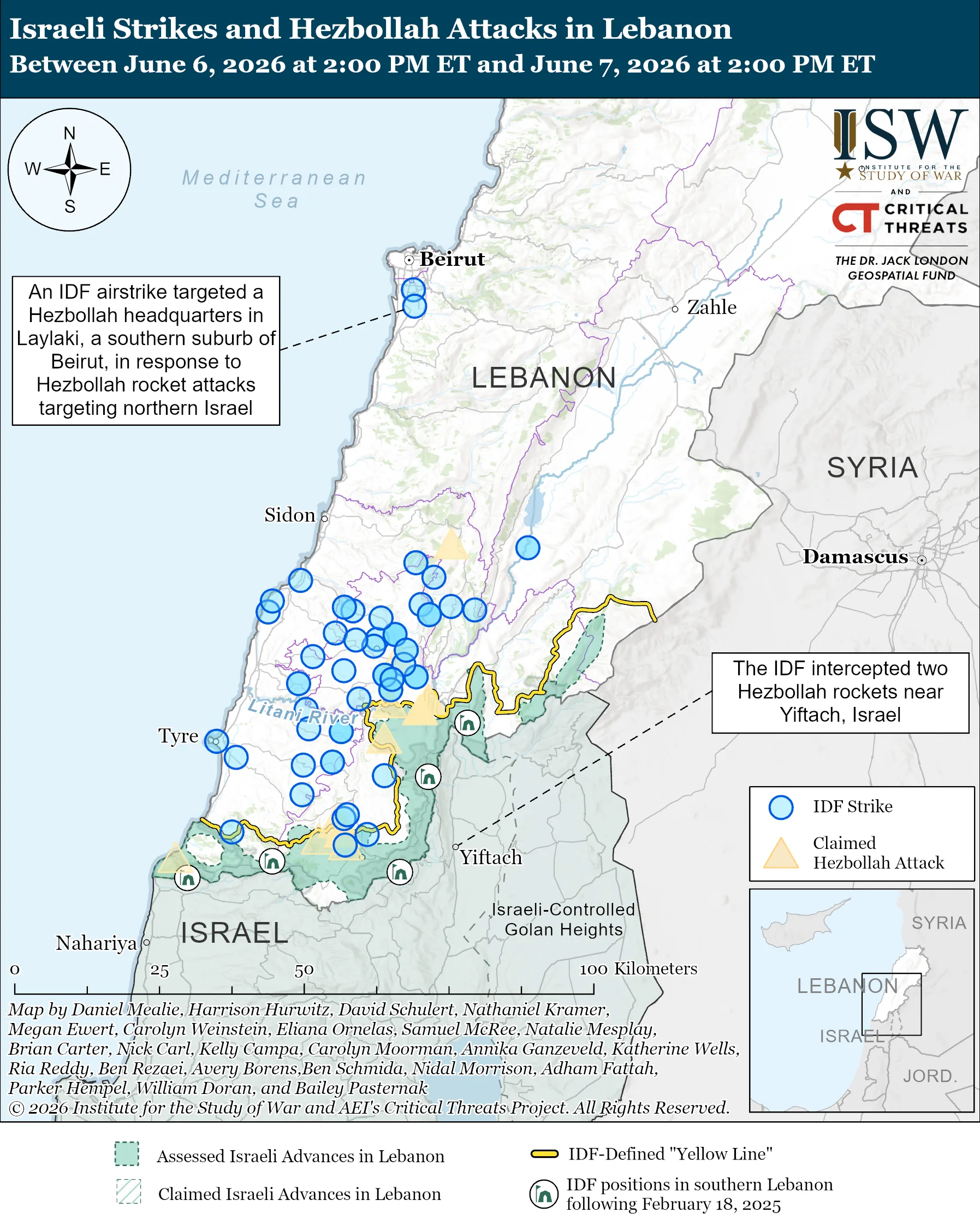
Iran responded with a missile attack designed to deter future Israeli attacks against Hezbollah while avoiding escalation into a resumption of full-scale war.[7] Iran targeted Ramat David Airbase in northern Israel because, according to the Islamic Revolutionary Guards Corps (IRGC), the Israeli aircraft that struck Hezbollah sites in Beirut on June 7 flew their mission from Ramat David.[8] The IRGC fired at least ten missiles.[9] The IDF intercepted all the missiles, and there appear to be no casualties at the time of this writing.[10] The IRGC also threatened to respond with “broader” attacks if Israel continues its operations against Hezbollah.[11] The commander of Iran's top operational headquarters, the Khatam ol Anbia Headquarters, threatened that Israel must stop attacking southern Lebanon and Beirut and that if Israel expands attacks regionally or responds to Iran's most recent attack, Israel “will face more crushing and regrettable blows.”[12]
Iran will likely seek to use the threat of a resumption of full-scale war to deter additional Israeli attacks. Iran has almost certainly observed discussions and leaks in Western media about the increasing tension between Trump and Netanyahu over Israeli strikes in Lebanon and Trump's fears that Israeli actions in Lebanon will cause US-Iran negotiations to collapse, for example.[13] Iran is already attempting to present itself as a reasonable actor in the most recent escalation, even though its ally, Hezbollah, started the escalation on June 7. Supreme Leader Military Adviser Mohsen Rezaei stated on X that Israel “received their response” and that “this response is a warning to stop their evil; any new action will be met with a more crushing response and heavier costs.”[14]
Israel has not yet responded to the attack. US President Donald Trump told Axios journalist Barak Ravid that he will call Israeli Prime Minister Benjamin Netanyahu and tell him not to launch retaliatory strikes at Iran.[15]
Iran has continued its efforts to use force to impose its control over the Strait of Hormuz. US Central Command stated on June 6 that US forces shot down two Iranian attack drones that threatened international maritime traffic in the strait.[16] The IRGC Navy warned other states against disrupting its unrecognized and illegal transit rules, which presumably refers to US efforts to support the movement of commercial vessels through the strait.[17] An Iranian parliamentarian told IRGC-affiliated media on June 7 that Iran has collected an average of one and a half to two million dollars per ship attempting to transit the strait through its unrecognized traffic separation scheme.[18] The parliamentarian added that these ships have paid Iran in the form of bartered goods and cryptocurrency.[19] Iran's Environment Department stated on June 7 that the Foreign Affairs Ministry is reviewing plans to charge ships transiting the strait for “maritime and environmental service fees.”[20]
Bloomberg reported on June 6 that US officials are considering using frozen Iranian funds to help Gulf allies repair damage caused by Iranian aggression, citing a Trump Administration official.[21] The official added that the US Treasury Department “will use all tools available” to obtain estimates of the damage that Iran caused to the United States’ Gulf allies and allow them to use Iranian assets for rebuilding.[22] Iranian Deputy Foreign Affairs Minister for Legal and International Affairs Kazem Gharibabadi stated on June 7 that Gulf states that cooperate with US forces against Iran “are not in a position to claim damages.”[23] He added that Iran's assets are not “plunder” or a fund to pay Gulf states from.[24]
The IRGC announced on June 7 that it killed four anti-regime militant fighters in Saravan, Sistan and Baluchistan Province.[25] Iranian media reported on June 7 that the IRGC identified and engaged anti-regime fighters who were attempting to enter Saravan.[26] The fighters killed one IRGC member, but the IRGC killed the fighters.[27] The IRGC added that it seized weapons, ammunition, and Starlink satellite terminals from the fighters.[28] Anti-regime militia activity in southeastern Iran is relatively common.[29]
https://understandingwar.org/research/middle-east/iran-update-special-report-june-7-2026/
2,135
posted on
06/08/2026 9:19:22 AM PDT
by
AdmSmith
(GCTGATATGTCTATGATTACTCAT)
Aimen Dean: My Two Cents/Shekels/Rials:
Some senior GCC figures believe the public disagreements between Trump and Netanyahu are largely political theater rather than evidence of a genuine strategic split. According to this view, Trump became trapped during earlier negotiations when Iranian negotiators, with support from Pakistani mediators, insisted that any broader agreement include a ceasefire involving Hezbollah. This effectively linked the Iranian nuclear and regional negotiations to Hezbollah's status and role in Lebanon.
From the Israeli and many GCC perspectives, this was problematic because it risked granting Hezbollah a degree of political and diplomatic legitimacy. The central argument is that Hezbollah is not a sovereign state actor but an armed non-state organization that operates outside the authority of the Lebanese state.
Trump's primary objectives were reportedly focused on issues such as:
Iran's nuclear program
Security in the Strait of Hormuz
Regional stability
Sanctions and frozen assets
As negotiations progressed, Hezbollah increasingly became intertwined with the broader Iran discussions, creating frustration among those who wanted the two tracks separated. The emerging strategy, according to this interpretation, is to force a clear distinction between:
The “Iran track” (nuclear, sanctions, regional security)
The “Lebanon/Hezbollah track” (Israel's conflict with Hezbollah)
Under this logic, Israel's military actions against Hezbollah should be viewed as part of its conflict with Hezbollah rather than part of any broader U.S.-Iran negotiation.
If Iran chooses to intervene militarily in defense of Hezbollah, it does so by choice rather than necessity, thereby assuming responsibility for any escalation. This approach allows Washington to argue:
“We are negotiating with Iran regarding Iran.”
“Israel is dealing with Hezbollah.”
“The two issues should not automatically be linked.”
Trump could then maintain that he attempted to restrain Israel but cannot dictate every Israeli military decision, particularly when Hezbollah remains engaged in hostilities. In this interpretation, the recent escalation is not necessarily a collapse of diplomacy but rather part of a pressure campaign intended to force Tehran to accept the separation of the Iranian and Lebanese files.
The underlying message to Iran would be:
Accept that Hezbollah is a separate issue from negotiations over Iran itself; or
Continue linking the two and risk further military escalation.
The ultimate objective is to prevent any diplomatic outcome that implicitly recognizes or legitimizes Hezbollah's military role as an extension of Iranian regional influence. Bottom line: This interpretation views the current tensions not as a breakdown in negotiations, but as a deliberate effort to decouple the Iran dossier from the Hezbollah dossier, forcing Tehran to choose whether it wants to negotiate on Iran's interests alone or continue tying its position to Hezbollah's fate.
8:05 am · 8 Jun 2026
https://x.com/AimenDean/status/2063864889769328649
2,136
posted on
06/08/2026 10:13:53 AM PDT
by
AdmSmith
(GCTGATATGTCTATGATTACTCAT)
Iran Update Special Report, June 8, 2026
The Iranian regime is attempting to use force and the threat of force to establish a strategic reality in which any Israeli or US attack on an Iranian proxy or partner would result in a large-scale conflict that would seek to impose significant economic and political costs on Israel and the United States. Iran launched missiles at Israel on June 7 following Israeli strikes on a Hezbollah first-person view (FPV) drone headquarters in Beirut's southern suburbs, which Israel conducted in response to a Hezbollah attack on northern Israel.[1] The Israel Defense Forces (IDF) then struck targets in Iran (see below), after which Iranian forces again launched missiles at Israel. All of the Iranian missiles were intercepted or struck open areas.[2] The Khatam ol Anbia Central Headquarters, which is Iran's top operational headquarters, subsequently announced the “cessation of [Iranian] armed forces operations” but warned that Iranian forces would inflict “much more severe and crushing measures” if the IDF continued to conduct operations against Hezbollah across Lebanon, including in southern Lebanon.[3] The Khatam ol Anbia Central Headquarters previously threatened on June 1 to attack Israel only if the IDF struck Beirut, which suggests that the regime has since lowered its threshold for attacking Israel.[4] The IDF stated that it will continue to target Hezbollah in southern Lebanon and warned that further attacks on northern Israel would trigger additional strikes on Beirut's suburbs.[5]
The recent exchange of fire comes as the Iranian regime appears to be placing renewed emphasis on the importance of the Axis of Resistance, and particularly Lebanese Hezbollah, as a central pillar of Iranian deterrence. A newspaper affiliated with the Supreme Leader's office argued on June 7 that Iran will “not hesitate to enter the field and defend the order that it is now seeking to achieve.”[6] The newspaper added that Iran's “new security equation” involves “an eye for an eye,” which suggests that Iran intends to respond to any threat to the Axis of Resistance.[7] Expediency Discernment Council Chairman Amoli Larijani similarly stated on X on June 8 that Iran's missile attack against Israel was not just a military response but a “formal declaration of a strategic doctrine…in which safeguarding regional power is pursued not in anticipation of threats, but through proactive initiative and offensive threat.”[8] These statements suggest that the regime seeks to deter future military action against its regional proxies and partners by increasing the costs of escalation.
The Iranian regime is almost certainly monitoring reports that US President Donald Trump would prefer a negotiated settlement over renewed conflict with Iran.[9] Iran's threats to inflict “much more severe and crushing measures” therefore likely seek to exploit the United States’ aversion to resuming the war and pressure the United States to convince Israel to halt attacks against Hezbollah.[10] This effort aligns with Iran and Hezbollah's broader objective of securing Israeli capitulation in Lebanon, particularly through a complete cessation of Israeli operations in Lebanon and the withdrawal of Israeli forces from Lebanese territory.[11]
Hezbollah likely seeks to benefit from Iranian deterrence because Iran's threat to respond to any Israeli attack against Hezbollah injects uncertainty into Israel's decision-making process for military operations against Hezbollah.[12] The Khatam ol Anbia Central Headquarters’ warning implied that any Israeli kinetic activity in Lebanon, including responses to Hezbollah attacks, may elicit an Iranian attack on Israeli territory.[13] This warning is likely designed to force Israeli leaders at almost every echelon of command to have to consider whether an operation against Hezbollah would trigger an Iranian attack. The constant need to consider a possible Iranian attack would result in a more reactive and defensive Israeli posture.
Iran and Hezbollah may also calculate that the United States could blame Israel for any Israeli strike that triggered an Iranian response and thereby try to drive a wedge between the United States and Israel. Iranian leaders are almost certainly aware of Western media reporting that US President Donald Trump has criticized Israeli Prime Minister Benjamin Netanyahu for advancing Israeli operations against Hezbollah, and it likely seeks to exploit these reports to stoke further tensions between the two states.[14] Iranian officials and media have sought in recent days to frame Israel as undermining US diplomatic efforts with Iran as part of its effort to sow divisions between the two countries.[15]
The recent Iranian strikes on Israel and Iran's renewed emphasis on the Axis of Resistance reflect how the Islamic Revolutionary Guards Corps (IRGC) likely continues to dominate regime decision-making. ISW-CTP has repeatedly assessed that IRGC Commander Major General Ahmad Vahidi and his inner circle are driving regime decision-making.[16] Vahidi and his inner circle have consistently opposed compromise and prioritized securing maximalist objectives, such as recognized Iranian control over the Strait of Hormuz.[17] Vahidi served as the first commander of the IRGC Quds Force, which is the extraterritorial arm of the IRGC, between 1988 and 1997, and played a central role in establishing Lebanese Hezbollah and developing the broader Axis of Resistance.[18] The regime's renewed emphasis on Hezbollah and the broader Axis of Resistance, coupled with its lower threshold for direct military conflict, likely reflects Vahidi’s efforts to preserve and reinforce what he views as one of Iran's most valuable forms of deterrence.
The IDF responded to the Iranian strikes on northern Israel by attacking Iranian air defense and ballistic missile sites in central and western Iran.[19] The IDF released footage of a strike targeting an Iranian air defense system.[20] The IDF also struck sites affiliated with ballistic missile production at the Bandar Imam Petrochemical Complex in Mahshahr, Khuzestan Province.[21] The IDF previously struck the same complex during the recent war as part of a broader Israeli and US effort to target Iran's petrochemical sector to impose economic costs on the regime and degrade its defense industrial capabilities.[22] Open-source intelligence (OSINT) accounts on X and anti-regime media reported strikes against other Iranian military facilities, including drone storage and production facilities in Tehran and Esfahan provinces, respectively.[23] Iran responded to the Israeli strikes by launching additional missiles at Israel, all of which either struck open areas or were intercepted.[24]
Iran's “new security equation” also relies on threatening critical economic chokepoints to deter Israel and the United States from striking Iran or its partners. Iran continues to use coercive measures in and around the Strait of Hormuz to force vessels to transit through Iran's illegal traffic separation scheme and comply with Iran's protection racket. ISW-CTP previously assessed that the regime increasingly views control over the strait as a key component of its future deterrence strategy.[25] Iranian leaders have repeatedly threatened to disrupt maritime commerce to impose economic costs on the United States and its allies to try to extract concessions during negotiations and discourage additional US or Israeli military action against Iran. The newspaper affiliated with the Supreme Leader's office stated that Iran intends to impose its new security equation “from [the Strait of] Hormuz to Beirut,” suggesting that control over the strait constitutes a core element of Tehran’s strategy.[26] Iranian officials have also repeatedly threatened to restrict shipping through the Bab al Mandeb (see below).[27] The regime likely calculates that threatening these economic chokepoints can generate sufficient economic pressure on the United States and its allies to secure concessions and strengthen Iran's long-term deterrence.
The Houthis announced on June 8 that they will target Israeli vessels in the Red Sea, but have not yet acted on this threat at the time of this writing.[28] Any Houthi attack on Israeli vessels in the Red Sea would likely seek to impose costs on Israel while remaining below the threshold that would trigger a US response. The Houthis announced on June 8 a complete ban on Israeli shipping in the Red Sea, though it has not conducted any attacks on Israeli vessels at the time of writing.[29] A Houthi source told Reuters on June 8 that the Houthis’ ban on Israeli ships in the Red Sea “was a first step” and added that “further escalation could lead [the Houthis] to stop the passage of any ships bound for Israel as well as other measures.”[30] A senior Houthi official also told the New York Times that the group would only target Israeli-linked vessels but warned that it would attack the vessels of any state, including Saudi Arabia, that intervenes.[31] Any Houthi campaign against Israeli shipping would likely seek to impose economic costs on Israel and complicate maritime trade in the Red Sea while seeking to avoid direct US military intervention. The Houthis have conducted limited ballistic missile and drone attacks targeting Israel during the current conflict, but have thus far not conducted attacks on international shipping.[32] Houthi attacks on Israeli vessels in the Red Sea would complement Iran's broader effort to pressure international shipping through the Strait of Hormuz and increase costs on regional and global commerce. The Houthis previously began targeting Israeli-linked vessels after October 7, 2023, and later expanded their attacks to include vessels associated with companies that used Israeli ports, which forced major shipping firms to adopt costlier routes outside the Red Sea.[33] The Houthis’ recent implementation of maritime restrictions on Israeli shipping in the Red Sea also follows a previous report that Iran pressured the Houthis to close the Bab al Mandeb Strait in April 2026.[34] It is unclear whether the Houthis’ current restriction on Israeli-linked shipping reflects Iranian pressure or independent Houthi decision-making, however.
The Houthis launched at least two ballistic missiles targeting central Israel on June 8, which is consistent with the group's “limited” involvement in the current war. The Houthis claimed that they launched a ballistic missile salvo at Tel Aviv and other unspecified areas of central Israel on June 8.[35] The IDF stated that it intercepted one missile while a second missile landed near the Yemeni–Saudi border, according to the Saudi Defense Ministry.[36] The Houthis also published a video of the attack, which showed Houthi fighters launching several Palestine-2 medium-range ballistic missiles.[37] The Houthis previously conducted at least seven ballistic missile and drone attacks targeting Israel before the US-Iran ceasefire came into effect in early April.[38] These attacks included a drone attack on April 6 that the Houthis conducted in coordination with Iran and Lebanese Hezbollah.[39]
US Central Command (CENTCOM) announced on June 8 that US forces disabled an unladen oil tanker that violated the US naval blockade on Iranian ports.[40] CENTCOM stated that the Palau-flagged M/T Marivex transited international waters in the Gulf of Oman and attempted to sail to an Iranian port.[41] US forces disabled the vessel by firing a precision munition at the vessel's engineering and steering spaces after its crew failed to comply with directions.[42] US forces have disabled seven non-compliant vessels and redirected 134 vessels since the United States began its blockade on Iranian ports on April 13.[43]
Two Iranian-backed Iraqi militias threatened to strike US bases and interests in Iraq and the region if the United States strikes Iran.[44] Kataib Hezbollah said on June 8 that the group would target US bases and interests in Iraq and the region if the United States “intervenes.”[45] Likely Kataib Sayyid al Shuhada front group Saraya Awliya al Dam released a similar statement on June 8.[46] Neither group has acted on their threats at the time of this writing. These threats coincide with reports that Iraqi Prime Minister Ali al Zaydi is leading efforts to prevent Iraqi armed factions from joining the Iran-Israel conflict, even if the United States reenters the war.[47]
https://understandingwar.org/research/middle-east/iran-update-special-report-june-8-2026/
2,137
posted on
06/09/2026 1:29:23 AM PDT
by
AdmSmith
(GCTGATATGTCTATGATTACTCAT)
To: nuconvert
Mark Dubowitz: I know this is an ongoing debate. Interested to hear from Iran watchers. I don't agree that a regime under Mojtaba Khamenei is necessarily more dangerous than the one under Ali Khamenei. Mojtaba may be more reckless, which makes him dangerous. Ali, however, was more strategic, disciplined, and patient—which in many ways made him even more dangerous.
Ali was steadily moving Iran toward a lethal end state: a massive ballistic missile arsenal, an eventual ICBM capability, permanent coercive leverage over Hormuz, and ultimately a nuclear weapons capability protected by the growing costs and risks of military action against it given Iran's trajectory to a massive missile arsenal.
Mojtaba has inherited a much weaker position. He has lost much of Iran's missile production base, its ICBM program, enrichment and reprocessing capabilities, top weapons scientists, and other critical elements of the weaponization effort. He retains temporary leverage over Hormuz, but that can still be reversed if the Trump chooses to reopen the waterway by force.
What Mojtaba lacks in capability, however, he may make up for in grievance and a desire for revenge. He does not have his father's experience or patience, which may make him more reckless—and less willing to accept any agreement that meaningfully constrains the regime.
Thoughts?
https://x.com/mdubowitz/status/2064074764788945292
Ariel Oseran: Considering he is alive, I agree that Mojtaba is more dangerous in the short term than Ali, who was the greater strategic threat.
With the elimination of Ali, Iran not only lost its experienced commander-in-chief, but also its main source of strategic patience. Absent of a moderating factor, the Iranian regime is much more willing to embark on military adventures, regardless of the damage it suffers in response. What we are witnessing now is an emboldened, overly confident, risk-taking and radicalized Iranian regime, which is exhibiting a dramatic transformation in its deterrence doctrine.
In the past, any attack on Iran or its interests was met by strategic patience, with Iran taking its time to thoroughly calculate its response at a time and place of its choosing. Now, under its current hardline leadership, it is displaying a strong sense of self-confidence and willingness to engage its advisories directly, and swiftly.
In the short term, Iran has become a more immediate tactical threat to Israel, showing a willingness to engage it directly, contrary to decades of restraint and strategic patience. Recognizing this, Israelis need to prepare to a new dynamic of rounds of escalation with Iran moving forward. But strategically, Iran has no direct levers of pressure over Israel, short of attempting to pressure US President Trump into curbing Israeli military action. It tried to create one last night by imposing a ‘Lebanon for Israel’ equation, but didn't succeed. This was likely not the last word from Iran, but the more it engages Israel directly, the more it exposes its weakness in the long-run.
https://x.com/ariel_oseran/status/2064106753332031701
tbc
2,138
posted on
06/09/2026 4:10:43 AM PDT
by
AdmSmith
(GCTGATATGTCTATGATTACTCAT)
To: AdmSmith
Danny Citrinowicz: A Brief Strategic Assessment
A. Without an agreement, maintaining the status quo between Iran and the United States will become increasingly difficult.
B. The main reason is the presence of multiple escalation triggers, particularly the Strait of Hormuz and Lebanon. Recent events have demonstrated how quickly friction can spiral into confrontation.
C. As long as Hezbollah rejects the current ceasefire arrangements and Iran views any perceived challenge to its position in the Gulf as a violation of the existing balance, another round of escalation is not a matter of if, but when.
D. Regardless of what military action the United States takes against Iran, Tehran is likely to respond. Policymakers in Washington should assume that Iran will retaliate against any direct attack, whether through actions in the Gulf, against U.S. facilities and partners in countries such as Kuwait, Bahrain, or the UAE.
E. If President Trump’s objective remains a negotiated agreement, the basic parameters are already well understood. The longer Washington delays a diplomatic resolution while simultaneously increasing pressure, the greater the risk that events on the ground will drive the United States toward a military confrontation it does not actually seek.
F. If the goal is a deal, continuously raising the level of escalation is unlikely to produce that outcome. Iran has consistently demonstrated that it responds to pressure with counter-pressure. Any strategy based primarily on coercion must take into account Tehran’s willingness and ability to retaliate, potentially creating a cycle of action and reaction that makes diplomacy even more difficult to achieve.
https://x.com/citrinowicz/status/2064412081655365696
2,139
posted on
06/09/2026 12:09:38 PM PDT
by
AdmSmith
(GCTGATATGTCTATGATTACTCAT)
To: nuconvert
Aimen returns to bring us up to date on all the latest manoeuvrings in the Middle East.
Aimen and Thomas discuss:
Trump’s chaotic, micromanaged Iran diplomacy and reliance on inexperienced “real estate” advisers.
Pakistan, Qatar, Oman, Turkey, and Egypt as flawed or compromised mediators with “skin in the game.”
Why Aimen thinks Switzerland would be the proper neutral US–Iran mediator.
Oman’s tilt toward Iran amid assumptions of American decline and future Iranian regional weight.
The UAE–Saudi split over Iran: Emirati hawkishness versus Saudi caution and strategic bruising.
Saudi resentment over Yemen, Houthi attacks, Israel’s freer hand, and lack of US security guarantees.
Israel, Hezbollah, Lebanon, and Iran: efforts to decouple the Lebanon front from the US–Iran track
https://podcasts.apple.com/ae/podcast/has-trump-lost-the-middle-east/id1443491069
2,140
posted on
06/09/2026 12:13:31 PM PDT
by
AdmSmith
(GCTGATATGTCTATGATTACTCAT)
Navigation: use the links below to view more comments.
first previous 1-20 ... 2,101-2,120, 2,121-2,140, 2,141-2,160 ... 2,401-2,406 next last
Disclaimer:
Opinions posted on Free Republic are those of the individual
posters and do not necessarily represent the opinion of Free Republic or its
management. All materials posted herein are protected by copyright law and the
exemption for fair use of copyrighted works.
FreeRepublic.com is powered by software copyright 2000-2008 John Robinson