Iran Update Special Report, June 3, 2026
Iran and Hezbollah are continuing to try to transform negotiations about ending the war over the Strait of Hormuz into negotiations about ending the war in Lebanon, which Iran and Hezbollah seek to end in Israel's capitulation. US President Donald Trump announced on June 1 a partial ceasefire between Israel and Hezbollah in which Israel would not attack Hezbollah targets in Beirut and Hezbollah would halt attacks against Israel.[1] Israeli Prime Minister Benjamin Netanyahu subsequently announced that Israel would attack Hezbollah targets in Beirut if Hezbollah continued to attack Israel, suggesting that he agreed not to strike Beirut if Hezbollah ceased attacks on Israel.[2] The Lebanese Embassy in Washington claimed on June 1 that Hezbollah had agreed to cease attacks on northern Israel.[3] Hezbollah officials claimed after Trump's announcement that the group would not adhere to a partial ceasefire, however.[4] Hezbollah conducted rocket attacks targeting the Israel Defense Forces (IDF) in northern Israel on June 3 for the first time since June 1.[5] Hezbollah claimed that it fired rockets targeting IDF soldiers near the Israel-Lebanon border on June 3, several hours after the IDF conducted an airstrike targeting a vehicle in Khalde, eight miles south of Beirut.[6] Israeli Ambassador to the United States Yechiel Leiter called Hezbollah's June 3 attack a violation of the partial ceasefire and suggested that Israel could respond by attacking Hezbollah targets in Beirut.[7] An Israeli military correspondent reported on June 3 that Netanyahu is set to meet with senior Israeli officials to determine Israel's response to Hezbollah's attack.[8]
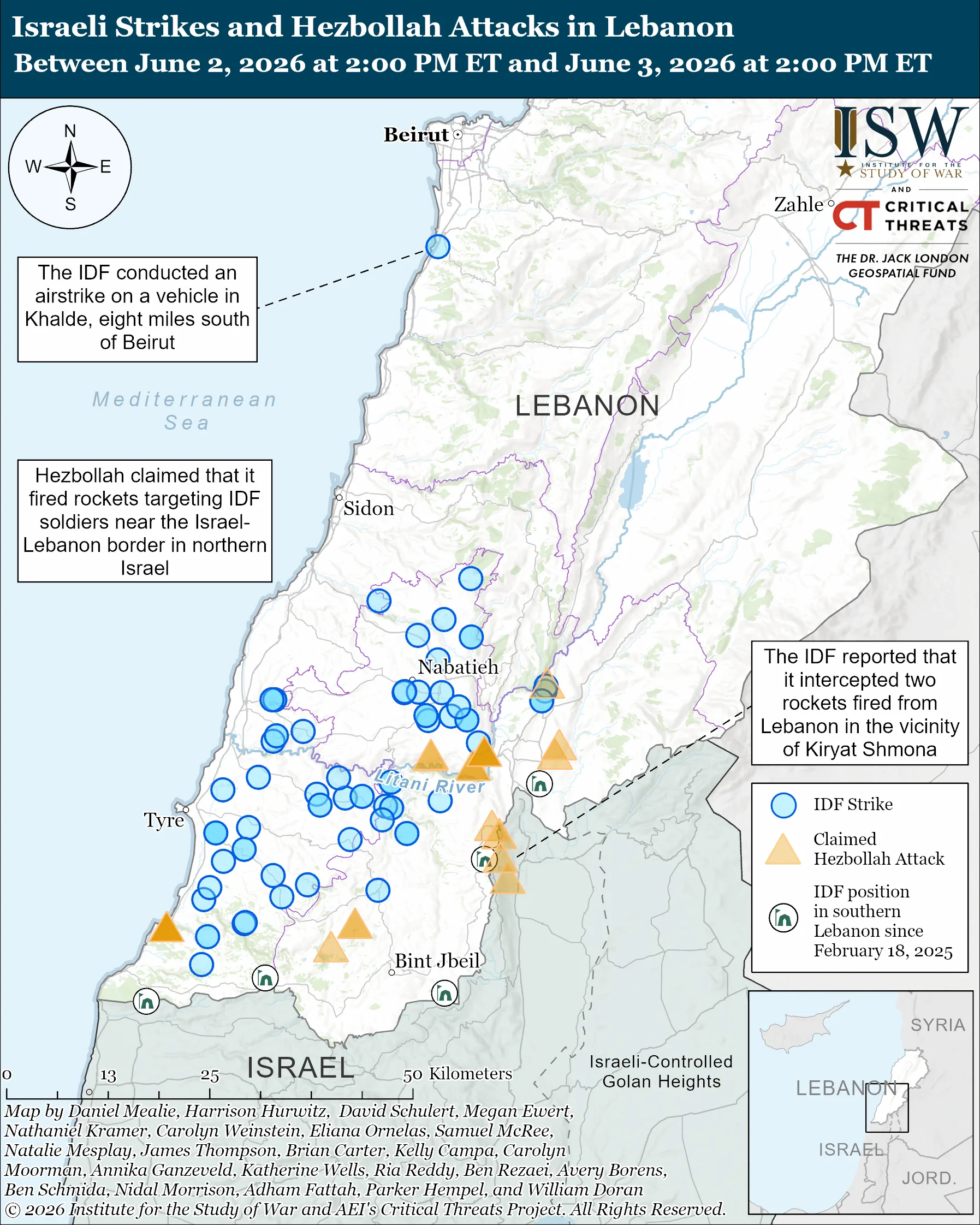
Senior Hezbollah officials have continued to demand a complete ceasefire and the withdrawal of Israeli forces from Lebanon. Hezbollah Political Council member Mahmoud Qamati told Western media that Hezbollah will not accept a partial ceasefire and later said that “there was no ceasefire agreement.”[9] Hezbollah officials have demanded that the IDF cease all military operations in Lebanon and fully withdraw from southern Lebanon and claimed that the group will make “whatever sacrifices are required” to expel Israeli forces from southern Lebanon.[10] A Hezbollah parliamentarian said on June 2 that one of Hezbollah's primary objectives is to obtain a timeframe for a full Israeli withdrawal from Lebanon.[11] These positions are consistent with Hezbollah Secretary General Naim Qassem’s demands that the IDF halt all operations against Hezbollah and withdraw from Lebanon.[12]
Iranian officials have echoed Hezbollah's maximalist demands for a complete ceasefire in Lebanon and withdrawal of Israeli forces from Lebanon as part of Iran's effort to create a protracted discussion about the Lebanon issue and thereby deflect attention from negotiations about the Strait of Hormuz and other key points of disagreement. Iranian Foreign Affairs Minister Abbas Araghchi told Hezbollah-affiliated media on June 3 that Iran and Lebanon are “linked” and that conflict with the United States and Israel will not end unless Israeli forces withdraw from southern Lebanon.[13] Iranian Parliamentary National Security and Foreign Policy Commission Chairman Ebrahim Azizi told Hezbollah officials on June 3 that ending the war with the United States and Israel on all fronts, “especially in Lebanon,” is at the “forefront” of Iran's ceasefire agreement with the United States.[14] Islamic Revolutionary Guards Corps (IRGC)-affiliated media outlet Tasnim News Agency argued on June 3 that there must be a complete ceasefire between Hezbollah and Israel and a complete withdrawal of Israeli forces from Lebanon. The outlet also highlighted how Iran can use Hezbollah to deter and preserve its leverage against Israel and the United States.[15] A political analyst close to the regime also noted on June 3 that the preservation of Hezbollah is “a geopolitical, strategic, and national security imperative for Iran.”[16]
The Iranian regime also likely calculates that it can preserve its leverage on other issues in negotiations with the United States, such as its nuclear program and control of the Strait of Hormuz, by deflecting talks to the war in Lebanon. The US-sanctioned Persian Gulf Strait Authority (PGSA) continued to post data on June 3 about ships requesting Iranian permission to pass through the strait.[17] Tasnim News Agency argued on June 3 that the PGSA’s reports “show the stabilization of Iranian sovereignty over the strait.” This comment is consistent with ISW-CTP’s assessment that Iran is using the ceasefire period to try to normalize Iranian control over the Strait of Hormuz.[18] Tasnim also stated that the Iranian regime is prioritizing achieving sovereignty over the strait over collecting tolls from vessels that transit through Iran's illegal traffic separation scheme. ISW-CTP assessed on May 14 that Iran may be prioritizing upholding the “legitimacy” of its claims to the Strait of Hormuz over toll collection.[19] These comments reflect how Iranian decision-makers are using the current situation to try to solidify de facto Iranian control over the Strait of Hormuz. A protracted discussion about Lebanon also deflects from negotiations over Iran's highly enriched uranium stockpile and ability to enrich uranium on Iranian territory, which Iranian decision-makers have refused to make concessions on.
The Iranian regime is trying to impose costs on the United States for continuing to enforce its blockade while also trying to strain Gulf states’ relations with the United States. US Central Command (CENTCOM) stated on June 2 that US naval forces disabled an Iranian-affiliated tanker, the Botswana-flagged M/T Lexie, that was transiting toward Iran's Kharg Island in violation of the US blockade.[20] Iranian forces then launched attack drones at civilian ships trying to transit the Persian Gulf. US forces intercepted three of the drones.[21] The IRGC also claimed that it launched anti-ship missiles at the Liberia-flagged MSC Panaya, which it claimed belongs to the United States and Israel.[22] US forces subsequently conducted self-defense strikes against drone ground control stations on Qeshm Island in the Strait of Hormuz.[23] Iranian forces then retaliated by firing ballistic missiles and drones at US bases in Kuwait and Bahrain.[24] The Kuwaiti Defense Ministry stated on June 3 that Kuwaiti forces intercepted 13 ballistic missiles and 17 drones.[25] Two Iranian missiles hit Kuwait International Airport, however, killing one person, injuring at least 63 others, and causing significant damage.[26] US and Bahraini air defenses also intercepted three ballistic missiles, one of which targeted the US Fifth Fleet Headquarters in Manama.[27] The Iranian regime's English-language media outlet, Press TV, claimed that Iran's attacks sent a message to Gulf countries that their “territory is not safe” if they continue to host US forces.[28] This comment reflects Iran's efforts to drive a wedge between the Gulf states and the United States by threatening to attack the Gulf states if they cooperate with the United States. Iran's efforts to sow divisions between the Gulf states and the United States are part of Iran's broader strategic objective to expel the United States from the Middle East.
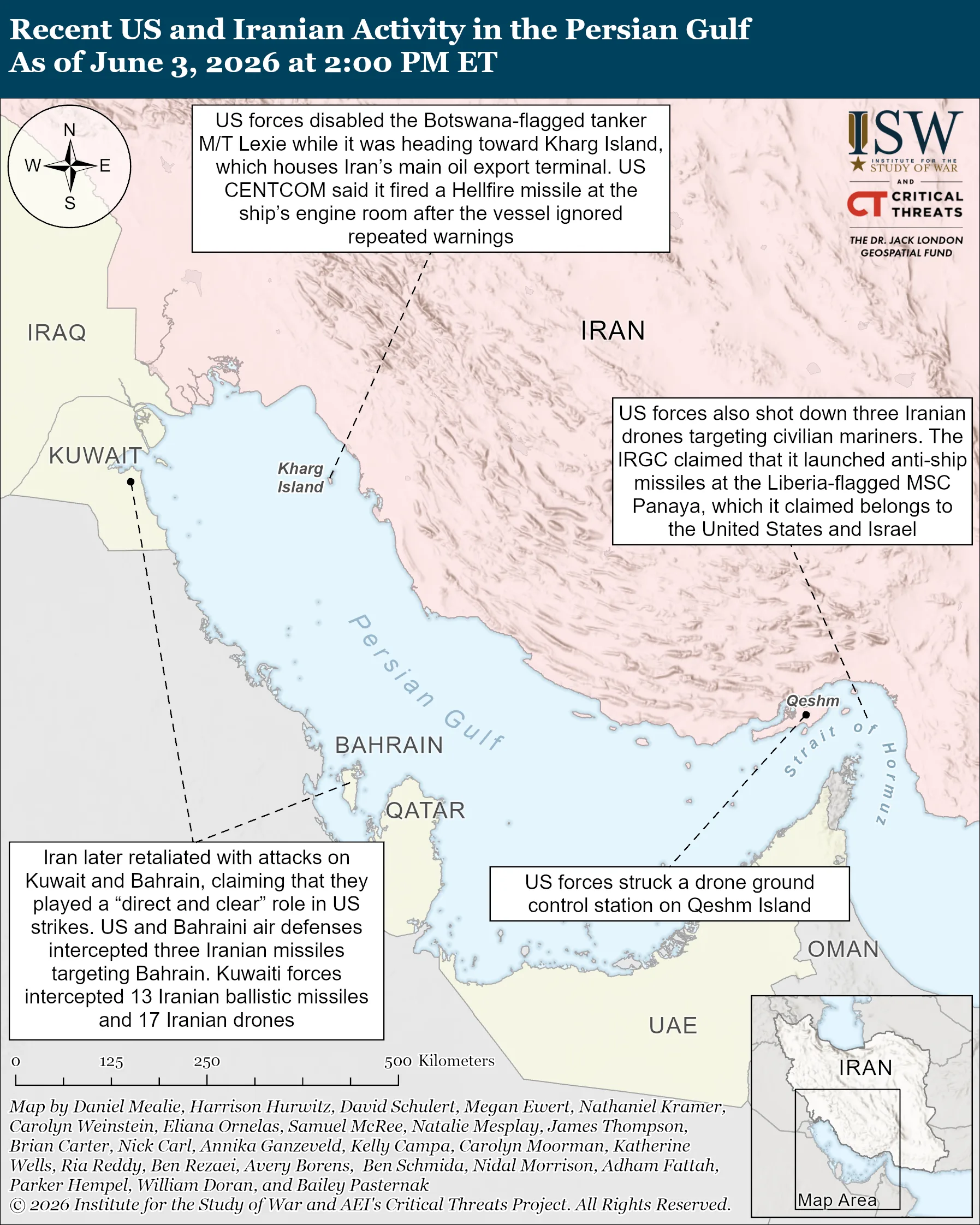
Iranian officials and media responded to these attacks with further threats, probably to try to deter the United States from enforcing its blockade on Iranian ports. Iranian Supreme Leader Mojtaba Khamenei’s military adviser, Mohsen Rezaei, stated on X on June 3 that Iran will not allow the United States to make “excessive demands” in negotiations and will respond to any US military action with a “barrage of missiles and drones.”[29] Press TV also argued that Iran will intensify its responses to US military action to deter the United States from taking such action.[30]
Iranian Parliament Speaker and Iran's Special Representative for the People's Republic of China (PRC) Affairs, Mohammad Bagher Ghalibaf, appears to be performing an executive-level role in Iran's economic and foreign policy. Ghalibaf convened the Iranian Central Bank governor, Planning and Budget Organization head, and oil, economy, and industry ministers on June 3 to coordinate Iran's economic policy toward the PRC.[31] This meeting marks the first meeting that Ghalibaf has convened as Iran's special representative for PRC affairs since Supreme Leader Mojtaba Khamenei appointed him to this position on May 17.[32] The meeting was unusual because parliament speakers in Iran do not normally convene government officials to coordinate and implement foreign economic policy. IRGC-affiliated Tasnim News Agency previously emphasized on May 17 that Ghalibaf’s new role carries a different “level of authority” than previous PRC-related representative roles.[33] The meeting to discuss Iran's economic policy toward the PRC also highlights how Ghalibaf seeks to deepen cooperation with US adversaries such as the PRC.
Ghalibaf’s meeting notably comes as President Masoud Pezeshkian appears to have been sidelined in the regime. Anti-regime media reported on May 31 that Pezeshkian recently submitted his resignation letter to Supreme Leader Mojtaba Khamenei due to IRGC officials’ growing dominance in the regime.[34] ISW-CTP continues to assess that IRGC Commander Major General Ahmad Vahidi and his inner circle are dominating regime decision-making and have gained the upper hand over Ghalibaf.[35] The fact that Ghalibaf appears to be playing an executive-level role does not mean that Ghalibaf holds the same influence over regime decision-making that Vahidi does.
Eighty-five Iranian parliamentarians implicitly called for the development of intercontinental ballistic missile (ICBM) capabilities in a letter to Supreme Leader Mojtaba Khamenei on May 31.[36] The parliamentarians stated that Parliament will support Iran's military forces and defense industry until Iranian missiles can reach the United States.[37] Iran's known longest-range missiles are the Emad, Sejjil, and Shahab-3, which have a reported range of 2,000 kilometers.[38] Iran attempted to launch two ballistic missiles targeting Diego Garcia in March 2026, which is approximately 3,700 kilometers from Iran's southern border, marking the furthest ever attempted Iranian missile strike.[39] One of the missiles failed in flight, while US forces intercepted the other.[40]
The United States continues to apply economic pressure on the Iranian regime by isolating the regime from international markets. The US Treasury Department sanctioned four major Iranian cryptocurrency exchanges and their leadership on June 2 for facilitating Iranian sanctions evasion.[41] The US Justice Department separately announced on June 3 that US law enforcement arrested a dual US-Iranian national and CEO of an Iran-based tech firm for evading US sanctions for more than a decade by covertly purchasing and exporting US-origin networking and encryption equipment to Iranian nuclear and military entities.[42] The CEO reportedly laundered over $15 million USD through international intermediaries.[43]
Hezbollah has continued to use first-person view (FPV) drones equipped with thermal cameras to conduct nighttime attacks targeting Israeli forces in southern Lebanon, likely in response to the IDF ground forces’ own tactical adjustments to operate at night to avoid Hezbollah FPV drone reconnaissance and attacks. Hezbollah posted footage from several FPV drones using thermal cameras to identify and strike Israeli positions at night on June 1 and 2.[44] Hezbollah has likely begun equipping FPV drones with thermal cameras for nighttime attacks on Israeli forces since at least May 23.[45] Hezbollah has primarily conducted nighttime FPV drone attacks on Israeli forces advancing north of the Litani River in recent days.[46] Hezbollah is also likely using FPV drones at night to degrade Israeli forces’ morale and maximize psychological distress, as these capabilities increase the risk of more frequent and unpredictable attacks.[47] Hezbollah may have posted footage of its nighttime FPV attacks to increase fear among the Israeli public and generate popular domestic pressure on Israeli political leaders to end the IDF’s campaign in Lebanon as well.[48]
https://understandingwar.org/research/middle-east/iran-update-special-report-june-3-2026/
Iran Update Special Report, June 4, 2026
Hezbollah and Iranian leaders continue to reject any ceasefire framework in Lebanon that does not meet their maximalist demand for total Israeli capitulation in Lebanon. Hezbollah and Iran's insistence on this demand is part of an effort to defer negotiations about key points of disagreement between Iran and the United States, particularly Iranian efforts to control the Strait of Hormuz, and strengthen Iran's negotiating position vis-à-vis the United States. The United States, Israel, and Lebanon issued a joint statement on June 3 agreeing to implement a ceasefire contingent upon Hezbollah's agreement to halt all attacks and evacuate its fighters south of the Litani River.[1] The joint statement indicates that Israel, Lebanon, and the United States seek to develop a framework to achieve their respective long-term objectives in Lebanon.[2] The statement announced that Israel and Lebanon would coordinate to establish “pilot zones” in southern Lebanon. The Lebanese Armed Forces (LAF) would deploy to these zones “to the exclusion of all non-state actors.”[3] The Lebanese government confirmed that the LAF has begun deploying to southern Lebanese territory that the Israel Defense Forces (IDF) seized during ground operations against Hezbollah.[4] Lebanese President Joseph Aoun called the joint statement the “last opportunity” to obtain “a final and comprehensive ceasefire” in Lebanon on June 4.[5] Israeli Ambassador to the United States Yechiel Leiter separately said on June 4 that a ceasefire in Lebanon would be contingent upon Hezbollah's “complete dismantling.”[6] Hezbollah rejected the joint statement's condition that the group cease attacks and withdraw to north of the Litani River.[7] Hezbollah Secretary General Naim Qassem said on June 4 that Hezbollah's accession to the joint statement would constitute surrender and instead reiterated the group's long-standing demands for a “comprehensive ceasefire” that would require Israel to cease all military operations and withdraw from Lebanon.[8] Qassem indicated that Hezbollah will continue its attacks until Israel accedes to the group's demands.[9] These demands constitute total Israeli capitulation in Lebanon because agreeing to them would force Israel to abandon its core political objective for operations in Lebanon, which is to dismantle Hezbollah as a militant group.[10]
Hezbollah and Iranian leaders are unified in viewing Israeli capitulation in Lebanon as inextricable from Iranian negotiations with the United States. Qassem acknowledged Iran's role in pushing for a complete ceasefire in Lebanon and noted that Iran's push for a complete ceasefire is an “integral part” of Iran's own efforts against the United States.[11] Islamic Revolutionary Guards Corps (IRGC) Quds Force Commander Brigadier General Esmail Ghaani also called for a full ceasefire in Lebanon and complete withdrawal of Israeli forces from Lebanon on June 4.[12] The IRGC similarly stated on June 4 that a ceasefire on “all fronts” was Iran's “initial condition” for the US-Iran ceasefire, which went into effect in early April.[13] Senior Iranian officials, including former IRGC Commander and current IRGC Baghiyatollah Sociocultural Headquarters Commander Major General Mohammad Ali Jafari, previously described a ceasefire in Lebanon as a precondition for negotiations with the United States.[14] Iranian officials have re-emphasized this issue in recent days amid the deadlock in US-Iran negotiations over Iran's nuclear program and the status of the Strait of Hormuz, however.[15]
Iranian officials have continued to emphasize the Lebanon issue in order to try to deflect focus away from key points of disagreement in the US-Iran negotiations, particularly the Strait of Hormuz and Iran's nuclear program, which the regime seeks to avoid making concessions on. The United States and Iran do not currently appear to be discussing Iran's nuclear program, given that Iran suspended negotiations until a complete ceasefire in Lebanon is reached.[16] ISW-CTP previously noted that a protracted discussion about Lebanon deflects from negotiations over Iran's highly enriched uranium stockpile and ability to enrich uranium. Iranian officials and media have also not commented on US demands regarding Iran's nuclear program in recent days. Iranian officials and media continue to insist that Iran will not cede control of the Strait of Hormuz, however. A newspaper published on the Supreme Leader's website, Voice of Iran, published an op-ed on June 2 claiming that Iran has the “winning cards” in negotiations over the strait and that the status of the strait will not return to pre-war conditions.[17] This comment reflects how the Iranian regime does not solely seek to survive this war and return to the pre-war status quo; the regime has positive objectives that it seeks to achieve, including securing Iranian sovereignty over the strait.[18]
Iran has continued to try to justify its control over the Strait of Hormuz by attempting to give its illegal actions in the strait a veneer of legality. Iranian Deputy Foreign Affairs Minister for Legal and International Affairs Kazem Gharibabadi claimed that Iran is complying with the UN Convention on the Law of the Sea (UNCLOS) because Iran is offering “services” and “protection” to vessels in Iranian waters in an interview with Iranian media on June 4.[19] The “protection” that Iran is “offering” vessels is protection from Iranian attacks, which means that Iran has effectively established a protection racket in the strait. Iran has repeatedly used force, including attacks on commercial vessels and naval mines, to make vessels sail through Iranian territorial waters. Iranian officials then claim that Iran has the right to extract a fee from these vessels.[20]
Iran also continues to demand other preconditions for negotiations, such as immediate economic relief upon the signing of any US-Iran memorandum of understanding (MOU). ISW-CTP previously assessed that, even if Iran's maximalist demands in Lebanon are met, Iran could condition further negotiations with the United States on additional US concessions.[21] Gharibabadi told Iranian media on June 4 that Iran still seeks the immediate release of at least half of its frozen assets upon the signing of an MoU and the second half in the subsequent negotiating period in his interview with Iranian media on June 4.[22]
Iran additionally continues to seek to erode US regional influence by trying to strain relations between the United States and the Gulf countries. Supreme Leader Mojtaba Khamenei claimed on June 4 that the war has caused a “tangible divergence of countries from” the United States, possibly in reference to the Gulf states.[23] Mojtaba previously claimed in late April that US bases in the region cannot defend the United States’ Gulf partners, also likely as part of an effort to sow divisions between the United States and its Gulf partners and push Gulf countries to expel US forces from their territory.[24] Iran has continued to launch missile and drone attacks targeting the Gulf states following the ceasefire in April, most recently Kuwait and Bahrain on June 2.[25]
The Iraqi federal government has begun to try to restrict arms to the state through the disarmament and integration of Iranian-backed Iraqi militias into the Iraqi security establishment, including the Iranian-backed Popular Mobilization Forces (PMF). The PMF is an Iraqi state security service that includes many Iranian-backed Iraqi militias that answer to Iran instead of the Iraqi prime minister.[26] Iraqi Shia nationalist cleric Muqtada al Sadr's “deputy for jihad affairs” formally handed over the flag of Sadr's militia, Saraya al Salam, to representatives of the federal government's committee in charge of restricting arms to the state on June 4.[27] Sadr announced on May 27 the dissolution of Saraya al Salam and the “full integration” of the militia's members into the Iraqi state.[28] The Iraqi Joint Operations Command deputy commander, who heads the federal government's disarmament committee, said that the “mechanism” linking Saraya al Salam to the PMF will be abolished and that the militia will be “directly linked” to the prime minister, presumably after it is integrated into the PMF.[29] Saraya al Salam controls the 313th, 314th, and 315th PMF brigades.[30] The federal government committee also includes representatives from the defense and interior ministries and the PMF and is responsible for developing “mechanisms, technical contexts, and arrangements related to weapons and restructuring, leading to [the] full integration” of militia members into the Iraqi security establishment.[31] Iraqi Prime Minister Ali al Zaydi’s spokesperson said on June 3 that the government's efforts to restrict arms to the state apply to all armed groups operating outside of the PMF.[32] A Shia Coordination Framework member also said on June 3 that the federal government has formed joint committees with militias to develop inventories of militia weapons and supervise the handover of operations to the PMF.[33] Zaydi held separate meetings with delegations from Asaib Ahl al Haq and Kataib al Imam Ali on June 3 to discuss disarmament.[34] Both militias announced their readiness to restrict arms to the state on June 2.[35]
Zaydi is also reportedly pursuing a plan, approved by unidentified framework leaders, in which disarmed militia members would integrate into other Iraqi security institutions, such as the Counter Terrorism Service (CTS).[36] Informed sources told Iraqi media on June 4 that Zaydi presented US officials with a proposal to gradually disarm Iranian-backed Iraqi militias in exchange for US investment in Iraq.[37] Zaydi’s plan reportedly includes granting jobs in formal security institutions, including CTS, to 35,000 militia members who disarm.[38] Saraya al Salam members would fill 15,000 of these positions, according to the informed sources.[39] Unidentified framework leaders reportedly approved this plan and agreed that officials from the defense and interior ministries would be “involved” in overseeing the federal government's disarmament efforts.[40] The framework is a loose coalition of Iraqi Shia political parties, some of which Iran backs, and it is unclear which specific elements of the framework supported this plan. Asaib Ahl al Haq head Qais al Khazali and Kataib al Imam Ali head Shibl al Zaidi, who are both framework members, almost certainly supported the plan, however. The informed sources added to Iraqi media that the political wings of multiple Iraqi militias have threatened to leave the framework and boycott the Iraqi political process if the framework proceeds with US pressure to disarm the militias and dissolve or integrate the PMF.[41]
Multiple Iranian-backed Iraqi militias, including Kataib Hezbollah–whose political wing is part of the framework, continue to reject disarmament. A Harakat Hezbollah al Nujaba official said on June 3 that the Islamic Resistance in Iraq refuses to disarm.[42] The Islamic Resistance in Iraq, which is a coalition of Iranian-backed Iraqi militias, includes Harakat Hezbollah al Nujaba, Kataib Hezbollah, Kataib Sayyid al Shuhada, and Ansar Allah al Awfiya.[43] These militias have, both historically and during the war, been the most kinetically active and are more subordinate to Iran than other Iraqi militias.[44] Kataib Hezbollah said on June 4 that it would not disarm until foreign troops in Iraq, almost certainly in reference to US and Turkish forces, withdraw and foreign interference in Yemen ends.[45] Kataib Hezbollah added that it would only surrender its weapons to the “Imam Mahdi.”[46] The Imam Mahdi is the twelfth and final Imam in Shia Islam, who, according to Twelver Shia, is hiding and will reveal himself in the future.[47] Kataib Hezbollah also said that militias that have agreed to disarm have already severed their ties to Iran, stopped obeying Iran's orders, and stopped conducting attacks against the “adversary,” in reference to Asaib Ahl al Haq and Kataib al Imam Ali.[48] Iraq analysts have long noted that Asaib Ahl al Haq’s leadership, particularly its head Qais al Khazali, has focused more on politics than kinetic activity in recent years, including during the October 7 War.[49] Kataib Hezbollah and Harakat Hezbollah al Nujaba criticized Asaib Ahl al Haq in November 2023 for failing to conduct attacks against US forces in Iraq and Syria.[50] The US Treasury Department noted in April 2026, however, that Asaib Ahl al Haq fighters had conducted drone attacks targeting US and coalition forces in northern Iraq in March 2026.[51] Kataib Sayyid al Shuhada separately said on June 3 that it would not disarm until US forces leave Iraq.[52] Likely Kataib Sayyid al Shuhada front group Saraya Awliya al Dam conditioned its disarmament on the Iraqi federal government fulfilling a large list of demands that include ending all financial and economic dependence that “restricts Iraqi sovereignty” and securing modern air defense and radar systems.[53]
Any Iraqi federal government attempt to disarm the militias and integrate them into the Iraqi security establishment that does not address the militias’ networks and allegiance to Iran will likely further embed Iranian influence within the Iraqi state. Some Iraqi officials have discussed reorganizing militia forces within Iraqi security institutions but have not specified how they plan to do so.[54] Zaydi’s spokesperson said on June 3 that the government's effort to “disengage” militias from the PMF refers to “reorganizing these forces within the security institutions” in a way that preserves militia members’ rights and legal protections, for example.[55] It is unclear if the Iraqi federal government plans to integrate the militias into Iraqi security institutions as units or individuals. Militia-controlled PMF brigades could be reflagged as new units, which would largely retain the units’ composition, networks, and structure. Integrating the militias into the PMF or other Iraqi security institutions as reflagged units would further entrench the militias into the Iraqi state's security sector, which would enable deeper Iranian infiltration. Zaydi’s spokesperson also said that the first step toward restricting arms to the state is “realigning” the forces, likely in reference to Iranian-backed Iraqi militia members who operate outside of militia-controlled PMF brigades, and ensuring that the “forces” only respond to the prime minister.[56]
Failing to properly address the militias’ networks and loyalty to Iran during their disarmament and integration into the Iraqi security establishment would also likely pose a threat to the institutions that the militia members would reportedly join, assuming the details of Zaydi’s proposal are accurate. The replacement of most of CTS’s top leadership during former Prime Minister Mohammad Shia al Sudani’s administration has led to worsening corruption and militia infiltration of what most analysts consider to be Iraq's most effective security service.[57] The risk posed by militia infiltration of Iraq's security services is especially great, given the extent to which the United States funds the Iraqi security establishment.[58] CTS gave a Kataib Hezbollah-owned company $12 million USD in its 2023 budget, for example.[59]
The Badr Organization denied on June 3 that the framework and Badr Organization head Hadi al Ameri had formed a committee to restrict arms to the Iraqi state.[60] Iraqi and regional reporting noted in early May that the committee, which included Ameri, Zaydi, and Sudani, had been preparing a plan to disarm the militias.[61] Iraqi media previously reported that the framework chose Ameri for the committee because his ties to Iran were meant to “help build trust with the militias and persuade them to engage with the state.”[62] Badr has integrated itself into Iraqi state institutions to a greater extent than other Iranian-backed Iraqi militias since 2003.[63] Badr would likely face economic blowback to a greater extent than other militias if the United States imposed sanctions or other financial pressure on the Iraqi federal government over failing to address the militias, given the extent of Badr’s dealings with the Iraqi state. Ameri may have denied the committee's existence in response to backlash from more ideologically hardline elements of the Badr Organization.
https://understandingwar.org/research/middle-east/iran-update-special-report-june-4-2026/
