Iran Update Special Report, June 7, 2026
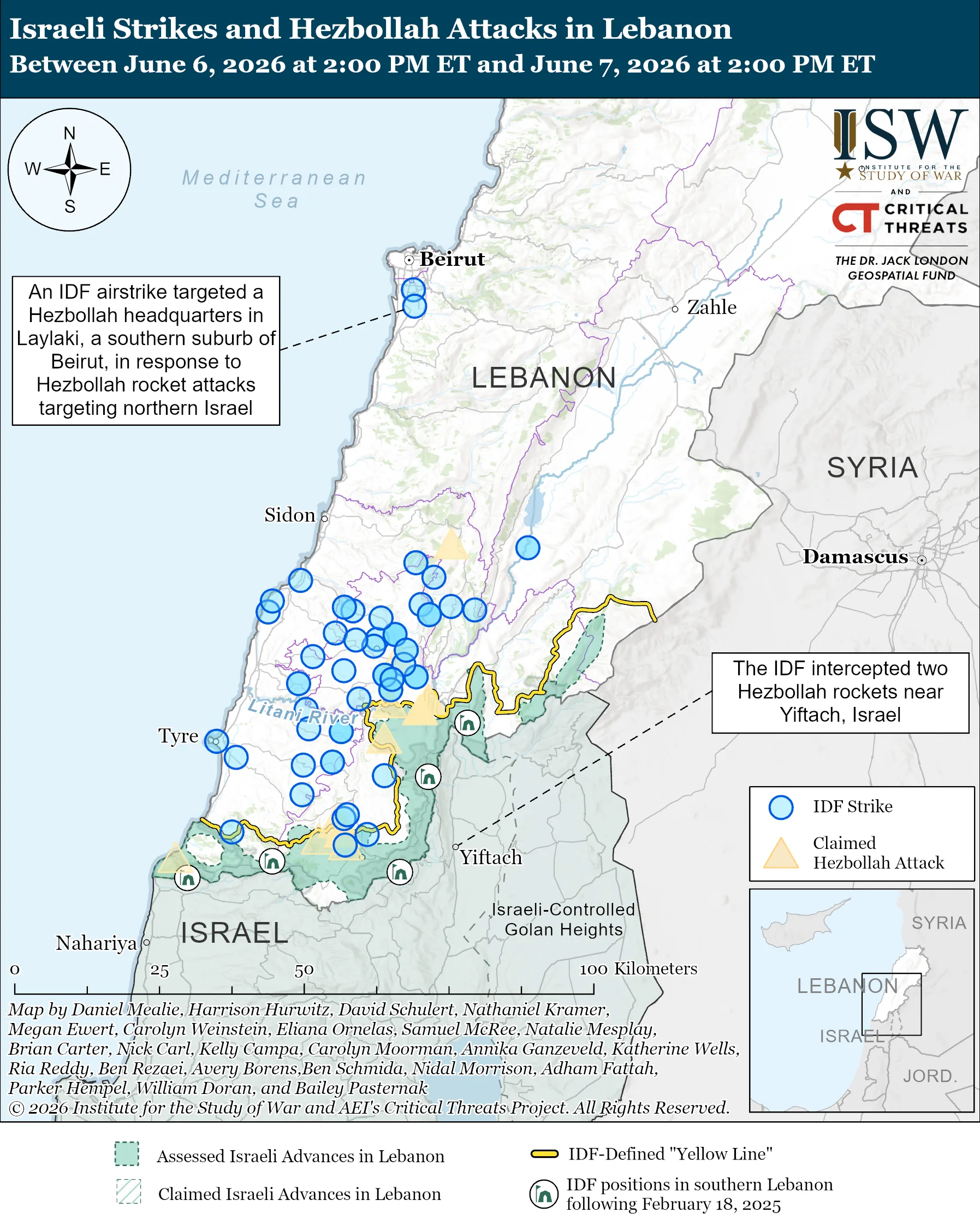
A Hezbollah rocket attack on northern Israel on June 7 is threatening to completely collapse the ceasefire in the Middle East. Israel responded to the Hezbollah attack by conducting an airstrike in Beirut's southern suburbs. Iran then retaliated against Israel's strike south of Beirut by firing about 10 missiles at an Israeli airbase.[1] Both the Israeli retaliation against Hezbollah and the Iranian retaliation against Israel were relatively restrained. Hezbollah began this round of escalation on June 7 when it fired a salvo of rockets at northern Israel.[2] These rockets were intercepted near Yiftach.[3] The Israel Defense Forces (IDF) then struck a Hezbollah headquarters in Beirut's southern suburbs.[4] Senior Israeli officials have been extremely clear about the possible Israeli response to Hezbollah attacks on northern Israel. Netanyahu said on June 1 that the IDF would strike Hezbollah targets in Beirut if Hezbollah continued to attack northern Israel.[5] Israeli media claimed that the IDF is prepared to conduct additional airstrikes in the Beirut area if Israeli political leaders authorize the IDF to expand its operations.[6]
Iran responded with a missile attack designed to deter future Israeli attacks against Hezbollah while avoiding escalation into a resumption of full-scale war.[7] Iran targeted Ramat David Airbase in northern Israel because, according to the Islamic Revolutionary Guards Corps (IRGC), the Israeli aircraft that struck Hezbollah sites in Beirut on June 7 flew their mission from Ramat David.[8] The IRGC fired at least ten missiles.[9] The IDF intercepted all the missiles, and there appear to be no casualties at the time of this writing.[10] The IRGC also threatened to respond with “broader” attacks if Israel continues its operations against Hezbollah.[11] The commander of Iran's top operational headquarters, the Khatam ol Anbia Headquarters, threatened that Israel must stop attacking southern Lebanon and Beirut and that if Israel expands attacks regionally or responds to Iran's most recent attack, Israel “will face more crushing and regrettable blows.”[12]
Iran will likely seek to use the threat of a resumption of full-scale war to deter additional Israeli attacks. Iran has almost certainly observed discussions and leaks in Western media about the increasing tension between Trump and Netanyahu over Israeli strikes in Lebanon and Trump's fears that Israeli actions in Lebanon will cause US-Iran negotiations to collapse, for example.[13] Iran is already attempting to present itself as a reasonable actor in the most recent escalation, even though its ally, Hezbollah, started the escalation on June 7. Supreme Leader Military Adviser Mohsen Rezaei stated on X that Israel “received their response” and that “this response is a warning to stop their evil; any new action will be met with a more crushing response and heavier costs.”[14]
Israel has not yet responded to the attack. US President Donald Trump told Axios journalist Barak Ravid that he will call Israeli Prime Minister Benjamin Netanyahu and tell him not to launch retaliatory strikes at Iran.[15]
Iran has continued its efforts to use force to impose its control over the Strait of Hormuz. US Central Command stated on June 6 that US forces shot down two Iranian attack drones that threatened international maritime traffic in the strait.[16] The IRGC Navy warned other states against disrupting its unrecognized and illegal transit rules, which presumably refers to US efforts to support the movement of commercial vessels through the strait.[17] An Iranian parliamentarian told IRGC-affiliated media on June 7 that Iran has collected an average of one and a half to two million dollars per ship attempting to transit the strait through its unrecognized traffic separation scheme.[18] The parliamentarian added that these ships have paid Iran in the form of bartered goods and cryptocurrency.[19] Iran's Environment Department stated on June 7 that the Foreign Affairs Ministry is reviewing plans to charge ships transiting the strait for “maritime and environmental service fees.”[20]
Bloomberg reported on June 6 that US officials are considering using frozen Iranian funds to help Gulf allies repair damage caused by Iranian aggression, citing a Trump Administration official.[21] The official added that the US Treasury Department “will use all tools available” to obtain estimates of the damage that Iran caused to the United States’ Gulf allies and allow them to use Iranian assets for rebuilding.[22] Iranian Deputy Foreign Affairs Minister for Legal and International Affairs Kazem Gharibabadi stated on June 7 that Gulf states that cooperate with US forces against Iran “are not in a position to claim damages.”[23] He added that Iran's assets are not “plunder” or a fund to pay Gulf states from.[24]
The IRGC announced on June 7 that it killed four anti-regime militant fighters in Saravan, Sistan and Baluchistan Province.[25] Iranian media reported on June 7 that the IRGC identified and engaged anti-regime fighters who were attempting to enter Saravan.[26] The fighters killed one IRGC member, but the IRGC killed the fighters.[27] The IRGC added that it seized weapons, ammunition, and Starlink satellite terminals from the fighters.[28] Anti-regime militia activity in southeastern Iran is relatively common.[29]
https://understandingwar.org/research/middle-east/iran-update-special-report-june-7-2026/
2,135 posted on
06/08/2026 9:19:22 AM PDT by
AdmSmith
(GCTGATATGTCTATGATTACTCAT)
Aimen Dean: My Two Cents/Shekels/Rials:
Some senior GCC figures believe the public disagreements between Trump and Netanyahu are largely political theater rather than evidence of a genuine strategic split. According to this view, Trump became trapped during earlier negotiations when Iranian negotiators, with support from Pakistani mediators, insisted that any broader agreement include a ceasefire involving Hezbollah. This effectively linked the Iranian nuclear and regional negotiations to Hezbollah's status and role in Lebanon.
From the Israeli and many GCC perspectives, this was problematic because it risked granting Hezbollah a degree of political and diplomatic legitimacy. The central argument is that Hezbollah is not a sovereign state actor but an armed non-state organization that operates outside the authority of the Lebanese state.
Trump's primary objectives were reportedly focused on issues such as:
Iran's nuclear program
Security in the Strait of Hormuz
Regional stability
Sanctions and frozen assets
As negotiations progressed, Hezbollah increasingly became intertwined with the broader Iran discussions, creating frustration among those who wanted the two tracks separated. The emerging strategy, according to this interpretation, is to force a clear distinction between:
The “Iran track” (nuclear, sanctions, regional security)
The “Lebanon/Hezbollah track” (Israel's conflict with Hezbollah)
Under this logic, Israel's military actions against Hezbollah should be viewed as part of its conflict with Hezbollah rather than part of any broader U.S.-Iran negotiation.
If Iran chooses to intervene militarily in defense of Hezbollah, it does so by choice rather than necessity, thereby assuming responsibility for any escalation. This approach allows Washington to argue:
“We are negotiating with Iran regarding Iran.”
“Israel is dealing with Hezbollah.”
“The two issues should not automatically be linked.”
Trump could then maintain that he attempted to restrain Israel but cannot dictate every Israeli military decision, particularly when Hezbollah remains engaged in hostilities. In this interpretation, the recent escalation is not necessarily a collapse of diplomacy but rather part of a pressure campaign intended to force Tehran to accept the separation of the Iranian and Lebanese files.
The underlying message to Iran would be:
Accept that Hezbollah is a separate issue from negotiations over Iran itself; or
Continue linking the two and risk further military escalation.
The ultimate objective is to prevent any diplomatic outcome that implicitly recognizes or legitimizes Hezbollah's military role as an extension of Iranian regional influence. Bottom line: This interpretation views the current tensions not as a breakdown in negotiations, but as a deliberate effort to decouple the Iran dossier from the Hezbollah dossier, forcing Tehran to choose whether it wants to negotiate on Iran's interests alone or continue tying its position to Hezbollah's fate.
8:05 am · 8 Jun 2026
https://x.com/AimenDean/status/2063864889769328649
2,136 posted on
06/08/2026 10:13:53 AM PDT by
AdmSmith
(GCTGATATGTCTATGATTACTCAT)
Iran Update Special Report, June 8, 2026
The Iranian regime is attempting to use force and the threat of force to establish a strategic reality in which any Israeli or US attack on an Iranian proxy or partner would result in a large-scale conflict that would seek to impose significant economic and political costs on Israel and the United States. Iran launched missiles at Israel on June 7 following Israeli strikes on a Hezbollah first-person view (FPV) drone headquarters in Beirut's southern suburbs, which Israel conducted in response to a Hezbollah attack on northern Israel.[1] The Israel Defense Forces (IDF) then struck targets in Iran (see below), after which Iranian forces again launched missiles at Israel. All of the Iranian missiles were intercepted or struck open areas.[2] The Khatam ol Anbia Central Headquarters, which is Iran's top operational headquarters, subsequently announced the “cessation of [Iranian] armed forces operations” but warned that Iranian forces would inflict “much more severe and crushing measures” if the IDF continued to conduct operations against Hezbollah across Lebanon, including in southern Lebanon.[3] The Khatam ol Anbia Central Headquarters previously threatened on June 1 to attack Israel only if the IDF struck Beirut, which suggests that the regime has since lowered its threshold for attacking Israel.[4] The IDF stated that it will continue to target Hezbollah in southern Lebanon and warned that further attacks on northern Israel would trigger additional strikes on Beirut's suburbs.[5]
The recent exchange of fire comes as the Iranian regime appears to be placing renewed emphasis on the importance of the Axis of Resistance, and particularly Lebanese Hezbollah, as a central pillar of Iranian deterrence. A newspaper affiliated with the Supreme Leader's office argued on June 7 that Iran will “not hesitate to enter the field and defend the order that it is now seeking to achieve.”[6] The newspaper added that Iran's “new security equation” involves “an eye for an eye,” which suggests that Iran intends to respond to any threat to the Axis of Resistance.[7] Expediency Discernment Council Chairman Amoli Larijani similarly stated on X on June 8 that Iran's missile attack against Israel was not just a military response but a “formal declaration of a strategic doctrine…in which safeguarding regional power is pursued not in anticipation of threats, but through proactive initiative and offensive threat.”[8] These statements suggest that the regime seeks to deter future military action against its regional proxies and partners by increasing the costs of escalation.
The Iranian regime is almost certainly monitoring reports that US President Donald Trump would prefer a negotiated settlement over renewed conflict with Iran.[9] Iran's threats to inflict “much more severe and crushing measures” therefore likely seek to exploit the United States’ aversion to resuming the war and pressure the United States to convince Israel to halt attacks against Hezbollah.[10] This effort aligns with Iran and Hezbollah's broader objective of securing Israeli capitulation in Lebanon, particularly through a complete cessation of Israeli operations in Lebanon and the withdrawal of Israeli forces from Lebanese territory.[11]
Hezbollah likely seeks to benefit from Iranian deterrence because Iran's threat to respond to any Israeli attack against Hezbollah injects uncertainty into Israel's decision-making process for military operations against Hezbollah.[12] The Khatam ol Anbia Central Headquarters’ warning implied that any Israeli kinetic activity in Lebanon, including responses to Hezbollah attacks, may elicit an Iranian attack on Israeli territory.[13] This warning is likely designed to force Israeli leaders at almost every echelon of command to have to consider whether an operation against Hezbollah would trigger an Iranian attack. The constant need to consider a possible Iranian attack would result in a more reactive and defensive Israeli posture.
Iran and Hezbollah may also calculate that the United States could blame Israel for any Israeli strike that triggered an Iranian response and thereby try to drive a wedge between the United States and Israel. Iranian leaders are almost certainly aware of Western media reporting that US President Donald Trump has criticized Israeli Prime Minister Benjamin Netanyahu for advancing Israeli operations against Hezbollah, and it likely seeks to exploit these reports to stoke further tensions between the two states.[14] Iranian officials and media have sought in recent days to frame Israel as undermining US diplomatic efforts with Iran as part of its effort to sow divisions between the two countries.[15]
The recent Iranian strikes on Israel and Iran's renewed emphasis on the Axis of Resistance reflect how the Islamic Revolutionary Guards Corps (IRGC) likely continues to dominate regime decision-making. ISW-CTP has repeatedly assessed that IRGC Commander Major General Ahmad Vahidi and his inner circle are driving regime decision-making.[16] Vahidi and his inner circle have consistently opposed compromise and prioritized securing maximalist objectives, such as recognized Iranian control over the Strait of Hormuz.[17] Vahidi served as the first commander of the IRGC Quds Force, which is the extraterritorial arm of the IRGC, between 1988 and 1997, and played a central role in establishing Lebanese Hezbollah and developing the broader Axis of Resistance.[18] The regime's renewed emphasis on Hezbollah and the broader Axis of Resistance, coupled with its lower threshold for direct military conflict, likely reflects Vahidi’s efforts to preserve and reinforce what he views as one of Iran's most valuable forms of deterrence.
The IDF responded to the Iranian strikes on northern Israel by attacking Iranian air defense and ballistic missile sites in central and western Iran.[19] The IDF released footage of a strike targeting an Iranian air defense system.[20] The IDF also struck sites affiliated with ballistic missile production at the Bandar Imam Petrochemical Complex in Mahshahr, Khuzestan Province.[21] The IDF previously struck the same complex during the recent war as part of a broader Israeli and US effort to target Iran's petrochemical sector to impose economic costs on the regime and degrade its defense industrial capabilities.[22] Open-source intelligence (OSINT) accounts on X and anti-regime media reported strikes against other Iranian military facilities, including drone storage and production facilities in Tehran and Esfahan provinces, respectively.[23] Iran responded to the Israeli strikes by launching additional missiles at Israel, all of which either struck open areas or were intercepted.[24]
Iran's “new security equation” also relies on threatening critical economic chokepoints to deter Israel and the United States from striking Iran or its partners. Iran continues to use coercive measures in and around the Strait of Hormuz to force vessels to transit through Iran's illegal traffic separation scheme and comply with Iran's protection racket. ISW-CTP previously assessed that the regime increasingly views control over the strait as a key component of its future deterrence strategy.[25] Iranian leaders have repeatedly threatened to disrupt maritime commerce to impose economic costs on the United States and its allies to try to extract concessions during negotiations and discourage additional US or Israeli military action against Iran. The newspaper affiliated with the Supreme Leader's office stated that Iran intends to impose its new security equation “from [the Strait of] Hormuz to Beirut,” suggesting that control over the strait constitutes a core element of Tehran’s strategy.[26] Iranian officials have also repeatedly threatened to restrict shipping through the Bab al Mandeb (see below).[27] The regime likely calculates that threatening these economic chokepoints can generate sufficient economic pressure on the United States and its allies to secure concessions and strengthen Iran's long-term deterrence.
The Houthis announced on June 8 that they will target Israeli vessels in the Red Sea, but have not yet acted on this threat at the time of this writing.[28] Any Houthi attack on Israeli vessels in the Red Sea would likely seek to impose costs on Israel while remaining below the threshold that would trigger a US response. The Houthis announced on June 8 a complete ban on Israeli shipping in the Red Sea, though it has not conducted any attacks on Israeli vessels at the time of writing.[29] A Houthi source told Reuters on June 8 that the Houthis’ ban on Israeli ships in the Red Sea “was a first step” and added that “further escalation could lead [the Houthis] to stop the passage of any ships bound for Israel as well as other measures.”[30] A senior Houthi official also told the New York Times that the group would only target Israeli-linked vessels but warned that it would attack the vessels of any state, including Saudi Arabia, that intervenes.[31] Any Houthi campaign against Israeli shipping would likely seek to impose economic costs on Israel and complicate maritime trade in the Red Sea while seeking to avoid direct US military intervention. The Houthis have conducted limited ballistic missile and drone attacks targeting Israel during the current conflict, but have thus far not conducted attacks on international shipping.[32] Houthi attacks on Israeli vessels in the Red Sea would complement Iran's broader effort to pressure international shipping through the Strait of Hormuz and increase costs on regional and global commerce. The Houthis previously began targeting Israeli-linked vessels after October 7, 2023, and later expanded their attacks to include vessels associated with companies that used Israeli ports, which forced major shipping firms to adopt costlier routes outside the Red Sea.[33] The Houthis’ recent implementation of maritime restrictions on Israeli shipping in the Red Sea also follows a previous report that Iran pressured the Houthis to close the Bab al Mandeb Strait in April 2026.[34] It is unclear whether the Houthis’ current restriction on Israeli-linked shipping reflects Iranian pressure or independent Houthi decision-making, however.
The Houthis launched at least two ballistic missiles targeting central Israel on June 8, which is consistent with the group's “limited” involvement in the current war. The Houthis claimed that they launched a ballistic missile salvo at Tel Aviv and other unspecified areas of central Israel on June 8.[35] The IDF stated that it intercepted one missile while a second missile landed near the Yemeni–Saudi border, according to the Saudi Defense Ministry.[36] The Houthis also published a video of the attack, which showed Houthi fighters launching several Palestine-2 medium-range ballistic missiles.[37] The Houthis previously conducted at least seven ballistic missile and drone attacks targeting Israel before the US-Iran ceasefire came into effect in early April.[38] These attacks included a drone attack on April 6 that the Houthis conducted in coordination with Iran and Lebanese Hezbollah.[39]
US Central Command (CENTCOM) announced on June 8 that US forces disabled an unladen oil tanker that violated the US naval blockade on Iranian ports.[40] CENTCOM stated that the Palau-flagged M/T Marivex transited international waters in the Gulf of Oman and attempted to sail to an Iranian port.[41] US forces disabled the vessel by firing a precision munition at the vessel's engineering and steering spaces after its crew failed to comply with directions.[42] US forces have disabled seven non-compliant vessels and redirected 134 vessels since the United States began its blockade on Iranian ports on April 13.[43]
Two Iranian-backed Iraqi militias threatened to strike US bases and interests in Iraq and the region if the United States strikes Iran.[44] Kataib Hezbollah said on June 8 that the group would target US bases and interests in Iraq and the region if the United States “intervenes.”[45] Likely Kataib Sayyid al Shuhada front group Saraya Awliya al Dam released a similar statement on June 8.[46] Neither group has acted on their threats at the time of this writing. These threats coincide with reports that Iraqi Prime Minister Ali al Zaydi is leading efforts to prevent Iraqi armed factions from joining the Iran-Israel conflict, even if the United States reenters the war.[47]
https://understandingwar.org/research/middle-east/iran-update-special-report-june-8-2026/
2,137 posted on
06/09/2026 1:29:23 AM PDT by
AdmSmith
(GCTGATATGTCTATGATTACTCAT)
FreeRepublic.com is powered by software copyright 2000-2008 John Robinson