Skip to comments.
Iranian Regime tv Channel One hacked while it was airing Khamenie speech
various
| 10-8-22
Posted on 10/08/2022 1:05:38 PM PDT by nuconvert
Iranian Regime national tv Channel One hacked about an hour ago. During a broadcast of Khamenie speech, a red crosshair appeared over his face and chanting of Women. Life. Freedom. There was writing to the side saying "Rise up. Join us". Also 4 photos at the bottom of the screen of young people killed and additional writing: "The blood of our youth is dropping from your paws".
Also, there was a huge banner in the middle of Tehran highway today that read: We are no longer afraid of you. We will fight.
Also, attempted attack on IRI ambassador in Denmark. Her bodyguard was stabbed. Diplomatic Security intervened before the attacker could stab the ambassador.
TOPICS:
KEYWORDS: basij; deathtothemullahs; denmark; ebrahimrigi; erdogan; iran; iranprotests; iraq; irgc; iri; israel; khameini; khamenei; kurdistan; lebanon; mahsaamini; mullahloversonfr; mullahsmustbekilled; najisharifizindashti; protests; qudsforce; raisi; receptayyiperdogan; shahrammaroufmola; syria; turkey; yemen; zahedi
Navigation: use the links below to view more comments.
first previous 1-20 ... 1,581-1,600, 1,601-1,620, 1,621-1,640 ... 2,441-2,445 next last
To: AdmSmith
So a bacon double cheeseburger costs about 10 million rials? That doesn’t sound good.
1,601
posted on
12/28/2025 8:38:26 AM PST
by
Kudsman
(Illusions for everybody. How about a nice rousing game of Apathy and Detachment? )
Iran Update, December 29, 2025
Small-scale protests demanding that the Iranian government address the devaluation of the Iranian rial and high inflation rates have continued for the second consecutive day in Tehran and Hamadan City, western Iran, on December 29, amid a rapid collapse of the Iranian currency since November 2025.[1] The value of the Iranian rial has deteriorated rapidly after November 2025, though its value has fallen for years due to sanctions and Iran's general international isolation. Protests initially began in Tehran on December 28.[2] Groups of less than roughly 100 civilians, who were reportedly Iranian ”businessmen,” marched from Lalezar Street toward the Imam Khomeini Square on December 29, demanding that the Iranian government intervene in the economy and address the high inflation rate and devaluation of the currency. Iranian security forces halted and clashed with the protesters at the Istanbul intersection on December 29, according to Islamic Revolutionary Guards Corps (IRGC)-affiliated media and geolocated footage.[3] Iranian security forces also launched tear gas and clashed with protesters on Boali Street in southern Hamedan City on December 29.[4] A BBC Persian journalist reported that economic protests also occurred in Malard City, Tehran Province, and on Gheshm Island in the Persian Gulf, but did not provide footage of the protests at the time of this writing.[5] Tehran merchants announced that they will continue to protest on December 30.[6] The protests come amid a drop in the value of the Iranian rial. The value of the Iranian rial reached 1,445,000 rials per one US dollar as of December 28, which marks its lowest value in 2025.[7] The rial appreciated slightly to 1,371,000 rials to one US dollar on December 29, however.[8]
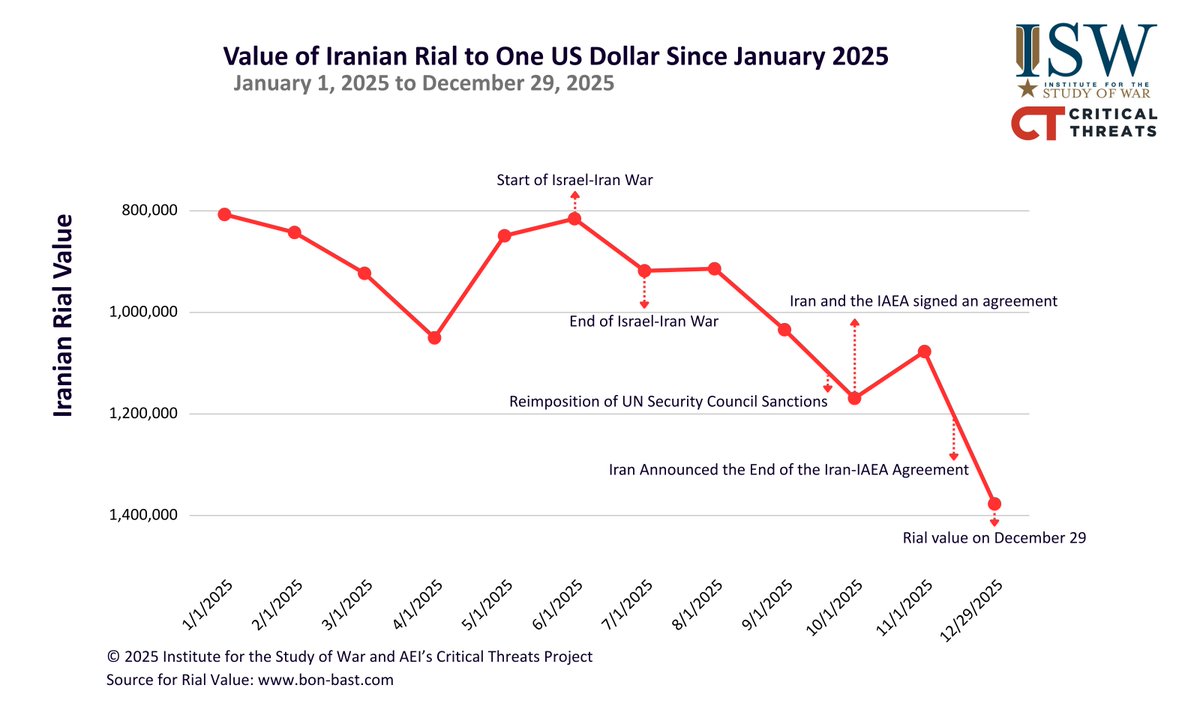
Current economic-related protests come as the Iranian regime is deliberating on Iran's 2026/27 budget, which is set to increase taxes to relieve Iran's budget deficit as state oil revenue decreases, but will put additional economic pressure on the Iranian people. Iranian President Masoud Pezeshkian defended his proposed budget in front of the Iranian Parliament's budget oversight committee on December 28, in which Pezeshkian proposed a tax increase by 62 percent.[9] This increase in the tax rate will worsen the economic challenges caused by inflation that are plaguing Iranians. Iranian outlets on December 28 and 29 criticized the budget for not adjusting salaries in accordance with the current 42.2 percent inflation rate.[10] The proposed 2025 budget reportedly reflects a decrease in dependency on oil revenue. Iranian oil revenue–its main source of government revenue–has dropped significantly, only meeting about 16 percent of the expected annual revenue in 2025, according to the parliamentary Budget and Planning Commission Deputy Chairman on November 6.[11] The parliament's budget oversight committee rejected Pezeshkian’s proposed 1405 March 2026 to March 2027 budget on December 29 and is set to provide feedback to Pezeshkian’s cabinet on December 30.[12]
Iranian regime-affiliated media recognized the protesters’ grievances as legitimate but warned that these protests could escalate into “unrest” or be exploited by Iran's adversaries. “Unrest” in this context presumably refers to anti-regime protests specifically, rather than protests over economic grievances.[13] IRGC-affiliated media acknowledged that Iranian merchants have been unable to pay rent for their shops due to the increase in the prices of imports and basic goods and drop in their sales, and even called on the government to take these economic protests seriously.[14] The regime's anxieties over these protests spiraling out of control and escalating into anti-regime protests are valid because previous economic protests have escalated into nationwide anti-regime protests in 2017 and 2018.[15] Iranian regime-affiliated outlets also warned that these could be exploited by Iranian adversaries, namely Israel.[16] The Iranian regime has repeatedly blamed Israel and the United States for anti-regime protests over the past decade.[17] The IRGC published an official statement on December 29, calling on the Iranian people to stay united amid the United States and Israel's efforts to undermine public trust and conduct “cognitive warfare.”[18] Mostafa Najafi, a political advisor close to former IRGC Commander and Expediency Discernment Council member Mohsen Rezaei, separately assessed on December 29 that Israel could exploit Iran's weakened position and attack Iran, and added that Israel could even convince the United States to attack Iran as well during Israeli Prime Minister Benjamin Netanyahu's visit to the United States.[19] Najafi noted that the Iranian regime needs to address external perceptions of internal unrest in Iran.[20]
The Iranian regime's attempts to address economic issues are unlikely to provide immediate relief to the economy, however. Pezeshkian replaced Iranian Central Bank Governor Mohammad Reza Farzin with former Economy Minister Abdol Nasser Hemmati on December 29, following pressure from “almost everyone in government,“ according to Najafi.[21] Hemmati previously served as Central Bank governor during US President Donald Trump's first round of maximum pressure between 2019 and 2021, when inflation rates increased from around 40 percent to 45 percent and the rial‘s value more than halved.[22] Pezeshkian claimed that his budget involved a 20-point plan, which involved controlling energy consumption and relying on trade with regional partners to ensure people's livelihoods, in an interview with the Supreme Leader's official outlet on December 27.[23] Pezeshkian held an emergency meeting with the government's economic team at the Central Bank on December 29 to discuss foreign exchange, trade, and livelihood policies after Parliament's budget oversight committee rejected his budget proposal.[24] One hundred sixty-five out of 290 Iranian parliamentarians separately signed a letter to Pezeshkian, Parliament Speaker Mohammad Bagher Ghalibaf, and Judiciary Chief Gholam Hossein Mohseni Ejei on December 25, in which they expressed their concern over severe price and foreign exchange rate fluctuations.[25] The letter presented five solutions to remove all competitor currencies to the rial from transactions (such as gold, cryptocurrencies, and foreign currencies) to strengthen the rial.[26] The Central Bank previously proposed and may have recently implemented other mechanisms, including exporting transactions to a secondary market to encourage exporters to return foreign currencies faster and increase the foreign currency reserve to help stabilize the foreign exchange market.[27] These mechanisms mean that, in theory, the Central Bank does not need to rely as much on building foreign reserves to control the exchange rate and subsequently inflation.[28] It remains uncertain whether any of these mechanisms would work in practice, as it would require public trust in the rial to stabilize inflation and the government's handling of the economy, which is currently lacking.
Russia is continuing to support the development of the Iranian space program. Russia launched three indigenous Iranian remote sensing satellites named Paya, Zafar 2, and Kowsar into orbit on December 28 using the Russian Soyuz space launch vehicle.[77] The Paya satellite is designed to deliver imagery with a resolution of around five meters in black and white and 10 meters in color.[78] The Kowsar satellite is the second model of the previously launched Iranian Kowsar satellite, which Russia launched into space in November 2024.[79] Russia has launched five Iranian-made satellites into orbit since 2022, including the Khayyam satellite in August 2022, the Pars-1 satellite in February 2024, the Kowsar and Hodhod satellites in November 2024, and the Nahid-2 satellite in July 2025.[80] IRGC-affiliated media previously reported in July 2020 that the IRGC uses satellites to collect intelligence on US military positions in the region, underscoring the importance of satellites to Iran's military forces.[81] Five- and ten-meter resolution imagery is very low resolution compared to commercially available 0.5m or 3m resolution imagery. Western media outlets, for example, commonly publish full-color satellite imagery at 0.5m resolution.
Iranian Armed Forces General Staff (AFGS)-controlled Defa Press warned on December 28 that Iran could use its “Hadid 110” drones to attack US military bases in the region, possibly to try to deter US and Israeli military action against Iran.[82] Iran showcased the Hadid 110 drone during the 2025 Sahand counterterrorism exercise in early December 2025.[83] The Hadid 110 is a fixed-wing, jet-powered, one-way drone that can fly up to 510 kilometers per hour at an altitude of 9 kilometers and can reach targets around 350 kilometers away.[84] It is the fastest Iranian drone (though it prioritizes speed over durability) and maintains a low radar visibility.[85] Defa Press stated that Iran could use the Hadid 110 to attack US military bases during a “full-scale conflict” between Iran and the United States.[86] Defa Press may have published this article in response to reports that Israeli Prime Minister Benjamin Netanyahu would brief US President Donald Trump on options for the United States to “join or assist” an Israeli military operation against Iran's ballistic missile program during his December 29 meeting with Trump.[87] Trump responded on December 29 to a question about whether he would allow Netanyahu to strike Iran again, stating, “for ballistic missiles, yes.”[88] Defa Press also published the threat to attack US military bases in English, which suggests that it was also intended for an English-speaking audience.[89]
https://understandingwar.org/research/middle-east/iran-update-december-29-2025/
1,602
posted on
12/30/2025 5:47:21 AM PST
by
AdmSmith
(GCTGATATGTCTATGATTACTCAT)
Iran Update, December 30, 2025
Protests in Iran have expanded geographically and demographically since December 28. Small protests broke out in Tehran on December 28 in response to worsening economic conditions. These protests were primarily concentrated near markets and shopping centers in Tehran.[1] The protests have since spread to other locations across Iran. Protesters demonstrated in at least nine provinces on December 30, including in Tehran, Alborz, Kermanshah, Markazi, Hamedan, and Esfahan provinces.[2] Students also participated in protests on December 30 at multiple universities across Iran, including at universities in Tehran, Yazd, and Zanjan.[3] Merchants went on strike in Shiraz, Fars Province, Ahvaz, Khuzestan Province, and Tehran Province.[4] The Iranian Truck Drivers Union declared support for striking shopkeepers and protesters on December 29.[5] Iranian truck drivers previously went on strike in May 2025.[6] CTP-ISW has recorded a total of 24 protests across Iran, including 13 protests in Tehran Province, since its last data cutoff on December 29.
Many of the recent protests adopted an explicitly anti-regime tone. Protesters and students chanted anti-regime slogans, such as “Death to the dictator” and “No Gaza, No Lebanon, I will sacrifice my life for Iran,” as well as slogans that praised the Pahlavi dynasty.[7] The anti-regime tone of many of the protests comes as the regime is trying to frame the protests as driven solely by economic grievances. Economic-related protests and strikes have the potential to transform into explicitly anti-regime protests. Demonstrations against an increase in gasoline prices morphed into anti-regime protests in Iran in 2019, for example.[8]
Iranian government officials and some Iranian media outlets have likely adopted a relatively soft tone toward the protests thus far to prevent the protests from expanding and becoming more overtly anti-regime in nature. Iranian government officials have acknowledged Iranians’ economic hardships and emphasized the need for dialogue with protesters during the first three days of the protests. Iranian President Masoud Pezeshkian stated on December 29 that the livelihoods of Iranians are his daily concern and that his administration will pursue monetary and banking reforms to preserve purchasing power.[9] Pezeshkian added that he tasked Interior Minister Eskandar Momeni to “hear protesters’ legitimate demands” through dialogue with the protesters’ representatives.[10] It is unclear what representatives Pezeshkian was referring to. Iranian Government Spokesperson Fatemeh Mohajerani separately stated on December 30 that the government recognizes public protests, supports peaceful gatherings, and listens to “harsh and critical voices.”[11] Parliament Speaker Mohammad Bagher Ghalibaf stated on December 30 that officials must respond fully and responsibly to public concerns over livelihood problems and that executive authorities must prioritize dialogue, especially with representatives of merchants.[12] Government officials’ relatively soft tone toward the protests is not completely unusual, given that the Iranian regime has historically been slightly more tolerant of economic-driven protests as compared to protests driven by sociocultural grievances, such as the 2022-2023 Mahsa Amini protest movement.
There are several other factors that could also explain the Iranian government’s relatively soft tone toward the protests thus far. The Pezeshkian administration includes more moderate figures than the administration of Pezeshkian’s hardline predecessor, Ebrahim Raisi, who was serving as president during the Mahsa Amini movement. The Iranian regime is also concerned about a potential new conflict with Israel and may seek to avoid worsening its internal security situation so that it does not have to confront external and internal threats simultaneously. An adviser to former IRGC Commander Mohsen Rezaei claimed on December 29 that Israel could exploit Iran’s weakened position to attack Iran. The adviser called on the Iranian regime to address external perceptions of internal unrest in Iran.[13]
Some elements of the Iranian security apparatus have adopted a more hardline tone toward the protests, however. The Armed Forces General Staff published a statement on December 29 in which it called on the government to address economic problems but also warned that Iran’s adversaries “will receive blows that are much stronger, more crushing, and more damaging” if they “make another mistake.”[14]
Iranian security forces have responded in a relatively restrained manner to the protests thus far. CTP-ISW has observed limited reports of engagements between security forces and protesters thus far. Social media users circulated a video from December 29 that showed security forces firing tear gas at a small crowd in Hamedan Province.[15] Security forces also arrested protesters in Tehran Province on December 30.[16] The Amir Kabir University newsletter reported clashes between security forces and student protesters at Shahid Beheshti University in Tehran on December 30.[17]
Iran will likely continue to rebuild its ballistic missile program despite rising Israeli concerns about Iranian reconstitution. Iranian officials emphasized that Iran will not make any concessions regarding its ballistic missile program after US President Donald Trump suggested after his meeting with Israeli Prime Minister Benjamin Netanyahu on December 29 that the United States could support an Israeli strike on Iran’s ballistic missile program.[18] Israeli officials have become increasingly concerned about recent Iranian efforts to rebuild its ballistic missile production facilities.[19] One of Supreme Leader Ali Khamenei’s representatives to the Defense Council, Ali Shamkhani, stated on December 29 that Iran’s missile capabilities are not “permission-based” and warned that Iran would respond to any threats before they materialize.[20] An Iranian analyst close to former IRGC Commander Mohsen Rezaei separately claimed that any path to negotiations with the United States would be based on Iran strengthening its “hard power, military capability, and…deterrence levers.”[21] Missiles, in addition to Iran’s Axis of Resistance, have long acted as the central pillar of Iran’s regional defense strategy, and Iranian officials have long considered the regime’s ballistic missile program to be a crucial deterrent to Israel and the United States.[22]
UK-based Amwaj Media reported on December 29 that Iran and Israel have recently exchanged secret messages through Russia to deescalate tensions, citing informed regional and political sources.[23] One unspecified regional source claimed that Netanyahu asked Russia to convey to Iran that Israel does not seek further confrontation with Iran.[24] A separate unspecified source in Tehran claimed that Iran and Israel told a Russian intermediary—believed to be President Vladimir Putin—on an unspecified date that they do not intend to conduct new strikes on the other country.[25] The source reported that Supreme National Security Council Secretary Ali Larijani engaged with the unspecified Russian intermediary, rather than the Iranian Foreign Affairs Ministry.[26] This report contrasts recent reports that Netanyahu was planning to brief Trump on options for the United States to “join or assist” an Israeli military operation against Iran’s ballistic missile program during his December 29 meeting with Trump.[27]
The United States sanctioned 10 individuals and entities on December 30 for their involvement in Iranian drone exports and Iran’s missile and drone programs.[87] The US Treasury Department sanctioned a Venezuelan company and its chair for acquiring Iranian-designed drones.[88] Iran has provided drone technology to Venezuela since at least 2006.[89] The US Treasury Department also sanctioned two Iranian individuals and an Iranian entity for procuring chemicals for Iran’s ballistic missile program.[90] The chemicals include sodium perchlorate, which is a chemical precursor for solid missile propellant.[91] The People’s Republic of China has transported sodium perchlorate to Iran both before and after the June 2025 Israel-Iran War to help Iran reconstitute its ballistic missile program.[92] The US Treasury Department lastly sanctioned two individuals and three entities with links to Rayan Fan Kav Andish, which is a holding company that has supported the Iranian defense industry.[93] Rayan Fan Kav Andish owns a company that has produced components for the IRGC’s drone program and software for the IRGC’s aerospace program, for example.[94]
https://understandingwar.org/research/middle-east/iran-update-december-30-2025/
1,603
posted on
12/30/2025 11:49:09 PM PST
by
AdmSmith
(GCTGATATGTCTATGATTACTCAT)
To: AdmSmith
The protests are in cities across the country
1,604
posted on
12/31/2025 7:21:55 AM PST
by
nuconvert
( Warning: Accused of being a radical militarist. Approach with caution.)
To: nuconvert
Iran Update, December 31, 2025
Protests continued to expand geographically across Iran on December 31. Small protests broke out in Tehran on December 28 and have since spread to 17 out of Iran’s 31 provinces.[1] Protests spread to Chaharmahal and Bakhtiari, Ilam, Khuzestan, Khorasan Razavi, and Lorestan provinces on December 31.[2] CTP-ISW recorded a total of 31 protests in Iran on December 31, compared to 24 protests on December 30. The protests took place across 12 provinces, including the five mentioned above.[3]
Iranian security forces shot live fire to disperse protesters in at least two instances on December 31, as protests continued across Iran for the fourth consecutive day. Security forces fired live ammunition at crowds of protesters in Fasa, Fars Province, and Kuhdasht, Lorestan Province, on December 31.[4] The regime appears to be using live fire to suppress protests in less populated areas of Iran. The regime has historically struggled to impose control in more rural areas.
The regime also deployed water cannons in an attempt to suppress protests on December 31.[5] Security forces used a water cannon against protesters in Hamedan. The weather in Hamedan is currently two degrees below zero degrees Celsius.[6] Security forces also reportedly used a water cannon against protesters in Arak, Markazi Province.[7] The regime’s use of water cannons against protesters comes amid Iran’s unprecedented water shortage crisis.[8] The regime’s deployment of water as a tool to suppress protests amid Iran’s water crisis highlights the regime’s prioritization of its security and survival.
The regime also continued to arrest protesters on December 31.[9] Security forces arrested four Kurdish individuals in Asadabad, Hamedan Province, four individuals in Fasa City, Fars Province, and four individuals in Behbahan, Khuzestan Province.[10] The Intelligence Ministry separately arrested seven individuals who allegedly have ties to Reza Pahlavi, son of former Iranian Shah Mohammad Reza Pahlavi.[11] The ministry claimed that the individuals had smuggled 100 Colt revolvers into Iran.[12] An informed source told Islamic Revolutionary Guards Corps (IRGC)-affiliated Tasnim News Agency that these individuals intended to incite violence at protest gatherings in Iran.[13]
The Iranian regime is taking steps to prevent further protests at universities. The regime likely views university students as a serious threat to regime stability given that students played a significant role in the Masha Amini protests. The regime directed some universities on December 31 to do remote learning until the end of the semester, citing “cold weather.”[14] The decision is very likely meant to prevent students from organizing and participating in protests, however. Students from at least 10 universities across Iran participated in protests on December 30, as CTP-ISW previously reported.[15] Iranian authorities separately released five Tehran University and Sharif University of Technology students whom security forces arrested on December 30 for participating in protests.[16] The Science, Research, and Technology Ministry additionally dismissed the “security managers” of several universities in Tehran on December 31, following the security forces’ “mistreatment of students,” possibly in an effort to appease university students and prevent further student protests.[17] An Iranian human rights organization reported on December 31 that security forces violently arrested a student protesting at Sharif University of Technology.[18] The regime likely regards university protests as a more serious threat to its stability than demonstrations organized by other segments of the population given that university students were a key demographic of the Mahsa Amini movement between September 2022 and January 2023.[19]
Iranian Supreme Leader Ali Khamenei appointed Brigadier General Ahmad Vahidi as IRGC deputy commander on December 27 only two months after appointing him as Armed Forces General Staff (AFGS) deputy chief.[20] Vahidi replaced Brigadier General Ali Fadavi, who had served as the IRGC deputy commander since May 2019.[21] Khamenei neglected to promote Fadavi as IRGC commander after the killing of former IRGC Commander Major General Hossein Salami in June 2025.[22] Khamenei instead appointed former IRGC Ground Forces Commander Major General Mohammad Pakpour as IRGC commander.[23] Vahidi is a long-time IRGC member who previously served as the IRGC Quds Force commander, defense minister, interior minister, and AFGS deputy chief.[24] Khamenei emphasized in Vahidi’s appointment decree that Vahidi should prioritize improving the readiness of the Iranian armed forces and addressing IRGC personnel’s livelihood concerns in coordination with the AFGS.[25] Iranian media has not reported who will replace Vahidi as AFGS deputy chief at the time of this writing. Iranian media reported Vahidi’s appointment on December 31, but Khamenei issued the appointment decree on December 27 based on a recommendation from Pakpour.[26]
Vahidi’s appointment as IRGC deputy commander reflects the challenges that Khamenei faces in trying to reconstitute Iran’s military leadership following the war. Unofficial reports allege that Vahidi was removed from the AFGS deputy chief position due to internal disputes between Vahidi and Artesh leadership over post-war air defense priorities, including Vahidi’s opposition to the acquisition of airborne early warning and control systems.[27] This internal debate highlights the challenges that Khamenei faces in trying to cohere and unite Iran’s new generation of military commanders. Israel killed numerous commanders during the Israel-Iran War, many of whom were part of the IRGC Command Network. The IRGC Command Network was one of the most influential networks in Iran for decades. Khamenei must now fill this void with a new cadre of military leaders, which presents challenges as Khamenei appoints individuals with different personalities and factional ties to senior positions.[28]
The regime’s decision to remove Vahidi from the AFGS deputy chief position and elevate him within the IRGC reflects his status within the security elite and may reflect the regime’s confidence in his ability to manage internal security challenges. The timing of Vahidi’s appointment is notable given the expanding protests in Iran and his prior role in suppressing demonstrations.[29] The United States and European Union sanctioned Vahidi in 2022 for his role in directing the Law Enforcement Command during the Mahsa Amini protests.[30]
Khamenei is also reportedly considering restructuring the relationship between the AFGS and the Khatam ol Anbia Central Headquarters, according to unspecified social media reports.[31] The AFGS is responsible for crafting strategic guidance and military policy and does not have operational responsibility.[32] The Khatam ol Anbia Central Headquarters is a parallel organization to the AFGS and is responsible for joint and wartime operations.[33] Unverified reports have suggested that Khamenei could merge the AFGS and the Khatam ol Anbia Central Headquarters. The AFGS and Khatam ol Anbia Central Headquarters previously operated as a single institution, but Khamanei separated the institutions in 2016.[34]
Iran reportedly conducted a missile launch in an unspecified location in Ilam Province, near Iran’s western border with Iraq, according to an Iranian media outlet with ties to the regime and footage circulated on social media on December 30.[35] CTP-ISW cannot verify that a launch took place or the purpose of the reported missile launch at the time of this writing. Open-source intelligence X accounts circulated a video on December 30 of an alleged missile test in Ilam Province.[36] Iranian outlet Nameh News published the same footage but claimed that the Iranian regime conducted a missile attack targeting a Free Life Party of Kurdistan (PJAK) “headquarters,” citing unconfirmed reports on December 30.[37] PJAK is a Kurdish anti-regime group that operates in the border region between Iran and Iraq.[38] Nameh News is owned by Ali Pour Mohammadi, who is related to Mostafa Pourmohammadi. Mostafa Pourmohammadi previously served as interior minister under hardline President Mahmoud Ahmadinejad and is reportedly well connected within the Iranian regime’s intelligence apparatus.[39] The reports about a missile launch in Ilam Province come after the Islamic Revolutionary Guards Corps reportedly recently conducted a missile exercise across multiple bases in Iran.[40]
https://understandingwar.org/research/middle-east/iran-update-december-31-2025/
1,605
posted on
01/01/2026 2:52:01 AM PST
by
AdmSmith
(GCTGATATGTCTATGATTACTCAT)
To: nuconvert
On the sixth day of nationwide protests in Iran, US President Donald Trump warned his country would intervene if Iranian authorities violently kill peaceful protesters, saying Washington is “locked and loaded.”
Iran’s foreign ministry as well as senior officials including the parliament speaker and the top security official threatened retaliation and warned of regional consequences after Trump’s remarks.
Residents of Zahedan in Iran’s restive southeast took to the streets after Friday prayers, chanting against Supreme Leader Ali Khamenei. The city was a central hub of the 2022 protests and its return marks a major escalation.
Funerals of slain protesters in Marvdasht, Kuhdasht and Fooladshahr became flashpoints, with mourners chanting anti-Khamenei and pro-Pahlavi slogans and, in some cases, forcing security forces to retreat.
At least seven protesters have been killed and over 30 injured so far, according to human rights groups.
https://www.iranintl.com/en/liveblog/202512283787
1,606
posted on
01/02/2026 7:36:55 AM PST
by
AdmSmith
(GCTGATATGTCTATGATTACTCAT)
Iran Update, January 2, 2026
The rate and geographic scope of protests in Iran increased on January 1 and 2. ISW-CTP recorded 56 protests on January 1 and 70 protests on January 2, compared to 31 protests on December 31.[1] Protests took place in 17 out of Iran’s 31 provinces between December 28 and 31 and have since spread to five additional provinces, including Ghazvin, Kohgiluyeh and Boyerahmad, Mazandaran, North Khorasan, and Sistan and Baluchistan provinces.[2] Protests have also spread to a greater number of cities within individual provinces. ISW-CTP recorded one protest in Chaharmahal and Bakhtiari Province on December 31 and three protests in three cities in Chaharmahal and Bakhtiari Province on January 1, for example.[3] Protests have primarily taken place in small and medium-sized towns instead of in major cities. ISW-CTP has not observed significant protest activity in provinces with large Kurdish populations, such as Kurdistan and West Azerbaijan Province. The lack of protest activity in these provinces thus far is notable, given that a significant portion of protests during the Mahsa Amini movement took place in Kurdistan and West Azerbaijan provinces.[4]
The protests in Iran have become more violent since January 1, primarily in less populated and more rural areas. Iranian security forces have killed protesters in at least the following locations: Kuhdasht, Lorestan Province; Fuladshahr, Esfahan Province; Marvdasht, Fars Province; Azna, Lorestan Province; and Lordegan, Chaharmahal and Bakhtiari Province.[5] Security forces previously fired live ammunition at crowds of protesters in Fasa, Fars Province, and Kuhdasht, Lorestan Province, on December 31.[6] The concentration of the use of lethal force in more rural areas reflects Iranian security forces’ reduced capacity to suppress unrest and impose control in these areas.
The Iranian regime claimed that a protester whom security forces killed during protests in Kuhdasht was a member of the Basij, likely in an effort to obfuscate the regime’s use of violence and lethal force against protesters.[7] The Basij is a paramilitary organization that largely focuses on producing and disseminating propaganda, suppressing domestic dissent, and conducting civil defense activities.[8] A Kurdish human rights organization reported that the regime refused to hand over the protester’s body to his family or allow his family to hold a funeral until they publicly stated that their family member was a member of the regime.[9] The protester’s father confirmed that his son was not a member of the Basij, however.[10]
Several funerals for killed protesters transformed into anti-regime protests on January 2. Funerals for killed protesters transformed into anti-regime protests in Kuhdasht, Lorestan Province, and Marvdasht, Fars Province, with protesters chanting slogans such as “I will kill, I will kill whoever killed my brother.”[11] Attendees at the funeral in Kuhdasht threw stones at and pushed back security forces.[12] The Iranian regime has historically sought to prevent Iranians from holding funeral and commemoration ceremonies for killed protesters, given that these ceremonies can often turn into protests against the regime.[13]
Protesters have, in some instances, responded violently to security forces’ use of violence and force. Social media users circulated a video of protesters throwing a Molotov cocktail at security forces in Arak, Markazi Province, on December 31.[14] Protesters have also reportedly set fire to regime property in multiple cities, including a security vehicle in Lorestan Province, a Basij building in Hamedan Province, and a seminary building in Chaharmahal and Bakhtiari Province.[15] Iranian media claimed that 13 Law Enforcement Command (LEC) and Basij members were injured by stones thrown by protesters in Kuhdasht.[16] The regime previously claimed that three security forces members were injured in Fasa, Fars Province, on December 31.[17] The Lorestan LEC Deputy for Cultural and Social Affairs claimed that LEC officers arrested a protester who had a “pistol” on January 1, although there is no evidence that the protester used or intended to use the weapon against security forces.[18]
Iranian officials have threatened that Iran could attack US interests in the Middle East if the United States intervenes in the ongoing protests. US President Donald Trump stated on January 2 that “If Iran [shoots] and violently kills peaceful protesters…the United States of America will come to [protesters’] rescue.”[19] Iranian Parliament Speaker Mohammad Bagher Ghalibaf responded to Trump’s statement, warning that US “adventurism” would make US bases and forces in the Middle East “legitimate target[s].”[20] Former Islamic Revolutionary Guards Corps (IRGC) Commander Mohsen Rezaei separately stated that any “hostile action” would “destroy” Israel, US bases, and regional stability.[21] Supreme National Security Council Secretary Ali Larijani similarly warned that US interference in the protests would destabilize the Middle East and destroy US interests, adding that the United States should “be mindful of [its] soldiers’ safety.”[22]
Anti-regime protests spread to Sistan and Baluchistan Province in southeastern Iran on January 2.[23] Protesters gathered after Friday prayers in Zahedan, which is the largest city in Sistan and Baluchistan Province. Prominent Sunni cleric Moulana Abdol Hamid addressed the ongoing anti-regime protests in his sermon on January 2, stating that peaceful protests constitute a legal and legitimate right.[24] Abdol Hamid criticized how Iranian officials handle the economy and stated that “Iranians’ lives have reached a dead end.”[25] Abdol Hamid urged protesters to keep the protests peaceful and urged security forces not to use violence against protesters. Zahedan residents began holding weekly protests after Friday prayers in late September 2022, after security forces violently suppressed protesters in an event that became known as “Bloody Friday.” Zahedan residents continued to hold weekly Friday protests even after the Mahsa Amini protest movement culminated in other parts of the country.[26]
The Iranian regime has reportedly offered to sell advanced weaponry to foreign governments for cryptocurrency within the past year to circumvent Western sanctions, according to a Financial Times investigation. The Financial Times reported on January 1 that Iran’s Defense Ministry Export Center offered to sell ballistic missiles, drones, and warships to foreign governments for cryptocurrency at an unspecified time in the past year.[70] The Defense Ministry Export Center advertises Emad ballistic missiles, Shahed drones, Shahid Soleimani-class warships, and short-range air defense systems. The Financial Times analyzed Defense Ministry promotional documents and payment terms and found that the ministry was willing to receive cryptocurrency payments in addition to rial payments and “barter arrangements.”[71] It is unclear if Iran would be willing to sell ballistic missiles to foreign countries in the aftermath of the Israel-Iran War, given the degradation of its ballistic missile program during the war and Iran’s recent prioritization of the reconstitution of its ballistic missile capabilities over other defense priorities.[72] Iran fired Emad ballistic missiles at Israel during the Israel-Iran War.[73] The Financial Times report did not specify which countries Iran tried to sell weapons to. Iran’s Defense Ministry claims that it has 35 foreign countries as sales clients. Iran has sold weapons, such as Shahed and Mohajer-series drones, to key US adversaries like Russia and Venezuela, respectively, in the past.[74]
The Iranian regime continues to face internal security challenges in southeastern Iran. IRGC intelligence agents arrested several individuals in Saravan, Sistan and Baluchistan Province on December 31, whom the IRGC claimed are affiliated with “terrorist and hostile groups.”[75] The IRGC arrested the individuals as part of a counterterrorism exercise in southeastern Iran.[76] The Iranian regime has been particularly concerned about internal security threats since the end of the Israel-Iran War, and these concerns have been heightened after the formation of the Mobarizoun Popular Front in early December 2025. The Mobarizoun Popular Front is a coalition of multiple anti-regime groups that includes the Baloch Salafi-jihadi group Jaish al Adl.[77]
The Iranian regime likely views its illicit sanctions evasion networks with Russia and the People’s Republic of China (PRC) as crucial to keeping the Iranian economy afloat as it faces immense economic challenges. Iranian state media outlet Mehr News assessed on December 31 that the Iran-Russia-PRC sanctions evasion mechanism of using “shadow fleets” is an indication of an “emerging economic-political bloc” between Iran, Russia, and the PRC.[78] Mehr News argued that Russia, the PRC, and Iran have developed a “deep strategic synergy” in the use of shadow fleets to evade sanctions.[79] Iran has historically relied on Russia and the PRC as key sanctions evasion partners. Iran heavily relies on the PRC to purchase sanctioned Iranian oil, for example.[80] The PRC purchases Iranian oil and promotes the use of alternatives to the US dollar and SWIFT banking system, which increases the network’s resistance to US sanctions.[81] Mehr News’s reference to Iran’s deep economic partnerships with Russia and the PRC comes at a moment when Iran continues to face extremely challenging economic circumstances. Iranian oil revenue – its main source of government revenue – has dropped significantly, only meeting about 16 percent of the expected annual revenue in 2025, according to the Parliamentary Budget and Planning Commission Deputy Chairman.[82] This article also follows the US seizure of an oil tanker off the coast of Venezuela on December 10 that had illicitly transported Iranian oil.[83]
https://understandingwar.org/research/middle-east/iran-update-january-2-2026/
1,607
posted on
01/03/2026 12:13:25 AM PST
by
AdmSmith
(GCTGATATGTCTATGATTACTCAT)
To: nuconvert
1,608
posted on
01/03/2026 11:26:34 PM PST
by
AdmSmith
(GCTGATATGTCTATGATTACTCAT)
To: AdmSmith
And now the regime has to deal with the U.S. spoiling their interests in Venezuela. : )
1,609
posted on
01/04/2026 6:40:53 AM PST
by
nuconvert
( Warning: Accused of being a radical militarist. Approach with caution.)
To: nuconvert
1,610
posted on
01/04/2026 1:16:40 PM PST
by
AdmSmith
(GCTGATATGTCTATGATTACTCAT)
To: nuconvert
“Anyone who had money in Venezuela has already taken it out,” Majidreza Hariri, head of the Iran-China Joint Chamber of Commerce, said on Sunday, amid questions over Iran’s investments following the arrest and transfer of Venezuelan President Nicolas Maduro by the United States.
Hariri said instability in Venezuela had been evident for at least five to six months, leaving ample time for Iranian funds to be withdrawn, and warned against attempts to use the crisis as a pretext to write off debts. He added that the Iran-Venezuela Bank had not functioned as an effective commercial bank in recent years.
https://x.com/IranIntl_En/status/2008082790424948832
1,611
posted on
01/05/2026 2:21:50 AM PST
by
AdmSmith
(GCTGATATGTCTATGATTACTCAT)
To: nuconvert
Iran Update, January 5, 2026
The Iranian regime appears to have shifted toward a harsher and more coercive crackdown after top Iranian officials began differentiating between “rioters” and “protesters” and calling for crackdowns on “rioters.” Iranian Supreme Leader Ali Khamenei delivered a speech on January 4, stating that while protesting is acceptable, it differs “from rioting.”[10] Khamenei added that speaking with “rioters” is useless and noted that “rioters should be put in their place.”[11] Iranian Judiciary Chief Gholam Hossein Mohseni Ejei similarly called for the judiciary to act decisively against rioters and said that ”this time [the regime] will show no mercy to the rioters.”[12] Mohseni Ejei also stated on X on January 5 that “this time, we [the regime] will show no mercy to the rioters.”[13] Armed Forces General Staff Chief Major General Abdol Rahim Mousavi stated during a meeting with Law Enforcement Command (LEC) commanders on January 4 that the LEC will “put the rioters in their place” with public support.[14]
These aggressive statements by top officials come amid growing reports of arrests and casualties linked to the protests. Iranian authorities have arrested nearly 1,000 people, including minors, and killed at least 16 people since the protests started on December 28.[15] Several media outlets reported that Iranian security forces raided a hospital in Ilam City, Ilam Province, to arrest wounded protesters.[16] Security forces also fired tear gas into the hospital compound and entered the wards and rooms to search for injured protesters.[17] Malekshahi, Ilam Province, in western Iran, has been a main focal point of protest activity and regime repression in recent days.[18] Islamic Revolutionary Guards Corps (IRGC)-affiliated Fars News Agency claimed on January 3 that some unrest in western provinces has taken the form of “organized cells” and ”semi-militant attacks.”[19] The IRGC Hazrat-e Abolfazl Unit in Lorestan Province, western Iran, also issued a statement on January 5 and warned that the “appeasement period” toward “elements of unrest” has ended, citing recent remarks by the Supreme Leader.[20]
Iranian officials appear to have considered a less violent approach to contain the protests, but have since shifted toward a harder and more coercive crackdown after Khamenei’s January 4 speech. Three unspecified Iranian officials told the New York Times on January 4 that the Iranian Supreme National Security Council (SNSC) held an emergency meeting on January 2 to discuss containing the protests with “less violence” in order to avoid fueling public anger.[21] The SNSC convened on January 2, before Khamenei’s speech on January 4. Both Mousavi and Mohseni Ejei are also SNSC members.[22] Mousavi’s and Mohseni Ejei’s statements suggest that the regime has shifted toward a harsher approach to suppress ongoing protests, however.
Iranian officials believe that recent US threats have limited their ability to respond effectively to protests. Unspecified Iranian officials told Reuters on January 5 that US President Donald Trump’s threat to intervene in Iranian protests has complicated Iran’s efforts to quell recent anti-government protests.[23] Trump told reporters on January 4 that the United States will “hit [Iran] hard” if the Iranian regime continues to violently target protesters as it has done in the past.[24] One Iranian official noted that some Iranian officials fear that the United States may target Iran after the January 3 US strikes in Venezuela.[25] Another unspecified Iranian official noted that these external pressures have narrowed the regime’s room to maneuver between public anger and protests, and hardening US demands, leaving Iranian leaders with the perception that there are “few viable options and high risks on every path.”[26]
The IRGC reportedly conducted a missile and air defense exercise on January 4 in multiple cities, including Tehran and Shiraz, which suggests that Iran is increasingly concerned about a renewed conflict with Israel after Israeli Prime Minister Benjamin Netanyahu’s visit to Washington.[27] IRGC-affiliated media previously reported on December 22 that the IRGC Aerospace Force launched missiles as part of a missile exercise in unspecified locations in five provinces.[28] Iran reportedly conducted a missile launch in an unspecified location in Ilam Province, near Iran’s western border with Iraq, on December 30.[29] CTP-ISW cannot independently verify these reports. Iran’s reported missile exercises highlight the regime’s concerns about a renewed Iran-Israeli conflict as Iran tries to prepare its air defense systems and missile capabilities. The Israel Defense Forces (IDF) established air superiority over western Iran and Tehran by destroying over 40 Iranian air defense systems in the first 24 hours of the June 2025 Iran-Israel War.[30]
An Iranian police officer appeared to express sympathy with some protesters on January 4 by appealing to shared identity. Similar expressions of sympathy could fuel regime fears of security forces failing to contain the protests if these sentiments expand.[58] A video circulated on social media on January 4 showed the officer telling a protester that “I am a businessman myself, a businessman should be in the shop right now… We are all fellow citizens. Let’s respect each other.”[59] The officer’s statement contrasts with the more violent and repressive attitude of security forces elsewhere in the country by appealing to the officer and the protester’s shared identity. It is unclear whether his statements signify broader support for the anti-regime sentiments that characterize the vast majority of current protests.
https://understandingwar.org/research/middle-east/iran-update-january-5-2026/
1,612
posted on
01/06/2026 1:04:13 AM PST
by
AdmSmith
(GCTGATATGTCTATGATTACTCAT)
To: nuconvert
Iran Update, January 6, 2026
The rate of protests across Iran declined slightly on January 5 and 6 compared to the rate of protests between January 2 and 4. CTP-ISW recorded at least 43 protests across Iran between January 5 at 2 PM ET and January 6 at 2 PM ET, and 37 protests between January 4 at 2 PM ET and January 5 at 2 PM ET.[1] The day-by-day breakdown of protests since January 1 illustrates that the protest rate has declined since January 4 at 2 PM ET:[2]
· 81 protests occurred across 23 provinces between January 3 at 2 PM ET and January 4 at 2 PM ET.
· 62 protests occurred across 18 provinces between January 2 at 2 PM ET and January 3 at 2 PM ET.
· 70 protests occurred across 22 provinces between January 1 at 2 PM ET and January 2 at 2 PM ET.
The Iranian weekend — which is on Friday and Saturday — may have driven the higher rate of protests from Friday, January 2, to Sunday, January 4. CTP-ISW observed an increase in protests across Tehran on January 5 and 6, in contrast to the declining national rate on January 5 and January 6. Nineteen protests took place in Tehran between January 5 and 6, while only eight protests occurred in Tehran between January 4 and 5.[3] A medium sized protest occurred in Abadan, Ilam Province, during which Iranian Law Enforcement Command personnel waved at protesters from the rooftop of a nearby police building.[4] Iranian authorities have arrested nearly 1,000 people and killed at least 25 people, including four minors, since the protests started on December 28, according to a Norway-based Kurdish Iranian rights group.[5] CTP-ISW has not observed a demographic or geographic change in protests since its last data cutoff at 2 PM ET on January 5.
The Iranian regime warned on January 6 that it would take unspecified preemptive measures to counter any US and/or Israeli attempts to exploit the ongoing protests across Iran that threaten Iranian regime security, almost certainly to deter US and Israeli activity against Iran.[6] The Defense Council condemned Iran's adversaries’ “intensifying threatening language and interventionist threats” on January 6 in the council's first official statement since its establishment in August 2025.[7] The council is presumably referring to US President Donald Trump's January 2 warnings that the United States could intervene if Iranian security forces shoot or kill Iranian protesters.[8] Iran's highest national security and foreign policy decision-making body, the Supreme National Security Council, established the Defense Council to restructure Iran‘s defense strategy and restore deterrence through “hard power” following the Israel-Iran War.[9] The Defense Council warned on January 6 that “Iran does not consider itself limited to reacting after the action and considers objective signs of threat as part of the security equation,” which implies the possibility of Iranian preemptive action.[10] A preemptive action is taken to prevent an imminent attack or threat from an adversary, whereas a preventive action is taken to avert a future, non-imminent threat.[11] A political analyst close to the Iranian regime, Mostafa Najafi, stated on January 6 that the Defense Council issued the January 6 statement after receiving ”multiple signals regarding the urgency of potential threats.”[12] Najafi assessed that Iran is “highly unlikely” to launch a preemptive strike, however, and that the only way for Iran alter the current position that Iran, the US, and Israel are in is through the “restoration of deterrence.”[13] An unspecified Iranian official separately told Reuters on January 5 that these external pressures have narrowed the regime's room to maneuver between protests and hardening US demands, leaving Iranian leaders with the perception that there are “few viable options and high risks on every path.”[14] Mahdi Mohammadi, an advisor to Iranian Parliament Speaker Mohammad Bagher Ghalibaf, similarly stated on X on January 5 that the “boundary” between the current state of the unknown and war, as well as “psychological operations and physical operations, and preemption and response, has become extremely faint” and even “intertwined.”[15]
The Iranian regime is likely trying to appease protesters by approving economic reforms, such as subsidies for basic goods. The Iranian Parliament approved the revised second edition of the 2026-2027 budget bill on January 5.[16] The bill mandates that the Iranian government will increase public sector salary raises from 20 percent up to 43 percent, keep the value added tax (VAT) rate at ten percent, and provide $8.8 billion (USD) in subsidized credits for the purchase of basic goods like eggs, oil, and red meat.[17] It is noteworthy that the first edition of the budget bill only increased public sector salaries by 20 percent, which some Iranian officials criticized as being insufficient to keep up with the current 42.2 percent inflation rate in Iran.[18] The updated subsidy will reportedly provide about 80 million Iranians approximately seven dollars a month per person for four months, which is still extremely low.[19] The average Iranian monthly wage is around $200.[20] It is unclear if the approved budget will appease protesters demanding economic reform, as some Iranian social media users mocked the subsidy amount as wholly insufficient.[21]
https://understandingwar.org/research/middle-east/iran-update-january-6-2026/
Iranian Rial https://www.bonbast.com/graph/usd
1,613
posted on
01/07/2026 1:23:44 AM PST
by
AdmSmith
(GCTGATATGTCTATGATTACTCAT)
04JAN2026
Igor Strelkov on whether Russia should help Iran in connection with the escalating protests there Therefore, unfortunately, it is simply foolish to talk about whether we should come to the rescue or not given the current configuration of power. Nothing of the sort will be done. And if it is done, it will again be as foolish and ineffective as possible.
As for Iran, Iran suffered a defeat in the war, a powerful defeat not only militarily, but also militarily and politically. Iran is in a state of internal struggle between its elites. Moreover, the elites most beneficial to Russia and China were wiped out during this war. Therefore, most likely, after some time, against the backdrop of defeat, Iran will face further internal destabilization with foreign intervention, including military intervention. There is no doubt that in the event of serious political upheaval in Iran, it will be subjected to additional strikes from Israel and the United States. In fact, the probability of this happening is 9 to 1.
Only Iran's own elite can save Iran, if it follows the example of Tiananmen Square in China. Unfortunately, I cannot predict whether it is capable of doing so or whether it has the necessary strength to do so.
https://t.me/i_strelkov_2023/2384
1,614
posted on
01/07/2026 11:34:03 AM PST
by
AdmSmith
(GCTGATATGTCTATGATTACTCAT)
To: nuconvert; BeauBo
07JAN2026 The Russian army is urgently evacuating the staff of the Russian embassy along with their families in Israel and returning them to Russia. This is the third flight by Russia in the past 24 hours to evacuate its embassy in Israel. There are some news that Russia has been informed of apparently.

https://x.com/DailyIranNews/status/2008865020277346687
1,615
posted on
01/07/2026 12:09:23 PM PST
by
AdmSmith
(GCTGATATGTCTATGATTACTCAT)
To: AdmSmith
1,616
posted on
01/07/2026 4:52:10 PM PST
by
nuconvert
( Warning: Accused of being a radical militarist. Approach with caution.)
To: nuconvert
Iran Update, January 7, 2026
CTP-ISW has recorded 89 protests across 21 provinces in Iran since its last data cutoff on January 6. CTP has adjusted its data cutoff for protests in Iran to 3:30 PM ET to correspond with 12 AM Tehran time.[1] CTP-ISW recorded eight protests across seven provinces in Iran between 2:00 and 3:30 PM ET on January 6.[2] Protests have continued to primarily take place in western Iran and in smaller, less populated areas. CTP-ISW has recorded 19 protests in Tehran City since its last data cutoff, however.[3] CTP-ISW has also recorded 14 medium-sized protests since its last data cutoff, which CTP-ISW defines as protests with more than 100 participants.[4]
The regime continues to use violence and lethal force to suppress the protests. CTP-ISW has recorded 15 instances of security forces firing at protesters across eight provinces since its last data cutoff, most of which were concentrated in Tehran, Fars, Kermanshah, and Chaharmahal and Bakhtiari provinces.[5] The regime reportedly disrupted internet access in Lordegan, Chaharmahal and Bakhtiari Province, and Malekshahi and Abdanan cities, Ilam Province, where security forces have clashed with protesters, according to an internet access researcher on January 7.[6] The regime has arrested at least 2,078 citizens and killed at least 24 protesters since December 28, according to a US-based human rights organization focused on Iran on January 6.[7]
Islamic Revolutionary Guards Corps (IRGC)-affiliated media reported on January 7 that protesters killed two Law Enforcement Command (LEC) officers during protests in Lordegan, Chaharmahal and Bakhtiari Province, as well as an unspecified security force member in Malekshahi, Ilam Province.[8] These reports mark the first time that the regime has publicly announced the death of security forces members since the start of the protests on December 28. The regime previously claimed on January 1 that protesters had killed a member of the Basij, but this claim turned out to be false.[9] The Iranian regime could use the deaths of security personnel as justification to intensify its suppression of Iranian protesters.
An Iranian media outlet affiliated with one of Iranian Supreme Leader Ali Khamenei’s representatives to the Defense Council, Ali Shamkhani, implicitly criticized security forces’ recent raid on a hospital in Ilam Province.[10] Security forces raided a hospital in Malekshahi County, Ilam Province, on January 5, where injured protesters were being treated.[11] The outlet argued that the incident represents “a serious test of how the government engages society during crises” and that “issuing conciliatory statements, declaring responsibility, and accepting the possibility of error” do not diminish the regime’s authority but rather strengthen it.[12] The outlet’s implicit criticism of the raid is notable, given that other parts of the regime have justified the raid.[13]
A group of seven Kurdish organizations, including anti-regime groups, called for a general strike across Iran on January 8.[14] The Kurdish Democratic Party of Iran (KDPI), Komala Party of Iranian Kurdistan, and Kurdistan Free Life Party (PJAK), among others, called for a nationwide “general strike” on January 8 in response to the regime’s violent crackdown on protests in Kermanshah, Ilam, and Lorestan provinces.[15] CTP-ISW has recorded 67 protests in Kermanshah, Ilam, and Lorestan provinces since December 28.[16] The organizations’ call for a general strike is notable, given that the regime previously accused Kurdish opposition groups of inciting protests in Kurdish areas during the Mahsa Amini movement.[17] The IRGC previously struck anti-regime Kurdish militant positions in Iraqi Kurdistan in October 2022.[18] Significant protest activity took place in Kurdistan and West Azerbaijan provinces, which have large Kurdish populations, during the Mahsa Amini movement.[19] CTP-ISW has not observed any protests in Kurdistan Province nor significant protest activity in West Azerbaijan Province thus far in the current wave of protests, however.
The Mobarizoun Popular Front (MPF), which is a coalition of Baloch anti-regime groups, killed an Iranian Law Enforcement Command (LEC) officer in Iranshahr, Sistan and Baluchistan Province, on January 7 in response to the regime’s violent crackdown on protesters across Iran.[20] The MPF claimed that it killed the Shahr-e Deraz LEC commander in response to “the killing and suppression of protesters in various parts of our country.”[21] The MPF claimed that the commander previously served as the Iranshahr LEC Information Protection Organization commander and had killed “Baloch fuel workers” in recent months.[22] The MPF previously warned on January 1 that it would respond to “every bullet” fired by Iranian security forces at protesters.[23] CTP-ISW has not recorded any protests in Iranshahr at the time of this writing. The MPF’s January 7 attack marks the first time that the MPF has conducted an attack in Iranshahr. The MPF previously conducted its first attack in Zahedan, Sistan and Baluchistan Province, in early December 2025.[24]
Anti-regime media and some social media users claimed that Iranian-backed Iraqi militias have deployed to Iran to support the Iranian regime’s crackdown on protests.[25] CTP-ISW is unable to verify these reports, and anti-regime media have circulated similar reports during previous waves of protests. Anti-regime outlet Iran International reported on January 6 that around 800 Iranian-backed Iraqi militia fighters have deployed to Iran since January 2 through border crossings in Diyala, Maysan, and Basra provinces, citing unsourced “information.”[26] The Iraqi fighters are reportedly members of Kataib Hezbollah, Harakat Hezbollah al Nujaba, Kataib Sayyid al Shuhada, and the Badr Organization, among other militias.[27] Iran International added that unspecified Iraqi government officials are aware of the fighters’ deployments, which have occurred under the guise of pilgrimage trips to the Imam Reza Shrine in Mashhad, Iran.[28] Iranian-backed Iraqi militias frequently use their control of many Iran-Iraq border crossings to smuggle items, such as weapons, in and out of Iraq.[29] Several social media users have also claimed in recent days that members of the Iranian-backed Popular Mobilization Forces (PMF) are suppressing protests in Iran, including in Hamedan City, Hamedan Province.[30] The PMF is an Iraqi state security service that includes many Iranian-backed Iraqi militias that tend to report to Iran instead of the Iraqi prime minister.[31] The militias’ deployments, if true, could bolster the regime’s efforts to contain the protests. Iraqi militias may also be more willing than Iranian security forces to use violence and lethal force against protesters, given that they lack personal connections to the Iranian communities that are protesting. Anti-regime media often circulate reports about the deployment of Iranian proxy forces to Iran to suppress protests during periods of unrest. Iran International, citing Israeli media, reported in 2022 that Iranian-backed Iraqi militias under the PMF deployed to Iran during the Masha Amini protest movement to help the Iranian regime contain the protests, for example.[32] The former head of Tehran’s Revolutionary Court, Musa Ghazanfarabadi, also implied in 2019 to Iranian religious students in Qom that Axis of Resistance groups, including Iranian-backed Iraqi militias, could support the regime’s suppression of future protest movements in Iran.[33] Iranian security forces notably helped the PMF violently suppress protests in Iraq in 2019.[34]
https://understandingwar.org/research/middle-east/iran-update-january-7-2026/
1,617
posted on
01/07/2026 11:39:44 PM PST
by
AdmSmith
(GCTGATATGTCTATGATTACTCAT)
Iran Update, January 8, 2026
Protest activity in Iran has expanded dramatically in both rate and magnitude since January 7, including in major cities like Tehran and in northwestern Iran. Protesters demonstrated in at least 156 instances across 27 provinces on January 8, which almost doubles the number of protests recorded on January 7.[1] The individual protests are also much larger than those prior to January 8 and include 60 medium-sized protests (over 100 participants) throughout the country.[2]
Protests and strikes have expanded to the Kurdish-populated Kurdistan Province in northwestern Iran. CTP-ISW has recorded six protests in Kurdistan Province.[3] The Kurdish Democratic Party of Iran (KDPI), Komala Party of Iranian Kurdistan, and Kurdistan Workers’ Party (PKK)-linked Kurdistan Free Life Party (PJAK), among others, called for a nationwide “general strike” on January 8 in response to the regime’s violent crackdown on protests in Kermanshah, Ilam, and Lorestan provinces.[4] Islamic Revolutionary Guards Corps (IRGC)-affiliated Tasnim News denounced the Kurdish groups’ call for a general strike, accusing them of attempting to incite riots.[5] The regime previously accused Kurdish opposition groups of inciting protests in Kurdish areas during the Mahsa Amini movement.[6]
Iranian leaders have long-standing concerns about Kurdish separatism and militancy in the western and northwestern provinces.[7] Iranian leaders have historically accused Kurdish militias in Iraq of operating in the border provinces and inciting social unrest. Those concerns grew particularly acute during the 2022-23 Mahsa Amini protests, which were partly concentrated among Kurdish communities that the regime worried the Kurdish militias could try to co-opt.[8] The regime appeared especially prepared to use extreme force to suppress protests in the western and northwestern provinces during the Mahsa Amini protests, at one point deploying the IRGC Ground Forces to conduct what the regime described as clearing operations across several towns and villages.[9] The expansion of the ongoing protests to northwestern Iran will reignite regime anxieties about Kurdish separatism and militancy there. That could in turn drive the regime to adopt an especially brutal crackdown in those areas, which may already happening in Kermanshah and Ilam provinces.
The regime has likely determined that these protests represent an extremely dire security threat and has intensified its crackdown accordingly, including by taking the rare step of using the Islamic Revolutionary Guards Corps (IRGC) Ground Forces to suppress protests in at least one province.[10] The regime used the IRGC Ground Forces to suppress protests in at least Kermanshah Province and possibly other provinces on January 8.[11] This is a rare step; the regime only deployed the IRGC Ground Forces once during the Mahsa Amini protests, but it did so in Kurdish-populated areas. Kermanshah Province, where there are reports of IRGC Ground Forces activity, has a large Kurdish population.[12] The regime tends to rely most heavily on the LEC and paramilitary Basij to manage social unrest and suppress protests.[13] The regime maintains elite Basij units that specialize in crowd control and repression and activates them when protests escalate meaningfully. The regime relies on the IRGC Ground Forces in the most extreme circumstances, during which the regime tends to approach protests as an insurgency rather than gatherings of aggrieved citizens. The IRGC Ground Forces is the final regime defense against civil upheaval and thus uses extreme levels of force to quell demonstrations.[14]
The use of the IRGC Ground Forces in Kermanshah and the reports of casualties there suggest that the regime is approaching the protests there as an insurgency rather than riots or protests. Norway-based human rights organization Hengaw claimed that two IRGC Ground Forces members were killed during the protests in Kermanshah City on January 8, citing Iranian state media outlets.[15] The deaths of the IRGC soldiers are notable because these individuals are from a military force, not the police, and should be more capable of protecting themselves. It is unclear what caused their deaths, though the deaths of two soldiers during protests indicate that the clashes between protesters and security forces have become particularly intense in Kermanshah City. Hengaw also claimed that forces from the Nabi Akram Operational Division fired live rounds at protesters in Kermanshah City, where the unit is based, on January 8.[16]
The use of the IRGC Ground Forces could indicate bandwidth constraints among security forces in addition to a shift in how the regime perceives the protests, however. The rapid expansion of the protests in space and magnitude may have outstripped the ability of the LEC and Basij to cover every protest. The lack of LEC and Basij manpower would require the regime to use the IRGC Ground Forces to continue to suppress ongoing protests.[17]
The regime arrested several security forces members on January 8 who reportedly refused orders to fire at protesters, according to a Norway-based human rights organization.[18] This is the only instance CTP-ISW has observed of security forces refusing orders at this time. Should this trend expand, however, it could cause major bandwidth constraints that would further limit the regime’s ability to suppress protests.
IRGC-affiliated media reported on January 8 that a Law Enforcement Command (LEC) member died of a stabbing injury he sustained on duty while attempting to contain protesters in Malard.[19] Protesters killed two LEC officers during protests in Lordegan, Chaharmahal and Bakhtiari Provinces, as well as an unspecified security force member in Malekshahi, Ilam Province.[20] The Iranian regime could use the deaths of security personnel as justification to intensify its suppression of Iranian protesters and contribute to the regime’s perception that it is suppressing insurgents rather than protesters or rioters.
The regime has also responded with sweeping internet shutdowns.[21] The regime has spent years developing its ability to impose localized internet shutdowns.[22] The regime has elected for a countrywide shutdown is dramatic and reflects how dire Iranian leaders perceive the situation. Countrywide internet shutdowns precede bloody crackdowns, as was the case during the Aban protests in November 2019. Reuters reported that the regime killed around 1,500 protesters during this period.[23]
The internet shutdown across Iran could severely limit the open-source information available to CTP-ISW. Our updates during the shutdown will likely reflect only some of the protest activity on a given day. Nevertheless, the continuation of the internet shutdown is an indicator in itself that a meaningful amount of protest activity is still occurring.
IRGC Quds Force Commander Brigadier General Esmail Ghaani reportedly urged unity among unspecified Iranian-backed Iraqi militia leaders on the issue of disarmament during a visit to Baghdad between January 6 and 8. Ghaani’s visit and his urgings demonstrate the continued divisions among Iraqi militias over disarmament.[24] “Informed” Iraqi sources told Asharq al Awsat that Ghaani emphasized the prevention of “internal differences or escalation” regarding disarmament during a meeting with unspecified Iraqi militia leaders in Baghdad.[25] Multiple prominent Iranian-backed Iraqi militia members have expressed varying positions on disarmament in recent weeks, even as the militias’ official coordinating body has attempted to maintain a unified face.[26] Ghaani’s visit to Baghdad follows a statement by the Iraqi Resistance Coordination Committee on January 4 that rejected calls for Iranian-backed Iraqi militias to disarm due to the continued presence of US and Turkish forces in Iraqi Kurdistan.[27] The Iraqi Resistance Coordination Committee is a coordinating body for Iranian-backed Iraqi militias.[28] Kataib Hezbollah, Kataib Sayyid al Shuhada, Harakat Hezbollah al Nujaba, Harakat Ansar Allah al Awfiya, and Asaib Ahl al Haq signed the statement.[29] CTP-ISW previously noted the inconsistencies between the committee’s statement and the positions that some of the militias that signed it have expressed about disarmament.[30] There may also be splits within as well as among the militias. A senior member of Asaib Ahl al Haq’s rejection of the statement on January 5 indicates that there may even be splinters within Asaib Ahl al Haq on the topic.[31] The United States has continuously pressured the Iraqi federal government to disarm Iranian-backed Iraqi militias, including throughout 2025.[32]
Ghaani may have attempted to increase militia support for disarmament in line with Iran’s reported efforts to push its larger partner militias in Iraq into politics. Iraqi political insiders told UK-based Amwaj media in November 2025 that Iran has encouraged unspecified Iranian-backed Iraqi militias to focus on political engagement instead of armed resistance, possibly to discourage US sanctions enforcement that would prevent Iran from using the Iraqi economy to evade sanctions.[33] Some prominent Iranian-backed Iraqi militias, including Kataib Hezbollah and Harakat Hezbollah al Nujaba, have refused to disarm.[34] Other militias, such as Kataib Sayyid al Shuhada, have attempted to obfuscate the relationship between the militias and the Iraqi state.[35] Kataib Sayyid al Shuhada Spokesperson Kazem al Fartousi claimed on December 20 that weapons are already restricted to the Iraqi state, and the militias therefore do not need to disarm.[36] Fartousi’s comments ignore the reality that many Iranian-backed Iraqi militias, such as Kataib Sayyid al Shuhada, possess weapons and are neither integrated into the Iraqi security forces nor answer to the Iraqi prime minister.[37]
https://understandingwar.org/research/middle-east/iran-update-january-8-2026/
1,618
posted on
01/09/2026 12:23:21 AM PST
by
AdmSmith
(GCTGATATGTCTATGATTACTCAT)
To: nuconvert; gleeaikin
Iran’s Supreme Leader Ali Khamenei on Friday warned that Donald Trump would be “overthrown,” accused foreign-backed forces of fueling protests and said the Islamic Republic would not back down.
Exiled Prince Reza Pahlavi praised the nationwide turnout on Thursday night, after millions took the streets across the country, and urged more Iranians to join coordinated protests at 8 p.m. on Friday.
A nationwide internet and phone blackout hit Iran on Thursday and continued into Friday, according to live network metrics from network monitoring groups.
Millions of Iranians took the streets across the country at around 8 p.m. local time for a national rally called by exiled Prince Reza Pahlavi.
US President Donald Trump warned Iran’s authorities against killing demonstratorswhile praising Iranians as “brave people” amid nationwide protests on Thursday.
Casualty and arrest figures climbed further, with rights group HRANA reporting at least 42 people killed since protests began, including 34 protesters and two members of security forces. More than 2,000 people have been arrested.
Live link
https://www.iranintl.com/en/liveblog/202601054803
1,619
posted on
01/09/2026 5:23:19 AM PST
by
AdmSmith
(GCTGATATGTCTATGATTACTCAT)
To: nuconvert; AdmSmith; BroJoeK; BeauBo; MalPearce; blitz128; PIF; ETCM; bert; adorno; USA-FRANCE; ...
Thank you for another informative thread started Oct. 8, 2022 and as of today, 1/9/2026 showing 1,620 comments covering serious developments in Iran.
I guess recent developments has serious compromised Iran’s ability to provide Shahed drones for Russia’s war on Ukraine. Putin had been covering his ash by helping Venezuela develop its own Shahed type drone production. Poor Putin, lacking Iran and now Venezuela help, he must be desperate for bombing capability this week to use his expensive hypersonic Quinsal (sp?) missiles. May his desperation continue until he packs his bags and heads home. Best wishes for the Iranian people and Ukraine.
1,620
posted on
01/09/2026 6:23:03 AM PST
by
gleeaikin
(Question Authority: report facts, and post their links in your message.)
Navigation: use the links below to view more comments.
first previous 1-20 ... 1,581-1,600, 1,601-1,620, 1,621-1,640 ... 2,441-2,445 next last
Disclaimer:
Opinions posted on Free Republic are those of the individual
posters and do not necessarily represent the opinion of Free Republic or its
management. All materials posted herein are protected by copyright law and the
exemption for fair use of copyrighted works.
FreeRepublic.com is powered by software copyright 2000-2008 John Robinson
