Small-scale protests demanding that the Iranian government address the devaluation of the Iranian rial and high inflation rates have continued for the second consecutive day in Tehran and Hamadan City, western Iran, on December 29, amid a rapid collapse of the Iranian currency since November 2025.[1] The value of the Iranian rial has deteriorated rapidly after November 2025, though its value has fallen for years due to sanctions and Iran's general international isolation. Protests initially began in Tehran on December 28.[2] Groups of less than roughly 100 civilians, who were reportedly Iranian ”businessmen,” marched from Lalezar Street toward the Imam Khomeini Square on December 29, demanding that the Iranian government intervene in the economy and address the high inflation rate and devaluation of the currency. Iranian security forces halted and clashed with the protesters at the Istanbul intersection on December 29, according to Islamic Revolutionary Guards Corps (IRGC)-affiliated media and geolocated footage.[3] Iranian security forces also launched tear gas and clashed with protesters on Boali Street in southern Hamedan City on December 29.[4] A BBC Persian journalist reported that economic protests also occurred in Malard City, Tehran Province, and on Gheshm Island in the Persian Gulf, but did not provide footage of the protests at the time of this writing.[5] Tehran merchants announced that they will continue to protest on December 30.[6] The protests come amid a drop in the value of the Iranian rial. The value of the Iranian rial reached 1,445,000 rials per one US dollar as of December 28, which marks its lowest value in 2025.[7] The rial appreciated slightly to 1,371,000 rials to one US dollar on December 29, however.[8]
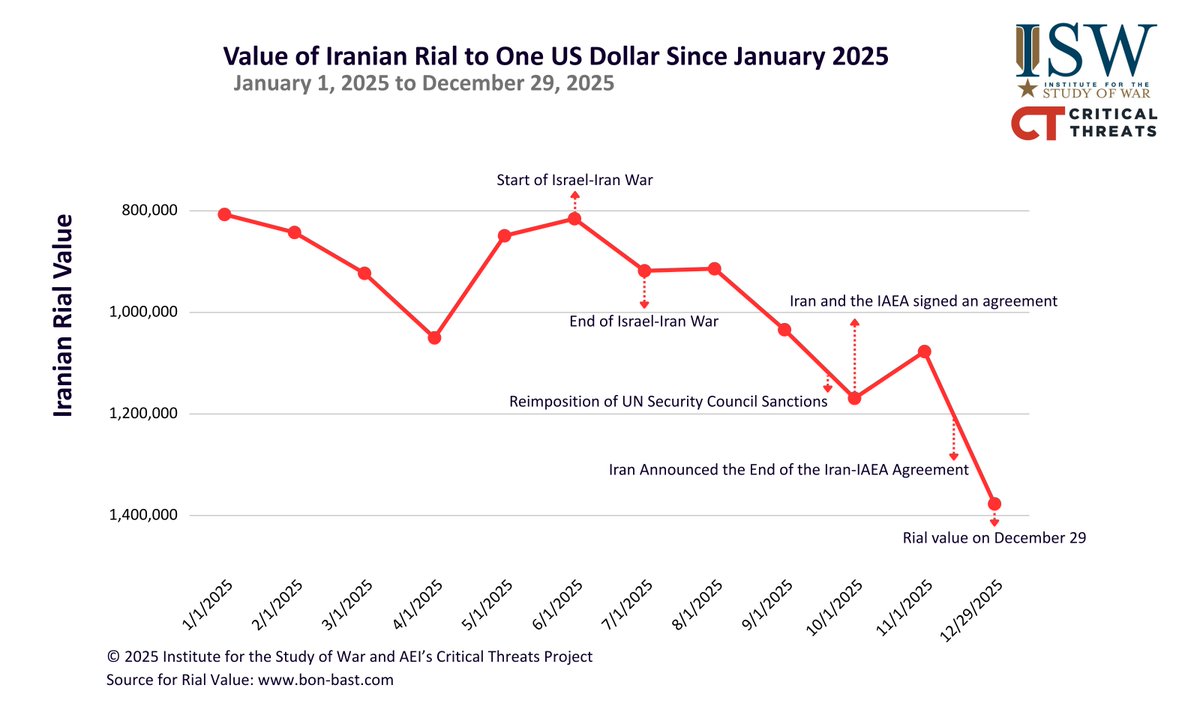
Current economic-related protests come as the Iranian regime is deliberating on Iran's 2026/27 budget, which is set to increase taxes to relieve Iran's budget deficit as state oil revenue decreases, but will put additional economic pressure on the Iranian people. Iranian President Masoud Pezeshkian defended his proposed budget in front of the Iranian Parliament's budget oversight committee on December 28, in which Pezeshkian proposed a tax increase by 62 percent.[9] This increase in the tax rate will worsen the economic challenges caused by inflation that are plaguing Iranians. Iranian outlets on December 28 and 29 criticized the budget for not adjusting salaries in accordance with the current 42.2 percent inflation rate.[10] The proposed 2025 budget reportedly reflects a decrease in dependency on oil revenue. Iranian oil revenue–its main source of government revenue–has dropped significantly, only meeting about 16 percent of the expected annual revenue in 2025, according to the parliamentary Budget and Planning Commission Deputy Chairman on November 6.[11] The parliament's budget oversight committee rejected Pezeshkian’s proposed 1405 March 2026 to March 2027 budget on December 29 and is set to provide feedback to Pezeshkian’s cabinet on December 30.[12]
Iranian regime-affiliated media recognized the protesters’ grievances as legitimate but warned that these protests could escalate into “unrest” or be exploited by Iran's adversaries. “Unrest” in this context presumably refers to anti-regime protests specifically, rather than protests over economic grievances.[13] IRGC-affiliated media acknowledged that Iranian merchants have been unable to pay rent for their shops due to the increase in the prices of imports and basic goods and drop in their sales, and even called on the government to take these economic protests seriously.[14] The regime's anxieties over these protests spiraling out of control and escalating into anti-regime protests are valid because previous economic protests have escalated into nationwide anti-regime protests in 2017 and 2018.[15] Iranian regime-affiliated outlets also warned that these could be exploited by Iranian adversaries, namely Israel.[16] The Iranian regime has repeatedly blamed Israel and the United States for anti-regime protests over the past decade.[17] The IRGC published an official statement on December 29, calling on the Iranian people to stay united amid the United States and Israel's efforts to undermine public trust and conduct “cognitive warfare.”[18] Mostafa Najafi, a political advisor close to former IRGC Commander and Expediency Discernment Council member Mohsen Rezaei, separately assessed on December 29 that Israel could exploit Iran's weakened position and attack Iran, and added that Israel could even convince the United States to attack Iran as well during Israeli Prime Minister Benjamin Netanyahu's visit to the United States.[19] Najafi noted that the Iranian regime needs to address external perceptions of internal unrest in Iran.[20]
The Iranian regime's attempts to address economic issues are unlikely to provide immediate relief to the economy, however. Pezeshkian replaced Iranian Central Bank Governor Mohammad Reza Farzin with former Economy Minister Abdol Nasser Hemmati on December 29, following pressure from “almost everyone in government,“ according to Najafi.[21] Hemmati previously served as Central Bank governor during US President Donald Trump's first round of maximum pressure between 2019 and 2021, when inflation rates increased from around 40 percent to 45 percent and the rial‘s value more than halved.[22] Pezeshkian claimed that his budget involved a 20-point plan, which involved controlling energy consumption and relying on trade with regional partners to ensure people's livelihoods, in an interview with the Supreme Leader's official outlet on December 27.[23] Pezeshkian held an emergency meeting with the government's economic team at the Central Bank on December 29 to discuss foreign exchange, trade, and livelihood policies after Parliament's budget oversight committee rejected his budget proposal.[24] One hundred sixty-five out of 290 Iranian parliamentarians separately signed a letter to Pezeshkian, Parliament Speaker Mohammad Bagher Ghalibaf, and Judiciary Chief Gholam Hossein Mohseni Ejei on December 25, in which they expressed their concern over severe price and foreign exchange rate fluctuations.[25] The letter presented five solutions to remove all competitor currencies to the rial from transactions (such as gold, cryptocurrencies, and foreign currencies) to strengthen the rial.[26] The Central Bank previously proposed and may have recently implemented other mechanisms, including exporting transactions to a secondary market to encourage exporters to return foreign currencies faster and increase the foreign currency reserve to help stabilize the foreign exchange market.[27] These mechanisms mean that, in theory, the Central Bank does not need to rely as much on building foreign reserves to control the exchange rate and subsequently inflation.[28] It remains uncertain whether any of these mechanisms would work in practice, as it would require public trust in the rial to stabilize inflation and the government's handling of the economy, which is currently lacking.
Russia is continuing to support the development of the Iranian space program. Russia launched three indigenous Iranian remote sensing satellites named Paya, Zafar 2, and Kowsar into orbit on December 28 using the Russian Soyuz space launch vehicle.[77] The Paya satellite is designed to deliver imagery with a resolution of around five meters in black and white and 10 meters in color.[78] The Kowsar satellite is the second model of the previously launched Iranian Kowsar satellite, which Russia launched into space in November 2024.[79] Russia has launched five Iranian-made satellites into orbit since 2022, including the Khayyam satellite in August 2022, the Pars-1 satellite in February 2024, the Kowsar and Hodhod satellites in November 2024, and the Nahid-2 satellite in July 2025.[80] IRGC-affiliated media previously reported in July 2020 that the IRGC uses satellites to collect intelligence on US military positions in the region, underscoring the importance of satellites to Iran's military forces.[81] Five- and ten-meter resolution imagery is very low resolution compared to commercially available 0.5m or 3m resolution imagery. Western media outlets, for example, commonly publish full-color satellite imagery at 0.5m resolution.
Iranian Armed Forces General Staff (AFGS)-controlled Defa Press warned on December 28 that Iran could use its “Hadid 110” drones to attack US military bases in the region, possibly to try to deter US and Israeli military action against Iran.[82] Iran showcased the Hadid 110 drone during the 2025 Sahand counterterrorism exercise in early December 2025.[83] The Hadid 110 is a fixed-wing, jet-powered, one-way drone that can fly up to 510 kilometers per hour at an altitude of 9 kilometers and can reach targets around 350 kilometers away.[84] It is the fastest Iranian drone (though it prioritizes speed over durability) and maintains a low radar visibility.[85] Defa Press stated that Iran could use the Hadid 110 to attack US military bases during a “full-scale conflict” between Iran and the United States.[86] Defa Press may have published this article in response to reports that Israeli Prime Minister Benjamin Netanyahu would brief US President Donald Trump on options for the United States to “join or assist” an Israeli military operation against Iran's ballistic missile program during his December 29 meeting with Trump.[87] Trump responded on December 29 to a question about whether he would allow Netanyahu to strike Iran again, stating, “for ballistic missiles, yes.”[88] Defa Press also published the threat to attack US military bases in English, which suggests that it was also intended for an English-speaking audience.[89]
https://understandingwar.org/research/middle-east/iran-update-december-29-2025/