Iran Update, January 8, 2026
Protest activity in Iran has expanded dramatically in both rate and magnitude since January 7, including in major cities like Tehran and in northwestern Iran. Protesters demonstrated in at least 156 instances across 27 provinces on January 8, which almost doubles the number of protests recorded on January 7.[1] The individual protests are also much larger than those prior to January 8 and include 60 medium-sized protests (over 100 participants) throughout the country.[2]
Protests and strikes have expanded to the Kurdish-populated Kurdistan Province in northwestern Iran. CTP-ISW has recorded six protests in Kurdistan Province.[3] The Kurdish Democratic Party of Iran (KDPI), Komala Party of Iranian Kurdistan, and Kurdistan Workers’ Party (PKK)-linked Kurdistan Free Life Party (PJAK), among others, called for a nationwide “general strike” on January 8 in response to the regime’s violent crackdown on protests in Kermanshah, Ilam, and Lorestan provinces.[4] Islamic Revolutionary Guards Corps (IRGC)-affiliated Tasnim News denounced the Kurdish groups’ call for a general strike, accusing them of attempting to incite riots.[5] The regime previously accused Kurdish opposition groups of inciting protests in Kurdish areas during the Mahsa Amini movement.[6]
Iranian leaders have long-standing concerns about Kurdish separatism and militancy in the western and northwestern provinces.[7] Iranian leaders have historically accused Kurdish militias in Iraq of operating in the border provinces and inciting social unrest. Those concerns grew particularly acute during the 2022-23 Mahsa Amini protests, which were partly concentrated among Kurdish communities that the regime worried the Kurdish militias could try to co-opt.[8] The regime appeared especially prepared to use extreme force to suppress protests in the western and northwestern provinces during the Mahsa Amini protests, at one point deploying the IRGC Ground Forces to conduct what the regime described as clearing operations across several towns and villages.[9] The expansion of the ongoing protests to northwestern Iran will reignite regime anxieties about Kurdish separatism and militancy there. That could in turn drive the regime to adopt an especially brutal crackdown in those areas, which may already happening in Kermanshah and Ilam provinces.
The regime has likely determined that these protests represent an extremely dire security threat and has intensified its crackdown accordingly, including by taking the rare step of using the Islamic Revolutionary Guards Corps (IRGC) Ground Forces to suppress protests in at least one province.[10] The regime used the IRGC Ground Forces to suppress protests in at least Kermanshah Province and possibly other provinces on January 8.[11] This is a rare step; the regime only deployed the IRGC Ground Forces once during the Mahsa Amini protests, but it did so in Kurdish-populated areas. Kermanshah Province, where there are reports of IRGC Ground Forces activity, has a large Kurdish population.[12] The regime tends to rely most heavily on the LEC and paramilitary Basij to manage social unrest and suppress protests.[13] The regime maintains elite Basij units that specialize in crowd control and repression and activates them when protests escalate meaningfully. The regime relies on the IRGC Ground Forces in the most extreme circumstances, during which the regime tends to approach protests as an insurgency rather than gatherings of aggrieved citizens. The IRGC Ground Forces is the final regime defense against civil upheaval and thus uses extreme levels of force to quell demonstrations.[14]
The use of the IRGC Ground Forces in Kermanshah and the reports of casualties there suggest that the regime is approaching the protests there as an insurgency rather than riots or protests. Norway-based human rights organization Hengaw claimed that two IRGC Ground Forces members were killed during the protests in Kermanshah City on January 8, citing Iranian state media outlets.[15] The deaths of the IRGC soldiers are notable because these individuals are from a military force, not the police, and should be more capable of protecting themselves. It is unclear what caused their deaths, though the deaths of two soldiers during protests indicate that the clashes between protesters and security forces have become particularly intense in Kermanshah City. Hengaw also claimed that forces from the Nabi Akram Operational Division fired live rounds at protesters in Kermanshah City, where the unit is based, on January 8.[16]
The use of the IRGC Ground Forces could indicate bandwidth constraints among security forces in addition to a shift in how the regime perceives the protests, however. The rapid expansion of the protests in space and magnitude may have outstripped the ability of the LEC and Basij to cover every protest. The lack of LEC and Basij manpower would require the regime to use the IRGC Ground Forces to continue to suppress ongoing protests.[17]
The regime arrested several security forces members on January 8 who reportedly refused orders to fire at protesters, according to a Norway-based human rights organization.[18] This is the only instance CTP-ISW has observed of security forces refusing orders at this time. Should this trend expand, however, it could cause major bandwidth constraints that would further limit the regime’s ability to suppress protests.
IRGC-affiliated media reported on January 8 that a Law Enforcement Command (LEC) member died of a stabbing injury he sustained on duty while attempting to contain protesters in Malard.[19] Protesters killed two LEC officers during protests in Lordegan, Chaharmahal and Bakhtiari Provinces, as well as an unspecified security force member in Malekshahi, Ilam Province.[20] The Iranian regime could use the deaths of security personnel as justification to intensify its suppression of Iranian protesters and contribute to the regime’s perception that it is suppressing insurgents rather than protesters or rioters.
The regime has also responded with sweeping internet shutdowns.[21] The regime has spent years developing its ability to impose localized internet shutdowns.[22] The regime has elected for a countrywide shutdown is dramatic and reflects how dire Iranian leaders perceive the situation. Countrywide internet shutdowns precede bloody crackdowns, as was the case during the Aban protests in November 2019. Reuters reported that the regime killed around 1,500 protesters during this period.[23]
The internet shutdown across Iran could severely limit the open-source information available to CTP-ISW. Our updates during the shutdown will likely reflect only some of the protest activity on a given day. Nevertheless, the continuation of the internet shutdown is an indicator in itself that a meaningful amount of protest activity is still occurring.
IRGC Quds Force Commander Brigadier General Esmail Ghaani reportedly urged unity among unspecified Iranian-backed Iraqi militia leaders on the issue of disarmament during a visit to Baghdad between January 6 and 8. Ghaani’s visit and his urgings demonstrate the continued divisions among Iraqi militias over disarmament.[24] “Informed” Iraqi sources told Asharq al Awsat that Ghaani emphasized the prevention of “internal differences or escalation” regarding disarmament during a meeting with unspecified Iraqi militia leaders in Baghdad.[25] Multiple prominent Iranian-backed Iraqi militia members have expressed varying positions on disarmament in recent weeks, even as the militias’ official coordinating body has attempted to maintain a unified face.[26] Ghaani’s visit to Baghdad follows a statement by the Iraqi Resistance Coordination Committee on January 4 that rejected calls for Iranian-backed Iraqi militias to disarm due to the continued presence of US and Turkish forces in Iraqi Kurdistan.[27] The Iraqi Resistance Coordination Committee is a coordinating body for Iranian-backed Iraqi militias.[28] Kataib Hezbollah, Kataib Sayyid al Shuhada, Harakat Hezbollah al Nujaba, Harakat Ansar Allah al Awfiya, and Asaib Ahl al Haq signed the statement.[29] CTP-ISW previously noted the inconsistencies between the committee’s statement and the positions that some of the militias that signed it have expressed about disarmament.[30] There may also be splits within as well as among the militias. A senior member of Asaib Ahl al Haq’s rejection of the statement on January 5 indicates that there may even be splinters within Asaib Ahl al Haq on the topic.[31] The United States has continuously pressured the Iraqi federal government to disarm Iranian-backed Iraqi militias, including throughout 2025.[32]
Ghaani may have attempted to increase militia support for disarmament in line with Iran’s reported efforts to push its larger partner militias in Iraq into politics. Iraqi political insiders told UK-based Amwaj media in November 2025 that Iran has encouraged unspecified Iranian-backed Iraqi militias to focus on political engagement instead of armed resistance, possibly to discourage US sanctions enforcement that would prevent Iran from using the Iraqi economy to evade sanctions.[33] Some prominent Iranian-backed Iraqi militias, including Kataib Hezbollah and Harakat Hezbollah al Nujaba, have refused to disarm.[34] Other militias, such as Kataib Sayyid al Shuhada, have attempted to obfuscate the relationship between the militias and the Iraqi state.[35] Kataib Sayyid al Shuhada Spokesperson Kazem al Fartousi claimed on December 20 that weapons are already restricted to the Iraqi state, and the militias therefore do not need to disarm.[36] Fartousi’s comments ignore the reality that many Iranian-backed Iraqi militias, such as Kataib Sayyid al Shuhada, possess weapons and are neither integrated into the Iraqi security forces nor answer to the Iraqi prime minister.[37]
https://understandingwar.org/research/middle-east/iran-update-january-8-2026/
1,618 posted on
01/09/2026 12:23:21 AM PST by
AdmSmith
(GCTGATATGTCTATGATTACTCAT)
To: nuconvert; gleeaikin
Iran’s Supreme Leader Ali Khamenei on Friday warned that Donald Trump would be “overthrown,” accused foreign-backed forces of fueling protests and said the Islamic Republic would not back down.
Exiled Prince Reza Pahlavi praised the nationwide turnout on Thursday night, after millions took the streets across the country, and urged more Iranians to join coordinated protests at 8 p.m. on Friday.
A nationwide internet and phone blackout hit Iran on Thursday and continued into Friday, according to live network metrics from network monitoring groups.
Millions of Iranians took the streets across the country at around 8 p.m. local time for a national rally called by exiled Prince Reza Pahlavi.
US President Donald Trump warned Iran’s authorities against killing demonstratorswhile praising Iranians as “brave people” amid nationwide protests on Thursday.
Casualty and arrest figures climbed further, with rights group HRANA reporting at least 42 people killed since protests began, including 34 protesters and two members of security forces. More than 2,000 people have been arrested.
Live link
https://www.iranintl.com/en/liveblog/202601054803
1,619 posted on
01/09/2026 5:23:19 AM PST by
AdmSmith
(GCTGATATGTCTATGATTACTCAT)
To: nuconvert; gleeaikin
Iran Update, January 9, 2026
The Iranian regime has sustained its nationwide internet shutdown, likely to disrupt protest coordination and obscure the scale of its crackdown.[1] Reports indicate that Iran's internet connectivity has remained at approximately one percent of normal levels since 3:00 PM ET on January 8.[2] The Iranian regime has historically imposed internet blackouts during periods of major unrest, including during the 2019 protests, when the regime killed around 1,500 protesters in less than two weeks.[3] The internet shutdown reflects the regime's concerns about the momentum of the protests and international scrutiny on its repression. The regime likely shut down the internet to disrupt protesters’ ability to communicate with one another and organize protests. The regime has also expanded its use of lethal force to crack down on protests beyond western and central Iran, and the internet shutdown is likely meant to hide the extent and brutality of the regime's crackdown across Iran.[4] A Norway-based Iranian human rights organization reported on January 9 that Iranian security forces have killed at least 51 protesters, including nine minors, and wounded hundreds of others since December 28.[5] Anti-regime media reported on January 9 that Iranian security forces killed at least 10 protesters during demonstrations in Fardis, Alborz Province.[6]
Widespread protest activity has continued to take place across Iran amid the internet shutdown. CTP-ISW has recorded 116 protests across 22 provinces since 3:30 PM ET on January 8.[7] Twenty of these protests were large protests, which CTP-ISW defines as protests with more than 1,000 participants.[8] CTP-ISW’s protest data since its last data cutoff likely reflects only part of the protest activity that has taken place in Iran since that time given that the internet shutdown restricts protesters’ ability to publish and share videos of the protests. Some protesters have reportedly used Starlink, which is a satellite-based internet service, to send reports of protests to foreign media.[9]
The protests in Iran may have expanded to such an extent that they are challenging Iranian security forces’ ability to suppress them. Regime security forces in Eslamabad-e Gharb, Kermanshah Province, retreated during intense clashes with protesters and were unable to receive reinforcements due to a shortage of security forces, according to a Kurdish human rights organization.[10] This report suggests that some Iranian security forces may be facing bandwidth constraints. CTP-ISW has not observed reports of security forces redeploying to other provinces, which could indicate that there is not a surplus of forces to reinforce areas with significant protest activity. The current scale of the protests and their distribution across wide swaths of Iran further complicate the regime's efforts to contain the protests. The New York Times reported on January 8 that security forces fled a protest in Bushehr City in southern Iran due to the large size of the protest, which highlights the challenge that large-scale protests pose to the regime's ability to impose control.[11]
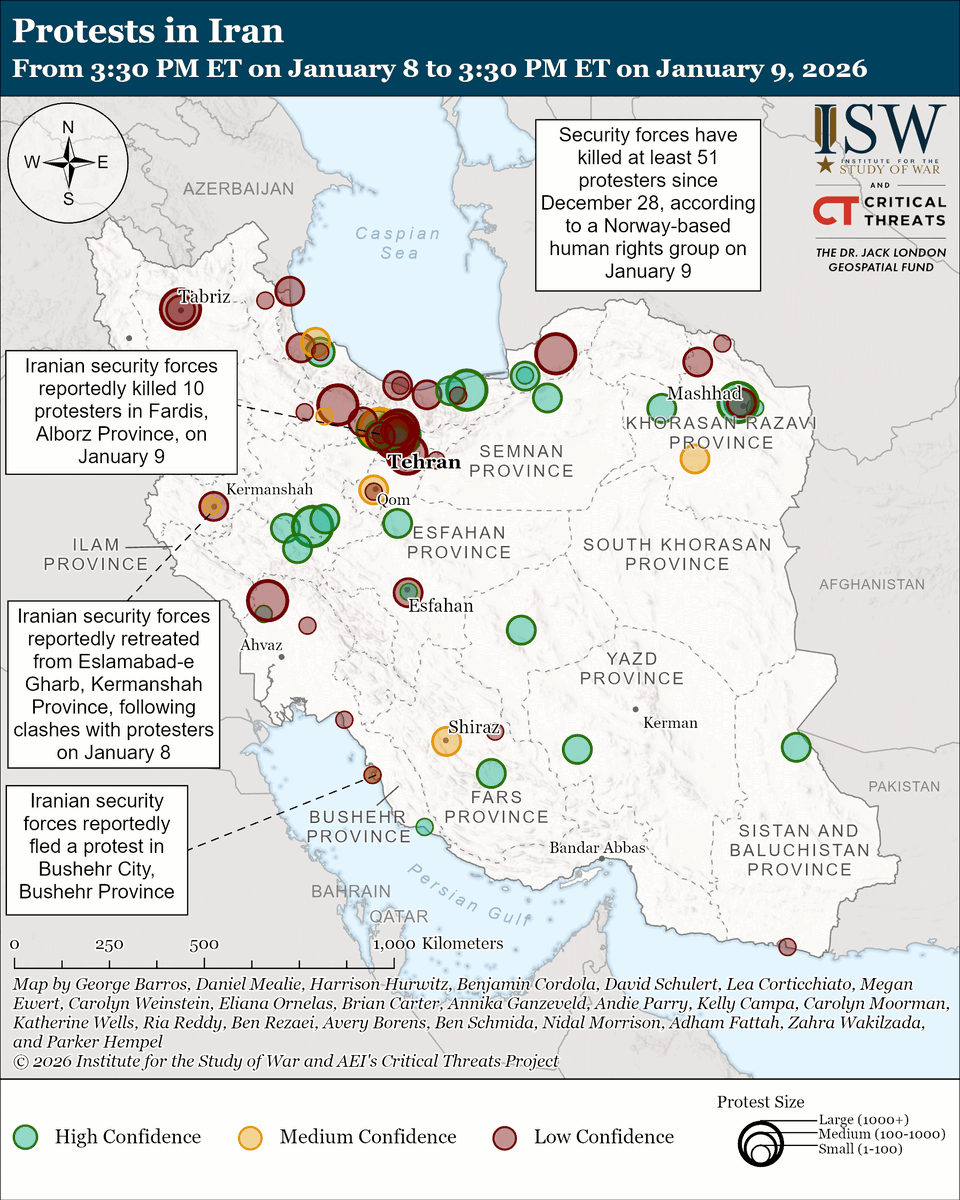
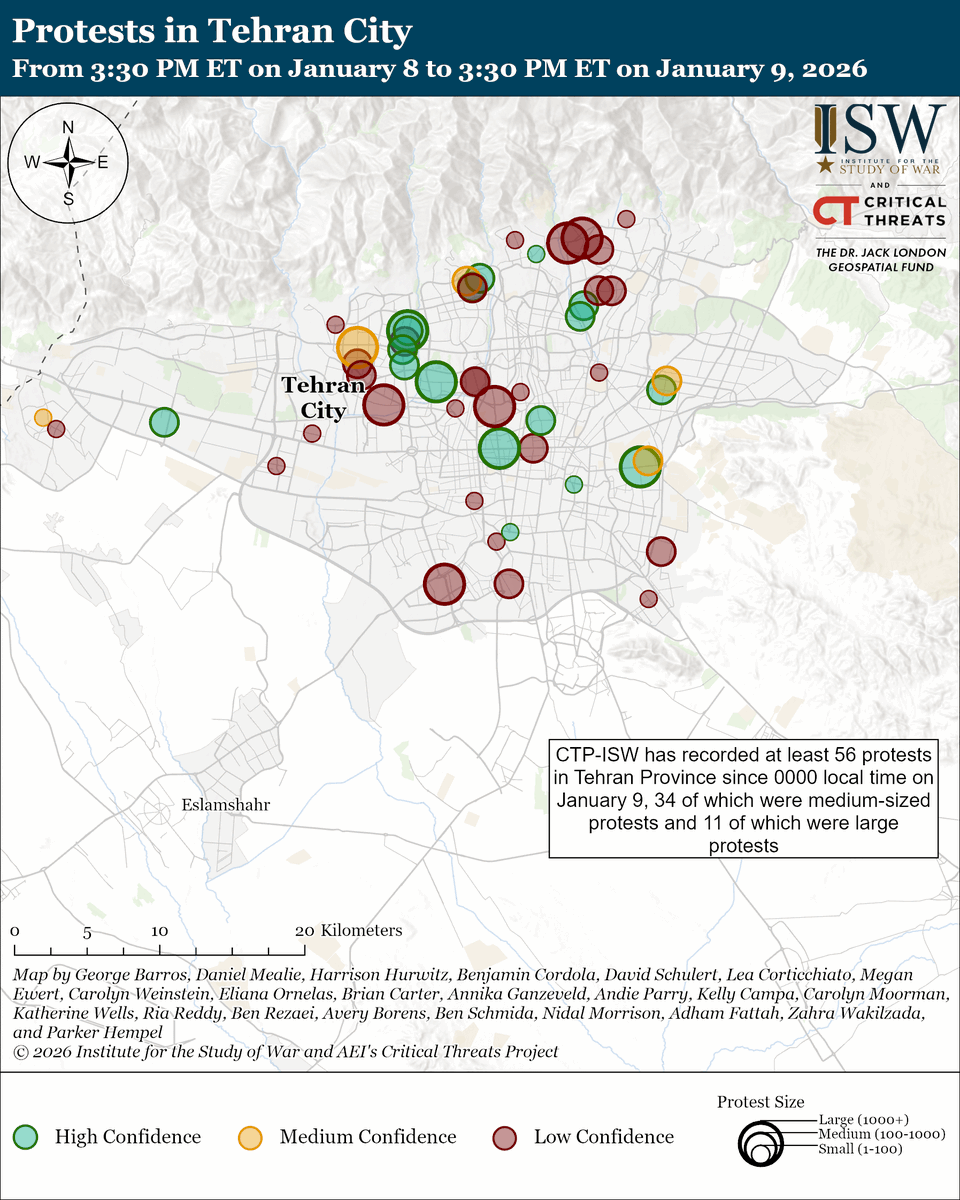
The Iranian regime may increasingly rely on the Islamic Revolutionary Guards Corps (IRGC) to suppress the protests as local Law Enforcement Command (LEC) forces reportedly face bandwidth constraints. An unspecified senior Iranian government official told the New York Times on January 8 that the Iranian regime is struggling to find a way to contain the “avalanche” of protests.[12] The official added that the IRGC would likely take over suppression efforts.[13] Anti-regime media reported on January 9 that clashes between protesters and security forces in Kermanshah Province killed at least 10 IRGC Ground Forces Nabi Akram Unit members.[14] The Nabi Akram Unit is headquartered in Kermanshah City and is subordinate to the Najaf-e Ashraf Operational Base, which oversees IRGC Ground Forces units in Kermanshah, Hamedan, and Ilam provinces.[15] The deaths of IRGC soldiers are notable because these individuals are from a military force, not the police, and should be more capable in violent situations. Social media users have also reported that the regime has deployed the IRGC in Ilam Province, although the regime has not confirmed this deployment at the time of this writing.[16]
Protesters damaged regime institutions in multiple cities across Iran on January 8 and 9.[17] Anti-regime media reported that protesters set fire to an Islamic Republic of Iran Broadcasting (IRIB) building in Esfahan on January 8.[18] Anti-regime media have also circulated videos of protesters burning the Iranian flag and images of Supreme Leader Ali Khamenei.[19] Tehran Mayor Alireza Zakani acknowledged damage to economic and public infrastructure on January 9.[20] Iranian officials have historically used protesters’ destruction of regime property to crack down on protests and frame protesters as rioters.[21]
Anti-regime media reported on January 9 that Iranians are unable to withdraw cash from Iran's largest bank. This banking disruption, if true, could exacerbate the current unrest in Iran. Anti-regime media reported that Iran's largest bank, Bank Melli, experienced a bank run and has suspended cash withdrawals.[22] Bank Melli’s suspension of cash withdrawals could exacerbate the current protests, which began on December 28 in response to Iran's deteriorating economic conditions.
Senior Iranian regime officials reaffirmed their hardline stance on the protests and willingness to sustain the regime's violent crackdown on the protests.
Prominent Iranian Sunni cleric Moulana Abdol Hamid may be reemerging as a catalyst for protests in southeastern Iran, which would compound the bandwidth constraints that Iranian security forces are reportedly facing. Abdol Hamid stated during his Friday sermon that Iranians believe that Iran is at an “impasse” and are seeking major, peaceful changes to ensure capable and inclusive governance and build positive relations with the world.[29] Abdol Hamid also urged security forces not to confront protesters, to avoid escalating tensions, and to respect citizens’ right to peaceful protest.[30] A medium-sized anti-regime protest, which CTP-ISW defines as a protest with 100-1,000 participants, broke out in Zahedan after Abdol Hamid’s January 9 sermon.[31] Security forces used live fire, plastic pellets, and tear gas to try to disperse the protesters.[32] Smaller protests separately took place in Chabahar, Sistan and Baluchistan Province, for the first time on January 9.[33] Abdol Hamid was a catalyst for protests in Zahedan during and after the Mahsa Amini movement. Zahedan residents began holding weekly protests after Friday prayers in late September 2022, after security forces violently suppressed protesters in an event that became known as “Bloody Friday.”[34] Zahedan residents continued to hold weekly Friday protests even after the Mahsa Amini protest movement culminated in other parts of the country.[35] The resumption of protest activity in southeastern Iran during the current wave of protests could further constrain Iranian security forces, as security forces also contend with unrest in other parts of the country.
https://understandingwar.org/research/middle-east/iran-update-january-9-2026/
1,634 posted on
01/10/2026 3:40:35 AM PST by
AdmSmith
(GCTGATATGTCTATGATTACTCAT)
FreeRepublic.com is powered by software copyright 2000-2008 John Robinson