Iran Update, January 9, 2026
The Iranian regime has sustained its nationwide internet shutdown, likely to disrupt protest coordination and obscure the scale of its crackdown.[1] Reports indicate that Iran's internet connectivity has remained at approximately one percent of normal levels since 3:00 PM ET on January 8.[2] The Iranian regime has historically imposed internet blackouts during periods of major unrest, including during the 2019 protests, when the regime killed around 1,500 protesters in less than two weeks.[3] The internet shutdown reflects the regime's concerns about the momentum of the protests and international scrutiny on its repression. The regime likely shut down the internet to disrupt protesters’ ability to communicate with one another and organize protests. The regime has also expanded its use of lethal force to crack down on protests beyond western and central Iran, and the internet shutdown is likely meant to hide the extent and brutality of the regime's crackdown across Iran.[4] A Norway-based Iranian human rights organization reported on January 9 that Iranian security forces have killed at least 51 protesters, including nine minors, and wounded hundreds of others since December 28.[5] Anti-regime media reported on January 9 that Iranian security forces killed at least 10 protesters during demonstrations in Fardis, Alborz Province.[6]
Widespread protest activity has continued to take place across Iran amid the internet shutdown. CTP-ISW has recorded 116 protests across 22 provinces since 3:30 PM ET on January 8.[7] Twenty of these protests were large protests, which CTP-ISW defines as protests with more than 1,000 participants.[8] CTP-ISW’s protest data since its last data cutoff likely reflects only part of the protest activity that has taken place in Iran since that time given that the internet shutdown restricts protesters’ ability to publish and share videos of the protests. Some protesters have reportedly used Starlink, which is a satellite-based internet service, to send reports of protests to foreign media.[9]
The protests in Iran may have expanded to such an extent that they are challenging Iranian security forces’ ability to suppress them. Regime security forces in Eslamabad-e Gharb, Kermanshah Province, retreated during intense clashes with protesters and were unable to receive reinforcements due to a shortage of security forces, according to a Kurdish human rights organization.[10] This report suggests that some Iranian security forces may be facing bandwidth constraints. CTP-ISW has not observed reports of security forces redeploying to other provinces, which could indicate that there is not a surplus of forces to reinforce areas with significant protest activity. The current scale of the protests and their distribution across wide swaths of Iran further complicate the regime's efforts to contain the protests. The New York Times reported on January 8 that security forces fled a protest in Bushehr City in southern Iran due to the large size of the protest, which highlights the challenge that large-scale protests pose to the regime's ability to impose control.[11]
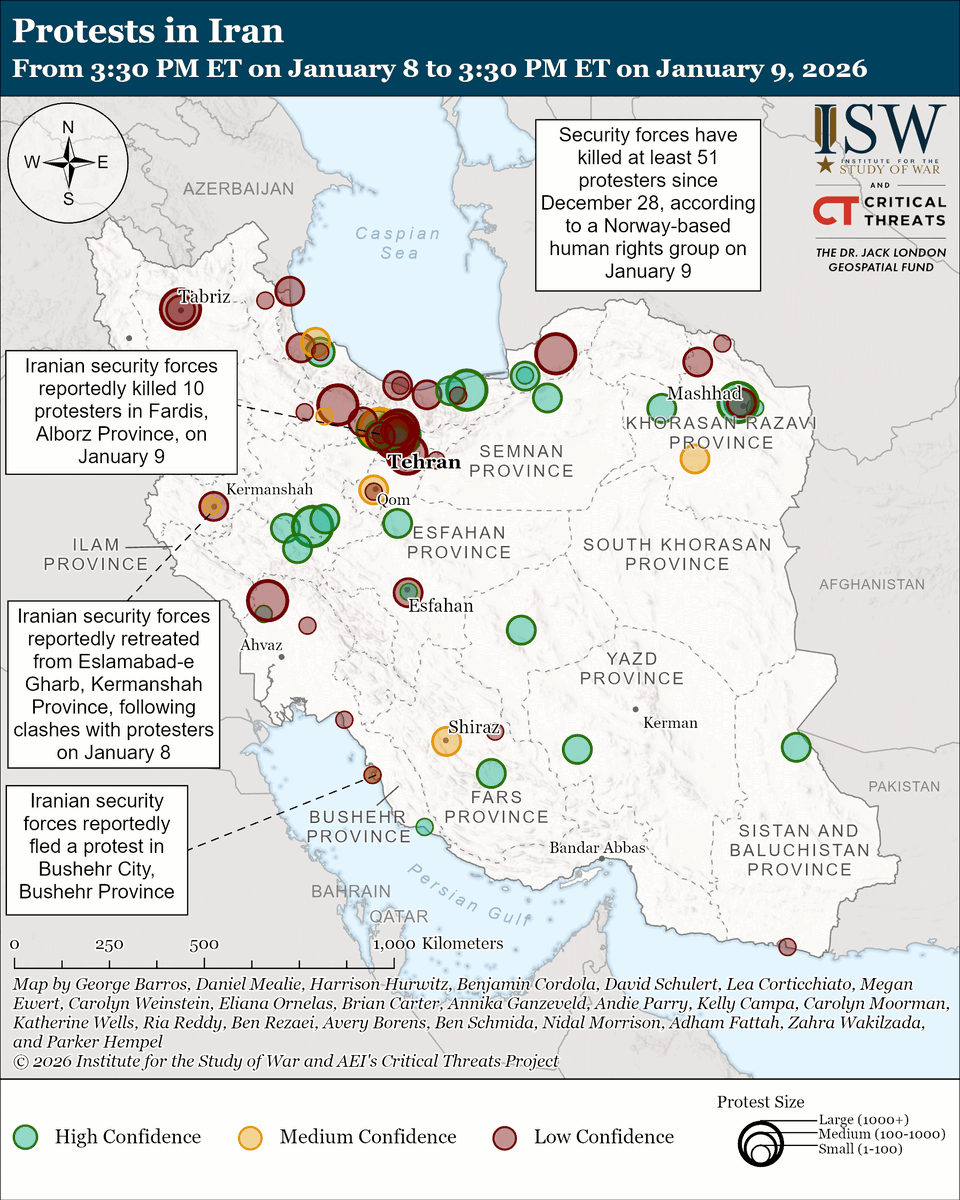
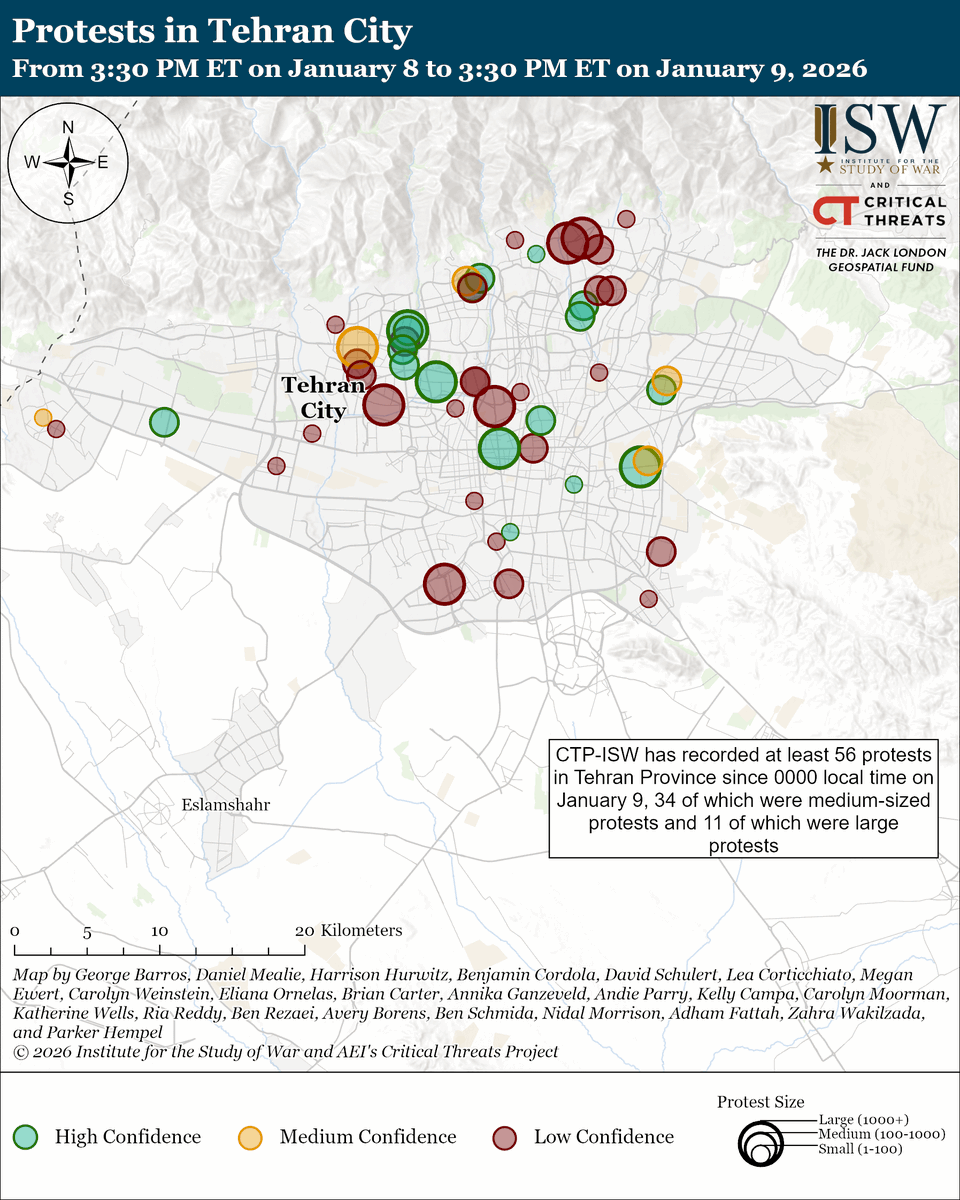
The Iranian regime may increasingly rely on the Islamic Revolutionary Guards Corps (IRGC) to suppress the protests as local Law Enforcement Command (LEC) forces reportedly face bandwidth constraints. An unspecified senior Iranian government official told the New York Times on January 8 that the Iranian regime is struggling to find a way to contain the “avalanche” of protests.[12] The official added that the IRGC would likely take over suppression efforts.[13] Anti-regime media reported on January 9 that clashes between protesters and security forces in Kermanshah Province killed at least 10 IRGC Ground Forces Nabi Akram Unit members.[14] The Nabi Akram Unit is headquartered in Kermanshah City and is subordinate to the Najaf-e Ashraf Operational Base, which oversees IRGC Ground Forces units in Kermanshah, Hamedan, and Ilam provinces.[15] The deaths of IRGC soldiers are notable because these individuals are from a military force, not the police, and should be more capable in violent situations. Social media users have also reported that the regime has deployed the IRGC in Ilam Province, although the regime has not confirmed this deployment at the time of this writing.[16]
Protesters damaged regime institutions in multiple cities across Iran on January 8 and 9.[17] Anti-regime media reported that protesters set fire to an Islamic Republic of Iran Broadcasting (IRIB) building in Esfahan on January 8.[18] Anti-regime media have also circulated videos of protesters burning the Iranian flag and images of Supreme Leader Ali Khamenei.[19] Tehran Mayor Alireza Zakani acknowledged damage to economic and public infrastructure on January 9.[20] Iranian officials have historically used protesters’ destruction of regime property to crack down on protests and frame protesters as rioters.[21]
Anti-regime media reported on January 9 that Iranians are unable to withdraw cash from Iran's largest bank. This banking disruption, if true, could exacerbate the current unrest in Iran. Anti-regime media reported that Iran's largest bank, Bank Melli, experienced a bank run and has suspended cash withdrawals.[22] Bank Melli’s suspension of cash withdrawals could exacerbate the current protests, which began on December 28 in response to Iran's deteriorating economic conditions.
Senior Iranian regime officials reaffirmed their hardline stance on the protests and willingness to sustain the regime's violent crackdown on the protests.
Prominent Iranian Sunni cleric Moulana Abdol Hamid may be reemerging as a catalyst for protests in southeastern Iran, which would compound the bandwidth constraints that Iranian security forces are reportedly facing. Abdol Hamid stated during his Friday sermon that Iranians believe that Iran is at an “impasse” and are seeking major, peaceful changes to ensure capable and inclusive governance and build positive relations with the world.[29] Abdol Hamid also urged security forces not to confront protesters, to avoid escalating tensions, and to respect citizens’ right to peaceful protest.[30] A medium-sized anti-regime protest, which CTP-ISW defines as a protest with 100-1,000 participants, broke out in Zahedan after Abdol Hamid’s January 9 sermon.[31] Security forces used live fire, plastic pellets, and tear gas to try to disperse the protesters.[32] Smaller protests separately took place in Chabahar, Sistan and Baluchistan Province, for the first time on January 9.[33] Abdol Hamid was a catalyst for protests in Zahedan during and after the Mahsa Amini movement. Zahedan residents began holding weekly protests after Friday prayers in late September 2022, after security forces violently suppressed protesters in an event that became known as “Bloody Friday.”[34] Zahedan residents continued to hold weekly Friday protests even after the Mahsa Amini protest movement culminated in other parts of the country.[35] The resumption of protest activity in southeastern Iran during the current wave of protests could further constrain Iranian security forces, as security forces also contend with unrest in other parts of the country.
https://understandingwar.org/research/middle-east/iran-update-january-9-2026/
Iran Update, January 10, 2026
The Iranian regime has shifted from labeling protesters as “rioters” to describing them as “terrorists,” which signals that the regime has taken an uncompromising stance toward the ongoing protests.[1] The regime will likely use its characterization of protesters as “terrorists” to justify further cracking down on the protests. Supreme National Security Council Secretary Ali Larijani distinguished on January 9 between protesters with legitimate economic demands and “urban semi-terrorist[s]” who conduct armed attacks. Islamic Revolutionary Guards Corps (IRGC)-affiliated media have repeatedly described protesters as “terrorists” and compared them to Islamic State in Iraq and al Sham (ISIS) fighters.[2] The “terrorist” label portrays protesters as an existential security threat that warrants a forceful and violent response.
The regime has also explicitly signaled its willingness to use lethal force to suppress protests. Ammar Headquarters Central Council member Hossein Yetka, who is close to Iranian Supreme Leader Ali Khamenei and his son, Mojtaba Khamanei, called on Basij members and regime supporters to mobilize and warned Iranians not to complain if “shots are fired or if something happens to someone.”[3] Yekta served in the IRGC Ground Forces Habib Ibn Mazaher Battalion during the Iran-Iraq War.[4] Many former members of that battalion, such as Hossein Taeb, Mehdi Taeb, Alireza Panahian, and Hassan Mohaghegh, have held or currently hold influential positions in the regime, especially related to internal security.[5] An anti-regime outlet reported in November 2022 that Yekta is linked to a network of individuals within the regime who finance the regime’s repression apparatus.[6]
The regime is increasingly approaching the protests as a military issue rather than a law enforcement or crowd control issue. The Artesh, which is Iran’s conventional military, issued a statement on January 10 in which it vowed to protect national interests, strategic infrastructure, and public property. The statement, similar to senior regime officials and state media, framed the protests as a plot by Iran’s adversaries, namely the United States and Israel, to disrupt public security.[7] The Artesh statement comes amid an unverified report of the deployment of Artesh forces in Karaj, Alborz Province, on January 10.[8] It is notable that the Artesh has indicated that it could get involved in the protests, given that it has historically played a limited role in suppressing domestic unrest. It is unclear what role the Artesh would play in the regime’s crackdown on the protests and whether Artesh personnel would demonstrate the same willingness to repress protesters as more ideological security institutions, such as the IRGC and Basij. The regime has also reportedly continued to deploy IRGC forces to suppress the unrest.[9] A citizen in Bukan, West Azerbaijan Province, told a Kurdish human rights organization on January 10 that IRGC forces had deployed to this city.[10] IRGC Ground Forces Nabi Akram Unit members have also been involved in the suppression of protests in Kermanshah.[11] An unspecified eyewitness in western Iran told Reuters on January 10 that IRGC forces were deployed to western Iran and opened fire on protesters.[12] CTP-ISW assessed on January 8 that the regime has taken the rare step of using the IRGC Ground Forces to suppress protests because it has likely determined that these protests represent a dire security threat to the regime.[13]
There are further indications that the ongoing protests are challenging the ability and willingness of Iranian security forces to crack down on the protests. The IRGC Intelligence Organization released a statement on January 10 that it is “dealing with possible acts of abandonment.”[14] This statement suggests that some Iranian security forces may have already defected or that the regime is very concerned about this possibility. A Law Enforcement Command (LEC) officer from an unspecified Kurdish-majority city in northwestern Iran told TIME on January 7 that Iranian security forces disagree over whether a “massive” regime crackdown on protests will contain the protests or incite further unrest.[15] The officer said that all of the officers at his station believe the regime is collapsing.[16] The officer added that he works in the LEC for money, “not to kill people.”[17] A Kurdish human rights organization previously reported on January 8 that the regime had arrested “dozens“ of security force members in Kermanshah City who refused to fire on protesters.[18] The regime may have started to frame protesters as “terrorists” to increase security forces’ willingness to use lethal force against protesters and reduce the risk of defections. The regime’s potential deployment of the Artesh would further indicate that the protests are challenging security forces’ ability and willingness to repress the unrest. The Artesh is generally less ideological and more representative of the Iranian population than the IRGC, which increases the risk that Artesh members could defect.[19] The deployment of the Artesh, which is not trained to control civil unrest, would also indicate that Iranian security forces may face bandwidth constraints, given that the regime would likely not deploy the Artesh unless it absolutely had to.[20]
Protest activity has continued to take place across Iran amid the Iranian regime’s continued nationwide internet shutdown. CTP-ISW has recorded 60 protests across 15 provinces since 0000 local time on January 10, 25 of which were medium-sized and eight of which were large.[21] CTP-ISW defines medium protests as protests with between 100 and 1,000 participants and large protests as protests with more than 1,000 participants. CTP-ISW recorded a decrease in the rate of protests on January 10 compared to the 116 protests across 22 provinces that it recorded on January 9.[22] The decrease in recorded protest activity is at least partly due to the Iranian regime’s nationwide internet shutdown that has been in effect for over 48 hours.[23] CTP-ISW’s protest data since its last data cutoff likely reflects only part of the protest activity that has taken place in Iran since that time, given that the internet shutdown restricts protesters’ ability to publish and share videos of the protests. Protesters have continued to reportedly use Starlink, which is a satellite-based internet service, to send reports of protests to foreign media.[24]
The regime has killed hundreds of protesters and injured hundreds more in its violent crackdown on the protests. A Tehran-based doctor told TIME on January 9 that six hospitals in Tehran have recorded at least 217 protester deaths since January 8.[25] Local Iranian sources in Tehran told anti-regime media on January 10 that “a large number” of protesters have been shot and killed by Iranian security forces in Tehran since January 8.[26] Several Iranian medical professionals told Western media on January 9 and 10 that Iranian hospitals are overwhelmed with casualties from the protests.[27] A doctor similarly told the BBC on January 9 that Farabi Hospital in Tehran is in “crisis mode” due to the number of wounded protesters.[28] A doctor told Reuters on January 10 that “large numbers” of injured protesters have been brought to hospitals in northwestern Iran since January 9 with head injuries, broken limbs, deep cuts, and gunshot wounds.[29] Unspecified sources told anti-regime media on January 8 that Iranian security agencies have threatened doctors and instructed them not to treat injured protesters in an effort to prevent information about protest-related injuries from leaving hospitals, citing unspecified sources.[30] Iranian security agencies told doctors to report any injured protesters who sought treatment to the security agencies immediately.[31] Unspecified observers reported that Iranian security forces have begun to forcibly remove protesters from medical facilities.[32] Iranian security forces previously raided a hospital in Ilam Province where injured protesters were being treated on January 5.[33]
There are unconfirmed reports of Kurdish militant activity in northwestern Iran. The Kurdistan National Guard announced on January 9 that its “Zagros Tornado units” attacked an IRGC base in Nourabad, Lorestan Province, and injured three IRGC members.[34] CTP-ISW cannot verify this attack at the time of this writing. It is unclear if the Kurdistan National Guard has ties to other Kurdish anti-regime groups that operate in northwestern Iran, such as the Kurdistan Workers’ Party (PKK)-linked Kurdistan Free Life Party (PJAK). Iranian state media outlet Mehr News separately reported on January 10 that Iranian authorities killed a group of PJAK fighters who were attempting to enter Iran from Iraq in rural areas of Ilam and Kermanshah provinces.[35] Iranian leaders have historically accused Kurdish groups in Iraqi Kurdistan of operating in Iranian border provinces and inciting social unrest. Those concerns grew particularly acute during the 2022-2023 Mahsa Amini protests, which were partly concentrated among Kurdish communities in northwestern Iran.[36] These Kurdish anti-regime groups do not represent the ongoing protest movement and its grievances.
US officials told the Wall Street Journal on January 10 that US officials have held “preliminary discussions” about taking military action against the Iranian regime. The officials stated that there is no sign of an imminent attack on Iran, however.[37] US President Donald Trump warned Iranian leadership on January 9 that the United States would get involved if the regime fires at protesters.[38] Trump issued a similar social media statement on January 10, stating that the United States is ready to help Iranian protesters achieve freedom.[39] A US official told the Wall Street Journal on January 10 that the Trump administration has discussed launching airstrikes targeting unspecified Iranian military sites to follow through on Trump’s repeated warnings to the regime.[40] Another US official stated that there is no consensus on what military action to take.[41] The US officials added that the United States has not moved any equipment or personnel to prepare for military action and that there is no “sign of an imminent attack on Iran.”[42]
https://understandingwar.org/research/middle-east/iran-update-january-10-2026/