https://bsky.app/profile/wartranslated.bsky.social/post/3m7x7bdrjjk25
Posted on 10/08/2022 1:05:38 PM PDT by nuconvert
Iranian Regime national tv Channel One hacked about an hour ago. During a broadcast of Khamenie speech, a red crosshair appeared over his face and chanting of Women. Life. Freedom. There was writing to the side saying "Rise up. Join us". Also 4 photos at the bottom of the screen of young people killed and additional writing: "The blood of our youth is dropping from your paws".
Also, there was a huge banner in the middle of Tehran highway today that read: We are no longer afraid of you. We will fight.
Also, attempted attack on IRI ambassador in Denmark. Her bodyguard was stabbed. Diplomatic Security intervened before the attacker could stab the ambassador.
Iranian-backed Iraqi actors reportedly pressured the Iraqi federal government to reverse its decision to designate the Houthis and Lebanese Hezbollah as terrorist organizations.[13] Iraqi state media reported on December 4 that the Iraqi Committee for Freezing Terrorist Funds had designated the Houthis and Hezbollah as terrorist organizations and froze the groups’ assets in mid-November 2025.[14] The committee later announced that it would remove the Houthis and Hezbollah from the list of designated terrorist organizations.[15] Iraqi Prime Minister Mohammad Shia al Sudani ordered an investigation of the incident on December 4.[16] Two Iraqi officials told the Associated Press on December 4 that the Iraqi federal government reversed its terrorist designation of the Houthis and Hezbollah due to pressure from Iranian-backed Iraqi militias and politicians.[17] The militias reportedly accused the government of targeting regional allies and risking conflict with Iran. Many Iranian-backed Iraqi actors condemned the Iraqi federal government's designation of the Houthis and Hezbollah on December 4.[18] This incident comes as the United States has repeatedly pressured the Iraqi federal government to reduce Iranian influence in Iraq.[19]
The Islamic Revolutionary Guards Corps (IRGC) Navy began an annual two-day military exercise on December 4 in which it displayed its “interception” capabilities, likely as part of an Iranian effort to deter the United States and its allies from seizing Iranian vessels.[45] The exercise took place in the Persian Gulf, Strait of Hormuz, and Gulf of Oman. The IRGC Navy claimed on December 4 that it alerted US vessels in the region about the exercise.[46] The Iranian regime's primary English language news outlet stated on December 4 that this exercise sends a “dual message” of peace toward Iran's regional partners and a warning to Iran's adversaries that Iran will confront any “miscalculations” with “a decisive response.”[47] The IRGC Navy previously used this annual exercise to signal Iran's commitment to “sustainable security” in the region but did not issue a warning to the United States and its allies.[48] The IRGC Navy also named this year's exercise after deceased IRGC Navy commander Mohammad Nazeri, who was reportedly involved in the seizure of two US patrol boats and 10 US personnel in the Persian Gulf in January 2016.[49] Senior Iranian military officials have consistently threatened to close the Strait of Hormuz if the United States blocks Iranian oil exports since the Israel-Iran War.[50]
Iran is using recent Israeli actions in the Middle East to try to rally regional countries against Israel. Iranian efforts to discourage regional countries, including the Gulf states, from cooperating with the United States and Israel are unlikely to succeed, however. Tehran Mayor Alireza Zakani emphasized in an interview on December 2 that Iran must create a “new front” in the region to counter Israeli and US influence.[51] Zakani is a hardline politician who has served as the mayor of Tehran since 2021. Zakani claimed that regional countries, including Turkey, realized that they cannot trust the United States and Israel after the June 2025 Israel-Iran War. Zakani added that some regional countries realized after the war that Western military equipment and defense coalitions cannot protect them against Israeli threats. Zakani’s comments come after Iranian officials highlighted the opportunity for Iran and Turkey to work together to counter Israel's presence in Syria during Turkish Foreign Minister Hakan Fidan’s visit to Tehran on December 1.
Zakani’s remarks about regional countries not being able to trust Israel bear similarities to Iran's effort to isolate Israel and the United States after the Israeli strike in Doha in September 2025. Iranian officials used Israel's strike in Doha to frame the United States as an unreliable security guarantor for Gulf states in an effort to break up the nascent anti-Iran coalition in the region.[52] Gulf states condemned the Israeli strike in Doha and Iran exploited the Gulf states’ frustration by questioning the reliability of the United States as a security partner.[53] Iranian officials, for example, misrepresented the degree of US knowledge of the Israeli strike and suggested that US-brokered agreements are incapable of defending Arab states from Israeli attacks.[54]
Iran seeks to increase defense cooperation with the People's Republic of China (PRC) through joint educational and security research.General Xiao Tianliang, signed a memorandum of understanding (MoU) on security research cooperation in Beijing on December 4.[55] The MoU includes the exchange of students and instructors as well as joint courses between the two universities.[56] Tianliang is one of the PRC's most important military strategic thinkers.[57] Tianliang’s expertise suggests that Moghaddam and Tianliang may have had a high-level strategic discussion during Moghaddam’s visit to Beijing.[58] Moghaddam served as the Iranian Law Enforcement commander between 2005 and 2015 and has been involved in the regime's crackdowns on domestic dissent.[59] The United States sanctioned Moghaddam in 2011 for human rights abuses.[60] Iran has recently held similar military-education cooperation meetings with other partners, such as Belarus.[61]
https://understandingwar.org/research/middle-east/iran-update-december-4-2025/
The Islamic Revolutionary Guards Corps (IRGC) Navy continued its two-day naval exercise on December 5 that likely aims to simultaneously deter the United States and its allies from seizing Iranian vessels and prepare for potential future maritime escalation.[25] The exercise took place in the Persian Gulf, Strait of Hormuz, and Gulf of Oman. The IRGC Navy fired medium-range Ghadr-110 ballistic missiles, Ghadr-380 anti-ship cruise missiles, Ghadir cruise missiles, and unspecified “303” ballistic missiles from multiple inland launch sites.[26] Iranian media did not provide any details about the “303” ballistic missile. The ship-mounted surface-to-air Navab air defense system struck projectiles targeting IRGC Navy fast attack craft and Iran's coastline.[27] Iranian media claimed that the IRGC Navy used the Sejjil anti-ship cruise missile, which reportedly has a range of 180 kilometers, for the first time during the exercise.[28] Iran has reportedly previously tried to send Sejjil anti-ship cruise missiles to the Houthis.[29] The Iranian regime's primary English language news outlet stated on December 4 that this exercise sent a “dual message” of peace toward Iran's regional partners and a warning to Iran's adversaries that Iran will confront any “miscalculations” with “a decisive response.”[30]
Iran is trying to portray itself as a reliable security partner for Eurasian countries, particularly Russia and the People's Republic of China (PRC). Armed Forces General Staff-affiliated Defa Press published an op-ed on December 5 in which it argued that Iran's recent “Sahand 2025” counterterrorism exercise demonstrated Iran's importance to the Shanghai Cooperation Organization (SCO) and its reliability as a security partner.[31] Iran held the exercise near the IRGC Ground Forces Imam Zaman Mechanized Brigade's headquarters in East Azerbaijan Province between December 1 and 5.[32] All ten SCO members, which include Russia, Belarus, and the PRC, sent military delegations to participate in the exercise.[33] The op-ed stated that the exercise sent a “geopolitical message” that Iran is ready to “form a new security order alongside the great Asian powers.”[34] The op-ed claimed that the exercise increased SCO members’ confidence in Iran's ability to guarantee the “security of economic and strategic routes.” Defa Press was likely referring to regional transportation routes, which Iran has sought to develop as a means to facilitate trade with regional countries and undermine sanctions. IRGC Commander Major General Mohammad Pakpour stated on December 4 that Iran is also prepared to share its counterterrorism expertise with SCO members “without any restrictions.”[35] Iran may be trying to position itself as a reliable security partner to SCO members as part of Iran's longstanding effort to undermine the US-led international order by strengthening ties with partners in multilateral security and economic institutions.[36]
https://understandingwar.org/research/middle-east/iran-update-december-5-2025/
Senior Iranian military officials called on students at Islamic Revolutionary Guards Corps (IRGC)-controlled universities to help the Iranian armed forces improve their technological and “preemptive” capabilities. Iranian Armed Forces General Staff Chief Major General Abdol Rahim Mousavi and Islamic Revolutionary Guards Corps (IRGC) Commander Major General Mohammad Pakpour gave speeches to students at the IRGC-controlled Command and Staff University and Imam Hossein University, respectively, on December 7.[67] Both officials called on the Iranian armed forces to develop and utilize advanced technologies, such as artificial intelligence.[68] Mousavi emphasized the need for Iran to keep up with technological developments and strengthen the armed forces’ “preemptive capabilities.”[69] Iranian media noted that developing “preemptive capabilities” is consistent with Iran's “active deterrence” strategy, which is an offensive strategy that Iran has employed since at least 2014.[70] “Active deterrence” emphasizes the need for Iran to intervene in situations abroad in order to expand Iranian influence and confront threats before they endanger Iran.[71] Pakpour highlighted applications for artificial intelligence in surveillance and targeting and stated that “stealth technology” could improve Iranian missiles’ ability to penetrate Israeli air defenses.[72] Pakpour emphasized that “more work should be done at Imam Hossein University in areas such as air defense and stealth technology.”[73] Mousavi and Pakpour’s emphasis on technological developments comes after Israel reportedly used artificial intelligence to identify Iranian targets during the war.[74]
Unspecified European diplomats told Al Monitor on December 6 that Israel would likely strike Iran in the next year if Iran resumes enriching uranium at high levels.[75] The diplomats stated that Israel would likely attack Iran if Iran takes “serious steps” to enrich uranium and advance its ballistic missile capabilities, and if the United States and Iran do not reach a nuclear deal. The European diplomats did not provide any evidence for these assertions, however. Iran has made minimal progress in repairing its three main nuclear sites that Israel and the United States damaged during the June 2025 Israel-Iran War but has conducted “extensive” clean-up efforts at several nuclear weaponization sites, according to satellite imagery analyzed by the Institute for Science and International Security.[76] The Institute assessed on November 21 that Iran's clean-up efforts at three nuclear weaponization sites “may be the prelude to rebuilding or related to sanitization activities.”[77] There are no indications that Iran has resumed enriching uranium or retrieved its highly-enriched uranium stockpile after the war. Iran possessed 440.9 kilograms of uranium enriched up to 60 percent before the start of the war, which is enough uranium, if enriched further, to produce at least 10 nuclear weapons.[78] A political analyst with ties to the Iranian regime assessed on December 7 that the probability of a “limited” and ”targeted” Israeli attack on Iran is high and that President Donald Trump's newly released National Security Strategy aims to uphold “the status quo” by containing Iran rather than pursuing strategic reconciliation or full-scale war.[79] The analyst claimed that the United States aims to keep Iran in a permanent state of “defense and effort to preserve survival” and prevent Iran from rebuilding its deterrence and influence.[80] The analyst suggested that Iran can impose costs on Israel and Arab states to reduce their willingness to contain Iran in line with the US National Security Strategy.[81]
Iran is pragmatically pursuing closer diplomatic and trade ties with Azerbaijan amid Iranian concerns about Azerbaijan's relationships with the United States and Israel, which Iran perceives as a threat to its security. Iranian Foreign Affairs Minister Abbas Araghchi met with Azerbaijani President Ilham Aliyev in Baku on December 8 to discuss strengthening Iranian-Azerbaijani relations.[82] Araghchi reaffirmed Iran's support for the 3+3 format, which is a diplomatic initiative involving Iran, Turkey, Russia, Armenia, and Azerbaijan to ensure security in the Caucasus through trade “without any foreign interference.”[83] Araghchi and his Azerbaijani counterpart, Jeyhun Bayramov, also discussed how Iran and Azerbaijan are expanding bilateral trade through border infrastructure projects, such as the Rasht-Astara Railway and the Aghband-Kalalah highway bridge.[84] An Iranian expert on the Caucasus told Iranian media on December 8 that Iran wants Azerbaijan to join the Eurasian Economic Union (EAEU) to remove trade barriers between the two countries.[85] Iran is not an EAEU member but has had an “observer status” in the union since 2024 and signed a free trade agreement with the EAEU in May 2025. Member or observer status in the union reduces tariffs by 90 percent.[86] The Iranian expert noted that increased trade between Iran and Azerbaijan would activate Iran‘s land trade routes with Russia and support Iran's regional trade network.[87] Iran's efforts to increase trade with Azerbaijan come amid Iranian officials’ concerns about US and Israeli interference in the Caucasus. The United States proposed in August 2025 to oversee the development of the Zangezur Corridor in southern Armenia to connect Azerbaijan to the Nakhchivan Autonomous Region.[88] The corridor would run along Iran's only shared border with Armenia and sever Iran's land access to Russia and Europe via Armenia, which could hinder Iranian efforts to become a major transit hub. Some Iranian media outlets separately accused Azerbaijan of allowing Israel to launch attacks against Iran from Azerbaijani territory during the June 2025 Israel-Iran War, which Azerbaijan has denied.[89] Iran remains concerned about Israeli infiltration into Iranian territory from Azerbaijan, as well as Azerbaijan's deepening relationship with Israel.[90]
https://understandingwar.org/research/middle-east/iran-update-december-8-2025/
Iran Update, December 9, 2025
Iran is reportedly prioritizing the rapid restoration of its ballistic missile production capacity over other aims, such as the reconstruction of its nuclear program. This prioritization signals that Iran views the restoration of its missile capabilities as an immediate strategic priority, likely because it is more readily achievable in the short term. A senior Israel Defense Forces (IDF) official told the Israeli Knesset on December 8 that Iran has resumed large-scale production of ballistic missiles.[1] Western diplomats also told Israeli media that Iran’s “top priority” is to restore the ballistic missile project, even if Iran does not appear to be advancing its nuclear program.[2] The diplomats also told Israeli media on December 8 that Iran is using older manufacturing methods to continue producing ballistic missiles.[3] Older manufacturing methods could refer to “trough-type mixers,” which are less efficient than the planetary mixers that Israel destroyed in October 2024, although CTP-ISW is unable to verify the type of mixers that Iran is currently using at the time of this writing.[4] Iran has begun rebuilding the Parchin and Shahroud missile production facilities, which Israel destroyed during the Israel-Iran War, since August 28 and September 5, respectively, according to satellite imagery analyzed by the Associated Press.[5] Iranian officials have long considered the ballistic missile program to be a crucial deterrent to Israel and the United States.
The Iranian assumption that Israel will resume the Israel-Iran War in the short term is likely animating the decision to prioritize the Iranian missile program over other defense priorities. Iranian officials have repeatedly publicly stated that they expect the war between Iran and Israel to resume imminently since the war ended in June 2025.[6] Iranian officials continue to say that they view ballistic missiles as a key deterrent to Israeli strikes, despite the ineffectiveness of Iranian ballistic missiles in the Israel-Iran War. Former Islamic Revolutionary Guards Corps (IRGC) Commander Mohammad Ali Jafari argued in October 2025 that Iran’s missile program is its main form of deterrence and that Iran deliberately prioritized developing its missile and drone capabilities over its air and ground forces to counter the superior capabilities of the United States and Israel.[7] Another former IRGC commander emphasized the role that Iran’s ballistic missile capabilities played in its “success” during the war.[8] Iranian officials are likely calculating that rapidly increasing their ballistic missile stockpile will deter the Israelis from resuming the war despite the missiles’ failures in June 2025. Some Iranian officials appear to want to improve the technical capabilities of these missiles over time, but could calculate that the perceived immediacy of future Israeli strikes requires an expansion of the stockpile of current systems.[9]
Iran is seeking to deepen its economic relations with Belarus in an attempt to circumvent the impact of international sanctions. Iran and Belarus held the eighteenth session of the Iran-Belarus Joint Economic Committee in Tehran on December 8.[43] Iranian Mining and Trade Minister Mohammad Atabak and Belarusian Industry Minister Andrei Kuznetsov discussed establishing a special economic zone and facilitating bilateral free trade.[44] Belarus National Agency of Investment and Privatization head Alena Perminova previously met with Iranian Free and Special Economic Zones High Council Secretary Reza Masrour on August 20 and proposed that Belarus could utilize Iranian ports to bypass its landlocked geography and sanctions.[45] Masrour said that, in exchange, Belarus could assist Iran with joining the Eurasian Economic Union (EAEU) as a full member.[46] Iran has had an “observer status” in the EAEU since 2024 and signed a free trade agreement with the EAEU in May 2025 that reduced tariffs by 90 percent.[47]
An Iranian delegation led by a senior Iranian military-diplomatic official responsible for managing defense relations, international coordination, and arms-related policy visited Belarus on December 8. This visit was the third Iran-Belarus interagency military cooperation commission meeting.[48] Belarusian First Deputy Defense Minister and Chief of the General Staff Major General Pavel Muraveiko emphasized Belarus’ readiness to cooperate with Iran in all areas during the meeting.[49] The two sides also approved a joint activity plan for 2026.[50] Iranian Artesh Air Force Commander Brigadier General Hamid Vahedi recently held a meeting with Belarusian Air Force and Air Defense Forces Commander Major General Andrei Lukyanovich during a four-day visit to Belarus between November 2 and 5.[51] CTP-ISW assessed that Iran may seek to exchange technical information with Belarus related to air defense systems and electronic warfare (EW) equipment to enhance its ability to produce these systems.[52] Belarus is unlikely to offer any low-density, high-demand air defense or electronic warfare equipment to Iran without Russia’s approval.[53] Air Defense and electronic warfare systems are in high demand for Russia’s war in Ukraine, and the available supply does not match Russia’s needs.[54]
https://understandingwar.org/research/middle-east/iran-update-december-9-2025/
Iran Update, December 10, 2025
Iran is seeking to develop and acquire electronic warfare (EW) systems, probably to attempt to remedy deficiencies that Israel exploited during the June 2025 war. The Iranian Defense Ministry unveiled the new “Sayyad-4” EW system on December 10 that can reportedly disrupt enemy positioning and navigation capabilities, according to Islamic Revolutionary Guards Corps-affiliated media.[23] This description suggests that this system is a GPS jamming system that can disrupt enemy precision targeting and target identification. Iran‘s unveiling of the Sayyad-4 system reflects continued Iranian investment in reconstituting its integrated air defense systems (IADS) in the wake of the Israel-Iran War. Iran has previously relied on Russia for EW systems such as the Krasukha-4, which were built to neutralize low earth orbit (LEO) spy satellites, ground-based radars, airborne surveillance radars, and radar-guided ordinance at ranges between 150 to 300 kilometers.[24] Israel possesses systems that can circumvent or suppress EW systems like the Krasukha.[25]
https://understandingwar.org/research/middle-east/iran-update-december-10-2025/
Iran Update, December 11, 2025
The United States seized an oil tanker, Skipper, off the coast of Venezuela on December 10 that had illicitly transported Iranian oil.[61] This seizure will likely increase Iran’s concerns that the United States and its allies may seize Iranian vessels to block Iranian oil exports. Skipper’s beneficial owner and operator is Nigeria-based Thomarose Global Ventures Ltd., and its registered owner is Marshall Islands-based Triton Navigation Corp.[62] US Attorney General Pam Bondi stated that Skipper has transported sanctioned oil from Venezuela and Iran.[63] Skipper has also conducted at least two ship-to-ship transfers to export illicit Iranian oil to China in 2025, according to two maritime analytics firms. [64] The United States sanctioned the vessel in 2022 for its role in illicit Iranian oil shipments under the vessel’s former name Adisa.[65] Iran’s embassy in Caracas condemned the seizure and claimed that it was a violation of international laws and norms.[66] The recent seizure comes amid Iranian concerns that the United States and its allies may seize Iranian vessels to prevent Iranian oil exports. Iran recently conducted a two-day naval exercise in the Persian Gulf, Strait of Hormuz, and Gulf of Oman that likely sought to deter the United States and its allies from seizing Iranian vessels and prepare Iranian forces for potential future maritime escalation.[67]
https://understandingwar.org/research/middle-east/iran-update-december-11-2025/
Iran Update, December 12, 2025
An Israeli journalist reported that Iran has reconstituted its “heavy” missile stockpile to around 2,000 missiles, which is consistent with other Israeli reports that Iran has prioritized rebuilding its missile program and stockpile after the Israel-Iran War.[10] “Heavy” ballistic missiles presumably refer to medium-range ballistic missiles that can reach Israel. This assumption would suggest that Iran reconstituted its stockpile from between 1,100 and 1,300 missiles to 2,000 missiles between June 2025 and December 2025, also assuming that post-war Israel Defense Forces (IDF) estimates about the missile stockpile were correct.[11] CTP-ISW assessed on December 9 that Iran views reconstituting its ballistic missile program as an immediate strategic priority, likely because reconstituting the program is more achievable in the short term than other defense projects.[12] Some Iranian officials appear to want to improve the technical capabilities of these missiles over time, but could calculate that the perceived immediacy of future Israeli strikes requires an expansion of the stockpile of current systems.[13]
This rapid reconstitution indicates that Israel either failed to destroy all of Iran’s planetary mixers or that Iran has acquired or built new planetary mixers used to produce solid fuel ballistic missiles. Israeli Military Intelligence head Major General Shlomi Bender told US Ambassador to the United Nations Mike Waltz on December 8 that Israeli damage to Iran’s ballistic missile industry was “less severe” than initially assessed, and that Iran has already restored its production capacity.[14] Iran could theoretically use a trough mixer, though planetary mixers are more efficient.[15]
An unspecified Israeli official told the Israeli journalist that the rebuilt ballistic missile program is an unacceptable threat.[16] The official said that Israel “must coordinate with the [United States on] the red lines and actions [Israel] will take in the future, perhaps even in the near future.”[17]
Iranian Armed Forces General Staff-affiliated media proposed on December 12 that Iran establish a “joint operations room” with the Axis of Resistance to mitigate their weaknesses in the wake of conflict since October 7, 2023.[18] The concept of an Axis of Resistance joint operations room is not new, and Iran has historically relied on joint operations rooms to coordinate activity across the Axis of Resistance.[19] Iran and the Axis of Resistance use these joint operations rooms to accomplish operational objectives in pursuit of their shared strategic objectives, but Hamas’s October 7 attack was poorly coordinated and resulted in a series of Israeli operations that badly degraded elements of the Axis.[20] Operations rooms could be used for expansive objectives on the regional level — such as destroying Israel — as well as less expansive objectives on the country level, like expelling US forces from Iraq. This new proposal demonstrates how Iran is considering mechanisms to facilitate learning from unsuccessful Axis of Resistance campaigns in this period of reconstitution for the Axis of Resistance.[21]
https://understandingwar.org/research/middle-east/iran-update-december-12-2025/
https://bsky.app/profile/wartranslated.bsky.social/post/3m7x7bdrjjk25
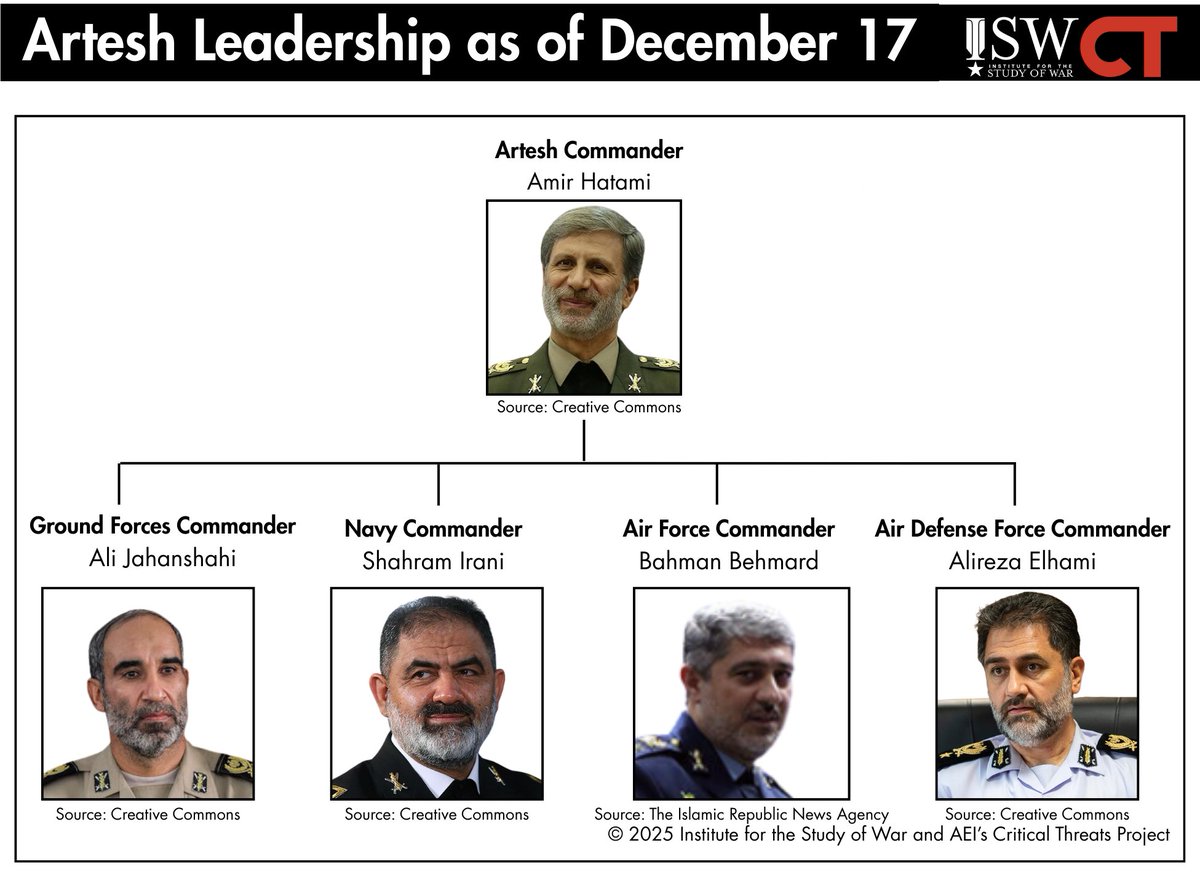
Iranian Artesh Ground Forces Commander Brigadier General Ali Jahanshahi appointed Brigadier General Second Class Abbas Malekizadeh as the new Artesh Ground Forces Southeast Regional Headquarters commander on December 13, possibly in response to the recent establishment of the Mobarizoun Popular Front.[32] The Artesh Ground Forces is responsible for defending Iran from foreign attacks, and the Southeast Regional Headquarters oversees Artesh Ground Forces units in Hormozgan, Kerman, and Sistan and Baluchistan provinces, as well as in parts of Yazd Province.[33] Malekizadeh replaced Brigadier General Amir Gholam Alian, who had commanded the headquarters since August 2020.[34] Malekizadeh had previously served as the deputy commander of the Artesh Ground Forces Southeast Regional Headquarters since at least July 2022.[35] Malekizadeh served as the commander of the Artesh Ground Forces 388th Mechanized Assault Brigade, which is based in Iranshahr, Sistan and Baluchistan Province, before becoming the deputy commander of the Southeast Regional Headquarters.[36]
The People's Republic of China (PRC) continues to support Iran's efforts to reconstitute its missile program following the Israel–Iran War. Unspecified US officials told the Wall Street Journal on December 12 that US special operations forces seized military and dual use components from a vessel that was heading from the PRC to Iran in November 2025.[37] A second unspecified US official familiar with the seizure stated that US intelligence assessed that the cargo was destined for Iranian companies that procure components for Iran's missile program.[38] US officials did not identify the vessel or its owner.[39] The PRC has previously helped Iran rebuild its ballistic missile program by supplying Iran with sodium perchlorate, which is a chemical precursor for solid missile propellant. The PRC sent at least two shipments of sodium perchlorate to Iran before the Israel-Iran War, and European intelligence sources are tracking 10 to 12 shipments to Iran following the war, according to CNN.[40] Iranian efforts to procure components and solid fuel ingredients for its missile program from the PRC are consistent with CTP-ISW’s assessment that Iran views reconstituting its ballistic missile program as an immediate strategic priority, likely because reconstituting the program is more achievable in the short term than other defense projects.[41] An Israeli journalist recently reported on December 11 that Iran has reconstituted its “heavy” ballistic missile stockpile to approximately 2,000 missiles.[42]
The Islamic Revolutionary Guards Corps (IRGC) Navy possibly seized the Marshall Islands-flagged oil tanker Talara on November 14 in response to the US interdiction of the PRC-origin, Iran-bound vessel.[43] The United States interdicted the vessel on an unspecified date in November 2025. The IRGC circulated a Quranic verse on X after the Talara’s seizure that suggested Iran seized the Talara in retaliation for a previous incident.[44] Iranian officials have recently expressed concern that the United States and its allies could enforce United Nations Security Council (UNSC) Resolution 1929, which calls on United Nations member states to inspect any Iranian vessel within their territorial waters suspected of “carrying prohibited cargo, including banned conventional arms or sensitive nuclear or missile items.”[45]
Iranian Brigadier General Alireza Elhami replaced Brigadier General Alireza Sabahi Fard as the Khatam ol Anbia Air Defense Headquarters commander and Artesh Air Defense Force commander on December 15.[46] Sabahi Fard’s removal from these positions may reflect Iranian Supreme Leader Ali Khamenei’s dissatisfaction with Sabahi Fard’s performance during the Israel-Iran War. Elhami previously served as deputy commander of the Artesh Air Defense Force, commander of the Khatam ol Anbia Air Defense Academy, and operations deputy of the Khatam ol Anbia Air Defense Headquarters.[47] Former Iranian Armed Forces General Staff Chief Major General Mohammad Bagheri appointed Sabahi Fard as the Khatam ol Anbia Air Defense Headquarters commander in February 2025.[48] Sabahi Fard maintained his position as Artesh Air Defense Force commander, which he had held since June 2018, when he was appointed as the Khatam ol Anbia Air Defense Headquarters commander.[49] The Khatam ol Anbia Air Defense Headquarters is responsible for coordinating air defense activity between the Artesh and Islamic Revolutionary Guards Corps (IRGC).[50] Sabahi Fard’s removal is notable given the poor performance of Iranian air defenses under his command during the Israel-Iran War in June 2025. The Israel Defense Forces (IDF) established air superiority over western Iran and Tehran by destroying over 40 Iranian air defense systems in the first 24 hours of the war.[51] The regime has not appointed Sabahi Fard to a new position at the time of this writing.
A delegation from a US-sanctioned, Iranian regime-controlled shipping company met with Sudanese port authorities in Port Sudan on December 13 to discuss re-establishing the company's operations at the Red Sea port after a seven-year hiatus.[60] The US Treasury sanctioned the Hafez Darya Shipping Company, which is a subsidiary of Islamic Republic of Iran Shipping Lines, in 2018 for transporting unspecified cargo to at least one known front company for the Iranian regime-controlled Defense Industries Organization.[61] The Defense Industries Organization, which the US Treasury sanctioned in 2007 for materially contributing to the development of Iran's nuclear and missile programs, is a subsidiary of the Iranian Defense and Armed Forces Logistics Ministry.[62] The Iranian ambassador to Sudan organized the meeting between Sudanese port officials and the Hafez Darya Shipping Company delegation.[63] A representative from Hafez Darya Shipping Company claimed that the company seeks to transport “containers only” from Sudan but did not specify what type of cargo the company would transport in the containers.[64] Iranian access to a Red Sea port in Sudan may allow Iran to expand its trade and influence in the Red Sea. It remains unclear if Iran seeks to use potential Red Sea port access to support other regional activities, such as Iran's illicit oil trade, weapons smuggling, or surveillance to support campaigns against international shipping.
https://understandingwar.org/research/middle-east/iran-update-december-15-2025/
Iran Update, December 16, 2025
Iranian oil exports slightly decreased between October and November 2025.[7] Iran exported around 61.3 million barrels of oil in November 2025, averaging around 2.04 million barrels per day (bpd), according to United Against Nuclear Iran (UANI). The Foundation for Defense of Democracies (FDD), citing Tanker Trackers, similarly reported that Iran exported around 61.8 million barrels in November, averaging around 2.06 million bpd.[8] Iranian oil exports averaged around 2.3 million bpd between the second week of October and the first week of November, in contrast.[9] Iran exported oil to the People’s Republic of China (PRC), the United Arab Emirates (UAE), and Malaysia, among other countries, and reportedly offered a 5 to 10 percent discount on the price of its oil in November.
https://understandingwar.org/research/middle-east/iran-update-december-16-2025/
The Iranian regime announced new Artesh appointments on December 17 as part of a broader reshuffling of senior Iranian military leadership following the Israel-Iran War.[1] Artesh Commander Major General Amir Hatami appointed Brigadier General Alireza Sabahi Fard as his assistant for air defense affairs.[2] Alireza Sabahi Fard most recently served as the Khatam ol Anbia Air Defense Headquarters commander and Artesh Air Defense Force commander.[3] Brigadier General Alireza Elhami replaced Sabahi Fard as the Khatam ol Anbia Air Defense Headquarters commander and Artesh Air Defense Force commander on December 15.[4] Sabahi Fard’s new appointment may reflect Supreme Leader Ali Khamenei’s dissatisfaction with the performance of Iranian air defenses under Sabahi Fard’s command during the Israel-Iran War. Israel established air superiority over western Iran and Tehran by destroying over 40 Iranian air defense systems during the first 24 hours of the conflict.[5]
Khamenei separately appointed Brigadier General Bahman Behmard as the new Artesh Air Force commander based on Hatami’s recommendation.[6] Behmard replaced Brigadier General Hamid Vahedi, who became Hatami‘s adviser for aviation affairs.[7] Behmard previously served as the commander of the Artesh Air Force 1st Tactical Air Base in Tehran and 4th Tactical Air Base in Dezful, Khuzestan Province, and most recently served as the Deputy Armed Forces General Staff (AFGS) Operations Deputy.[8]
These appointments are part of a broader reshuffling of senior Iranian military leaders after the Israel-Iran War. The Iranian regime has signaled that it urgently seeks to improve its air defense capabilities to better defend against potential future attacks on Iranian territory. Iran has expressed interest in acquiring advanced air defense systems and aircraft from Russia, such as the S-400 air defense system and Su-35 fighter jet, given that it currently lacks advanced air defense systems and fighter aircraft.[9]
All sources for the above graphic are included in the endnote section at the end of this update.[10]
Ansar al Furqan recently conducted a tactically sophisticated attack targeting Iranian security forces in southeastern Iran. This attack is demonstrative of the growing threat that anti-regime Baloch groups in southeastern Iran have posed to the Iranian regime since late 2022. Ansar al Furqan, which is a Salafi-jihadi group, claimed that it killed at least 16 Iranian intelligence and Law Enforcement Command (LEC) personnel at a checkpoint in Fahraj, Kerman Province, on December 16.[11] Iranian media reported that the group only killed three LEC personnel and one civilian at the checkpoint, however.[12] Ansar al Furqan claimed that its fighters launched the attack on the checkpoint from three axes and initially killed the security forces at the checkpoint before ambushing reinforcements that arrived at the checkpoint following the initial attack.[13] Ansar al Furqan claimed that 43 of its fighters participated in the attack. The group also said that the attack marked the second phase of “Operation Sayf al Furqan.”[14] Ansar al Furqan stated that the first phase of “Operation Sayf al Furqan” took place in August 2025 when the group allegedly killed over 50 Iranian security personnel in Golkhani, Sistan and Baluchistan Province.[15] Iranian media did not report any casualties among Iranian forces in the August 2025 attack. Ansar al Furqan did not specify a motive for the August 2025 attack, but the group's spokesperson stated on December 16 that the recent attack on the Fahraj checkpoint was in response to Iranian officials insulting a companion of Prophet Mohammad.[16] Ansar al Furqan has reportedly not merged with the newly established Mobarizoun Popular Front (MPF), which is notable given that Ansar al Furqan operates in southeastern Iran like the MPF.[17] Jaish al Adl, which is a Baloch Salafi-jihadi organization, and several other Baloch groups established the MPF on December 10.[18] MPF fighters killed four Islamic Revolutionary Guards Corps (IRGC) Ground Forces Quds Operational Base personnel from the Imam Hossein Battalions near Zahedan, Sistan and Baluchistan Province, on December 10.[19]
Senior Iranian officials have held several meetings with Belarusian and Russian officials over the past week that have focused on increasing economic cooperation to circumvent international sanctions. Iranian Foreign Affairs Minister Abbas Araghchi discussed the benefits of bilateral trade with his Russian counterpart, Sergei Lavrov, in Moscow on December 17.[83] Lavrov emphasized that trade with Iran is a Russian “priority” in an interview with Iranian state media on December 15, especially since Russia and Iran both face international sanctions.[84] Araghchi also signed three trade-focused memorandums of understanding with his Belarusian counterpart and met with Belarusian President Alexander Lukashenko in Minsk on December 15.[85] The Belarusian government is a key ally of Russia. Iranian Supreme National Security Council Secretary Ali Larijani separately discussed obstacles to operationalizing the International North-South Transport Corridor (INSTC) with Russian Deputy Prime Minister for Transport Vitaly Savelyev in Tehran on December 16.[86] The INSTC is a trade route that, when completed, will connect India, Iran, Russia, and Central Asia via road, rail, and sea to reduce transit time and costs between South Asia and Europe.[87] Iranian President Masoud Pezeshkian discussed bilateral trade with Russian President Vladimir Putin on the sidelines of the International Peace and Trust Summit in Turkmenistan on December 12.[88] Pezeshkian claimed in his meeting with Putin that Iran plans to complete a key Iranian part of the INSTC, the Rasht-Astara Railway, by March 2026.[89]
https://understandingwar.org/research/middle-east/iran-update-december-17-2025/
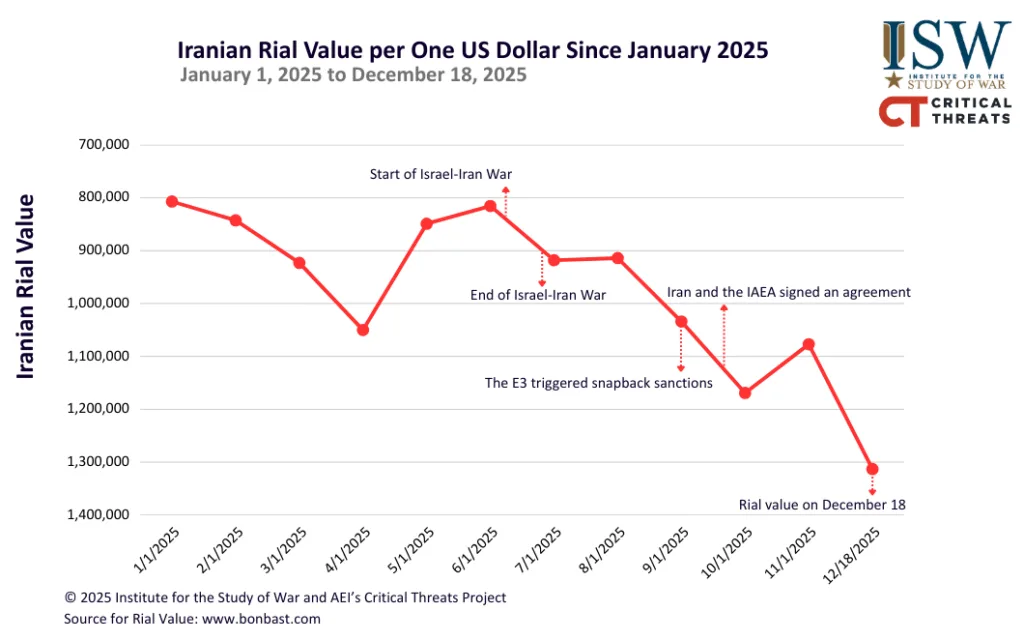
The Iranian regime has failed to address Iran's worsening economic situation. Economic issues in Iran have previously incited major protests. The Iranian rial hit a record low on December 18 and traded at 1,313,000 rials to one US dollar.[48] The devaluation demonstrates the regime's inability to stabilize the currency market following the reinstatement of UN Security Council snapback sanctions in September 2025.[49] Iranian newspaper Jomhouri Eslami warned on December 18 that the “rapid” devaluation of the Iranian currency will push society into “the abyss of despair and disintegration.”[50] Iranian Parliament Speaker Mohammad Bagher Ghalibaf also announced on December 18 that the parliament will hold a public oversight session on December 23 to review government efforts to preserve purchasing power, manage currency fluctuations, and implement a ration card program.[51]
The devaluation of the Iranian rial comes amid energy shortages that have put further pressure on the Iranian economy. Iran has faced recurring electricity shortages and blackouts, natural gas shortfalls, and water shortages that have disrupted household consumption and industrial activity in recent months.[52] Pezeshkian stated on December 18 that the government may impose energy consumption restrictions in some areas during the winter if authorities fail to manage the energy crisis “properly.”[53] Energy shortages in Iran have historically triggered protests and strikes.[54] Iranian officials also recently increased gasoline prices through a multi-tiered pricing system on December 13.[55] Similar gas price increases sparked large protests in 2019.[56]
Iran also faces a budget deficit and—reportedly—shrinking foreign exchange reserves, which may hinder Iran's ability to import basic goods. Iranian Executives of Construction Party Head Hossein Marashi warned in an op-ed on December 11 that “tactical and superficial” reforms are no longer sufficient.[57] Marashi added that the government cannot even pay roughly $200 million to unload ships waiting at ports in southern Iran.[58] Iran's limited ability to import goods could affect the Iranian public's access to basic goods. Marashi warned that a food supplcould trigger unrest and that the danger is “serious and very close.”[59] Pezeshkian stated in August 2025 that Iran funds many institutions and foundations that “have no output,” and questioned why the government pays them when it cannot provide for people's livelihoods.[60] Pezeshkian did not name specific institutions, but Iran previously increased budget allocations for religious and ideological organizations, including large funding hikes for IRGC-affiliated sociocultural bodies, the Islamic Propaganda Organization, and al Mustafa International University.[61]
https://understandingwar.org/research/middle-east/iran-update-december-18-2025/
The Institute for Science and International Security assessed on December 18 that Iran has placed panels over the anti-drone cage at the Pilot Fuel Enrichment Plant (PFEP) at the Natanz Nuclear Complex in order to explore the rubble at the site discreetly, citing satellite imagery from December 13.[19] The anti-drone cage seeks to protect the PFEP from drone attacks.[20] The cage was present at the site before the Israel-Iran War and Israeli projectiles penetrated it during the war. The PFEP’s internal structure, which was also damaged during the Israel-Iran War, is still visible in the satellite imagery.[21] International Atomic Energy Agency Director General Rafael Grossi stated on October 18 that the majority of Iran's enriched uranium stockpile is stored at the Esfahan Nuclear Technology Center and Fordow, and some at Natanz.[22]
Iran is facing continued US efforts to drive Iranian oil exports to zero. The United States sanctioned 29 vessels and multiple shipping companies on December 18 for transporting illicit Iranian petroleum and other petroleum products.[23] The US Treasury reported that these vessels carried hundreds of millions of dollars’ worth of Iranian crude oil, among other products.[24] The Trump administration has sanctioned more than 180 vessels involved in Iranian oil transport since January 2025.[25] Recent sanctions on December 18 also targeted shipping firms based in the United Arab Emirates, Panama, the Marshall Islands, India, Liberia, and the British Virgin Islands, for their involvement in Iran's petroleum exports.[26] The United States also sanctioned Egyptian businessman Hatem Elsaid Farid Ibrahim Sakr for facilitating Iranian petroleum exports through UAE-based shipping companies.[27] Sakr’s firms coordinated petroleum shipments linked to Iran's Ministry of Defense and Armed Forces Logistics (MODAFL)-associated front company Sahara Thunder and facilitated ship-to-ship transfers of Iranian oil exports.[28]
https://understandingwar.org/research/middle-east/iran-update-december-19-2025/
Iran is likely prioritizing ballistic missile production due to both organizational inertia within the Iranian defense apparatus and the need to restore deterrence in what it views as an ongoing war with Israel. The reconstitution appears to be an effort to restore deterrence against Israeli attack, though a reconstituted ballistic missile program could be used to attack Israel. One former senior Iranian official has doubled down on investment in the ballistic missile program after the Israel-Iran War to “restore deterrence,” while a current senior official advocated for new technical improvements to the missiles, for example.[1] These officials probably calculate that more and higher-quality missiles are needed to penetrate Israeli defenses, given the effectiveness of Israeli ballistic missile interceptors and the decreasing Israeli interceptor stockpile. The reconstitution of Iran's ballistic missile capabilities is nonetheless increasing anxiety in Israel over the quantity of missiles Iran now possesses (see below).
An Israeli journalist reported on December 9 that Iran had reconstituted its missile stockpile to around 2,000 “heavy” ballistic missiles, which presumably refers to medium-range ballistic missiles capable of striking Israel. This rapid reconstitution indicates that Israel either failed to destroy all of Iran's planetary mixers or that Iran has acquired or built new planetary mixers used to produce solid fuel ballistic missiles. The United States intercepted a shipment with components for Iran's ballistic missile program, which could have included mixers, in the Indian Ocean in November 2025 (more on this incident below). Iran is reportedly prioritizing the rapid restoration of its ballistic missile production capabilities over other defense priorities. Iran has begun rebuilding the Parchin and Shahroud missile production facilities, which Israel damaged during the Israel-Iran War, and reconstructing buildings at these sites that previously housed planetary mixers.[2] Planetary mixers are essential for turning a chemical precursor of solid fuel, sodium percolate, into ballistic missile fuel.[3] Israel destroyed Iran's planetary mixers in October 2024, and Western media assessed in September 2025 that Iran still did not have the necessary planetary mixers to produce solid missile fuel.[4] Western diplomats also told Israeli media on December 8 that Iran is using older manufacturing methods to continue producing ballistic missiles, which may refer to the less efficient “trough-type mixers” that can also produce solid fuel.[5]
Iranian defense officials view ballistic missiles as a critical piece of their defense strategy, and a hypothetical Iranian decision to abandon the ballistic missile program would be antithetical to the way that Iranian commanders view their capabilities and relative strengths. Iran's decision to prioritize ballistic missiles after their failure to penetrate Israeli defenses during the Iran-Israel War in June 2025 may appear unwise to Western observers, but this ignores the primacy with which Iranian officials view ballistic missiles in their defense strategy. Iranian officials would probably find it extremely difficult to come to a personal conclusion and then convince the bureaucracy to conclude that ballistic missiles must be abandoned, given that most of Iran's defense community has long viewed and continues to view ballistic missiles as a critical element of their defense strategy both now and in the future. Missiles, in addition to Iran's Axis of Resistance, have long acted as the central pillar of Iran's regional defense strategy, and Iranian officials have long considered the ballistic missile program to be a crucial deterrent to Israel and the United States.
Senior Iranian officials have continued to laud Iran's missile capabilities as an essential piece of Iranian defense strategy, even after the Israel-Iran War.[6] A former IRGC Navy commander said that the missile program contributed to Iran's ”success” during the war.[7] Former Islamic Revolutionary Guards Corps (IRGC) Commander Mohammad Ali Jafari argued in October 2025 that Iran's missile program is its main form of deterrence and that Iran deliberately prioritized developing its missile and drone capabilities over its air and ground forces to counter the superior capabilities of the United States and Israel.[8] Another senior official illustrated the need for more investment in the program by calling for various technical improvements to the missiles to improve their ability to penetrate ballistic missile defenses.[9] Iranian military officials would need to garner enormous political backing in order to alter a pillar of Iranian defense strategy for decades, and so far, no sizeable group of officials has challenged the importance of the missile program in the public discourse.
Iran's ability to produce ballistic missiles at scale only six months after the end of the Israel-Iran War in June 2025 is causing Israeli anxieties over Iranian capabilities and intent to attack Israel. Israeli Prime Minister Benjamin Netanyahu is planning to brief US President Donald Trump on the United States’ options for joining or assisting future Israeli attacks on Iranian ballistic missile sites during Netanyahu's upcoming visit to the United States on December 29, according to an unspecified source and four former US officials.[10] Israeli officials reportedly view Iran's efforts to rebuild ballistic missile production facilities and repair air defense systems as “more immediate concerns” than Iran reconstituting its nuclear enrichment sites.[11] Axios reported on December 21 that Israeli military intelligence and Mossad do not assess that the pace at which Iran is rebuilding its ballistic missile capabilities necessitates “urgency to take military action” within the next two to three months. The Israeli sources stressed that Iran's ballistic missiles could “become a more urgent issue later in the year,” presumably referring to late 2026.[12] Israeli media highlighted Israel's threat perception and noted that the Iranian regime may only need between one and two years to acquire enough ballistic missiles to overwhelm Israeli air defenses. This calculation is based on Iran reaching a production rate of about 300 ballistic missiles per month.[13] The Wall Street Journal reported in June 2025, during the war, that Israel was “running low on defensive Arrow interceptors.”[14] Defensive Arrow interceptors enable Israel to counter long-range ballistic missiles.[15] Israel used 52.3 percent of its interceptor stockpile during the war, according to the Jewish Institute for National Security of America (JINSA).[16]
Reports about a possible IRGC Aerospace Force missile exercise coordinated across multiple bases in Iran have also contributed to Israeli fears of a rising Iranian ballistic missile threat.[17] IRGC-affiliated media reported on December 22 that the IRGC Aerospace Force launched missiles as part of its missile exercise in unspecified locations in five provinces.[18] The exercise reportedly spanned across Khorramabad, Lorestan Province, Mahabad, West Azerbaijan Province, Mashhad, Khorasan Razavi Province, Tehran Province, and Esfahan Province.[19] Iranian media did not provide any more specific details on the exercise, such as the types of missiles launched.
The regime may have been rehearsing the synchronization and coordination of large scale missile strikes from bases spread across the country through the exercise. Iran's ability to launch coordinated, large scale missile attacks targeting Israel during the June 2025 war grew constrained as Israel destroyed Iranian missile launchers across different regions of Iran, according to an Israeli Army Radio correspondent in June 2025.[20] Unspecified sources told anti-Iranian regime media on December 20 that Western intelligence agencies detected “unusual” IRGC Aerospace Force activity, including irregular drone, missile, and air defense units’ command-and-control signals, deployments, and logistical movements.[21] These activities, if accurate, would also be consistent with Iranian efforts to rehearse the synchronized deployments of missile, drone, and air defense assets. Exercises to improve coordination and synchronization do not necessarily need to involve missile launches.
The regime may be attempting to obscure details about the exercise and therefore downplay the extent to which the IRGC may be preparing for future conflict. Iranian state media denied the IRGC-affiliated news report on the IRGC exercise, calling it “not accurate.”[22] Another Iranian media outlet affiliated with the Supreme Leader's representative to the Defense Council circulated a news report about the exercise before later removing the article.
IDF Chief of Staff Lieutenant General Eyal Zamir warned US Central Command (CENTCOM) Commander Admiral Brad Cooper on December 20 that the IRGC Aerospace Force missile exercise and other operational steps could be “cover for a surprise attack“ on Israel.[23] Zamir referred to an IRGC exercise that “began several days ago.“[24] Netanyahu also stated on December 22 that Israel is “aware that Iran is conducting military exercises: and “making the necessary preparations,” warning that any attacks on Israel will be met with a “very harsh response.”[25] An unspecified US source told Axios on December 22 that US intelligence agencies have no indication that Iran is preparing for an attack.[26]
The People's Republic of China (PRC) continues to support Iranian missile production. An Israeli Army Radio correspondent reported on December 22 that a shipment of planetary mixers was expected to travel from the PRC to Iran in recent weeks but that the “shipment ultimately did not reach its destination,” citing Western intelligence sources.[27] US officials told the Wall Street Journal on December 12 that US special forces recently boarded and seized a vessel in the Indian Ocean carrying PRC-made components destined for Iran's missile program.[28] It is possible that this vessel was carrying the planetary mixers shipment that the Israeli Army Radio correspondent reported. Iran currently lacks planetary mixers. The PRC has previously helped Iran rebuild its ballistic missile program by supplying Iran with sodium perchlorate, which is a chemical precursor for solid missile propellant. The PRC previously sent two shipments of sodium perchlorate to Iran in February and June 2025, and European intelligence sources have been tracking a further 10 to 12 shipments following the Israel-Iran War.[29]
Iran may retaliate against the United States’ attempted seizure of an Iranian-linked tanker in the Caribbean Sea with disruptive activity in the Persian Gulf.[30] US authorities obtained a seizure warrant for the Bella 1 tanker on December 21 due to the vessel's “previous involvement in the Iranian oil trade.”[31] The Bella 1 loaded oil in August 2025 at Kharg Island, which is Iran's primary oil export hub, and later offloaded its cargo to another tanker near Oman before continuing to the Caribbean Sea.[32] The United States has not seized the Bella 1 as of this writing. Senior Iranian officials have threatened to close the Strait of Hormuz if the United States and its allies seize Iranian exports in recent months.[33] The IRGC also conducted various combat operations in the Persian Gulf as part of their annual naval exercise in the Persian Gulf in early December as a warning to its adversaries that Iran will confront any “miscalculations” with “a decisive response.”[34] The IRGC Navy also named this year's exercise after deceased IRGC Navy commander Mohammad Nazeri, who was reportedly involved in the seizure of two US patrol boats and 10 US personnel in the Persian Gulf in January 2016.[35] Iran responded to US seizures of Iranian weapons shipments under US President Donald Trump's first maximum pressure campaign in 2019 by threatening international shipping, including by seizing a British oil tanker, harassing vessels transiting the Strait of Hormuz, and conducting an attack targeting Saudi oil facilities.[36]
https://understandingwar.org/research/middle-east/iran-update-december-22-2025/
Iran Update, December 23, 2025
Iranian regime entities continue to emphasize that Iran is prioritizing the expansion of its missile program to reestablish deterrence against Israel. An Iranian outlet affiliated with Ali Shamkhani, who is one of the Supreme Leader’s representatives to the Defense Council, reported on December 23 that Iran formed the Defense Council to restructure its defense strategy and restore deterrence through “hard power.”[23] Iran’s highest national security and foreign policy decision-making body, the Supreme National Security Council, established the Defense Council following the Israel-Iran War.[24] The outlet stated that the Defense Council’s most significant achievement since the war has been the reconstruction and improvement of Iran’s defense capabilities, most likely referring to Iran’s missile and air defense capabilities.[25] A political analyst close to former Islamic Revolutionary Guards Corps (IRGC) Commander and Expediency Discernment Council member Mohsen Rezaei confirmed on December 23 that Iran recently conducted a missile exercise.[26] Najafi stated that the missile exercise and recent threats from Iranian officials are part of an effort “to restore deterrence” ahead of Israeli Prime Minister Benjamin Netanyahu’s visit to the United States.[27] Western media recently reported that Netanyahu will brief US President Donald Trump on options to strike Iranian ballistic missile sites during his visit to the United States.[28] Iran has taken concrete steps since the war to rebuild its missile program, including reconstructing infrastructure at at least two missile bases.[29] Iran has also imported a chemical precursor for solid missile fuel and attempted to obtain fuel mixers from the People’s Republic of China.[30] Iran has historically prioritized missile development as a deterrent against potential Israeli attacks.[31] CTP-ISW previously assessed that this approach is deeply embedded in Iranian military doctrine and is unlikely to change in the near future.[32]
The outlet affiliated with Shamkhani separately called on the regime to develop a mechanism for “strategic information dissemination” to manage popular perceptions and retain public trust during periods of conflict.[33] The outlet argued that narrative warfare and psychological operations have become an “inseparable part” of modern conflicts and called on the regime to strengthen its “narrative management” in addition to its “hard power.”[34] The outlet’s call for “strategic information dissemination” is consistent with Iranian officials’ belief that Israel sought to use psychological operations during the Israel-Iran War to degrade Iranian national unity and overthrow the Iranian regime.[35] The regime may believe that increasing its control over media narratives and increasing the dissemination of regime propaganda are necessary to counter such psychological operations and protect Iranian internal security in future conflicts with Israel.
https://understandingwar.org/research/middle-east/iran-update-december-23-2025/
The Italian Institute for International Political Studies (ISPI) reported on December 24 that unspecified sources in Tehran told ISPI that Iranian Supreme Leader Ali Khamenei authorized the initial development of miniaturized nuclear warheads for ballistic missiles in October 2025.[1] ISPI is the only source that has reported information about the supreme leader authorizing the development of miniaturized nuclear warheads.[2] This source has not previously offered in-depth analysis of or verifiable information about the Iranian nuclear program. ISPI reported that Khamenei did not authorize uranium enrichment beyond 60 percent, however.[3] ISPI noted that producing deliverable, miniaturized nuclear warheads poses significant technical challenges and requires weapons-grade uranium enriched to 90 percent, which Iran does not currently possess.[4]
Iran has previously explored alternative nuclear weapon paths that do not require warhead miniaturization. The New York Times reported in February 2025 that a “secret team” of Iranian weapons engineers and scientists is “exploring” a faster approach to building a nuclear weapon in a “matter of months.”[5] Unspecified US officials told the New York Times that Iran could build an “older-style nuclear weapon” using the new approach, but noted that such a weapon would not fit on a ballistic missile and would likely be less reliable than a modern weapon.[6]
https://understandingwar.org/research/middle-east/iran-update-december-24-2025/
Iran Update, December 26, 2025
The Islamic Revolutionary Guards Corps (IRGC) seized a “foreign” tanker near Gheshm Island in the Strait of Hormuz on December 24. The IRGC claimed the tanker was smuggling four million liters of oil.[1] The IRGC Navy also detained 16 non-Iranian crew members, according to local judicial authorities in Hormozgan Province on December 26.[2] Neither the IRGC nor Iranian media has disclosed the name of the tanker or the nationality of its crew members. CTP-ISW is unable to confirm the incident or verify the name of the tanker using commercially available maritime tracking data at this time.
It is possible that Iran seized the tanker in response to recent US seizures of tankers in the Caribbean Sea. The US Coast Guard seized a reported ghost fleet tanker, the Bella 1, in an unspecified location in the Atlantic Ocean on December 25 after a five-day pursuit through the Caribbean.[3] An attributed IRGC X account posted the following Islamic verse: ”throw the enemy’s stone back in the same direction it was thrown from, because evil is repelled only by evil” on December 24, around the same time as the IRGC Navy’s seizure of the tanker near Gheshm Island.[4] The same account quoted the following Quranic verse at the same time of the seizure of the oil tanker Talara on November 14: “So whoever has assaulted you, then assault him in the same way that he has assaulted you.[5] US special operations forces intercepted a shipment of military-related equipment from China to Iran in the Indian Ocean at some point in November 2025.[6] It is unclear if the IRGC statement or the Talara seizure on November 14 was in response to this seizure. The seizure of the Talara also followed an unspecified explosion on the M/V Falcon in the Red Sea in October.[7] The non-profit United Against Nuclear Iran reported that the Falcon was an Iranian shadow fleet vessel that transports illicit Iranian oil.[8] The United States has also seized three oil tankers near Venezuela in December 2025.[9]
Iran announced on December 21 the deployment of Artesh Naval flotillas to escort commercial vessels, amid Iranian concern over US tanker seizures. Iranian Foreign Affairs Ministry spokesperson Esmail Baghaei and the Embassy in Caracas called the US seizure of oil tanker Skipper off the coast of Venezuela on December 10 an act of “piracy.”[10] The Skipper has historically transported illicit Iranian oil.[11] Artesh Navy Commander Admiral Shahram Irani announced on December 21 that the Artesh Navy deployed the 103rd and 104th flotillas on overseas missions and added that one of the fleets will be “tasked with escorting commercial ships.”[12] CTP-ISW cannot determine the composition of the Artesh 103rd and 104th flotillas as of the time of writing.
https://understandingwar.org/research/middle-east/iran-update-december-26-2025/
Mobile phone traders gathered outside Tehran’s Alaeddin and Iran Mobile shopping centers on Sunday after closing their shops, according to eyewitnesses and videos sent to Iran International.
Iran's rial weakened to new historic lows on Sunday, falling to about 1,445,000 per dollar, according to open market rates, extending a prolonged slide.
https://www.iranintl.com/en/liveblog/202512283787
Exchange rate https://www.bonbast.com/graph/usd
Disclaimer: Opinions posted on Free Republic are those of the individual posters and do not necessarily represent the opinion of Free Republic or its management. All materials posted herein are protected by copyright law and the exemption for fair use of copyrighted works.