The Iranian regime announced new Artesh appointments on December 17 as part of a broader reshuffling of senior Iranian military leadership following the Israel-Iran War.[1] Artesh Commander Major General Amir Hatami appointed Brigadier General Alireza Sabahi Fard as his assistant for air defense affairs.[2] Alireza Sabahi Fard most recently served as the Khatam ol Anbia Air Defense Headquarters commander and Artesh Air Defense Force commander.[3] Brigadier General Alireza Elhami replaced Sabahi Fard as the Khatam ol Anbia Air Defense Headquarters commander and Artesh Air Defense Force commander on December 15.[4] Sabahi Fard’s new appointment may reflect Supreme Leader Ali Khamenei’s dissatisfaction with the performance of Iranian air defenses under Sabahi Fard’s command during the Israel-Iran War. Israel established air superiority over western Iran and Tehran by destroying over 40 Iranian air defense systems during the first 24 hours of the conflict.[5]
Khamenei separately appointed Brigadier General Bahman Behmard as the new Artesh Air Force commander based on Hatami’s recommendation.[6] Behmard replaced Brigadier General Hamid Vahedi, who became Hatami‘s adviser for aviation affairs.[7] Behmard previously served as the commander of the Artesh Air Force 1st Tactical Air Base in Tehran and 4th Tactical Air Base in Dezful, Khuzestan Province, and most recently served as the Deputy Armed Forces General Staff (AFGS) Operations Deputy.[8]
These appointments are part of a broader reshuffling of senior Iranian military leaders after the Israel-Iran War. The Iranian regime has signaled that it urgently seeks to improve its air defense capabilities to better defend against potential future attacks on Iranian territory. Iran has expressed interest in acquiring advanced air defense systems and aircraft from Russia, such as the S-400 air defense system and Su-35 fighter jet, given that it currently lacks advanced air defense systems and fighter aircraft.[9]
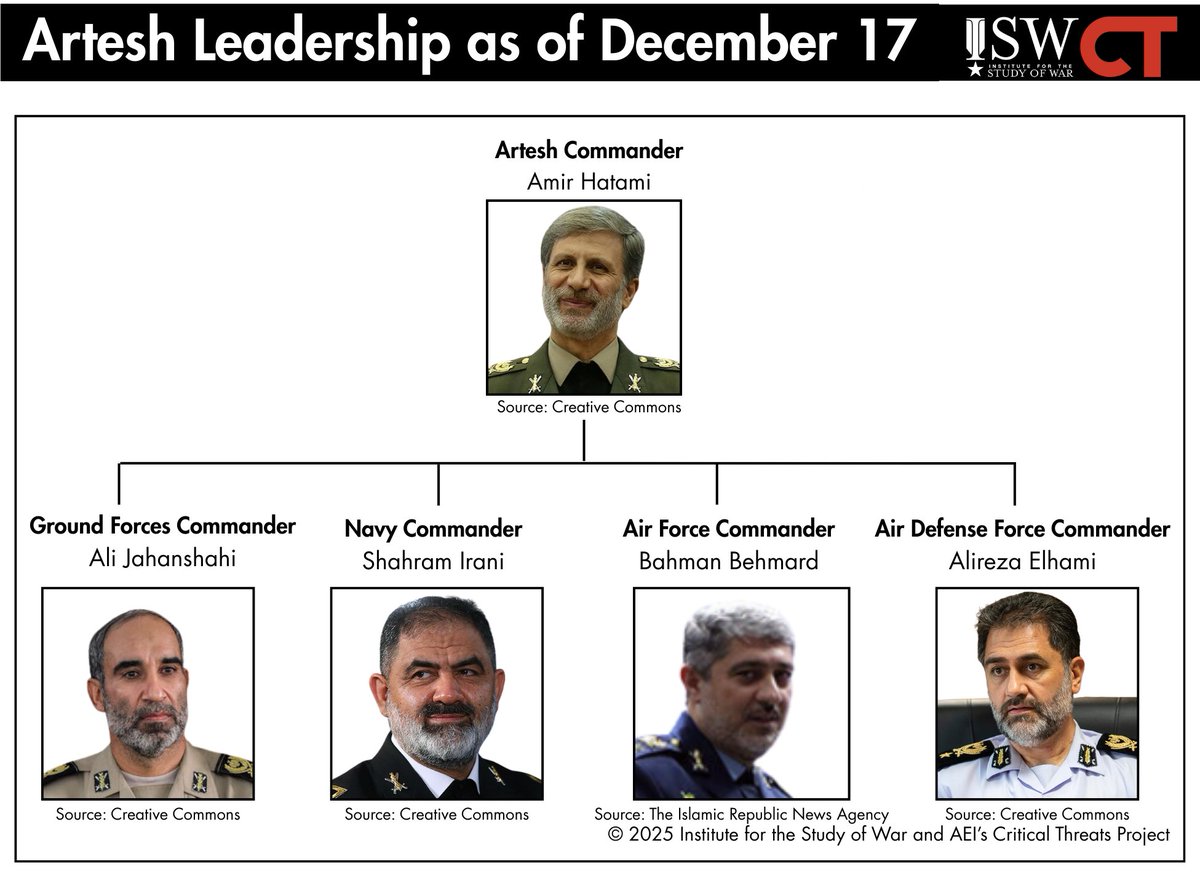
All sources for the above graphic are included in the endnote section at the end of this update.[10]
Ansar al Furqan recently conducted a tactically sophisticated attack targeting Iranian security forces in southeastern Iran. This attack is demonstrative of the growing threat that anti-regime Baloch groups in southeastern Iran have posed to the Iranian regime since late 2022. Ansar al Furqan, which is a Salafi-jihadi group, claimed that it killed at least 16 Iranian intelligence and Law Enforcement Command (LEC) personnel at a checkpoint in Fahraj, Kerman Province, on December 16.[11] Iranian media reported that the group only killed three LEC personnel and one civilian at the checkpoint, however.[12] Ansar al Furqan claimed that its fighters launched the attack on the checkpoint from three axes and initially killed the security forces at the checkpoint before ambushing reinforcements that arrived at the checkpoint following the initial attack.[13] Ansar al Furqan claimed that 43 of its fighters participated in the attack. The group also said that the attack marked the second phase of “Operation Sayf al Furqan.”[14] Ansar al Furqan stated that the first phase of “Operation Sayf al Furqan” took place in August 2025 when the group allegedly killed over 50 Iranian security personnel in Golkhani, Sistan and Baluchistan Province.[15] Iranian media did not report any casualties among Iranian forces in the August 2025 attack. Ansar al Furqan did not specify a motive for the August 2025 attack, but the group's spokesperson stated on December 16 that the recent attack on the Fahraj checkpoint was in response to Iranian officials insulting a companion of Prophet Mohammad.[16] Ansar al Furqan has reportedly not merged with the newly established Mobarizoun Popular Front (MPF), which is notable given that Ansar al Furqan operates in southeastern Iran like the MPF.[17] Jaish al Adl, which is a Baloch Salafi-jihadi organization, and several other Baloch groups established the MPF on December 10.[18] MPF fighters killed four Islamic Revolutionary Guards Corps (IRGC) Ground Forces Quds Operational Base personnel from the Imam Hossein Battalions near Zahedan, Sistan and Baluchistan Province, on December 10.[19]
Senior Iranian officials have held several meetings with Belarusian and Russian officials over the past week that have focused on increasing economic cooperation to circumvent international sanctions. Iranian Foreign Affairs Minister Abbas Araghchi discussed the benefits of bilateral trade with his Russian counterpart, Sergei Lavrov, in Moscow on December 17.[83] Lavrov emphasized that trade with Iran is a Russian “priority” in an interview with Iranian state media on December 15, especially since Russia and Iran both face international sanctions.[84] Araghchi also signed three trade-focused memorandums of understanding with his Belarusian counterpart and met with Belarusian President Alexander Lukashenko in Minsk on December 15.[85] The Belarusian government is a key ally of Russia. Iranian Supreme National Security Council Secretary Ali Larijani separately discussed obstacles to operationalizing the International North-South Transport Corridor (INSTC) with Russian Deputy Prime Minister for Transport Vitaly Savelyev in Tehran on December 16.[86] The INSTC is a trade route that, when completed, will connect India, Iran, Russia, and Central Asia via road, rail, and sea to reduce transit time and costs between South Asia and Europe.[87] Iranian President Masoud Pezeshkian discussed bilateral trade with Russian President Vladimir Putin on the sidelines of the International Peace and Trust Summit in Turkmenistan on December 12.[88] Pezeshkian claimed in his meeting with Putin that Iran plans to complete a key Iranian part of the INSTC, the Rasht-Astara Railway, by March 2026.[89]
https://understandingwar.org/research/middle-east/iran-update-december-17-2025/