Skip to comments.
Battle of Appomattox: Understanding General Lee's Surrender
Ammo.com ^
| 7/26/2021
| Sam Jacobs
Posted on 07/26/2021 4:33:01 PM PDT by ammodotcom
The Battle of Appomattox Courthouse is considered by many historians the end of the Civil War and the start of post-Civil War America. The events of General Robert E. Lee’s surrender to General and future President Ulysses S. Grant at a small town courthouse in Central Virginia put into effect much of what was to follow.
The surrender at Appomattox Courthouse was about reconciliation, healing, and restoring the Union. While the Radical Republicans had their mercifully brief time in the sun rubbing defeated Dixie’s nose in it, they represented the bleeding edge of Northern radicalism that wanted to punish the South, not reintegrate it into the Union as an equal partner.
The sentiment of actual Civil War veterans is far removed from the attitude of the far left in America today. Modern day “woke-Americans” clamor for the removal of Confederate statues in the South, the lion’s share of which were erected while Civil War veterans were still alive. There was little objection to these statues at the time because it was considered an important part of the national reconciliation to allow the defeated South to honor its wartime dead and because there is a longstanding tradition of memorializing defeated foes in honor cultures.
(Excerpt) Read more at ammo.com ...
TOPICS: History; Military/Veterans
KEYWORDS: 1of; appomattox; blogpimp; civilwar; history; neoconfederates; pimpmyblog; postandleave; postandrun; selfpromotion
Navigation: use the links below to view more comments.
first previous 1-20 ... 1,021-1,040, 1,041-1,060, 1,061-1,080 ... 1,101 next last
To: DiogenesLamp
We’re tired of that stupid graphic.
To: DiogenesLamp
Obviously you didn’t read my earlier post. New Orleans shipbuilders built hundreds of ships for the coastal trade that you claim was completely run by the north.
To: DiogenesLamp
They are not cherry picked. They are concrete, specific examples listed by name so that you can’t say that I’m making things up. You have never in all our debates, posted the name of a single New York banker raping Southern interests, nor any Northern cotton factor buying from Southern planters, with any specifics how they somehow managed to take away all this ridiculously high percentage of profits that you claim. Not a single one.
On the other hand, I have shown you the exact range of percentage charges that cotton factors and bankers charged the Southern plantation owners. All of which were completely reasonable and in line with normal capitalist practices. Yet somehow you label them as evil exploiters of the downtrodden Southern man. Straight out of Marx and Lennon.
To: SoCal Pubbie
Actually I don’t really mind the graphic but to paraphrase Inigo Montoya: “You keep using that graphic. I do not think it means what you think it means”.
He acts as though he believes that the tariff collection sites were private enterprises and that New York pocketed the funds instead of adding them to the United States treasury. Just because the funds were collected at a particular location does not mean that that location benefited inordinately.
1,044
posted on
09/10/2021 2:34:02 PM PDT
by
rockrr
( Everything is different now...)
To: rockrr
I don’t mind a Double Double from In-N-Out either, but I don’t want it for every meal!🤓
To: DiogenesLamp; SoCal Pubbie; jmacusa
SoCal Pubbie:
"Yet you claim the North took 60% of the profits from Southern production.
How do all these numbers add up?"DiogenesLmap: "I got that number from a source BroJoeK linked me to a couple of years ago.
I can go back through old messages and find it again, or perhaps BroJoeK remembers where that was?"
As I posted here, among other places, the true 1860 number for Confederate state cotton exports was ~$200 million, which alone accounted for roughly 50% of the US total ~$400 million in exports, including "specie" (California gold & Nevada silver).
I also pointed out that while Southerners imported relatively little from abroad, they did "import" about $200 million per year from the North (i.e., woolen clothing, shoes & iron products like stoves, farm equipment & railroad materials), and that's partly how Northerners earned money to pay for their own raw-material imports.
In that sense you might even say that virtually 100% of Southern cotton export earnings eventually ended up in Northern hands.
I should also mention again that the Confederate states' 1860 GDP totaled circa $650 million, or roughly 15% of the US $4.4 billion total GDP.
However, here DiogenesLamp's 60% figure is something quite different.
What he claims by it is that, first, nearly all Southern produced cotton effectively trans-shipped to NYC before export overseas and second, that somehow New Yorkers absconded with 60% of "profits" from such "Southern production".
Indeed, there was some number like 60% at some point claimed by a NYC booster referring to New Yorkers' earnings from transportation, warehousing, insurance, loans & supplies sold to Southerners.
But the truth cannot be what that NYC booster claimed, much less what DiogenesLamp makes of it.
For starters, the vast majority of Southern cotton exports shipped directly from ports like New Orleans & Mobile, not through New York.
So, if New York packet ships picked up small lots of cotton along the East Coast inland waterway, for consolidation in New York warehouses, that can only have been a small percentage of the South's total cotton exports.
But the real problem here is DiogenesLamp's abject, abysmal economic ignorance -- he really does sound like somebody trained in Marxist thought-rubbish with no real clues on how businesses work.
Again, for starters: sales dollars are almost never 100% "profits" -- there are always legitimate expenses that must be subtracted before you can even begin to think about "profits".
And the word "profits" never really stands alone -- there are always modifiers like "gross profits", "profits before taxes & interest", "net profits" and, my favorite: "net-net-net profits" meaning what's left, if anything, after you subtract out all the many expenses your business must pay or reserve for.
Typically, net-net taxable profits run circa 10% of sales dollars.
Now, when it comes to US cotton exports, as SoCal Pubbie & others have pointed out, most planters worked through Southern "factors" and bankers who, first, loaned them money to plant their crops, then paid for the cotton when it was ready to ship.
Local farmers took their produce to local markets for sale, then buyers (i.e. "factors") consolidated & shipped it to big cities & overseas customers.
So, just like every other businessmen in the world, when Southern farmers/planters in 1860 sold their produce, those sales dollars were not "profits" because, first & foremost, farmers had to pay-off everyone who'd loaned them money, supplies or hours of work.
What was then left might first be called "gross profits" but how much there was depended entirely on the farmer's individual circumstances.
Bottom line: very few Southern planters shipped their produce directly to New York for sale there.
Instead they sold in their local markets to "factors" or other financers who then transported & sold again in big-cities or to foreign customers.
So I think DiogenesLamp's 60% number is meaningless.
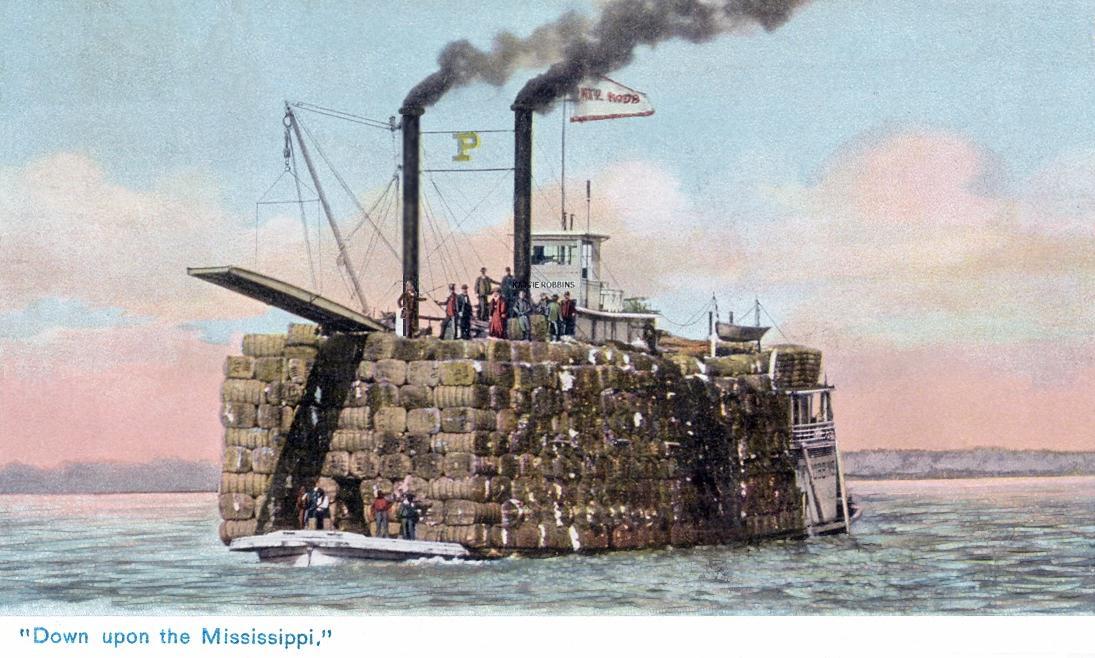
Steamboat with cotton on Mississippi River:
1,046
posted on
09/11/2021 7:30:19 AM PDT
by
BroJoeK
(future DDG 134 -- we remember)
To: BroJoeK
What you wrote here is spot on. While there was clear regional specialization, the country was very interdependent. Most of the wheat and corn that Southerners ate came from the Northern, Midwestern, and Western farmlands. As I found from one source, rich Southerners became land speculators in Yankee territories. Furthermore, a lot of money loaned by Northern banks came by way of England. Financiers in Great Britain were investing heavily in the growing economy of the United States.
I have dug deep (for a non full time historian anyway) and shown that contemporary sources, and more recent historical works, put the lie to the Neo-Confederate nonsense. Although probably primitive by today’s standards, economic activity was a lot more complicated in many cases than people tend to give credit for that era. I have read that shares of ownership of merchant vessels could be bought just as shares of company stock can be bought today. Southern investors were free to buy these chairs just as much as New Englanders could, unlikely did.
Of course no amount of factual information will dissuade those Neo-Confederates from their burning love of the Lost Cause. Some people just love a good conspiracy theory, in this case, even a weak one.
To: SoCal Pubbie
"Most of the wheat and corn that Southerners ate came from the Northern, Midwestern, and Western farmlands..."Here is my source for the breakdown of $200 million in Northern "exports" to the South, and here it is again in table format.
Curiously, except for smoked fish there are no food items on the list, and I'm not sure what that means.
I've supposed it means that most of the food items "imported" by, say, the Deep South came from Upper South & Border States.
1,048
posted on
09/12/2021 4:21:05 AM PDT
by
BroJoeK
(future DDG 134 -- we remember)
To: BroJoeK
I found an article on JSTOR titled The Antebellum South: What Probably Was and What Should Have Been by Stanley L. Engerman. Much of the piece discusses problems that the author has with previous work on the topic, and discussions of the efficiency of Southern farms and the affects of slavery on agriculture. The author also states that obtaining hard miners is difficult because no records remain from distribution by certain means such flatboat shipments and overland trade.
However, he does state that at least parts of the South were “deficit areas in grain.” Apparently 1860 was a bad year for grain production in at least parts of the South. He also writes “That’s why the possibility of regional self-sufficiency is indicated by the “better estimates,” they remain substantial room for interregional flows in both types of commodities (as well as in livestock on the hoof.”
So I think it’s highly likely that at least some of the food consumed by both the Southern population and its livestock came from areas outside the Southern and border states.
Perhaps more interesting though is this line:
“Regional distributions of federal receipts and expenditures by John Legler indicate that in most antebellum years federal expenditures in the south exceeded revenues collected from that region.”
Hmmm....
To: SoCal Pubbie
We’re tired of that stupid graphic. Why? Doesn't it show exactly what you wish to believe? The guy that created it did so to prove that the South wasn't paying the tariffs, and so they could not possibly have been upset about the tariffs.
Doesn't it show exactly what you wish to believe?
1,050
posted on
09/13/2021 10:31:44 AM PDT
by
DiogenesLamp
("of parents owing allegiance to no other sovereignty.")
To: SoCal Pubbie
New Orleans shipbuilders built hundreds of ships for the coastal trade that you claim was completely run by the north. The packet shipping trade was ran by the north. If you haven't learned that yet, you need to go back and look at your information sources again.
I went back and tried to find where you said "New Orleans shipbuilders built hundreds of ships", but I didn't see it. Perhaps you could provide a link to where you said it?
1,051
posted on
09/13/2021 10:35:46 AM PDT
by
DiogenesLamp
("of parents owing allegiance to no other sovereignty.")
To: SoCal Pubbie
They are concrete, specific examples listed by name so that you can’t say that I’m making things up. I do not doubt that these particular examples support your claim, but where do they fit in the overall picture? What percentage of the total do these few anecdotal examples represent?
You have never in all our debates, posted the name of a single New York banker raping Southern interests, nor any Northern cotton factor buying from Southern planters, with any specifics how they somehow managed to take away all this ridiculously high percentage of profits that you claim. Not a single one.
I never considered it particularly important since you joined the discussion relatively recently. I have some years ago listed a bunch of names of movers and shakers that pretty much ran the major industries of New York back in this era, but I don't keep up with it much because the names don't really matter to me. Who are the people running the deep state today? We don't know their names, but we can certainly see what they are doing, can't we?
You can tell by looking at the money flow that something was seriously wrong, and it didn't really matter who did it. You can look up for yourself who was running what industries of that time, and which companies, and therefore which specific people would have been financially destroyed by the South's secession.
On the other hand, I have shown you the exact range of percentage charges that cotton factors and bankers charged the Southern plantation owners. All of which were completely reasonable and in line with normal capitalist practices.
If the charges were reasonable, than the Southern exporters would have continued to use them, but if the charges were reasonable, why did the US Government have to implement protectionist policies like the Navigation Act of 1817 and succeeding versions all the way up to the Jones Act of 1922?
1,052
posted on
09/13/2021 10:45:36 AM PDT
by
DiogenesLamp
("of parents owing allegiance to no other sovereignty.")
To: rockrr
Actually I don’t really mind the graphic but to paraphrase Inigo Montoya: “You keep using that graphic. I do not think it means what you think it means”. I am perfectly interested in hearing what YOU think it means. I told SolCal Pubbie that it shows exactly what he wishes to believe. What does it show you?
He acts as though he believes that the tariff collection sites were private enterprises and that New York pocketed the funds instead of adding them to the United States treasury.
Not at all. Interesting what you think I believe that graphic means.
Just because the funds were collected at a particular location does not mean that that location benefited inordinately.
Now that's funny.
1,053
posted on
09/13/2021 10:48:17 AM PDT
by
DiogenesLamp
("of parents owing allegiance to no other sovereignty.")
To: DiogenesLamp
Even a great stand up act gets tired after a while. Get some new material.
To: DiogenesLamp
How do you explain that the North wasn’t financially destroyed by Southern secession?
To: DiogenesLamp
“ I never considered it particularly important since you joined the discussion relatively recently”
We had this same debate a couple of years ago. You’ve never given specifics.
To: DiogenesLamp
“The packet shipping trade was ran by the north. If you haven’t learned that yet, you need to go back and look at your information sources again.”
Because you say so? I posted a specific example of a rich shipping firm in North Carolina and you just ignore it, because your worldview trumps reality.
To: DiogenesLamp
“ If the charges were reasonable, than the Southern exporters would have continued to use them, but if the charges were reasonable, why did the US Government have to implement protectionist policies like the Navigation Act of 1817 and succeeding versions all the way up to the Jones Act of 1922? ”
Sales commissions and lending fees have nothing to with navigation. Furthermore, the purpose of such legislation was to protect domestic industries, the same as virtually identical laws in many other countries.
To: DiogenesLamp
“I went back and tried to find where you said “New Orleans shipbuilders built hundreds of ships”, but I didn’t see it. Perhaps you could provide a link to where you said it?”
Here it is:
“A thriving coasting trade existed along the shores of the Gulf of Mexico...it appears that in Louisiana the two-masted schooner was built and used at a ratio of 5:1 over all other self-propelled craft.”
Later in post 1019:
“Several hundred schooners, most in the forty-fifty foot range, were constructed in antebellum Louisiana, with peaks of building activity from 1811 to 1820 and from 1831 to 1840...a high percentage of these saw maritime use.”
https://freerepublic.com/focus/chat/3979429/posts?page=1019#1019
To: BroJoeK
That's a good picture. I assume it is a colorized photo from the 19th century?
1,060
posted on
09/13/2021 2:59:59 PM PDT
by
DiogenesLamp
("of parents owing allegiance to no other sovereignty.")
Navigation: use the links below to view more comments.
first previous 1-20 ... 1,021-1,040, 1,041-1,060, 1,061-1,080 ... 1,101 next last
Disclaimer:
Opinions posted on Free Republic are those of the individual
posters and do not necessarily represent the opinion of Free Republic or its
management. All materials posted herein are protected by copyright law and the
exemption for fair use of copyrighted works.
FreeRepublic.com is powered by software copyright 2000-2008 John Robinson