Skip to comments.
On this date in 1863
Posted on 07/04/2018 6:19:14 AM PDT by Bull Snipe
A glorious 4th of July for the Union cause. General Lee's Army of Northern Virginia begins it retreat from Pennsylvania after having been defeated by General Meade's Army of the Potomac at the Battle of Gettysburg. General Grant accepts the surrender of the City of Vicksburg from General Pemberton. About 32,000 Confederate soldiers stack their weapons and are paroled by the Union forces. This is the second Confederate Army to surrender to Grant. The Union now controls the Mississippi river and the Confederate state is split into two parts.
TOPICS: History
KEYWORDS: militaryhistory
Navigation: use the links below to view more comments.
first previous 1-20 ... 161-180, 181-200, 201-220, 221-237 next last
To: DiogenesLamp; rockrr; BroJoeK
Because some sort of magical ownership transfer to New York occurs when products are shipped to Europe?
Because when you spend money, you no longer have money.
Bill Gates or Stephen Spielberg bring millions into the the US, but that money isn't permanently theirs after they use it to buy things.
If Gates and Spielberg said that everything anyone else imported into the country was really bought and paid for by them, we'd look at them as if they were crazy ...
... which some of the secessionists actually were.
201
posted on
07/12/2018 2:35:16 PM PDT
by
x
To: x
Because when you spend money, you no longer have money. You are deliberately glossing over the reality of the situation. Yes, I deliberately exaggerated it, but not by much.
The South was producing 70-80% of all export value. Exports are paid for by imports. Trade approximately balances over time. Yes, the merchants and industrialists of New York had garnered enough support in Congress to get laws passed that favored the use of their City for the vast bulk of the European trade, and they had acquired favorable conditions, both through congress and some occurring naturally, to monopolize the shipping of US exports to Europe as well as the coastal packet trade.
But they were taking bigger bites out of the Southern apple than the South would have put up with had they a choice.
The South was effectively paying for 70-80% of the imports, with much of that value being siphoned off by the people who were controlling the import/export trade.
202
posted on
07/12/2018 2:47:33 PM PDT
by
DiogenesLamp
("of parents owing allegiance to no other sovereignty.")
To: DiogenesLamp; BroJoeK
There were slaves in a lot of Northern states, but the great body of people in the North were not concerned so much with these small bits of slavery here and there, they objected mostly to the large scale plantation farming that employed thousands of slaves.
Read your own article. There were 18 slaves left in New Jersey in 1860, and none in the states to the north or east. That is not a lot.
They would have tolerated this small scale slavery in the territories just as much as they tolerated it in their own states, were it not for the hyped propaganda which had them believing new plantations would be opening up in the territories.
It's not really the same thing. 18 or 236 slaves with no prospect of more slaves or new slaves is different from several thousand slaves with prospects for more new slaves. Northerners really might not have cared if Kansas had 200 or 20 people enslaved for the rest of their lives with no possibility of additional slaves.
If Kansans and Nebraska had slaveowners who were reconciled to the fact that slavery was becoming a thing of the past, other Americans probably would have been reconciled to that. But if Kansas and Nebraska had slaveowners who were committed to the growth and expansion of slavery - even into free states - of course those in the free states would be concerned.
George Washington would have felt the same way. He was a slaveowner uneasy with the idea of slavery, a slaveowner who hoped the institution would eventually disappear. Some people say the same thing about Robert E. Lee. Whether that's true or not, it's hypocritical if you respect such men and attack Northerners for attitudes that weren't entirely different.
203
posted on
07/12/2018 2:48:46 PM PDT
by
x
To: x
Read your own article. There were 18 slaves left in New Jersey in 1860, and none in the states to the north or east. That is not a lot. It is not "none", and it is probably about what they would have had in Kansas had everyone ignored it.
It's not really the same thing. 18 or 236 slaves with no prospect of more slaves or new slaves is different from several thousand slaves with prospects for more new slaves.
And that's just what i'm saying. The climatological evidence indicates they were never going to grow enough cotton in Kansas to worry about large numbers of slaves in the state.
But if Kansas and Nebraska had slaveowners who were committed to the growth and expansion of slavery - even into free states - of course those in the free states would be concerned.
I think they were concerned that it become a "slave" state as a political point, but didn't really care as a practical matter, because it obviously wasn't practical to have any significant slavery in Kansas. Symbol over substance.
George Washington would have felt the same way. He was a slaveowner uneasy with the idea of slavery, a slaveowner who hoped the institution would eventually disappear.
In the latter part of his life. Earlier he had no qualms about it. I've rad Washington's writings on the subject. One of his common concerns was finding things for his slaves to do that were sufficiently profitable to cover the costs of running his estates.
Some people say the same thing about Robert E. Lee. Whether that's true or not, it's hypocritical if you respect such men and attack Northerners for attitudes that weren't entirely different.
One of my long running arguments is that the Northerners were no different from the Southerners in their disdain for the black man. Most Northern opposition was to the very idea of black people living in their state. Most of their concerns over slavery were concerns of free labor versus paid wages. A person selling their labor for wages cannot compete against someone who works for free, and the economic threat this poses creates quite a lot of hatred on that basis alone.
But the historians would have us believe that the Northerners were motivated by the milk of human kindness when they invaded the states of the South to reassert Washington DC control over people who did not want it.
But the truth is, the Northern people hated blacks, and hated economic competition from them, and most of them did not care about the well being of blacks.
I just read yesterday that in the aftermath of the Civil War, hundreds of thousands of blacks died, mostly of starvation. Disrupting the economic system that kept them fed and housed was done too quickly.
As George W Bush didn't seemingly have a plan for victory in Iraq, it appears Lincoln didn't have a plan for victory in the South either. Well... not one that included the well being of blacks anyway.
204
posted on
07/12/2018 3:13:05 PM PDT
by
DiogenesLamp
("of parents owing allegiance to no other sovereignty.")
To: DiogenesLamp; BroJoeK; DoodleDawg; rockrr
But the historians would have us believe that the Northerners were motivated by the milk of human kindness when they invaded the states of the South to reassert Washington DC control over people who did not want it.
You are still relying on what you think you learned in third grade. Few historians say that. That is an ignorant stereotype of what historians are actually saying today -- and what they have been saying for some time.
For a long time, academic historians were sympathetic to the South and disliked Republicans and abolitionists. Today, they admire abolitionists and African-American leaders, but still think little of Republicans and the average White Northerner.
But the truth is, the Northern people hated blacks, and hated economic competition from them, and most of them did not care about the well being of blacks.
That is another ignorant stereotype. Many Northerners did not like African-Americans. Others didn't have much of a problem with them. Many would have resisted any change in their situation, and introducing slavery or any large population of newcomers would certainly have been a major change. Calling that "hatred" would be a gross exaggeration.
And then or now, the question of how much people "care about the well-being" of others is a complicated question. A little serious introspection on your part might lead you to understand how people care in some ways and don't care in others -- how people are not deeply concerned about conditions elsewhere, and yet capable of responding when horrendous things happen.
I just read yesterday that in the aftermath of the Civil War, hundreds of thousands of blacks died, mostly of starvation. Disrupting the economic system that kept them fed and housed was done too quickly.
They had not been vaccinated against smallpox, and many freedmen died of it. There were other diseases like typhus, dysentery, yellow fever and cholera, which spread quickly when large numbers of people were together in hastily improvised conditions.
But I don't see that large numbers of freed slaves starved or that they were horribly mistreated by Union authorities. The freedpeople weren't helpless, and most who were on their own fended for themselves well enough, but overcrowding could kill in those days.
205
posted on
07/12/2018 3:45:21 PM PDT
by
x
To: DiogenesLamp
And that's just what i'm saying. The climatological evidence indicates they were never going to grow enough cotton in Kansas to worry about large numbers of slaves in the state.
Most of the places where slavery has been practiced around the world and throughout history have not been hospitable to profitable plantation cotton growing. That hasn't stopped people from owning, buying, selling or being slaves.
If slavery could be legally established in Kansas or Nebraska this would make slavery more secure in its core area further South. Washington and other Founders hoped that slavery would eventually disappear. Free Soilers were following in the tradition of the Founders by restricting slavery and expanding the realm of freedom.
206
posted on
07/12/2018 3:53:01 PM PDT
by
x
To: x
Most of the places where slavery has been practiced around the world and throughout history have not been hospitable to profitable plantation cotton growing. That hasn't stopped people from owning, buying, selling or being slaves. The economies of those places was even worse than the economies of the South. They worked slaves at much lower profit than did the plantation owners in the South, and if they had had their choice, they would have used them to make the sort of lucrative profits that Cotton was making in the mid 19th century. But they didn't have that choice, so they used them in whatever manner seemed to them most profitable.
If slavery could be legally established in Kansas or Nebraska this would make slavery more secure in its core area further South. \
More secure than impossible to abolish? How do you get more secure than it already was? No, it wasn't about the security of slavery, it was about the destination of the profits of slavery. It was about congressional representation in Washington, and I have come to doubt any other claimed explanation. It is no coincidence that millions of dollars were riding on the make up of the congressional delegation from territories that became states, and in every case those millions represented money that would fall out of the New York/Washington DC economy, and be spent in the various economies of the South.
Sure, there were the liberal nut-jobs then as there are now, and in those day the liberal cause of the day was abolition. Nowadays it's transgenders and abortion. But the liberal nut-jobs hardly made up a majority of the people back then as now.
The rest of the people were astro-turfed into believing that there was this great worry over the "expansion of slavery" and the "Free Soil" party was there to stir the pot. "free soil, free speech, free labor, and free men." They were literally trying to bribe people with offers of land to get them to move to Kansas and vote against slavery. Why? Because 200 million per year (in 1860 dollars) hinged on Kansas not aligning with the Slave states in their congressional representation.
Of course nobody paints a movement as being for the purpose of profit, they color it as a just and noble cause. This is why the Liberals today say "REPRODUCTIVE RIGHTS!" when they talk about the lucrative industry of Abortion.
But the dollars tell a different story.
207
posted on
07/12/2018 5:43:12 PM PDT
by
DiogenesLamp
("of parents owing allegiance to no other sovereignty.")
To: jeffersondem; gandalftb; rustbucket; DiogenesLamp; Pelham; FLT-bird
jeffersondem:
"I guess still water really does run shallow." This from a poster who sometimes complains my responses are too long.
But you already know my rule on this: a serious post will get a serious response, a silly or insulting post will get... usually just a mirror image.
208
posted on
07/14/2018 7:25:44 AM PDT
by
BroJoeK
((a little historical perspective...))
To: DiogenesLamp; x; DoodleDawg; rockrr; jeffersondem
DiogenesLamp:
"Well if *I* was paying 70-80% of all the taxes, I probably wouldn't want the money spent on the other portion of the population that was paying only 25% of the taxes. " Setting all Fire Eater propaganda aside, **you** never paid anything remotely resembling "70-80%" of all taxes.
- First of all, note this link reports the percent of total Federal revenues represented by tariff receipts.
Notice tariff receipts rose from a low of 54% of total revenues in 1835 to 94% in 1860, the average was 80%.
So right away we see 20%, on average, of Federal revenues came from non-tariff sources.
- Second, as you well know by now, only one export, cotton, was exclusively "Southern" and that totaled roughly $200 million in 1860, 50% of US total $400 million exports, this link, page 605.
Everything else classified as "Southern" could be and was produced in Union states, a fact clearly demonstrated in 1861 when all Confederate exports were deleted from US totals and yet US exports fell, in total, only 35%.
- Third, and most important of all, Northern & Western states "exported" about $200 million per year to the South thus legitimately earning the right to claim a large portion of import tariffs.
This fact DiogenesLamp has never yet wrapped his mind around.
| Category of Northern "export" |
Value |
cumulative % |
| woolen goods |
$34 million |
17% |
| shoes |
$30 million |
32% |
| cotton woven goods |
$27 million |
46% |
| ready-made clothing |
$24 million |
58% |
| silk goods |
$12 million |
64% |
| cast iron stoves |
$11 million |
69% |
| bar, sheet & railroad iron |
$8 million |
73% |
| hats |
$7 million |
77% |
| paper |
$7 million |
80% |
| pig iron |
$6 million |
83% |
| soap & candles |
$6 million |
86% |
| carpeting |
$4 million |
88% |
| farm tools |
$4 million |
90% |
| hosiery |
$4 million |
92% |
| linen goods |
$4 million |
94% |
| tea |
$4 million |
96% |
| everything else |
$8 million |
100% |
| total "exports" to the South |
$200 million |
100% |
So in years past, DiogenesLamp or others produced quotes which show that some Fire Eaters
believed the 80% figure, but it was a lie then and remains so today.
DiogenesLamp: "So let's see.
Tax people with money, to fund government projects for the people who didn't pay the bills. *LIBERAL*."
So let's see.
Lie about the facts and claim credit for things you don't deserve, go berserk when elections don't go your way: **Democrat**
DiogenesLamp: "Wait, westerners?
You mean Chicago?
I always thought "west" was west of the Mississippi."
By now DiogenesLamp cannot be surprised when reminded that "the West" even in 1860 still meant west of the Appalachians.
DiogenesLamp: "Well they were paying for the bulk of the costs.
If I was paying the vast lion's share of the bills, I would be less bothered that some of the money got spent back on me."
But if their claims to paying "the bulk of the costs" were just propaganda fantasies, then the entire political game is exposed as hypocritical nonsense.
DiogenesLamp: "And yes, people are hypocrites."
;-)
209
posted on
07/14/2018 9:12:21 AM PDT
by
BroJoeK
((a little historical perspective...))
To: DiogenesLamp; jeffersondem; Leaning Right; rockrr
BJK reposted by jeffersondem:
"“Show us where the word “slavery” appears in the original Constitution.”DiogenesLamp: "Indirectly here: "
Remember, the issue here is whether the Constitution "enshrines" slavery, and I've posted no, post #107
"slavery was never 'enshrined' it was never even explicitly mentioned, rather it was snuck in the back door under false pretenses, like a man bringing his mistress home for a dalliance, hoping nobody would notice.
They noticed. "
I'll take DiogenesLamp's word above, "indirectly" as proof-positive of my, ahem, colorful metaphor.
210
posted on
07/14/2018 9:42:17 AM PDT
by
BroJoeK
((a little historical perspective...))
To: BroJoeK; wardaddy; rustbucket; DiogenesLamp; Pelham; FLT-bird; Rome2000; Ambrosia; central_va
“Remember, the issue here is whether the Constitution “enshrines” slavery, and I’ve posted no, post #107”
Here we see someone seeking to legitimize his views by citing his own inferences.
Some call this “circular reasoning” but renouncing reason is a better term.
To: BroJoeK; DoodleDawg; wardaddy; rustbucket; DiogenesLamp; Pelham; FLT-bird; Rome2000; Ambrosia; ...
“But you already know my rule on this: a serious post will get a serious response, a silly or insulting post will get... usually just a mirror image.”
Your comment about using a mirror image is interesting.
Recalling the definition of mirror image:
1 a : something that has its parts reversely arranged in comparison with another similar thing or that is reversed with reference to an intervening axis or plane
b : the direct opposite
I can somewhat understand your viewing your off-axis arguments as “mirror image.”
Just remember, when you advocate the opposite of the truth you are not advocating the truth.
To: DiogenesLamp; x; rockrr
DiogenesLamp:
"There were slaves in Deleware up till the 1860s." Delaware was a Southern slave-state, though with fewer slaves than any other slave-state.
Delaware's slave population fell from 9,000 in 1790 to fewer than 2,000 in 1860, while its freed-black population rose from 4,000 in 1790 to 20,000 in 1860.
But Delawareans refused to secede in 1861, refused to abolish slavery on their own and refused to even ratify the 13th amendment until ~1902.
DiogenesLamp: "There were slaves in a lot of Northern states..."
The total number of slaves in Northern states fell from 40,000 in 1790 to just 18 in 1860.
At the same time the population of Northern freed-blacks rose from 27,000 to 226,000.
DiogenesLamp: "...the great body of people in the North were not concerned so much with these small bits of slavery here and there, they objected mostly to the large scale plantation farming that employed thousands of slaves."
The "great body of people in the North" wanted zero slaves -- none, zip, nada slaves -- in their own states and in western territories.
Most were generally satisfied to let slavery continue in states where it was already legal, believing that eventually those states, like their own, would come to see slavery as wrong and abolish it, on their own.
But the SCOTUS Dred Scott ruling opened many eyes and raise realistic fears that, as Lincoln said in 1858:
"We shall lie down pleasantly dreaming that the people of Missouri are on the verge of making their State free; and we shall awake to the reality, instead, that the Supreme Court has made Illinois a slave State."
DiogenesLamp: "They would have tolerated this small scale slavery in the territories just as much as they tolerated it in their own states, were it not for the hyped propaganda which had them believing new plantations would be opening up in the territories."
The issue was fought out in Kansas with the 1860 census result: 2 slaves and 625 freed-blacks in Kansas territory.
White Kansans did not object to blacks, but did want slavery eliminated in their territory.
DiogenesLamp: "It appears more and more that the whole 'expansion of slavery' argument was just histrionic astroturf."
There was nothing "histrionic" or "astro-turf" about "bleeding Kansas" in the 1850s.
Rather there was a serious contest to see whether slavery or freedom would rule the territory, and slavery almost won, thanks to help from Washington, DC, Democrats.
Even in Illinois slavery was debatable, as the 1837 legislation condemning abolitionists (which Lincoln was one of very few to oppose) clearly demonstrated.
Indeed, Illinois used slaves at its Gallitin County salt works officially until 1825 and with subterfuge thereafter.
So there was nothing "histrionic" or "astro-turf" about it.
213
posted on
07/14/2018 10:43:45 AM PDT
by
BroJoeK
((a little historical perspective...))
To: DiogenesLamp; x
DiogenesLamp:
"The climatological evidence indicates they were never going to grow enough cotton in Kansas to worry about large numbers of slaves in the state." Clearly DiogenesLamp wishes us to equate slavery writ-large with large Deep South cotton plantations, but that is not the case.
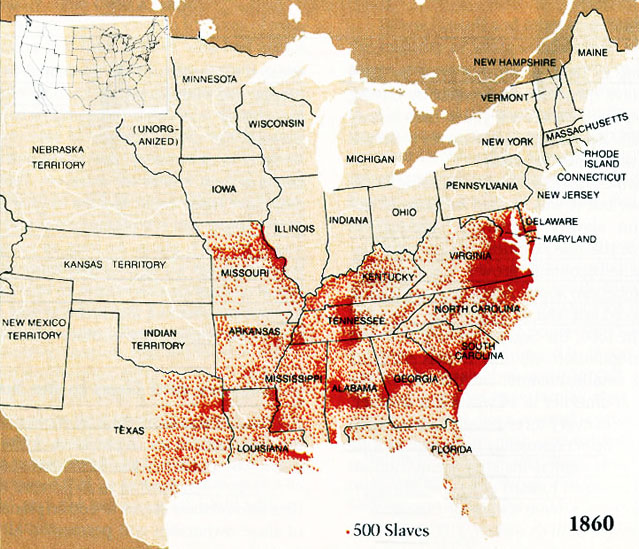
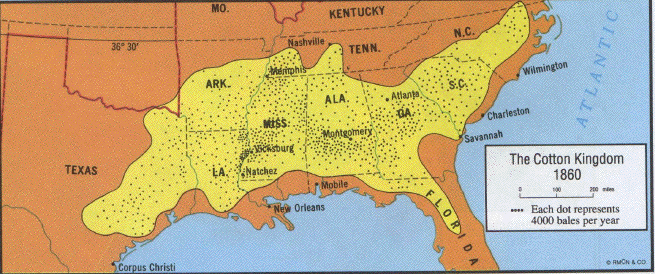
In 1860 the US had roughly 4 million slaves, of whom about 60% lived in the Deep South = 2.4 million.
Of those we can suppose that 2/3 grew cotton = 1.5 million, and the rest did everything else where slaves could be employed -- growing rice & sugar, dock workers, artisans & craftsmen, clearing land, building railroads, working factories like the Vulcan Iron Works in Charleston, SC., not to mention plantation "house slaves."
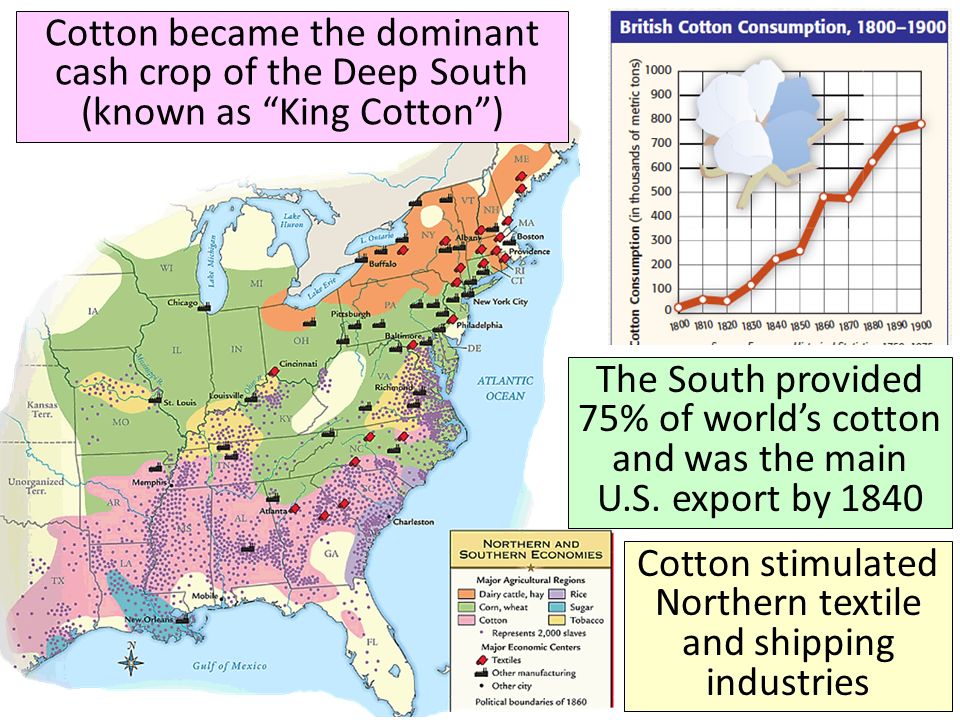
Point is: in 1860 just over 1/3 of all slaves grew cotton, the rest did any number of other jobs which could be found in any state or territory, North, West or South, where slavery was not prohibited.
Note on these maps that slave populations often extended well beyond the regions of cotton plantations:
Here we see the slaves & produce maps overlapped:
DiogenesLamp: "But the truth is, the Northern people hated blacks, and hated economic competition from them, and most of them did not care about the well being of blacks."
Here's what we know for certain: Northern slaves fell from 40,000 in 1790 to 18 (in NJ) in 1860, while freed-blacks increased from 27,000 in 1790 to 226,000 in 1860.
That was not the result of "hatred".
DiogenesLamp: "But the historians would have us believe that the Northerners were motivated by the milk of human kindness when they invaded the states of the South to reassert Washington DC control over people who did not want it. "
Northerners were certainly motivated by the milk of human kindness towards their beloved United States and by hatred for the idea that a few lousy slavers could destroy it.
Of course we can't expect DiogenesLamp to ever understand such feelings.
DiogenesLamp: "I just read yesterday that in the aftermath of the Civil War, hundreds of thousands of blacks died, mostly of starvation."
No such reports provide any real evidence for those high estimates and serious scholars discount them.
Even your own link says:
"Relief from the disaster was provided first by the U.S. Army.
Shortly thereafter the Freedman’s Bureau was authorized to distribute food to all in need regardless of race within the constraints of their existing budget.
Commissioner Oliver O. Howard was able to free about $500,000 for the effort.
Private agencies began to spring up in the north, among the more prominent of which was the Southern Famine Relief Commission.
By the end of 1867 the famine largely abated."
214
posted on
07/14/2018 11:55:16 AM PDT
by
BroJoeK
((a little historical perspective...))
To: jeffersondem; Leaning Right; rockrr; DiogenesLamp
jeffersondem:
"Here we see someone seeking to legitimize his views by citing his own inferences.
Some call this “circular reasoning” but renouncing reason is a better term." Total nonsense, as usual for jeffersondem.
Nothing "circular" about my post, simply pointed out where and how I'd said "no" -- in post #107.
So my point remains valid and jeffersondem's is destroyed, because the Constitution nowhere "enshrined" slavery, just the opposite, slavery snuck in, unacknowledged through the back door.
215
posted on
07/14/2018 1:26:23 PM PDT
by
BroJoeK
((a little historical perspective...))
To: jeffersondem
jeffersondem:
"I can somewhat understand your viewing your off-axis arguments as “mirror image.”
Just remember, when you advocate the opposite of the truth you are not advocating the truth." But my term "mirror image" referred to "a silly or insulting post," which by definition cannot be the truth.
So as usual, your concern here is misplaced.
But I should say that I do appreciate your attention to the fine points of word definitions, and indeed your use of some more unusual words when on the prod to chivvy your mess & gom into a tally book.
216
posted on
07/14/2018 1:38:18 PM PDT
by
BroJoeK
((a little historical perspective...))
Not exactly on point to this discussion but I can’t see a Union victory without Grant. I’m a Southerner born and bred but like the late Shelby Foote I have an abiding respect for Grant and that other Ohio boy William Tecumseh Sherman (who would rather shoot an abolitionist than a rebel), true sons of the Northwest Ordinance of 1887.
I highly recommend Jean Edward Smith’s bio of Grant and Horace Porter’s ‘Campaigning With Grant’.
Smith: “If Appomattox was Grant’s finest hour, then his determination to protect those who surrendered there ranks a close second.” Just so. It was Grant’s magnanimity and word that saved Lee from the gallows.
An excellent article (10 minute read) on R. E. Lee and the issue of treason by historian Allen C. Guelzo.
https://www.weeklystandard.com/allen-c-guelzo/the-trial-that-didnt-happen
Grant forwarded his own views to Secretary of War Edwin Stanton on June 16, 1865:
In my opinion the officers and men paroled at Appomattox Court-House, and since, upon the same terms given to Lee, cannot be tried for treason so long as they observe the terms of their parole. This is my understanding. Good faith, as well as true policy, dictates that we should observe the conditions of that convention. Bad faith on the part of the Government, or a construction of that convention subjecting the officers to trial for treason, would produce a feeling of insecurity in the minds of all the paroled officers and men. If so disposed they might even regard such an infraction of terms by the Government as an entire release from all obligations on their part. I will state further that the terms granted by me met with the hearty approval of the President at the time, and of the country generally. The action of Judge Underwood, in Norfolk, has already had an injurious effect, and I would ask that he be ordered to quash all indictments found against paroled prisoners of war, and to desist from further prosecution of them.
Another fine article about Grant and Lee:
http://www.civilwarprofiles.com/grant-protects-lee-from-treason-trial/
217
posted on
07/14/2018 1:58:23 PM PDT
by
donaldo
To: BroJoeK; wardaddy; rustbucket; DiogenesLamp; Pelham; FLT-bird; Rome2000; Ambrosia; Ohioan; ...
“Nothing “circular” about my post, simply pointed out where and how I’d said “no” — in post #107.”
Your use of repetition (e.g. slavery in the U.S. constitution is unacknowledged) brings to mind what one European socialist said sometime back:
“It would not be impossible to prove with sufficient repetition and a psychological understanding of the people concerned that a square is in fact a circle. They are mere words, and words can be molded until they clothe ideas and disguise.”
To: BroJoeK
“But my term “mirror image” referred to “a silly or insulting post,” which by definition cannot be the truth.”
You state that an insulting post “by definition cannot be the truth.” I’m not following your thinking.
An insult may not be a nice thing to utter - that’s why I work so hard to avoid them - but they can be the truth.
To: jeffersondem
I doubt that you have ever inadvertently bumped up against the truth, much less sought it plainly.
220
posted on
07/14/2018 7:32:06 PM PDT
by
rockrr
( Everything is different now...)
Navigation: use the links below to view more comments.
first previous 1-20 ... 161-180, 181-200, 201-220, 221-237 next last
Disclaimer:
Opinions posted on Free Republic are those of the individual
posters and do not necessarily represent the opinion of Free Republic or its
management. All materials posted herein are protected by copyright law and the
exemption for fair use of copyrighted works.
FreeRepublic.com is powered by software copyright 2000-2008 John Robinson