To: x
Read your own article. There were 18 slaves left in New Jersey in 1860, and none in the states to the north or east. That is not a lot. It is not "none", and it is probably about what they would have had in Kansas had everyone ignored it.
It's not really the same thing. 18 or 236 slaves with no prospect of more slaves or new slaves is different from several thousand slaves with prospects for more new slaves.
And that's just what i'm saying. The climatological evidence indicates they were never going to grow enough cotton in Kansas to worry about large numbers of slaves in the state.
But if Kansas and Nebraska had slaveowners who were committed to the growth and expansion of slavery - even into free states - of course those in the free states would be concerned.
I think they were concerned that it become a "slave" state as a political point, but didn't really care as a practical matter, because it obviously wasn't practical to have any significant slavery in Kansas. Symbol over substance.
George Washington would have felt the same way. He was a slaveowner uneasy with the idea of slavery, a slaveowner who hoped the institution would eventually disappear.
In the latter part of his life. Earlier he had no qualms about it. I've rad Washington's writings on the subject. One of his common concerns was finding things for his slaves to do that were sufficiently profitable to cover the costs of running his estates.
Some people say the same thing about Robert E. Lee. Whether that's true or not, it's hypocritical if you respect such men and attack Northerners for attitudes that weren't entirely different.
One of my long running arguments is that the Northerners were no different from the Southerners in their disdain for the black man. Most Northern opposition was to the very idea of black people living in their state. Most of their concerns over slavery were concerns of free labor versus paid wages. A person selling their labor for wages cannot compete against someone who works for free, and the economic threat this poses creates quite a lot of hatred on that basis alone.
But the historians would have us believe that the Northerners were motivated by the milk of human kindness when they invaded the states of the South to reassert Washington DC control over people who did not want it.
But the truth is, the Northern people hated blacks, and hated economic competition from them, and most of them did not care about the well being of blacks.
I just read yesterday that in the aftermath of the Civil War, hundreds of thousands of blacks died, mostly of starvation. Disrupting the economic system that kept them fed and housed was done too quickly.
As George W Bush didn't seemingly have a plan for victory in Iraq, it appears Lincoln didn't have a plan for victory in the South either. Well... not one that included the well being of blacks anyway.
204 posted on
07/12/2018 3:13:05 PM PDT by
DiogenesLamp
("of parents owing allegiance to no other sovereignty.")
To: DiogenesLamp; BroJoeK; DoodleDawg; rockrr
But the historians would have us believe that the Northerners were motivated by the milk of human kindness when they invaded the states of the South to reassert Washington DC control over people who did not want it.
You are still relying on what you think you learned in third grade. Few historians say that. That is an ignorant stereotype of what historians are actually saying today -- and what they have been saying for some time.
For a long time, academic historians were sympathetic to the South and disliked Republicans and abolitionists. Today, they admire abolitionists and African-American leaders, but still think little of Republicans and the average White Northerner.
But the truth is, the Northern people hated blacks, and hated economic competition from them, and most of them did not care about the well being of blacks.
That is another ignorant stereotype. Many Northerners did not like African-Americans. Others didn't have much of a problem with them. Many would have resisted any change in their situation, and introducing slavery or any large population of newcomers would certainly have been a major change. Calling that "hatred" would be a gross exaggeration.
And then or now, the question of how much people "care about the well-being" of others is a complicated question. A little serious introspection on your part might lead you to understand how people care in some ways and don't care in others -- how people are not deeply concerned about conditions elsewhere, and yet capable of responding when horrendous things happen.
I just read yesterday that in the aftermath of the Civil War, hundreds of thousands of blacks died, mostly of starvation. Disrupting the economic system that kept them fed and housed was done too quickly.
They had not been vaccinated against smallpox, and many freedmen died of it. There were other diseases like typhus, dysentery, yellow fever and cholera, which spread quickly when large numbers of people were together in hastily improvised conditions.
But I don't see that large numbers of freed slaves starved or that they were horribly mistreated by Union authorities. The freedpeople weren't helpless, and most who were on their own fended for themselves well enough, but overcrowding could kill in those days.
205 posted on
07/12/2018 3:45:21 PM PDT by
x
To: DiogenesLamp
And that's just what i'm saying. The climatological evidence indicates they were never going to grow enough cotton in Kansas to worry about large numbers of slaves in the state.
Most of the places where slavery has been practiced around the world and throughout history have not been hospitable to profitable plantation cotton growing. That hasn't stopped people from owning, buying, selling or being slaves.
If slavery could be legally established in Kansas or Nebraska this would make slavery more secure in its core area further South. Washington and other Founders hoped that slavery would eventually disappear. Free Soilers were following in the tradition of the Founders by restricting slavery and expanding the realm of freedom.
206 posted on
07/12/2018 3:53:01 PM PDT by
x
To: DiogenesLamp; x
DiogenesLamp:
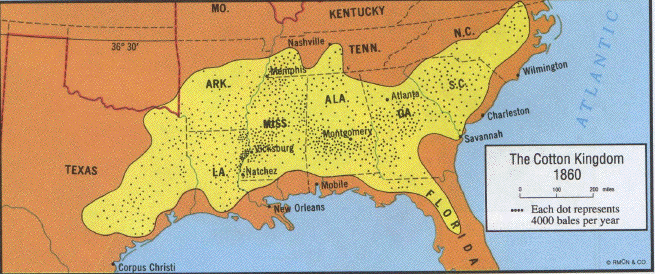
"The climatological evidence indicates they were never going to grow enough cotton in Kansas to worry about large numbers of slaves in the state." Clearly DiogenesLamp wishes us to equate slavery writ-large with large Deep South cotton plantations, but that is not the case.
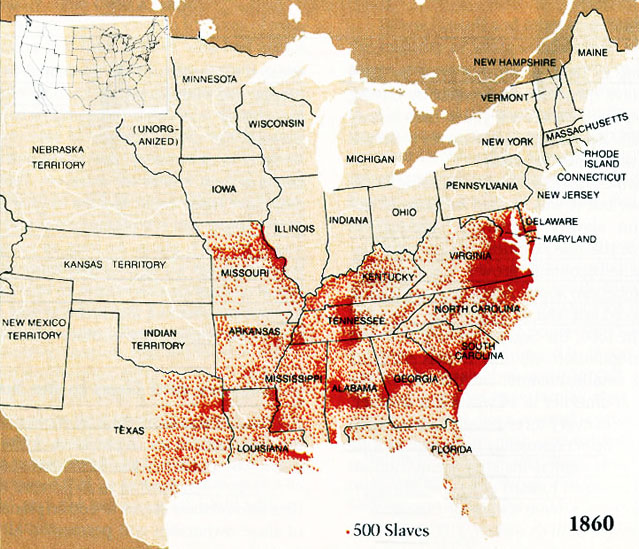
In 1860 the US had roughly 4 million slaves, of whom about 60% lived in the Deep South = 2.4 million.
Of those we can suppose that 2/3 grew cotton = 1.5 million, and the rest did everything else where slaves could be employed -- growing rice & sugar, dock workers, artisans & craftsmen, clearing land, building railroads, working factories like the Vulcan Iron Works in Charleston, SC., not to mention plantation "house slaves."
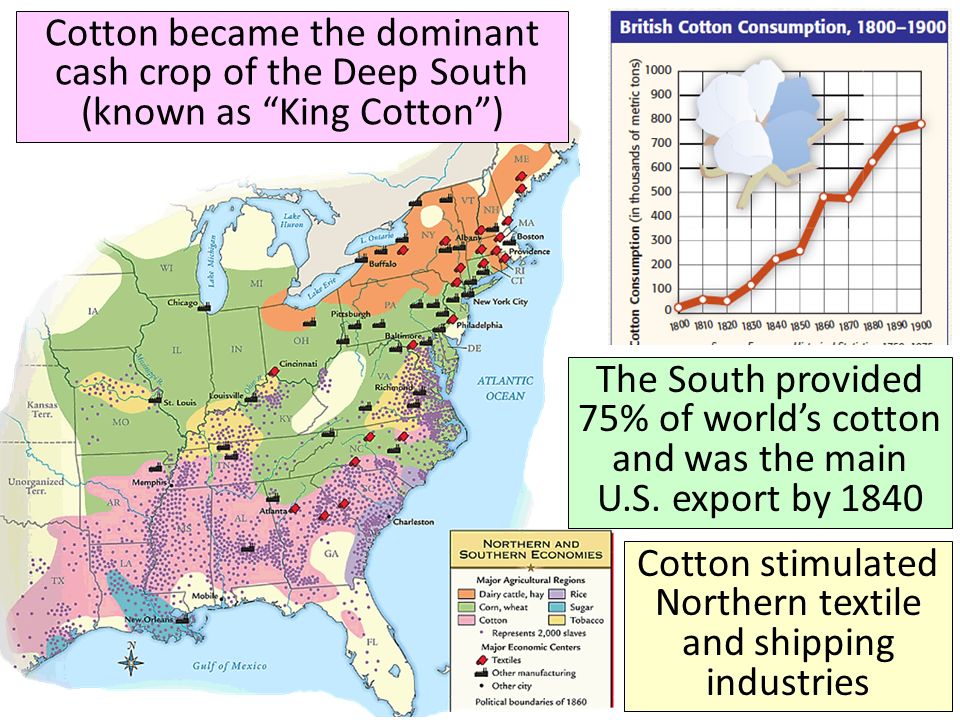
Point is: in 1860 just over 1/3 of all slaves grew cotton, the rest did any number of other jobs which could be found in any state or territory, North, West or South, where slavery was not prohibited.
Note on these maps that slave populations often extended well beyond the regions of cotton plantations:
Here we see the slaves & produce maps overlapped:
DiogenesLamp: "But the truth is, the Northern people hated blacks, and hated economic competition from them, and most of them did not care about the well being of blacks."
Here's what we know for certain: Northern slaves fell from 40,000 in 1790 to 18 (in NJ) in 1860, while freed-blacks increased from 27,000 in 1790 to 226,000 in 1860.
That was not the result of "hatred".
DiogenesLamp: "But the historians would have us believe that the Northerners were motivated by the milk of human kindness when they invaded the states of the South to reassert Washington DC control over people who did not want it. "
Northerners were certainly motivated by the milk of human kindness towards their beloved United States and by hatred for the idea that a few lousy slavers could destroy it.
Of course we can't expect DiogenesLamp to ever understand such feelings.
DiogenesLamp: "I just read yesterday that in the aftermath of the Civil War, hundreds of thousands of blacks died, mostly of starvation."
No such reports provide any real evidence for those high estimates and serious scholars discount them.
Even your own link says:
"Relief from the disaster was provided first by the U.S. Army.
Shortly thereafter the Freedman’s Bureau was authorized to distribute food to all in need regardless of race within the constraints of their existing budget.
Commissioner Oliver O. Howard was able to free about $500,000 for the effort.
Private agencies began to spring up in the north, among the more prominent of which was the Southern Famine Relief Commission.
By the end of 1867 the famine largely abated."
214 posted on
07/14/2018 11:55:16 AM PDT by
BroJoeK
((a little historical perspective...))
FreeRepublic.com is powered by software copyright 2000-2008 John Robinson