Skip to comments.
Storms that built a graveyard: ancient monsoons and flood created a spectacular dinosaur fossil site
The Conversation ^
| 07/22/2026
| Alfio Alessandro Chiarenza Royal Society Newton International Fellow in Palaeontology, UCL
Posted on 07/26/2026 9:15:35 PM PDT by SeekAndFind
Around 80 million years ago, a stretch of tropical coastline in what is now north-eastern Italy was lashed by monsoon rains and tropical cyclones. Those storms swept dinosaur carcasses, crocodiles, plants and river mud onto a tidal flat, where the tides and a film of microbes sealed everything away with extraordinary preservation.
My colleagues and I have published a new study that reconstructs the violent tropical climate behind the Villaggio del Pescatore Lagerstätte near Trieste and reveals it preserves just four decades of life, recorded almost day by day.
The Villaggio del Pescatore site near Trieste is one of the most important Late Cretaceous fossil localities in the Mediterranean. It is the only known site in the region to preserve large land animals, including dinosaurs such as Tethyshadros insularis, from the final 15 million years or so of the age of dinosaurs.
Palaeoenvironmental reconstruction of Villaggio del Pescatore. Davide Bonadonna, Author provided (no reuse)
Tethyshadros insularis was a plant-eating, duck-billed dinosaur that lived in what is now north-eastern Italy around 80 million years ago. It was initially interpreted as a dwarf island species, shaped by the “island rule” – that large animals evolve smaller bodies in environments with limited space and resources.
However, the discovery of larger specimens challenged this idea. Up to 11 individuals are potentially preserved in this succession of rocks, with at least three other fairly complete skeletons still waiting to be extracted from the hard (and expensive to cut) limestone rock. Geological evidence has also revealed that the site was about 10 million years older than previously thought and was not part of a tiny, isolated island. Instead, it lay near a larger landmass connected through the ancient Mediterranean region.
Reconstruction of a Tethyshadros insularis skeleton, nicknamed Antonio, near his finding site. Tiziana Brazzatti, CC BY-ND
The fossils of tiny crocodilians named Acynodon (with shorter muzzles than modern crocodilians) have also been found at this site.
After years of research, Professor Federico Fanti of the University of Bologna and I led a multidisciplinary team of palaeontologists, physicists and geologists to determine exactly how this fossil treasure trove formed. Our findings overturn decades of competing interpretations.
In a study published in Global and Planetary Change, we show that the site was not a quiet, isolated lake or sinkhole, as previously suggested. Our results suggest it was a storm-battered tidal flatland at the edge of a tropical sea.
Villaggio del Pescatore is not simply a place where fossils happen to be beautifully preserved. It is also a record of the weather that shaped the site. We can identify individual storms and floods in the rocks, almost day by day. Very few fossil sites on Earth allow us to do that.
Reading the rock like a calendar
The fossils at Villaggio del Pescatore are concentrated in a finely layered carbonate rock, marked by thousands of paper-thin light and dark bands. For years these were interpreted as annual layers (like tree rings) laid down season by season.
Our new analysis tells a different story. Using high-resolution X-ray scans at the Elettra Synchrotron in Trieste, alongside detailed geochemical and microscopic analyses, we showed that the bands were not annual but daily. A synchrotron accelerates electrons (particles with a negative charge) to almost the speed of light. This produces powerful X-rays that can penetrate dense materials such as rock. This allowed us to examine structures inside the rocks and bones at a resolution of fractions of a millimetre.
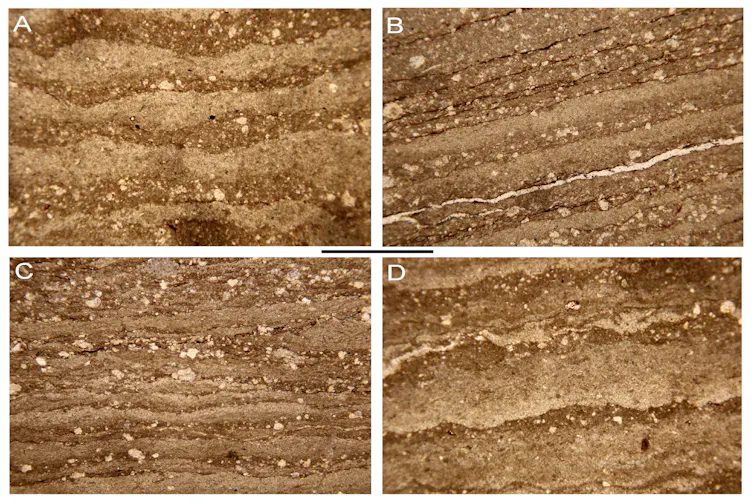
The scans revealed that the layers were deposited by ocean tides, two pairs each day. These tides varied according to the familiar fortnightly cycle of stronger and weaker tides that still happen today. We could count these tidal layers, thanks to this unparalleled resolution.
Rock sections from Villaggio del Pescatore under the microscope. The lighter layers are mainly carbonate mud, while the darker ones contain more sediment washed in from land. Alfio Alessandro Chiarenza, Author provided (no reuse)The entire fossil-bearing rock pile, our results calculate, accumulated in only about 40 years, a single human lifetime, frozen in stone. Most fossil deposits containing several individuals average together thousands or millions of years. Here, we’re looking at a few decades.
Monsoons, cyclones and microbes
To explain why storms were so central to the preservation of the fossils, the team ran climate simulations. The models consistently placed the site at around 29° north, inside a powerful, summer-dominated monsoon belt. This was a tropical regime of intensely wet summers and recurring tropical cyclones, sustained by the greenhouse climate of the age.
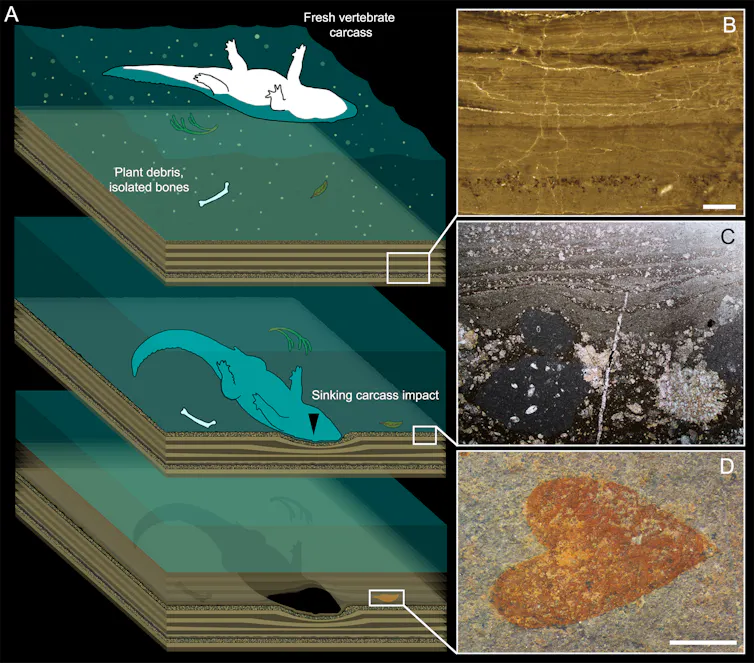
Monsoon-driven floods and cyclone surges created pulses of sediment, nutrients, plant debris and animal carcasses onto the tidal flat. The tides trapped this material, and mats of microbes rapidly stabilised it. This encouraged the sediment to harden right after the carcass was deposited, before it started rotting or predators could scavenge its dead tissues. These storms were the main agents behind this preservation.
As normal tidal conditions returned, thin layers of sediment gradually buried bones and articulated carcasses (like the Acynodon croc in the drawing, A), sometimes preserving soft tissues. The photographs show undisturbed tidal layers (B), a storm deposit covered by microbial mats (C), and a plant leaf washed in from inland (D). Alfio Alessandro Chiarenza, Author provided (no reuse)The site’s three most important Tethyshadros insularis dinosaurs show a range of fates: one buried so quickly that soft-tissue outlines survive, another bearing the cracked, sun-dried bones of a carcass that lay exposed inland before being washed in by a flood. Crocodilians such as Acynodon adriaticus, fish and shrimps were also local residents, entombed close to where they lived and died.
We propose that this combination of “ingredients”, monsoon floods, tidal trapping and microbial sealing, represents a recipe for creating exceptionally preserved fossil sites in hot, tropical greenhouse climates – precisely the kind of setting in which rapid decay would normally destroy organic remains.
The study also offers an ancient perspective on how intensifying monsoons and cyclones can reshape coastlines, ecosystems and what becomes preserved along tropical shores.
Villaggio del Pescatore has been studied for more than four decades, yet it still has new stories to tell. Understanding how extreme storms transformed this ancient coastline may also help us think about how modern coasts could respond to a warmer and more turbulent climate fuelled by high levels of CO₂.
Alfio Alessandro Chiarenza works for University College London, Department of Earth Sciences. He receives funding from The Royal Society as a Newton International Research Fellow.
TOPICS: History; Science; Weather; Weird Stuff
KEYWORDS: catastrophism; dinosaurs; flood; fossils; godsgravesglyphs; italy; paleontology; science; storms; tsunami
Navigation: use the links below to view more comments.
first 1-20, 21-38 next last
To: SeekAndFind
Understanding extreme storms What?????
Extreme???
Before SUVs??
Before AlGore?
Before The Hockey Stick?
Before Mar-a-Lago?
To: SeekAndFind
So where are there examples of modern storms, hurricanes and the like forming fossils today?
To: SeekAndFind
Thank you for posting this.
4
posted on
07/27/2026 3:07:40 AM PDT
by
sauropod
(Make sure Satan has to climb over a lot of Scripture to get to you. John MacArthur Ne supra crepidam)
To: SeekAndFind
and mats of microbes rapidly stabilised it.
Really? Microbes usually aid in breaking down carcasses.
5
posted on
07/27/2026 3:26:25 AM PDT
by
Adder
("A pack of jackasses led by a lion is superior to a pack of lions led by a jackass.” GW.)
To: SeekAndFind
The elevation of the Villaggio del Pescatore paleontological site is approximately 15 meters (50 feet) above sea level. It is supposed to have flooded, and drowned and killed, mobile creatures too stupid to flee rising water...50 feet above sea level. Right.
Ummmm...what happened to the creatures BELOW the 50 foot elevation? Where are THEIR fossils?
Bible...Genesis...flood.
Believe as you will.
6
posted on
07/27/2026 3:37:34 AM PDT
by
philman_36
(Pride breakfasted with plenty, dined with poverty and supped with infamy. Benjamin Franklin)
To: 75thOVI; Abathar; agrace; aimhigh; Alice in Wonderland; AnalogReigns; AndrewC; aragorn; ...
Nice twofer! GGG / Catastrophism ping.

7
posted on
07/27/2026 4:35:16 AM PDT
by
SunkenCiv
(The Demagogic Party is just a collection of violent, rival street gangs.)
To: EnderWiggin1970
LOLOL!!
So, who’s gonna tell them?
Climate change is the norm.
Noah’s flood was real.
8
posted on
07/27/2026 4:44:03 AM PDT
by
Westbrook
(democRATs are wizards at two things: Finding votes and losing evidence.)
To: philman_36; Westbrook
Thank you both for your posts.
It’s simple to see the reality of Noah’s Flood.
The stones (and fossils!!) cry out!!
9
posted on
07/27/2026 5:19:03 AM PDT
by
fishtank
(The denial of original sin is the root of liberalism.)
To: EnderWiggin1970
“ So where are there examples of modern storms, hurricanes and the like forming fossils today?”
Live to be several hundred thousands year old and you can answer that question for yourself.
10
posted on
07/27/2026 5:21:01 AM PDT
by
muir_redwoods
(You choose; a world without dogs or a world without muslims.)
To: Adder
The term microbe refers to more than just the kind of bacteria the feed on dead tissue.
11
posted on
07/27/2026 5:22:16 AM PDT
by
muir_redwoods
(You choose; a world without dogs or a world without muslims.)
To: philman_36
You do remember from fifth grade science class that geological strata rise and fall over time, right? Plate tectonics is a good example
12
posted on
07/27/2026 5:24:46 AM PDT
by
muir_redwoods
(You choose; a world without dogs or a world without muslims.)
To: SeekAndFind
Is this article suggesting there were weather extremes 80 million years ago?
Our youth today are being indoctrinated to believe weather extremes did not happen until after capitalist economies and the GOP came into existence.
To: SeekAndFind
So, a giant flood killed dinosaurs.
Only thing I question in the story is the dating.
14
posted on
07/27/2026 7:02:06 AM PDT
by
PAR35
To: philman_36
Yeah, they lost me at “80 million years”...
15
posted on
07/27/2026 8:39:44 AM PDT
by
jagusafr
To: EnderWiggin1970
“ So where are there examples of modern storms, hurricanes and the like forming fossils today?”
I bet there are many human fossils forming in the Mississippi Delta.
16
posted on
07/27/2026 9:21:28 AM PDT
by
VanShuyten
("...that all the donkeys were dead. I know nothing as to the fate of the less valuable animals.)
To: jagusafr
Yeah, they lost me at “80 million years”... This would have been during the Cretaceous period of the Mesozoic era, so dinosaurs were still around.
To: fishtank
I was once an atheistic evolutionist.
From the age of about 12, when I was taught it in school, until I was 42, when the Lord saved me.
18
posted on
07/27/2026 11:48:27 AM PDT
by
Westbrook
(democRATs are wizards at two things: Finding votes and losing evidence.)
To: SeekAndFind
“ Understanding how extreme storms transformed this ancient coastline may also help us think about how modern coasts could respond to a warmer and more turbulent climate fuelled by high levels of CO₂.”
CO2 is a trailing factor, not a causal factor for climate change. Enough of this BS.
19
posted on
07/27/2026 12:23:12 PM PDT
by
JimRed
(TERM LIMITS, NOW! Finish the damned WALL! TRUTH is the new HATE SPEECH! )
To: muir_redwoods
Live to be several hundred thousands year old and you can answer that question for yourself. Not necessary. If remains vanish within a few years, you know they are not going to be forming fossils. We had millions of bison roaming the plans in the 19th century. No trace of them left. No fossilization. We have plenty of modern floods, hurricane deposits up to 6 feet thick, in modern times. But those deposits remain biologically active with any plant and animal remains decaying away.
Fossilization requires deep burial beyond the range of decomposers, on a scale we don't see from contemporary floods and storms. So interpretations claiming dinosaur fossils were created by ancient monsoons and such are anti-empirical. If we don't see monsoons forming fossils today, we shouldn't claim they formed fossils in the past. It's unscientific.
Navigation: use the links below to view more comments.
first 1-20, 21-38 next last
Disclaimer:
Opinions posted on Free Republic are those of the individual
posters and do not necessarily represent the opinion of Free Republic or its
management. All materials posted herein are protected by copyright law and the
exemption for fair use of copyrighted works.
FreeRepublic.com is powered by software copyright 2000-2008 John Robinson