Posted on 07/14/2026 6:40:51 PM PDT by nickcarraway
Ancient mathematical texts discovered at the Maya city of Xultun in Guatemala have revealed the name of a Maya astronomer for the first time, offering rare evidence of the scholars behind one of the ancient world’s most advanced systems of mathematics and astronomy.
Researchers reconstructed and transcribed dozens of tiny inscriptions found on the plaster walls of a small building at the site. Their work uncovered a unique mathematical formula and identified its author, marking the first known case of a Classic Maya mathematician-astronomer being directly credited for his work. The findings were published in the journal Antiquity.
Wall writings reveal a hidden scholar
During the Classic Maya period, from about A.D. 250 to 900, astronomy and mathematics shaped many aspects of public life. Scholars tracked the movements of celestial bodies and combined those observations with an advanced calendar system. Their calculations determined the timing of royal ceremonies, monument dedications, and other important events.
While Maya artists and sculptors often signed their work, the experts responsible for these complex calculations remained anonymous.
The breakthrough came after researchers examined more than 50 mathematical and astronomical microtexts preserved on the walls of a small room at Xultun. The inscriptions appear to be working notes rather than formal inscriptions, preserving calculations and tables created as scientific work was underway.
Grecian Delight supports Greece Artist’s reconstruction of structure 10K-2, showing painted figures on the north and east walls Artist’s reconstruction of structure 10K-2, showing painted figures on the north and east walls. Credit: Franco D. Rossi / CC BY-NC 4.0 To study the texts, researchers produced detailed drawings, high-resolution photographs, and digital scans of the walls. Image enhancement techniques revealed 11 previously difficult-to-read hieroglyphs.
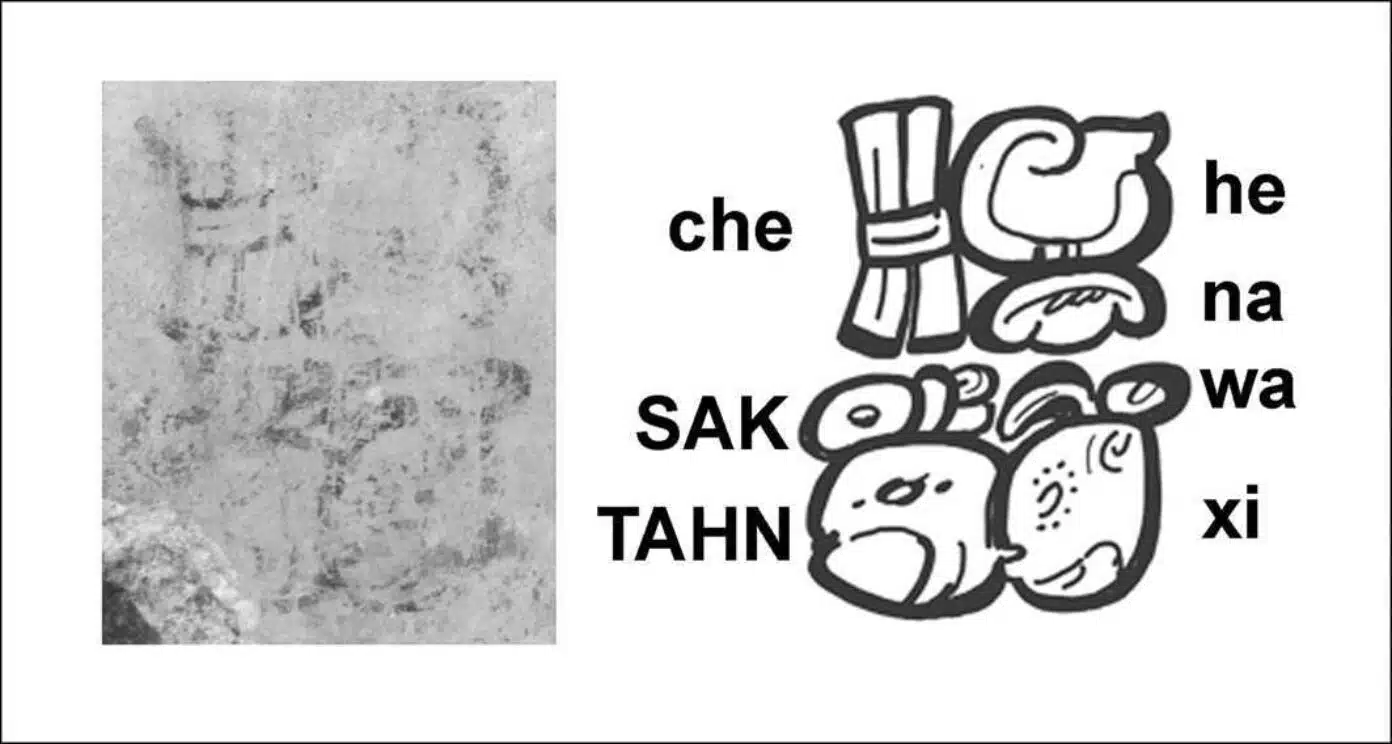
Those newly deciphered glyphs identified the author as Sak Tahn Waax, whose name translates to “White-chested Fox.” Researchers say no other surviving Classic Maya mathematical text has been linked to an individual scholar.
Co-author Heather Hurst, director of the San Bartolo-Xultun Project, compared the discovery to finding an early draft of a famous manuscript or a sketch by a master artist because it captures the scientific process before a finished work was produced.
Formula offers a new view of Maya astronomy
The mathematical formula itself proved just as remarkable as the signature.
Although it relies on familiar Maya calendar and astronomical cycles, it combines them in a way never before documented. Researchers found that the calculations connect the 260-day sacred calendar, the solar year, and the cycles of Venus and Mars through a unique mathematical relationship.
Co-author David Stuart, the project’s epigrapher at the University of Texas at Austin, said the formula reflects the author’s own understanding of how these different cycles fit together. Researchers describe it as a creative expression of mathematical thought rather than a routine calculation.
The discovery offers an unprecedented look into the scientific work of Indigenous Maya scholars and highlights their contributions to astronomy and mathematics.
Researchers note that ancient scholars in India, Mesopotamia, China, and Greece are often remembered by name for their scientific achievements. The identification of Sak Tahn Waax now places a Maya mathematician alongside those historic figures and underscores the rich astronomical traditions that developed independently in the ancient Americas.
Check that name against voter registration in Texas and Arizona.
It’s a mystery how a “priestly” class survived in what was a desperately barbaric culture.



Do you think the Mayans were like the Aztecs? The Mayans had the zero 1200 years before Europe.

GROK says Haley’s comet is named after Alex Haley in honor of Roots. Whatever. Build me another data center.
I think maybe you see my point. The Mayans were violent and bloodthirsty — exceedingly so — which is why it is astounding that the class of individuals who maintained the astronomical records even developed in the first place, let alone survived.
Remember, we’re talking about city-state rulers who showed the people what’s what by dragging a string of jaguar teeth through their own tongues.
” highlights their contributions to astronomy and mathematics.”
which was exactly zilch, given the isolation of the Mayans from the rest of the scientific world and the fact that this was just discovered ...
Ouch!
Was that to show how tough they were? How they could ignore pain? Great for picking up chicks? What the hell...??
Wherever did you hear about / read about that?
It will be back in 2061 for all of us to witness again, including GROK.
Where did I first hear about that I don’t recall.
This is related, I think. (sorry for using a wipedia link)
https://en.wikipedia.org/wiki/Bloodletting_in_Mesoamerica
The rites sometimes involved using a a stingray spine to pierce the penis or by drawing a rope of thorns through a slit in the tongue.
Ping!.............
No prob about using a Wikipedia link, they're okay on scientific and technical topics. (Not good on politics or society.)
That's some wacky crazy stuff going on back then, geez.
ROTFL!
Grok said that??
Don’t we slay more than a million with abortions every year?
You sure they were more barbaric?
Minor quibble -- this isn't even close to being the earliest known astronomer name, just the first identified in Mayan inscriptions.
I didn’t know they had cell phones back then.
Nah, just kidding but I could see AI coming up with something like that.
Disclaimer: Opinions posted on Free Republic are those of the individual posters and do not necessarily represent the opinion of Free Republic or its management. All materials posted herein are protected by copyright law and the exemption for fair use of copyrighted works.
