
Posted on 06/20/2026 11:01:58 AM PDT by Red Badger
Via NBC, we're about to see a whole lot more of outer space than we've ever witnessed before:
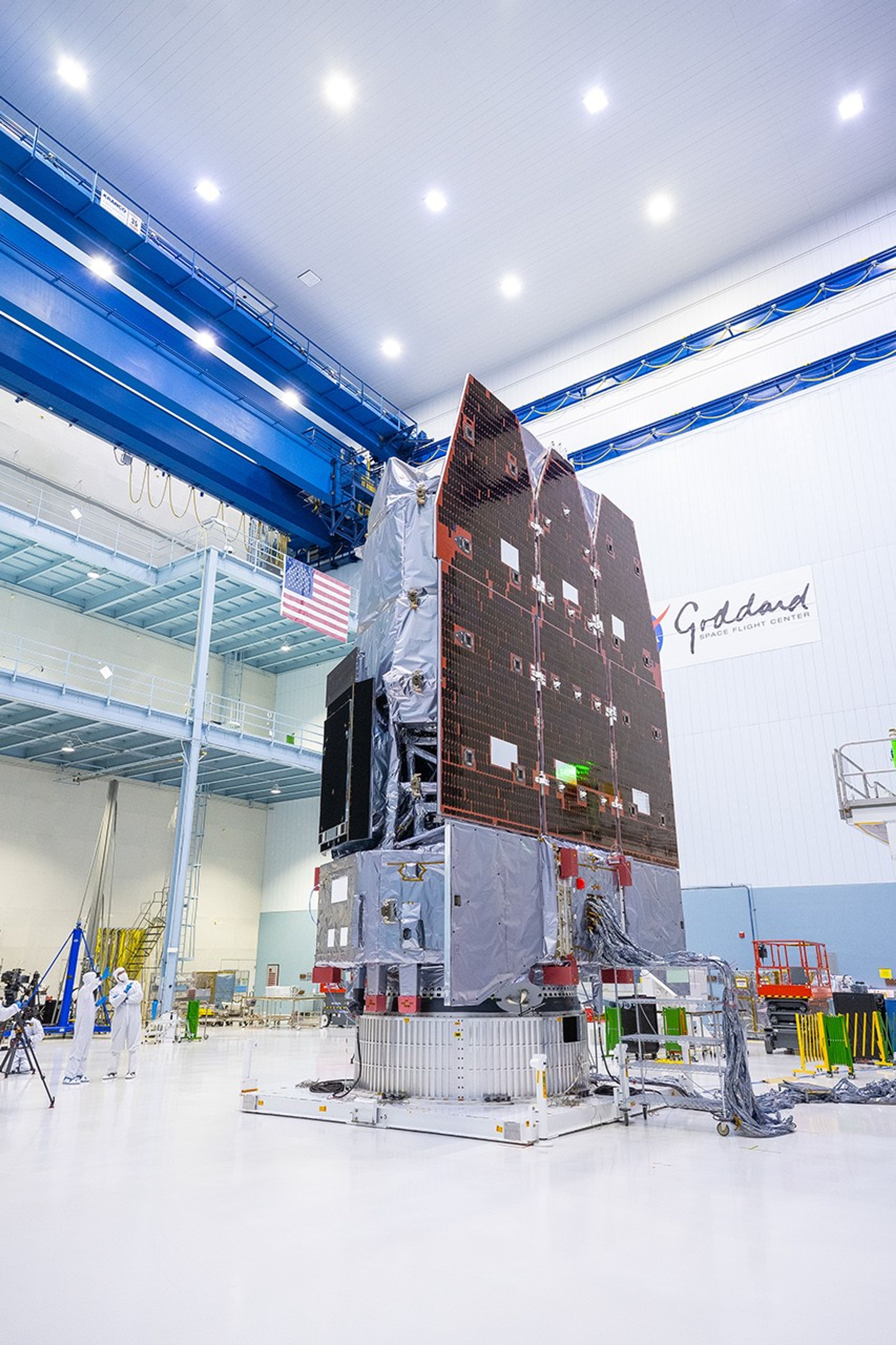
After nearly two decades of development, $4.3 billion and the labor of hundreds of scientists and engineers, the Nancy Grace Roman Space Telescope is less than three months from launch.
From a point roughly 1 million miles from Earth, the telescope is expected to survey the cosmos, capturing panoramas of hundreds of millions of stars and billions of galaxies. With this observatory, NASA hopes to unravel the secrets of dark matter and dark energy and discover thousands of planets beyond our solar system.
This is no little Walmart telescope, y'all. Here's some NASA-furnished artists' depictions of this bad boy, imagined as it will look in space:


(And yes, I guess technically you don't call a telescope a "bad boy" if it goes by the name "Nancy." But we're not going to call this thing a "bad girl," so stop asking.)
NBC says the scope "will be able to survey and map more of the sky than ever before, at a pace hundreds of times faster," and NASA told the news network that "in just one month of data collection, Roman will be able to peer at underexplored parts of the Milky Way to study stars across a deep slice of the galaxy, building an astronomical catalog far larger than any that exists today."
Here's a pre-launch video put out by NASA (I really, really love how it's as amped-up as an old-school WWF preview):
VIDEO AT LINK............
NASA's James Webb Space Telescope, of course, has already been busy for a few years snapping crazy shots of the universe from its vantage point a million miles away from Earth:

NASA's James Webb Space Telescope just snapped a photo of the most distant star – a whole 28 billion light-years away Everyone's favorite space telescope continues to amaze:
Roman has lower resolution than Webb but a much larger field of view, meaning it can more continuously monitor a huge patch of the sky relative to the Webb scope.
Meanwhile, compared to the Hubble telescope — which we all know and love — Roman is an absolute beast:
The two are roughly the same size — about that of a semitrailer truck — and similarly barrel-shaped. But the new observatory should be able to survey the cosmos 1,000 times faster than Hubble, and each image will capture a patch of sky at least 100 times larger than one of Hubble's, according to McEnery.
"To put this into context, one month of Roman observations would correspond to a century with Hubble," she said.
The Roman telescope is meant to function in part as a sort of big net, scooping up huge patches of the sky and identifying points of interest that Webb and Hubble will be able to study more closely. The telescope is also meant to conduct large-scale surveys on both dark energy and "exoplanets," or planets outside our solar system.
The scope is planned to launch later this summer, and you can tell NASA is amped for it:
Our @NASARoman space telescope is officially slated to launch on Aug. 30!
Get the details and follow Roman's journey on our new Roman Space Telescope blog: https://t.co/72iud38kMm pic.twitter.com/z5uxW2ficd— NASA (@NASA) June 3, 2026
So am I, for that matter!
Ping!....................
😎.......................
Very interesting. Will be looking forward to the launch.

Thanks!
· join · view topics · view or post blog · bookmark ·
· post new topic · subscribe ·Google news searches: exoplanet · exosolar · extrasolar ·
Two comments removed so far…over a space telescope?
1.375 terabytes of data daily.
Now you know why they need all these Data Centers...............
According to Microsoft CoPilot...
"Astronomers now estimate that the observable universe contains roughly 2 trillion galaxies..."
"This revision comes from deep-space observations using the Hubble Space Telescope and other instruments, combined with mathematical models that account for galaxies too faint or distant to be directly observed..."
****
That telescope has some serious baffling in the tube. Can’t wait to see what it can do…
Why?
HUMONGOUS!............
Why?
—
There is no other company/rocket that can match the price, reliability, or lift the weight to that high an orbit.
Disclaimer: Opinions posted on Free Republic are those of the individual posters and do not necessarily represent the opinion of Free Republic or its management. All materials posted herein are protected by copyright law and the exemption for fair use of copyrighted works.

