Posted on 10/05/2021 11:32:29 AM PDT by Red Badger
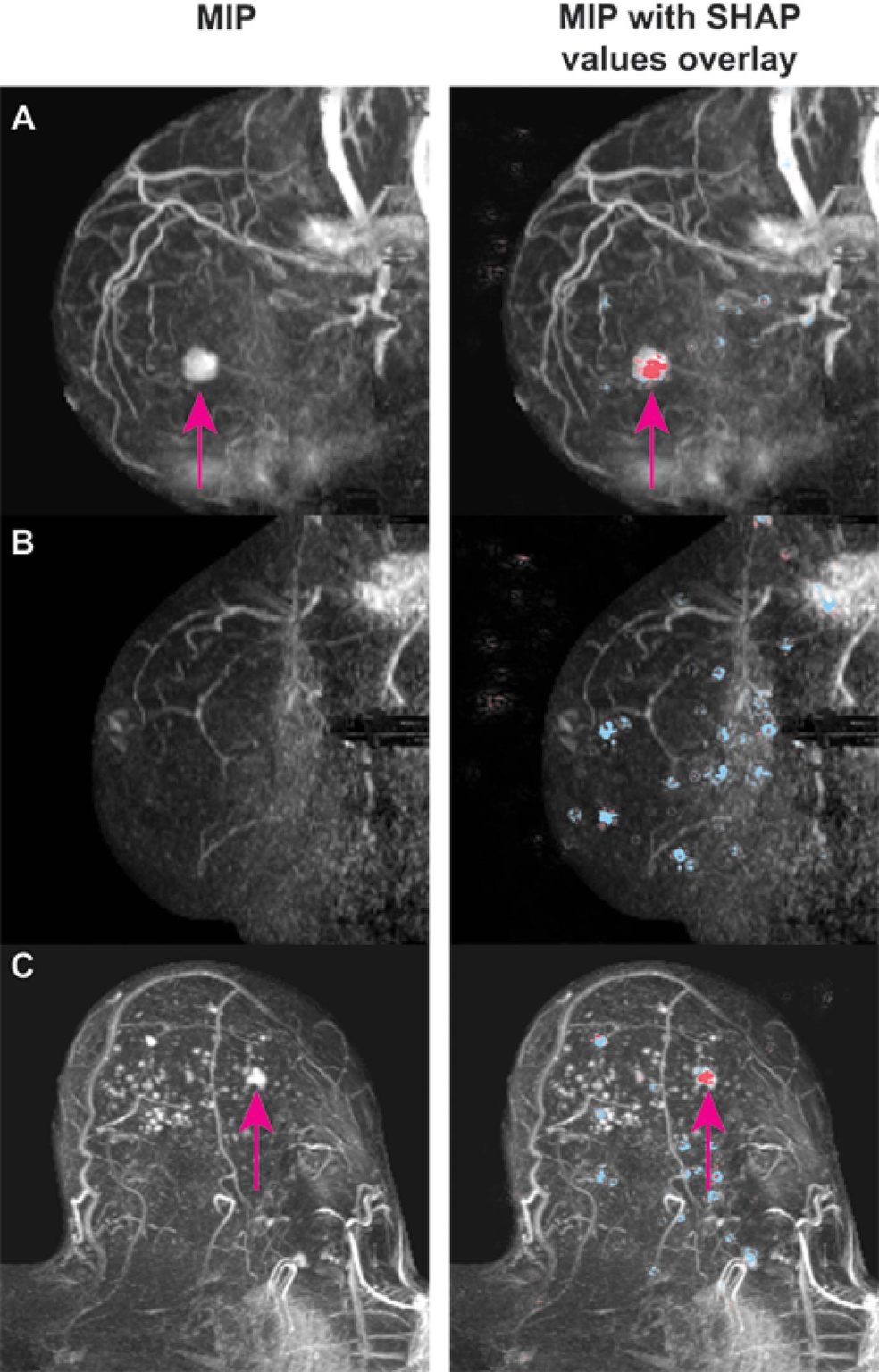
Examples of deep Shapley additive explanations (SHAP) overlay images. Maximum intensity projection (MIP) images are on left, and MIP images with the SHAP overlay are on right. Positive SHAP values (red) show areas that contribute to a high probability of lesion presence, negative SHAP values (blue) show locations with reduced probability. (A) Sagittal MIP images of contrast-enhanced breast MRI scan of an invasive ductal carcinoma in a 57-year-old woman with Breast Imaging Reporting and Data System (BI-RADS) category 4. The deep learning (DL) model yielded a probability of lesion presence of 90%. Positive SHAP values (red) are shown to coincide with the location of the lesion (arrows). (B) Sagittal MIP images of contrast-enhanced breast MRI scan of a breast without lesions in a 53-year-old woman with BI-RADS 1 score. The DL model yielded a probability of lesion presence of 11%. Negative SHAP values (blue) are diffusely distributed in the breast region. (C) Transverse MIP images of contrast-enhanced breast MRI scan of a ductal carcinoma in situ in a 65-year-old woman with BI-RADS 4 score. The DL model yielded a probability of lesion presence of 32%—the lowest probability value among all breasts with malignant disease in our study. Positive SHAP values (red) are shown to coincide with the location of the lesion (arrows). Credit: Radiological Society of North America
====================================================================================================
An automated system that uses artificial intelligence (AI) can quickly and accurately sift through breast MRIs in women with dense breasts to eliminate those without cancer, freeing up radiologists to focus on more complex cases, according to a study published in Radiology.
Mammography has helped reduce deaths from breast cancer by providing early detection when the cancer is most treatable. However, it is less sensitive in women with extremely dense breasts than in women with fatty breasts. In addition, women with extremely dense breasts have a three- to six-times higher risk of developing breast cancer than women with almost entirely fatty breasts and a twofold higher risk than the average woman.
Supplemental screening in women with extremely dense breasts increases the sensitivity of cancer detection. Research from the Dense Tissue and Early Breast Neoplasm Screening (DENSE) Trial, a large study based in the Netherlands, supported the use of supplemental screening with MRI.
“The DENSE trial showed that additional MRI screening for women with extremely dense breasts was beneficial,” said study lead author Erik Verburg, M.Sc., from the Image Sciences Institute at the University Medical Center Utrecht in the Netherlands. “On the other hand, the DENSE trial confirmed that the vast majority of screened women do not have any suspicious findings on MRI.”
Since most MRIs show normal anatomical and physiological variation that may not require radiological review, ways to triage these normal MRIs to reduce radiologist workload are needed.
In the first study of its kind, Verburg and colleagues set out to determine the feasibility of an automated triaging method based on deep learning, a sophisticated type of AI. They used breast MRI data from the DENSE trial to develop and train the deep learning model to distinguish between breasts with and without lesions. The model was trained on data from seven hospitals and tested on data from an eighth hospital.
More than 4,500 MRI datasets of extremely dense breasts were included. Of the 9,162 breasts, 838 had at least one lesion, of which 77 were malignant, and 8,324 had no lesions.
The deep learning model considered 90.7% of the MRIs with lesions to be non-normal and triaged them to radiological review. It dismissed about 40% of the lesion-free MRIs without missing any cancers.
“We showed that it is possible to safely use artificial intelligence to dismiss breast screening MRIs without missing any malignant disease,” Verburg said. “The results were better than expected. Forty percent is a good start. However, we have still 60% to improve.”
The AI-based triaging system has the potential to significantly reduce radiologist workload, Verburg said. In the Netherlands alone, nearly 82,000 women may be eligible for biennial MRI breast screening based on breast density.
“The approach can first be used to assist radiologists to reduce overall reading time,” Verburg said. “Consequently, more time could become available to focus on the really complex breast MRI examinations.”
The researchers plan to validate the model in other datasets and deploy it in subsequent screening rounds of the DENSE trial.
Reference: “Deep Learning for Automated Triaging of 4581 breast MRI Examinations from the DENSE Trial” 5 October 2021, Radiology.
Collaborating with Erik Verburg were Carla H. van Gils, Ph.D., Bas H.M. van der Velden, Ph.D., Marije F. Bakker, Ph.D., Ruud M. Pijnappel, M.D., Ph.D., Wouter B. Veldhuis, M.D., Ph.D., and Kenneth G. A. Gilhuijs, Ph.D.
I feel you are right..........................
Based on a quick survey of 2 decades worth of data, I believe the evidence supports your conclusion

You got that right! My wife is an ultrasound tech specializing in breast exams...I have offered to help her apply the gel on more than one occasion...
LMAO!

I'm that kind of guy. Nice.
Well now, I’m certainly going to keep abreast of this topic.
That guy with the “Place Boobs Here” headpiece reminds me of the old joke about the guy who would walk down a city street, asking every woman he saw, “Would you like to have sex with me?” He claimed that on average, he’d get slapped 9 times out of 10, but get laid 1 in 10. “Not bad odds, when you think about it...”
I probably have a better feel for this than A.I.
Thanks to all the men here who took this incredibily exciting story and made it into a high school bathroom thread.
No kidding, but who can blame us. We are all, in the end, basically eleven year old boys with the responsibilities and social norms of adults bolted on.
Sometimes not securely bolted...:)
It was inevitable....................
As a normal man I can attest that if you have seen one pair, you want to see them all. What is wrong with that?
This is great stuff. Congratulations to the programmers.
I have some exposure to this, and there is a lot of opportunity in medicine for AI to help.
A good example is years ago, when a CT exam might have been a few hundred slices, with the technology now, it can be a few thousand routinely. So all those additional images have to have eyes on them, you can imagine the change in scope.
We have some AI projects that can help. None of these “diagnose”. But many of them flag studies saying “look here” or “look here”. A human still has to provide the interpretation, but it helps. We use AI to help flags and prioritize CT Brain exams for stroke patients, if the AI sees something, it bumps up the priority to the top of the list and helpfully flags areas of interest. We have a bunch of other algorithms we use as well, and it really does improve care.
Of course, with all these things, the devil is in the details. You can’t just plug in an AI algorithm and off you go. It has to be modified for your area and patient population, because those things differ not only throughout the world, but for your own country, your own state, and even your own locale.
Thank you.
Why can't it rule out cancer in smart breasts?
Disclaimer: Opinions posted on Free Republic are those of the individual posters and do not necessarily represent the opinion of Free Republic or its management. All materials posted herein are protected by copyright law and the exemption for fair use of copyrighted works.