Posted on 11/24/2020 6:29:35 AM PST by Red Badger
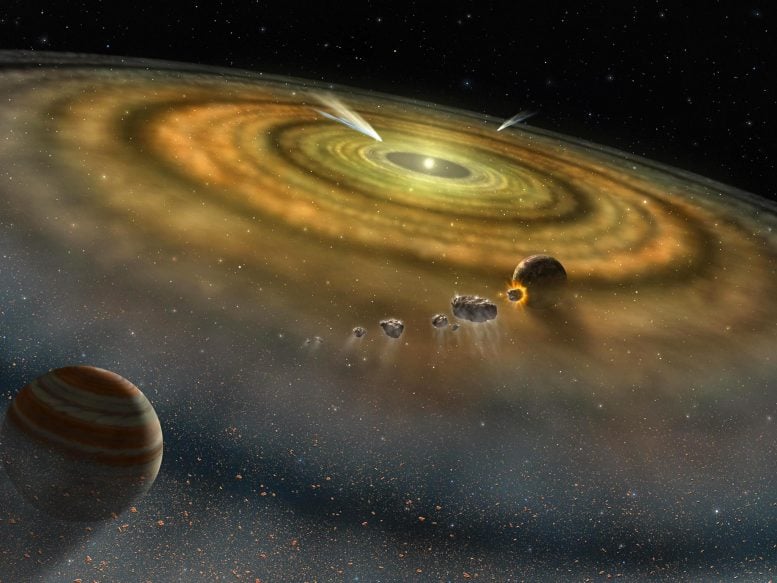
Artist’s conception of the dust and gas surrounding a new planetary system. Credit: NASA
=========================================================================
A long time ago — roughly 4.5 billion years — our sun and solar system formed over the short time span of 200,000 years. That is the conclusion of a group of Lawrence Livermore National Laboratory (LLNL) scientists after looking at isotopes of the element molybdenum found on meteorites.
The material that makes up the sun and the rest of the solar system came from the collapse of a large cloud of gas and dust about 4.5 billion years ago. By observing other stellar systems that formed similarly to ours, astronomers estimate that it probably takes about 1-2 million years for the collapse of a cloud and ignition of a star, but this is the first study that can provide numbers on our own solar system.
“Previously, the timeframe of formation was not really known for our solar system,” said LLNL cosmochemist Greg Brennecka, lead author of a paper appearing in Science. “This work shows that this collapse, which led to the formation of the solar system, happened very quickly, in less than 200,000 years. If we scale this all to a human lifespan, formation of the solar system would compare to pregnancy lasting about 12 hours instead of nine months. This was a rapid process.”
The oldest dated solids in the solar system are calcium-aluminum–rich inclusions (CAIs), and these samples provide a direct record of solar system formation. These micrometer- to centimeter-sized inclusions in meteorites formed in a high-temperature environment (more than 1,300 Kelvin), probably near the young sun. They were then transported outward to the region where carbonaceous chondrite meteorites (and their parent bodies) formed, where they are found today. The majority of CAIs formed 4.567 billion years ago, over a period of about 40,000 to 200,000 years.
This is where the LLNL team comes in. The international team measured the molybdenum (Mo) isotopic and trace element compositions of a variety of CAIs taken from carbonaceous chondrite meteorites, including Allende, the largest carbonaceous chondrite found on Earth. Because they found that the distinct Mo isotopic compositions of CAIs cover the entire range of material that formed in the protoplanetary disk instead of just a small slice, these inclusions must have formed within the time span of cloud collapse.
Since the observed time span of stellar accretion (1-2 million years) is much longer than CAIs took to form, the team was able to pinpoint which astronomical phase in the solar system’s formation was recorded by the formation of CAIs, and ultimately, how quickly the material that makes up the solar system accreted.
Reference: “Astronomical context of Solar System formation from molybdenum isotopes in meteorite inclusions” by Gregory A. Brennecka, Christoph Burkhardt, Gerrit Budde, Thomas S. Kruijer, Francis Nimmo and Thorsten Kleine, 13 November 2020, Science. DOI: 10.1126/science.aaz8482
Former LLNL scientist Thomas Kruijer (now at the Museum für Naturkunde in Berlin) also contributed to this study, as well as researchers from University of Münster, California Institute of Technology and the University of California, Santa Cruz.
The work is funded by LLNL’s Laboratory Directed Research and Development program and NASA.
Where did all that stuff come from?
That is THE question.
Another star’s death.......................
How did they measure what a year was?
Lately (past five years), there’s been talk of 2 ‘big bangs’ occurring. Maybe this is tied into the 2 bang discussion?
Where did that star come from....
They asked Biden................
Another star’s death......................
Interesting.
But I'll ask for either BB...where did the material come from?
This time frame supports Electric Universe Theory.
Or Terry Pratchett’s Ankhpomork is not far away.
GM Mr. Badger :) I’m in better mood today, and if you have time this will answer all the questions about where!
And the intro-text for the DVD listing: “The probability of life originating at random is so utterly minuscule as to make it absurd.”
Sir Fred Hoyle
Physicist

From God.
But do you know how He did it?
No one does—no human that is.
Why couldn’t He have used timeless processes to do so? Why couldn’t He have used billions of OUR years?
Who is to say He didn’t create star after star, exploding them into supernovas until he had just the right mix of elements and then let them form the Solar System in the time that science shows?
After all, if I am playing billiards, and say I’m going to put the 8 Ball in the left corner pocket, and do so, nobody requires me to explain a cue stick, a cue ball, lining up the shot, etc. I just do it. But it don’t snap my fingers and make it so. I use the laws of physics—with the above apparatus—to make it happen.
God brought ORDER to the whole plane of existence. Unlike the so-called whimsical and capricious Islam god Allah, Jehovah/Yahweh God is precise, just and uses His rules in all things. He set the rules of physics and chemistry, and uses them in is His way of design.
Which gathers itty bitty stuff faster? Gravity, the weakest force in the universe, or static cling?
Well, if it’s that quick in forming, we ought to be able to see it happening elsewhere in the galaxy, or in nearby galaxies.
nearby galaxies?...................
Sure.
It is most difficult to see another star system in our own galaxy, much less one in another galaxy...............
>Another star’s death.......................
Every new beginning comes from some other beginning’s end.
Disclaimer: Opinions posted on Free Republic are those of the individual posters and do not necessarily represent the opinion of Free Republic or its management. All materials posted herein are protected by copyright law and the exemption for fair use of copyrighted works.