Posted on 11/05/2020 12:48:46 PM PST by Red Badger
The successful eradication of the first nest of Asian giant hornets ever discovered in the US made headlines last week, and now scientists have shared new details on the technology and techniques they're using to counter the encroaching menace of this invasive pest.
The Asian giant hornet (Vespa mandarinia), often nicknamed the 'murder' hornet, is the world's largest hornet, and is common in parts of Asia and Russia. It was never seen in North America until recently, however, when sightings since 2019 in both Washington State and British Columbia indicated the infamous insect had immigrated.
Ever since then, authorities have been trying to track down and terminate the giant hornet before it can establish a firm foothold in the region.
While the hornet and its long stinger can pose a danger to people, human fatalities are generally rare. The murderous overtones of the nickname pertain rather to the hornets' tendency to attack and destroy honeybee hives, decapitating the insects in a vicious 'slaughter phase'.
While some entomologists say fears over the dangers of the Asian giant hornet are overblown, agricultural authorities in the US have nonetheless been working hard for months to find nests and eliminate them before the murder hornet becomes widespread stateside.
Last week's successful nest eradication in the town of Blaine, Washington was the result of a long effort to find the nest after repeated hornet sightings. But even if you can spot individual hornets, finding their nests can be a challenge, because they're often built out of sight in forested areas, hidden inside trees or underground cavities.
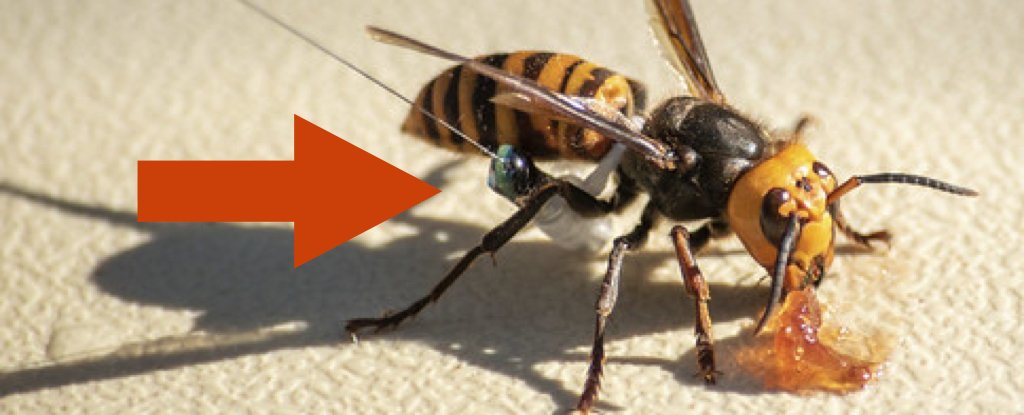
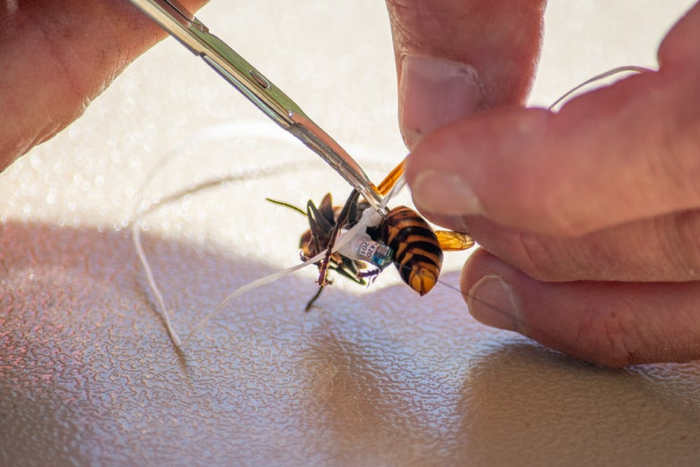
To solve the puzzle, entomologists from the Washington State Department of Agriculture (WSDA) came up with a plan to capture a live hornet, affix a trackable radio tag to it, and then release the insect, following it back to its nest.
 (Karla Salp/WSDA)
To pull off the scheme, WSDA researchers worked with colleagues at the USDA, who had already found success using similar radio tags to study spotted lanternfly movements.
After numerous failed attempts – where the scientists lost their quarry, or difficulties with the tag saw the tracker fall off the hornet – the bug-hunters realised their ultimate goal in late October.
The radio tag led the team to a dead tree, and WSDA managing entomologist Sven-Erik Spichiger noticed hornets entering and exiting the tree through a crevice several feet up the trunk.
The team successfully vacuumed out 85 hornets, catching 13 more with a net.
"I'm pretty confident as long as we can get live hornets, we can follow them back, and that really gives us a great tool in an overall eradication program," Spichiger says.
That wasn't the end of the story, though. Days after the nest elimination, the team cut into the portion of the tree containing the nest and discovered two queens, along with other worker hornets, larvae, and white-capped cells containing developing adults.
The capture is a win for the entomologists, but the team also points out the battle to contain the Asian giant hornets could play out over several years – as we still don't know how many nests are already out there, nor how the insects will begin to move and spread in US regions.
"It's hard to say how they will behave here compared to their native range, but the fear is that there are large apiaries of bees that could be sitting ducks, while as the hornets move south to warmer weather their colonies could grow larger," WSDA entomologist Chris Looney told The Guardian.
"The object of our work is to avoid finding this out."
Aren't Hornets pretty much all dead by mid-September? The only ones that should be left are Queens hibernating until next spring.
“.....is common in parts of Asia and Russia. .....”
“Nothing to be worried about. I’m just here to make your last hours on earth as peaceful as possible. Don’t mind this. This is doctor’s orders.”
Amazing technology - I want those generically modified mosquitoes in my neighborhood - the once that force 98% males in the next generation (eliminating future generations)
Wow! Cool!! Thanks for sharing Red Badger.

I am not an expert on hornets, but this is surprising to me.
I wouldn’t expect this. At least with bees a second queen would not be tolerated in the hive.
Ya know? We need to tag poll workers as well. In fact everyone who handles ballots AND votes should be GPS tagged, and be forced to follow specific routes when carrying votes and ballots!

Could be like Fire ants that Migrated to USA. Their social structure changes and they tolerate multiple queens and nests and why they are so devastating. Seems to be some behavior modification that allows multiple queens in these species when they encounter new virgin environments where there is no competition from their own kind.
I think I'll text this idea on my cell phone to my Facebook group.
You get filmed everywhere you go. How come a room where votes are counted is not on camera where one can see the vans of ballots that come in.
Actually, the USPS has applied for a patent for a block chain voting system which is supposedly quite secure. For more info:
That clip from SNL is at least 38 years old since Belushi died in 1982. Somehow we have survived this long despite killer bees.
The ant version....
Indiana Jones and the Kingdom of the Crystal Skull
https://www.youtube.com/watch?v=H_2qpsPhUIY
Lol. I couldn’t begin to list all the dire threats that fizzled over the years. But for each one some person or group pocketed millions. Fear sells.
How about having the identity of the voter of absentee and mail in ballots authenticated by a notary public. That would preclude Democrat ballet stuffing. A bunch of ballots authenticated by the same notary would be evidence of fraud.
In the photo it looks like they are strapping a bomb onto the bee. A Bee Bomb.
Disclaimer: Opinions posted on Free Republic are those of the individual posters and do not necessarily represent the opinion of Free Republic or its management. All materials posted herein are protected by copyright law and the exemption for fair use of copyrighted works.