Posted on 10/14/2025 11:34:17 AM PDT by Red Badger
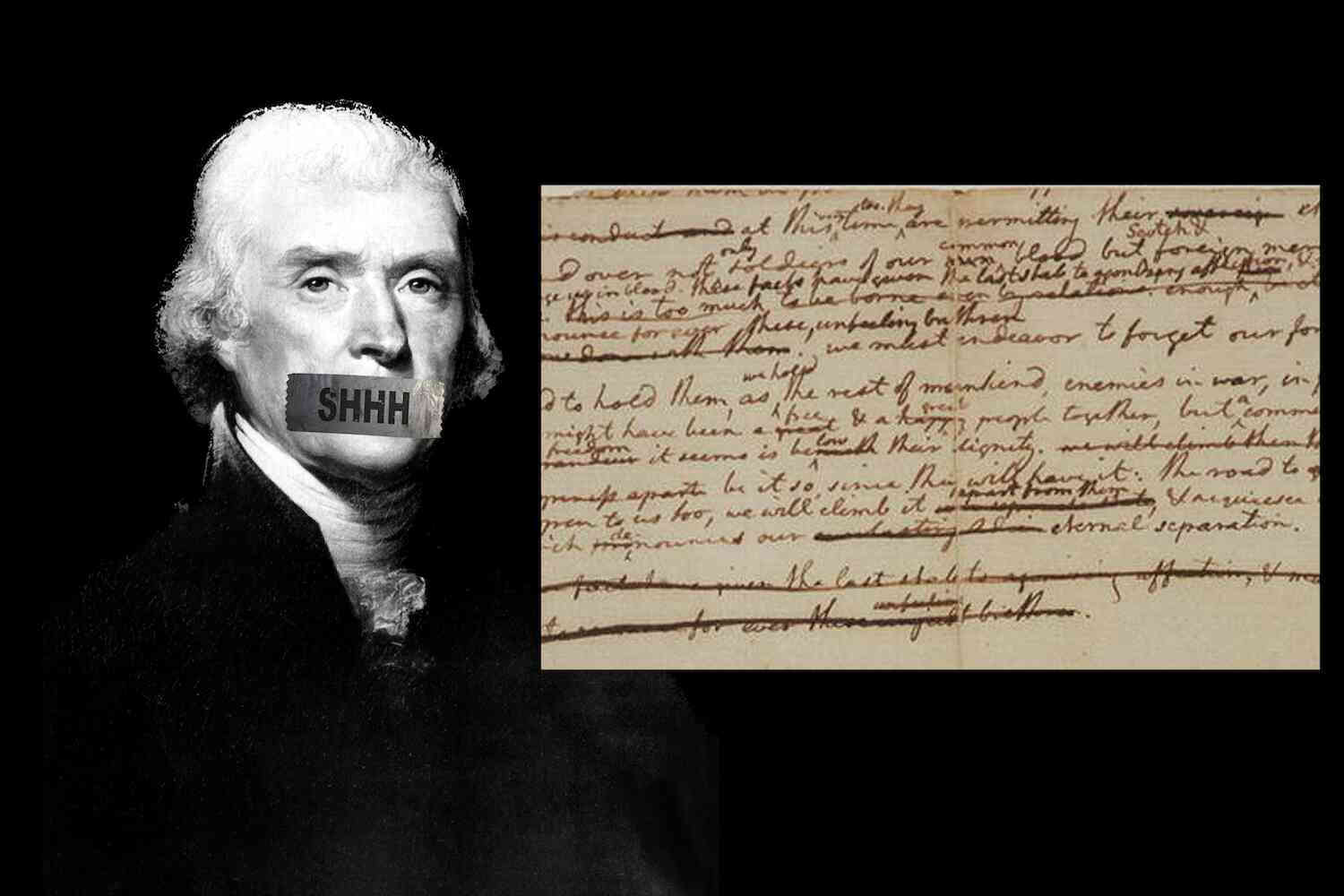
Blaze Media pioneer Glenn Beck has apparently been sharing this unearthed paragraph since at least 2020, but I heard it for the first time just days ago.
It's a passage Thomas Jefferson wrote for a draft of the Declaration of Independence - a paragraph I have never encountered. Given that I've taught U.S. History and Government for two decades, that fact stuns me as much as it embarrasses and frustrates me.
Every year, I've made my government students memorize the Declaration's preamble - those immortal words about all men being endowed by their Creator with the unalienable rights of life, liberty, and the pursuit of happiness - as a requirement to pass my class.
But this paragraph? I'd never even read it.
Here are Jefferson's banished words about the slave trade:
****************************************************************************
He (King George III) has waged cruel war against human nature itself, violating its most sacred rights of life & liberty in the persons of a distant people who never offended him, captivating & carrying them into slavery in another hemisphere, or to incur miserable death in their transportation thither.
****************************************************************************
Those aren't the words of a man indifferent to slavery. They are the cry of conscience from someone who recognized its evil for the "cruel war against human nature" it was. This wasn't just a policy criticism, it was an aggressive condemnation of a practice that assailed the very image of God in man.
What's more, Jefferson's accusation was morally piercing.
****************************************************************************
This piratical warfare, the opprobrium of infidel powers, is the warfare of the CHRISTIAN king of Great Britain.
****************************************************************************
That is remarkably prescient moral insight and stunning boldness for an 18th-century politician. Jefferson, long caricatured as a disinterested deist, deliberately weaponizes religious language to shame a "Christian" king complicit in the slave trade. His outrage is not merely political, it's moral. He's confronting the British empire's spiritual hypocrisy, revealing that the real corruption lies in a civilization that calls itself Christian while trafficking in human lives.
And he wasn't done:
****************************************************************************
Determined to keep open a market where MEN should be bought & sold, he has prostituted his negative for suppressing every legislative attempt to prohibit or to restrain this execrable commerce.
****************************************************************************
Read that again:
"A market where MEN should be bought and sold." In the original draft, Jefferson capitalized "MEN." In a world where "men" so often meant only landowners or white citizens, Jefferson's emphasis was intentional. He was unequivocally asserting that Africans were men, endowed with the same sacred rights of life and liberty he had already declared "self-evident."
He then closed with a final, haunting sentence:
****************************************************************************
Thus paying off former crimes committed against the liberties of one people, with crimes which he urges them to commit against the lives of another.
****************************************************************************
Talk about both prophetic and painful irony. Jefferson was suggesting that moral compromise would always multiply injustice. His words foreshadowed the conflict America herself would face a little less than a century later.
It's fair to acknowledge Jefferson's contradictions. He owned slaves. He struggled against the very evil he condemned. But I'm confident the omission of this paragraph from our public memory isn't about confronting hypocrisy. I believe it's about controlling narrative.
Our modern institutions - from media to academia - have spent decades flattening the Founders into easy villains: elitist, racist white men whose lofty ideals were mere cover for their crimes.
That caricature serves an ideological purpose:
It keeps young Americans from admiring the brilliance and moral wrestling of the men who birthed a free nation, replacing complexity with easy condemnation.
That's why this paragraph - a stunning, soaring moral rebuke of slavery written by one of those "dead white guys" - must remain buried. Because to read it is to admit that Jefferson, for all his flaws, saw and named evil with moral clarity. To acknowledge that truth would complicate the narrative.
Count me as one history teacher who thinks it's high time we do just that. Recovering Jefferson's lost grievance isn't about excusing sin or sanitizing history. It's about reclaiming truth.
It's about offering proof that human beings, and the nations they build, can be both right and wrong, often at the same time.
Exactly!
I read Washington’s book “Up From Slavery”, and was so impressed with his pragmatic, honest, and workable approach to race relations, that when I read about W.E.B. Dubois, the contrast in approach was appalling.
I remember thinking in disgust at the time: “Influential blacks chose the path of DuBois???”
Because that is most certainly the path they went on, and the path they are on today.
American Scripture, Pauline Maier,Alfred A. Knopf, 1997, Appendix C, p.239. Nobody ever hid it from people who looked for it. The edit was part of the basis for the story Franklin comforted frustrated Jefferson with example of the sign “John Thompson,
Hatter, makes and sells hats for ready money 🎩 “,pared down to “John Thompson 🎩” on the advice of several others
Yes. I make no claim to be a great historian, but this is no surprise to most anyone with any interest. Or so I would have thought.
I guess he only liked “American Made” slaves on his property. And in his bed.
OK we don’t know if it was him or is brother. But we do KNOW it was one of them. The DNA is clear on that. And he was mighty kind to the offspring.
A combination of Virginia's semi-feudal inheritance statutes and his own spendthrift ways prevented him from ever freeing his own slaves. My understanding is he would have not only had to pay off his own debts, but also family members who had any partial claim on the slaves' market value.
He had to sell his books to the Federal government for cash. Those formed the nucleus of the Library of Congress. My wife and I have accumulated 3,000+ volumes. I can't imagine how painful that was for him.
“He was unequivocally asserting that Africans were men”
Don’t forget that African’s weren’t the only indentured servants and slaves in the colonies.
Indentured servants and slaves came from various countries outside of Africa, primarily from:
Western Europe: Many indentured servants were from England, Scotland, and Ireland, who came to the Americas to work on plantations.
Ireland: A significant number of Irish indentured servants migrated to the Americas during the colonial period.
Scotland: Scottish indentured servants also contributed to the labor force in the early American colonies.
Other European Nations: Various other European countries also sent laborers to the Americas, although specific details may vary.
https://teachingamericanhistory.org/document/chapter-3-labor-servitude-and-slavery/
https://www.ushistory.org/us/5b.asp
https://quizlet.com/8267663/takaki-3-flash-cards/
https://alphahistory.com/americanrevolution/slaves-indentured-servants/
There were at least three and possibly four people it could have been.
I think Jefferson was kind to most people he was associated with.
10 accepted 2 rejected: https://brewminate.com/almost-12-the-bill-of-rights-james-madisons-two-failed-amendments/
The 2 rejected were:
The first of these would have established how members of the House of Representatives would be apportioned to the states. It was drafted to ensure that members of the House would continue to represent small constituencies even as the general population grew, small enough that Representatives would not be too far removed from the concerns of citizens. In addition, keeping the House of Representatives from being too small was thought to protect against its becoming a kind of oligarchy. Congress did send this amendment to the states, but the number of states that ratified it was just short of the number needed. Although the proposed amendment did not become law, Congressional apportionment is nevertheless grounded in the Constitution (Article 1, Section 2, Paragraph 3) and the total number of members of the House of Representatives is set by federal statute (currently at 435).
The second of Madison’s 12 amendments forbade Congress from giving itself a pay raise: Congress could vote for a raise but it would only apply from the beginning of the next Congress. This amendment also failed to gather the required number of state ratifications in the years after it was introduced. In 1982, however, Gregory Watson, a university student doing research for a government class, ran across a description of this amendment and realized that it remained “alive” because it had included no language in it about a window of time in which it had to gain the needed number of state ratifications. Watson organized a successful effort to lobby various state legislatures, seeking their ratification of the amendment. As a result, the needed number was eventually reached and this amendment, first proposed in 1789, became the 27th (and most recent) amendment to the U.S. Constitution in 1992.
Both of which resulted in some of the issues we have with Congress today.
We have the BEST ADMINISTRATION SINCE THE FOUNDING FATHERS
Thanks Red Badger.
I'm sure the abolitionists would have strongly objected due to moral repugnance at the US gov't trading in slaves, even if was to free them, and rewarding the slaveholders who they thought should be punished.
The slaveholders were not economically stupid. If the price was right they might have sold. Probably a few at first and then more and more when they realized they could simply re-hire the newly freed slaves and also have been relieved of the necessity of maintaining them with food and shelter.
Instead the "immediate emancipation" faction carried the day and we all know how that turned out.
I noticed that the old books were written with amazing language skills. Those fellows were a lot better educated than we are.
That’s an old lie told about Thomas Jefferson. It was resurrected to divert from serial rapist Bill Clinton. We can review if you like but the DNA evidence is not as clear cut as some would have you believe. Some of the other Jefferson men were pretty flagrant about banging the slaves which is why the DNA evidence is not clear cut as some would have you believe.
There is zero evidence that Thomas Jefferson was the Jefferson involved in exploiting slave women. It could have very easily been his uncle or nephews who were also in proximity for place and time.
I've known about this since I was a child. It's mentioned in the movie 1776, which was made 50+ years ago.
Point of clarification ... Jefferson's wife was not "away"; she had been dead for at least 15 years when his relationship with Sally Hemings allegedly started.
Sorry, 5 years, not 15.
Disclaimer: Opinions posted on Free Republic are those of the individual posters and do not necessarily represent the opinion of Free Republic or its management. All materials posted herein are protected by copyright law and the exemption for fair use of copyrighted works.
