
Posted on 09/24/2025 6:49:08 AM PDT by Red Badger
A new study explains that time travel itself eventually leads to a reality without it.
Is time travel truly possible? The prospect presents its fair share of paradoxes.
Of course, there are famous logical examples, such as the Grandfather paradox, which explores what would happen if a time traveler killed their grandparent before their parent was conceived (an idea not so far removed from the plot of the sci-fi great Back to the Future). Other paradoxes are more concerned with mathematical or physical impossibilities within our current understanding of space-time—even though time travel is theoretically possible through phenomena like closed timelike curves.
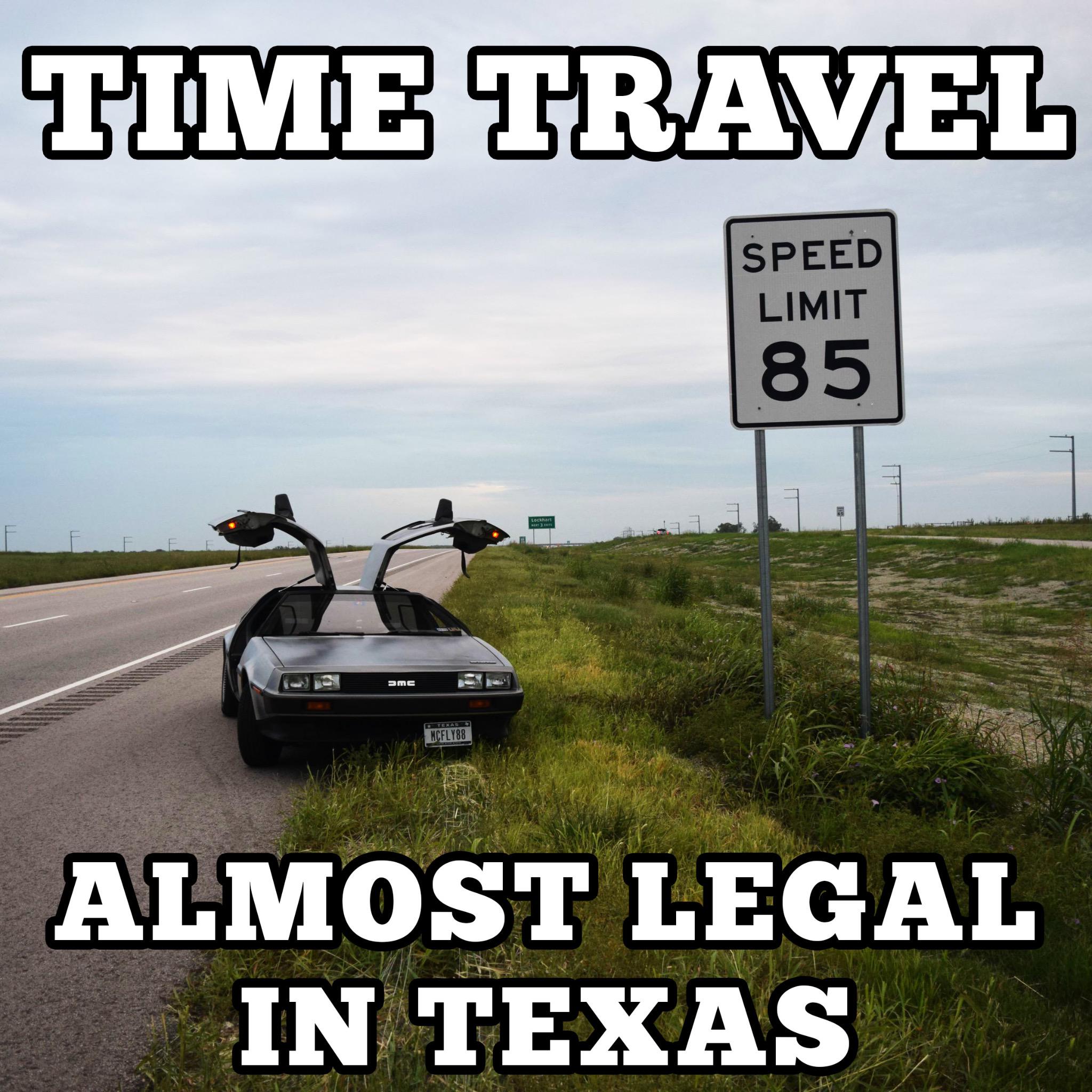
But maybe the biggest paradox of all is also the simplest one: If time travel were possible, wouldn’t we encounter these temporal tourists all the time? Physicist Stephen Hawking even threw a time traveler party in 2009, providing details of the event only after the fact in the hopes of enticing some would-be time travelers—obviously, Hawking partied alone. Because the world isn’t awash with Marty McFlys, maybe that means time travel isn’t possible after all.
Unfortunately, when it comes to the ins and outs of something immensely complicated like time travel, things are rarely so simple.
In a new study, Andrew Jackson—a research associate from the School of Informatics—explores reasons beyond the scientific or technological as to why time travel appears to be impossible (at least, in this reality). Published in the preprint journal arXiv and titled “Where Are All the Tourists From 3025?,” the study posits that maybe time travel itself is a self-suppressing phenomenon.
“I conclude that, assuming my model, time travel is self-suppressing: the timeline is continually rewritten until it inevitably reaches a timeline with no time machines ever being constructed, “ Jackson wrote. “At this point, no further changes to the timeline are possible.”
Jackson illustrates this idea with what’s known as a Markov chain, named after Russian mathematician Andrey Markov, which describes a sequence of possible events wherein the probability of those events depends only on the current state. In the paper, Jackson shows that introducing time travel into any timeline would create dynamic instability that would eventually (at least, statistically) create a timeline where time travel was never invented, which is the most stable state for any timeline. The process of this continuous timeline change would, however, feel instantaneous to non-time travelers such as you and I.
Why would this happen this way? Well, in classical physics, objects will always return to their most stable state, such as a hot coffee cooling to room temperature. If time machines introduce temporal instability, then timelines will similarly default to the most stable state, which would be a timeline with no time machines at all.
“[The paper] shows that time travel—by enabling timeline alterations—induces a dynamic instability that—with very high probability—leads to its own erasure,” Jackson wrote. “This self-suppressing mechanism results in the asymptotic convergence of all timelines toward states in which no time machines ever exist.”
Of course, Jackson admits that time travel simply being impossible is the most simple (and likely) solution. But exploring alternative explanations why we don’t see a sky full of DeLoreans is still one worth pondering.
“It may simply not be possible to travel through time,” Jackson wrote. “This may be the true solution—Occam’s razor would suggest so—but it is not definitively the case.”
Or go back in time and change the results of many “scientific” experiments or the text of ancient historical documents...
Look up Bio-Evolutionary Anthropocene Hypothesis.
Where Are All the Tourists From 3025?
—
The Time Police limit them to the past 3.5 billion years - after all how many billions of years do tourists need to explore? Off-planet time-tourists get an extra 10 billion years to visit, depending on local conditions, rules & regulations.
What a bunch of theoretical BS.
A “timeline” doesn’t care if someone thinks that it has ‘instability’.
If a change is made by someone or some thing that did not originate in that time previously, then whatever it effects will be effected and even any changes perceived to have been caused to the “timeline” by the “traveler” (if they could perceive them, which they couldn’t, because of the paradox) would simply be the reality that is. There is no actual change. Whatever happened happened. All perceptions or memories of something else having happened are now a non-reality. There is no instability except for the paradox. If you want to call a paradox an instability, fine. Either way, the paradox will make the travel impossible.
Same thing with Fry from Futurama. Diddled his grandmother unbeknownst in WWIi. He did do the nasty in the pasty.
Ha Ha!
((((Actually, “Country Roads” by John Denver is the Official State Song of WVa, But I get it. LOL.))))
That must do wonders for the gene pool. :-)
One of the major problems encountered in time travel is not that of becoming your own father or mother. There is no problem in becoming your own father or mother that a broad-minded and well-adjusted family can’t cope with. There is no problem with changing the course of history—the course of history does not change because it all fits together like a jigsaw. All the important changes have happened before the things they were supposed to change and it all sorts itself out in the end.
The major problem is simply one of grammar, and the main work to consult in this matter is Dr. Dan Streetmentioner’s Time Traveler’s Handbook of 1001 Tense Formations. It will tell you, for instance, how to describe something that was about to happen to you in the past before you avoided it by time-jumping forward two days in order to avoid it. The event will be descibed differently according to whether you are talking about it from the standpoint of your own natural time, from a time in the further future, or a time in the further past and is futher complicated by the possibility of conducting conversations while you are actually traveling from one time to another with the intention of becoming your own mother or father.
Most readers get as far as the Future Semiconditionally Modified Subinverted Plagal Past Subjunctive Intentional before giving up; and in fact in later aditions of the book all pages beyond this point have been left blank to save on printing costs.
The Hitchhiker’s Guide to the Galaxy skips lightly over this tangle of academic abstraction, pausing only to note that the term “Future Perfect” has been abandoned since it was discovered not to be.
Douglas Adams, The Restaurant at the End of the Universe (The Hitchhiker’s Guide to the Galaxy, #2)
GOBBLEDEGOOK
I would think that the entropy gradient alone would prevent time travel.
The brain constructs the concept of time when it looks at the unending sequence of before/after, cause/effect.
All our perceptions are a construct, to some degree. Color is a construct. There is no such thing as color in the world. Our brains create the concept of color because it has survival value. Same for time.
To jump out of the sequence of cause/effect would be impossible for mortals and physical objects. It’s the nature of the physical world that the chain of cause/effect cannot be broken. That would be time travel. So there is no time travel possible.
God is not constrained by the physical world, and so doesn’t need to take part in the endless chain of cause/effect. God can travel in time in the sense that GOD exists in ALL time simultaneously.


Aimee Mann.
“In the paper, Jackson shows that introducing time travel into any timeline would create dynamic instability that would eventually (at least, statistically) create a timeline where time travel was never invented, which is the most stable state for any timeline.”
_____________
But which timeline (or alternate reality) are we living in?
Maybe one where time travel is still possible?
Yes! (Not Yes the band, but Yes, I agree)
When DC comic books tried to keep continuity (Silver Age), whenever Superman went to the past (he did it a lot. It was effortless), it turned out that whatever he did (in one, he infiltrated Al Capone’s gang) had already happened. He just didn’t know he was the catalyst/agent. Each parallel univese (they didn’t call it multi-verse back then) was discrete, with its owwn unchangeable past.
That was all ruined with “Crisis on Infinite Earths” and everything afterwards.
Disclaimer: Opinions posted on Free Republic are those of the individual posters and do not necessarily represent the opinion of Free Republic or its management. All materials posted herein are protected by copyright law and the exemption for fair use of copyrighted works.