Posted on 09/09/2025 10:00:39 PM PDT by SunkenCiv
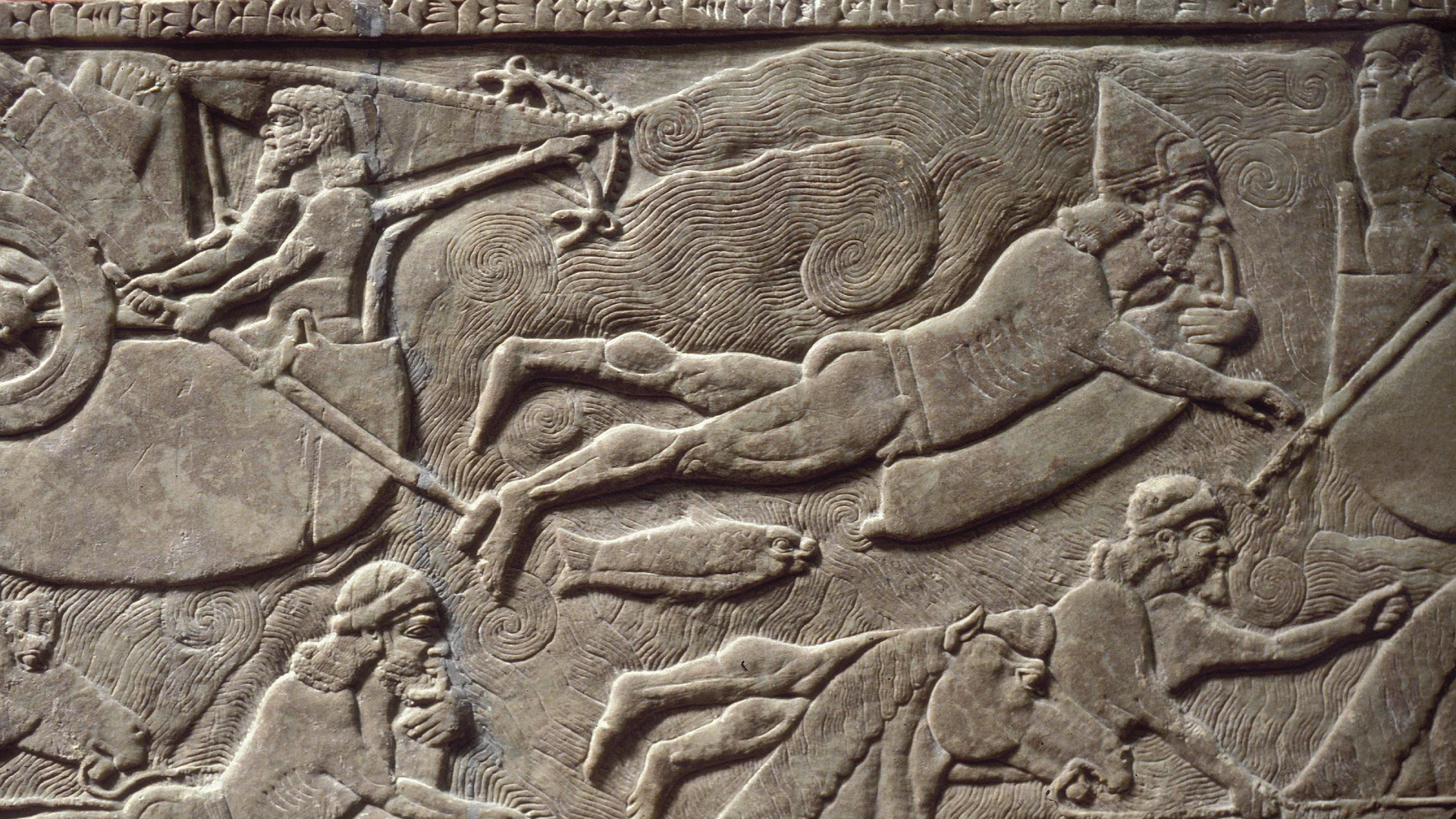
This carved relief from Nimrud, a major city of the ancient Assyrian Empire in present-day Iraq, regularly drifts around the internet as purported evidence for scuba diving nearly 3,000 years ago. But the wall panel actually depicts an army crossing a river, and soldiers are navigating the waves with the help of ancient flotation devices.
The gypsum panel is one of several excavated in the 1840s from the Northwest Palace, which was built on the Tigris River around 865 B.C. on the orders of King Ashurnasirpal II. Originally located around the interior walls of the throne room and royal apartments, the carved panels depict the king leading a military campaign, engaging in rituals and hunting animals.
This panel fragment, which is in the collection of The British Museum, shows several men and horses crossing a river. The horses are swimming, pulled on leads by cavalry soldiers. One soldier is free-swimming, one is rowing a small boat, and two are using goat-skin bags that the soldiers are inflating to stay afloat.
A cuneiform inscription running across the top of the panel traces the king's lineage and describes his key accomplishments. The two-dimensionality of the perspective -- in which the figures appear complete and not half-submerged -- is typical in Assyrian art, according to The British Museum.
Animal skin or bladder floats appear several times in the Nimrud wall panels, and they were likely made from goats or pigs. The floats were used to help keep a soldier's weapons dry and to allow an army to sneak up on an enemy. Ashurnasirpal II was known for his military prowess as well as his brutality, and his innovative tactics -- including the goat-skin floats -- helped him expand his empire considerably in the ninth century B.C.
(Excerpt) Read more at livescience.com ...
😆
There’s be no reason for it, no UDT teams because no explosives.
https://cdn.mos.cms.futurecdn.net/8eVrEPGgrUNW3haWMDP4sE.png
Thanks for the kind remarks.
The pants flotation was taught until recently and probably still is.
One thing about crossing water in cold places like Europe during winter is that you do it naked to keep your clothes dry, because of hypothermia, once you cross, you dress.
The use of bales straw to cross rivers en masse has been used all the way up into modern times, but perhaps the first documented use of a related method was by Alexander the Great, to move his entire force across a river in India.
I think that was the same battle where he’d figured out how to deal with a large number of war elephants. Probably coming up with that idea was why he decided to get his army across during the night to try it out.
Use of African elephants as a sort of ancient tank was dealt with in the same way, thanks to A the G’s tactics having been taught in ancient military academies; last known large use of African elephants in combat was at Thapsus if memory serves. Not sure it was ever all that common.
Thanks, SunkenCiv.
My pleasure.
Heh. 😆
Last week I finished a book by Eckhart Frahm on the Rose and fall of Assyria.
Very good book
Note that Syrians of today aren’t the same.
Assyria is in what is now northern Iraq.
What is now Syria, in the Bronze age was a mixture of Urartu, Aram, Canaan speaking a Canaanite language that later split into Hebrew, Phoenicians, Canaanite, Aramaic etc.
Present day “Syrians” are a mix of those ancient people’s plus Romans, Greeks, mAcedonian, Arabs, Persians etc etc.
yes, mixtures but still really bright folks
yes — and hey, we’re all mixtures :)
I just wanted to point out that the Syrians and the Assyrians were different.
The words Syria and Assyria are these confusing tangles.
Assyria - from Aššur (Ashur), the city in northern Mesopotamia (modern northern Iraq), which was the heart of Assyria - it was originally founded by the Akkadian empire (2200 to 2000 BC) and then muddled along for 1000 years bullied by neighbors until Tighlath Pileser III (one of my historical heroes), formed an empire that terrified everyone (they were the Borg!) until the BAbylonians and Medes together crushed them in 620 BC.
The Greeks came later and used the word “Syria” to describe what we think of today as Syria + Iraq. Then it narrowed to just what we think of today as Syria.
The Greeks also made a mess of other nation’s names too - it called the lands of Azerbaijan as “Albania”
They also took the land of Hayastan (named after the legendary ancestor of the Armenians Hayk), and named it after the Persian satrapy (province) called Armina - so Armenia
They also took the Kartvelian people who lived in the area they called Sakartvelo and named them first Iberia, then Georgia
They named all the “barbarians” (speakers of “bah bah languages” i.e. non-Greek speakers) to the north as Scythians, clubbing together Iranic, Thracian, proto-Slavic, Finno-Ugric, Hunnic etc. etc. speakers under one term “scyth”
They also took the Persian geographic term “Hindhu” river (original name Sindhu river) and dropped the H to say the land was “Indu” and then “Indie”
ah, those wacky Greeks!
yes and if memory serves, the Babylonians and Assyrian Empire basically existed at different times in the same area, so they were basically the same people.
Disclaimer: Opinions posted on Free Republic are those of the individual posters and do not necessarily represent the opinion of Free Republic or its management. All materials posted herein are protected by copyright law and the exemption for fair use of copyrighted works.