Skip to comments.
Iranian Regime tv Channel One hacked while it was airing Khamenie speech
various
| 10-8-22
Posted on 10/08/2022 1:05:38 PM PDT by nuconvert
Iranian Regime national tv Channel One hacked about an hour ago. During a broadcast of Khamenie speech, a red crosshair appeared over his face and chanting of Women. Life. Freedom. There was writing to the side saying "Rise up. Join us". Also 4 photos at the bottom of the screen of young people killed and additional writing: "The blood of our youth is dropping from your paws".
Also, there was a huge banner in the middle of Tehran highway today that read: We are no longer afraid of you. We will fight.
Also, attempted attack on IRI ambassador in Denmark. Her bodyguard was stabbed. Diplomatic Security intervened before the attacker could stab the ambassador.
TOPICS:
KEYWORDS: basij; deathtothemullahs; denmark; ebrahimrigi; erdogan; iran; iranprotests; iraq; irgc; iri; israel; khameini; khamenei; kurdistan; lebanon; mahsaamini; mullahloversonfr; mullahsmustbekilled; najisharifizindashti; protests; qudsforce; raisi; receptayyiperdogan; shahrammaroufmola; syria; turkey; yemen; zahedi
Navigation: use the links below to view more comments.
first previous 1-20 ... 2,261-2,280, 2,281-2,300, 2,301-2,320 ... 2,401-2,404 next last
To: nuconvert
🚨 Iran’s Foreign Minister says he has never met Mojtaba Khamenei and has never had any direct contact with him.
Interviewer: How well do you know Mr. Mojtaba Khamenei? Have you ever met him?
Araghchi: No, never.
Interviewer: So you’ve never met him at all?
Araghchi: Not during this period, no. I don’t think many people have, aside from a very small number. Even before that, unfortunately, I never met him either.
Interviewer: So you’ve never had any contact with him?
Araghchi: No.
Interviewer: And you don’t really know him personally?
Araghchi: Only indirectly, from what I’ve heard from others. Personally, I’ve never interacted with him. I’ve seen him from a distance a few times at public gatherings, but we’ve never had a conversation.
Interviewer: I mean more than just seeing him from afar. Did you expect the Assembly of Experts to choose him?
Araghchi: He had always been mentioned as one of the possible candidates, or rather, as someone considered qualified for the position. Of course, the decision rested with the Assembly of Experts. What turned out very well for us was the message it sent to the world.
https://x.com/TheIranWatcher/status/2079226877525327996
Video in Persian
It’s strange that they’re airing this as reports from June 2025 stated clearly that Mojtaba was never supposed to be picked as a successor.
https://www.iranintl.com/en/202506218672
2,281
posted on
07/20/2026 11:29:32 PM PDT
by
AdmSmith
(GCTGATATGTCTATGATTACTCAT)
2,282
posted on
07/20/2026 11:42:55 PM PDT
by
AdmSmith
(GCTGATATGTCTATGATTACTCAT)
2,283
posted on
07/21/2026 4:44:04 AM PDT
by
AdmSmith
(GCTGATATGTCTATGATTACTCAT)
Iran Update Special Report, July 21, 2026
The Houthis likely decided to impose their blockade on Saudi Arabia to advance their own interests, though Iran probably encouraged them to impose the blockade for Tehran’s own purposes. The Houthis have repeatedly warned Saudi-owned ships against transiting the Red Sea via radio on July 20 and July 21.[1] The Houthis also emailed shipping companies on July 20 and warned them against loading or discharging cargo in Saudi ports on the Red Sea.[2] These threats and warnings have resulted in at least two vessels turning around in the Red Sea to avoid crossing the Bab al Mandeb and a third turning around rather than continuing its transit to a Saudi port.[3] The Houthis have not yet attacked shipping, however. These efforts will almost certainly increase the cost of shipping goods through the Red Sea while also imposing high economic costs on Saudi Arabia specifically. The increase in costs globally and the economic impact on Saudi Arabia specifically supports both Iranian and Houthi objectives. The Houthis seek to discourage Saudi action against them, while the Iranians seek to extend the maritime shipping crisis and increase oil prices caused by Tehran’s efforts to close the Strait of Hormuz.
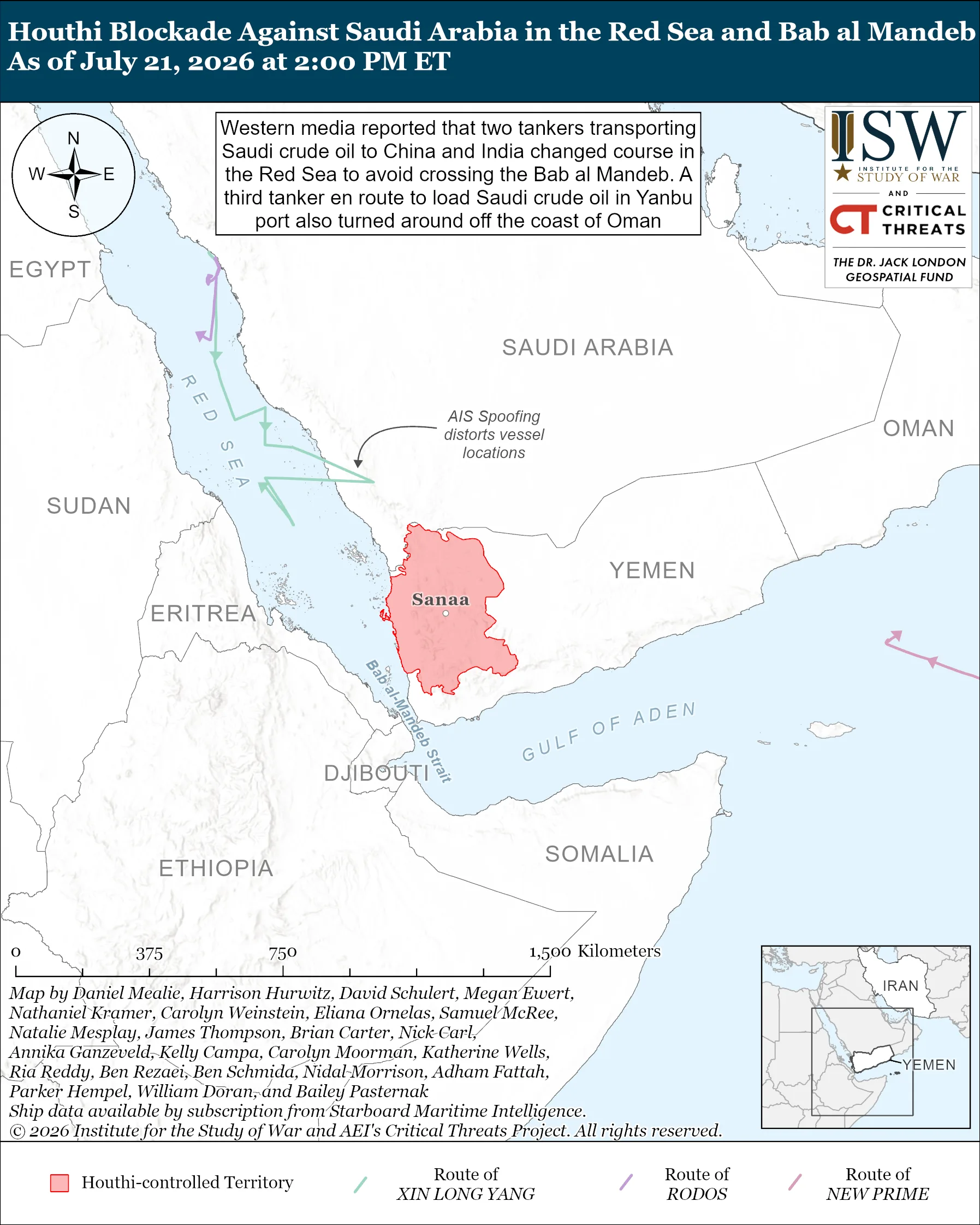
The Houthis only threatened shipping in the Red Sea once it benefited Houthi objectives. The Houthis did not adhere to earlier Iranian calls in July to close the Bab al Mandeb Strait during the recent conflict and only decided to impose a blockade on Saudi Arabia on July 20 following Saudi strikes on Sanaa International Airport on July 13.[4] This suggests the Houthis expanded the shipping crisis only when doing so served their interests, such as deterring future Saudi strikes on Houthi targets in Yemen.[5] Iranian and Houthi interests align in this case, but the Houthis are not enforcing the blockade for Iran. Their actions benefit Iran while directly serving Houthi objectives against Saudi Arabia. The Houthis’ enforcement of the blockade, regardless of how it affects Houthi objectives in Yemen, supports Iranian efforts to degrade US willingness to continue the war and force the United States to accept Iran's demand to retain control over the Strait of Hormuz.[6] Disruption in both the Strait of Hormuz and the Bab al Mandeb increases pressure on the United States and global markets more than disruption in either waterway alone.[7] This pressure could help Iran force the United States to accept Iranian control over the Strait of Hormuz, assuming Iran is able to secure Saudi assurances that Riyadh will not strike Houthi assets and end the Houthi blockade on Saudi Arabia.
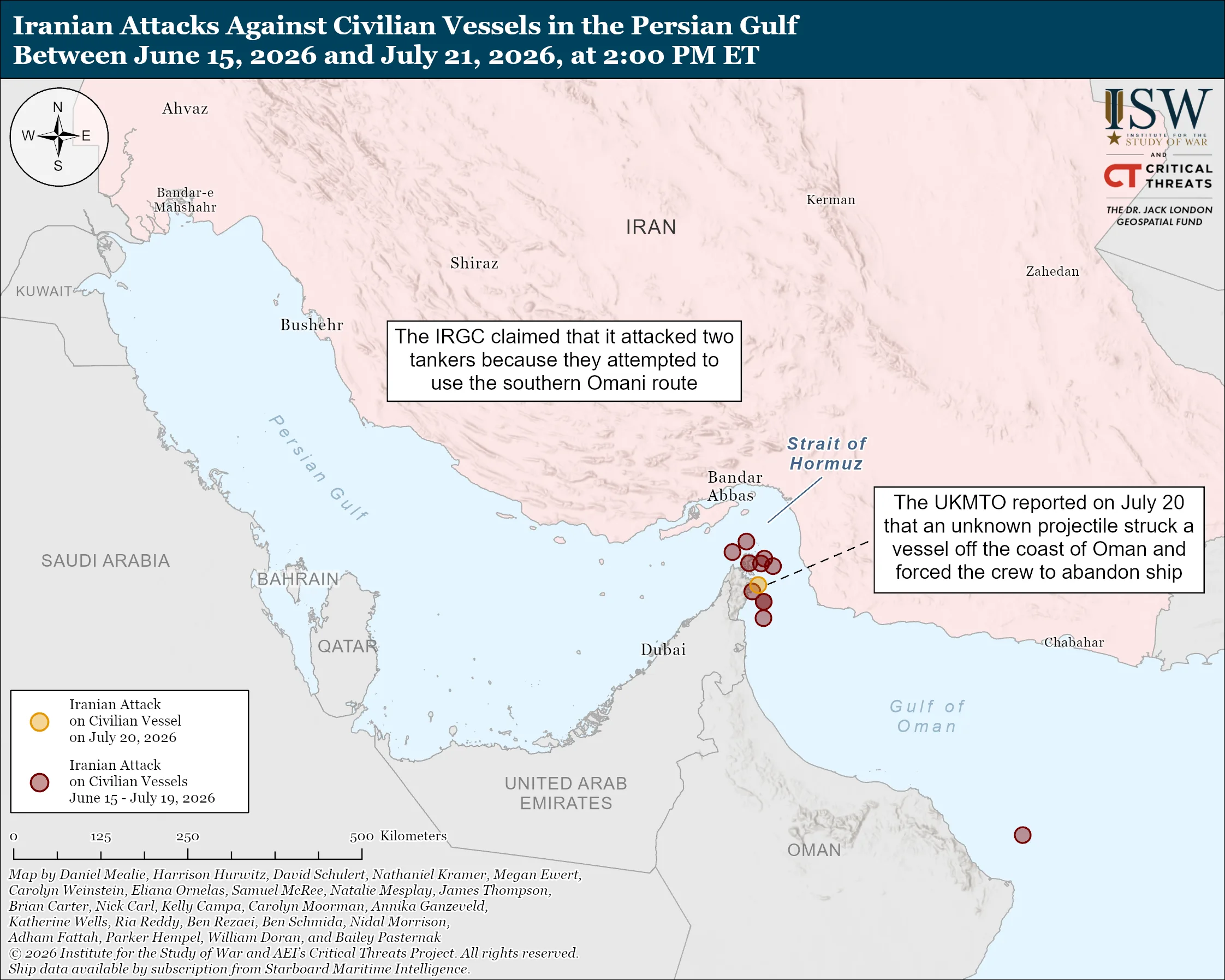
Iran continues to use force to impose its control over the Strait of Hormuz and compel vessels to follow Iranian transit restrictions. Iran rejects any alternative to its designated traffic separation scheme, particularly the southern Omani route, because it allows vessels to bypass Iranian authorization and directly undermines Iran's claim to control maritime traffic through the strait.[8] Iran sees this control as its primary means of imposing costs on the United States and compelling Washington to accept Iranian demands. Supreme National Security Council (SNSC) Deputy Secretary for International Affairs Ali Bagheri Kani described the strait on July 21 as Iran's “decisive leverage,” and argued that Iran must translate its military strength into political gains.[9] Iran has repeatedly threatened and attacked vessels using the southern route to enforce this objective.[10] The United Kingdom Maritime Trade Organization (UKMTO) reported on July 20 that unknown projectiles struck two vessels near Oman and the United Arab Emirates, which damaged one vessel's steering gear and forced the crew of the second vessel to abandon ship.[11] Kuwait identified the second vessel as the Kuwaiti tanker Kaifan and reported that the likely Iranian attack injured several crew members.[12] The Islamic Revolutionary Guards Corps (IRGC) separately claimed on July 20 that it attacked two tankers on July 20 because they attempted to use the southern Omani route.[13]
Iran is repeatedly attacking US bases and personnel across the region in order to erode US willingness to challenge Iranian control over the Strait of Hormuz. Iran likely calculates that sustained attacks and rising US casualties will generate domestic pressure on the United States to end the conflict, force the United States to surrender, and accept Iranian control over the strait. The Wall Street Journal reported on July 20 that Iran conducted three ballistic missile strikes against Muwaffaq al Salti Air Base in Jordan on July 17 and 18.[14] The first two Iranian missiles reportedly struck a gym and an empty aircraft hangar, while the third struck housing units and killed two US service members.[15] These strikes demonstrate that Iran can still penetrate US air defenses and inflict casualties despite repeated US strikes on Iranian drone and missile launch sites, storage facilities, and command and control centers. Satellite imagery also shows that Iran attacked King Faisal Air Base and another Jordanian airfield, where Iranian strikes reportedly damaged several US Army UH-60 Blackhawk helicopters.[16] Iran continued to claim attacks on US bases and military assets in Bahrain, Iraq, Jordan, Kuwait, and Qatar on July 20 and 21.[17]
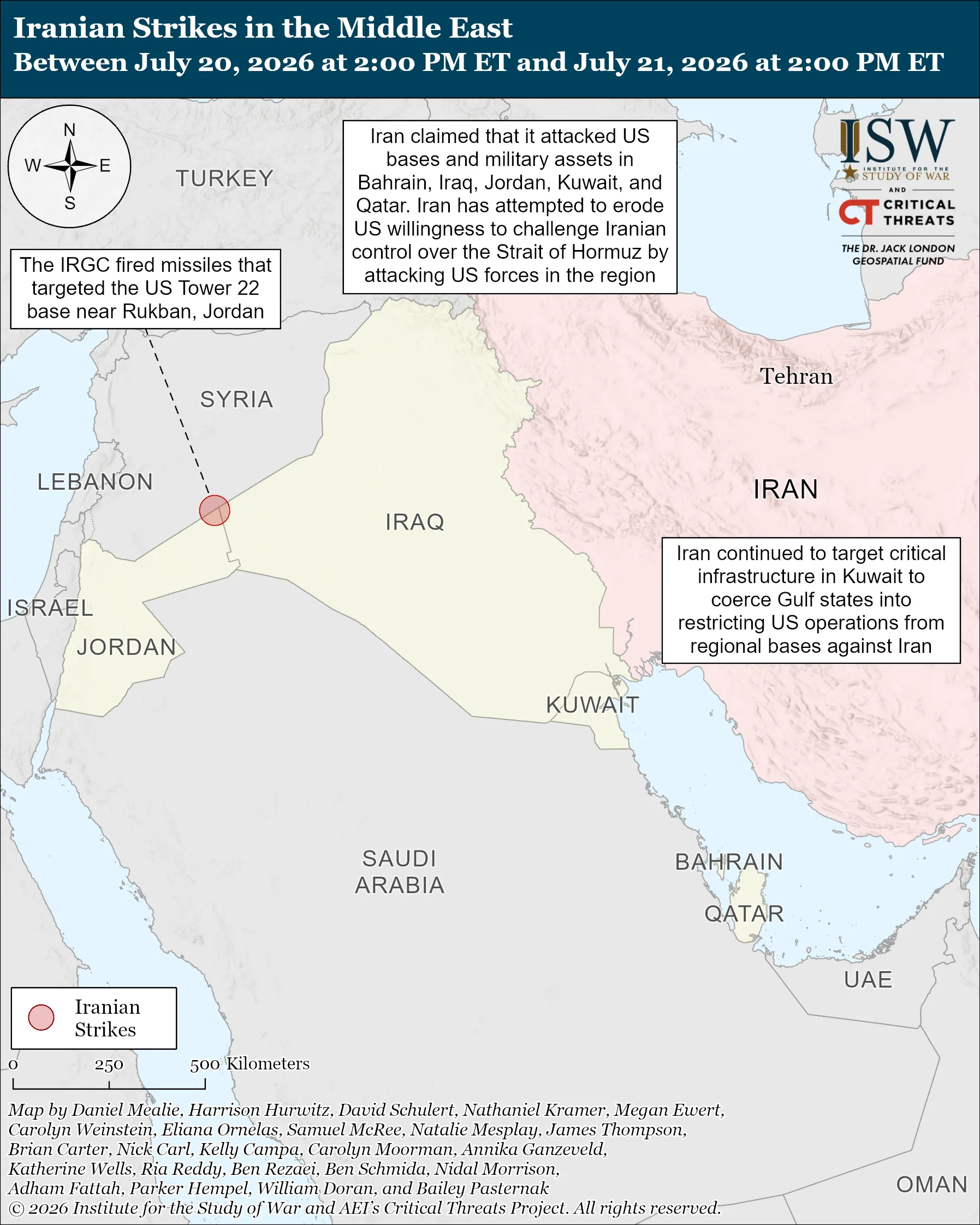
Iran is broadening the costs of the war beyond military facilities by targeting infrastructure that supports essential civilian services. Iran likely calculates that sustained disruptions to electricity and water supplies will increase domestic pressure on Kuwait to restrict US operations from Kuwaiti territory. The Kuwaiti government stated on July 21 that Iran attacked several power-generation and water-desalination facilities for the fourth consecutive day on July 20, which disabled several generators.[18] Islamic Development Organization-affiliated Mehr News Agency separately reported on July 21 that an Iranian drone strike targeted the al Zour power plant in southeastern Kuwait.[19] Iran is likely trying to demonstrate to Kuwait and other Gulf states that they will bear direct civilian and economic costs for hosting US forces and supporting US operations against Iran. Iran likely also conducted these attacks to portray the United States as an unreliable security guarantor and drive a wedge between the United States and its Gulf partners. Iranian Supreme Leader Mojtaba Khamenei stated on March 12 that Iran would strike bases used to attack Iran but avoid attacking host countries and urged neighboring states to close US bases.[20] Iran's attacks on Kuwaiti civilian infrastructure expand beyond this distinction, however.
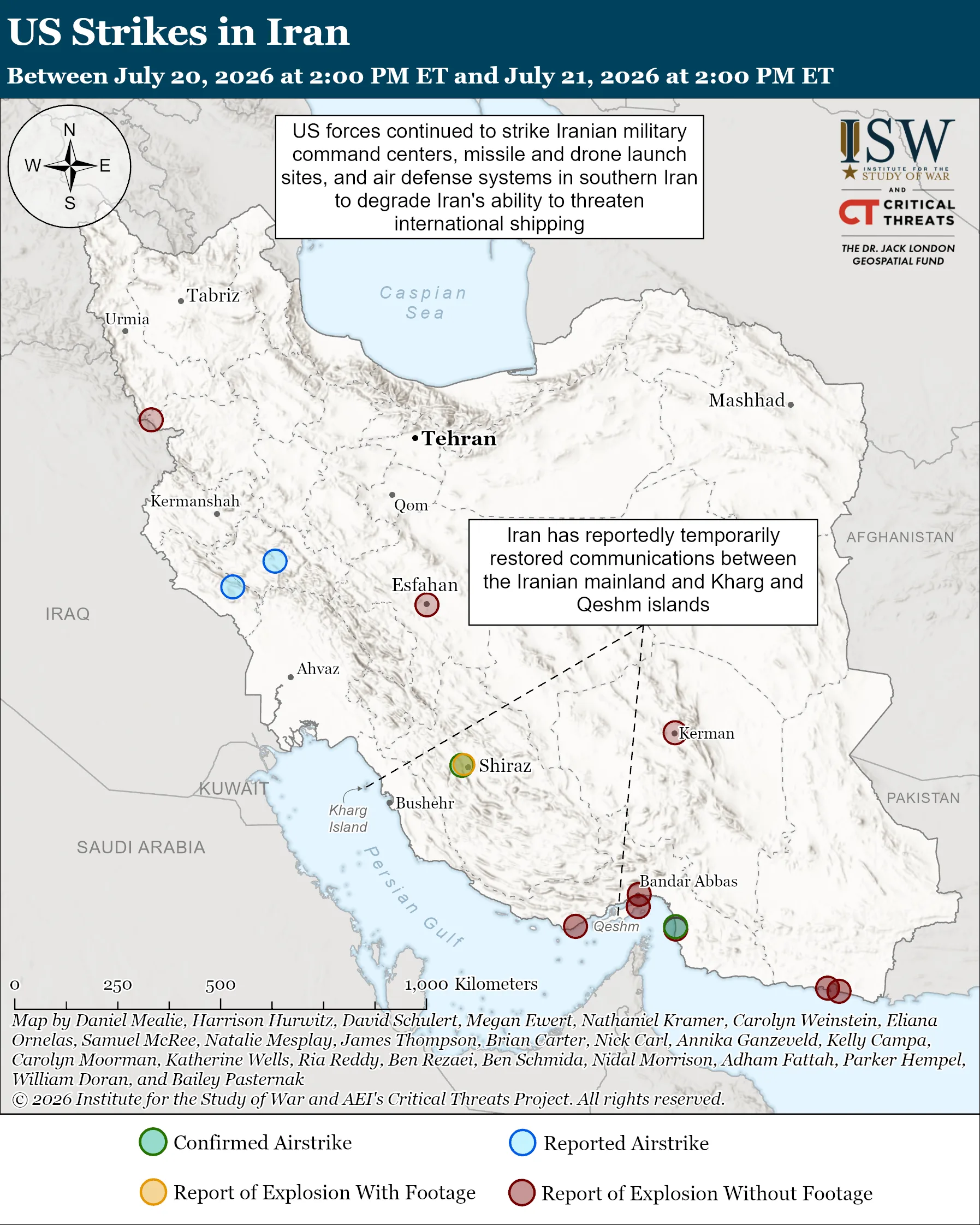
Iran has reportedly temporarily restored communications between the mainland and Kharg and Qeshm islands after US strikes disrupted key communications and supply networks along the southern coast of Iran. Iranian Communications and Information Technology Minister Sattar Hashemi told Iranian media on July 21 that US strikes have repeatedly disrupted communications between mainland Iran and the islands, including Kharg and Qeshm.[21] Iran has reportedly replaced damaged fiber-optic links with radio and satellite communications, but Hashemi emphasized that these measures are only temporary and that Iran must restore fiber-optic networks to reestablish reliable communications.[22] The reported repairs follow recent US strikes along Iran's southern coast that sought to disrupt communications and sever supply networks linking key locations in southern Iran to the mainland to degrade Iran's ability to coordinate operations to threaten international shipping.[23] Iran's illegal traffic separation scheme runs along Qeshm Island.[24]
Iran reportedly moved critical nuclear infrastructure and material to the Mount Kolang Gaz site in Esfahan Province after the June 2025 Israel-Iran War. Unspecified US and Israeli officials, citing Israeli intelligence, told the Wall Street Journal July 21 that Iran moved “thousands” of uranium-enrichment centrifuges to Mount Kolang after the war.[25] An Israeli source told CNN on July 21 that Iran also moved part of its highly enriched uranium (HEU) stockpile to the site.[26] US and Israeli strikes during the June 2025 war damaged or destroyed thousands of centrifuges at Iran's principal underground enrichment facilities, including Fordow, Natanz, and the Esfahan Nuclear Technology Center.[27] The Institute for Science and International Security assessed following the June 2025 war that the Israeli campaign rendered most, if not all, of Iran's operational centrifuges inoperable and effectively destroyed Iran's enrichment capacity.[28] The strikes also buried at least a majority of Iran's HEU stockpile, according to International Atomic Energy Agency Director Rafael Grossi.[29] Commercially available satellite imagery suggests that Iran has not accessed the damaged underground facilities since the June 2025 war to recover buried centrifuges or HEU.[30] Iran may nevertheless retain additional centrifuges or portions of its HEU stockpile at undisclosed facilities that the US-Israeli strikes did not target. Commercially available satellite imagery indicates that Iran has conducted activity at the Mount Kolang site since the war, including efforts to harden the facility against future strikes.[31]
The Lebanese Armed Forces (LAF) deployed to Zawtar el Gharbiyeh in Nabatieh District on July 21 after the Israel Defense Forces (IDF) withdrew from the town.[32] This marks the first Israeli withdrawal in southern Lebanon in accordance with the June 26 Trilateral Framework Agreement.[33] The IDF reported on July 21 that its forces fired into the air to repel Lebanese forces who “breached” the IDF’s security zone in Zawtar el Charqiyeh, a town immediately east of Zawtar el Gharbiyeh.[34] The IDF added that Zawtar el Charqiyeh is not part of the “pilot zones” plan and that the IDF did not permit Lebanese forces to enter the town.[35] The LAF told Lebanese media on July 21 that its forces did not enter Zawtar el Charqiyeh and stated that this engagement “will hinder the implementation” of the “pilot zones.”[36] Lebanese media also reported on July 21 that vehicles in a Red Cross convoy struck an Israeli mine in Zawtar el Charqiyeh, which injured two paramedics.[37] The IDF established operational control over Zawtar el Charqiyeh in May 2026 to use the village as a bridgehead for ground operations north of the Litani River.[38]
Israeli and Lebanese efforts to implement the “pilot zones” coincided with US President Donald Trump's meeting with Lebanese President Joseph Aoun in Washington, DC, on July 21.[39] Trump pledged political and military support to help the Lebanese government disarm Hezbollah.[40] An unspecified US official told Axios on July 21 that the LAF will be responsible for disarming Hezbollah in the first “pilot zones.”[41] The official's statement is consistent with the June 26 Trilateral Framework Agreement, which stipulates that the LAF will be responsible for disarming Hezbollah in the “pilot zones.”[42] Aoun and other LAF officials recently said that the Lebanese government is reluctant to use force to disarm Hezbollah due to the risk of civil war and fractures within the LAF, however.[43]
Hezbollah Political Council Deputy Chairman Mahmoud Qamati threatened on July 21 that Hezbollah may shut down Rafic Hariri International Airport in Beirut in response to Lebanese government restrictions on Iranian influence in Lebanon.[44] Qamati warned during an interview with Hezbollah media that “no more planes will land in Beirut” and demanded that the government repeal its February 2025 ban on Iranian aircraft in Lebanese airspace and its visa requirements for visiting Iranian civilians, which it instituted in March 2026.[45] Qamati said that Hezbollah will employ strictly “peaceful means” to compel the government to reverse its restrictions on Iranian travel to Lebanon.[46] It is unclear how Hezbollah would shut down Hariri International Airport or what Qamati meant by “peaceful” means, however. Unspecified Lebanese Foreign Ministry officials told Saudi media on July 21 that Hezbollah's threats will not compel the government to reverse its decisions regarding Iran.[47] The Lebanese Foreign Ministry expelled the newly appointed Iranian Ambassador to Lebanon on March 24 because of Iran's support for Hezbollah.[48]
The Iraqi National Intelligence Service arrested three unidentified individuals who operated a first-person view (FPV) drone factory in Baghdad on July 21.[49] Iraqi authorities seized 25 drone frames, carbon fiber panels, and assembly and production equipment.[50] The factory is likely located in an area of eastern Baghdad in which Iranian-backed Iraqi militia Kataib Hezbollah maintains a presence, according to footage from July 21 that ISW-CTP geolocated.[51] Iranian-backed Iraqi militias, likely including Kataib Hezbollah, conducted multiple FPV drone attacks on US targets in Iraq during the war, as well as targets in the Gulf, in March and April.[52] The drones the Iraqi authorities seized, according to Iraqi media, appear to be made locally and differ from the types of drones that the IRGC has attempted to transfer to Lebanese Hezbollah. Syrian Interior Ministry forces thwarted an IRGC attempt to smuggle advanced weapons, including FPV and fiber-optic drones, from Iraq through Syria to Hezbollah on July 7.[53]
Multiple Iranian-backed Iraqi militias within the Islamic Resistance of Iraq, which is a coalition of Iranian-backed Iraqi militias, reiterated their refusal to disarm until after a complete US withdrawal from Iraq.[54] Unidentified sources told Iraqi media on July 21 that 10 militias within the Islamic Resistance of Iraq informally told the Iraqi federal government that they would retain their weapons until this withdrawal occurs.[55] The sources said that the militias do not believe the United States will withdraw from Iraq by the end of September, as planned by the Iraqi government.[56] Kataib Hezbollah, Kataib Sayyid al Shuhada, Harakat Hezbollah al Nujaba, and Harakat Allah al Awfiya are known to comprise the militia coalition, but the identity of the other six militias the sources are referring to is unknown.[57] The six other militias could include smaller Iraqi militias, front groups affiliated with the Islamic Resistance in Iraq, or members of the Islamic Resistance Coordination Committee.
Multiple Iraqi militias have repeatedly rejected disarmament in recent months and will likely continue to use the US presence in Iraq to justify their existence amid the Iraqi federal government's disarmament initiative.[58] The United States has increasingly pressured the Iraqi federal government to disarm the militias due to militia activity in March and April.[59] The militias’ opposition to US presence in Iraq is integral to their identity as “resistance” organizations, hence their recent efforts to cast doubt on US plans to leave Iraq in September. The militias have also used a variety of justifications for their existence, such as sectarian violence in coastal Syria in 2025, and thus they are likely to use new justifications once the United States withdraws. [60] Iraqi media reported on July 20 that Iraqi Prime Minister Ali al Zaydi will ask the Iranian government to pressure the militias to surrender Iranian-provided missiles to the Iraqi federal government during his upcoming visit to Tehran on July 23.[61]
The Iraqi Security Forces reported on July 21 that an explosive-laden drone crashed near the US al Harir Air Base in Iraqi Kurdistan.[62] It is not clear at the time of this writing which actor conducted the attack or if the base was the intended target. Iranian-backed Iraqi militias conducted numerous attacks targeting US positions in Iraqi Kurdistan, such as al Harir Air Base, in March and April.[63] US air defenses at the US Consulate in Erbil also reportedly intercepted at least three drones on March 21.[64] The consulate's air defenses have intercepted multiple drone swarms in recent days.[65] No actor has yet claimed these attacks.
https://understandingwar.org/research/middle-east/iran-update-special-report-july-21-2026/
2,284
posted on
07/22/2026 7:04:51 AM PDT
by
AdmSmith
(GCTGATATGTCTATGATTACTCAT)
Sal Mercogliano- What's Going on With Shipping? 22JUL2026: Guardians of the Strait? The New Reality in Hormuz
In this Week 20 update on the Strait of Hormuz crisis, Sal Mercogliano reports from the Irish Sea on the rapidly escalating situation in the Middle East. From the announcement of the “Guardians of the Strait” and proposed cargo tolls to the reappearance of Houthi interdictions in the Bab el-Mandeb, the maritime landscape is shifting once again. We break down the latest tanker attacks, the impact of new blockades on Saudi Arabian ports, and why the brief guise of a ceasefire has completely vanished.
Key Points:
⚓️Guardians of the Strait: Analysis of the latest administration statements regarding U.S. control and the controversial proposal for a 20% cargo toll.
⚓️Houthi Blockade: The Houthis have announced a blockade targeting ships serviced in Saudi Arabian ports, causing immediate U-turns in the Gulf of Aden.
⚓️Tanker Attacks: A recap of the ninth and tenth nights of strikes, including reports of abandoned Kuwaiti and Greek tankers following live-fire incidents.
⚓️Infrastructure Strikes: Details on U.S. strikes against Iranian bases and the use of sea drones in recent combat operations.
⚓️Seafarer Impact: The rising death toll among merchant mariners and the desperate measures ship owners are taking to maintain crews in high-risk zones.
2,285
posted on
07/22/2026 7:09:18 AM PDT
by
AdmSmith
(GCTGATATGTCTATGATTACTCAT)
To: nuconvert
The MoU with Iran has broken down, war has returned to the Middle East, and so Aimen walks us through the events since the war re-ignited on 7th July.
More than anything, the fighting now focuses on the Strait of Hormuz. In Iran’s eyes, it has won control of the Strait as a spoil of war. In the rest of the world’s eyes, freedom of navigation through the Strait remains a cast-iron principle of international law.
Aimen and Thomas discuss:
•Why the US–Iran MoU collapsed over control of the Strait of Hormuz
•Iran’s attacks on Gulf shipping and the return of the US naval blockade
•US strikes on Bandar Abbas and Iran’s coastal military infrastructure
•GCC retaliation: Kuwait, Bahrain, UAE and Jordan confront Iran
•Trump assassination threats and divisions inside the US administration
•Saudi Arabia’s internal debate over Iran and renewed war with the Houthis
•Houthi threats to close Bab al-Mandab and attack Saudi infrastructure
•Oman, NATO and Israel’s roles in the widening Iran war
https://x.com/AimenDean/status/2079453766139715945
https://podcasts.apple.com/ae/podcast/iran-will-never-give-up-hormuz/id1443491069?i=1000777659054
2,286
posted on
07/22/2026 8:20:15 AM PDT
by
AdmSmith
(GCTGATATGTCTATGATTACTCAT)
To: nuconvert; BeauBo; blitz128; gleeaikin
Iran Update Special Report, July 22, 2026
ISW-CTP is tracking initial reports that the Houthis attacked two Saudi oil tankers in the Red Sea on July 22. Sources close to the Houthis previously stated that the Houthis had finished deploying missiles and drones near the Bab al Mandeb Strait to attack civilian shipping, according to the Joint Maritime Information Center on July 21.[1] ISW-CTP will provide further analysis about the Houthi blockade against Saudi Arabia in its July 23 Iran Update.
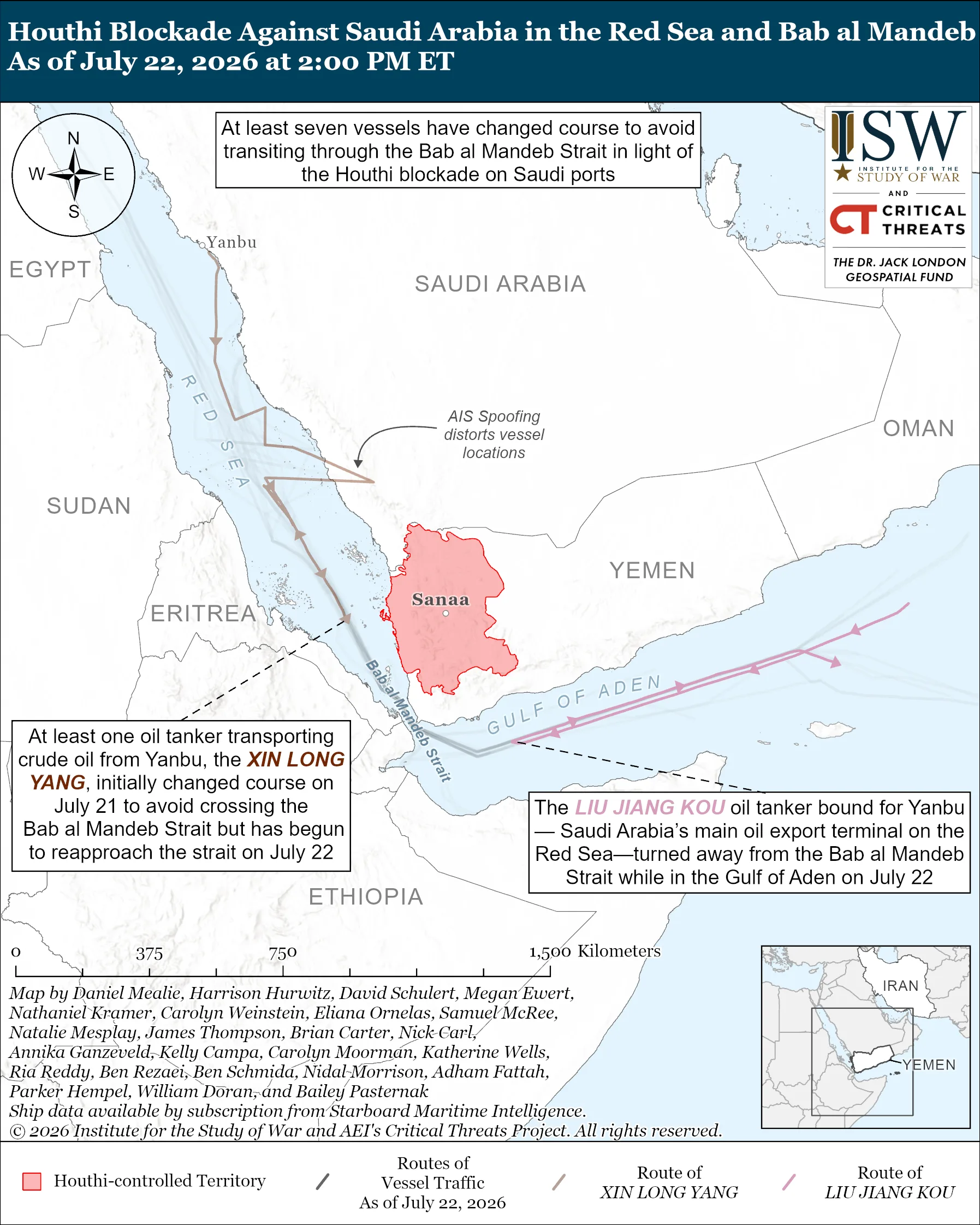
At least seven vessels have changed course to avoid transiting through the Bab al Mandeb Strait in light of the Houthi blockade on Saudi ports. The Houthis imposed the blockade against Saudi Arabia on July 20.[2] Six commercial vessels altered their course away from Saudi ports on July 22, according to ship-tracking data cited by Reuters.[3] Another oil tanker that was bound for Yanbu — Saudi Arabia's main oil export terminal on the Red Sea — turned away from the Bab al Mandeb Strait while in the Gulf of Aden on July 22.[4] The European Union Naval Force warned commercial vessels with links to the United States, Israel, and Saudi Arabia on July 22 against sailing in the Red Sea and Gulf of Aden.[5] Commercial ship traffic through the Bab al Mandeb Strait continued on July 22 despite the Houthis’ threats against commercial vessels, however. Commercially available ship tracking data from July 22 shows that 30 commercial vessels have transited through the Bab al Mandab Strait since ISW-CTP’s last data cutoff on July 21.[6] This is a notable decrease from the 64 commercial vessels that transited the strait between 2:00 PM ET on July 20 and 2:00 PM ET on July 21, however.[7] At least one oil tanker transporting crude oil from Yanbu, the Xin Long Yang, initially changed course on July 21 to avoid crossing the Bab al Mandeb Strait but has begun to reapproach the strait on July 22.[8] Houthi officials have emphasized that the Houthis will maintain their blockade on Saudi ports until Saudi Arabia lifts its blockade on Yemeni ports and airports.[9]
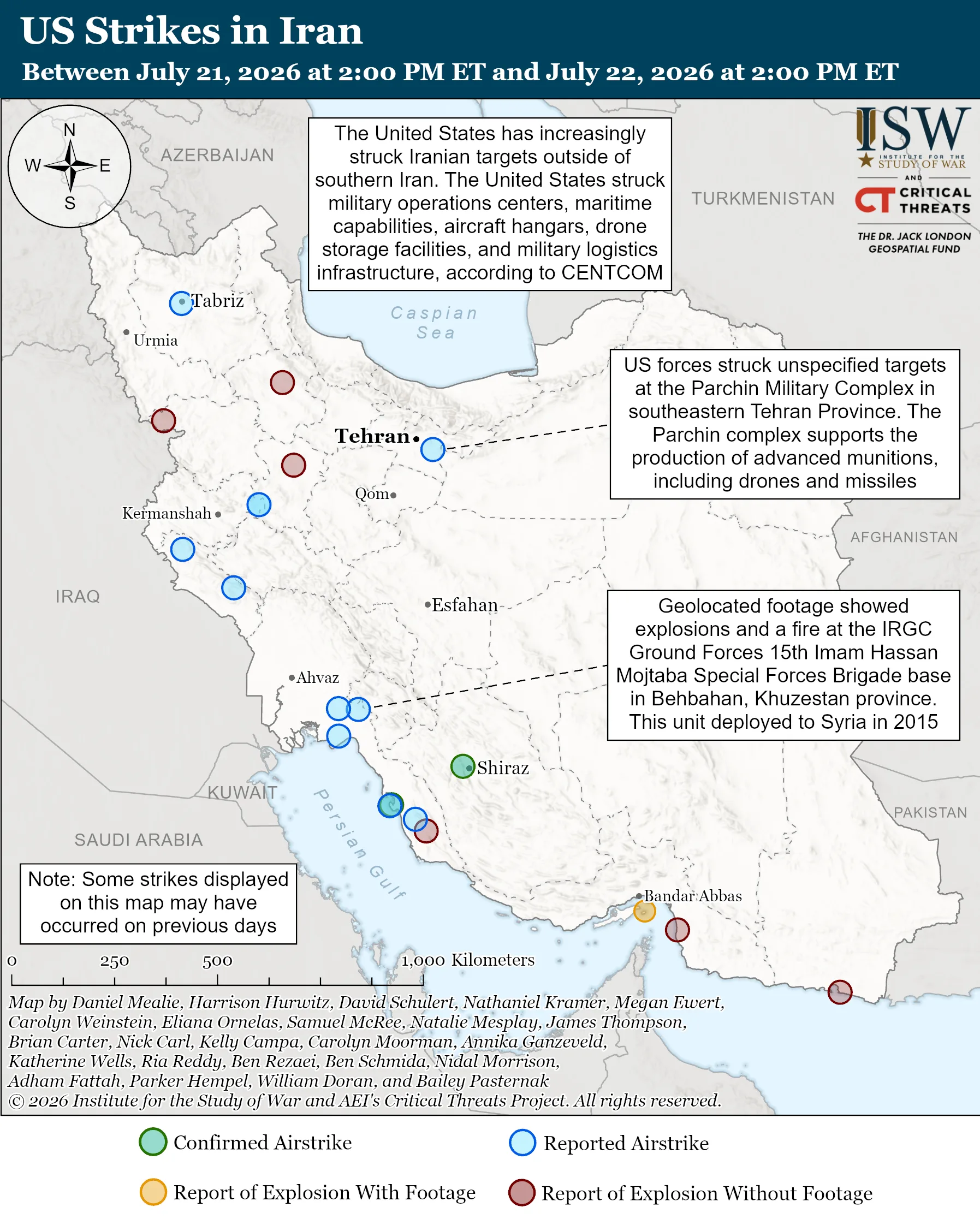
US forces struck Iranian military targets across western, northwestern, central, and southern Iran on July 21 and 22. US Central Command (CENTCOM) stated on July 21 that it struck Iranian military operations centers, maritime capabilities, aircraft hangars, drone storage facilities, and military logistics infrastructure in its 11th consecutive evening of strikes against Iran.[10] Geolocated CENTCOM footage showed that US forces struck military installations at Bushehr Airport on July 21.[11] US forces also struck Larak Island, Hormozgan Province, on July 22.[12] The previous Iranian traffic separation scheme, which Iran introduced in April 2026, passed through Qeshm and Larak islands.[13] Iranian authorities confirmed that strikes targeted two locations near Chabahar and Konarak, Sistan and Baluchistan Province, on July 21.[14] Iranian regime media also confirmed explosions near Sirik, Hormozgan Province, and Dashti, Bushehr Province, and missile attacks near Omidiyeh, Behbahan, Bandar Mahshahr, and Hendijan in Khuzestan Province.[15]
The United States struck an Islamic Revolutionary Guards Corps (IRGC) Ground Forces base in Behbahan, Khuzestan Province. Geolocated footage showed a major fire and explosions at the IRGC Ground Forces Bekhradian Barracks in Behbahan, which hosts the IRGC Ground Forces 15th Imam Hassan Mojtaba Special Forces Brigade.[16] This unit deployed to Syria in 2015 and incurred casualties fighting for the Assad regime.[17] This unit was also likely involved in suppressing protests in Izeh, Khuzestan Province, during the 2022 Mahsa Amini protests.[18]
The United States has increasingly struck Iranian targets outside of southern Iran, including western and northwestern Iran. Iranian regime media reported US strikes in Baneh, Kurdistan Province, Kabudarahang, Hamedan Province, Kangavar, Kermanshah Province, and Chivar and Abdanan, Ilam Province, on July 21 and 22.[19] It is not clear what the United States struck in western and northwestern Iran. The US-Israeli combined force struck Iranian air defenses and air bases, missile bases and launchers, and internal security targets in these regions in March and April 2026.[20]
The United States also struck unspecified targets in the Parchin Military Complex in southeastern Tehran Province.[21] Iran's Defense Industries Organization, which is a subsidiary of Iran's Ministry of Defense and Armed Forces Logistics (MODAFL), controls the Parchin complex and uses the complex to produce advanced munitions, including drones and missiles.[22] Multiple reports indicate that Iranian activities at Parchin are also potentially relevant to nuclear weapons development.[23] Western media and the Institute for Science and International Security reported on July 10 that Iran is constructing a concrete roof over the Taleghan 2 facility at the Parchin Military Complex to protect it from future strikes.[24] The Iranian regime previously used the Taleghan 2 facility to test explosives that are needed to detonate a nuclear device before the regime suspended its nuclear weapons program in 2003.[25]
Hezbollah is likely alleging that Lebanese Shia are being discriminated against at the Beirut airport as part of an effort to remobilize support for the group and protect Hezbollah's military organization. An anti-Hezbollah, French-language Lebanese media outlet reported on July 21 that Hezbollah- and Hezbollah ally Amal-affiliated social media accounts have alleged in a weeks-long internet campaign that Rafic Hariri International Airport's head of security, General Fadi Kfoury, is discriminating against Lebanese Shia.[26] The accounts alleged that airport security prohibited Shia airport engineers with reported ties to Amal from accessing certain areas in the airport, such as the airport's radar facilities.[27] Hezbollah Spokesperson Youssef Zein told Lebanese media on July 21 that Hezbollah “is not involved” in the internet campaign against Kfoury, however.[28]
Hezbollah's rhetoric is likely intended to remobilize support for the group among its Shia base in order to protect Hezbollah's military organization. Hezbollah's efforts to fuel sectarian-based discontent among Shia over the Beirut airport are likely intended to capitalize on existing sectarian-based tensions that have been exacerbated by the current Israel-Hezbollah conflict. The Wall Street Journal reported that Maronite Christian, Sunni, and Druze communities are not allowing internally displaced Shias to enter their towns for fear that doing so will invite Israel Defense Forces (IDF) airstrikes on their communities, for example.[29] Hundreds of mostly internally displaced Shias reportedly live in Beirut tent encampments because non-Shia landlords refuse to rent them apartments.[30] Hezbollah leaders and parliamentarians have accused the Lebanese government of neglecting its Shia population since the war began, which is a narrative that allows Hezbollah to reassert itself as the primary defender of Lebanese Shia.[31] Reinforcing Hezbollah's popular support amongst its Shia base is one way through which Hezbollah can protect its military organization, which is under threat of disarmament by the Lebanese government.
Hezbollah Political Council Deputy Chairman Mahmoud Qamati threatened on July 21 that Hezbollah may shut down the airport in response to Lebanese government restrictions on Iranian influence in Lebanon.[32] Rafic Hariri International Airport is Lebanon's only commercial airport and is surrounded by the Dahiyeh suburbs, which are Hezbollah's strongholds in southern Beirut.[33] Hezbollah previously blocked access to the airport in May 2008 to pressure the Lebanese government to reverse its decision to remove the airport's Hezbollah-affiliated security head and disable Hezbollah-controlled telecommunications infrastructure.[34] Hezbollah threats to close the airport could also upset ongoing US-Lebanese diplomatic initiatives. US President Donald Trump encouraged US airlines to begin offering direct flights to Lebanon following his meeting with Lebanese President Joseph Aoun on July 21.[35]
Assessed Iranian War Aims:
Secure international recognition of Iranian control over the Strait of Hormuz
Degrade the US ability and willingness to continue the war
Restore deterrence vis-à -vis the United States and its regional partners
Divide the United States and Israel from the Arab states
Iran fired at US military installations in the region as part of its ongoing efforts to degrade US capabilities and willingness to continue the war, end the war in a way that maintains Iranian control over the Strait of Hormuz, and break the coalition between the United States and regional Arab states. Islamic Revolutionary Guards Corps (IRGC) media claimed on July 21 that the IRGC struck “tactical radar” systems at the Ali al Salem Base and on Bubiyan Island in Kuwait.[36] This attack appears to be the first Iranian attack on Bubiyan Island since July 11. Six IRGC officers previously attempted to infiltrate Bubiyan Island on May 1 via a chartered fishing boat to carry out unspecified “hostile acts” against Kuwait.[37] An open-source intelligence account on X reported on July 22 that Iran also struck an AN/FPS-117 long-range air search radar system at the Ahmed al Jaber Air Base in Kuwait.[38] The AN/FPS-117 is a fixed, ground-based, long-range air surveillance radar with a detection range of up to 470 kilometers and designed for early warning and tracking of aircraft and ballistic missiles.[39] Iran likely aimed to degrade US forces’ capability to detect Iranian ballistic missiles.
Iran attacked Saudi Arabia for the second time since April 2026. Iranian regime media and an open-source intelligence account on X reported on July 22 that Iranian forces targeted the King Abdulaziz Air Base in Dhahran, Saudi Arabia, for the first time.[40] An early-warning siren went off in Dammam.[41] This attack marks the second Iranian attack on Saudi Arabia since July 11 and comes amid the Houthis’ blockade against Saudi Arabia.[42] Iran launched a single ballistic missile at a US air base near Riyadh on July 18.[43]
Iranian forces continued to target US military bases across Jordan, likely to reduce Jordan's willingness to support the US campaign against Iran. Regime media stated on July 21 that Iranian forces targeted US military assets at King Faisal Air Base in al Jafr and Prince Hussein Air Base in Mafraq.[44] The IRGC claimed that its missile and drone strikes targeted an F-15 preparation hangar, a drone preparation hangar, a helicopter storage hangar, and US personnel housing.[45] An Israeli military correspondent also reported on July 22 that Iranian forces struck an unspecified target in Aqaba, Jordan.[46] Aqaba is a regional trading and energy hub that Iran may be targeting in order to impose similar economic costs on Jordan as it has sought to impose on Gulf states to reduce their willingness to support the US campaign.[47] The Kuwaiti government stated on July 21 that Iran disabled generators at several power generation and water desalination facilities in Kuwait, for example.[48]
Iran is expanding trade with Pakistan, likely to mitigate the effects of the US naval blockade. Iranian Interior Minister Eskandar Momeni announced on July 22 that Iran and Pakistan agreed to expand bilateral trade and cross-border commerce. Momeni said that the agreement would increase bilateral trade from three billion US dollars to at least 10 billion US dollars and increase daily truck traffic across the Iran-Pakistan border to five times its current level.[49] The US naval blockade is limiting Iran's ability to export goods by sea, and Iranian efforts to increase land-based trade with its neighbors likely represent an effort to mitigate the effects of the blockade.[50] Iran has undertaken a broader effort to expand regional trade corridors since the United States first imposed the blockade on April 13. The New York Times reported on May 9 that Iran was using ports on the Caspian Sea to trade crucial goods and military equipment with Russia, for example.[51] The United States struck a railway in Golestan Province in northeastern Iran on July 9 that Iranian media stated was used to transport goods from Russia and the People's Republic of China.[52]
The Lebanese judiciary is reportedly considering implementing legal mechanisms that would permit the Lebanese Armed Forces (LAF) to search private property and confiscate Hezbollah weapons in the “pilot zones.” The LAF only conducted limited private property searches at the IDF’s request during previous efforts to disarm Hezbollah after the November 2024 ceasefire.[53] The Lebanese government recently agreed to the June 26 Trilateral Framework Agreement, which stipulates that the LAF will disarm and dismantle local armed groups in the “pilot zones.”[54] An unspecified judicial source told Saudi media on July 22 that the judiciary is considering three mechanisms.[55] One mechanism would reportedly grant the LAF “open” access to search private property in the “pilot zones.”[56] The second mechanism would reportedly require the LAF to apply for search warrants before searching individual properties, while the third mechanism would reportedly offer search warrants for entire villages or towns.[57] An unspecified senior judicial source told Lebanese media on July 22 that the judiciary has not granted the LAF permission to search private properties in the “pilot zones” at this time.[58] It is unclear when or if the Lebanese government will implement these measures. Lebanese President Joseph Aoun and other LAF officials have recently said that the Lebanese government is reluctant to use force to disarm Hezbollah due to the risk of civil war and fractures within the LAF.[59] Any Hezbollah disarmament plan that restricts the LAF from searching private property would likely fail because Hezbollah frequently conceals materiel in civilian homes.[60]
US Secretary of State Marco Rubio dismissed the possibility of Syrian military intervention against Hezbollah in Lebanon on July 22.[61] Rubio told reporters that the US State Department has encouraged the Syrian government to focus on internal challenges in Syria, including state building and countering the Islamic State in Iraq and Syria (ISIS), rather than planning and executing operations in Lebanon.[62] President Trump has repeatedly suggested to both Syrian and Lebanese leadership that Syria's military could intervene in Lebanon to degrade Hezbollah.[63] Lebanese President Joseph Aoun and Trump reportedly discussed the “proposal” for Syria to conduct a limited military intervention around the Syria-Lebanon border to degrade Hezbollah during their meeting in Washington, DC on July 21. Aoun reportedly rejected this proposal because Syrian intervention would be politically counter-productive and strengthen political support for Hezbollah.[64] Syrian officials, including Syrian President Ahmed al Shara, also rejected Trump's request for Syrian military intervention in Lebanon in June 2026.[65] Syrian intervention in Lebanon against Hezbollah would violate an agreement that Syria and Lebanon signed on July 3 that explicitly commits both nations to respecting each other's sovereignty, territorial integrity, and non-interference in internal affairs.[66]
Iraqi Prime Minister Ali al Zaydi appointed a new Counter Terrorism Service (CTS) chief and Federal Police commander on July 22.[67] Iraqi state-run media reported on July 22 that Zaydi appointed former Iraqi Military Intelligence Director Lieutenant General Zayd Hoshi al Moussawi as the CTS chief.[68] Moussawi served as military intelligence director from 2022 until his dismissal for unspecified reasons in 2024.[69] Zaydi also named Deputy Federal Police Commander Mohammad Qasem al Fahd as the Federal Police commander on July 22.[70] Former Iraqi Prime Minister Mohammad Shia al Sudani appointed Fahd as deputy Federal Police commander in July 2025 shortly after the Wasit Provincial Council dismissed Fahd from his position as the Wasit Province police chief. The council dismissed Fahd for “poor management” three days after a major fire in a supermarket in the provincial capital killed over 70 people.[71]
https://understandingwar.org/research/middle-east/iran-update-special-report-july-22-2026/
2,287
posted on
07/22/2026 11:37:58 PM PDT
by
AdmSmith
(GCTGATATGTCTATGATTACTCAT)
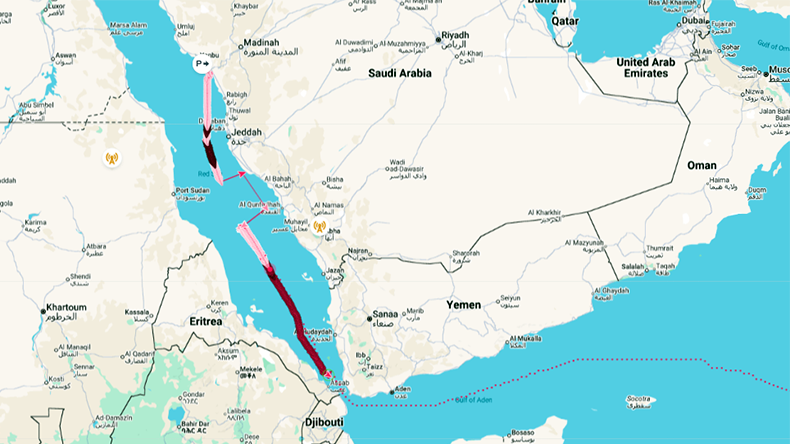
Chinese VLCC granted Houthi passage as militia tightens Saudi blockade
Cosco Shipping's VLCC Xin Long Yang has secured Houthi clearance to transit the Bab el-Mandeb strait after two U-turns in the Red Sea
Chinese tankers returning from Yanbu could negotiate passage on a case-by-case basis, though vessels heading to load remain in a holding pattern
Expected transit comes as Houthis claimed to have attacked two Saudi tankers earlier today, escalating from blockade to direct military strikes
https://www.lloydslist.com/LL1157956/Chinese-VLCC-granted-Houthi-passage-as-militia-tightens-Saudi-blockade
2,288
posted on
07/22/2026 11:44:00 PM PDT
by
AdmSmith
(GCTGATATGTCTATGATTACTCAT)
To: AdmSmith; BeauBo; blitz128; PIF; SpeedyInTexas; adorno; ETCM; GBA; bert; nuconvert; USA-FRANCE; ...
Those Houthis have certainly been busy beavers, damming up the second ME supply route. I see Saudi Arabia has actually responded to their block of SA oil shipment. Nice to see that the Houthis may have allowed a non oil Cosco shipment to transit. I wonder what kind of bribe Cosco might have had to pay to accomplish that. Of course the fact they are not trying to ship oil probably helps. There is certainly an amazing amount of activity now taking place in these parts, most of it probably not appearing in US news reports. Thank you again for the long work you are supplying us with.
2,289
posted on
07/23/2026 12:30:44 PM PDT
by
gleeaikin
(Question Authority: report facts and post their 'links" in your messages.)
To: gleeaikin; nuconvert
Mark Fowler 23JUL2026
The issues facing Iran prior to the War were serious, in fact existential – a collapsing economy, hyper-inflation, severe water shortages, lack of electricity, and growing widespread popular anger and unrest – and are ongoing and only getting worse. Whatever the Iranian leadership looks like, it will have to address these issues. And it is not clear that they will be capable of doing this without outside help. This is where the U.S. and hopefully our Western allies come in: sanctions relief, and extensive economic and other assistance in exchange for real changes in policy and a pullback on objectionable activities and programs. The potential for this may, and I say may, have increased with the removal of Ali Khamenei from the Supreme Leader’s seat. But it will depend on whether his son and successor, Mojtaba, is less rigidly ideological than his father. We will see if he is willing to put the Iranian people ahead of the regime.”
Next steps
First, we need to significantly blunt the regime’s ongoing ability to project power and control the Strait of Hormuz. It needs to reopen and stay open. And it will. Both sides need it to, but not on the regime’s terms. The focused effort on degrading Iran’s coastal offensive capabilities should continue apace.
We need the regime to be forced to address the internal existential threats listed above. This is sure to absorb much of their time and money and may eventually consume them. And it may even bring them back to the negotiating table. Escalating military strikes on energy facilities and civilian infrastructure would serve only to alienate the Iranian population and distract from the Iranian leadership’s appalling incompetence, strengthening the regime. As part of this, the current MOU must be abandoned and recast in a more evenhanded manner, leading to permanent peace. Adhering to it as currently written will only ensure we will be forced to return in the future. As we are already seeing.
The current dynamic from the U.S. side is emotionally driven and self-defeating. The Iranians appear riven by paralyzing factionalism, with a hefty dose of hubris regarding their temporary advantage. Neither is a recipe for success. The question is not whether Iran can win a military confrontation with the United States. It cannot. The question is whether it can continue forcing Washington to react rather than act. For now, that answer appears to be yes.
https://www.thecipherbrief.com/is-iran-controlling-the-gulf-conflict
2,290
posted on
07/23/2026 2:46:38 PM PDT
by
AdmSmith
(GCTGATATGTCTATGATTACTCAT)
The Houthis are not going to stop attacking, just as Iran is not going to stop supporting them. These threats are unlikely to change behavior in either Sana’a or Tehran. If anything, repeated ultimatums that are not enforced risk highlighting the limits of American deterrence rather than its strength.
President Trump is free to escalate if he believes that serves U.S. interests. But he should also recognize that every public threat that is not followed by action further erodes the credibility of American deterrence. Threats alone are not a strategy.
The United States is not negotiating with business partners seeking the best deal. It is confronting deeply ideological actors that have repeatedly demonstrated a willingness to absorb significant costs rather than capitulate under pressure. Expecting Tehran to reverse course simply because Washington raises the rhetorical stakes misunderstands how the Iranian leadership makes decisions.
Iran is not waiting for another agreement at any price, nor is it pleading for negotiations. If Washington's approach relies primarily on threats without a clear strategic objective and a credible plan to achieve it, it risks reinforcing the perception that the administration is reacting tactically rather than pursuing a coherent long-term strategy.
https://x.com/citrinowicz/status/2080284101634887880
2,291
posted on
07/23/2026 2:55:31 PM PDT
by
AdmSmith
(GCTGATATGTCTATGATTACTCAT)
Iranian Spy Ship in the Red Sea
In complete secrecy, the Iranian ship Saviz, which gained notoriety as a spy ship operated by the Iranian Revolutionary Guard in the Red Sea, has returned to anchor 90 nautical miles northwest of Yemen's Kamaran Island in international waters under a new name, WAVE, and it is nearly the same spot where it was stationed when it came under attack in April 2021.
The ship had been withdrawn from the Red Sea to Iran for maintenance after the explosion that targeted it, and Iran's Foreign Ministry spokesman Saeed Khatibzadeh stated at the time that the Saviz was a “non-military ship” that was assisting in “providing security along shipping lines and combating pirates.”
Ship tracking tools show no traces of the ship's movements that could confirm the date of its return to the area.

https://x.com/YoopYupFact/status/2079989911680168128
https://en.wikipedia.org/wiki/MV_Saviz
Mission equipment: Radar, SIGNIT (tbc), comms, multiple ‘Boston Whaler’ small boats.
Saviz has been at anchor in a position (15.8689 N, 41.1344 E / 15° 52’ 8.04” N, 41° 8’ 3.84”) on the Dahlak Bank, about 7 nautical miles south West in the main shipping route of the Red Sea. This position allows complete radar surveillance of the main shipping corridor, which is likely combined with AIS (Automated Identification System, used by ships to tell over vessels where they are) and signals intelligence (SIGNIT) to build up a detailed picture of vessel activity in the Red Sea. This combination of sensors allows a reasonable likelihood of detecting and monitoring naval vessels supporting the Saudi-UAE coalition off Yemen, as well as civilian vessels.
https://www.hisutton.com/Saviz.html
https://www.marinetraffic.com/en/ais/details/ships/shipid:657728/mmsi:0/imo:9167253/vessel:WAVE
https://www.vesseltracker.com/en/Ships/Saviz-9167253.html
2,292
posted on
07/23/2026 3:44:42 PM PDT
by
AdmSmith
(GCTGATATGTCTATGATTACTCAT)
Iran Update Special Report, July 23, 2026
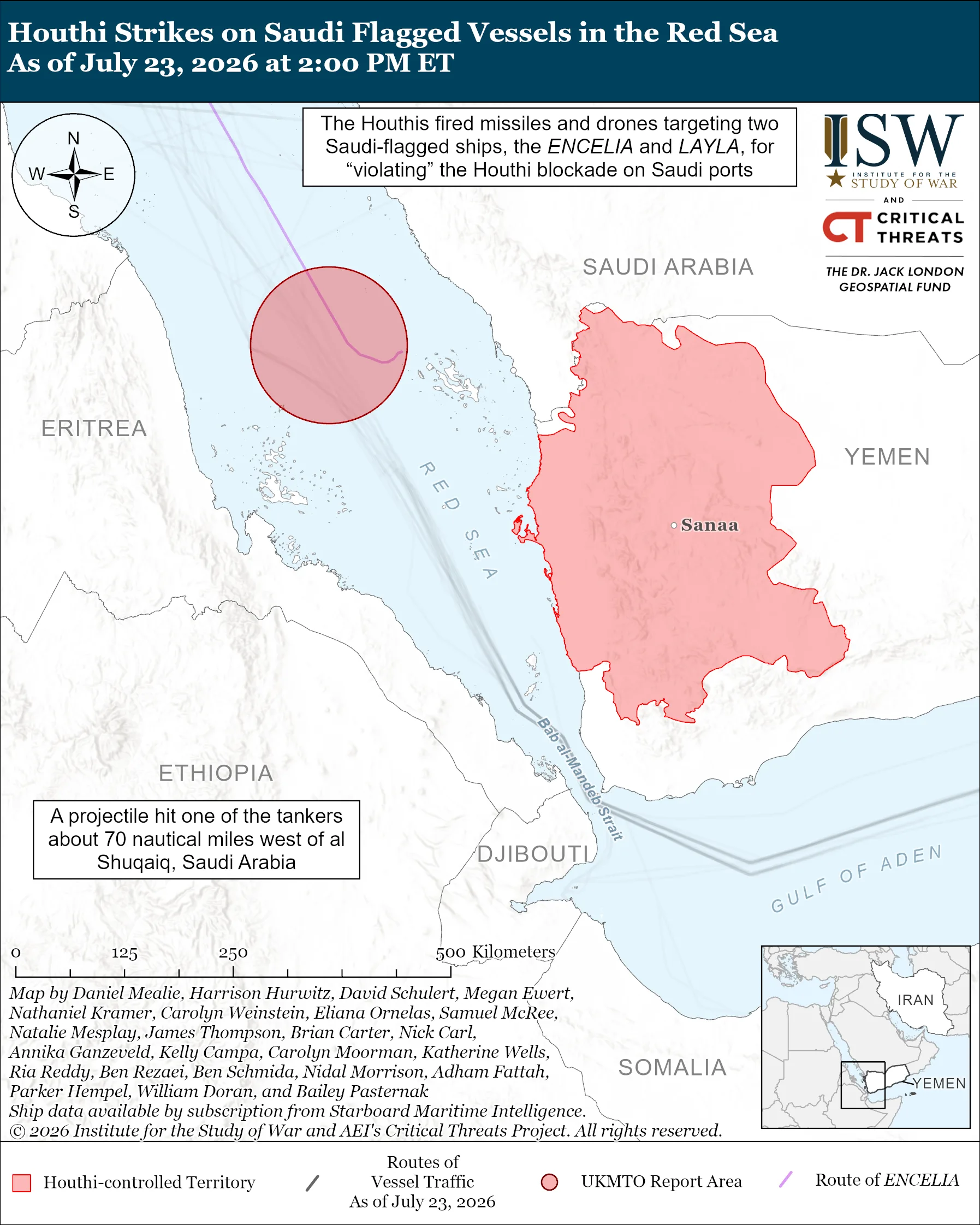
The Houthis struck at least one Saudi vessel to enforce their naval blockade of Saudi Arabia on July 22.[1] Houthi Military Spokesperson Yahya Saree claimed on July 22 that the Houthis fired missiles and drones targeting two Saudi-flagged ships, the ENCELIA and LAYLA, for “violating” the Houthi blockade.[2] United Kingdom Maritime Trade Operations confirmed on July 23 that the Houthis attacked an unspecified Saudi-flagged tanker with an “unknown projectile.”[3] Saudi state media also reported on July 22 that a Houthi attack caused a fire on the ENCELIA but no casualties.[4] These attacks follow repeated Houthi warnings on July 20 and 21 to Saudi-owned ships to avoid transiting the Red Sea.[5] Commercial ship traffic through the Bab al Mandeb Strait continued on July 23, however.[6] Commercially available ship tracking data from July 23 shows that 40 commercial vessels have transited through the Bab al Mandeb Strait since ISW-CTP’s last data cutoff on July 22, which marks a significant decrease from the number of vessels transiting the Bab al Mandeb before the Houthis announced their blockade on July 20.[7]
Iran continues to support the Houthis and their efforts to disrupt maritime traffic in and around the Red Sea. The expansion of the maritime shipping crisis to the Red Sea supports Iranian efforts to degrade the United States’ willingness and ability to continue its strike campaign against Iran and coerce the United States to accept Iranian control over the Strait of Hormuz. Four sources familiar with the matter, including two Iranian sources, told Reuters on July 23 that Iran transported Islamic Revolutionary Guards Corps (IRGC) commanders, military advisers, and missile and drone-related equipment to the Houthis in Yemen on July 13.[8] The two Iranian sources confirmed to Reuters that between 10 and 21 IRGC personnel, including senior commanders, were on the Mahan Air flight that was set to land at Houthi-controlled Sanaa Airport but diverted to Houthi-controlled Hudaydah Airport after Saudi-backed Yemeni armed forces attacked Sanaa Airport to prevent the plane from landing.[9] One of the sources said that the IRGC commanders traveled to Yemen to support Houthi operations and provide training on “new missile systems.”[10] The source added that Iran also sent gold on the flight to fund Houthi activities.[11] The Houthis pursue their own agenda, but they remain a key Iranian partner in Iran's broader regional network.[12] The Houthis’ campaign against international shipping between 2023 and 2025 disrupted international shipping in the Red Sea and imposed costs on Israel for its campaigns against Hezbollah in Lebanon and Hamas in the Gaza Strip.[13] The Houthis also pose a threat to US regional partners, as demonstrated by the Houthis’ current blockade against Saudi Arabia.[14] The report about Iran sending military commanders and advisers to Yemen to support Houthi operations comes after Reuters, citing two Iranian sources and a regional source, reported on July 16 that Iran asked the Houthis to attack shipping in the Bab al Mandeb Strait if the United States attacked Iranian energy infrastructure.[15]
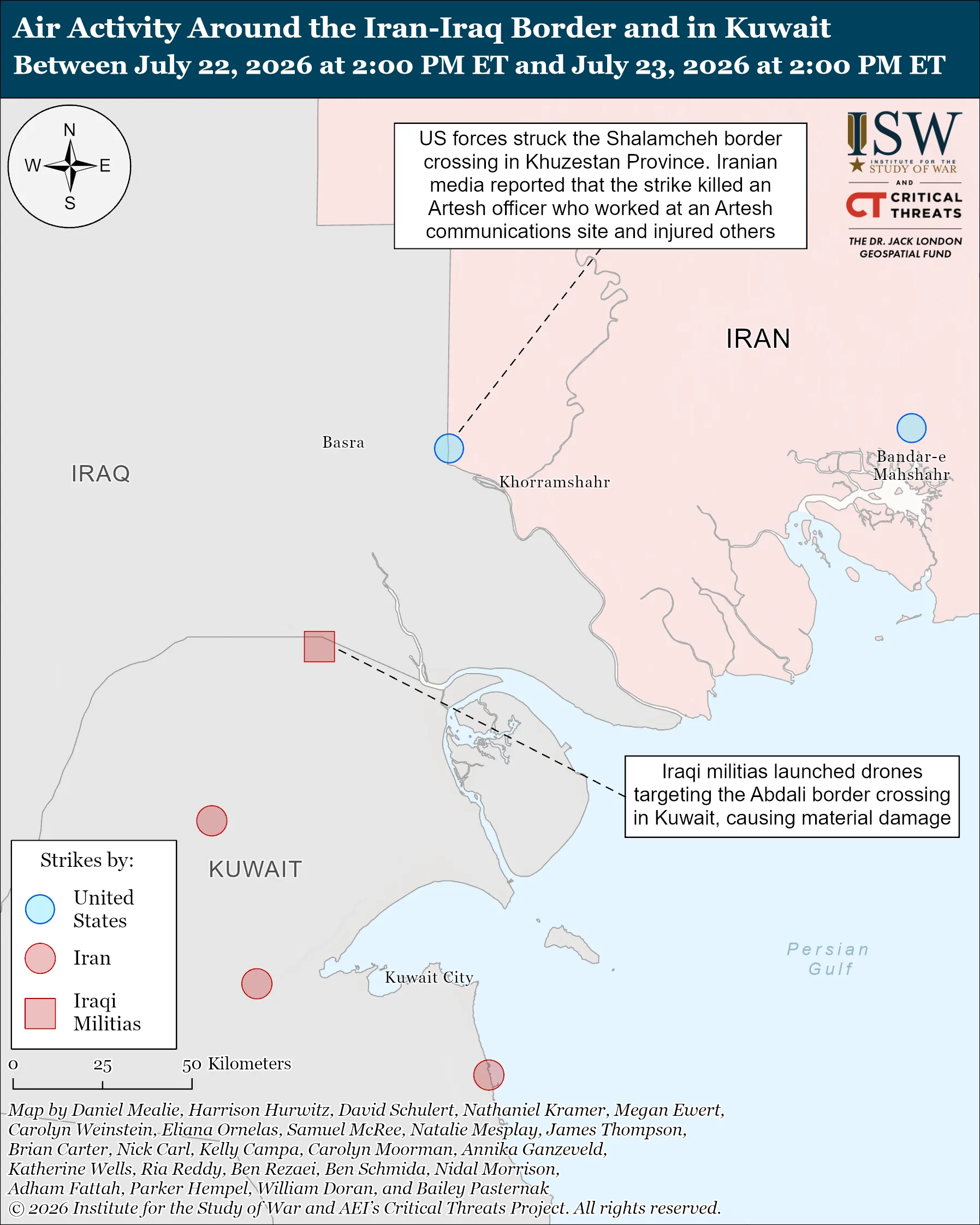
Unspecified Iranian-backed Iraqi militias likely conducted a drone attack on Kuwait's Abdali border crossing with Iraq on July 23, marking Iran and the Axis of Resistance's first attack on a regional border crossing since July 11.[16] Iranian media reported that militias conducted the drone attack in response to US airstrikes on Iran's Shalamcheh border crossing with Iraq (see US and Partner Military Operations text below for more details on the US airstrike on Shalamcheh).[17] No Iranian-backed Iraqi militia has taken responsibility for the attack at the time of this writing. The Kuwaiti Armed Forces confirmed on July 23 that the attack caused material damage but no casualties.[18]
Iranian media separately reported on July 23 explosions on Kuwait's Bubiyan Island, which hosts US air defense equipment.[19] ISW-CTP cannot confirm Iranian airstrikes on the island at the time of this writing. The IRGC claimed that its forces struck a US radar on the island on July 21.[20] Six IRGC officers previously attempted to infiltrate Bubiyan Island on May 1 via a chartered fishing boat to carry out unspecified “hostile acts” against Kuwait.[21]
The IRGC is highlighting the alleged presence of naval mines in the southern corridor to deter commercial vessels from using this corridor and consolidate Iran's control over the Strait of Hormuz. The IRGC claimed on July 22 that an oil tanker attempting to use the southern route struck a naval mine that disabled the vessel.[22] The IRGC added that this incident caused two other tankers that were also trying to use the southern route to turn around.[23] ISW-CTP has not observed reports of any commercial vessels hitting mines in the southern route at the time of this writing. United Kingdom Maritime Trade Operations (UKMTO) confirmed on July 7 the presence of a floating mine in the southern route, citing the Pakistani Navy's maritime navigational warning system, however.[24] Iran has repeatedly used force to attack vessels attempting to transit through the strait using the southern route, given that this route is an alternative to Iran's illegal traffic separation scheme. Traffic through the southern route therefore undermines Iranian efforts to assert full control over the strait. ISW-CTP has not observed any Iranian attacks on vessels in the strait since July 20.[25]
Russia may be helping Iran increase the accuracy of its targeting of US military sites in the region. Four people familiar with US intelligence told Reuters on July 22 that Russia may be providing Iran with targeting intelligence on US sites and equipment in the region.[26] US officials similarly told the Wall Street Journal on July 18 that they are concerned that Russia and the People's Republic of China are supporting Iran's targeting of US assets.[27] Russia's provision of targeting intelligence to Iran would likely improve the accuracy and effectiveness of Iran's drone and missile attacks. The sources speaking to Reuters cited the effectiveness and precision of Iran's drone attacks on a US Central Intelligence Agency (CIA) outpost in Saudi Arabia in March as possible evidence.[28] Two Western officials briefed on intelligence reports told Reuters that unspecified analysts assessed that Iran used “Russian-enhanced versions” of Shahed drones in the attack on the US CIA outpost.[29] Ukrainian President Volodymyr Zelensky previously told CNN on March 15 that he had seen intelligence that confirms that Iran has used Russian-produced Shahed drones “with Russian details” to attack US bases in the region.[30] These “details” reportedly include equipping Shaheds with Verba shoulder‑fired man-portable air-defense systems (MANPADS) to increase the Shahed’s capacity to target enemy aircraft.[31]
US President Donald Trump told Axios on July 23 that he may decide to expand US strikes against Iran.[32] Trump said that the United States is prepared to launch a “massive attack” against Iran if he orders such an operation.[33] Trump stated that the US military has not currently inflicted sufficient pressure on Iran to compel the Iranian regime to accept a deal.[34] Trump did not specify when he will decide whether to expand US strikes against Iran. US Secretary of State Marco Rubio similarly told reporters on July 23 that Iran is currently unwilling to make a deal that it would uphold, despite Iranian officials “begging” both directly and indirectly for a deal.[35] Rubio warned that US strikes on Iran will continue to increase daily until Iran accepts a deal.[36] The US military has conducted 12 consecutive rounds of strikes on Iranian targets as of July 23 (see below).[37]
US forces struck Iranian military targets across southern, southeastern, and western Iran on July 22 and 23. US Central Command (CENTCOM) stated on July 22 that it struck Iranian maritime capabilities, missile and drone storage facilities, coastal surveillance sites, and air defense assets in its 12th consecutive evening of strikes against Iran.[38] Iranian officials and media confirmed strikes and explosions in Khuzestan, Hormozgan, Bushehr, Sistan and Baluchistan, Kermanshah, and Chaharmahal and Bakhtiari provinces on July 22 and 23.[39] Khuzestan Province Deputy Governor for Security and Law Enforcement Valiollah Hayati reported on July 22 that US missiles struck the Shalamcheh border crossing.[40] The Shalamcheh border crossing is a major transit point located between Khuzestan Province and Iraq's Basra Province.[41] Iranian media later reported on July 23 that the strike killed two people, including an Iranian Artesh captain who worked at an Artesh communications site in Shalamcheh.[42] US and Israeli forces previously targeted the Shalamcheh border crossing at least twice in April 2026.[43] At least 1,000 Iraqi Popular Mobilization Forces (PMF) fighters reportedly entered Khuzestan Province through Shalamcheh in March 2026 and deployed to Basij bases in Khuzestan Province.[44] The PMF is an Iraqi state security service that includes many Iranian-backed Iraqi militias that answer to Iran instead of the Iraqi prime minister.[45]
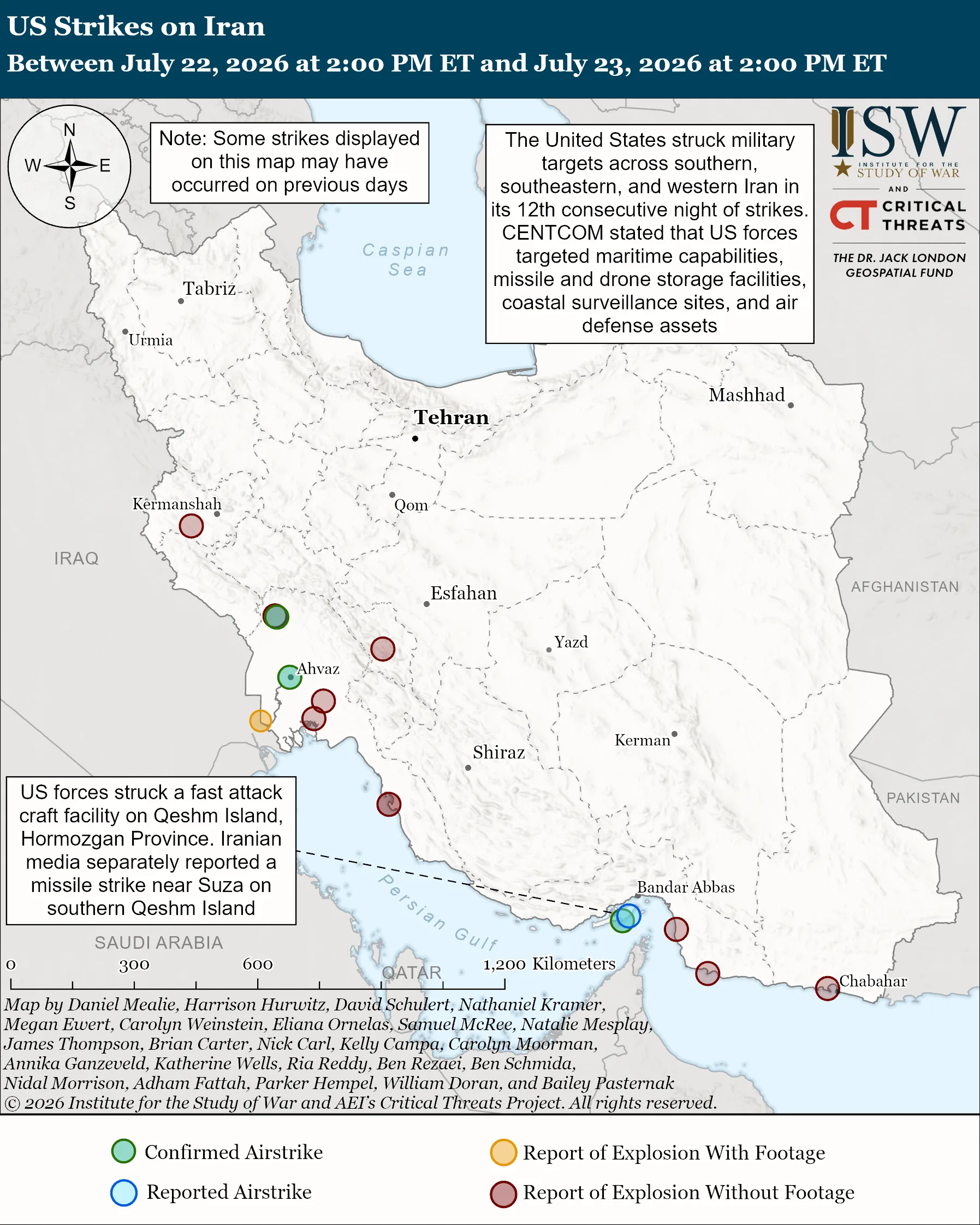
Iran continues to conduct attacks on US military facilities in the region and Gulf civilian infrastructure, likely to deter the United States from further expanding its strike campaign in Iran. The IRGC and Artesh have both claimed drone and missile attacks on US bases in Qatar, Jordan, Bahrain, Iraq, and Kuwait since ISW-CTP’s last data cutoff at 2:00 PM ET on July 22.[46] The IRGC claimed that a missile attack destroyed a US electronic warfare unit, a flight control tower, and a medical center at Camp Buehring in Kuwait, and killed and wounded several US soldiers.[47] ISW-CTP cannot confirm the IRGC claim at the time of this writing. Kuwaiti armed forces and the Jordanian Army confirmed that they have intercepted Iranian drone and missile attacks since ISW-CTP’s last data cutoff at 2:00 PM ET on July 22.[48] Open-source intelligence accounts on X, citing commercially available satellite imagery on July 22 and 23, confirmed damage to a US preparation hangar for F-15E fighter jets at King Faisal Air Base in Jordan, as well as damage to a helicopter shelter and warehouse at Camp Buehring and multiple sites at Ali al Salem Base in Kuwait.[49]
Iraqi Prime Minister Ali al Zaydi met with Iranian President Masoud Pezeshkian in Tehran on July 23 to oversee the signing of four memoranda of understanding (MoUs) between Iraq and Iran, according to Iraqi media.[50] The MoUs cover trade and transportation cooperation, including an agreement to construct a Khosravi-Khanaqin-Baghdad railway that would connect Baghdad to Iran's Kermanshah Province in western Iran.[51] Iraqi media reported that Zaydi emphasized Iraq and Iran's “shared security” and pledged to protect Iran from possible threats originating from Iraqi territory during his meeting with Pezeshkian, almost certainly referring to Kurdish opposition groups in Iraqi Kurdistan.[52] Iraqi and Iranian officials previously signed an MoU in August 2025 to implement a 2023 security agreement that required Iraqi authorities to disarm and relocate members of Kurdish opposition groups from the Iran-Iraq border.[53] Iran has historically accused Kurdish opposition groups and Israel of using Iraqi Kurdistan to facilitate anti-regime activity in Iran, particularly in the Iranian provinces located on the Iran-Iraq border.[54] Iran has repeatedly struck Kurdish opposition groups in Iraqi Kurdistan in recent months.[55]
https://understandingwar.org/research/middle-east/iran-update-special-report-july-23-2026/
2,293
posted on
07/24/2026 12:10:10 AM PDT
by
AdmSmith
(GCTGATATGTCTATGATTACTCAT)
To: gleeaikin
Houthis are Iran
Iran is a Chinese surrogate
Chinese ships get free passage fron the Iranian houthis guarding the straight into the Red Sea
QED
That is, as the Houthi are to Iran, Iran is to China
2,294
posted on
07/24/2026 4:32:55 AM PDT
by
bert
( (KE. NP. +12) Quid Quid Nominatur Fabricatur)
To: bert
2,295
posted on
07/24/2026 10:38:58 AM PDT
by
AdmSmith
(GCTGATATGTCTATGATTACTCAT)
Gut feelings and threats won’t solve this. After nearly six months of conflict with Iran in one form or another, the Trump administration still appears to underestimate the nature of the regime it is confronting.
U.S. policy should begin with a basic working assumption: Iran is unlikely to capitulate simply because military pressure increases. The key question is what Washington expects to achieve. Does it believe Tehran will abandon its missile program, give up its right to enrich uranium, or relinquish what it sees as its strategic position in the Strait of Hormuz? There is little evidence to suggest the regime is prepared to make concessions on issues it considers fundamental to the Islamic Revolution. On the contrary, Tehran appears convinced that, over time, Washington’s political resolve will weaken first.
If that is the underlying assumption behind the current strategy, disappointment is almost inevitable. Iran is not going to plead for an agreement or surrender its core strategic assets. Instead, the likely consequences are continued upward pressure on global oil prices and growing frustration in Washington as expectations collide with reality.
Retaliation is not a strategy, and a bombing campaign without a clearly defined political objective is unlikely to produce the desired outcome. If the goal is to force Iran back to the negotiating table in a significantly weaker position, that objective appears increasingly unrealistic.
Policymakers should be clear-eyed about the costs. A strategy centered on coercing Iran into submission risks imposing substantial economic and strategic costs on the United States and its allies without achieving its intended political objectives.
Iran is far from invulnerable. It has significant military, economic, and social vulnerabilities that can be exploited. But one reality remains unavoidable: confronting Iran requires time, sustained political commitment, a willingness to absorb casualties, major economic costs, and enormous military resources.
As long as the administration is unwilling to bear those costs, extending the current campaign, even if it produces tactical successes, is unlikely to bring Iran to the point of strategic defeat. If anything, a prolonged campaign without the resources or political will necessary to achieve decisive results risks strengthening Tehran’s belief that it can simply outlast Washington.
https://x.com/citrinowicz/status/2080701721471316051
2,296
posted on
07/24/2026 10:41:10 AM PDT
by
AdmSmith
(GCTGATATGTCTATGATTACTCAT)
Iran Update Special Report, July 24, 2026
Iran reportedly rejected a US ceasefire proposal on July 23, which suggests that Iran believes that it has the advantage over the United States in this phase of the war.[1] Unspecified Iranian officials told the New York Times on July 23 that Iran rejected a US ceasefire proposal that Iraqi Prime Minister Ali al Zaydi carried to Tehran during his July 23 visit.[2] Zaydi met with Iranian President Masoud Pezeshkian, Foreign Minister Abbas Araghchi, and Parliament Speaker Mohammad Bagher Ghalibaf in Tehran.[3] The Iranian officials speaking to the New York Times described the rejected proposal as the “only offer on the table” and stated that the Iranian government is not interested in a “temporary deal” that does not resolve ongoing disputes over the Strait of Hormuz.[4] This report comes after US President Donald Trump threatened on July 23 to expand the current US strike campaign.[5] Zaydi’s office denied the New York Times report on July 24.[6] Iraq has historically acted as a mediator between Iran and other countries, including the United States, however.[7] Iraq helped broker the 2023 rapprochement between Iran and Saudi Arabia, for example.[8] Zaydi’s visit to Tehran also follows his recent visit to Washington, D.C, on July 14, during which he met with Trump and other US officials.[9]
Iran is trying to inflict a steady number of US casualties by targeting sleeping quarters and recreation facilities at US regional bases in order to impose US domestic pressure that would force the US government to halt its airstrike campaign on Iran. The Artesh claimed that its forces conducted drone attacks targeting US forces gathered at Sheikh Isa Base in Bahrain, Muwaffaq Salti Airbase in Jordan, at al Udeid base in Qatar, and Camp Arifjan in Kuwait, since ISW-CTP’s last data cutoff at 2:00 PM ET on July 23.[10] The IRGC also claimed that its forces targeted the quarters of US forces at Camp Buehring in Kuwait on July 24.[11] Iranian regime media separately published on July 24 satellite imagery depicting damage from an Iranian ballistic missile hitting buildings reportedly housing US military forces at the Ali al Salem base in Kuwait.[12] ISW-CTP cannot confirm the veracity of this satellite image or the Iranian claims from July 24. These claims follow an Iranian missile attack on the Muwaffaq al Salti Airbase on July 17 that struck troop quarters on base and killed 3 US soldiers and injured several others.[13]
Khatam ol Anbia Central Headquarters Commander Major General Ali Abdollahi Aliabadi separately threatened on July 24 that Iran would “capture and send to hell” a US soldier for every Iranian killed during the war.[14] ISW-CTP has not observed any Iranian attempts to abduct US soldiers in the region at the time of this writing. Six IRGC officers previously attempted to infiltrate Bubiyan Island on May 1 via a chartered fishing boat to carry out unspecified “hostile acts” against Kuwait, however.[15]
ISW-CTP is tracking initial reports from Yemeni locals speaking to international media that an unspecified actor conducted airstrikes on the Houthi-controlled Yemeni port of Hudaydah on July 24.[16] ISW-CTP will provide further analysis about air operations against the Houthis in its July 25 Iran Update.
The Houthis likely calculated that closing the Bab al Mandeb Strait could help them extract concessions from Saudi Arabia without provoking a major US military response. Anti-Saudi Houthi rhetoric notably increased after the US-Iran MoU was signed in June, suggesting that the Houthis saw a moment of weakness and opportunity for them to extract concessions from Washington and its allies. Oman-based Houthi spokesperson and negotiator Mohamed Abdul Salam announced on July 24 that the Houthis are currently only enforcing a blockade against Saudi Arabia and have not closed the Bab al Mandeb Strait to all maritime traffic.[17] Abdul Salam, who is the Houthi movement's primary point of contact with Saudi diplomats, asserted that the blockade is a direct response to Saudi military action in Yemen, and Houthi officials have emphasized in recent days that the Houthis will maintain their blockade on Saudi ports and vessels until Saudi Arabia lifts its own controls on Houthi-controlled ports and airports.[18] Saudi forces struck Sanaa International Airport on July 13 to prevent an Iranian Mahan Air flight from landing in Houthi-controlled territory as part of this effort to control access to Houthi-controlled airports.[19] The Houthis are likely reiterating that the group is only blockading Saudi Arabia–not wholly closing the Bab al Mandeb Strait–to avoid provoking US military action, which would hinder the Houthis’ ability to coerce the Saudi government into abandoning its campaign against Houthi-controlled ports and airports. This effort to avoid US responses assumes that the United States will not back a close partner with whom it just signed a major agreement on nuclear issues.[20] US Central Command (CENTCOM) conducted airstrikes on Houthi targets under Operation Rough Rider between March and May 2025 to render the Houthis “unable or unwilling” to threaten maritime traffic in the Red Sea and significantly degrade Houthi military capabilities.[21] A similar US air campaign in response to any Houthi attempt to close the Bab al Mandeb Strait to maritime traffic would almost certainly target Houthi capabilities that are necessary to enforce a blockade on Saudi Arabia and threaten Saudi vessels.[22]
The Houthis are still capable of exerting pressure on the United States and the international community without closing the Bab al Mandeb Strait to all maritime traffic, however. The Houthis likely understand the United States’ sensitivity to the current conflict's economic costs and disruption to global commerce and may seek to deter the United States using the threat of a broader economic shock. Reuters reported on July 23 that marine insurance costs increased significantly for exporters and shipping companies transiting goods through the Red Sea, and maritime traffic through the Red Sea has fluctuated significantly in recent days amid the start of the Houthi blockade on Saudi Arabia.[23] An unspecified shipping company executive told US media on July 21 expressed concern that oil prices will rise dramatically if the Houthis announce that they are threatening all traffic in the Bab al Mandeb Strait.[24]
Iranian officials have threatened the United States with closing the Bab al Mandeb Strait entirely, and the Houthis’ strategic calculus could change if the group decides that it may be able to secure more of its interests by expanding the conflict. Two unspecified Iranian officials told the New York Times on July 23 that the Iranian regime will ask the Houthis to close the Bab al Mandeb Strait to all maritime traffic if Trump authorizes airstrikes on Tehran and Iranian critical infrastructure.[25] The Houthis are an Iranian partner, not a proxy, which means that the Houthis sometimes act independently of Iran's wishes.[26] The Houthis have avoided Iran's request for the group to close the Bab al Mandab Strait for several months.[27] Iran retains some means of leverage over the Houthis, however, and the Houthis could completely fulfill Iran's request if the group assesses that its priorities have changed.[28] Reuters reported on July 23 that Iran has trafficked significant amounts of various weapons, including drone and missile components, as well as liquid financial assets like gold, to Houthi-controlled territory throughout July 2026.[29] Reliance on Iranian funding and weapons could incentivize the Houthis to consider enforcing an Iranian request to fully close the Bab al Mandeb Strait if the Houthis deem Iranian support to be a higher current priority than forcing Saudi Arabia to forfeit its blockade on Houthi ports and airports.
Iranian leaders may assess that Iran can deter the United States from expanding its campaign by threatening that the Houthis could fully disrupt traffic in the Bab al Mandeb. The Iranian regime understands the United States’ sensitivity to economic costs derived from Iranian attempts to assert control over the Strait of Hormuz.[30] Iranian leaders may seek to maintain the possibility of disrupting all traffic in the Bab al Mandeb Strait to deter the United States from significantly expanding its military operations against Iran. Iranian officials’ threats that they could demand that the Houthis disrupt traffic in the Bab al Mandeb follow recent US media reporting that US Central Command (CENTCOM) is expanding its force presence in the Middle East, which would provide CENTCOM with options to expand US operations against Iran.[31]
A US-based Yemen analyst reported on July 23 that Houthi leaders have adopted enhanced operations security (OPSEC) protocols amid reports that Saudi Arabia may expand its operations against the group.[32] The analyst reported that the OPSEC protocols may be part of Houthi preparations for a possible Saudi-led, anti-Houthi coalition air campaign in Yemen.[33] Houthi Leader Abdulmalik al Houthi refrained from delivering a regularly scheduled and televised speech on July 23.[34] It is unclear whether Abdulmalik's absence is part of ongoing Houthi preparations for a potential Saudi air campaign, however.
US forces struck Iranian military targets across western, northwestern, southern, and southwestern Iran on July 23 and 24. US Central Command (CENTCOM) stated on July 23 that it struck Iranian military command centers, drone storage facilities, communications networks, coastal surveillance sites, and maritime capabilities.[35] CENTCOM added that the strikes sought to further reduce Iran's ability to threaten commercial shipping in the Strait of Hormuz.[36] The United States struck Artesh military facilities in western and northwestern Iran. Satellite imagery showed that a US strike destroyed a hangar and another unspecified structure at the Artesh Air Force 3rd Tactical Airbase (TAB) in Kabudarahang, Hamedan Province, on July 21.[37] US forces separately struck the Artesh Ground Forces 164th Mobile Assault Brigade barracks in Piranshahr, West Azerbaijan Province, on July 24.[38] The 164th Mobile Assault Brigade is subordinate to the 64th Urmia Infantry Division and is based in Piranshahr.[39] The brigade specializes in heliborne assaults, night raids, controlling roads, mountain warfare, offensive demolition, and urban warfare.[40]
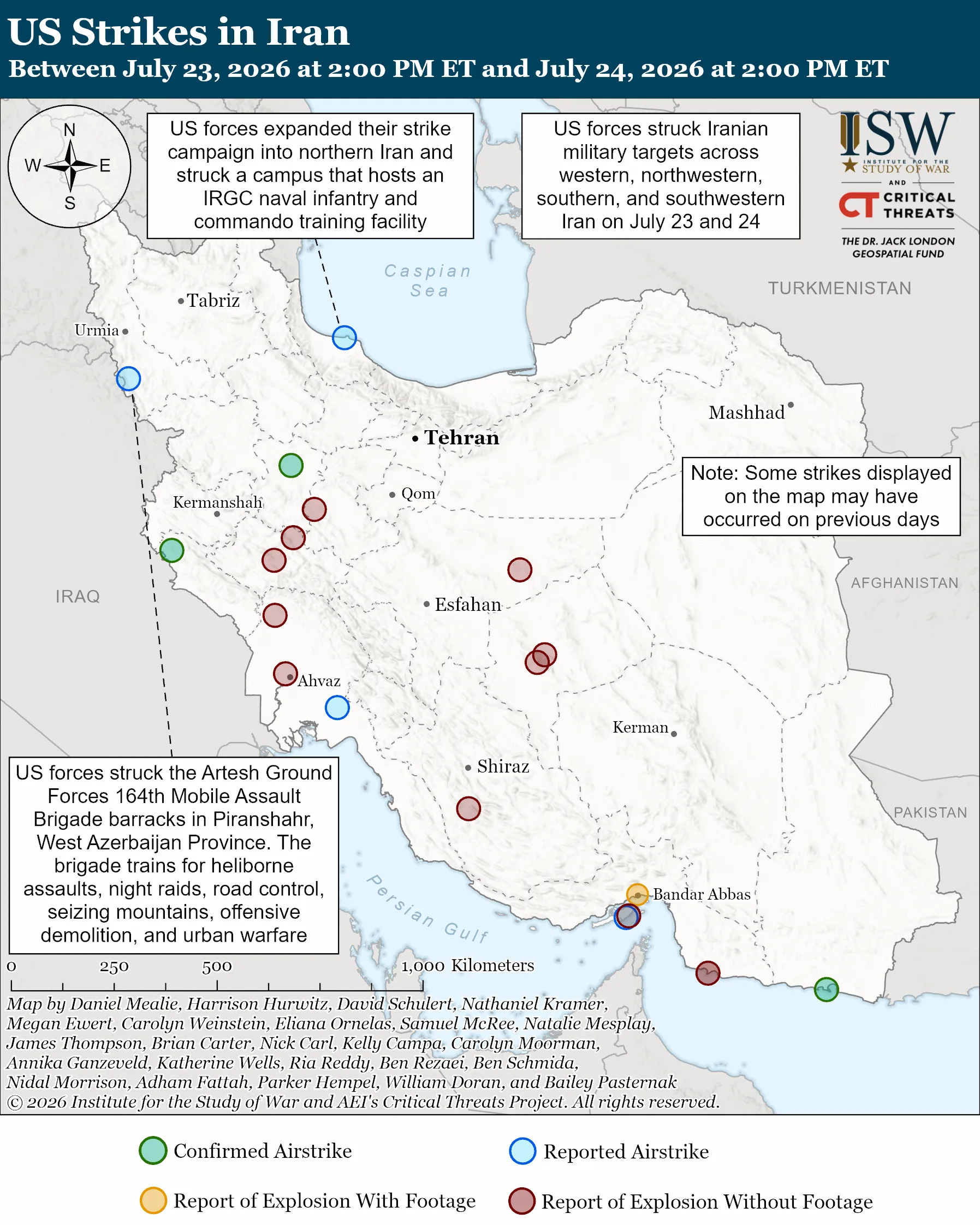
US forces also expanded their strike campaign into northern Iran on July 24.[41] Iranian officials confirmed that US forces struck the IRGC Navy Hazrat Seyyed ol Shohada Headquarters in Zibakenar, Gilan Province.[42] The facility houses the IRGC Navy's Seyyed ol Shohada Commando College, which trains naval infantry and commando forces.[43]
US forces separately continued targeting Iranian communications and military infrastructure in southern and western Iran. Geolocated footage from July 23 showed that a US strike targeted the Telecommunications Regulatory Authority building in Bandar Abbas, Hormozgan Province.[44] US forces previously targeted this building on July 16.[45] Geolocated imagery from July 24 also showed that US forces destroyed a communications facility in Ilam Province.[46] Geolocated imagery from July 23 showed that US forces struck tunnels beneath a military garrison town associated with the Artesh Air Force 10th TAB and Konarak Naval Base in Sistan and Baluchistan Province on July 21.[47]
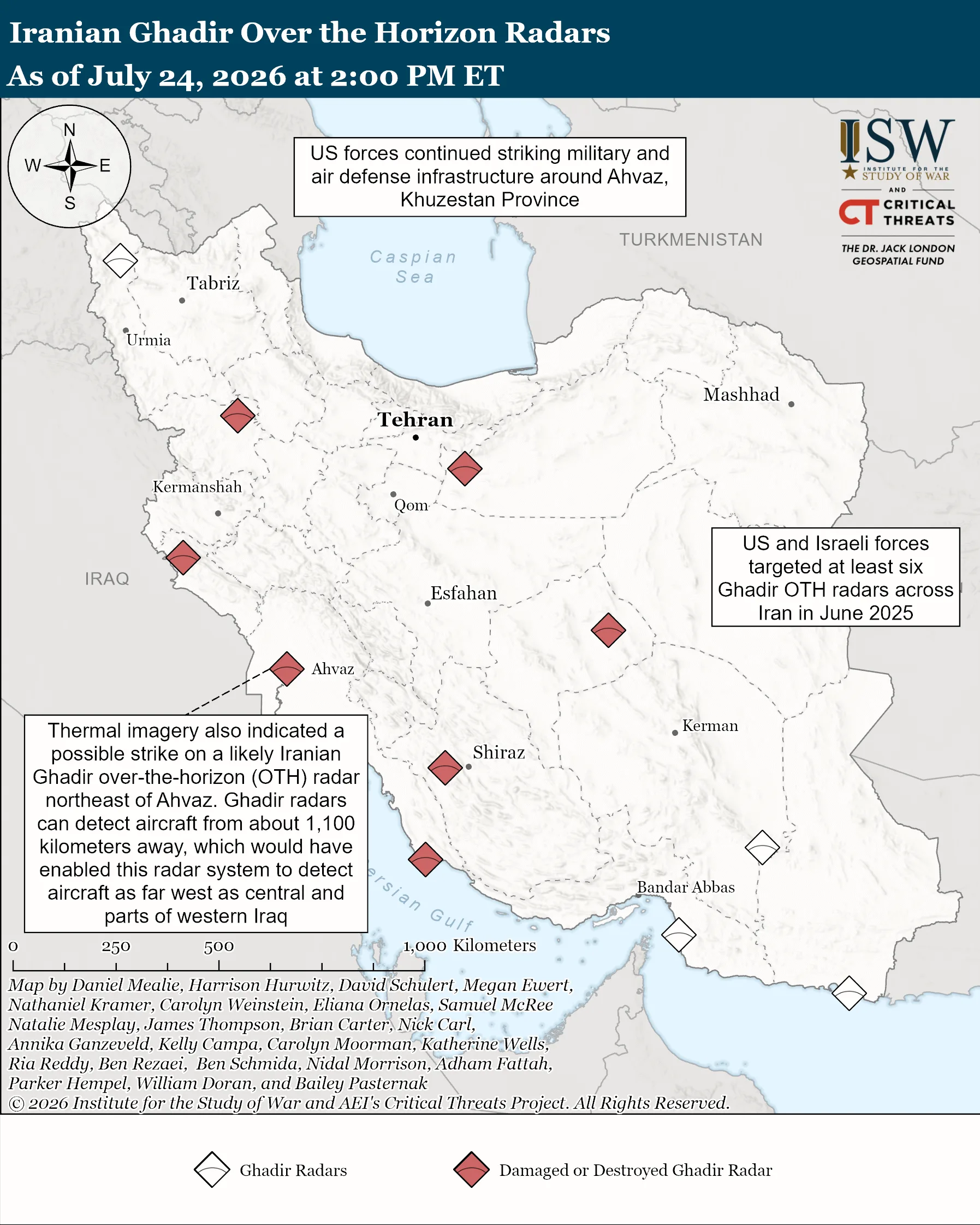
The United States also continued striking targets in Iran's Khuzestan Province. Satellite imagery showed several buildings burning at a military installation in western Ahvaz after the July 23 strikes.[48] Khuzestan Province Deputy Governor for Security and Law Enforcement stated on July 24 that US missiles struck locations around Ahvaz, killing four people and injuring five others.[49] Thermal imagery also indicated a possible strike on a likely Iranian Ghadir over-the-horizon (OTH) radar northeast of Ahvaz.[50] Ghadir radars can detect aircraft from about 1,100 kilometers away, which would have enabled this radar system to detect aircraft as far west as parts of central and western Iraq.[51] US and Israeli forces targeted at least six Ghadir OTH radars across Iran in June 2025.[52] Regime media confirmed strikes and explosions near Andimeshk and Omidiyeh in Khuzestan Province on July 24.[53]
The Wall Street Journal reported on July 24 that Bahrain and Kuwait secretly struck sites inside Iran sometime after July 11, according to people familiar with the matter.[54] The United Arab Emirates (UAE) reportedly supplied Bahrain and Kuwait with targeting intelligence and defensive air cover to conduct the strikes.[55] The UAE previously struck an oil refinery on Iran's Lavan Island in April.[56] Iran prioritized attacks against US bases and critical infrastructure in Bahrain and Kuwait in recent weeks, likely to deter them and other Gulf states from supporting US military efforts against Iran.[57]
Iran is likely targeting civilian sites in Bahrain to both raise the cost of Bahrain hosting US forces and to pressure Bahrain to urge the United States to end its airstrike campaign on Iran. The Bahrain Defense Force announced on July 24 that Bahraini air defenses intercepted several Iranian attacks attempting to strike unspecified civilian targets in Bahrain.[58] Bahrain has reportedly participated in US airstrikes on Iran since July 11 (see text above).
One of these civilian sites could be referring to a data center belonging to Bahraini state-run telecommunications company Batelco in Askar, Bahrain, which Iran has claimed to target in drone and missile attacks on July 18 and 24.[59] An open-source intelligence account confirmed damage at the data center via commercially available satellite imagery from July 22.[60] The account reported that Batelco hosts Amazon Web Services (AWS) servers in Bahrain.[61] The IRGC claimed on July 18 that the US military also used the center to aid its operations against Iran.[62] ISW-CTP cannot confirm if the data center hosted AWS servers or if the US military used the data center. Iran stated that it would target data centers of US companies in Gulf states in response to US-Israeli strikes on Iran's defense industrial sites in March.[63]
Iran claimed to deploy more advanced drones and drone tactics on US bases in Gulf states to overwhelm US and Gulf states’ air defense systems. Armed Forces General Staff-run media reported on July 24 that the IRGC struck a very large ammunition depot located on the Ali al Salem base in Kuwait using “advanced destructive drones” in “successive attacks.”[64] The reported attack is consistent with Iran's demonstrated ability to conduct coordinated and sophisticated drone operations against US targets. Iran penetrated and damaged a Central Intelligence Agency (CIA) outpost via a two-drone attack in March.[65] The first drone breached the facility's exterior, creating an opening, and the second drone exploited that vulnerability by flying through the breach and detonating inside the site, according to a US intelligence official speaking to Reuters on July 22.[66] US intelligence also assessed that Russia may be helping Iran target US sites in the region through adapted Shahed-136s with access to Russian satellite navigation systems.[67] Ukrainian President Volodymyr Zelensky previously told CNN on March 15 that he had seen intelligence that confirms that Iran has used Russian-produced Shahed drones “with Russian details” to attack US bases in the region.[68] These “details” reportedly include equipping Shaheds with Verba shoulder‑fired man-portable air-defense systems (MANPADS) to increase the Shahed’s capacity to target enemy aircraft.[69]
Iraqi security forces reportedly raided a likely Iranian-backed Iraqi militia Kataib Hezbollah headquarters and drone factory in Jurf al Nadaf, Baghdad Province, on July 24.[70] An unspecified security source told Iraqi media on July 24 that an Iraqi ”joint security force besieged” the headquarters and drone factory of an unspecified militia affiliated with the Popular Mobilization Forces (PMF) in Jurf al Nadaf.[71] This source claimed that unspecified actors had fired drones targeting the US Embassy in Baghdad and Baghdad International Airport from this area.[72] The PMF is an Iraqi state security service that includes many Iranian-backed Iraqi militias, such as Kataib Hezbollah, that answer to Iran instead of the Iraqi prime minister.[73] Kataib Hezbollah-affiliated PMF brigades have used a PMF headquarters in Jurf al Nadaf to store explosives, ammunition, and weapons, according to a security official speaking to Qatari media in November 2025.[74]
This raid comes as Iraqi security forces have targeted several other Iranian-backed militia sites in July.[75] The Iraqi National Security Service arrested three individuals during a raid on a first-person video (FPV) drone factory located in an area of Baghdad with a Kataib Hezbollah presence on July 21.[76] The Iraqi Counter Terrorism Service (CTS) also attempted to retake a likely Kataib Hezbollah-controlled farm in Dora District, Baghdad Province on July 3.[77] Iranian-backed Iraqi militias, including Kataib Hezbollah, have used areas under their control to store weapons and conduct rocket attacks targeting US interests in Iraq.[78]
The Kurdistan Counter-Terrorism Service intercepted between five and six explosive-laden one-way attack drones over Erbil, Iraqi Kurdistan, on July 24, according to Iraqi media.[79] Unspecified actors reportedly launched the drones from western Iraqi Kurdistan.[80] It is not clear at the time of this writing which actor conducted the attack, however. Iranian-backed Iraqi militias previously conducted numerous attacks targeting US positions in Iraqi Kurdistan in March and April. [81]Unspecified actors have also launched a plethora of drones targeting the US Consulate in Erbil in recent days.[82] Iranian media separately claimed that the Islamic Revolutionary Guards Corps (IRGC) struck a US Patriot air defense system, a US “fighter jet” hangar, and a “spy balloon” in Erbil on July 24.[83] An Israeli OSINT account published footage of reported smoke rising at Erbil International Airport, which hosts a US base, on July 24.[84] The IRGC and Artesh have both claimed drone and missile attacks on US bases in Iraq in recent days.[85]
https://understandingwar.org/research/middle-east/iran-update-special-report-july-24-2026/
2,297
posted on
07/25/2026 2:42:53 AM PDT
by
AdmSmith
(GCTGATATGTCTATGATTACTCAT)
Iran smuggling agents into UK as Channel migrants Tehran boasts it is positioning ‘revolutionary people’ in London through secret network Individuals with links to Tehran’s intelligence agencies are understood to have been intercepted by UK authorities while attempting to enter Britain on small boats. People smugglers working on the Continent told The Telegraph that the Iranian regime facilitated the passage to Britain of migrants living at Calais in exchange for a “favour” for Iran after they settled in England.
Home Office officials have thwarted Iranian-linked individuals arriving in Britain from small boats by using drones and surveillance watchtowers fitted with artificial intelligence to monitor vessels crossing the English Channel. Suspected Iranian operatives intercepted in small boats are thought to have links to the Ministry of Intelligence and Security, the country's primary intelligence and domestic security agency responsible for overseas operations.
An Iranian official said: “Of course, don't forget that our armed forces have influence and run the [smuggling] routes in some cases if they want. “At the moment we have people right there in London, revolutionary people who care about the world and the lives of children – they wait for us to tell them what to do. We have not done that yet, but we can easily make London unsafe for you if we want to.
It is understood that the number of threats arriving via small boats is dwarfed by the amount of IRGC-affiliated people entering Britain on legal flights from Europe. Officials also told The Telegraph that the radicalisation and activation of Iranian diaspora in London and the use of proxies in Britain posed a bigger national security risk than small boats, which are often an expensive and unreliable route.
https://www.telegraph.co.uk/news/2026/07/24/iran-smuggling-agents-into-uk-as-channel-migrants/

2,298
posted on
07/25/2026 8:23:48 AM PDT
by
AdmSmith
(GCTGATATGTCTATGATTACTCAT)
Michael Rubin: Saudi Arabia Bought Off the Houthis. Now They Are Blockading Its Ports Saudi Arabia stopped bombing the Houthis, pulled back in Yemen, and let its proxies work with them. Michael Rubin on what that bought Riyadh, why Qatar and Oman learned the same lesson first, and what the Kingdom would have to do now to get the Red Sea back.
After all, despite public posturing against the Houthis, Riyadh has, after Iran and the Sultanate of Oman, become their biggest supporters. The chief difference between Tehran and Riyadh is that while Iranian authorities embrace the Houthis out of ideological and sectarian sympathy, Saudi officials do so out of a cynical belief that they can co-opt and appease them.
While Houthi drone attacks on Israel make headlines, the Houthis launched more than a thousand drone and ballistic missile attacks on Saudi Arabia; not only did the United States barely make any mention, but when the Saudis intervened to counter the Houthis, Obama administration progressives took the Houthi side criticizing the imprecision of Saudi bombing and demanding an end to U.S. intelligence sharing with the Kingdom. On its face, this made no sense: To deny intelligence in support of Saudi strikes on the Houthis would never force Riyadh to stop countering what it believed to be an existential threat but rather was equivalent to blindfolding a sniper as punishment for missing.
Absent consistent and meaningful support, Saudi Arabia went to Plan B: Buying off the Houthis. irstrikes on the Houthis stopped, and Saudi forces inside Yemen pulled back. On March 29, 2022, Saudi authorities announced a broad ceasefire in Yemen to facilitate peace talks. Shortly after, the Saudis created the Presidential Leadership Council to unite the various Yemeni factions that opposed the Houthis into a singular government.
... snip...
With Red Sea security now under threat, it is time the Saudis stop indulging the Houthis. The Southern Forces in Yemen were the most effective fighting force against the Houthis, until the Saudis turned on them. Likewise, the Saudis must end their indulgence of General Abdel Fattah al-Burhan in Sudan so long as he also works with and empowers the Houthis.
Finally, if Saudi Arabia wants to maintain security in the Red Sea and cease the Houthi stranglehold over the Bab el-Mandeb, it should start working with Somaliland. If Muhammad Bin Salman chooses to pursue proxy wars with the United Arab Emirates and spread online poison regarding Israel's recognition of Somaliland over Saudi Arabia's own security, then Saudi Arabia will lose, a victim of its own short-sightedness.
https://nationalsecurityjournal.org/saudi-arabia-bought-off-the-houthis-now-they-are-blockading-its-ports/
2,299
posted on
07/25/2026 8:38:10 AM PDT
by
AdmSmith
(GCTGATATGTCTATGATTACTCAT)
Iran Update Special Report, July 25, 2026
The Saudi-led coalition struck several Houthi targets across Yemen on July 24 and 25 in order to degrade the Houthis’ capabilities to threaten Saudi-linked shipping in the Red Sea and strike Saudi critical infrastructure.[1] The Houthis and Houthi-affiliated media claimed that Saudi-led forces struck Hudaydah Port, a telecommunications building in Hudaydah City, and an unspecified target on Karaman Island near Salif Port, northwestern Yemen, on July 24.[2] Anti-Houthi Yemeni media claimed that the strikes targeted Houthi barracks near Hudaydah Port.[3] Geolocated imagery showed a fire burning at Hudaydah Port on July 24 after the alleged Saudi strikes.[4] A spokesperson for the Saudi-led coalition denied that the coalition conducted any strikes targeting the port.[5] Saudi forces later struck likely Houthi drone and missile launch sites in Jawf and Marib provinces on July 25 in response to Houthi attacks on Saudi critical infrastructure in Yanbu and Jizan on July 24.[6]
The Houthis attacked Saudi vessels and Red Sea ports on July 24 to coerce Saudi Arabia into abandoning its air campaign against Houthi ports and infrastructure.[7] The Houthis fired missiles and drones targeting Saudi state-owned oil infrastructure in Yanbu and Jizan on the Red Sea coast.[8] An open-source intelligence account on X confirmed that Houthi munitions impacted in Jizan, and Reuters reported that Greek-operated Saudi air defenses intercepted two Houthi ballistic missiles targeting Yanbu.[9] The Houthis claimed that their forces conducted the attacks in response to Saudi airstrikes on Houthi sites several hours earlier.[10] International media reported that Houthi forces also attacked a Saudi vessel, the NCC Masa, in the Red Sea on July 24.[11] Houthi military spokesperson Yahya Sarea warned on July 25 that the Houthis will continue to enforce their blockade on Saudi ports and vessels and will “not hesitate” to escalate or expand the group's targeting in response to Saudi attacks.[12] A US-based Yemen analyst reported on July 25 that the Houthis may expand their targeting of Saudi infrastructure, including energy and maritime assets.[13] Houthi attacks on oil infrastructure in major Red Sea port cities compound the tactical effects of the group's blockade on Saudi Arabia, which raises the cost for Saudi Arabia to continue air operations in Houthi-controlled territory.[14] Saudi Arabia heavily depends on Yanbu as an oil export hub in light of Iranian attacks on vessels and oil infrastructure in the Persian Gulf and Strait of Hormuz.[15] Houthi attacks on Yanbu and other Saudi Red Sea ports also advance Iranian interests by eliminating Saudi alternatives to accepting Iran's demand for recognized control over the Strait of Hormuz.[16]
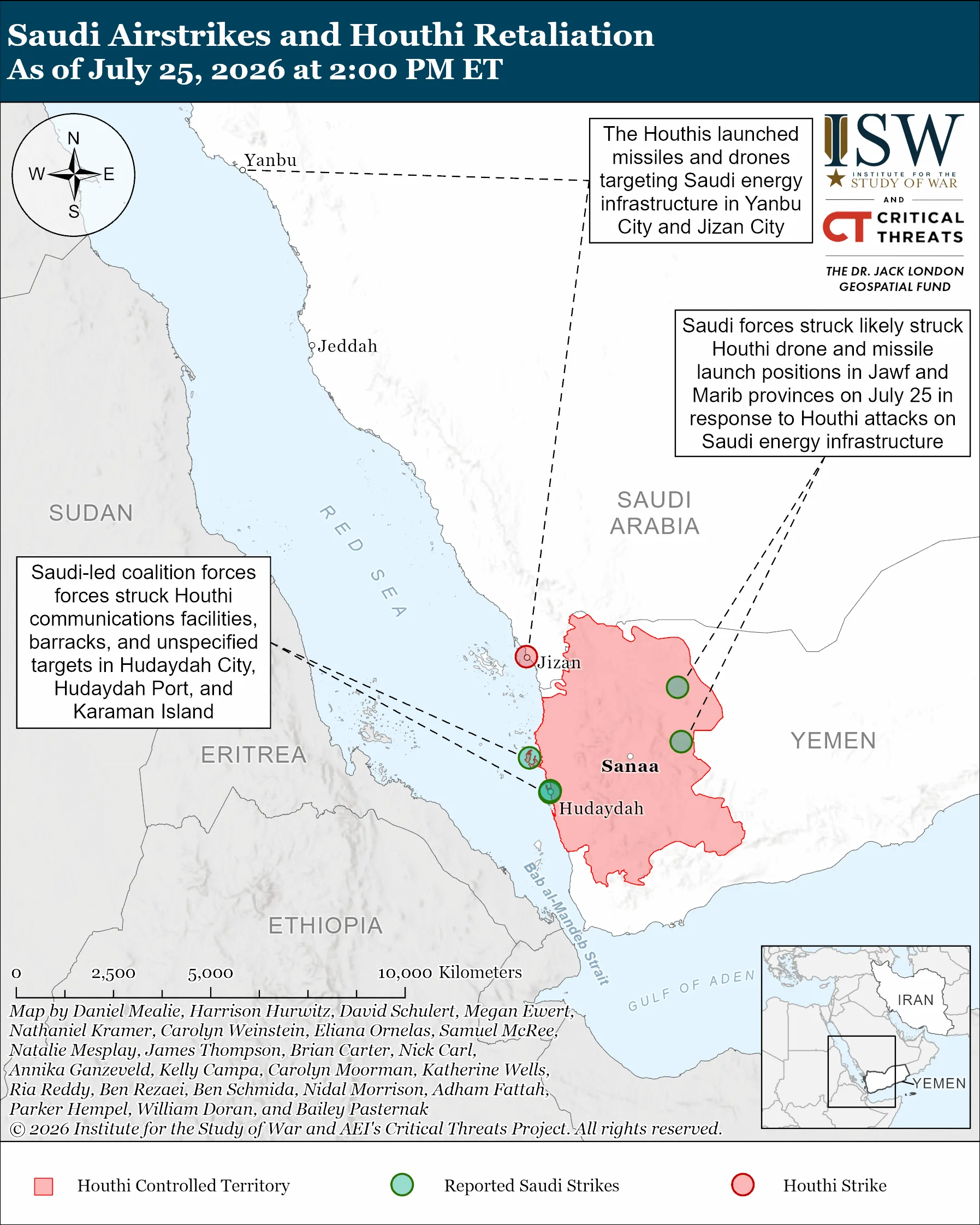
The United States did not conduct a wave of overnight strikes in Iran for the first time in 13 days. An Iranian health ministry spokesperson confirmed that the United States had not conducted any attacks in Iran since July 24.[17] US President Donald Trump met with senior advisers at the White House on July 24 to discuss US options for operations in Iran, including reportedly the possibility of expanding US military operations.[18] Trump reportedly ordered the US military to hold strikes on Iran several hours after an Omani delegation arrived in Tehran to discuss efforts to re-open the Strait of Hormuz with the Iranians.[19] Trump told reporters that the United States “is talking” with the Iranians.[20]
The United States has conducted nightly waves of strikes in Iran since July 12 targeting Iranian military command centers, drone storage facilities, communications networks, coastal surveillance sites, maritime capabilities, and military logistics infrastructure.[21] US military officials said that US forces have struck over 1,000 targets.[22] The United States struck 13,000 targets in 38 days during the previous phase of the war.[23]
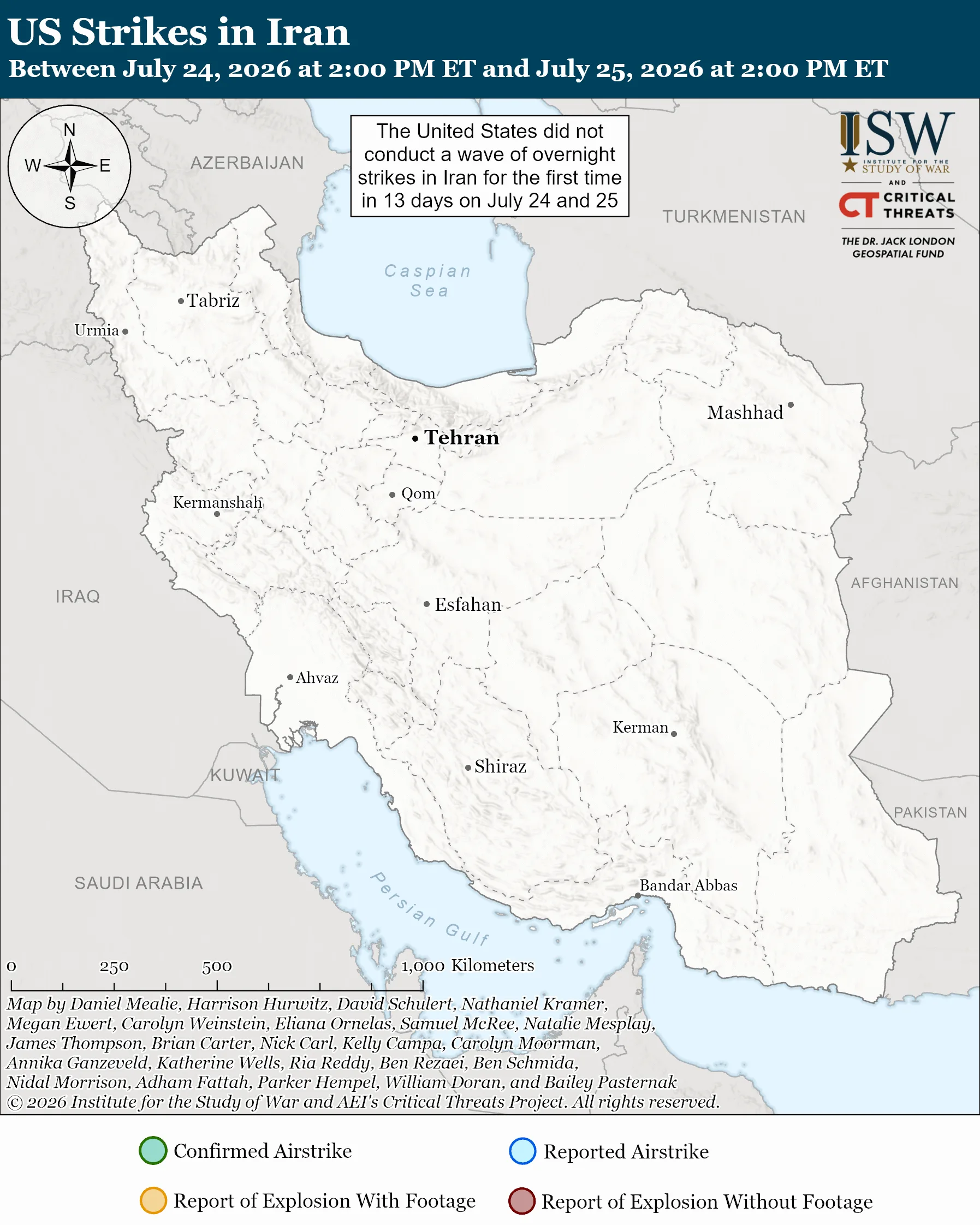
Iran has only conducted one attack targeting a US base in Bahrain since CTP-ISW’s last data cut-off on July 24, which suggests that Iran is calibrating attacks on US positions in response to US activity.[24] A likely Iranian attack triggered alarms in Bahrain on July 24.[25] Iran has conducted daily attacks on states hosting US bases—particularly Bahrain, Kuwait, and Jordan—since the US resumed daily strikes on Iran on July 12.[26] The sharp reduction in Iranian attacks on US bases overnight between July 24 and 25 may reflect the absence of US strikes in Iran during the same period. Iran is using its attacks on US bases to inflict a steady number of US casualties at US regional bases in order to impose US domestic pressure that would force the US government to halt its airstrike campaign on Iran.[27] Iran also aims to raise the cost for US regional allies of hosting US forces and pressure US allies to urge the United States to end its strike campaign on terms favorable to Tehran.
A “credible” Iranian-linked threat prompted US President Donald Trump to switch to a more secure plane for his return flight from the NATO summit in Ankara on July 8.[28] Multiple people briefed on the matter told the New York Times on July 24 that US officials determined that “Iranian proxy forces” posed a “credible threat” to Trump and Air Force One.[29] Sources briefed on the matter said that the threat that prompted Trump to change planes was ”separate” from a recent Iranian threat attributed to Israeli intelligence.[30] Israel recently shared intelligence with the United States that Israel said indicated that an Iranian plan to kill Trump, according to the Wall Street Journal on July 9.[31]
US forces disabled a vessel that violated the US blockade in the Gulf of Oman on July 24.[32] A CENTCOM spokesperson said that US forces fired into the engine room of the Lavine after the crew did not comply with US warnings after at least four previous attempts to run the blockade.[33]The Lavine was attempting to transport Iranian liquefied petroleum gas, according to Iranian media.[34] Iranian media reported that the attack killed two sailors.[35] CENTCOM acknowledged the reports of casualties.[36] The Lavine is the second ship that US forces have disabled since the United States re-imposed the blockade on July 14.[37]
Iran has fired advanced variants of the Kheybar Shekan medium-range ballistic missiles (MRBM) at regional US bases during the current conflict that have evaded US defenses, according to US officials speaking to the Wall Street Journal.[38] The US officials stated that Iran has launched Kheybar Shekan missiles along different flight paths and at varying speeds and maneuvers in attempts to circumvent US air defenses.[39] One US official stated that some of these missiles have successfully evaded US defenses. Unspecified analysts and officials told the Wall Street Journal that some Kheybar Shekan variants have a detachable warhead-bearing nosecone that can adjust its trajectory during the terminal phase at speeds of up to 6,000 miles per hour.[40] A military analyst added that Iran can rapidly fuel and load these missiles onto mobile launchers, which allows Iran to reduce its vulnerability to strikes targeting fixed Iranian launch sites. The United States and Israel estimated that Iran possessed approximately 2,500 Kheybar Shekan MRBMs before the US-Iran war began in February 2026. A missile expert told the Wall Street Journal that Iran may be currently assembling more Kheybar Shekan missiles using components stored in underground facilities.[41] The expert added that previous US-Israeli strikes have destroyed Iranian facilities used to assemble the missile's engine, however.
Nuclear expert David Albright assessed on July 24 that the degraded state of Iran's nuclear program following the June 2025 Israel-Iran war will continue to pose significant barriers to Iran's development of a post-fission nuclear weapon.[42] The New York Times reported on July 24 that US intelligence agencies assess that Iranian Supreme Leader Mojtaba Khamenei has more interest in developing a nuclear weapon than former Supreme Leader Ali Khamenei, according to officials briefed on the assessments.[43] The officials said that this assessment relies primarily upon Mojtaba’s public statements and intercepted communications before US and Israeli strikes in Iran in February and April 2026. US officials told the New York Times that Mojtaba supports the development of a thermonuclear warhead that Iran could miniaturize for deployment on a long-range ballistic missile.[44] Albright suggested that Mojtaba is unlikely to pursue developing thermonuclear weapons at this time, given the current status of Iran's targeted nuclear weaponization-related sites.[45] US and Israeli airstrikes in 2026 targeted Iranian nuclear weaponization sites, following June 2025 strikes that disabled Iran's uranium enrichment infrastructure and buried at least a majority of Iran's highly enriched uranium stockpile.[46] Albright stated that the June 2025 war significantly reduced Iran's capacity to produce a nuclear weapon while increasing both the likelihood of detection and the risk of technological failure.[47]
https://understandingwar.org/research/middle-east/iran-update-special-report-july-25-2026/
2,300
posted on
07/25/2026 11:02:00 PM PDT
by
AdmSmith
(GCTGATATGTCTATGATTACTCAT)
Navigation: use the links below to view more comments.
first previous 1-20 ... 2,261-2,280, 2,281-2,300, 2,301-2,320 ... 2,401-2,404 next last
Disclaimer:
Opinions posted on Free Republic are those of the individual
posters and do not necessarily represent the opinion of Free Republic or its
management. All materials posted herein are protected by copyright law and the
exemption for fair use of copyrighted works.
FreeRepublic.com is powered by software copyright 2000-2008 John Robinson