Iran Update Special Report, July 21, 2026
The Houthis likely decided to impose their blockade on Saudi Arabia to advance their own interests, though Iran probably encouraged them to impose the blockade for Tehran’s own purposes. The Houthis have repeatedly warned Saudi-owned ships against transiting the Red Sea via radio on July 20 and July 21.[1] The Houthis also emailed shipping companies on July 20 and warned them against loading or discharging cargo in Saudi ports on the Red Sea.[2] These threats and warnings have resulted in at least two vessels turning around in the Red Sea to avoid crossing the Bab al Mandeb and a third turning around rather than continuing its transit to a Saudi port.[3] The Houthis have not yet attacked shipping, however. These efforts will almost certainly increase the cost of shipping goods through the Red Sea while also imposing high economic costs on Saudi Arabia specifically. The increase in costs globally and the economic impact on Saudi Arabia specifically supports both Iranian and Houthi objectives. The Houthis seek to discourage Saudi action against them, while the Iranians seek to extend the maritime shipping crisis and increase oil prices caused by Tehran’s efforts to close the Strait of Hormuz.
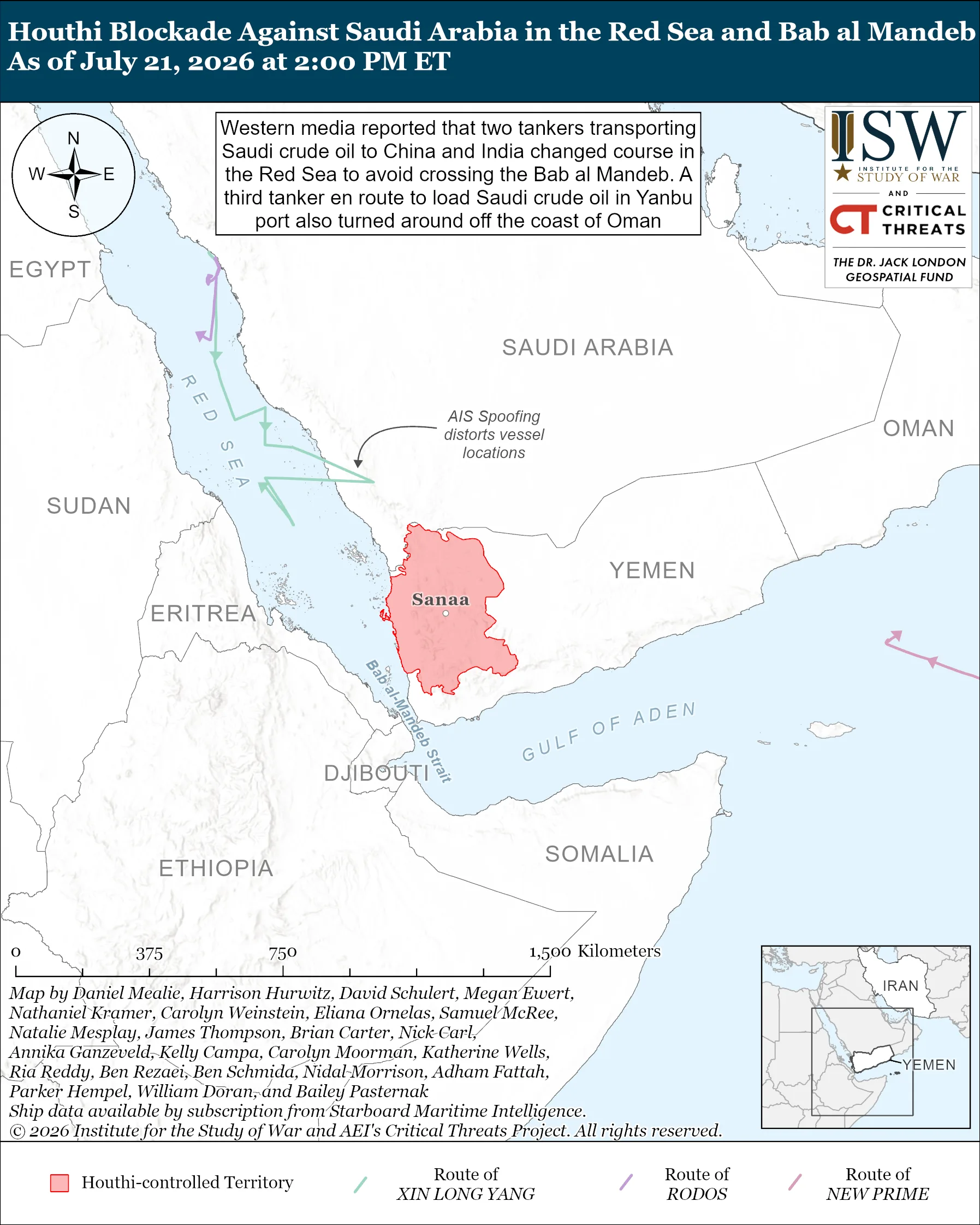
The Houthis only threatened shipping in the Red Sea once it benefited Houthi objectives. The Houthis did not adhere to earlier Iranian calls in July to close the Bab al Mandeb Strait during the recent conflict and only decided to impose a blockade on Saudi Arabia on July 20 following Saudi strikes on Sanaa International Airport on July 13.[4] This suggests the Houthis expanded the shipping crisis only when doing so served their interests, such as deterring future Saudi strikes on Houthi targets in Yemen.[5] Iranian and Houthi interests align in this case, but the Houthis are not enforcing the blockade for Iran. Their actions benefit Iran while directly serving Houthi objectives against Saudi Arabia. The Houthis’ enforcement of the blockade, regardless of how it affects Houthi objectives in Yemen, supports Iranian efforts to degrade US willingness to continue the war and force the United States to accept Iran's demand to retain control over the Strait of Hormuz.[6] Disruption in both the Strait of Hormuz and the Bab al Mandeb increases pressure on the United States and global markets more than disruption in either waterway alone.[7] This pressure could help Iran force the United States to accept Iranian control over the Strait of Hormuz, assuming Iran is able to secure Saudi assurances that Riyadh will not strike Houthi assets and end the Houthi blockade on Saudi Arabia.
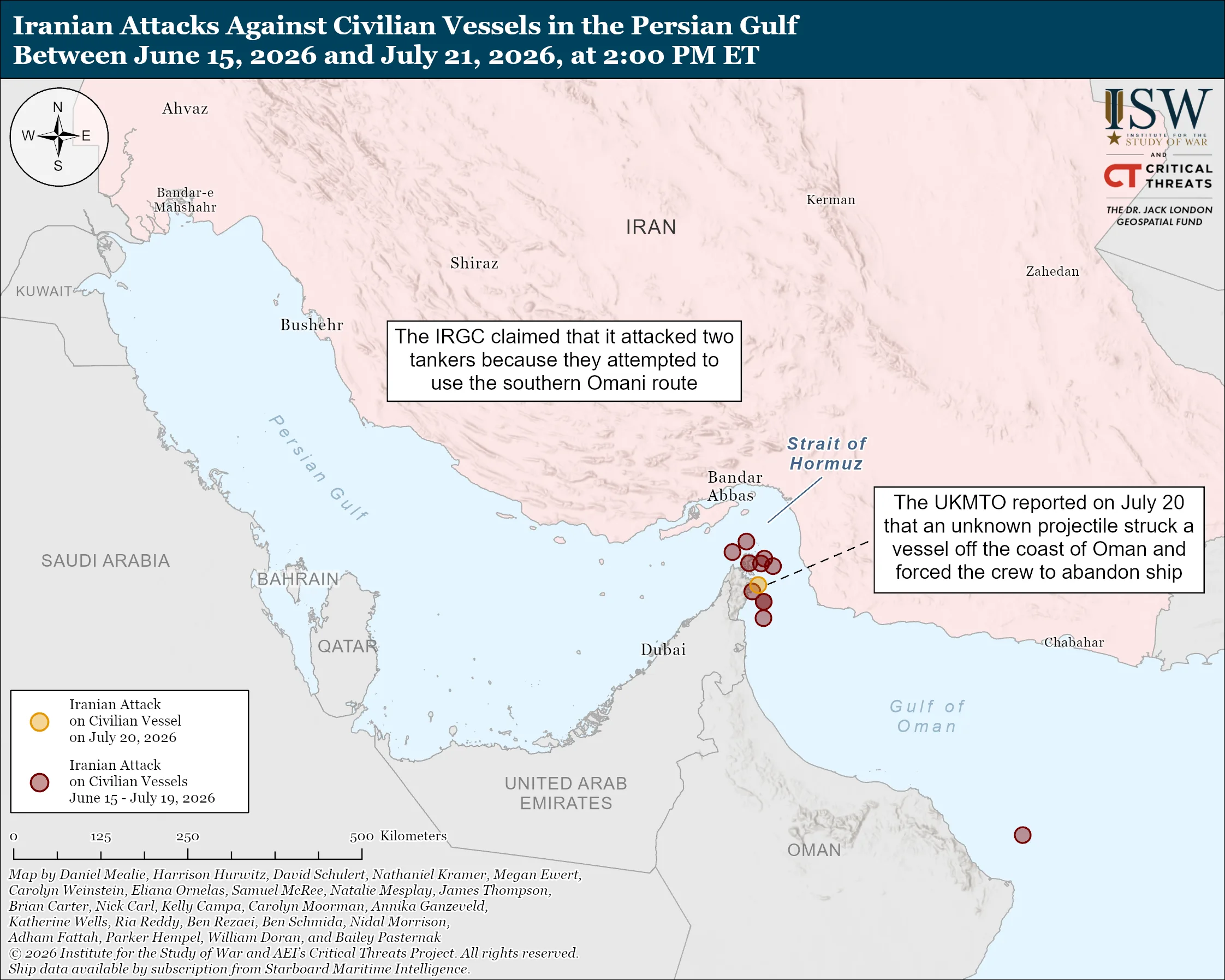
Iran continues to use force to impose its control over the Strait of Hormuz and compel vessels to follow Iranian transit restrictions. Iran rejects any alternative to its designated traffic separation scheme, particularly the southern Omani route, because it allows vessels to bypass Iranian authorization and directly undermines Iran's claim to control maritime traffic through the strait.[8] Iran sees this control as its primary means of imposing costs on the United States and compelling Washington to accept Iranian demands. Supreme National Security Council (SNSC) Deputy Secretary for International Affairs Ali Bagheri Kani described the strait on July 21 as Iran's “decisive leverage,” and argued that Iran must translate its military strength into political gains.[9] Iran has repeatedly threatened and attacked vessels using the southern route to enforce this objective.[10] The United Kingdom Maritime Trade Organization (UKMTO) reported on July 20 that unknown projectiles struck two vessels near Oman and the United Arab Emirates, which damaged one vessel's steering gear and forced the crew of the second vessel to abandon ship.[11] Kuwait identified the second vessel as the Kuwaiti tanker Kaifan and reported that the likely Iranian attack injured several crew members.[12] The Islamic Revolutionary Guards Corps (IRGC) separately claimed on July 20 that it attacked two tankers on July 20 because they attempted to use the southern Omani route.[13]
Iran is repeatedly attacking US bases and personnel across the region in order to erode US willingness to challenge Iranian control over the Strait of Hormuz. Iran likely calculates that sustained attacks and rising US casualties will generate domestic pressure on the United States to end the conflict, force the United States to surrender, and accept Iranian control over the strait. The Wall Street Journal reported on July 20 that Iran conducted three ballistic missile strikes against Muwaffaq al Salti Air Base in Jordan on July 17 and 18.[14] The first two Iranian missiles reportedly struck a gym and an empty aircraft hangar, while the third struck housing units and killed two US service members.[15] These strikes demonstrate that Iran can still penetrate US air defenses and inflict casualties despite repeated US strikes on Iranian drone and missile launch sites, storage facilities, and command and control centers. Satellite imagery also shows that Iran attacked King Faisal Air Base and another Jordanian airfield, where Iranian strikes reportedly damaged several US Army UH-60 Blackhawk helicopters.[16] Iran continued to claim attacks on US bases and military assets in Bahrain, Iraq, Jordan, Kuwait, and Qatar on July 20 and 21.[17]
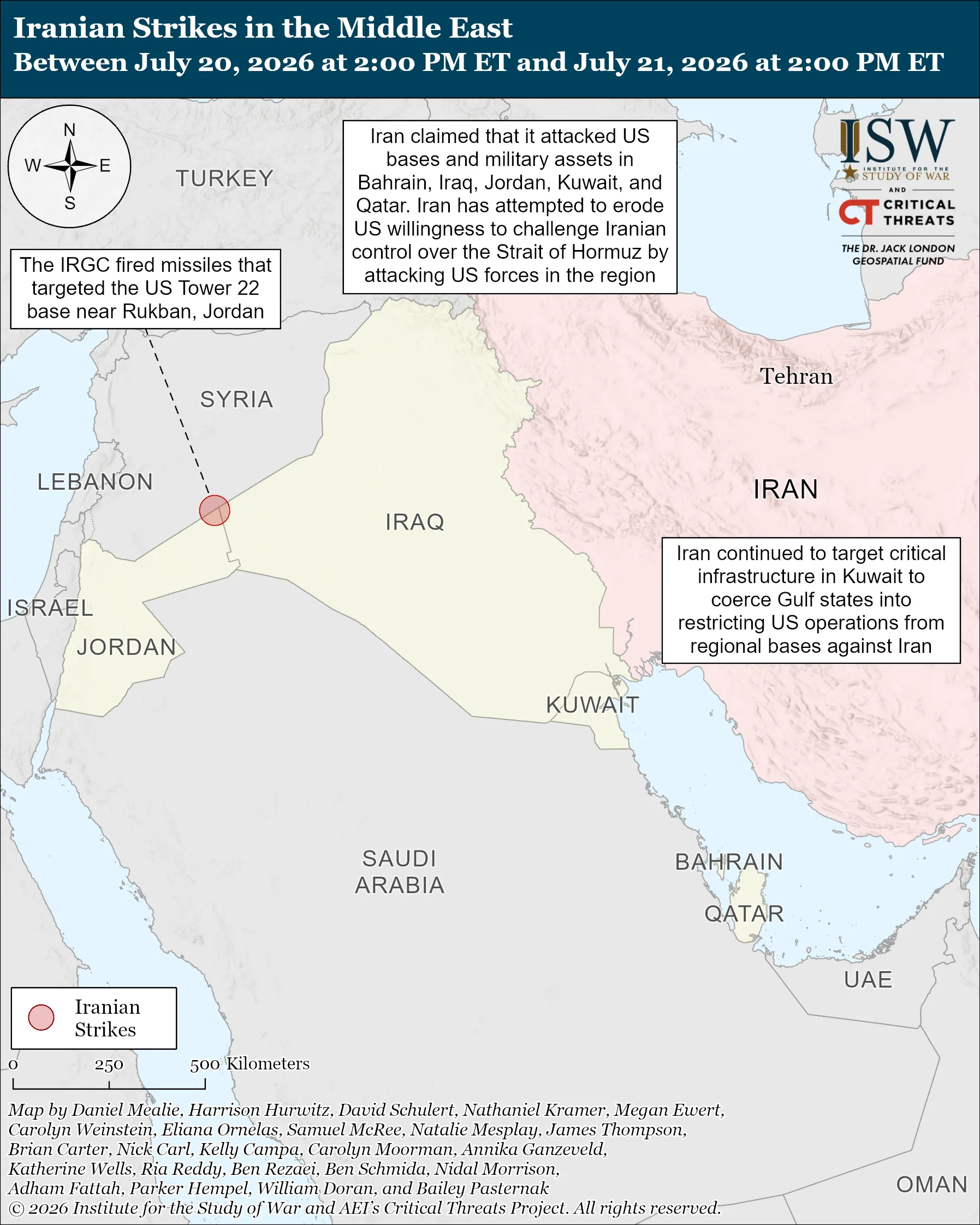
Iran is broadening the costs of the war beyond military facilities by targeting infrastructure that supports essential civilian services. Iran likely calculates that sustained disruptions to electricity and water supplies will increase domestic pressure on Kuwait to restrict US operations from Kuwaiti territory. The Kuwaiti government stated on July 21 that Iran attacked several power-generation and water-desalination facilities for the fourth consecutive day on July 20, which disabled several generators.[18] Islamic Development Organization-affiliated Mehr News Agency separately reported on July 21 that an Iranian drone strike targeted the al Zour power plant in southeastern Kuwait.[19] Iran is likely trying to demonstrate to Kuwait and other Gulf states that they will bear direct civilian and economic costs for hosting US forces and supporting US operations against Iran. Iran likely also conducted these attacks to portray the United States as an unreliable security guarantor and drive a wedge between the United States and its Gulf partners. Iranian Supreme Leader Mojtaba Khamenei stated on March 12 that Iran would strike bases used to attack Iran but avoid attacking host countries and urged neighboring states to close US bases.[20] Iran's attacks on Kuwaiti civilian infrastructure expand beyond this distinction, however.
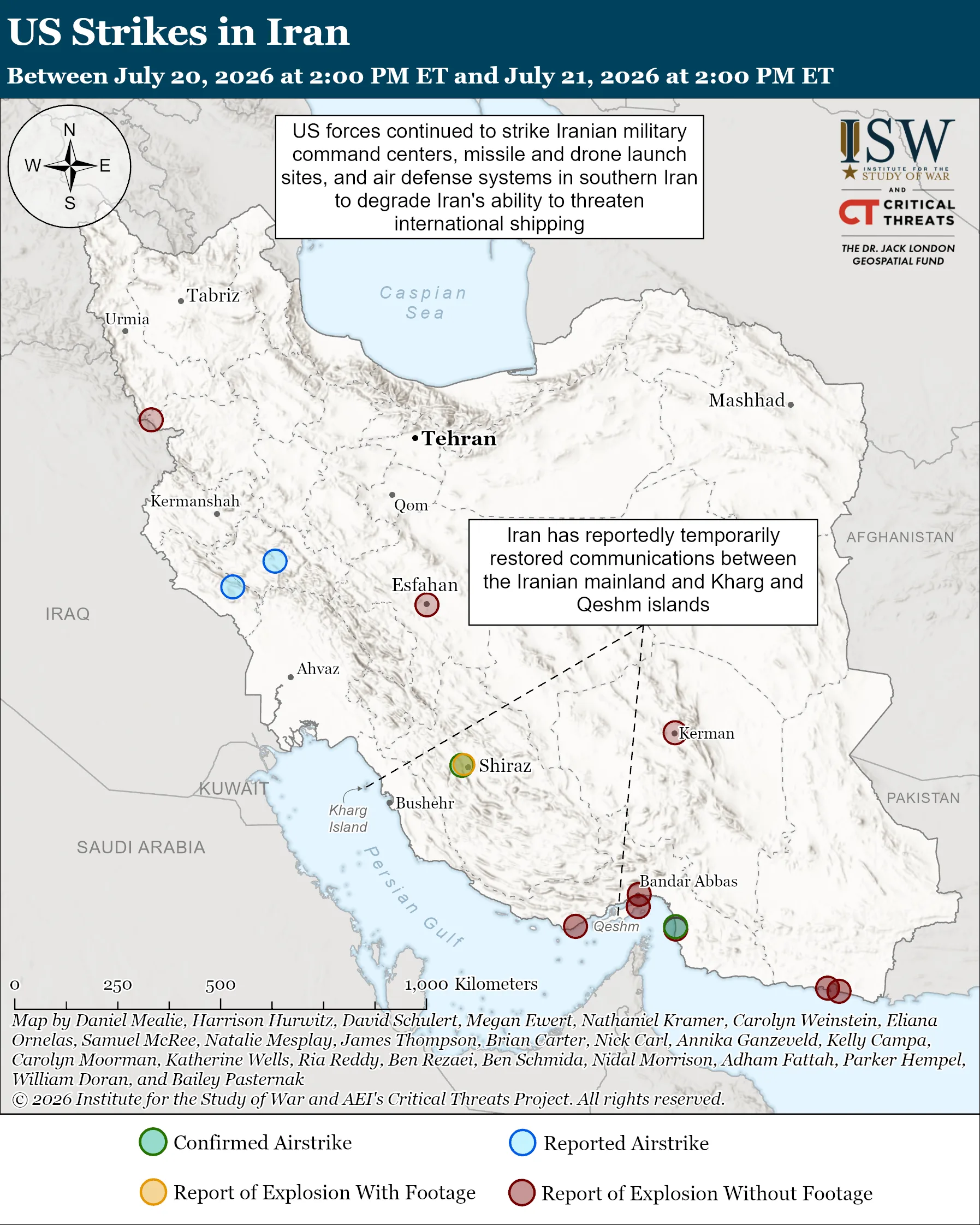
Iran has reportedly temporarily restored communications between the mainland and Kharg and Qeshm islands after US strikes disrupted key communications and supply networks along the southern coast of Iran. Iranian Communications and Information Technology Minister Sattar Hashemi told Iranian media on July 21 that US strikes have repeatedly disrupted communications between mainland Iran and the islands, including Kharg and Qeshm.[21] Iran has reportedly replaced damaged fiber-optic links with radio and satellite communications, but Hashemi emphasized that these measures are only temporary and that Iran must restore fiber-optic networks to reestablish reliable communications.[22] The reported repairs follow recent US strikes along Iran's southern coast that sought to disrupt communications and sever supply networks linking key locations in southern Iran to the mainland to degrade Iran's ability to coordinate operations to threaten international shipping.[23] Iran's illegal traffic separation scheme runs along Qeshm Island.[24]
Iran reportedly moved critical nuclear infrastructure and material to the Mount Kolang Gaz site in Esfahan Province after the June 2025 Israel-Iran War. Unspecified US and Israeli officials, citing Israeli intelligence, told the Wall Street Journal July 21 that Iran moved “thousands” of uranium-enrichment centrifuges to Mount Kolang after the war.[25] An Israeli source told CNN on July 21 that Iran also moved part of its highly enriched uranium (HEU) stockpile to the site.[26] US and Israeli strikes during the June 2025 war damaged or destroyed thousands of centrifuges at Iran's principal underground enrichment facilities, including Fordow, Natanz, and the Esfahan Nuclear Technology Center.[27] The Institute for Science and International Security assessed following the June 2025 war that the Israeli campaign rendered most, if not all, of Iran's operational centrifuges inoperable and effectively destroyed Iran's enrichment capacity.[28] The strikes also buried at least a majority of Iran's HEU stockpile, according to International Atomic Energy Agency Director Rafael Grossi.[29] Commercially available satellite imagery suggests that Iran has not accessed the damaged underground facilities since the June 2025 war to recover buried centrifuges or HEU.[30] Iran may nevertheless retain additional centrifuges or portions of its HEU stockpile at undisclosed facilities that the US-Israeli strikes did not target. Commercially available satellite imagery indicates that Iran has conducted activity at the Mount Kolang site since the war, including efforts to harden the facility against future strikes.[31]
The Lebanese Armed Forces (LAF) deployed to Zawtar el Gharbiyeh in Nabatieh District on July 21 after the Israel Defense Forces (IDF) withdrew from the town.[32] This marks the first Israeli withdrawal in southern Lebanon in accordance with the June 26 Trilateral Framework Agreement.[33] The IDF reported on July 21 that its forces fired into the air to repel Lebanese forces who “breached” the IDF’s security zone in Zawtar el Charqiyeh, a town immediately east of Zawtar el Gharbiyeh.[34] The IDF added that Zawtar el Charqiyeh is not part of the “pilot zones” plan and that the IDF did not permit Lebanese forces to enter the town.[35] The LAF told Lebanese media on July 21 that its forces did not enter Zawtar el Charqiyeh and stated that this engagement “will hinder the implementation” of the “pilot zones.”[36] Lebanese media also reported on July 21 that vehicles in a Red Cross convoy struck an Israeli mine in Zawtar el Charqiyeh, which injured two paramedics.[37] The IDF established operational control over Zawtar el Charqiyeh in May 2026 to use the village as a bridgehead for ground operations north of the Litani River.[38]
Israeli and Lebanese efforts to implement the “pilot zones” coincided with US President Donald Trump's meeting with Lebanese President Joseph Aoun in Washington, DC, on July 21.[39] Trump pledged political and military support to help the Lebanese government disarm Hezbollah.[40] An unspecified US official told Axios on July 21 that the LAF will be responsible for disarming Hezbollah in the first “pilot zones.”[41] The official's statement is consistent with the June 26 Trilateral Framework Agreement, which stipulates that the LAF will be responsible for disarming Hezbollah in the “pilot zones.”[42] Aoun and other LAF officials recently said that the Lebanese government is reluctant to use force to disarm Hezbollah due to the risk of civil war and fractures within the LAF, however.[43]
Hezbollah Political Council Deputy Chairman Mahmoud Qamati threatened on July 21 that Hezbollah may shut down Rafic Hariri International Airport in Beirut in response to Lebanese government restrictions on Iranian influence in Lebanon.[44] Qamati warned during an interview with Hezbollah media that “no more planes will land in Beirut” and demanded that the government repeal its February 2025 ban on Iranian aircraft in Lebanese airspace and its visa requirements for visiting Iranian civilians, which it instituted in March 2026.[45] Qamati said that Hezbollah will employ strictly “peaceful means” to compel the government to reverse its restrictions on Iranian travel to Lebanon.[46] It is unclear how Hezbollah would shut down Hariri International Airport or what Qamati meant by “peaceful” means, however. Unspecified Lebanese Foreign Ministry officials told Saudi media on July 21 that Hezbollah's threats will not compel the government to reverse its decisions regarding Iran.[47] The Lebanese Foreign Ministry expelled the newly appointed Iranian Ambassador to Lebanon on March 24 because of Iran's support for Hezbollah.[48]
The Iraqi National Intelligence Service arrested three unidentified individuals who operated a first-person view (FPV) drone factory in Baghdad on July 21.[49] Iraqi authorities seized 25 drone frames, carbon fiber panels, and assembly and production equipment.[50] The factory is likely located in an area of eastern Baghdad in which Iranian-backed Iraqi militia Kataib Hezbollah maintains a presence, according to footage from July 21 that ISW-CTP geolocated.[51] Iranian-backed Iraqi militias, likely including Kataib Hezbollah, conducted multiple FPV drone attacks on US targets in Iraq during the war, as well as targets in the Gulf, in March and April.[52] The drones the Iraqi authorities seized, according to Iraqi media, appear to be made locally and differ from the types of drones that the IRGC has attempted to transfer to Lebanese Hezbollah. Syrian Interior Ministry forces thwarted an IRGC attempt to smuggle advanced weapons, including FPV and fiber-optic drones, from Iraq through Syria to Hezbollah on July 7.[53]
Multiple Iranian-backed Iraqi militias within the Islamic Resistance of Iraq, which is a coalition of Iranian-backed Iraqi militias, reiterated their refusal to disarm until after a complete US withdrawal from Iraq.[54] Unidentified sources told Iraqi media on July 21 that 10 militias within the Islamic Resistance of Iraq informally told the Iraqi federal government that they would retain their weapons until this withdrawal occurs.[55] The sources said that the militias do not believe the United States will withdraw from Iraq by the end of September, as planned by the Iraqi government.[56] Kataib Hezbollah, Kataib Sayyid al Shuhada, Harakat Hezbollah al Nujaba, and Harakat Allah al Awfiya are known to comprise the militia coalition, but the identity of the other six militias the sources are referring to is unknown.[57] The six other militias could include smaller Iraqi militias, front groups affiliated with the Islamic Resistance in Iraq, or members of the Islamic Resistance Coordination Committee.
Multiple Iraqi militias have repeatedly rejected disarmament in recent months and will likely continue to use the US presence in Iraq to justify their existence amid the Iraqi federal government's disarmament initiative.[58] The United States has increasingly pressured the Iraqi federal government to disarm the militias due to militia activity in March and April.[59] The militias’ opposition to US presence in Iraq is integral to their identity as “resistance” organizations, hence their recent efforts to cast doubt on US plans to leave Iraq in September. The militias have also used a variety of justifications for their existence, such as sectarian violence in coastal Syria in 2025, and thus they are likely to use new justifications once the United States withdraws. [60] Iraqi media reported on July 20 that Iraqi Prime Minister Ali al Zaydi will ask the Iranian government to pressure the militias to surrender Iranian-provided missiles to the Iraqi federal government during his upcoming visit to Tehran on July 23.[61]
The Iraqi Security Forces reported on July 21 that an explosive-laden drone crashed near the US al Harir Air Base in Iraqi Kurdistan.[62] It is not clear at the time of this writing which actor conducted the attack or if the base was the intended target. Iranian-backed Iraqi militias conducted numerous attacks targeting US positions in Iraqi Kurdistan, such as al Harir Air Base, in March and April.[63] US air defenses at the US Consulate in Erbil also reportedly intercepted at least three drones on March 21.[64] The consulate's air defenses have intercepted multiple drone swarms in recent days.[65] No actor has yet claimed these attacks.
https://understandingwar.org/research/middle-east/iran-update-special-report-july-21-2026/
Iran Update Special Report, July 22, 2026
ISW-CTP is tracking initial reports that the Houthis attacked two Saudi oil tankers in the Red Sea on July 22. Sources close to the Houthis previously stated that the Houthis had finished deploying missiles and drones near the Bab al Mandeb Strait to attack civilian shipping, according to the Joint Maritime Information Center on July 21.[1] ISW-CTP will provide further analysis about the Houthi blockade against Saudi Arabia in its July 23 Iran Update.
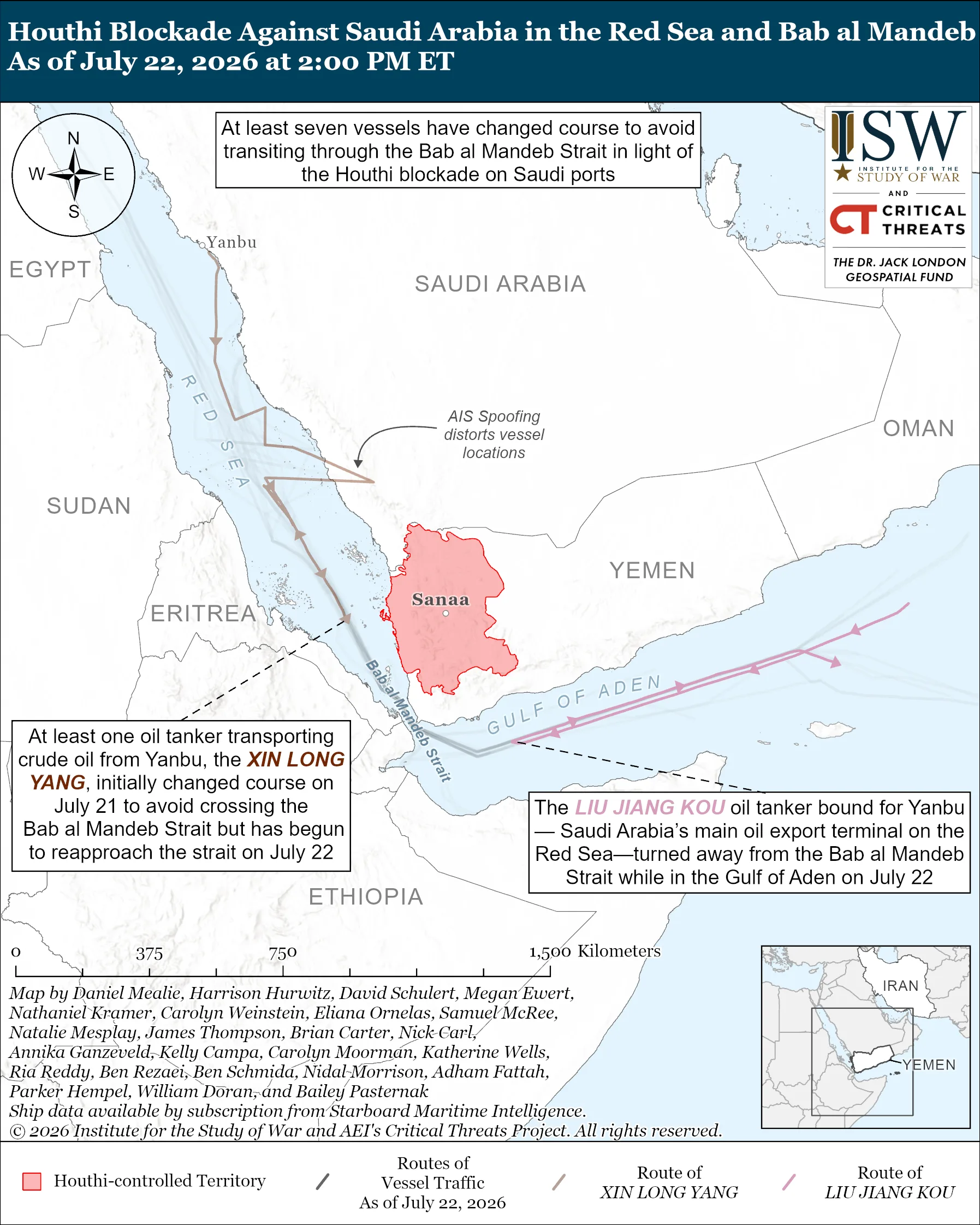
At least seven vessels have changed course to avoid transiting through the Bab al Mandeb Strait in light of the Houthi blockade on Saudi ports. The Houthis imposed the blockade against Saudi Arabia on July 20.[2] Six commercial vessels altered their course away from Saudi ports on July 22, according to ship-tracking data cited by Reuters.[3] Another oil tanker that was bound for Yanbu — Saudi Arabia's main oil export terminal on the Red Sea — turned away from the Bab al Mandeb Strait while in the Gulf of Aden on July 22.[4] The European Union Naval Force warned commercial vessels with links to the United States, Israel, and Saudi Arabia on July 22 against sailing in the Red Sea and Gulf of Aden.[5] Commercial ship traffic through the Bab al Mandeb Strait continued on July 22 despite the Houthis’ threats against commercial vessels, however. Commercially available ship tracking data from July 22 shows that 30 commercial vessels have transited through the Bab al Mandab Strait since ISW-CTP’s last data cutoff on July 21.[6] This is a notable decrease from the 64 commercial vessels that transited the strait between 2:00 PM ET on July 20 and 2:00 PM ET on July 21, however.[7] At least one oil tanker transporting crude oil from Yanbu, the Xin Long Yang, initially changed course on July 21 to avoid crossing the Bab al Mandeb Strait but has begun to reapproach the strait on July 22.[8] Houthi officials have emphasized that the Houthis will maintain their blockade on Saudi ports until Saudi Arabia lifts its blockade on Yemeni ports and airports.[9]
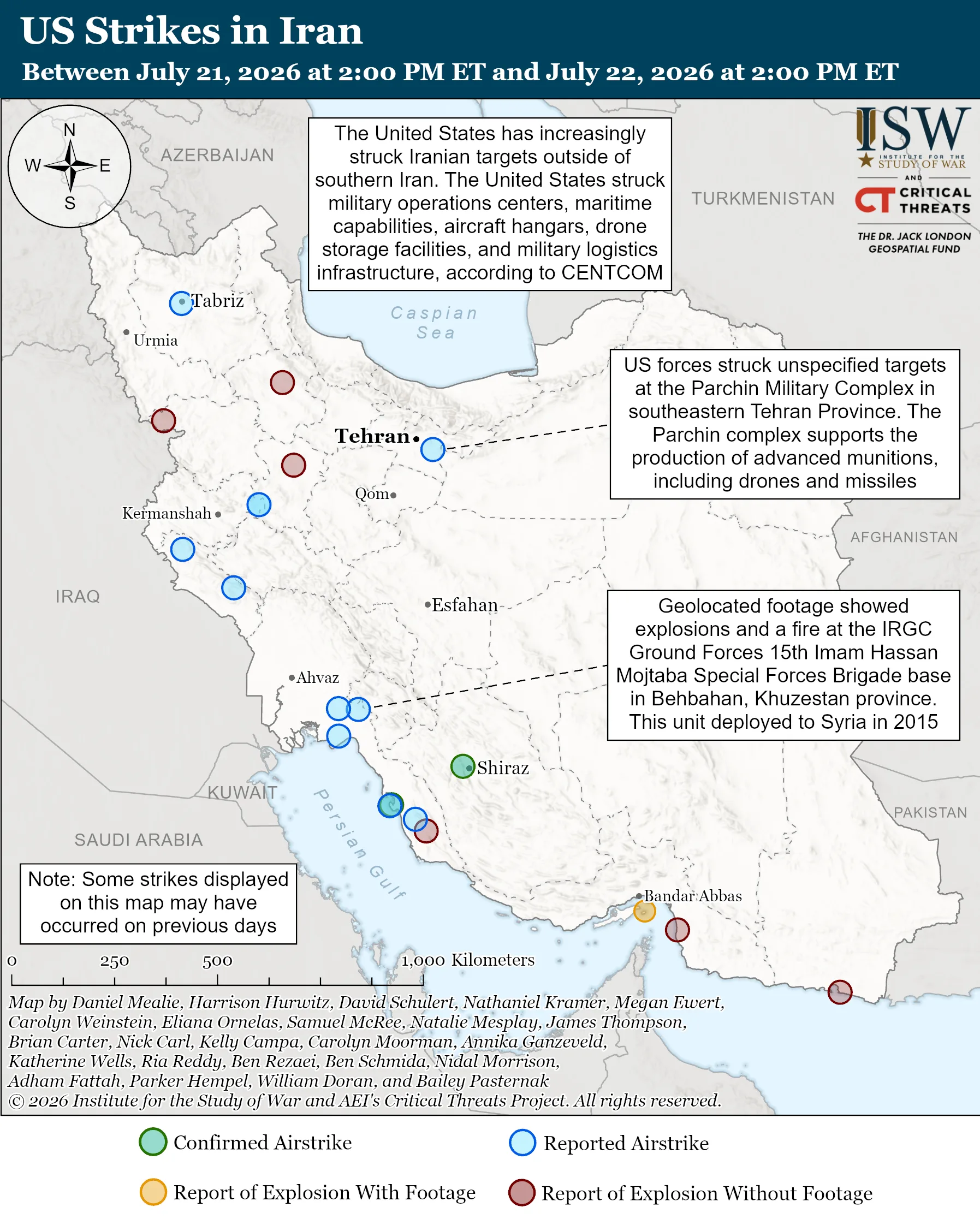
US forces struck Iranian military targets across western, northwestern, central, and southern Iran on July 21 and 22. US Central Command (CENTCOM) stated on July 21 that it struck Iranian military operations centers, maritime capabilities, aircraft hangars, drone storage facilities, and military logistics infrastructure in its 11th consecutive evening of strikes against Iran.[10] Geolocated CENTCOM footage showed that US forces struck military installations at Bushehr Airport on July 21.[11] US forces also struck Larak Island, Hormozgan Province, on July 22.[12] The previous Iranian traffic separation scheme, which Iran introduced in April 2026, passed through Qeshm and Larak islands.[13] Iranian authorities confirmed that strikes targeted two locations near Chabahar and Konarak, Sistan and Baluchistan Province, on July 21.[14] Iranian regime media also confirmed explosions near Sirik, Hormozgan Province, and Dashti, Bushehr Province, and missile attacks near Omidiyeh, Behbahan, Bandar Mahshahr, and Hendijan in Khuzestan Province.[15]
The United States struck an Islamic Revolutionary Guards Corps (IRGC) Ground Forces base in Behbahan, Khuzestan Province. Geolocated footage showed a major fire and explosions at the IRGC Ground Forces Bekhradian Barracks in Behbahan, which hosts the IRGC Ground Forces 15th Imam Hassan Mojtaba Special Forces Brigade.[16] This unit deployed to Syria in 2015 and incurred casualties fighting for the Assad regime.[17] This unit was also likely involved in suppressing protests in Izeh, Khuzestan Province, during the 2022 Mahsa Amini protests.[18]
The United States has increasingly struck Iranian targets outside of southern Iran, including western and northwestern Iran. Iranian regime media reported US strikes in Baneh, Kurdistan Province, Kabudarahang, Hamedan Province, Kangavar, Kermanshah Province, and Chivar and Abdanan, Ilam Province, on July 21 and 22.[19] It is not clear what the United States struck in western and northwestern Iran. The US-Israeli combined force struck Iranian air defenses and air bases, missile bases and launchers, and internal security targets in these regions in March and April 2026.[20]
The United States also struck unspecified targets in the Parchin Military Complex in southeastern Tehran Province.[21] Iran's Defense Industries Organization, which is a subsidiary of Iran's Ministry of Defense and Armed Forces Logistics (MODAFL), controls the Parchin complex and uses the complex to produce advanced munitions, including drones and missiles.[22] Multiple reports indicate that Iranian activities at Parchin are also potentially relevant to nuclear weapons development.[23] Western media and the Institute for Science and International Security reported on July 10 that Iran is constructing a concrete roof over the Taleghan 2 facility at the Parchin Military Complex to protect it from future strikes.[24] The Iranian regime previously used the Taleghan 2 facility to test explosives that are needed to detonate a nuclear device before the regime suspended its nuclear weapons program in 2003.[25]
Hezbollah is likely alleging that Lebanese Shia are being discriminated against at the Beirut airport as part of an effort to remobilize support for the group and protect Hezbollah's military organization. An anti-Hezbollah, French-language Lebanese media outlet reported on July 21 that Hezbollah- and Hezbollah ally Amal-affiliated social media accounts have alleged in a weeks-long internet campaign that Rafic Hariri International Airport's head of security, General Fadi Kfoury, is discriminating against Lebanese Shia.[26] The accounts alleged that airport security prohibited Shia airport engineers with reported ties to Amal from accessing certain areas in the airport, such as the airport's radar facilities.[27] Hezbollah Spokesperson Youssef Zein told Lebanese media on July 21 that Hezbollah “is not involved” in the internet campaign against Kfoury, however.[28]
Hezbollah's rhetoric is likely intended to remobilize support for the group among its Shia base in order to protect Hezbollah's military organization. Hezbollah's efforts to fuel sectarian-based discontent among Shia over the Beirut airport are likely intended to capitalize on existing sectarian-based tensions that have been exacerbated by the current Israel-Hezbollah conflict. The Wall Street Journal reported that Maronite Christian, Sunni, and Druze communities are not allowing internally displaced Shias to enter their towns for fear that doing so will invite Israel Defense Forces (IDF) airstrikes on their communities, for example.[29] Hundreds of mostly internally displaced Shias reportedly live in Beirut tent encampments because non-Shia landlords refuse to rent them apartments.[30] Hezbollah leaders and parliamentarians have accused the Lebanese government of neglecting its Shia population since the war began, which is a narrative that allows Hezbollah to reassert itself as the primary defender of Lebanese Shia.[31] Reinforcing Hezbollah's popular support amongst its Shia base is one way through which Hezbollah can protect its military organization, which is under threat of disarmament by the Lebanese government.
Hezbollah Political Council Deputy Chairman Mahmoud Qamati threatened on July 21 that Hezbollah may shut down the airport in response to Lebanese government restrictions on Iranian influence in Lebanon.[32] Rafic Hariri International Airport is Lebanon's only commercial airport and is surrounded by the Dahiyeh suburbs, which are Hezbollah's strongholds in southern Beirut.[33] Hezbollah previously blocked access to the airport in May 2008 to pressure the Lebanese government to reverse its decision to remove the airport's Hezbollah-affiliated security head and disable Hezbollah-controlled telecommunications infrastructure.[34] Hezbollah threats to close the airport could also upset ongoing US-Lebanese diplomatic initiatives. US President Donald Trump encouraged US airlines to begin offering direct flights to Lebanon following his meeting with Lebanese President Joseph Aoun on July 21.[35]
Assessed Iranian War Aims:
Secure international recognition of Iranian control over the Strait of Hormuz
Degrade the US ability and willingness to continue the war
Restore deterrence vis-à -vis the United States and its regional partners
Divide the United States and Israel from the Arab states
Iran fired at US military installations in the region as part of its ongoing efforts to degrade US capabilities and willingness to continue the war, end the war in a way that maintains Iranian control over the Strait of Hormuz, and break the coalition between the United States and regional Arab states. Islamic Revolutionary Guards Corps (IRGC) media claimed on July 21 that the IRGC struck “tactical radar” systems at the Ali al Salem Base and on Bubiyan Island in Kuwait.[36] This attack appears to be the first Iranian attack on Bubiyan Island since July 11. Six IRGC officers previously attempted to infiltrate Bubiyan Island on May 1 via a chartered fishing boat to carry out unspecified “hostile acts” against Kuwait.[37] An open-source intelligence account on X reported on July 22 that Iran also struck an AN/FPS-117 long-range air search radar system at the Ahmed al Jaber Air Base in Kuwait.[38] The AN/FPS-117 is a fixed, ground-based, long-range air surveillance radar with a detection range of up to 470 kilometers and designed for early warning and tracking of aircraft and ballistic missiles.[39] Iran likely aimed to degrade US forces’ capability to detect Iranian ballistic missiles.
Iran attacked Saudi Arabia for the second time since April 2026. Iranian regime media and an open-source intelligence account on X reported on July 22 that Iranian forces targeted the King Abdulaziz Air Base in Dhahran, Saudi Arabia, for the first time.[40] An early-warning siren went off in Dammam.[41] This attack marks the second Iranian attack on Saudi Arabia since July 11 and comes amid the Houthis’ blockade against Saudi Arabia.[42] Iran launched a single ballistic missile at a US air base near Riyadh on July 18.[43]
Iranian forces continued to target US military bases across Jordan, likely to reduce Jordan's willingness to support the US campaign against Iran. Regime media stated on July 21 that Iranian forces targeted US military assets at King Faisal Air Base in al Jafr and Prince Hussein Air Base in Mafraq.[44] The IRGC claimed that its missile and drone strikes targeted an F-15 preparation hangar, a drone preparation hangar, a helicopter storage hangar, and US personnel housing.[45] An Israeli military correspondent also reported on July 22 that Iranian forces struck an unspecified target in Aqaba, Jordan.[46] Aqaba is a regional trading and energy hub that Iran may be targeting in order to impose similar economic costs on Jordan as it has sought to impose on Gulf states to reduce their willingness to support the US campaign.[47] The Kuwaiti government stated on July 21 that Iran disabled generators at several power generation and water desalination facilities in Kuwait, for example.[48]
Iran is expanding trade with Pakistan, likely to mitigate the effects of the US naval blockade. Iranian Interior Minister Eskandar Momeni announced on July 22 that Iran and Pakistan agreed to expand bilateral trade and cross-border commerce. Momeni said that the agreement would increase bilateral trade from three billion US dollars to at least 10 billion US dollars and increase daily truck traffic across the Iran-Pakistan border to five times its current level.[49] The US naval blockade is limiting Iran's ability to export goods by sea, and Iranian efforts to increase land-based trade with its neighbors likely represent an effort to mitigate the effects of the blockade.[50] Iran has undertaken a broader effort to expand regional trade corridors since the United States first imposed the blockade on April 13. The New York Times reported on May 9 that Iran was using ports on the Caspian Sea to trade crucial goods and military equipment with Russia, for example.[51] The United States struck a railway in Golestan Province in northeastern Iran on July 9 that Iranian media stated was used to transport goods from Russia and the People's Republic of China.[52]
The Lebanese judiciary is reportedly considering implementing legal mechanisms that would permit the Lebanese Armed Forces (LAF) to search private property and confiscate Hezbollah weapons in the “pilot zones.” The LAF only conducted limited private property searches at the IDF’s request during previous efforts to disarm Hezbollah after the November 2024 ceasefire.[53] The Lebanese government recently agreed to the June 26 Trilateral Framework Agreement, which stipulates that the LAF will disarm and dismantle local armed groups in the “pilot zones.”[54] An unspecified judicial source told Saudi media on July 22 that the judiciary is considering three mechanisms.[55] One mechanism would reportedly grant the LAF “open” access to search private property in the “pilot zones.”[56] The second mechanism would reportedly require the LAF to apply for search warrants before searching individual properties, while the third mechanism would reportedly offer search warrants for entire villages or towns.[57] An unspecified senior judicial source told Lebanese media on July 22 that the judiciary has not granted the LAF permission to search private properties in the “pilot zones” at this time.[58] It is unclear when or if the Lebanese government will implement these measures. Lebanese President Joseph Aoun and other LAF officials have recently said that the Lebanese government is reluctant to use force to disarm Hezbollah due to the risk of civil war and fractures within the LAF.[59] Any Hezbollah disarmament plan that restricts the LAF from searching private property would likely fail because Hezbollah frequently conceals materiel in civilian homes.[60]
US Secretary of State Marco Rubio dismissed the possibility of Syrian military intervention against Hezbollah in Lebanon on July 22.[61] Rubio told reporters that the US State Department has encouraged the Syrian government to focus on internal challenges in Syria, including state building and countering the Islamic State in Iraq and Syria (ISIS), rather than planning and executing operations in Lebanon.[62] President Trump has repeatedly suggested to both Syrian and Lebanese leadership that Syria's military could intervene in Lebanon to degrade Hezbollah.[63] Lebanese President Joseph Aoun and Trump reportedly discussed the “proposal” for Syria to conduct a limited military intervention around the Syria-Lebanon border to degrade Hezbollah during their meeting in Washington, DC on July 21. Aoun reportedly rejected this proposal because Syrian intervention would be politically counter-productive and strengthen political support for Hezbollah.[64] Syrian officials, including Syrian President Ahmed al Shara, also rejected Trump's request for Syrian military intervention in Lebanon in June 2026.[65] Syrian intervention in Lebanon against Hezbollah would violate an agreement that Syria and Lebanon signed on July 3 that explicitly commits both nations to respecting each other's sovereignty, territorial integrity, and non-interference in internal affairs.[66]
Iraqi Prime Minister Ali al Zaydi appointed a new Counter Terrorism Service (CTS) chief and Federal Police commander on July 22.[67] Iraqi state-run media reported on July 22 that Zaydi appointed former Iraqi Military Intelligence Director Lieutenant General Zayd Hoshi al Moussawi as the CTS chief.[68] Moussawi served as military intelligence director from 2022 until his dismissal for unspecified reasons in 2024.[69] Zaydi also named Deputy Federal Police Commander Mohammad Qasem al Fahd as the Federal Police commander on July 22.[70] Former Iraqi Prime Minister Mohammad Shia al Sudani appointed Fahd as deputy Federal Police commander in July 2025 shortly after the Wasit Provincial Council dismissed Fahd from his position as the Wasit Province police chief. The council dismissed Fahd for “poor management” three days after a major fire in a supermarket in the provincial capital killed over 70 people.[71]
https://understandingwar.org/research/middle-east/iran-update-special-report-july-22-2026/