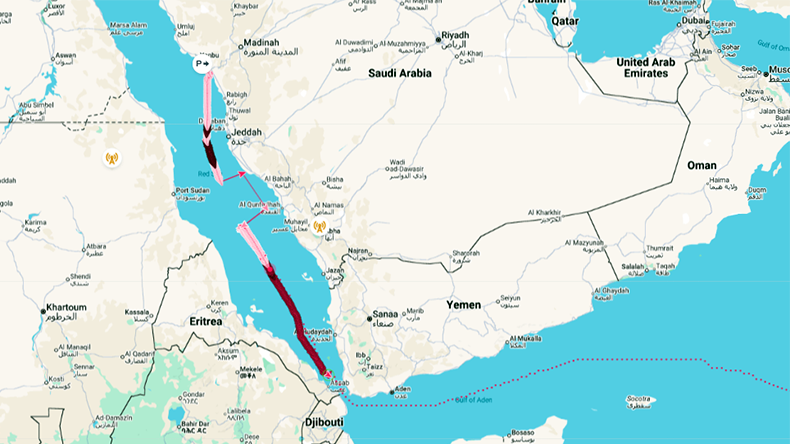
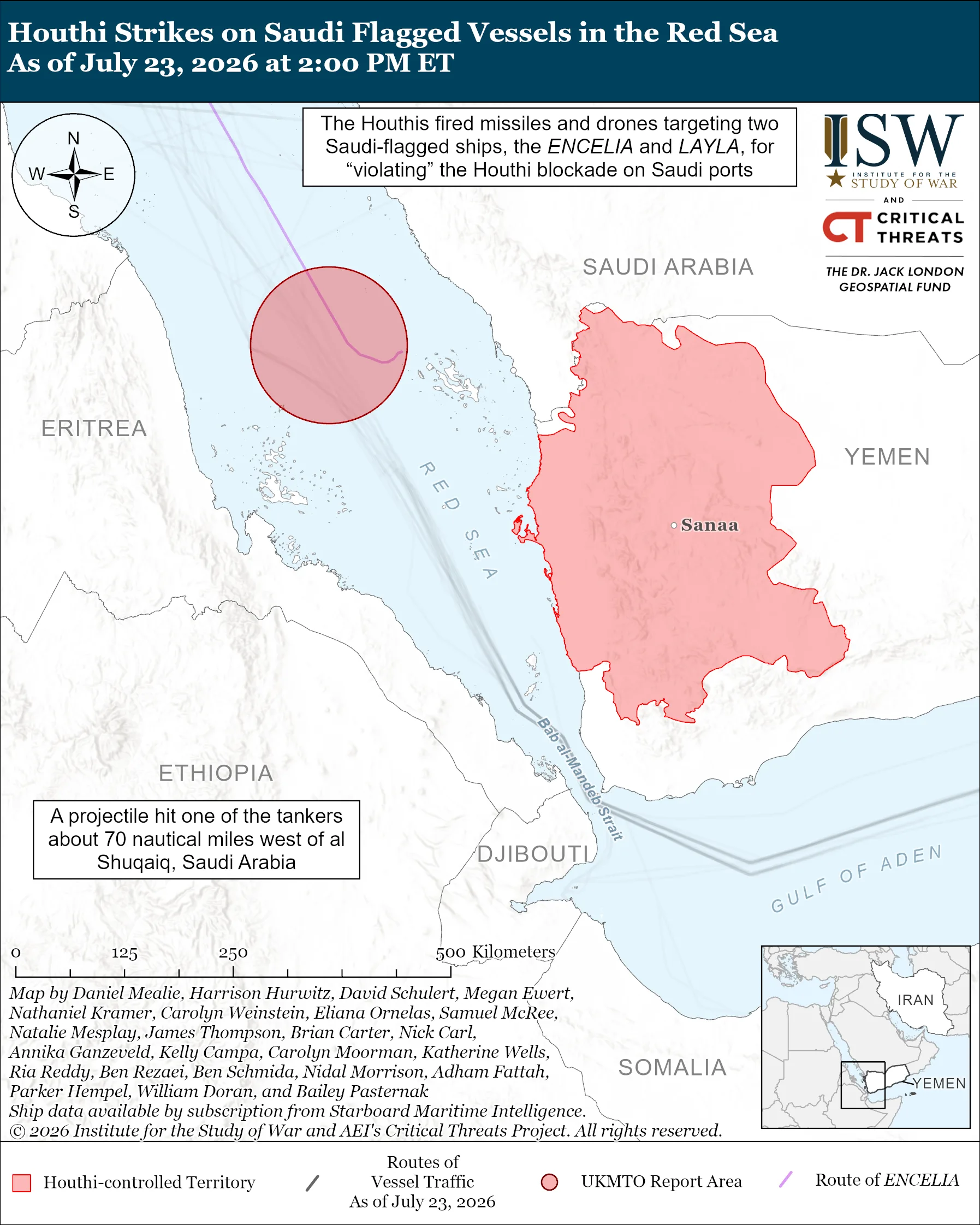
ISW-CTP is tracking initial reports that the Houthis attacked two Saudi oil tankers in the Red Sea on July 22. Sources close to the Houthis previously stated that the Houthis had finished deploying missiles and drones near the Bab al Mandeb Strait to attack civilian shipping, according to the Joint Maritime Information Center on July 21.[1] ISW-CTP will provide further analysis about the Houthi blockade against Saudi Arabia in its July 23 Iran Update.
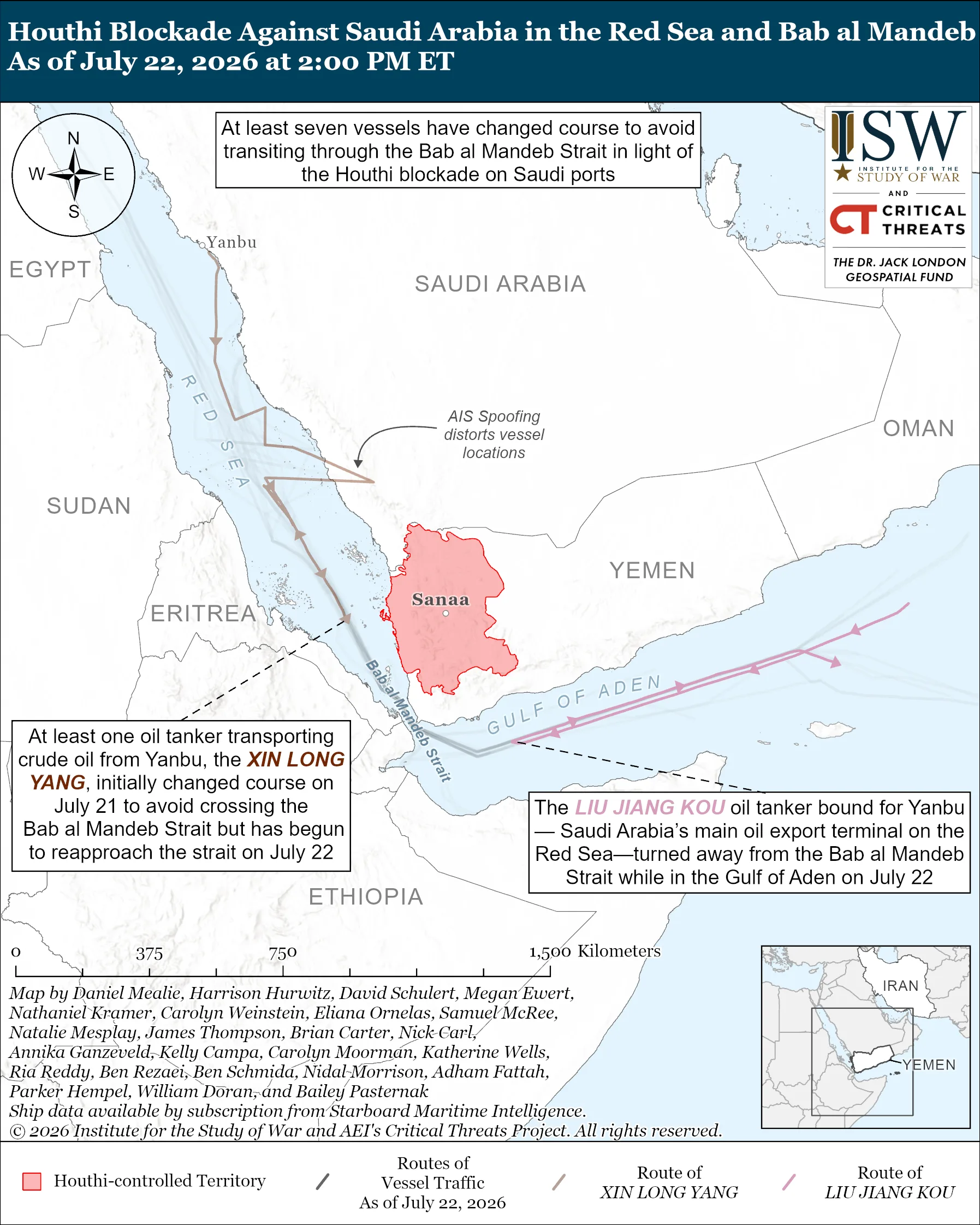
At least seven vessels have changed course to avoid transiting through the Bab al Mandeb Strait in light of the Houthi blockade on Saudi ports. The Houthis imposed the blockade against Saudi Arabia on July 20.[2] Six commercial vessels altered their course away from Saudi ports on July 22, according to ship-tracking data cited by Reuters.[3] Another oil tanker that was bound for Yanbu — Saudi Arabia's main oil export terminal on the Red Sea — turned away from the Bab al Mandeb Strait while in the Gulf of Aden on July 22.[4] The European Union Naval Force warned commercial vessels with links to the United States, Israel, and Saudi Arabia on July 22 against sailing in the Red Sea and Gulf of Aden.[5] Commercial ship traffic through the Bab al Mandeb Strait continued on July 22 despite the Houthis’ threats against commercial vessels, however. Commercially available ship tracking data from July 22 shows that 30 commercial vessels have transited through the Bab al Mandab Strait since ISW-CTP’s last data cutoff on July 21.[6] This is a notable decrease from the 64 commercial vessels that transited the strait between 2:00 PM ET on July 20 and 2:00 PM ET on July 21, however.[7] At least one oil tanker transporting crude oil from Yanbu, the Xin Long Yang, initially changed course on July 21 to avoid crossing the Bab al Mandeb Strait but has begun to reapproach the strait on July 22.[8] Houthi officials have emphasized that the Houthis will maintain their blockade on Saudi ports until Saudi Arabia lifts its blockade on Yemeni ports and airports.[9]
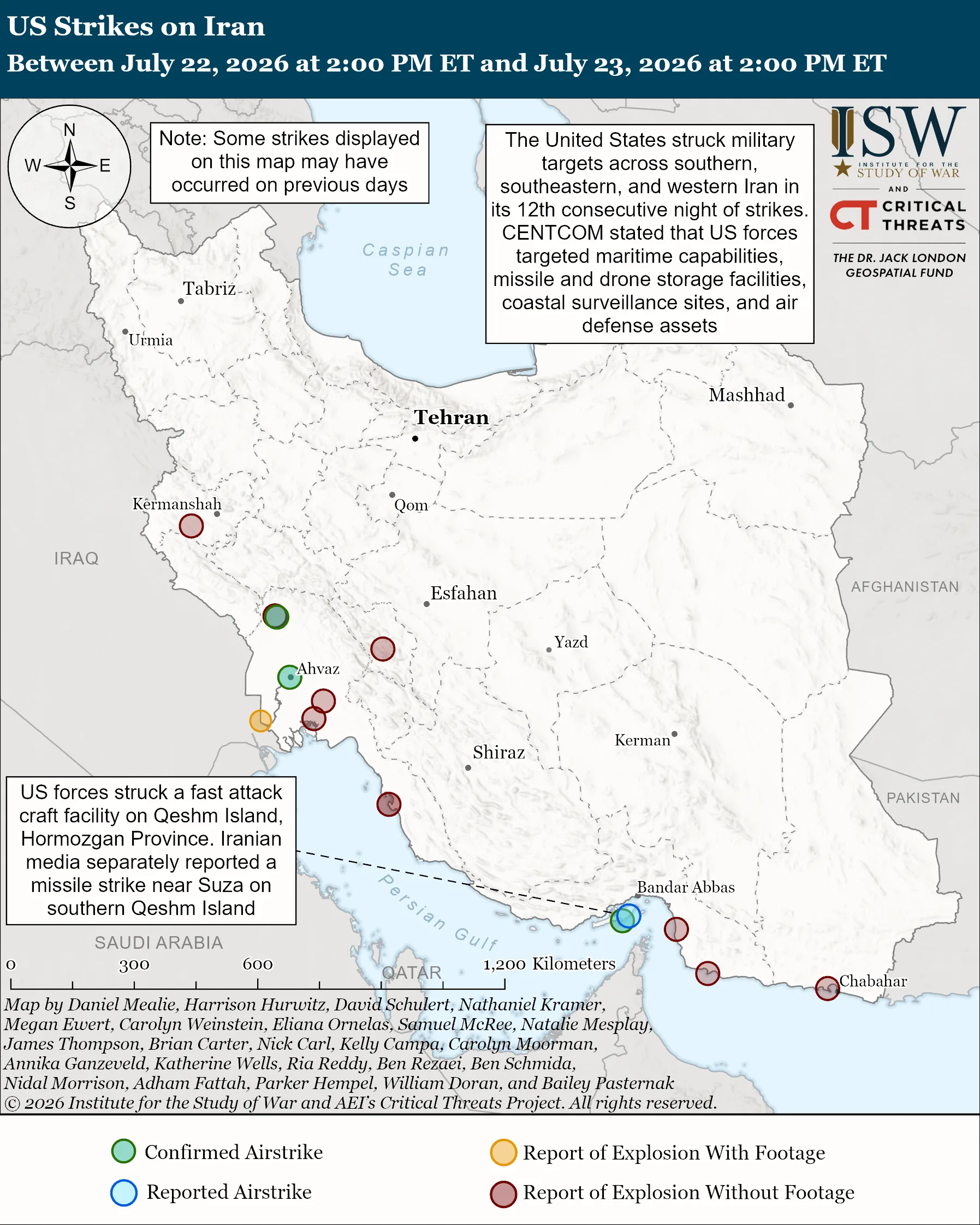
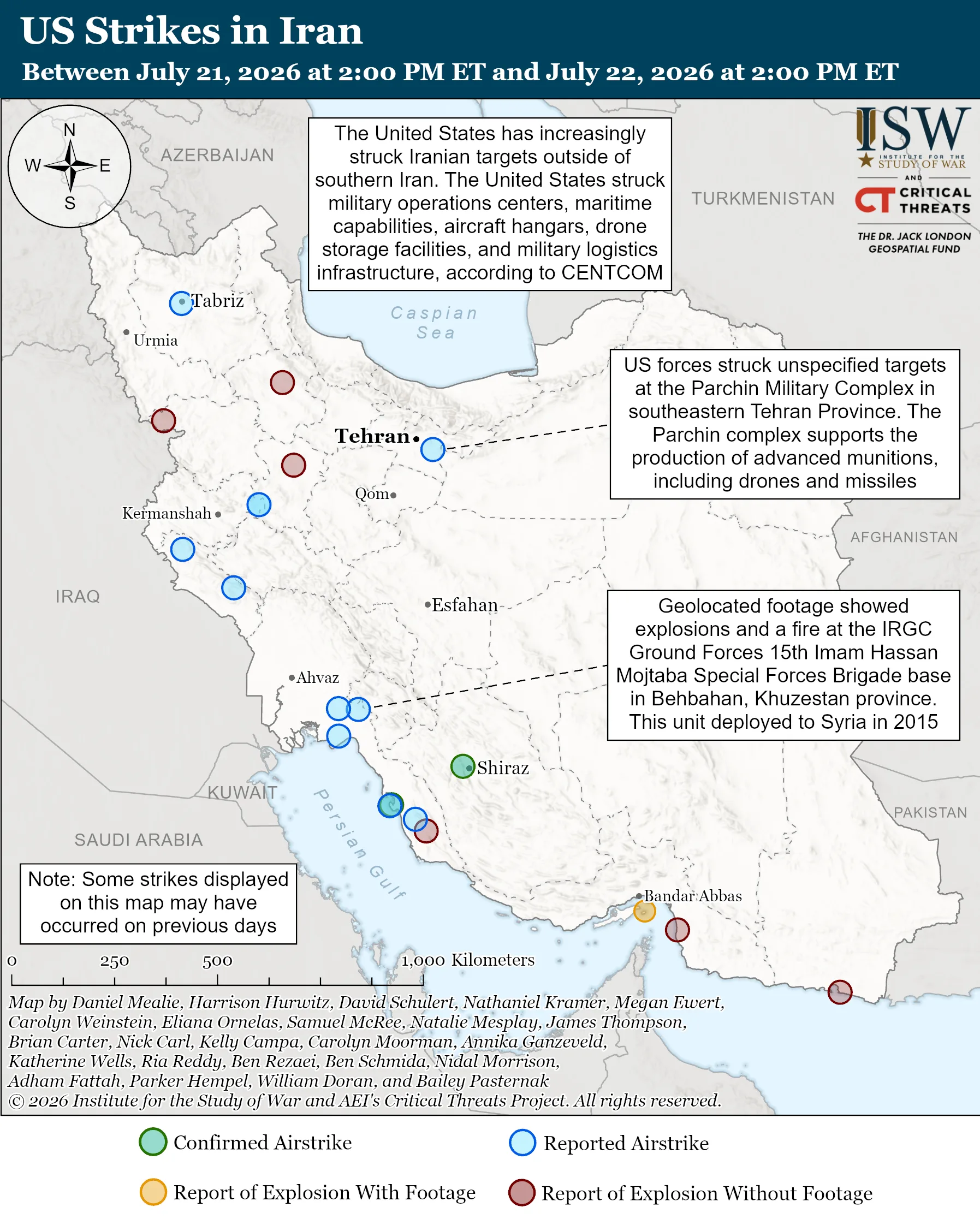
US forces struck Iranian military targets across western, northwestern, central, and southern Iran on July 21 and 22. US Central Command (CENTCOM) stated on July 21 that it struck Iranian military operations centers, maritime capabilities, aircraft hangars, drone storage facilities, and military logistics infrastructure in its 11th consecutive evening of strikes against Iran.[10] Geolocated CENTCOM footage showed that US forces struck military installations at Bushehr Airport on July 21.[11] US forces also struck Larak Island, Hormozgan Province, on July 22.[12] The previous Iranian traffic separation scheme, which Iran introduced in April 2026, passed through Qeshm and Larak islands.[13] Iranian authorities confirmed that strikes targeted two locations near Chabahar and Konarak, Sistan and Baluchistan Province, on July 21.[14] Iranian regime media also confirmed explosions near Sirik, Hormozgan Province, and Dashti, Bushehr Province, and missile attacks near Omidiyeh, Behbahan, Bandar Mahshahr, and Hendijan in Khuzestan Province.[15]
The United States struck an Islamic Revolutionary Guards Corps (IRGC) Ground Forces base in Behbahan, Khuzestan Province. Geolocated footage showed a major fire and explosions at the IRGC Ground Forces Bekhradian Barracks in Behbahan, which hosts the IRGC Ground Forces 15th Imam Hassan Mojtaba Special Forces Brigade.[16] This unit deployed to Syria in 2015 and incurred casualties fighting for the Assad regime.[17] This unit was also likely involved in suppressing protests in Izeh, Khuzestan Province, during the 2022 Mahsa Amini protests.[18]
The United States has increasingly struck Iranian targets outside of southern Iran, including western and northwestern Iran. Iranian regime media reported US strikes in Baneh, Kurdistan Province, Kabudarahang, Hamedan Province, Kangavar, Kermanshah Province, and Chivar and Abdanan, Ilam Province, on July 21 and 22.[19] It is not clear what the United States struck in western and northwestern Iran. The US-Israeli combined force struck Iranian air defenses and air bases, missile bases and launchers, and internal security targets in these regions in March and April 2026.[20]
The United States also struck unspecified targets in the Parchin Military Complex in southeastern Tehran Province.[21] Iran's Defense Industries Organization, which is a subsidiary of Iran's Ministry of Defense and Armed Forces Logistics (MODAFL), controls the Parchin complex and uses the complex to produce advanced munitions, including drones and missiles.[22] Multiple reports indicate that Iranian activities at Parchin are also potentially relevant to nuclear weapons development.[23] Western media and the Institute for Science and International Security reported on July 10 that Iran is constructing a concrete roof over the Taleghan 2 facility at the Parchin Military Complex to protect it from future strikes.[24] The Iranian regime previously used the Taleghan 2 facility to test explosives that are needed to detonate a nuclear device before the regime suspended its nuclear weapons program in 2003.[25]
Hezbollah is likely alleging that Lebanese Shia are being discriminated against at the Beirut airport as part of an effort to remobilize support for the group and protect Hezbollah's military organization. An anti-Hezbollah, French-language Lebanese media outlet reported on July 21 that Hezbollah- and Hezbollah ally Amal-affiliated social media accounts have alleged in a weeks-long internet campaign that Rafic Hariri International Airport's head of security, General Fadi Kfoury, is discriminating against Lebanese Shia.[26] The accounts alleged that airport security prohibited Shia airport engineers with reported ties to Amal from accessing certain areas in the airport, such as the airport's radar facilities.[27] Hezbollah Spokesperson Youssef Zein told Lebanese media on July 21 that Hezbollah “is not involved” in the internet campaign against Kfoury, however.[28]
Hezbollah's rhetoric is likely intended to remobilize support for the group among its Shia base in order to protect Hezbollah's military organization. Hezbollah's efforts to fuel sectarian-based discontent among Shia over the Beirut airport are likely intended to capitalize on existing sectarian-based tensions that have been exacerbated by the current Israel-Hezbollah conflict. The Wall Street Journal reported that Maronite Christian, Sunni, and Druze communities are not allowing internally displaced Shias to enter their towns for fear that doing so will invite Israel Defense Forces (IDF) airstrikes on their communities, for example.[29] Hundreds of mostly internally displaced Shias reportedly live in Beirut tent encampments because non-Shia landlords refuse to rent them apartments.[30] Hezbollah leaders and parliamentarians have accused the Lebanese government of neglecting its Shia population since the war began, which is a narrative that allows Hezbollah to reassert itself as the primary defender of Lebanese Shia.[31] Reinforcing Hezbollah's popular support amongst its Shia base is one way through which Hezbollah can protect its military organization, which is under threat of disarmament by the Lebanese government.
Hezbollah Political Council Deputy Chairman Mahmoud Qamati threatened on July 21 that Hezbollah may shut down the airport in response to Lebanese government restrictions on Iranian influence in Lebanon.[32] Rafic Hariri International Airport is Lebanon's only commercial airport and is surrounded by the Dahiyeh suburbs, which are Hezbollah's strongholds in southern Beirut.[33] Hezbollah previously blocked access to the airport in May 2008 to pressure the Lebanese government to reverse its decision to remove the airport's Hezbollah-affiliated security head and disable Hezbollah-controlled telecommunications infrastructure.[34] Hezbollah threats to close the airport could also upset ongoing US-Lebanese diplomatic initiatives. US President Donald Trump encouraged US airlines to begin offering direct flights to Lebanon following his meeting with Lebanese President Joseph Aoun on July 21.[35]
Assessed Iranian War Aims:
Secure international recognition of Iranian control over the Strait of Hormuz
Degrade the US ability and willingness to continue the war
Restore deterrence vis-à -vis the United States and its regional partners
Divide the United States and Israel from the Arab states
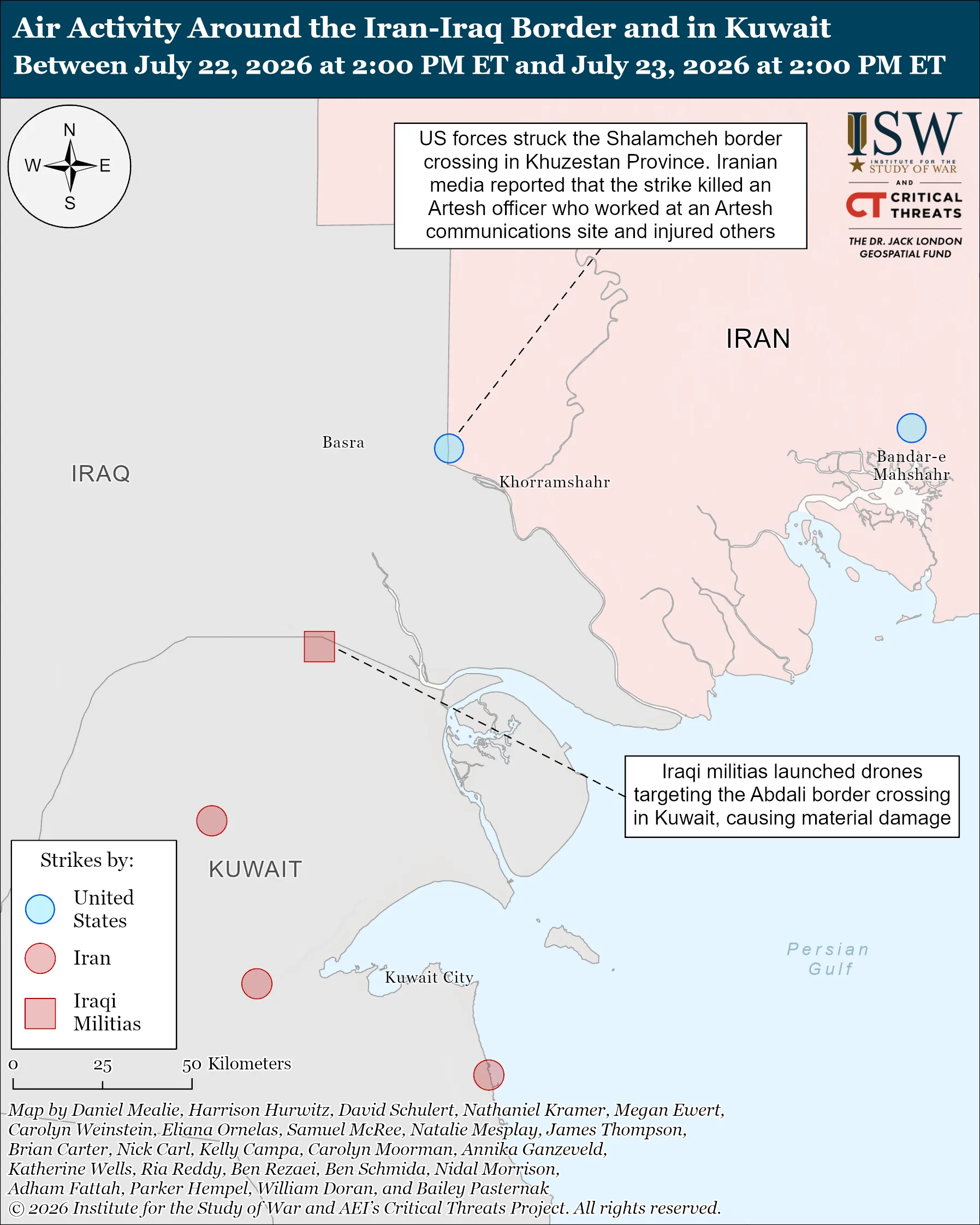
Iran fired at US military installations in the region as part of its ongoing efforts to degrade US capabilities and willingness to continue the war, end the war in a way that maintains Iranian control over the Strait of Hormuz, and break the coalition between the United States and regional Arab states. Islamic Revolutionary Guards Corps (IRGC) media claimed on July 21 that the IRGC struck “tactical radar” systems at the Ali al Salem Base and on Bubiyan Island in Kuwait.[36] This attack appears to be the first Iranian attack on Bubiyan Island since July 11. Six IRGC officers previously attempted to infiltrate Bubiyan Island on May 1 via a chartered fishing boat to carry out unspecified “hostile acts” against Kuwait.[37] An open-source intelligence account on X reported on July 22 that Iran also struck an AN/FPS-117 long-range air search radar system at the Ahmed al Jaber Air Base in Kuwait.[38] The AN/FPS-117 is a fixed, ground-based, long-range air surveillance radar with a detection range of up to 470 kilometers and designed for early warning and tracking of aircraft and ballistic missiles.[39] Iran likely aimed to degrade US forces’ capability to detect Iranian ballistic missiles.
Iran attacked Saudi Arabia for the second time since April 2026. Iranian regime media and an open-source intelligence account on X reported on July 22 that Iranian forces targeted the King Abdulaziz Air Base in Dhahran, Saudi Arabia, for the first time.[40] An early-warning siren went off in Dammam.[41] This attack marks the second Iranian attack on Saudi Arabia since July 11 and comes amid the Houthis’ blockade against Saudi Arabia.[42] Iran launched a single ballistic missile at a US air base near Riyadh on July 18.[43]
Iranian forces continued to target US military bases across Jordan, likely to reduce Jordan's willingness to support the US campaign against Iran. Regime media stated on July 21 that Iranian forces targeted US military assets at King Faisal Air Base in al Jafr and Prince Hussein Air Base in Mafraq.[44] The IRGC claimed that its missile and drone strikes targeted an F-15 preparation hangar, a drone preparation hangar, a helicopter storage hangar, and US personnel housing.[45] An Israeli military correspondent also reported on July 22 that Iranian forces struck an unspecified target in Aqaba, Jordan.[46] Aqaba is a regional trading and energy hub that Iran may be targeting in order to impose similar economic costs on Jordan as it has sought to impose on Gulf states to reduce their willingness to support the US campaign.[47] The Kuwaiti government stated on July 21 that Iran disabled generators at several power generation and water desalination facilities in Kuwait, for example.[48]
Iran is expanding trade with Pakistan, likely to mitigate the effects of the US naval blockade. Iranian Interior Minister Eskandar Momeni announced on July 22 that Iran and Pakistan agreed to expand bilateral trade and cross-border commerce. Momeni said that the agreement would increase bilateral trade from three billion US dollars to at least 10 billion US dollars and increase daily truck traffic across the Iran-Pakistan border to five times its current level.[49] The US naval blockade is limiting Iran's ability to export goods by sea, and Iranian efforts to increase land-based trade with its neighbors likely represent an effort to mitigate the effects of the blockade.[50] Iran has undertaken a broader effort to expand regional trade corridors since the United States first imposed the blockade on April 13. The New York Times reported on May 9 that Iran was using ports on the Caspian Sea to trade crucial goods and military equipment with Russia, for example.[51] The United States struck a railway in Golestan Province in northeastern Iran on July 9 that Iranian media stated was used to transport goods from Russia and the People's Republic of China.[52]
The Lebanese judiciary is reportedly considering implementing legal mechanisms that would permit the Lebanese Armed Forces (LAF) to search private property and confiscate Hezbollah weapons in the “pilot zones.” The LAF only conducted limited private property searches at the IDF’s request during previous efforts to disarm Hezbollah after the November 2024 ceasefire.[53] The Lebanese government recently agreed to the June 26 Trilateral Framework Agreement, which stipulates that the LAF will disarm and dismantle local armed groups in the “pilot zones.”[54] An unspecified judicial source told Saudi media on July 22 that the judiciary is considering three mechanisms.[55] One mechanism would reportedly grant the LAF “open” access to search private property in the “pilot zones.”[56] The second mechanism would reportedly require the LAF to apply for search warrants before searching individual properties, while the third mechanism would reportedly offer search warrants for entire villages or towns.[57] An unspecified senior judicial source told Lebanese media on July 22 that the judiciary has not granted the LAF permission to search private properties in the “pilot zones” at this time.[58] It is unclear when or if the Lebanese government will implement these measures. Lebanese President Joseph Aoun and other LAF officials have recently said that the Lebanese government is reluctant to use force to disarm Hezbollah due to the risk of civil war and fractures within the LAF.[59] Any Hezbollah disarmament plan that restricts the LAF from searching private property would likely fail because Hezbollah frequently conceals materiel in civilian homes.[60]
US Secretary of State Marco Rubio dismissed the possibility of Syrian military intervention against Hezbollah in Lebanon on July 22.[61] Rubio told reporters that the US State Department has encouraged the Syrian government to focus on internal challenges in Syria, including state building and countering the Islamic State in Iraq and Syria (ISIS), rather than planning and executing operations in Lebanon.[62] President Trump has repeatedly suggested to both Syrian and Lebanese leadership that Syria's military could intervene in Lebanon to degrade Hezbollah.[63] Lebanese President Joseph Aoun and Trump reportedly discussed the “proposal” for Syria to conduct a limited military intervention around the Syria-Lebanon border to degrade Hezbollah during their meeting in Washington, DC on July 21. Aoun reportedly rejected this proposal because Syrian intervention would be politically counter-productive and strengthen political support for Hezbollah.[64] Syrian officials, including Syrian President Ahmed al Shara, also rejected Trump's request for Syrian military intervention in Lebanon in June 2026.[65] Syrian intervention in Lebanon against Hezbollah would violate an agreement that Syria and Lebanon signed on July 3 that explicitly commits both nations to respecting each other's sovereignty, territorial integrity, and non-interference in internal affairs.[66]
Iraqi Prime Minister Ali al Zaydi appointed a new Counter Terrorism Service (CTS) chief and Federal Police commander on July 22.[67] Iraqi state-run media reported on July 22 that Zaydi appointed former Iraqi Military Intelligence Director Lieutenant General Zayd Hoshi al Moussawi as the CTS chief.[68] Moussawi served as military intelligence director from 2022 until his dismissal for unspecified reasons in 2024.[69] Zaydi also named Deputy Federal Police Commander Mohammad Qasem al Fahd as the Federal Police commander on July 22.[70] Former Iraqi Prime Minister Mohammad Shia al Sudani appointed Fahd as deputy Federal Police commander in July 2025 shortly after the Wasit Provincial Council dismissed Fahd from his position as the Wasit Province police chief. The council dismissed Fahd for “poor management” three days after a major fire in a supermarket in the provincial capital killed over 70 people.[71]
https://understandingwar.org/research/middle-east/iran-update-special-report-july-22-2026/