Iran Update Special Report, July 23, 2026
The Houthis struck at least one Saudi vessel to enforce their naval blockade of Saudi Arabia on July 22.[1] Houthi Military Spokesperson Yahya Saree claimed on July 22 that the Houthis fired missiles and drones targeting two Saudi-flagged ships, the ENCELIA and LAYLA, for “violating” the Houthi blockade.[2] United Kingdom Maritime Trade Operations confirmed on July 23 that the Houthis attacked an unspecified Saudi-flagged tanker with an “unknown projectile.”[3] Saudi state media also reported on July 22 that a Houthi attack caused a fire on the ENCELIA but no casualties.[4] These attacks follow repeated Houthi warnings on July 20 and 21 to Saudi-owned ships to avoid transiting the Red Sea.[5] Commercial ship traffic through the Bab al Mandeb Strait continued on July 23, however.[6] Commercially available ship tracking data from July 23 shows that 40 commercial vessels have transited through the Bab al Mandeb Strait since ISW-CTP’s last data cutoff on July 22, which marks a significant decrease from the number of vessels transiting the Bab al Mandeb before the Houthis announced their blockade on July 20.[7]
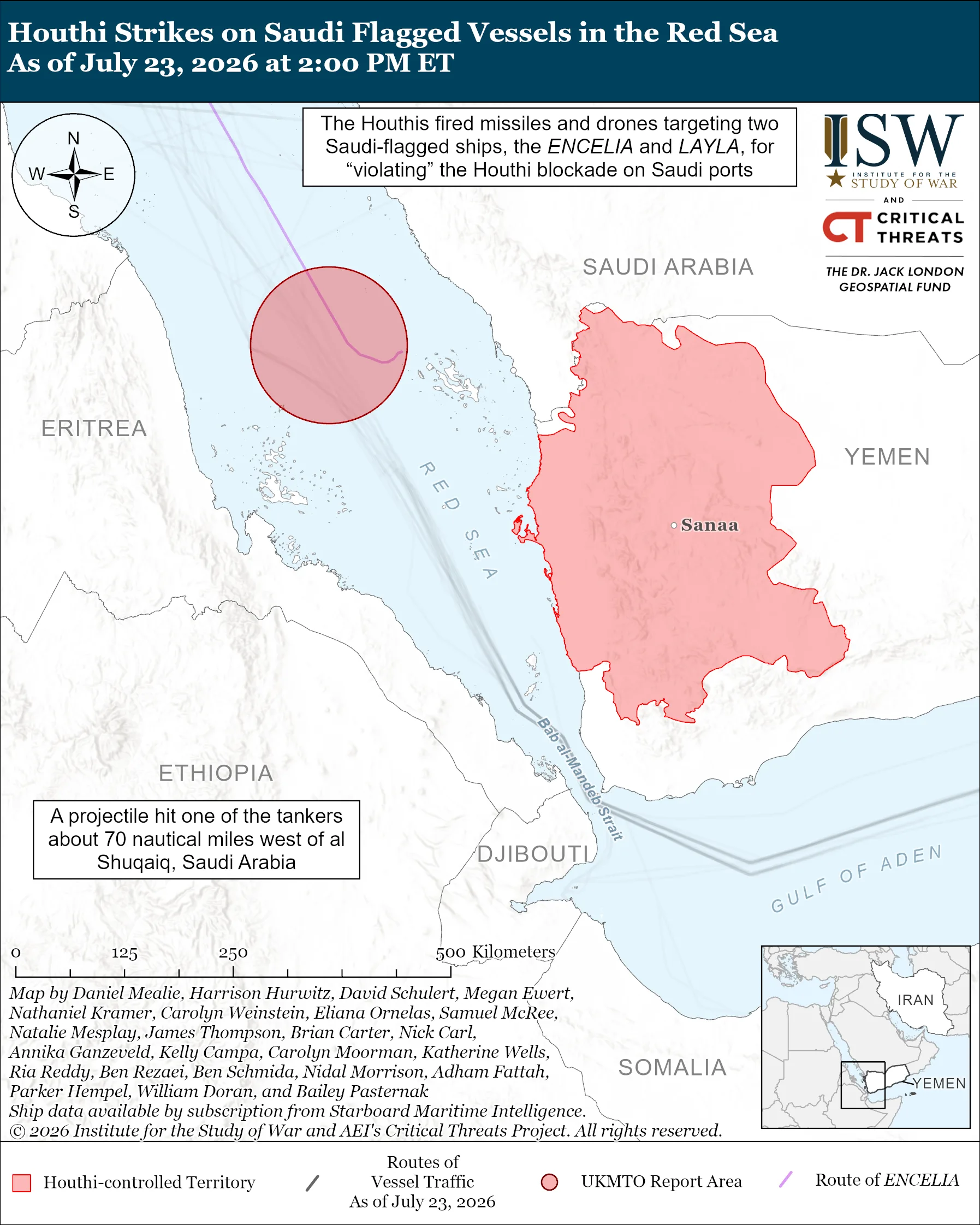
Iran continues to support the Houthis and their efforts to disrupt maritime traffic in and around the Red Sea. The expansion of the maritime shipping crisis to the Red Sea supports Iranian efforts to degrade the United States’ willingness and ability to continue its strike campaign against Iran and coerce the United States to accept Iranian control over the Strait of Hormuz. Four sources familiar with the matter, including two Iranian sources, told Reuters on July 23 that Iran transported Islamic Revolutionary Guards Corps (IRGC) commanders, military advisers, and missile and drone-related equipment to the Houthis in Yemen on July 13.[8] The two Iranian sources confirmed to Reuters that between 10 and 21 IRGC personnel, including senior commanders, were on the Mahan Air flight that was set to land at Houthi-controlled Sanaa Airport but diverted to Houthi-controlled Hudaydah Airport after Saudi-backed Yemeni armed forces attacked Sanaa Airport to prevent the plane from landing.[9] One of the sources said that the IRGC commanders traveled to Yemen to support Houthi operations and provide training on “new missile systems.”[10] The source added that Iran also sent gold on the flight to fund Houthi activities.[11] The Houthis pursue their own agenda, but they remain a key Iranian partner in Iran's broader regional network.[12] The Houthis’ campaign against international shipping between 2023 and 2025 disrupted international shipping in the Red Sea and imposed costs on Israel for its campaigns against Hezbollah in Lebanon and Hamas in the Gaza Strip.[13] The Houthis also pose a threat to US regional partners, as demonstrated by the Houthis’ current blockade against Saudi Arabia.[14] The report about Iran sending military commanders and advisers to Yemen to support Houthi operations comes after Reuters, citing two Iranian sources and a regional source, reported on July 16 that Iran asked the Houthis to attack shipping in the Bab al Mandeb Strait if the United States attacked Iranian energy infrastructure.[15]
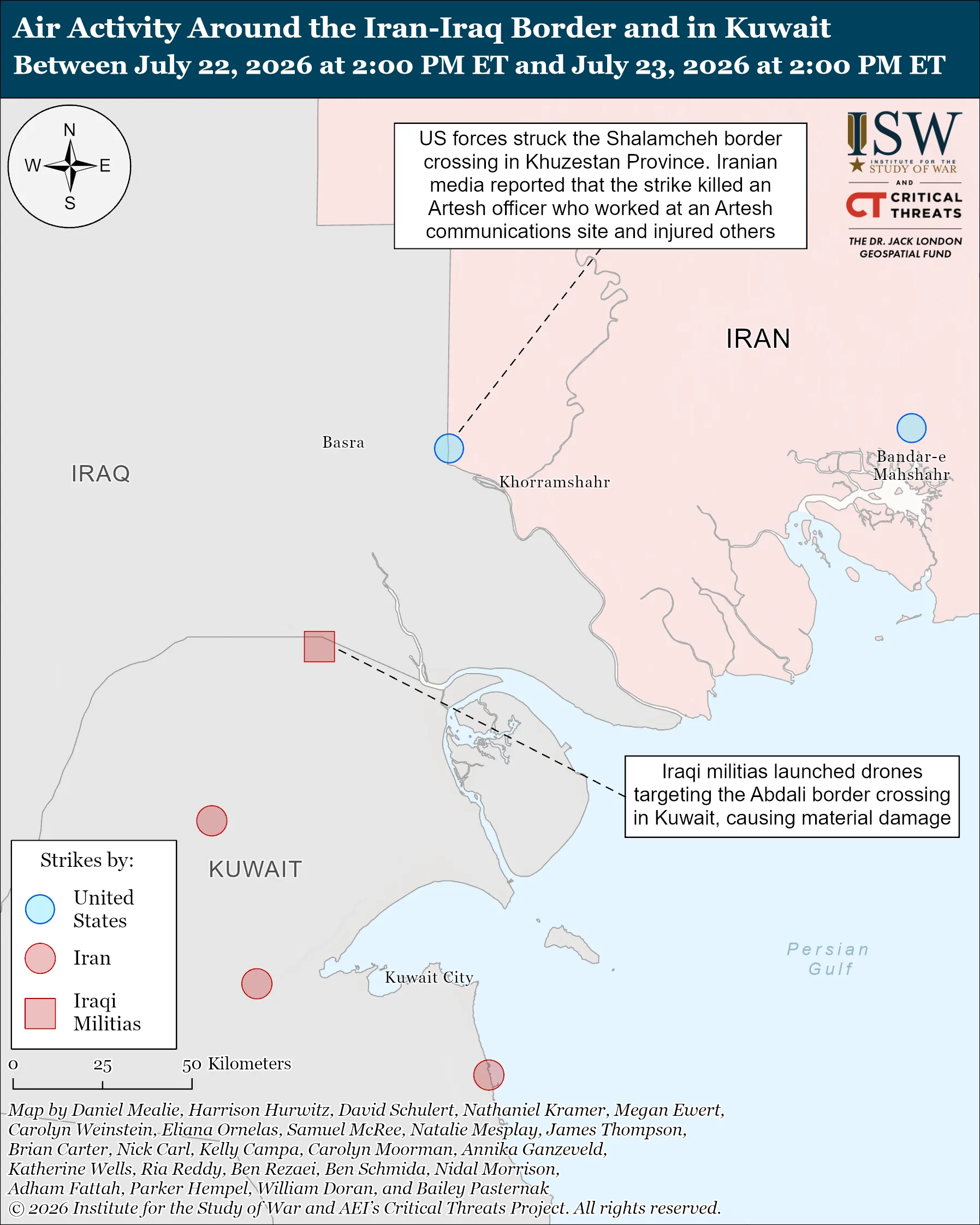
Unspecified Iranian-backed Iraqi militias likely conducted a drone attack on Kuwait's Abdali border crossing with Iraq on July 23, marking Iran and the Axis of Resistance's first attack on a regional border crossing since July 11.[16] Iranian media reported that militias conducted the drone attack in response to US airstrikes on Iran's Shalamcheh border crossing with Iraq (see US and Partner Military Operations text below for more details on the US airstrike on Shalamcheh).[17] No Iranian-backed Iraqi militia has taken responsibility for the attack at the time of this writing. The Kuwaiti Armed Forces confirmed on July 23 that the attack caused material damage but no casualties.[18]
Iranian media separately reported on July 23 explosions on Kuwait's Bubiyan Island, which hosts US air defense equipment.[19] ISW-CTP cannot confirm Iranian airstrikes on the island at the time of this writing. The IRGC claimed that its forces struck a US radar on the island on July 21.[20] Six IRGC officers previously attempted to infiltrate Bubiyan Island on May 1 via a chartered fishing boat to carry out unspecified “hostile acts” against Kuwait.[21]
The IRGC is highlighting the alleged presence of naval mines in the southern corridor to deter commercial vessels from using this corridor and consolidate Iran's control over the Strait of Hormuz. The IRGC claimed on July 22 that an oil tanker attempting to use the southern route struck a naval mine that disabled the vessel.[22] The IRGC added that this incident caused two other tankers that were also trying to use the southern route to turn around.[23] ISW-CTP has not observed reports of any commercial vessels hitting mines in the southern route at the time of this writing. United Kingdom Maritime Trade Operations (UKMTO) confirmed on July 7 the presence of a floating mine in the southern route, citing the Pakistani Navy's maritime navigational warning system, however.[24] Iran has repeatedly used force to attack vessels attempting to transit through the strait using the southern route, given that this route is an alternative to Iran's illegal traffic separation scheme. Traffic through the southern route therefore undermines Iranian efforts to assert full control over the strait. ISW-CTP has not observed any Iranian attacks on vessels in the strait since July 20.[25]
Russia may be helping Iran increase the accuracy of its targeting of US military sites in the region. Four people familiar with US intelligence told Reuters on July 22 that Russia may be providing Iran with targeting intelligence on US sites and equipment in the region.[26] US officials similarly told the Wall Street Journal on July 18 that they are concerned that Russia and the People's Republic of China are supporting Iran's targeting of US assets.[27] Russia's provision of targeting intelligence to Iran would likely improve the accuracy and effectiveness of Iran's drone and missile attacks. The sources speaking to Reuters cited the effectiveness and precision of Iran's drone attacks on a US Central Intelligence Agency (CIA) outpost in Saudi Arabia in March as possible evidence.[28] Two Western officials briefed on intelligence reports told Reuters that unspecified analysts assessed that Iran used “Russian-enhanced versions” of Shahed drones in the attack on the US CIA outpost.[29] Ukrainian President Volodymyr Zelensky previously told CNN on March 15 that he had seen intelligence that confirms that Iran has used Russian-produced Shahed drones “with Russian details” to attack US bases in the region.[30] These “details” reportedly include equipping Shaheds with Verba shoulder‑fired man-portable air-defense systems (MANPADS) to increase the Shahed’s capacity to target enemy aircraft.[31]
US President Donald Trump told Axios on July 23 that he may decide to expand US strikes against Iran.[32] Trump said that the United States is prepared to launch a “massive attack” against Iran if he orders such an operation.[33] Trump stated that the US military has not currently inflicted sufficient pressure on Iran to compel the Iranian regime to accept a deal.[34] Trump did not specify when he will decide whether to expand US strikes against Iran. US Secretary of State Marco Rubio similarly told reporters on July 23 that Iran is currently unwilling to make a deal that it would uphold, despite Iranian officials “begging” both directly and indirectly for a deal.[35] Rubio warned that US strikes on Iran will continue to increase daily until Iran accepts a deal.[36] The US military has conducted 12 consecutive rounds of strikes on Iranian targets as of July 23 (see below).[37]
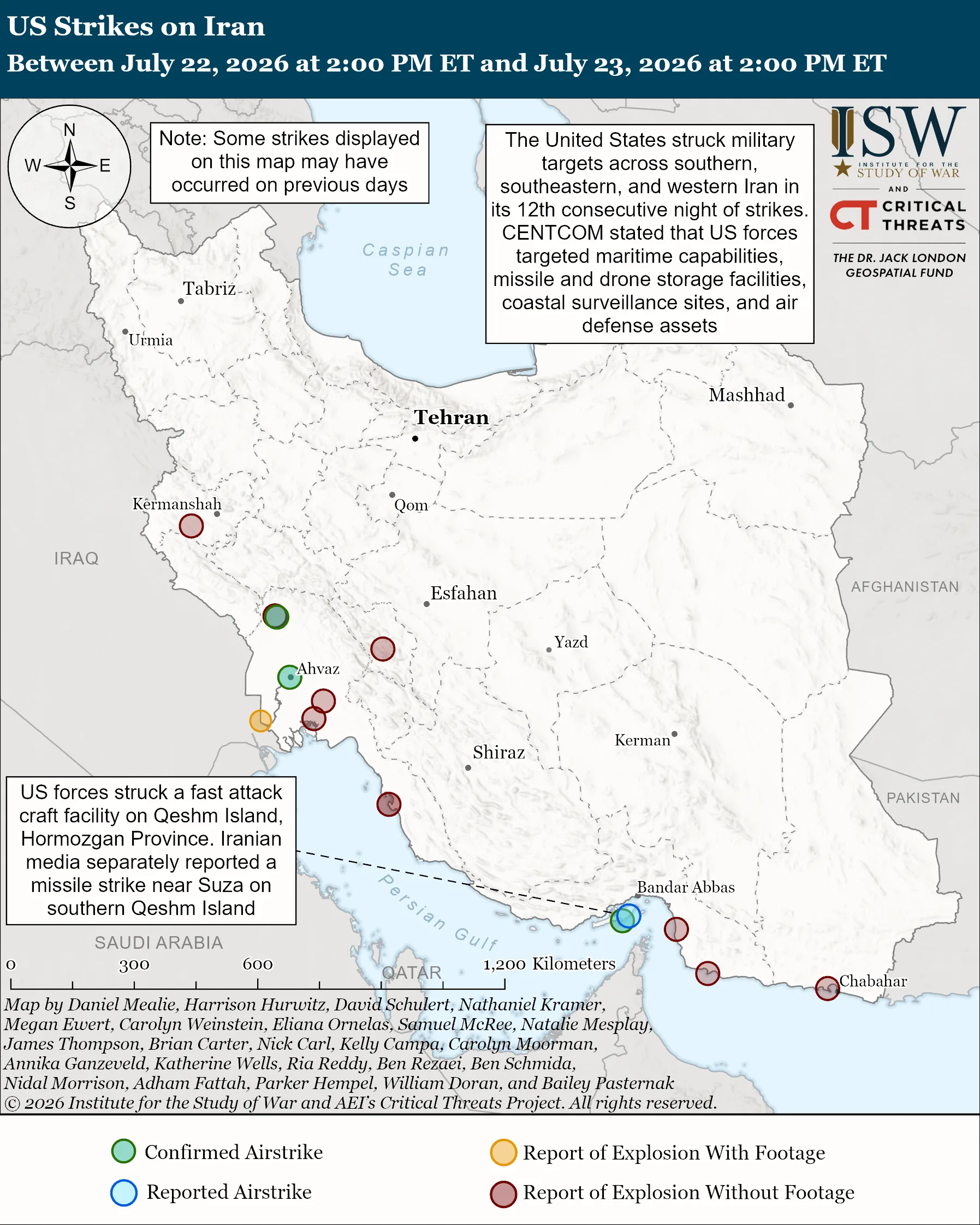
US forces struck Iranian military targets across southern, southeastern, and western Iran on July 22 and 23. US Central Command (CENTCOM) stated on July 22 that it struck Iranian maritime capabilities, missile and drone storage facilities, coastal surveillance sites, and air defense assets in its 12th consecutive evening of strikes against Iran.[38] Iranian officials and media confirmed strikes and explosions in Khuzestan, Hormozgan, Bushehr, Sistan and Baluchistan, Kermanshah, and Chaharmahal and Bakhtiari provinces on July 22 and 23.[39] Khuzestan Province Deputy Governor for Security and Law Enforcement Valiollah Hayati reported on July 22 that US missiles struck the Shalamcheh border crossing.[40] The Shalamcheh border crossing is a major transit point located between Khuzestan Province and Iraq's Basra Province.[41] Iranian media later reported on July 23 that the strike killed two people, including an Iranian Artesh captain who worked at an Artesh communications site in Shalamcheh.[42] US and Israeli forces previously targeted the Shalamcheh border crossing at least twice in April 2026.[43] At least 1,000 Iraqi Popular Mobilization Forces (PMF) fighters reportedly entered Khuzestan Province through Shalamcheh in March 2026 and deployed to Basij bases in Khuzestan Province.[44] The PMF is an Iraqi state security service that includes many Iranian-backed Iraqi militias that answer to Iran instead of the Iraqi prime minister.[45]
Iran continues to conduct attacks on US military facilities in the region and Gulf civilian infrastructure, likely to deter the United States from further expanding its strike campaign in Iran. The IRGC and Artesh have both claimed drone and missile attacks on US bases in Qatar, Jordan, Bahrain, Iraq, and Kuwait since ISW-CTP’s last data cutoff at 2:00 PM ET on July 22.[46] The IRGC claimed that a missile attack destroyed a US electronic warfare unit, a flight control tower, and a medical center at Camp Buehring in Kuwait, and killed and wounded several US soldiers.[47] ISW-CTP cannot confirm the IRGC claim at the time of this writing. Kuwaiti armed forces and the Jordanian Army confirmed that they have intercepted Iranian drone and missile attacks since ISW-CTP’s last data cutoff at 2:00 PM ET on July 22.[48] Open-source intelligence accounts on X, citing commercially available satellite imagery on July 22 and 23, confirmed damage to a US preparation hangar for F-15E fighter jets at King Faisal Air Base in Jordan, as well as damage to a helicopter shelter and warehouse at Camp Buehring and multiple sites at Ali al Salem Base in Kuwait.[49]
Iraqi Prime Minister Ali al Zaydi met with Iranian President Masoud Pezeshkian in Tehran on July 23 to oversee the signing of four memoranda of understanding (MoUs) between Iraq and Iran, according to Iraqi media.[50] The MoUs cover trade and transportation cooperation, including an agreement to construct a Khosravi-Khanaqin-Baghdad railway that would connect Baghdad to Iran's Kermanshah Province in western Iran.[51] Iraqi media reported that Zaydi emphasized Iraq and Iran's “shared security” and pledged to protect Iran from possible threats originating from Iraqi territory during his meeting with Pezeshkian, almost certainly referring to Kurdish opposition groups in Iraqi Kurdistan.[52] Iraqi and Iranian officials previously signed an MoU in August 2025 to implement a 2023 security agreement that required Iraqi authorities to disarm and relocate members of Kurdish opposition groups from the Iran-Iraq border.[53] Iran has historically accused Kurdish opposition groups and Israel of using Iraqi Kurdistan to facilitate anti-regime activity in Iran, particularly in the Iranian provinces located on the Iran-Iraq border.[54] Iran has repeatedly struck Kurdish opposition groups in Iraqi Kurdistan in recent months.[55]
https://understandingwar.org/research/middle-east/iran-update-special-report-july-23-2026/
Iran Update Special Report, July 24, 2026
Iran reportedly rejected a US ceasefire proposal on July 23, which suggests that Iran believes that it has the advantage over the United States in this phase of the war.[1] Unspecified Iranian officials told the New York Times on July 23 that Iran rejected a US ceasefire proposal that Iraqi Prime Minister Ali al Zaydi carried to Tehran during his July 23 visit.[2] Zaydi met with Iranian President Masoud Pezeshkian, Foreign Minister Abbas Araghchi, and Parliament Speaker Mohammad Bagher Ghalibaf in Tehran.[3] The Iranian officials speaking to the New York Times described the rejected proposal as the “only offer on the table” and stated that the Iranian government is not interested in a “temporary deal” that does not resolve ongoing disputes over the Strait of Hormuz.[4] This report comes after US President Donald Trump threatened on July 23 to expand the current US strike campaign.[5] Zaydi’s office denied the New York Times report on July 24.[6] Iraq has historically acted as a mediator between Iran and other countries, including the United States, however.[7] Iraq helped broker the 2023 rapprochement between Iran and Saudi Arabia, for example.[8] Zaydi’s visit to Tehran also follows his recent visit to Washington, D.C, on July 14, during which he met with Trump and other US officials.[9]
Iran is trying to inflict a steady number of US casualties by targeting sleeping quarters and recreation facilities at US regional bases in order to impose US domestic pressure that would force the US government to halt its airstrike campaign on Iran. The Artesh claimed that its forces conducted drone attacks targeting US forces gathered at Sheikh Isa Base in Bahrain, Muwaffaq Salti Airbase in Jordan, at al Udeid base in Qatar, and Camp Arifjan in Kuwait, since ISW-CTP’s last data cutoff at 2:00 PM ET on July 23.[10] The IRGC also claimed that its forces targeted the quarters of US forces at Camp Buehring in Kuwait on July 24.[11] Iranian regime media separately published on July 24 satellite imagery depicting damage from an Iranian ballistic missile hitting buildings reportedly housing US military forces at the Ali al Salem base in Kuwait.[12] ISW-CTP cannot confirm the veracity of this satellite image or the Iranian claims from July 24. These claims follow an Iranian missile attack on the Muwaffaq al Salti Airbase on July 17 that struck troop quarters on base and killed 3 US soldiers and injured several others.[13]
Khatam ol Anbia Central Headquarters Commander Major General Ali Abdollahi Aliabadi separately threatened on July 24 that Iran would “capture and send to hell” a US soldier for every Iranian killed during the war.[14] ISW-CTP has not observed any Iranian attempts to abduct US soldiers in the region at the time of this writing. Six IRGC officers previously attempted to infiltrate Bubiyan Island on May 1 via a chartered fishing boat to carry out unspecified “hostile acts” against Kuwait, however.[15]
ISW-CTP is tracking initial reports from Yemeni locals speaking to international media that an unspecified actor conducted airstrikes on the Houthi-controlled Yemeni port of Hudaydah on July 24.[16] ISW-CTP will provide further analysis about air operations against the Houthis in its July 25 Iran Update.
The Houthis likely calculated that closing the Bab al Mandeb Strait could help them extract concessions from Saudi Arabia without provoking a major US military response. Anti-Saudi Houthi rhetoric notably increased after the US-Iran MoU was signed in June, suggesting that the Houthis saw a moment of weakness and opportunity for them to extract concessions from Washington and its allies. Oman-based Houthi spokesperson and negotiator Mohamed Abdul Salam announced on July 24 that the Houthis are currently only enforcing a blockade against Saudi Arabia and have not closed the Bab al Mandeb Strait to all maritime traffic.[17] Abdul Salam, who is the Houthi movement's primary point of contact with Saudi diplomats, asserted that the blockade is a direct response to Saudi military action in Yemen, and Houthi officials have emphasized in recent days that the Houthis will maintain their blockade on Saudi ports and vessels until Saudi Arabia lifts its own controls on Houthi-controlled ports and airports.[18] Saudi forces struck Sanaa International Airport on July 13 to prevent an Iranian Mahan Air flight from landing in Houthi-controlled territory as part of this effort to control access to Houthi-controlled airports.[19] The Houthis are likely reiterating that the group is only blockading Saudi Arabia–not wholly closing the Bab al Mandeb Strait–to avoid provoking US military action, which would hinder the Houthis’ ability to coerce the Saudi government into abandoning its campaign against Houthi-controlled ports and airports. This effort to avoid US responses assumes that the United States will not back a close partner with whom it just signed a major agreement on nuclear issues.[20] US Central Command (CENTCOM) conducted airstrikes on Houthi targets under Operation Rough Rider between March and May 2025 to render the Houthis “unable or unwilling” to threaten maritime traffic in the Red Sea and significantly degrade Houthi military capabilities.[21] A similar US air campaign in response to any Houthi attempt to close the Bab al Mandeb Strait to maritime traffic would almost certainly target Houthi capabilities that are necessary to enforce a blockade on Saudi Arabia and threaten Saudi vessels.[22]
The Houthis are still capable of exerting pressure on the United States and the international community without closing the Bab al Mandeb Strait to all maritime traffic, however. The Houthis likely understand the United States’ sensitivity to the current conflict's economic costs and disruption to global commerce and may seek to deter the United States using the threat of a broader economic shock. Reuters reported on July 23 that marine insurance costs increased significantly for exporters and shipping companies transiting goods through the Red Sea, and maritime traffic through the Red Sea has fluctuated significantly in recent days amid the start of the Houthi blockade on Saudi Arabia.[23] An unspecified shipping company executive told US media on July 21 expressed concern that oil prices will rise dramatically if the Houthis announce that they are threatening all traffic in the Bab al Mandeb Strait.[24]
Iranian officials have threatened the United States with closing the Bab al Mandeb Strait entirely, and the Houthis’ strategic calculus could change if the group decides that it may be able to secure more of its interests by expanding the conflict. Two unspecified Iranian officials told the New York Times on July 23 that the Iranian regime will ask the Houthis to close the Bab al Mandeb Strait to all maritime traffic if Trump authorizes airstrikes on Tehran and Iranian critical infrastructure.[25] The Houthis are an Iranian partner, not a proxy, which means that the Houthis sometimes act independently of Iran's wishes.[26] The Houthis have avoided Iran's request for the group to close the Bab al Mandab Strait for several months.[27] Iran retains some means of leverage over the Houthis, however, and the Houthis could completely fulfill Iran's request if the group assesses that its priorities have changed.[28] Reuters reported on July 23 that Iran has trafficked significant amounts of various weapons, including drone and missile components, as well as liquid financial assets like gold, to Houthi-controlled territory throughout July 2026.[29] Reliance on Iranian funding and weapons could incentivize the Houthis to consider enforcing an Iranian request to fully close the Bab al Mandeb Strait if the Houthis deem Iranian support to be a higher current priority than forcing Saudi Arabia to forfeit its blockade on Houthi ports and airports.
Iranian leaders may assess that Iran can deter the United States from expanding its campaign by threatening that the Houthis could fully disrupt traffic in the Bab al Mandeb. The Iranian regime understands the United States’ sensitivity to economic costs derived from Iranian attempts to assert control over the Strait of Hormuz.[30] Iranian leaders may seek to maintain the possibility of disrupting all traffic in the Bab al Mandeb Strait to deter the United States from significantly expanding its military operations against Iran. Iranian officials’ threats that they could demand that the Houthis disrupt traffic in the Bab al Mandeb follow recent US media reporting that US Central Command (CENTCOM) is expanding its force presence in the Middle East, which would provide CENTCOM with options to expand US operations against Iran.[31]
A US-based Yemen analyst reported on July 23 that Houthi leaders have adopted enhanced operations security (OPSEC) protocols amid reports that Saudi Arabia may expand its operations against the group.[32] The analyst reported that the OPSEC protocols may be part of Houthi preparations for a possible Saudi-led, anti-Houthi coalition air campaign in Yemen.[33] Houthi Leader Abdulmalik al Houthi refrained from delivering a regularly scheduled and televised speech on July 23.[34] It is unclear whether Abdulmalik's absence is part of ongoing Houthi preparations for a potential Saudi air campaign, however.
US forces struck Iranian military targets across western, northwestern, southern, and southwestern Iran on July 23 and 24. US Central Command (CENTCOM) stated on July 23 that it struck Iranian military command centers, drone storage facilities, communications networks, coastal surveillance sites, and maritime capabilities.[35] CENTCOM added that the strikes sought to further reduce Iran's ability to threaten commercial shipping in the Strait of Hormuz.[36] The United States struck Artesh military facilities in western and northwestern Iran. Satellite imagery showed that a US strike destroyed a hangar and another unspecified structure at the Artesh Air Force 3rd Tactical Airbase (TAB) in Kabudarahang, Hamedan Province, on July 21.[37] US forces separately struck the Artesh Ground Forces 164th Mobile Assault Brigade barracks in Piranshahr, West Azerbaijan Province, on July 24.[38] The 164th Mobile Assault Brigade is subordinate to the 64th Urmia Infantry Division and is based in Piranshahr.[39] The brigade specializes in heliborne assaults, night raids, controlling roads, mountain warfare, offensive demolition, and urban warfare.[40]
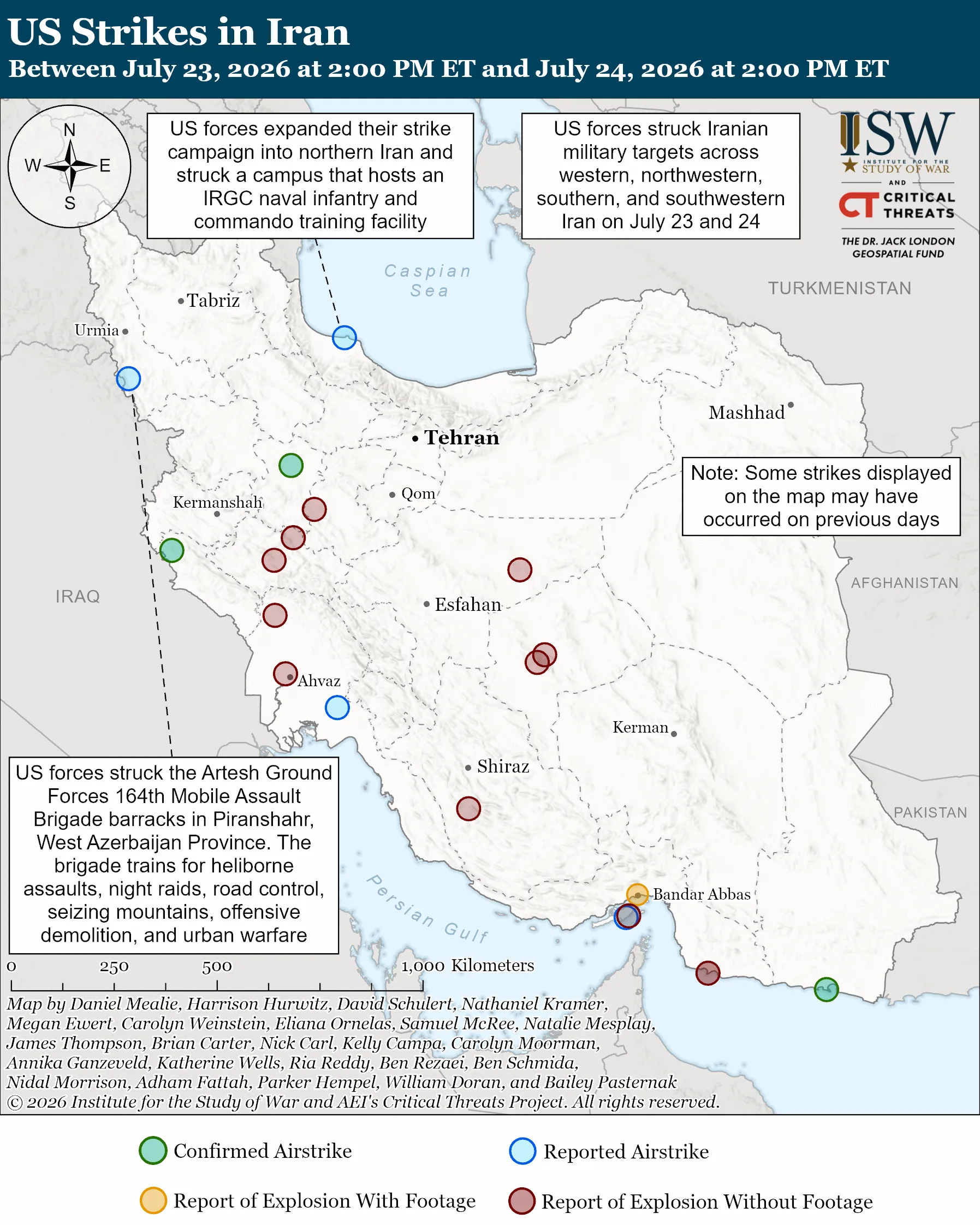
US forces also expanded their strike campaign into northern Iran on July 24.[41] Iranian officials confirmed that US forces struck the IRGC Navy Hazrat Seyyed ol Shohada Headquarters in Zibakenar, Gilan Province.[42] The facility houses the IRGC Navy's Seyyed ol Shohada Commando College, which trains naval infantry and commando forces.[43]
US forces separately continued targeting Iranian communications and military infrastructure in southern and western Iran. Geolocated footage from July 23 showed that a US strike targeted the Telecommunications Regulatory Authority building in Bandar Abbas, Hormozgan Province.[44] US forces previously targeted this building on July 16.[45] Geolocated imagery from July 24 also showed that US forces destroyed a communications facility in Ilam Province.[46] Geolocated imagery from July 23 showed that US forces struck tunnels beneath a military garrison town associated with the Artesh Air Force 10th TAB and Konarak Naval Base in Sistan and Baluchistan Province on July 21.[47]
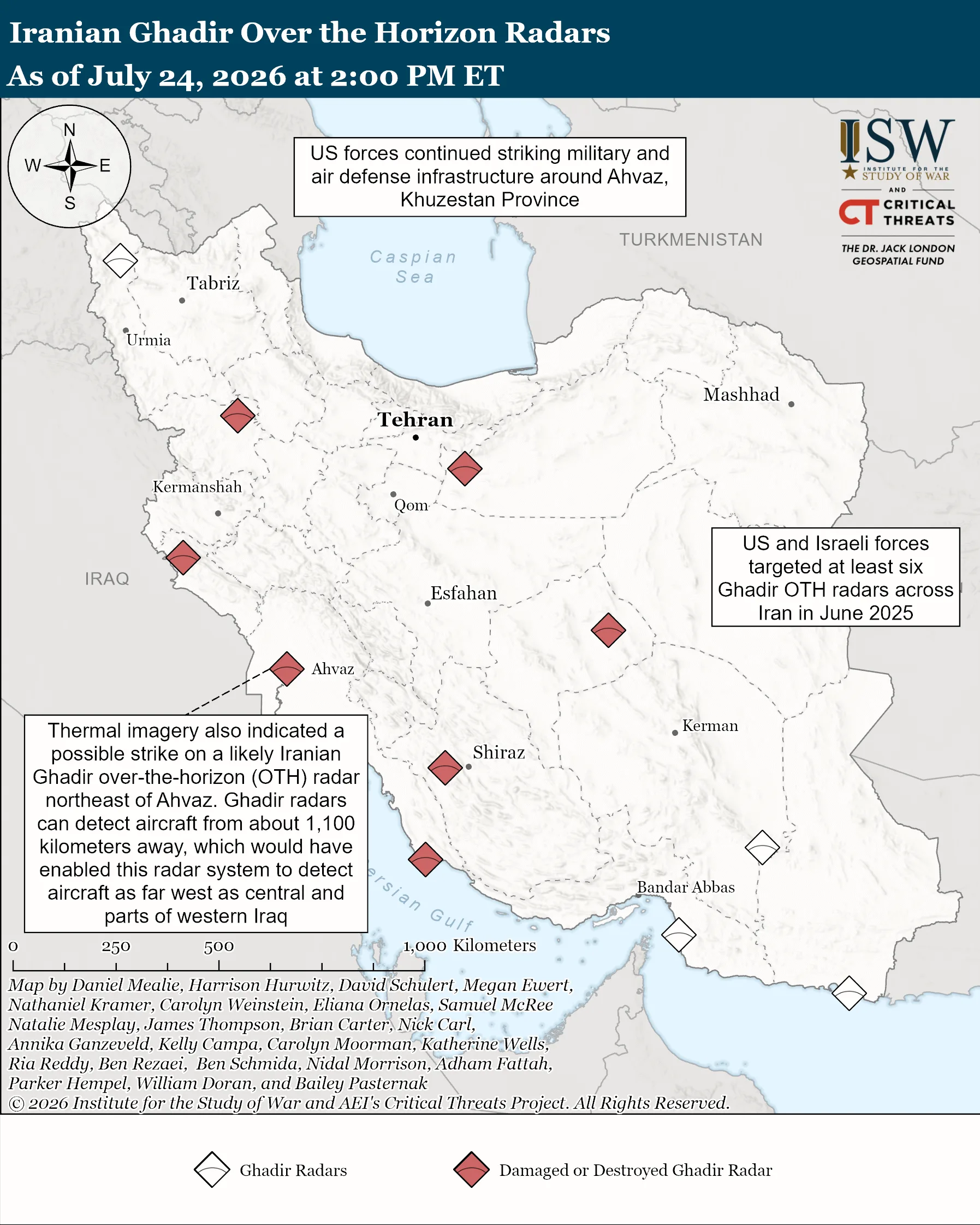
The United States also continued striking targets in Iran's Khuzestan Province. Satellite imagery showed several buildings burning at a military installation in western Ahvaz after the July 23 strikes.[48] Khuzestan Province Deputy Governor for Security and Law Enforcement stated on July 24 that US missiles struck locations around Ahvaz, killing four people and injuring five others.[49] Thermal imagery also indicated a possible strike on a likely Iranian Ghadir over-the-horizon (OTH) radar northeast of Ahvaz.[50] Ghadir radars can detect aircraft from about 1,100 kilometers away, which would have enabled this radar system to detect aircraft as far west as parts of central and western Iraq.[51] US and Israeli forces targeted at least six Ghadir OTH radars across Iran in June 2025.[52] Regime media confirmed strikes and explosions near Andimeshk and Omidiyeh in Khuzestan Province on July 24.[53]
The Wall Street Journal reported on July 24 that Bahrain and Kuwait secretly struck sites inside Iran sometime after July 11, according to people familiar with the matter.[54] The United Arab Emirates (UAE) reportedly supplied Bahrain and Kuwait with targeting intelligence and defensive air cover to conduct the strikes.[55] The UAE previously struck an oil refinery on Iran's Lavan Island in April.[56] Iran prioritized attacks against US bases and critical infrastructure in Bahrain and Kuwait in recent weeks, likely to deter them and other Gulf states from supporting US military efforts against Iran.[57]
Iran is likely targeting civilian sites in Bahrain to both raise the cost of Bahrain hosting US forces and to pressure Bahrain to urge the United States to end its airstrike campaign on Iran. The Bahrain Defense Force announced on July 24 that Bahraini air defenses intercepted several Iranian attacks attempting to strike unspecified civilian targets in Bahrain.[58] Bahrain has reportedly participated in US airstrikes on Iran since July 11 (see text above).
One of these civilian sites could be referring to a data center belonging to Bahraini state-run telecommunications company Batelco in Askar, Bahrain, which Iran has claimed to target in drone and missile attacks on July 18 and 24.[59] An open-source intelligence account confirmed damage at the data center via commercially available satellite imagery from July 22.[60] The account reported that Batelco hosts Amazon Web Services (AWS) servers in Bahrain.[61] The IRGC claimed on July 18 that the US military also used the center to aid its operations against Iran.[62] ISW-CTP cannot confirm if the data center hosted AWS servers or if the US military used the data center. Iran stated that it would target data centers of US companies in Gulf states in response to US-Israeli strikes on Iran's defense industrial sites in March.[63]
Iran claimed to deploy more advanced drones and drone tactics on US bases in Gulf states to overwhelm US and Gulf states’ air defense systems. Armed Forces General Staff-run media reported on July 24 that the IRGC struck a very large ammunition depot located on the Ali al Salem base in Kuwait using “advanced destructive drones” in “successive attacks.”[64] The reported attack is consistent with Iran's demonstrated ability to conduct coordinated and sophisticated drone operations against US targets. Iran penetrated and damaged a Central Intelligence Agency (CIA) outpost via a two-drone attack in March.[65] The first drone breached the facility's exterior, creating an opening, and the second drone exploited that vulnerability by flying through the breach and detonating inside the site, according to a US intelligence official speaking to Reuters on July 22.[66] US intelligence also assessed that Russia may be helping Iran target US sites in the region through adapted Shahed-136s with access to Russian satellite navigation systems.[67] Ukrainian President Volodymyr Zelensky previously told CNN on March 15 that he had seen intelligence that confirms that Iran has used Russian-produced Shahed drones “with Russian details” to attack US bases in the region.[68] These “details” reportedly include equipping Shaheds with Verba shoulder‑fired man-portable air-defense systems (MANPADS) to increase the Shahed’s capacity to target enemy aircraft.[69]
Iraqi security forces reportedly raided a likely Iranian-backed Iraqi militia Kataib Hezbollah headquarters and drone factory in Jurf al Nadaf, Baghdad Province, on July 24.[70] An unspecified security source told Iraqi media on July 24 that an Iraqi ”joint security force besieged” the headquarters and drone factory of an unspecified militia affiliated with the Popular Mobilization Forces (PMF) in Jurf al Nadaf.[71] This source claimed that unspecified actors had fired drones targeting the US Embassy in Baghdad and Baghdad International Airport from this area.[72] The PMF is an Iraqi state security service that includes many Iranian-backed Iraqi militias, such as Kataib Hezbollah, that answer to Iran instead of the Iraqi prime minister.[73] Kataib Hezbollah-affiliated PMF brigades have used a PMF headquarters in Jurf al Nadaf to store explosives, ammunition, and weapons, according to a security official speaking to Qatari media in November 2025.[74]
This raid comes as Iraqi security forces have targeted several other Iranian-backed militia sites in July.[75] The Iraqi National Security Service arrested three individuals during a raid on a first-person video (FPV) drone factory located in an area of Baghdad with a Kataib Hezbollah presence on July 21.[76] The Iraqi Counter Terrorism Service (CTS) also attempted to retake a likely Kataib Hezbollah-controlled farm in Dora District, Baghdad Province on July 3.[77] Iranian-backed Iraqi militias, including Kataib Hezbollah, have used areas under their control to store weapons and conduct rocket attacks targeting US interests in Iraq.[78]
The Kurdistan Counter-Terrorism Service intercepted between five and six explosive-laden one-way attack drones over Erbil, Iraqi Kurdistan, on July 24, according to Iraqi media.[79] Unspecified actors reportedly launched the drones from western Iraqi Kurdistan.[80] It is not clear at the time of this writing which actor conducted the attack, however. Iranian-backed Iraqi militias previously conducted numerous attacks targeting US positions in Iraqi Kurdistan in March and April. [81]Unspecified actors have also launched a plethora of drones targeting the US Consulate in Erbil in recent days.[82] Iranian media separately claimed that the Islamic Revolutionary Guards Corps (IRGC) struck a US Patriot air defense system, a US “fighter jet” hangar, and a “spy balloon” in Erbil on July 24.[83] An Israeli OSINT account published footage of reported smoke rising at Erbil International Airport, which hosts a US base, on July 24.[84] The IRGC and Artesh have both claimed drone and missile attacks on US bases in Iraq in recent days.[85]
https://understandingwar.org/research/middle-east/iran-update-special-report-july-24-2026/