Skip to comments.
Spooky Alignment of Quasars Across Billions of Light-years — Science Release — ESO1438
European Southern Observatory ^
| 19 November 2014
Posted on 11/25/2014 10:36:03 PM PST by Swordmaker
VLT reveals alignments between supermassive black hole axes and large-scale structure
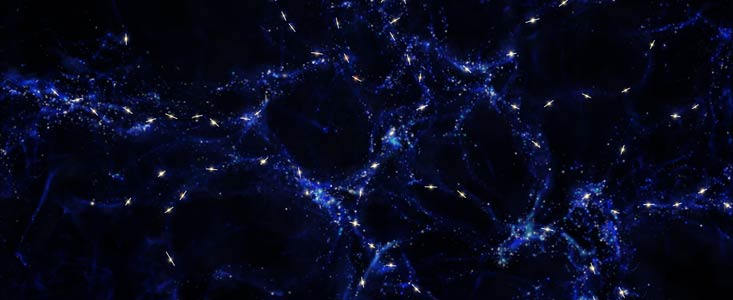
New observations with ESO’s Very Large Telescope (VLT) in Chile have
revealed alignments over the largest structures ever discovered in the
Universe. A European research team has found that the rotation axes of the
central supermassive black holes in a sample of quasars are parallel to each
other over distances of billions of light-years. The team has also found that
the rotation axes of these quasars tend to be aligned with the vast
structures in the cosmic web in which they reside.
See Full Size Photo
Quasars are galaxies with very active supermassive black holes at their centres. These black holes are surrounded by spinning discs of extremely hot material that is often spewed out in long jets along their axes of rotation. Quasars can shine more brightly than all the stars in the rest of their host galaxies put together.
A team led by Damien Hutsemékers from the University of Liège in Belgium used the FORS instrument on the VLT to study 93 quasars that were known to form huge groupings spread over billions of light-years, seen at a time when the Universe was about one third of its current age.
“The first odd thing we noticed was that some of the quasars’ rotation axes were aligned with each other — despite the fact that these quasars are separated by billions of light-years,” said Hutsemékers.
The team then went further and looked to see if the rotation axes were linked, not just to each other, but also to the structure of the Universe on large scales at that time.
When astronomers look at the distribution of galaxies on scales of billions of light-years they find that they are not evenly distributed. They form a cosmic web of filaments and clumps around huge voids where galaxies are scarce. This intriguing and beautiful arrangement of material is known as large-scale structure.
The new VLT results indicate that the rotation axes of the quasars tend to be parallel to the large-scale structures in which they find themselves. So, if the quasars are in a long filament then the spins of the central black holes will point along the filament. The researchers estimate that the probability that these alignments are simply the result of chance is less than 1%.
“A correlation between the orientation of quasars and the structure they belong to is an important prediction of numerical models of evolution of our Universe. Our data provide the first observational confirmation of this effect, on scales much larger that what had been observed to date for normal galaxies,” adds Dominique Sluse of the Argelander-Institut für Astronomie in Bonn, Germany and University of Liège.
The team could not see the rotation axes or the jets of the quasars directly. Instead they measured the polarisation of the light from each quasar and, for 19 of them, found a significantly polarised signal. The direction of this polarisation, combined with other information, could be used to deduce the angle of the accretion disc and hence the direction of the spin axis of the quasar.
“The alignments in the new data, on scales even bigger than current predictions from simulations, may be a hint that there is a missing ingredient in our current models of the cosmos,” concludes Dominique Sluse.
TOPICS: Astronomy; Science
KEYWORDS: astronomy; catastrophism; eso1438; haltonarp; physics; quasars; science; stringtheory
Navigation: use the links below to view more comments.
first previous 1-20, 21-39 last
To: Swordmaker
The alignment is a function of gravitational attraction that flips the flat mass of the galaxy.
The gravity is galactic accretion process in action
21
posted on
11/26/2014 5:08:01 AM PST
by
bert
((K.E.; N.P.; GOPc.;+12, 73, ..... Obama is public enemy #1)
To: RandallFlagg
To: Swordmaker
Thank you for the ping, Sir.
To: Swordmaker; brytlea; cripplecreek; decimon; bigheadfred; KoRn; Grammy; steelyourfaith; Mmogamer; ...
Thanks Swordmaker. Extra to APoD.
24
posted on
11/26/2014 5:28:49 AM PST
by
SunkenCiv
(https://secure.freerepublic.com/donate/_______________________Celebrate the Polls, Ignore the Trolls)
To: 75thOVI; agrace; aimhigh; Alice in Wonderland; AndrewC; aragorn; aristotleman; Avoiding_Sulla; ...
Thanks Swordmaker. Halton Arp ping.
25
posted on
11/26/2014 5:29:13 AM PST
by
SunkenCiv
(https://secure.freerepublic.com/donate/_______________________Celebrate the Polls, Ignore the Trolls)
26
posted on
11/26/2014 5:31:35 AM PST
by
SunkenCiv
(https://secure.freerepublic.com/donate/_______________________Celebrate the Polls, Ignore the Trolls)
To: Swordmaker
27
posted on
11/26/2014 6:28:10 AM PST
by
SatinDoll
(A NATURAL BORN CITIZEN IS BORN IN THE US OF US CITIZEN PARENTS.)
To: Swordmaker
"A European research team has found that the rotation axes of the central supermassive black holes in a sample of quasars are parallel to each other over distances of billions of light-years."

Hmmm, what could it be that causes things to align at such great distances. Couldn't be gravity, the force is not strong enough. Could it be...... electromagnetism?
To: SpaceBar
“... it is pretty undeniable that there is a large scale filamentous like structure to the universe.”
You’d think so, but not to a mainstream cosmologist. They deny it on principle:
“In modern physical cosmology, the cosmological principle is an axiom that embodies the working assumption or premise that the distribution of matter in the universe is homogeneous and isotropic when viewed on a large enough scale, since the forces are expected to act uniformly throughout the universe, and should, therefore, produce no observable irregularities in the large scale structuring over the course of evolution of the matter field that was initially laid down by the Big Bang.”
http://en.wikipedia.org/wiki/Cosmological_principle
(Note this is an axiom that is assumed to be true without (or regardless of) evidence)
To: bert
“The alignment is a function of gravitational attraction that flips the flat mass of the galaxy.”
How does gravity affect the alignment of quasars that are far beyond the normal reach of any significant gravitational attraction?
To: Swordmaker; SunkenCiv
The distance of 10 Billion Light Years is impossible! We all know the Universe isn’t older than 10,000 years, according to lots of people here, and elsewhere. Could they possibly be wrong?
(flame bait.. I know, but it’s fun sometimes)
31
posted on
11/26/2014 3:03:20 PM PST
by
KoRn
(Department of Homeland Security, Certified - "Right Wing Extremist")
To: KoRn
The distance of 10 Billion Light Years is impossible! We all know the Universe isn’t older than 10,000 years, according to lots of people here, and elsewhere. Could they possibly be wrong?
(flame bait.. I know, but it’s fun sometimes) Well, obviously, the light was created well on its way in mid flight here already. . . say 6006 light years away or so.
32
posted on
11/26/2014 4:21:24 PM PST
by
Swordmaker
(This tag line is a Microsoft insult free zone... but if the insults to Mac users contnue...)
To: Boogieman
it is my understanding that quasars are associated with black holes and the gravity acts along the accreted linear quasar mass.
33
posted on
11/27/2014 5:47:02 AM PST
by
bert
((K.E.; N.P.; GOPc.;+12, 73, ..... Obama is public enemy #1)
To: Swordmaker
Super-Strings Theory
(or is it Silly String ;?)
34
posted on
11/29/2014 8:55:23 AM PST
by
mikrofon
(BIG Thread BUMP)
To: KoRn
35
posted on
11/30/2014 5:45:04 PM PST
by
SunkenCiv
(https://secure.freerepublic.com/donate/_______________________Celebrate the Polls, Ignore the Trolls)
To: Swordmaker; 6SJ7; AdmSmith; AFPhys; Arkinsaw; allmost; aristotleman; autumnraine; bajabaja; ...
36
posted on
03/22/2023 10:41:33 AM PDT
by
SunkenCiv
(Imagine an imaginary menagerie manager imagining managing an imaginary menagerie.)
37
posted on
03/22/2023 10:42:19 AM PDT
by
SunkenCiv
(Imagine an imaginary menagerie manager imagining managing an imaginary menagerie.)
To: Swordmaker
Where have I seen that structure before?
Oh yeah on the left...

38
posted on
03/22/2023 10:47:17 AM PDT
by
StAnDeliver
(Tanned, rested, and ready.)
To: Swordmaker
Similar to the random netting i use to screen birds off my blue berries.
That works out to an interesting size for the bird…
39
posted on
03/22/2023 10:50:54 AM PDT
by
KC Burke
(Diversity, Inclusion and Equity is not another way to spell GOD but it is a way to spell DIE.)
Navigation: use the links below to view more comments.
first previous 1-20, 21-39 last
Disclaimer:
Opinions posted on Free Republic are those of the individual
posters and do not necessarily represent the opinion of Free Republic or its
management. All materials posted herein are protected by copyright law and the
exemption for fair use of copyrighted works.
FreeRepublic.com is powered by software copyright 2000-2008 John Robinson