Posted on 07/12/2011 5:54:31 PM PDT by decimon
New Haven, Conn.—A team of scientists has discovered the youngest dinosaur preserved in the fossil record before the catastrophic meteor impact 65 million years ago. The finding indicates that dinosaurs did not go extinct prior to the impact and provides further evidence as to whether the impact was in fact the cause of their extinction.
Researchers from Yale University discovered the fossilized horn of a ceratopsian – likely a Triceratops, which are common to the area – in the Hell Creek formation in Montana last year. They found the fossil buried just five inches below the K-T boundary, the geological layer that marks the transition from the Cretaceous period to the Tertiary period at the time of the mass extinction that took place 65 million years ago.
Since the impact hypothesis for the demise of the dinosaurs was first proposed more than 30 years ago, many scientists have come to believe the meteor caused the mass extinction and wiped out the dinosaurs, but a sticking point has been an apparent lack of fossils buried within the 10 feet of rock below the K-T boundary. The seeming anomaly has come to be known as the "three-meter gap." Until now, this gap has caused some paleontologists to question whether the non-avian dinosaurs of the era – which included Tyrannosaurus rex, Triceratops, Torosaurus and the duckbilled dinosaurs – gradually went extinct sometime before the meteor struck. (Avian dinosaurs survived the impact, and eventually gave rise to modern-day birds.)
"This discovery suggests the three-meter gap doesn't exist," said Yale graduate student Tyler Lyson, director of the Marmarth Research Foundation and lead author of the study, published online July 12 in the journal Biology Letters. "The fact that this specimen was so close to the boundary indicates that at least some dinosaurs were doing fine right up until the impact."
While the team can't determine the exact age of the dinosaur, Lyson said it likely lived tens of thousands to just a few thousand years before the impact. "This discovery provides some evidence that dinosaurs didn't slowly die out before the meteor struck," he said.
Eric Sargis, curator of vertebrate paleontology at the Yale Peabody Museum of Natural History, and graduate student Stephen Chester discovered the ceratopsian last year while searching for fossilized mammals that evolved after the meteor impact. At first, Lyson said, the team thought it was buried within about three feet of the K-T boundary, but were surprised to learn just how close to the boundary – and hence, how close in time to the impact – it was. They sent soil samples to a laboratory to determine the exact location of the boundary, which is marked by the relative abundance of certain types of fossilized pollen and other geological indicators but is difficult to determine visually while in the field.
Because the dinosaur was buried in a mudstone floodplain, the team knew it hadn't been re-deposited from older sediments, which can sometimes happen when fossils are found in riverbeds that may have eroded and re-distributed material over time.
The team is now examining other fossil specimens that appear to be buried close to the K-T boundary and expect to find more, Lyson said. He suspects that other fossils discovered in the past may have been closer to the boundary than originally thought and that the so-called three-meter gap never existed.
"We should be able to verify that using the more sophisticated soil analysis technique rather than estimating the boundary's location based solely on a visual examination of the rock formations while in the field, which is what has typically been done in the past," Lyson said.
###
Other authors of the paper include Eric Sargis and Stephen Chester (Yale University); Antoine Bercovici (China University of Geosciences); Dean Pearson (Pioneer Trails Regional Museum) and Walter Joyce (University of Tübingen).
The only insects that survived, unfortunately, were politicians.
great. lets adopt him as our mascot.
He was the one with the sign on his back that said “hit me”.
That was a crying shame, wasn’t it.

Rats! I thought it was CBS Nightly News....
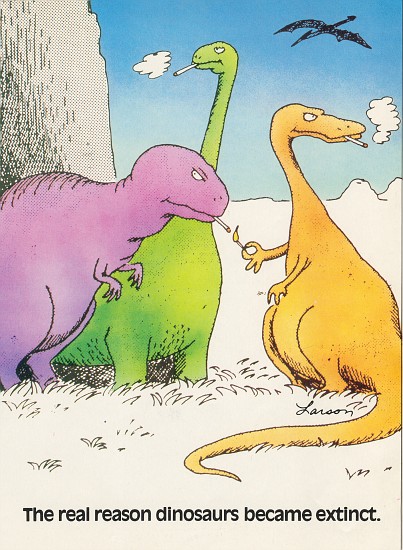
Four dinosaurs survived the 65 Million kill-off:
Larry King
Harry Reid
Jerry Brown
Hugh Hefner
They are now listed on the “Endangered Feces List”
So one Dinosaur found proves dinosaurs were killed 10,000 years later even though none are found in the preceding 9999 years or in the impact itself????
That makes as much sense as the claiming woolly mammoths were wiped 10,000 years ago by the Tunguska event in 1906.
The Dino killed by an asteroid hypothesis people are almost as pathetic with their "evidence" as the global warming people are with theirs
And Alligators even though they were supposedly at ground zero, not to mention parrots, honeybees, sea turtles, phytoplankton, and pretty much everything else you would expect would be the 1st to go under an impact scenario
I'll go with Geologist Dr. Norman Macleod who said it best
"The impact theory says in effect that a rock fell out of the sky and killed everything, except for the things that it didn't kill. I don't think that's much of an explanation."
I’m amazed at how many things a meteor can do. Sort of a utility explanation for anything that happens.
So I've switched and now go with Dr. Robert T. Bakker(1) (pronounced "Backer") who postulates that it wasn't an Asteroid but, a Virus from migrating dinosaurs that slowly killed them all off.
Kinda like the deadly bugs 'migrant' illegals are slowly infecting us with today.
(1) Dr Bakkar was the first paleontologist who brought forth the idea that Dinosaurs had to be warm blooded.
The last dinosaur?
Lonely, I’m Mr. Lonely,
I have nobody for my own.
I’m so lonely, I’m Mr. Lonely,
wish I had someone to call on the phone.
Disclaimer: Opinions posted on Free Republic are those of the individual posters and do not necessarily represent the opinion of Free Republic or its management. All materials posted herein are protected by copyright law and the exemption for fair use of copyrighted works.