
Posted on 05/20/2026 3:03:46 AM PDT by Cronos
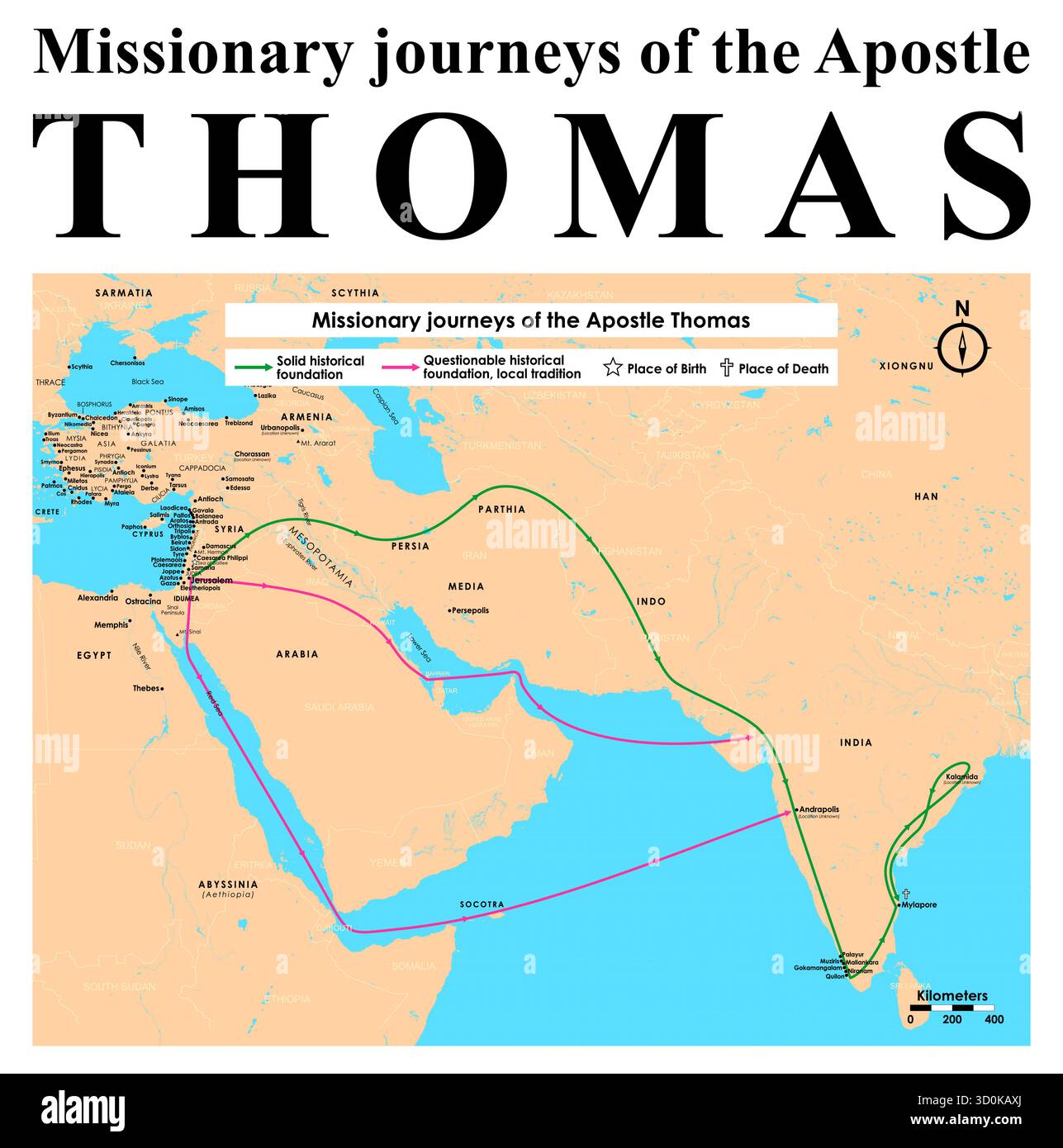
In my last post, I evaluated the tradition that the apostle Thomas ministered in India. While the evidence for Thomas in India is not as strong as for Peter and Paul in Rome, it is at least probable that he founded the church in India. But did Thomas die as a martyr?
THE ACTS OF THOMAS
The Acts of Thomas (c. AD 200-220) is the earliest literary account of the martyrdom of Thomas in India. It begins with the apostles in Jerusalem dividing up the world for missions. According to lot, Thomas was assigned to go to India, but he reluctantly objected, even though Jesus appears to him at night. Shortly thereafter a merchant named Abban came from India looking for a carpenter to work for king Gondophares. Jesus offers to sell him Thomas as a slave, and this time Thomas enthusiastically agrees. Once he arrives in the city, Gondophares assigns Thomas to build him a palace outside the city gates. Thomas agrees, but instead of using the money to build the palace, he gives it away to the poor and afflicted. Gondophares, furious when he heard how Thomas used the money, casts him in prison, contemplating how he would kill him. That very night the king’s brother Gad died and was taken by an angel to see the palace Thomas had built in heaven. Gad was allowed to return to life the next day and tell his brother all he had seen. As a result, both Gondophares and Gad sought the forgiveness of Thomas, and decide also to follow the Lord. Thomas travels to another land, and after preaching, casting out demons, and performing miracles, he is eventually thrown in prison by king Misdaeus (Mizdai). Thomas prays as he is escorted to his death by four guards who kill him with spears.
Scholars either consider this account entirely fictional, or believe that there is a historical core beneath the legendary embellishment. Western scholars tend to assume its legendary nature rather than argue for it.
Nevertheless, it would be premature—simply because it was written in the early third century, at least two to three generations removed from the events—to dismiss the Acts of Thomas as lacking any historical value. While earlier sources are certainly preferred, later sources often provide valuable historical information. A helpful example comes from comparing the Acts of Thomas with the writings of Plutarch. In his Lives, Plutarch wrote over sixty biographies, fifty of which have survived. For several subjects in the Lives, Plutarch is treated as seriously as with earlier sources. He is the main source for a number of ancient figures, many of whom lived hundreds of years before his writing (e.g., Pelopidas, Timoleon, Dion, Eumenes, Agis, Cleomenes).
THE GENRE OF THE ACTS OF THOMAS
Understanding the genre of the Acts is important in determining its historicity. Christine Thomas has suggested that the various Acts of this period, and other similar novels, are best categorized as historical fiction.[1] The mere fact that the Acts of Thomas contains known historical figures such as Thomas, Gondophares, Gad, and possibly even Habban and Xanthippe, Mazdai, and the city of Andrapolis, indicates that it is not entirely divorced from a historical memory. Rather than inventing a narrative for the apostle, the authors of the Acts would elaborate upon a known historical tradition.
Kurikilamkatt asks an important question: “If the story did not have a historical background and if the readers of the book knew Thomas had gone to some places other than those mentioned in the Ath [Acts of Thomas], how could the author of the Ath believe that any credibility would be given to his story?”[2] Later tradition, as well as the lack of any competing tradition for his journeys and fate, helps confirm this conclusion.
ARCHAEOLOGICAL CONFIRMATION
The most significant find convincing many scholars of the historical core of Acts of Thomas was the discovery in 1834 of a collection of ancient coins in the Kabul Valley of Afghanistan. Ancient coins often provide similar information as modern coins, including the names of various rulers and kings. Among the many forgotten kings whose images christened these coins, was the name “Gondophares” in a variety of spellings including “Gundaphar,” “Gundaphara,” “Gondophernes” and “Gondapharasa.” Many other coins were soon found in different regions confirming the existence of Gondophares and his family as well. Additionally, ruins have been discovered that many consider his former palace. Some other clues have been found that lend some credibility to the possibility of a historical core behind the Acts of Thomas.[3]
Subsequent research dated the coins to the first century AD. More specific dating became possible with the discovery of a stone tablet among the ruins of a Buddhist city near Peshawar that contained six lines of text in an Indo-Bactrian language. Moffett concludes, “Deciphered, the inscription not only named King Gundaphar, it dated him squarely in the early first century A.D., making him a contemporary of the apostle Thomas just as the maligned Acts of Thomas had described him.”[4]
In addition to the written tradition of the death of Thomas in The Acts of Thomas, there is an oral tradition found among the St. Thomas Christians.
ST. THOMAS CHRISTIANS
Perhaps the most accurate rendition of the tradition surrounding Thomas in southern India is told by The St. Thomas Christian Encyclopaedia of India:
According to Indian tradition, St. Thomas came by sea, and first landed at Cranganore about the year 52 A.D.; converted high case Hindu families in Cranganore, Palayur, Quilon and some other places; visited the Coromandel coast, making conversions; crossed over to China and preached the Gospel; returned to India and organized the Christians of Malabar under some guides (priests) from among the leading families he had converted, and erected a few public places of worship. Then he moved to the Coromandel, and suffered martyrdom on or near the Little Mount. His body was brought to the town of Mylapore and was buried in a holy shrine he had built. Christians, goes the tradition, from Malabar, the Near East and even from China used to go on pilgrimage to Mylapore and venerate the tomb.[5]
Rather than being preserved in written text, the tradition of the St. Thomas Christians has been transmitted through songs, stories, legends, customs, and celebrations of the people. These various forms of oral tradition were how Indians at this time recorded their history. The St. Thomas Christians are utterly convinced that their heritage traces back to the apostle Thomas himself, including introduction of the Syriac or Chaldaic (East Syriac) language. The community has preserved many ancient antiquities that testify to their traditions. Some of the names of the converts of Thomas have been preserved as part of this tradition and are still remembered today in Kerala. When the Portuguese landed in Malabar around 1500, they found an indigenous community of Christians who had already held for centuries that Thomas was their founder. Like the tradition contained in the Acts of Thomas, the southern tradition contains numerous legends, exaggerations, and conflicting episodes. But the core of the tradition remains: that Thomas travelled to southern India, preached to the people, established a community, and was martyred and buried at Mylapore.
Indian scholar Benedict Vadakkekara provides five supporting reasons for the credibility of the St. Thomas tradition.[6] First, the mere existence of a community claiming apostolic roots speaks to the genuineness of the tradition. There must have been some significant reason, says Vadakkekara, for why the Indian Christians chose Thomas. Second, the St. Thomas Christians are unique in claiming Thomas as their founding apostle. The lack of competing traditions is a sign of the reliability of the St. Thomas tradition. Third, the community has passed down the tradition with consistency. Marco Polo notes (1288- 1298) the pilgrimages that Christians were making to the tomb of the apostle Thomas at Mylapore. Fourth, the tradition has been unanimous amongst both Christians and non- Christians sources. There have been some denominational splits among the St. Thomas Christians, but they unanimously share the conviction that their community has apostolic roots. Fifth, while there are undeniable embellishments, the tradition has retained its pristine simplicity.
CONCLUSION
Issues surrounding the travels and fate of Thomas go far beyond the scope of this article. If you want to analyze further factors in detail, and even consider some important objections, check out my book The Fate of the Apostles.
The evidence for the martyrdom of Thomas is certainly not as strong as for Peter, Paul, and both James. But when all the facts are considered, my research and analysis brings me to the conclusions that the martyrdom of Thomas in India seems at least more probable than not.
Regardless, we do know that Thomas (like the other apostles) willingly suffered for his faith, which shows the depth of his convictions. Thomas was not a liar. He really believed Jesus rose from the grave and was willing to suffer and die for that conviction.
Yes he did..................
St. Thomas Cathedral, Chennai (Madras) India:
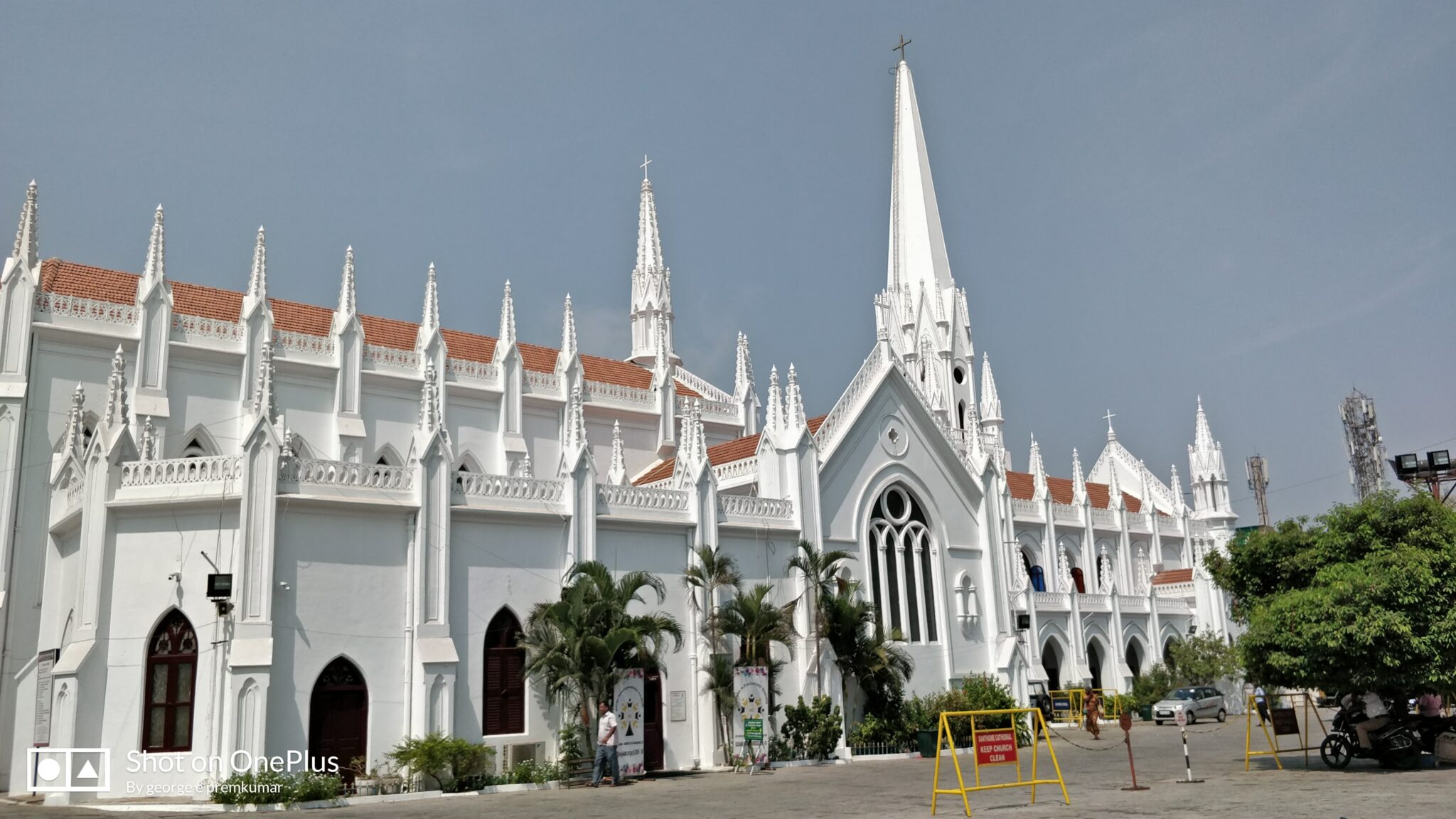 In 1995 I visited Madras (now named Chennai) on India's southeastern coast.
My host pointed out the Roman Catholic San Thome (St. Thomas) Cathedral Basilica.
He told me it was built on the tomb of St. Thomas.
The St. Thomas cathedral is the seat of the Chennai archdiocese of around 800,000 Indian Christians.
They make up about 7% of the Chennai population.
The current archbishop is named as George Antonysamy.
In India as a whole there are around 30 million Christians, ~23 million of them Catholics.
So, today there are more Christians in India (30 million) than in Spain (28 million)!
Perhaps the best answer I could come up with revolved around the great commission, "Go therefore and make disciples of all nations..."
God expects humanity and his church on earth to promulgate and perpetuate His teachings and His mission; in fact, the promotion of His teachings is an essential part of His mission. In order to carry that message, to "all nations," the disciples needed the ability to travel to all nations and it was not until the infrastructure of the Roman Empire and its aftermath that this became a realizable possibility. So to answer the question why God sent his son when he did, my response would be that He came as soon as we were ready to do His work
The head priest at my Parrish in central Tennessee is from southern India. Currently he is leading a pilgrimage to the grave/shrine of St. Thomas, located in Chennai in southern India and he speaks of St. Thomas and his ministry in India as if it is all true. I believe it.
Thomas has one spoken line in the New Testament. John 11:16 reads “Thomas, nicknamed the Twin, said to his fellow disciples, “Let’s go, too—and die with Jesus.””
Why would anyone doubt Thomas?
And the St. Thomas Christians, despite being separated from western Christians for a long time, still retained similar beliefs
There is a small chapel on shore in Madras, India where Thomas was murdered while preaching.
And what were those belirfs? Are they preserved without change? Can thet be enumerated? Why are those beliefs simpler than those presumed later?
Those are very good questions, imardmd1 - I will first give you some books that you can pick up and read for yourself and then I will summarize thse:
1. Philip Jenkins "the lost history of Christianity" - not specifically about MarThomites, but overall
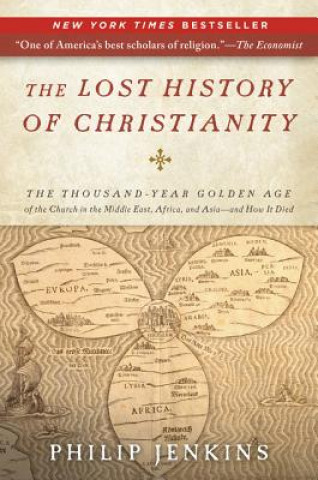
2. Leslie w Brown "The indian christians of St. Thomas"
amazon link - this is a 1982 book
3. "History of Christianity in India, Volume I" by A. M. Mundadan

4. "The Christians of St. Thomas and Their Liturgies" by George B. Howard
I first got interested in the Marthomite Christians when I visited India in the late 1990s and went to Cochin and to Kodungallur then later was in Iraq (first to the Sumerian ruins etc) - the Eastern Churchs are not as well known as they ought to be - as an aside, did you knwo that Genghis Khan's wife was from a tribe that had been Christian for a long time?
anyway, back to your question - the Nasranis (St. Thomas christians) call Saints as "mar" - Aramaic I belief, just as the core theologian of the Assyrian church was MAR Babai.
In the Liturgy of Addai and Mari, the Epiclesis (invocation of the Holy Spirit) explicitly begs: “May your Holy Spirit come, O Lord... and bless and sanctify this oblation... that it may be unto us, O Lord, for the pardon of offenses, the forgiveness of sins, and the great hope of resurrection from the dead.”-- reference archive.org/download/TheChristiansOfStThomas/TheChristiansOfStThomas.pdf
urthermore, during the Synod of Diamper, the Portuguese did not accuse them of holding a Protestant "symbolic" view; rather, they targeted specific East Syriac liturgical customs (such as using a mixture of rice wine or oil in some local instances or utilizing specific leavened bread dynamics).
Please dont' take my word for it - I encourage you to read these sources yourself
Well, he certainly didn’t die in a Tim Horton’s fighting over an incorrect order of a cup of coffe + donut, did he?
I met a Hindu (non-Christian) Indian who believed St. Thomas went to India. Perhaps because he had read about it or whatever. But local Indians living near Mylapore believe it to be true.
👍
I had done some similar research on St Thomas but not as in depth after stumbling on The Gospel of St. Thomad.
This history not even a mention of his journeys was even whispered about in the Catholic Church.
For years its made me question my participation in the Cath Church.
Why isn’t this taught? Its a darn shame it isnt
The Catholic Church doesn’t teach its own history well enough.
Otherwise we would learn about:
1. marcion and the foolishness of trying to separate the OT from the NT
2. Arius and why he was wrong - and why we need to specific that Jesus was God even in the womb
3. Nestorious and what happens if we try to split the two natures of Jesus
4. the fact that Christianity is an Asian religion - and that until the 12th century its center was a lot further EAST — in fact in the 8th century fully one third to nearly one half of all Christians lived in Asia
“Jesus offers to sell him Thomas as a slave, and this time Thomas enthusiastically agrees.”
Right there I put the legend and any writing purporting to be a “record” of Thomas to be a myth.
That Jesus would sell Thomas to be a slave is to me totally out of character of Jesus.
Don’t worry I won’t take your word for it (or your sources).
Entry that we made through those lands, and traces that we found of the Apostle Saint Thomas. §. XXI.Conquista espiritual hecha por los religiosos de la Compañia de Iesus, en las prouincias del Paraguay, Parana, Vruguay y Tape; p. 29-30
.. We were received by these people with extraordinary signs of love, dances, and rejoicings, a thing that until then we had not experienced; the women came out to receive us, bringing their children in their arms, a very certain sign of peace and love; they treated us with their ordinary foods, roots, and fruits of the land. Astonished at such strange kindness, they told us that by a very ancient tradition, and received from their ancestors, they held that when Saint Thomas (whom commonly in the Province of Paraguay whom they call Pay Zumé, and in those of Peru Pay Tumé) passed through those parts, he said these words to them: This doctrine that I now preach to you, with time you will lose it; but when after many times there shall come some Priests, my successors, who shall bring Crosses as I brought, your descendants will hear this doctrine. This tradition obliged them to give us such extraordinary welcome."
That’s from the Gospel of Thomas - do read the rest of the article
you don’t take the Bible’s word for anything either as you hold Jesus to be the angel Michael, so quite frankly anything else you don’t take is moot
Disclaimer: Opinions posted on Free Republic are those of the individual posters and do not necessarily represent the opinion of Free Republic or its management. All materials posted herein are protected by copyright law and the exemption for fair use of copyrighted works.