Skip to comments.
World Jewish Congress criticizes Pope's decision to beatify Pius XII
The Jerusalem Post ^
| 21 DEC 2009
| Lisa Palmieri-Billig
Posted on 12/21/2009 9:37:41 AM PST by Gamecock
The World Jewish Congress (WJC) Monday criticized the decision by Pope Benedict XVI to pave the way for the beatification of his controversial war-time predecessor Pius XII (Eugenio Pacelli), who was pontiff of the Catholic Church from 1939 to 1958.
Benedict XVI's signature on the document certifying Eugenio Pacelli's (religiously defined) "heroic virtues" over the weekend came as a surprise since the pope's decision to move his World War II-era predecessor, Pius XII, a step nearer sainthood was taken less than a month before the pontiff's planned visit to Rome's main synagogue.
"As long as the archives of Pope Pius about the crucial period 1939 to 1945 remain closed, and until a consensus on his actions - or inaction - concerning the persecution of millions of Jews in the Holocaust is established, a beatification is inopportune and premature," WJC President Ronald S. Lauder said in a statement.
"While it is entirely a matter for the Catholic Church to decide on whom religious honors are bestowed, there are strong concerns about Pope Pius XII's political role during World War II which should not be ignore," Lauder added.
Lauder called on the Vatican to immediately open all existing archives about the Pius era to international researchers in order to dispel doubts that still persist. "Given the importance of good relations between Catholics and the Jews, and following the difficult events of the past year, it would be appreciated if the Vatican showed more sensitivity on this matter," he said.
Vatican authorities, along with some Catholic and Jewish scholars, have claimed that precisely through his silence, Pius XII was able to work quietly to rescue as many Jews as possible. While he never publicly condemned the Nazi persecutions, many Catholic institutions, and many individual priests and nuns, opened their doors at personal risk to save Jewish lives. Doubtless, the pope was informed of this; the as yet unanswered question is whether he had given orders for this activity.
TOPICS: Catholic; Current Events; Judaism; Religion & Politics
KEYWORDS: holocost; housejew; massacre
Navigation: use the links below to view more comments.
first 1-20, 21-40, 41-60, 61-80 ... 401-420 next last
1
posted on
12/21/2009 9:37:45 AM PST
by
Gamecock
To: Dr. Eckleburg; Quix; Alex Murphy
2
posted on
12/21/2009 9:38:48 AM PST
by
Gamecock
To: Gamecock
While he never publicly condemned the Nazi persecutions, many Catholic institutions, and many individual priests and nuns, opened their doors at personal risk to save Jewish lives. Doubtless, the pope was informed of this; the as yet unanswered question is whether he had given orders for this activity. ROFL. No matter how much proof is presented, the lies will never stop.
I read the other day that the first American officer to arrive at the Vatican when Rome was liberated asked the prelate who was sent to greet him whether the Vatican needed anything. The response, according to the American officer himself, was, "Oh, we're fine, but we have Jews hidden all over Rome. Please help them."
And then there's Angelo Roncalli, later Bl. Pope John XXIII, who spent the war as Papal nuncio in Istanbul giving false baptismal papers to Jews to save their lives. He was thanked for what he did, and responded, "Thank Pius XII. Everything I did was done on his orders."
If they won't believe the first American officer to arrive at the Vatican and they won't believe John XXIII, whom will they believe?
3
posted on
12/21/2009 9:43:56 AM PST
by
Campion
("President Barack Obama" is an anagram for "An Arab-backed Imposter")
To: Gamecock
Not in my name, they don't.
ML/NJ
4
posted on
12/21/2009 9:45:40 AM PST
by
ml/nj
To: Gamecock
"... As long as the archives of Pope Pius about the crucial period 1939 to 1945 remain closed..." Perhaps it is feasible, nay likely, that B16 has seen them? In which case, please sit down and shut up.
5
posted on
12/21/2009 9:46:13 AM PST
by
Enosh
(†)
To: Enosh
It's the Holy See's position that everything of interest concerning the Vatican and the war has already been released.
In any case, since his pontificate ended 50 years ago this year, the remaining records of Pius XII's pontificate are "opened" and are in the process of being catalogued. They should be available to scholars within a very few years.
6
posted on
12/21/2009 9:50:06 AM PST
by
Campion
("President Barack Obama" is an anagram for "An Arab-backed Imposter")
To: Gamecock
The World Jewish Congress to normal Jews is about as relevant as that priest who just gave a serman telling poor people to shoplift.
Not as bad as Foxman, but hardly a religous organization.
7
posted on
12/21/2009 9:51:03 AM PST
by
Jewbacca
(The residents of Iroquois territory may not determine whether Jews may live in Jerusalem.)
To: Gamecock
8
posted on
12/21/2009 9:56:43 AM PST
by
Quix
(POL Ldrs quotes fm1900 TRAITORS http://www.freerepublic.com/focus/religion/2130557/posts?page=81#81)
To: Gamecock
these Jewish organizations should spend as much time getting Yad Vashem to recognize the Bergson Group.
Also let the WJC open their archives. How many telegrams did they send to the Vatican asking for help? or to FDR? Did they give $ to the Bergsonites.
No matter how bad the Pope may or may not have been, American Jews were worse in their silence.
9
posted on
12/21/2009 9:58:44 AM PST
by
hecht
To: Campion
Sounds wonderful.
Thankfully, God keeps perfect score.
10
posted on
12/21/2009 9:59:41 AM PST
by
Quix
(POL Ldrs quotes fm1900 TRAITORS http://www.freerepublic.com/focus/religion/2130557/posts?page=81#81)
To: Gamecock
11
posted on
12/21/2009 10:02:30 AM PST
by
philly-d-kidder
(....Nothing is more powerful than a man who prays...(St. John Chrysostom))
To: Enosh
Would you make a similar argument regarding the president’s birth certificate?
12
posted on
12/21/2009 10:05:01 AM PST
by
stormer
To: Enosh
13
posted on
12/21/2009 10:08:12 AM PST
by
vladimir998
(Part of the Vast Catholic Conspiracy (hat tip to Kells))
To: Campion
The article said:
“Doubtless, the pope was informed of this; the as yet unanswered question is whether he had given orders for this activity.”
Unanswered question?:
“Back in March, Fr. Gumpel found written evidence, a note by Pius instructing the Augustinian Nuns of the Roman Monestary to take in Jews:
“The Holy Father wishes to save his children, the Jews as well, and orders that the Monasteries provide hospitality to these persecuted people.” The note is from November of 1943 and includes a list of 24 people taken in by the monastery in response to the Holy Father’s request.”
http://the-american-catholic.com/2009/06/29/the-case-for-pius-xii-grows-stronger/
14
posted on
12/21/2009 10:11:32 AM PST
by
vladimir998
(Part of the Vast Catholic Conspiracy (hat tip to Kells))
To: stormer
"Would you make a similar argument regarding the president’s birth certificate?" I wouldn't compare a politician to the Pontiff.
15
posted on
12/21/2009 10:21:00 AM PST
by
Enosh
(†)
To: Gamecock
The World Jewish Council are ignorant left-wing stooges.
". . . the Catholic Church, under the pontificate of Pope Pius XII was instrumental in saving at least 700,000, but probably as many as 860,000, Jews from certain death at Nazi hands."
Pinchas E. Lapide, THREE POPES AND THE JEWS (1967)
"When fearful martyrdom came to our people, the voice of the pope was raised for its victims."
Golda Meir, Israeli Foreign Minister (October 9, 1958)
"I should like you to take this occasion to express to His Holiness my deeply-felt appreciation of the frequent action which the Holy See has taken on its own initiative in its generous and merciful efforts to render assistance to the victims of racial and religious persecution."
Franklin D. Roosevelt to Myron C. Taylor (August 3, 1944)
. . . I told him [the Pope] that my first duty was to thank him , and through him, the Catholic Church, on behalf of the Jewish public, for all they had done in the various countries to rescue Jews, to save children, and Jews in general." .
Moshe Sharett, First Israeli Foreign Minister (April 1945)
"In all these painful matters, I referred to the Holy See and afterwards I simply carried out the Pope's orders: first and foremost to save human lives."
Angelo Cardinal Roncalli, Patriarch of Venice, Later Pope John XXIII (1957)
"What we can say already, in light of what we have learned, is that the Nazis considered Pius XII and his collaborators as their greatest enemies and that, reciprocally, the Pope and his entourage saw the Nazis as criminals working for the destruction of the Church and civilization."
Jean Chelini, LE FIGARO (October 8, 1983)
"The gratitude [to Pope Pius XII] of the world Jewish leaders, for deeds to which their own archives are witness, was transformed after 1963 into totally negative commentary. The well-intentioned, informed world Jewish community was downgraded to 'disgraceful testimonials of a few Jews' (NEW YORK TIMES, September 27, 1989,Letters)."
Rev. Robert A. Graham, S. J. (October 1989)
"Anyone who does not limit himself to cheap polemics knows very well what Pius XII thought of the Nazi regime and how much he did to help countless people persecuted by the regime."
Pope John Paul II (1995)
"In his 1942 Christmas message, which THE NEW YORK TIMES among others extolled, the pope became the first figure of international stature to condemn what was turning into the Holocaust."
Kenneth Woodward, NEWSWEEK (March 30, 1998)
To: Gamecock; Quix; Alex Murphy; the_conscience; HarleyD; wmfights; 1000 silverlings; blue-duncan
Two books for anyone who believes the lie that Pacelli was a saint...

"HITLER'S POPE"
And...

"THE POPES AGAINST THE JEWS: THE VATICANS ROLE IN THE RISE OF MODERN ANTI-SEMITISM"
The first book was written by a practicing Roman Catholic who started out to write a book vindicating Pacelli and was given access to secret documents in the Vatican by papal authorities. What he found there shocked him and caused him to write a different book altogether.
Needless to say RC apologists have crucified him.
The second book was written by a Jew, a brilliant writer who knows who the enemy really is.
17
posted on
12/21/2009 10:22:10 AM PST
by
Dr. Eckleburg
("I don't think they want my respect; I think they want my submission." - Flemming Rose)
To: Gamecock
The foremost Jewish Scholar of the Holocaust at its height in Hungary, Jeno Levai, insisted some years ago that it was a
"particularly regrettable irony that the one person in all of occupied Europe who did more than anyone else to halt the dreadful crime and alleviate its consequences is today made the scapegoat for the failures of others."
The Israeli diplomat and scholar Pinchas Lapide concluded his careful review of Pius XII’s wartime activities with the following words:
"The Catholic Church under the pontificate of Pius XII was instrumental in saving lives of as many as 860,000 Jews from certain death at Nazi hands."
He went on to add that this "figure far exceeds those saved by all other Churches and rescue organizations combined." After recounting statements of appreciation from a variety of preeminent Jewish spokespersons, he noted. "No Pope in history has been thanked more heartily by Jews . . .
Several suggested in open letters that a Pope Pius XII forest of 860,000 trees be planted on the hills of Judea in order to fittingly honor the memory of the late Pontiff ("Three Popes and the Jews" pp. 214–215).
Jeno Levai in his own book did not hesitate to argue that the attacks on the Pope’s wartime record are "demonstrably malicious and fabricated . . . . The archives of the Vatican of diocesan authorities of Ribbentrop’s foreign ministry, contain a whole series of protests—direct and indirect, diplomatic and public, secret and open. The nuncios and bishops of the Catholic Church intervened again and again on the instructions of the Pope," he wrote.
From Hungarian Jews and the Papacy: The former chief rabbi of Rome during the German occupation, Emilio Zolli, concluded his firsthand account of wartime events thus: "Volumes could be written on the multiform works of Pius XII, and the countless priests, religious and laity who stood with him throughout the world during the war." "No hero," he said, "in all of history was more militant, more fought against, none more heroic, than Pius XII in pursuing the works of true charity . . . and thus on behalf of all the suffering children of God."
Zolli was so moved by Pius XII’s work that he became a Catholic after the war and took the Pope’s name.
The New York Times in its Christmas editorials of 1941 and 1942 praised Pius XII for his moral leadership as a "lonely voice crying out of the silence of a continent" and for, among other things, assailing "the violent occupation of territory, and the exile and persecution of human beings, for no other reason than race."
Golda Meir, Israel’s representative to the United Nations, was the first of the delegates to react to the news of Pope Pius XII’s death. She sent an eloquent message: "We share in the grief of humanity at the passing away of His Holiness, Pope Pius XII. In a generation afflicted by wars and discords he upheld the highest ideals of peace and compassion. When fearful martyrdom came to our people in the decade of Nazi terror, the voice of the Pope was raised for its victims. The life of our times was enriched by a voice speaking out about great moral truths above the tumult of daily conflict. We mourn a great servant of peace."
Leonard Bernstein, on learning of Pope Pius XII’s death while conducting his orchestra in New York’s Carnegie Hall, tapped his baton for a moment of silence to pay tribute to the Pope who had saved the lives of so many people without distinction of race, nationality, or religion.
The great Jewish physicist, Albert Einstein, who himself barely escaped annihilation at Nazi hands, made the point well in 1944 when he said, "Being a lover of freedom, when the Nazi revolution came in Germany, I looked to the universities to defend it, but the universities were immediately silenced. Then I looked to the great editors of the newspapers, but they, like the universities were silenced in a few short weeks. Then I looked to individual writers . . . . they too were mute. Only the Church," Einstein concluded, "stood squarely across the path of Hitler’s campaign for suppressing the truth. . . . I never had any special interest in the Church before, but now I feel great affection and admiration . . . . and am forced thus to confess that what I once despised, I now praise unreservedly."
To: Dr. Eckleburg
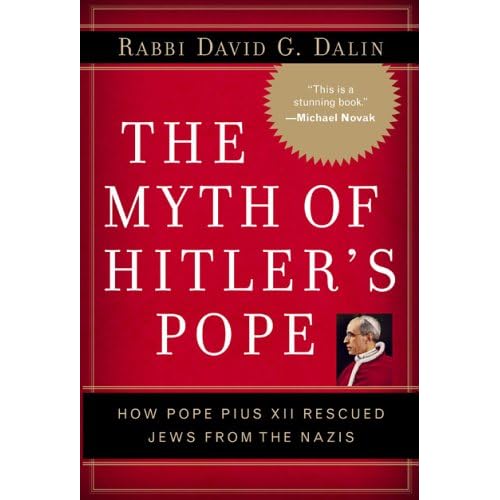
Enough said!
19
posted on
12/21/2009 10:34:01 AM PST
by
Pyro7480
("If you know how not to pray, take Joseph as your master, and you will not go astray." - St. Teresa)
To: Quix; Alex Murphy; the_conscience; HarleyD; wmfights; 1000 silverlings; blue-duncan
20
posted on
12/21/2009 10:34:31 AM PST
by
Pyro7480
("If you know how not to pray, take Joseph as your master, and you will not go astray." - St. Teresa)
Navigation: use the links below to view more comments.
first 1-20, 21-40, 41-60, 61-80 ... 401-420 next last
Disclaimer:
Opinions posted on Free Republic are those of the individual
posters and do not necessarily represent the opinion of Free Republic or its
management. All materials posted herein are protected by copyright law and the
exemption for fair use of copyrighted works.
FreeRepublic.com is powered by software copyright 2000-2008 John Robinson