
Posted on 08/10/2009 9:27:31 AM PDT by AreaMan
|
Friday 26 June 2009
Not a Chimp: The Hunt to Find the Genes That Make Us Human is a refreshing defence of human uniqueness. ‘We are a truly exceptional primate with minds that are genuinely discontinuous to other animals’, Jeremy Taylor writes.
The first half of Not a Chimp challenges ‘the basis of a 40-year-old concept of human genetic chimp proximity’. Taylor does admit that ‘over very appreciable lengths of their respective genomes, humans and chimpanzees are very similar indeed’. He writes: ‘This is where the oft-quoted “1.6 per cent that makes us human” comes from. Despite 12million years of evolutionary separation, six million for each species since the split from the common ancestor, we are surprisingly similar in our genes.’
Yet he argues that, despite the very small difference in the gene coding sequence between humans and chimps, some of the important genetic differences are in genes that regulate a whole host of other genes. So a small change can make an immense difference. The genetic difference between us and chimps may be much greater than the 1.6 per cent figure implies, as our uniqueness is based on a powerful network of gene regulation, he argues.
Not being an expert on genetics, I do not know whether he is right or wrong. But his case is persuasive and well argued. There has to be a genetic basis to our uniqueness, otherwise we would be able to raise chimps as humans and in the process make them human. But despite the dedication of a number of primatologists, the cognitive and linguistic abilities of the great apes have never surpassed those of a two-year-old child. This is because they clearly lack the precondition for becoming human: a human genetic make-up.
Taylor sets out to argue that it is ‘as wrong as it is misguided’ to ‘exaggerate the narrowness of the gap between chimpanzees and ourselves’: ‘It plays into the hands of our natural propensity to anthropomorphise our pets and other animals, and even our inanimate possessions, and it has allowed us to distort what the science is trying to tell us.’ His aim is ‘to set the record straight and restore chimpanzees to arm’s length’.
Taylor shows that many of the overblown claims made by scientists are pounced on by the media. In 2008, the UK’s Channel 5 aired a documentary on Tetsuro Matzuzawa’s chimpanzee research in Japan, which had already drawn newspaper headlines such as ‘Chimp beats college students at math’. One chimpanzee, Ayuma, was able to beat humans at a computer game where the numerals 1 to 9 were flashed up in random patterns on a screen before being replaced by an empty box. The participants then touched the screen to put the numerals in the order they had just been shown.
But does the fact that the chimps did well on this task merit the claims that they have ‘leapfrogged’ us in their mathematical abilities? Of course not. As Taylor points out: ‘This was a test of eidetic – or photographic – memory, not mathematical skills.’ He adds: ‘Tiny children have this skill before it becomes engulfed by language and a genuine symbolic understanding of numerals.’
This is something my husband discovered to his surprise when he was thrashed by a three- and a four-year-old child while playing the ‘Memory Game’, where one has to memorise the location of cards turned upside-down and try to retrieve matching pairs.
In the chapter titled ‘Povinelli’s Gauntlet’, Taylor outlines the fascinating work of the comparative cognitive psychologist Daniel Povinelli, who runs the Cognitive Evolution Group at the University of Louisiana. Povinelli is unequivocal in arguing that no test to date has reliably demonstrated that chimpanzees – or any other primate for that matter – have an understanding of the mental life of others or an understanding of causation in the physical world.
To investigate chimps’ so-called understanding of ‘folk psychology’, Povinelli tested whether chimps understood that their begging gestures will only be effective if the person they are begging from can see them. When one of two experimenters either wore a blindfold, held their hands over their eyes or wore a bucket over their head, the chimps showed no preference for whom they made their begging gestures to.
In terms of their ‘folk physics’, Povinelli showed that despite many chimps in captivity being observed using rakes to pull out-of-reach food towards them, they didn’t show an understanding of how the tools worked. Povinelli designed an experiment that showed that, when attempting to capture a cookie on a table, the chimps couldn’t distinguish between the efficacy of a rake held in the normal position and one in the inverted position: ‘They consistently failed to understand that to move the cookie they had to make contact between the [rake and the cookie] by using the inverted rake’, Taylor writes.
In order to demonstrate that far too much has been made of the tool-using abilities of chimpanzees in the wild, Taylor outlines recent discoveries showing that the tool-making of some birds equals, or in many cases betters, anything observed in chimpanzees. ‘In two species that parted company 280million years ago, performance is either very similar, or corvids might even have an edge. Bird brains, in specific contexts, are a match for chimp brains’, he writes. What this shows is that chimpanzees may not tell us that much more than corvids about the evolution of our unique genetic make-up, he argues.
‘Though you may argue that all the differences between us and chimpanzees, from variation among neurotransmitter regulators to spindle cell populations and a host of genes to do with the nervous system, metabolism, and immunity, are a matter of degree – quantitative rather than qualitative differences – I think that these quantitative differences are of such magnitude that their combined effect is to produce a cognitive creature that is unique and whose mind is in a league of its own’, he writes.
Although the bulk of Not a Chimp focuses on the case for our genetic uniqueness, Taylor does recognise that biology alone cannot explain our exceptional abilities. Like a number of groundbreaking developmental and comparative psychologists, he recognises the powerful role of social learning – such as true imitation – in human development. The difference between emulation (which other animals are clearly capable of) and true imitation ‘is crucial to an understanding of how we, as a species, have amassed such a variety and complexity of material culture’. He writes:
‘Understanding that a demonstrator intends his actions to make something, allied to detailed copying of every move he makes, allied to the reciprocal understanding in the demonstrator’s mind that he knows something you don’t and therefore has to teach you it, produces a potent ratchet effect.’
Unlike any other animal ‘we build on very modest foundations and blow them up to extraordinary dimensions of power and complexity’, which has ‘led from the invention of the wheel, less than six thousand years ago, to the wheeling out of the latest passenger jet’.
Taylor shows that both ape-language and ape-cognition research ‘were subjected to a cold douche of searching criticism during the 1990s’, but that ‘now the worm has turned again, with a number of research groups emerging with bolder and bolder claims for Machiavellian machinations of primate minds’. However, Taylor has thankfully added his voice to the few who are prepared to put the case – and convincingly so – for the idea of human uniqueness.
Helene Guldberg is managing editor of spiked. Her book, Reclaiming Childhood, is published by Routledge. (Buy this book from Amazon(UK).) Her next book, Just Another Ape? will be published in 2010 by Imprint Academic. Visit Helene’s website here.
Not a Chimp: The hunt to find the genes that make us human by Jeremy Taylor is published by OUP Oxford. (Buy this book from Amazon(UK).)
reprinted from: http://www.spiked-online.com/index.php/site/reviewofbooks_article/7087/
|
I think Humans are an aquatic offshoot of the ancestors of ourselves and chimps. This somehow led us to develop big brains.
Yes! Half chimp, half dolphin, half lizard...that’s what were made of.
>> Yes! Half chimp, half dolphin, half lizard...that’s what were made of. <<
Yes and boy are made of snips, snail, and puppy dog tails, and girls are made of sugar, spice and everything nice, and sometimes Chemical X.
Really more like Mostly Primate with some Aquatic Adaptations. Definitely not a Chimp or Bonobo. More like, primate with some doplin like adaptations, adipose tissues, shape of the snout, lack of hair, etc....
So when a male chimp goes into a bar to hit on some female chimps does he ask her what her sign is?
And what are the astrological signs for chimps anyway?
Aquatic Ape Theory?
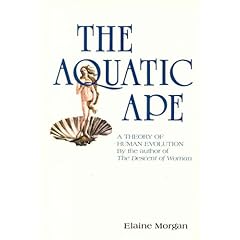
The Scars of Evolution:"The most remarkable aspect of Todaro's discovery emerged when he examined Homo Sapiens for the 'baboon marker'. It was not there... Todaro drew one firm conclusion. 'The ancestors of man did not develop in a geographical area where they would have been in contact with the baboon. I would argue that the data we are presenting imply a non-African origin of man millions of years ago.'"
What Our Bodies Tell Us
About Human Origins
by Elaine Morgan
|
|
|||||
Gods |
To all -- please ping me to other topics which are appropriate for the GGG list. |
||||
|
· Discover · Nat Geographic · Texas AM Anthro News · Yahoo Anthro & Archaeo · Google · · The Archaeology Channel · Excerpt, or Link only? · cgk's list of ping lists · |
|||||

Disclaimer: Opinions posted on Free Republic are those of the individual posters and do not necessarily represent the opinion of Free Republic or its management. All materials posted herein are protected by copyright law and the exemption for fair use of copyrighted works.
